
The Board of Supervisors debate the prohibitions Tuesday. Screenshot.
###
Private detention centers, onshore facilities that support offshore drilling and deep sea mining, and data centers could soon be barred in Humboldt County. The Board of Supervisors kickstarted an effort to prohibit these controversial establishments during a meeting Tuesday.
The move follows an upswell of public concern in recent months. In separate votes, the board directed county staff to start the process of drafting policy to prohibit these uses. All are proposed for now as permanent bans, except data centers, which would be limited by a year-long moratorium as their regulation is studied by county staffers.
Humboldt County has no pending applications for any projects in these categories. But planning staff said they’d heard a lot of concern from the public.
This included a line of public commenters who largely spoke in support of the move during the meeting.
“We want to keep these things out of here. The thing is, they don’t suit us. They don’t suit our place,” said Diana Preston, a Eureka resident.
The board considered placing moratoriums on these facilities while staff worked on drafting the policy. But planning staff said it would be more efficient to get straight to prohibition.
The specific policies will come back to the board at a future meeting, with Tuesday’s motions being a first step in the process.
Detention centers
Despite all proposals moving forward yesterday, the discussion wasn’t without some tension.
After a question from First District Supervisor Rex Bohn, Planning and Building Director John Ford emphasized the impetus for the proposal had come from planning staff, and no supervisor requested these items.
Ford said the department was seeking direction from the board before researching into the legality and practicality of any or all of the prohibitions, following a wave of public comments.
The staff report pointed out that the proposed Amazon facility in McKinleyville had been met with suspicion by members of the public worried the warehouse could turn into a data center or detention center.
While the federal government has spent a combined $1.074 billion on warehouses to be used to detain immigrants nationwide, according to reporting from the Associated Press, ICE has retreated from this plan in recent months. Plus, the proposed Amazon facility in McKinleyville is planned for a zoning district that doesn’t allow detention facilities, staff noted. Supervisor Bohn added that Humboldt County doesn’t seem to be much of an priority for ICE so far.
Bushnell grilled Ford on why the department had brought forward the data/detention center ban at all. Later, she argued current county processes already provide an opportunity for input and denials, like through public meetings and appeals of projects.
She asked what the action would do to the Amazon project in process.
“Nothing,” said Ford.
“Then why would we do this?” she asked.
“The concern is that a facility like that would be turned into something else,” he said.
“I Googled that to see if that has happened. And it hasn’t,” she said, asking if so, why would they consider this.
“I think the reason — staff’s rationale for bringing this forward — is because that’s very much in the minds of the public,” Ford said, adding it would be helpful for planning staff to avoid arguing about whether or not the facility could possibly be turned into a detention center.
Third District Supervisor Mike Wilson interjected, disagreeing that concerns were unfounded. “There is a concern that any warehouse facility, including a new warehouse facility, could be converted to either a data center or a detention facility.” He pointed to a nationwide expansion in data centers and the federal government amassing warehouses.
“Can I finish?” said Bushnell.
“I am supportive of things not being turned into detention centers, but I think through this staff report, you’ve already largely said that it’s prohibited out there already,” she said to Ford.
She asked why county staff hadn’t fully researched the legality of barring detention centers operated by the federal government, and again asked why the county would make the move.
“I’m asking you if you want to regulate them or not,” said Ford, in response.
Fifth District Supervisor Steve Madrone followed the exchange by thanking the planning department for bringing the topics up, and spoke in support of all prohibitions.
The ban on private detention facilities was otherwise fairly uncontroversial, with the Board voting unanimously in support of drafting a policy to do so. County facilities would be explicitly excluded.
Offshore oil and deep sea mining support facilities
The only split vote among the proposals was a ban on offshore oil and deep sea mining support facilities.
This comes as the Trump administration takes steps to open offshore drilling in California, possibly including the North Coast — and after the board passed a resolution opposing offshore oil and gas drilling in October 2025.
Municipalities across California have passed similar resolutions opposing offshore drilling. State lawmakers are pursing legislation attempting to stymie federal efforts.
The county can’t do much about federal waters, but one proposed change may prevent development of onshore support facilities in Humboldt County.
During the discussion, planning staff noted that Humboldt County voters already were in majority support of something like this decades ago.
Voters passed a measure in 1988 that would require any proposed onshore support facility for offshore oil drilling to come to a vote of the people. This was never put into county code. One possible explanation was that the measure was contradictory to the Coastal Act at the time, something that’s no longer the case following a 2023 law.
“I can’t imagine that the vote that was taken in 1988 has decreased in any way shape or form, in terms of support for a prohibition on this land use,” said Wilson.
Bushnell, who later abstained from the vote, cited concern the prohibition could affect other industries that share infrastructure with offshore wind, like Humboldt Bay’s proposed heavy lift marine terminal.
“We’re going to say no blanketly, not knowing really what the consequences are for other development,” she said.
“My concern is that we are again talking ourselves out of economic viabilities within Humboldt County, because we tend to say no more than we say yes. I’m not specifically talking about these five items, but in general, and it concerns me,” she said.
Bohn cited similar concerns about limiting businesses, and said he was voting against it because he felt like more went into the effort to ban the facilities than what was brought forward publicly during the meeting.
Data centers
The supervisors also unanimously directed staff to draft a moratorium on data centers, choosing to avoid a wider ban after noting the existing data center in Arcata. Public commenters cited the environmental impact, including high volume water and power use, of data centers. The one-year moratorium would be coupled with investigation into the subject matter.
Board approves boost to housing density
Earlier in the meeting, the board agreed in a 3-2 vote to adopt zoning changes that would allow for multi-unit housing in some areas currently planned for single-family homes.
The changes would allow small-scale multi-family housing in “Housing Opportunity Zones,” (HOZ), a designation located in parts of Redway, Garberville, Miranda, Weott, Scotia, McKinleyville and communities on the outskirts of Eureka.
These areas can now easily host buildings with more units than a single-family home. This includes duplexes, triplexes, quadplexes and apartments with five dwelling units, interspersed within areas with single-family homes.
Planning staff pointed out this was a common development pattern before the 1950s in places like Eureka.

Planning department staff described the changes. | Screenshot
The changes would increase density to 25 dwelling units per acre in residential areas within the HOZ, which are largely considered infill areas in towns. Apartments with six or more units would need a special permit. The change would also mean an increase in ground coverage up to 45%.
The proposal was met with a split vote, with Bushnell and Bohn dissenting. This followed Bushnell probing how neighbors who moved in with an expectation of privacy could appeal the construction of larger buildings.
The ordinance has some caveats for nearby residents in mind, such as a provision to prevent a direct window view into a neighboring unit, or buildings not exceeding heights over 15 feet taller than a neighboring residence if they’re within 20 feet of a single-family home.
The change was drafted with interest and support from the California Department of Housing & Community Development (HCD), the agency responsible for taking statewide housing policy to planning rules of cities and counties.
The ordinance aims to allow for higher-density housing, to address workforce housing needs and the county’s more general shortage of housing. The Humboldt County Planning Commission previously passed these changes with a 5-0 vote.
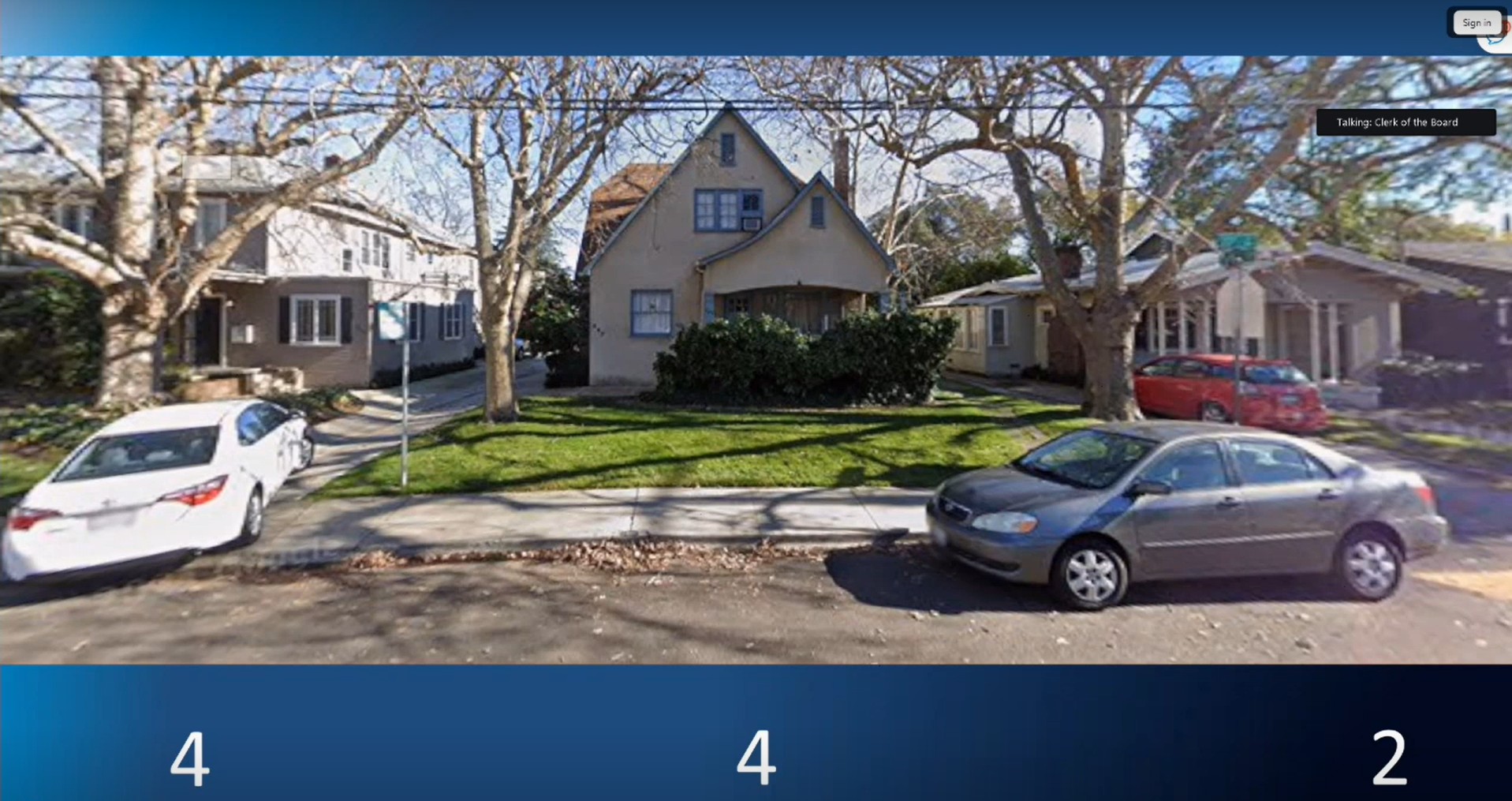
An example of the kind of density the change allows for, with unit quantity listed underneath. | Screenshot
Bohn largely spoke about parking requirements.
“The parking issue needs to be addressed,” he said, pointing to trouble parking in downtown Eureka.
The proposed code would require one parking space per unit for buildings with four or more units. These could be reduced if it’s within a half-mile of an active bus stop. The developer may choose to build more parking than required.
Other supervisors spoke in support of the change. Wilson said revenues of municipalities tasked with maintaining public infrastructure have been capped, thanks to zoning rules that prioritized single-family homes.
###
In other housing news, the supervisors agreed to move forward a zoning change on the south side of Eureka’s Ridgewood neighborhood’s Eggert Road. Green Diamond asked to rezone 100 acres, 60 of which would be switched to single-family residential for possible development. Wilson was the sole no vote, citing sprawl into forest and lack of facilities.