John Jefferson DeHaven was one of the original leaders of the Republican Party in Humboldt County, and probably the most important political figure ever produced locally.
DeHaven was born in St. Joseph’s, Missouri, on March 12, 1849. He was the son of Jacob and Elizabeth DeHaven, who were traveling to California from the midwest, and who reached the present Golden State later in 1849.
The DeHaven family settled in Eureka in 1853. John J. DeHaven went to work as a compositor for The Humboldt Times in 1862, when he was 13. He studied law with Judge J.E. Wyman, who owned the Times from 1864 until his death in 1880. In 1866, when he was 17, DeHaven was admitted to the bar.
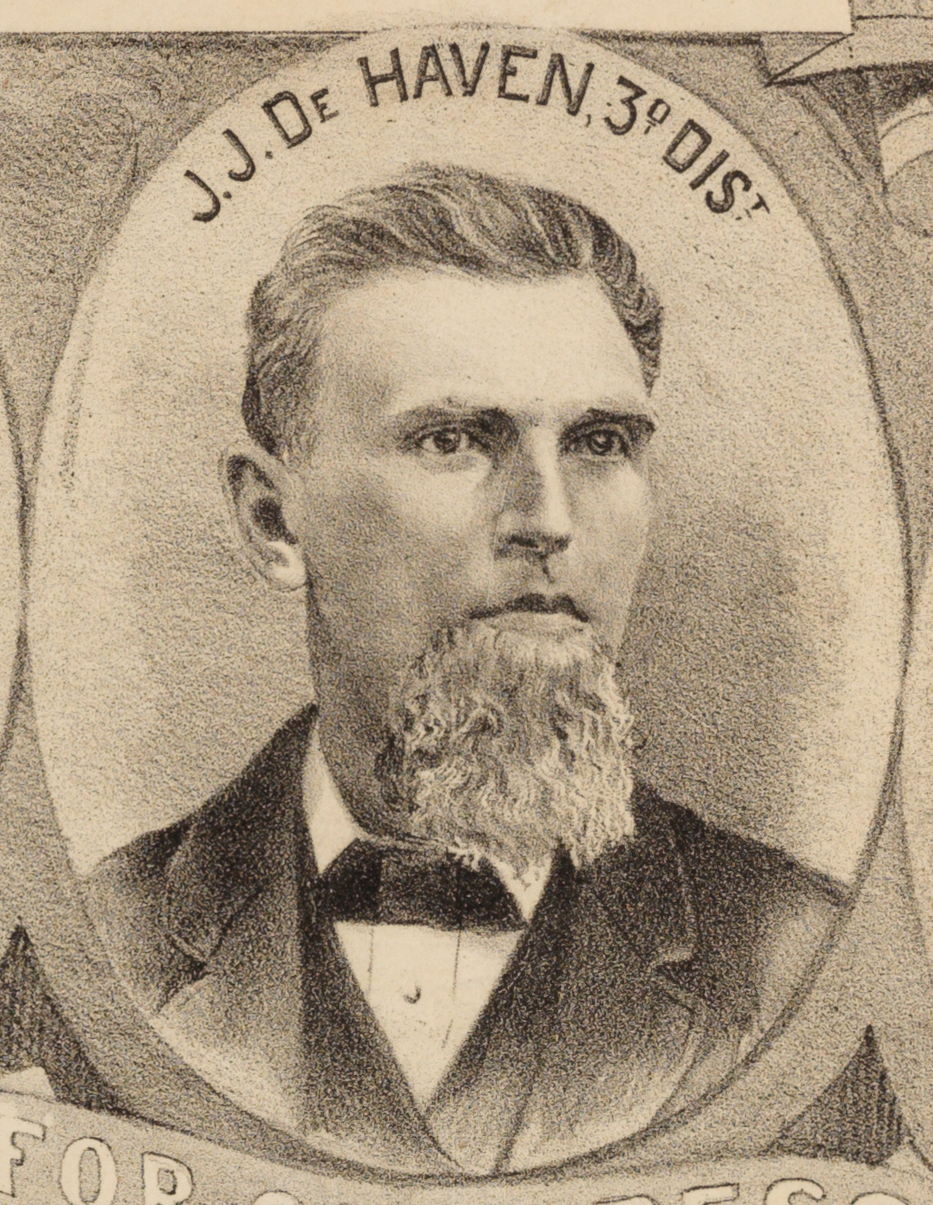
By Morse Photography. Britton & Rey Lithography - California State Library, Public Domain, Link
In 1867, DeHaven became District Attorney of Humboldt County. He resigned as District Attorney in 1869, after having been elected a Republican member of the State Assembly. When the Assembly was not in session, DeHaven had a law practice with J.D.H. Chamberlain.
From 1871 until 1874, DeHaven represented Humboldt, Del Norte, and Klamath counties in the State Senate, as a Republican.
On June 12, 1872, DeHaven’s sister, Sarah E. DeHaven, married John W. Connick, at the Eureka residence of Judge J.E. Wyman. The Connicks had four children — Harris DeHaven Connick, Edward (Ned) Connick, Walter Connick, and Pauline Connick. Mrs. Connick died June 8, 1899.
DeHaven lost an election in 1878 for the post of delegate to the State Constitutional Convention. The same year he did become Eureka City Attorney, serving until 1880.
In 1882, DeHaven was the Republican nominee for Congress, but lost to Democrat Barclay Henley of Santa Rosa. Henley received 21,807 votes to DeHaven’s 19,473 votes.
In 1884, DeHaven was elected Superior Court Judge for Humboldt County, DeHaven ran for Congress again in 1888, and won, defeating the incumbent Democrat, Thomas L. Thompson of Santa Rosa, by 19,345 votes to 19,019 votes.
The new Humboldt County Superior Court Judge was George W. Hunter, who had lived with DeHaven, studied law with DeHaven, and who was considered DeHaven’s protege. Hunter later held non-political statewide office, serving as Grand Master of Masons in California, in 1904.
Two other local attorneys who studied law with DeHaven were Kenneth Clyde and J.M. Melendy.
DeHaven began his service in the House of Representatives on March 4, 1889. He served on the important Ways and Means Committee with Congressman William McKinley of Ohio.
DeHaven found he was ignored in Congress by the autocratic Speaker of the House, “Czar” Thomas Reed of Maine. In disgust, DeHaven ran for a vacant short term on the California Supreme Court, and resigned from Congress effective October 1, 1890. He was elected to the Supreme Court on November 4, 1890, and served four years.
In 1897, DeHaven’s former fellow Congressman, William McKinley, was President and he appointed DeHaven a United States District Court Judge for Northern California. He served as a Federal judge from June 8, 1897, until his death. While serving as a State and Federal judge, DeHaven lived in San Francisco. When he died he was living at 2200 Eddy Street.
John J. DeHaven had married Z.J. Ball of Ohio in 1892, and they were the parents of two children — Jotham J. DeHaven, and Sarah DeHaven.
DeHaven died at his country home in Yountville, Napa County, on Sunday, January 26, 1913. He was 63 years old. His funeral was held in San Francisco on January 29, and he was buried at Mount Olivet Cemetery in Colma.
Under the leadership of John J. DeHaven, Humboldt County became a solid Republican County. During the years from the 1880s until the 1910s no Democrat could carry Humboldt County. Democrats occasionally represented the county but only because they received enough votes outside Humboldt County to overcome the local Republican margin. During these years Humboldt County was the most Republican county in California.
The Humboldt Times, in the 1870s had nicknamed the Republicans as the “DeHavens” in recognition of the political leadership of John J. DeHaven.
###
The piece above was printed in the September-October 1980 issue of the Humboldt Historian, a journal of the Humboldt County Historical Society. It is reprinted here with permission. The Humboldt County Historical Society is a nonprofit organization devoted to archiving, preserving and sharing Humboldt County’s rich history. You can become a member and receive a year’s worth of new issues of The Humboldt Historian at this link.
CLICK TO MANAGE