Emma Belle Freeman, the mother of stylized Native American photography, was born on a small farm on the flat plains of Nebraska. There is not much known about her young life, except that she took to drawing with crayons at a very young age, worked diligently on the farm with her parents, and was often spanked for drawing silly pictures of her teacher on the school blackboard. Her parents were William K. Richart and Belle Zoover Richart, originally from Ohio and of German stock.

Emma Freeman self-portrait. Public domain.

When Emma grew to womanhood, she decided to travel to San Francisco to become an artist, but her savings only got her as far as Denver, Colo. Here she worked behind a ribbon counter of a department store and met the man who became her husband of 13 years, Edwin Ruthven Freeman. Edwin was a salesman and, together, they made a handsome couple.
Eventually, the two made their way to San Francisco where the first Freeman Art Company was opened. After the earthquake destroyed their business, the couple borrowed money to move to Humboldt County and open a new Freeman Art Company. Here Emma began her now-famous work with the local Native Americans. She also found notoriety when the submarine H3 went aground on the Samoa Beach, and the heavy cruiser USS Milwaukee went trying to save the sub. Emma photographed these events in full detail and called herself the “Official Government Photographer.”
During this period, Emma surprised the local population by traveling to San Francisco with a visiting ex-governor of Illinois. The matter led to divorce proceedings with Emma being sued for adultery by Edwin. Following her divorce, she continued her work and sought friends among her Native American subjects. Her best friend, Bertha Stevens, met Emma’s photographer Fred Chamley, fell in love with the handsome half-Cherokee Indian, and married him soon after. When Emma decided to return to San Francisco, Fred stayed on in the Eureka store under new ownership. The second Freeman Art, located in the Bay Area, was quite impressive. The entire second floor, called the Humboldt County Room, featured Indian baskets, artifacts and paintings of the North Coast.
All went well for a time thanks in part to prestigious customers such as the I. Magnin Company. But by 1923, only four years after her move to San Francisco, Emma went bankrupt. The competition was steep and, in addition, Freeman Art Company in San Francisco was linked to a scam involving the theft of artifacts from Islamic temples in Constantinople (Istanbul). The stolen objects were earmarked for the Freeman Art Company.
Emma lived on in San Francisco though she was somewhat lost without her shop. She remarried in 1925 at age 45, and lived quietly for two more years. In 1927 she suffered a severe stroke and died.
Peter Palmquist, Society board member and photo-historian, said of Emma, “Her artistic output, like the Northern California Indians, was largely ignored until recent years. Now both remain basis for legend.”
Her art
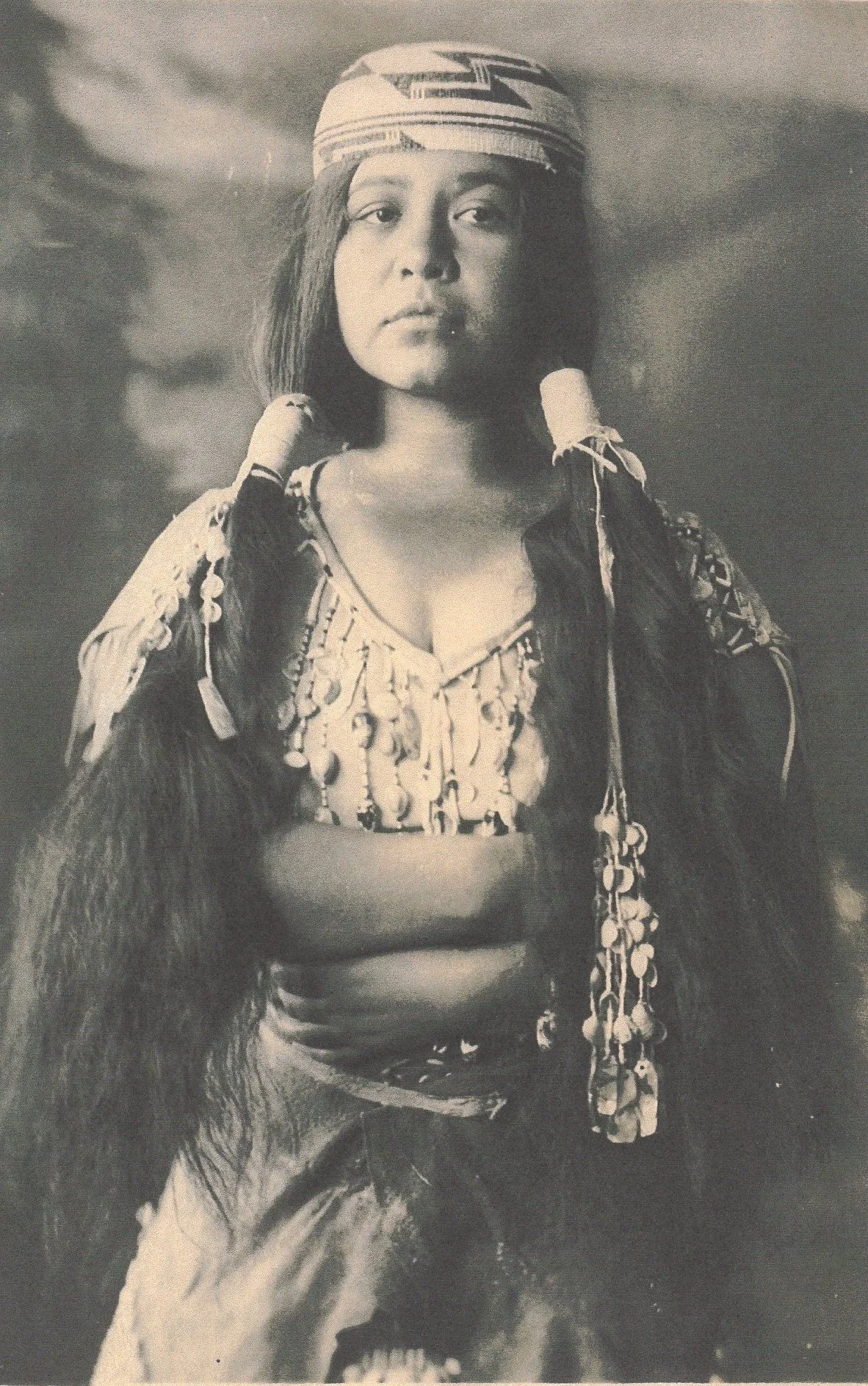
A Freeman portrait of Bertha Thompson. Photo via the Humboldt County Historical Society.
If not for her early “Bohemianism” or for the sometimes interesting way in which she dressed around town, Emma B. Freeman would probably be remembered for her original and, up until then, unique artistic style. It should be stated that she started using crayons as a little girl, spending what little free time she had on the farm out in the countryside, drawing colorful birds and flowers that the caught her eye.
This was, of course, the beginning of her career. She went on to make handcrafted souvenir curios after her marriage while she and Edwin lived in San Francisco. A short list of the kinds of curios include: leather novelties, burnt wood gee-gaws, painted Easter and Christmas items, hand-colored photographs, and sketches in both pastels and watercolors.
But it was not until after she and her husband opened their tiny shop on the corner of Union and Octavia streets that she finally began to fulfill her childhood wish to become a serious artist. Acting on the advice of other artists and students, she enrolled in a San Francisco art school where she attended classes religiously and honed her skills at drawing and painting.
It was not until Emma and Edwin moved to Eureka and officially opened the Freeman Art Studio and Supply Shop that she began to incorporate photography into her work. Emma was an apparently self-taught photographer, making full use of a previously-owned camera and equipment. She began to experiment at once, exploring the possibilities of artistic portraiture. She also painted her own backgrounds, often custom-made for each picture. Her romantic, artistically conceived portraits became very popular with the locals, attracting those interested in obtaining fashionable images of themselves. She was renowned for her tableaux settings of women; the three-quarter length pose was the one she used most and featured backgrounds and props to approximate a homelike environment.
Emma even did some early nude photography, but examples have not been preserved. She must have been accepted in the community because a man who attempted to do nudes in this area at that same time was sentenced to a prison term. She was also one of the first to photograph Humboldt County landscapes. However, few original examples of Emma’s romantic landscapes can be found.
It was not the knick-knacks, photographic portraits, experimental nude photographs or landscapes that made Emma B. Freeman a great artist. She earned her place in the legitimate art world for her portrayals of the local Native American population in and around Northern California. She created fantastic photographs of chiefs, braves and young men, elderly women and younger women, even some children in the surrounding forests or streams. Sometimes she brought them into her studio and took pictures there.

Miss Redwood Empire 1927, Little Fawn of Klamath River. Little Fawn was a stereotypical “Indian Princess” of the 1920s, complete with flapper-inspired costume and hair. Photo and description via the Humboldt County Historical Society.
One criticism could be made of Emma: She did not pay much attention to the closer details of her subjects. Sometimes she used a blanket from the faraway Navajo tribe in the background of a local Yurok woman. One time she angered Native Americans when she took a picture of a woman holding a bow and arrow. Sooner or later, Emma did start paying more attention to authenticity. Her later photos are now not only viewed as beautiful pictures, but also as serious, realistic documents of Northern California’s Native American population.
Emma once commented on her taking photographs of the local Native Americans in an issue of Pacific Outdoors:
The average Indian is extremely opposed to facing the camera. This is because of a tribal tradition which forbids handling the dead or preserving anything ever owned or worn by the departed: only their memory is left and that an unspoken thought. …As a basis of legend and literature for future generations I have endeavored to preserve in picture what scholars and literature have preserved in story, viz., the very best in the life history of the American Indian.
It was extremely difficult for Emma to find willing Native American models. She often used models of mixed ancestry and other people who were not very well placed in the community, although there were exceptions.
One final, interesting aspect of the art work of Emma B. Freeman was that she often added pencil work and pastels to her finished photographs. There were other photo-colorists, but with Emma it was different. Somehow her additions added to her artistic vision and were not simply an attempt at realism. It should also be noted that one of her most famous works, a photograph of the Humboldt County redwoods, is still on display in the White House.
Emma B. Freeman, with every picture she took, offered us a new and romantic view of the ancient woodlands. She also gave us an idyllic, Utopian view of the Native American that the local whites surely had never seen before.

The Freeman Art Company, at Fifth and H Streets in Eureka. Photo: Emma B. Freeman - Beinecke Rare Book and Manuscript Library, Public Domain, Link
A personal perspective
My great-grandfather came to know Emma B. Freeman when he bought the Freeman Art Company from her before she moved back to San Francisco. His name was Niel Nielsen, an officer of the Danish Royal Guard, who immigrated to San Francisco one year after she left the city for the first time in 1906. Niel came to manage his uncle’s Nickelodeon in Chinatown. He sent for his bride-to-be Helena Anne Sorensen the next year. My grandmother, Anna Nielsen Carlson, and her brother, Frances Nielsen, were born in the city. They often played hopscotch and jump rope with the Chinese children in front of the theatre. One of my mother’s favorite possessions is a small, fire-opal ring that her mother found in the Nickelodeon.
In 1918 when my grandmother was nine years old, the Nielsen family moved to Eureka. My great-grandfather bought the Colonial, one of the earliest movie theatres on the coast. Later, he sold the Colonial in favor of the more “stable” lifestyle as owner of the Freeman Art Company. Niel inherited the services of Emma’s studio photographer Fred Chamley, a gentleman who stayed with the business until Niel’s death in 1953. Fred and his wife Bertha became a part of the Nielsen circle of friends, and could be found picnicking together on Sundays at Dyerville Bridge or Trinidad.
Niel also inherited Emma’s “colorization” techniques, and continued to use oils on portraits photographed by Fred. Niel liked the artwork and the business end as well. He added a china section and moved the Freeman Art to Fifth Street, next to the old Rialto Theatre. He began to add oils to black and white photos of the redwoods, mostly taken on those Sunday picnics at Dyerville. The tinted and enlarged redwood scenes, often framed in gold, are now in many homes in Humboldt County, and in many lumber company offices both in Eureka and as faraway as Tokyo.
It is interesting to me, as a senior at Fortuna High, to know that the Freeman Art Company took all senior pictures at my school for many years, stopping only after my great-grandfather’s death. As a small child my mother helped glue folders and wrap packages of senior pictures for Fortuna High students long before I was ever thought of. She also remembers accompanying her grandfather to San Francisco on buying trips where they had tea with Chinese merchants.
The Freeman Art went on for a few years with my grandfather Allan Carlson doing mostly photo-engraving and wedding pictures. However, color photography was now popular and the large Fairchild machines did the engraving faster and cheaper. In 1963, the Freeman Art Company closed it doors. What remains of Emma B. Freeman for my family, including myself, are many of her original pictures and four of her tinted portraits of Native Americans … and lots of good stories.
###
The piece above — written by then-Fortuna High Student, now celebrated local artist Gus Clark — was printed in the September-October 1991 issue of the Humboldt Historian, a journal of the Humboldt County Historical Society. It is reprinted here with permission. The Humboldt County Historical Society is a nonprofit organization devoted to archiving, preserving and sharing Humboldt County’s rich history. You can become a member and receive a year’s worth of new issues of The Humboldt Historian at this link.
CLICK TO MANAGE