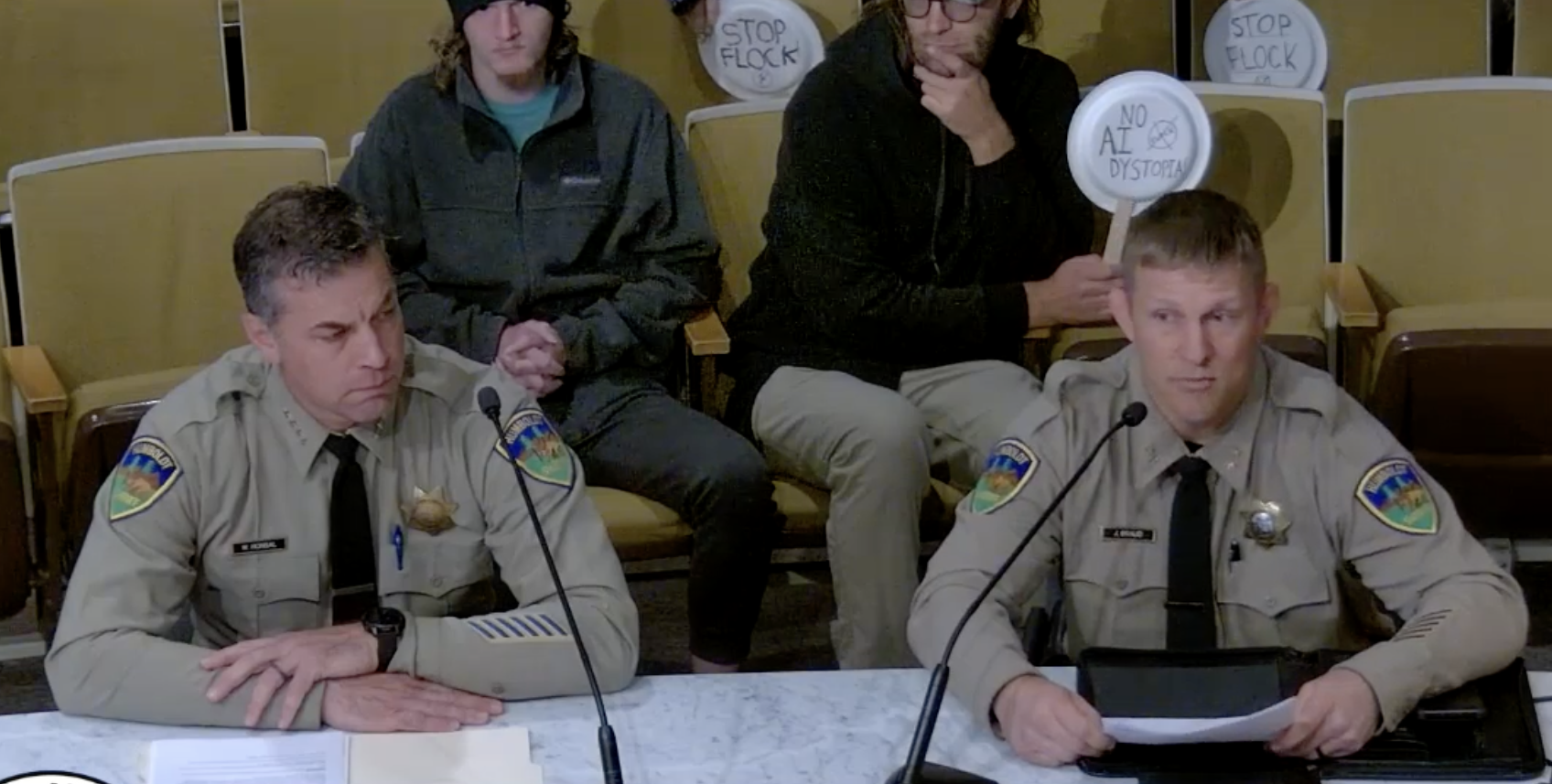
Humboldt Sheriff William Honsal and Undersheriff Justin Braud speaking at Tuesday’s Humboldt County Board of Supervisors meeting.| Screenshot.
###
PREVIOUSLY:
- The Humboldt County Sheriff’s Office Appears to be Violating Its Own Policy and State Law on Automated License Plate Readers
- Humboldt Sheriff’s Office Responds to Outpost Investigation Into Its Automated License Plater Reader Program
- ’A Climate of Fear and Mistrust’: Petition Urges Humboldt Sheriff, Board of Supervisors to Cancel Flock Safety Contract Amid Privacy Concerns
###
In response to mounting concern over the Humboldt County Sheriff’s Office’s use of Flock Safety’s automated license plate-reading (ALPR) cameras, the Humboldt County Board of Supervisors is directing the department to take extra steps to improve transparency and prevent potential misuse of the surveillance technology.
The board’s four-hour discussion, which touched on a wide range of issues surrounding modern surveillance tactics and data sharing, largely focused on the HCSO’s contract with Flock Safety, an Atlanta-based company that provides ALPR technology to more than 5,000 law enforcement agencies and 1,000 private businesses nationwide. Flock has come under fire in recent years, especially here in California, for allowing out-of-state and federal agencies to access information captured by its ALPR cameras, which violates Senate Bill 34.
Ultimately, the board voted 4-1, with First District Supervisor Rex Bohn dissenting, to form an ad hoc committee to look into alternatives to Flock Safety that would allow the HCSO to have greater control over its data, which is encrypted and stored in a cloud hosted by Amazon Web Services.
The board passed a second motion to direct Public Works staff to come up with a policy that will prevent the private use of ALPR cameras and other similar technology on county rights of way. The motion came in response to news that a Westhaven resident had installed a Flock camera at Westhaven Drive and Scenic Drive, just south of Trinidad. (We’ll explain what happened in further detail, below.)

An automated license plate-reading camera. | Image courtesy of Flock Safety.
‘This is not about being anti-law enforcement’
Before we dig into the board’s discussion, a little bit of background on how these license-plate reading cameras work. ALPR technology employs high-resolution cameras to record and analyze the license plates of passing vehicles along with the make, model and color of each car and other identifying features, including scratches and dents. ALPR does not use facial recognition technology, though it does use AI to transform the image into alphanumeric characters using optical character recognition.
The footage and metadata, which is “encrypted throughout its entire lifecycle,” according to Flock, is deleted after 30 days.
Humboldt Sheriff William Honsal implemented the HCSO’s ALPR program in April 2024. The department currently operates seven permanently mounted cameras and two mobile ALPR devices across the county, which cost about $21,000 per year to operate. The cameras were purchased with grant funding from the Department of Homeland Security.
At the start of Tuesday’s discussion, Fifth District Supervisor Steve Madrone explained that he brought the agenda item because “many Humboldt residents are deeply concerned about the continued use of Flock Safety cameras in our county.”

Madrone | Screenshot
“We all want our sheriff’s office to have the tools needed to solve crime, [but] public trust requires real oversight, not just promises,” he said. “… This is not about being anti-law enforcement; it is about making sure powerful surveillance technology is used lawfully, transparently, and with meaningful accountability to the public that pays for it. … The central question remains: When the data and audit trail are controlled by a private contractor, how can we honestly tell the people of Humboldt that their privacy is protected?”
Madrone raised concerns about the HCSO’s compliance with SB 34, which, among other things, requires operators to state their purpose every time they access the information. The search logs can be viewed in the HCSO’s transparency portal, linked here.
“Humboldt deputies continue to log nearly every search with vague one-word reasons, like … ‘investigation’ or ‘drug trafficking,’ while California Highway Patrol officers properly document a specific case or a call number for each query, which is required by [SB] 34,” he continued. “More troubling [is that] all of this data lives on Flock’s private servers, and the sheriff has no independent access to the full audit logs. That means when federal agencies access Humboldt’s data, or when searches are conducted without proper justification, our office has no way of knowing.”
Speaking at Tuesday’s meeting, Honsal said he takes the issue of privacy “very, very seriously,” but emphasized that ALPR technology has helped local law enforcement solve “numerous” crimes, including missing persons cases and homicides, that may have otherwise gone unsolved.
“We have a hard time maintaining our deputies on the street and making sure that there’s a patrol element on the street, and we owe our community the best investigative efforts we possibly can, and if that’s incorporating technology, we are going to do it,” he said. “I think we have to look at the hypotheticals here, but we also have to look at the facts and know what actually is occurring by utilizing this use of technology.”
Honsal acknowledged that there have been issues with data sharing in the past, as detailed in an Outpost investigation last year, but said his department has “tightened things up” and imposed additional limits on which departments can access the county’s data.
Undersheriff Justin Braud, who oversees the ALPR program, added that the HCSO has created memorandums of understanding (MOUs) for data sharing with 22 agencies, including the California Highway Patrol, local law enforcement agencies and several other county sheriff’s departments across Northern California.
“Flock has implemented safeguards that ensure all data is controlled by the originating agency,” Braud said. “There are now options to lock out sharing with federal or out-of-state agencies; we are currently utilizing these restrictive options. Additionally, each request to share information with an outside agency is reviewed by the assigned administrator. … A monthly internal audit is conducted to ensure compliance within the HCSO and any agencies we share with … and even that sharing is very minimal, often only allowing them to check for a major crime involvement, a stolen vehicle, an endangered person or a missing person vehicle.”
“If it’s something that is tied to a crime, we have to download that data into our evidence, which is then secured by us and under our control, and Flock still deletes the data,” Braud continued, adding that the ALPR cameras “only record the plate and vehicle description,” and do not log “occupant characteristics” or “data associated with the plate,” such as DMV records.
Like Honsal, Braud said he could understand the community’s privacy concerns, but emphasized that the cameras are placed in public areas “where there is no reasonable expectation of privacy.”
“I would hate to think that somebody I cared about or a loved one might have been saved with technological advances like this, which improve our ability to respond [and] investigate things,” he said. “If we got rid of it just because of concern that it could be misused, I think we’ve taken more steps than any agency I’m aware of in the state of California to restrict the use.”
Honsal chimed in to note that the HCSO is not the only local law enforcement agency using Flock cameras, referring to the CHP and Blue Lake Rancheria’s tribal police department. He also touted his department’s success in using Flock cameras to track down the suspect who stole the Pride flag from the flagpole in front of the county courthouse in 2024.
“Those are the kind of uses of [this] technology that we utilize here. … I mean, what if we had this technology when Karen Mitchell went missing?” he asked, referring to the Eureka teenager who vanished in 1997. “We have a vehicle description of someone that may have kidnapped Karen Mitchell, but that case has gone unsolved for 35 [to] 40 years. … If we had this technology back then, then we would have something to follow up on, and that is very important.”
Before delving into public comment, Fourth District Supervisor Natalie Arroyo asked about jurisdiction and whether the Board of Supervisors even has the authority to tell the HCSO how it spends its funding.
“The board does have budgetary control over my overall budget, but the board does not have the ability to tell me how to investigate crime and can’t interfere with my investigative element here in the county,” Honsal said. “If I need an investigative tool here that I feel is important and valid, I can install that investigative tool, like I did the ALPR cameras.”
Bohn asked Honsal if the HCSO had had any issues with deputies using Flock cameras “to track their girlfriends and boyfriends,” referring to a Milwaukee police officer who was criminally charged last year for using the technology to surveil the person he was dating, as well as their ex.
“No,” Honsal said. “We’ve had no documented use violations of our policy for ALPR, and no one’s been disciplined for that.”
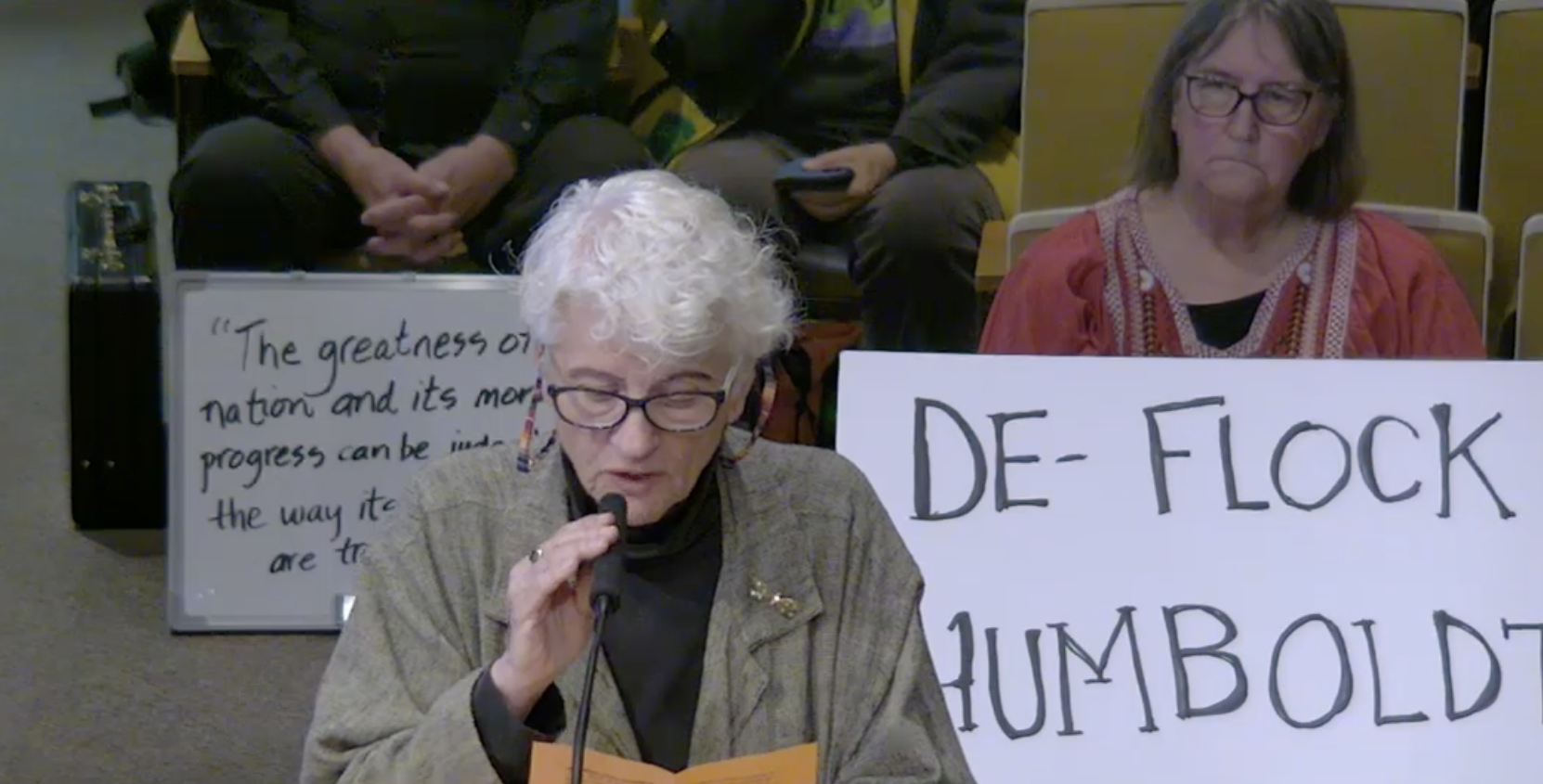
McKinleyville resident Hilary Mosher speaks during public comment. | Screenshot.
‘De-Flock Humboldt’
All but two of the three dozen-odd people who spoke during public comment raised concerns about the potential for misuse of ALPR cameras and urged the board to end HCSO’s contract with Flock immediately. Some speakers held handmade signs that said “De-Flock Humboldt” and “No AI Dystopia.”
McKinleyville resident Hilary Mosher acknowledged that the ALPR cameras may have “seemed like a good idea at the time,” but asserted that Flock had changed their initial agreement with the HCSO and could no longer be trusted.
“Flock also recently announced that they have launched a Flock Business Network, a collaborative hub designed to help private sector organizations work together to solve and prevent crimes,” Mosher said. “This means private companies [are] creating watch lists, blacklists and databases about everyday people like you and me. I remember being on a watch list as a Vietnam War protester in my college days, and I ended up having to go to college in Europe rather than subjecting my neighbors, teachers, friends, employers and family to the Inquisition of the FBI — and that was before Flock cameras.”
Mosher emphasized that “the attack on Flock cameras is not an attack on law enforcement.”
Others raised concerns about misuse of data and the hackability of Flock’s system, which has been discussed in a white paper written by a cybersecurity researcher and demonstrated by YouTuber Benn Jordan. Flock stated in response that “none of the vulnerabilities detailed in the report have an impact on our customers’ ability to carry out their public safety objectives.”
One speaker, who claimed to be an AI consultant and a “high political target,” asserted that he could use a large language model to “cause President Trump to catch a stray bullet from the Secret Service.” Third District Supervisor and Board Chair Mike Wilson interjected immediately, discouraging any references to violence.
Eureka resident Pat Hansler and several other speakers raised concern about Flock data being shared with federal immigration authorities, including Immigration and Customs Enforcement (ICE).
“I’m very upset about this because of the political atmosphere right now,” she said. “[Law enforcement] … can use these Flock cameras [to] start looking at just regular citizens, not just for migrants or criminals — and they shouldn’t be looking for migrants, but we know they do anyway. … I also want to remind you [that] you work for me, all right? We voted for you. … We’re talking about surveillance here, and I expect you to do your duty.”
Charles Blassingame, who indicated he works in law enforcement, was one of two speakers who spoke in favor of Flock cameras. He dismissed concerns about ALPR technology, noting that, if people are actually concerned about their personal data, they should throw away their cellphones.
“I have to agree with what the sheriff and the undersheriff both said; Flocks are very useful tools in solving crimes,” he said. “I work mainly … down in the Bay Area [and] LA, and that’s how I get to fulfill my job is using Flock, finding people and then arresting them. I mean, this is crucial.”
‘[This] mass surveillance tool clearly reduces public trust.’
Following public comment, Honsal addressed some of the speakers’ concerns about “vague” searches in HCSO’s transparency portal and potential violations to SB 34. Honsal said his deputies do attach case numbers to their searches, but, for one reason or another, the numbers aren’t visible to the public. The numbers are visible on the HCSO’s audit logs, he said, which are accessible via a Public Records Act request. Honsal said he would work with Flock to update the page.
On the issue of Flock’s data storage being hosted on Amazon servers, Honsal said he would be willing to look at other options, including on-site storage through a local server.
Honsal also disputed claims made during public comment that there is no evidence that Flock cameras have helped reduce violent crime. “Oakland had 300 cameras put up, — yeah, that’s a lot of cameras — but it … lowered their violent crime by 40%,” he said. “That’s a real number, and people in Oakland are benefiting from those Flock cameras.”
The Outpost wasn’t able to verify that figure, though we did find a report from KTVU FOX that said “crime clearance rates in Oakland have increased 11% since the cameras were installed in 2024, and that roughly one-third of homicides are solved using Flock data.”
Asked if he had anything more to add, Braud reiterated that the Flock cameras are “just tools to help us do our job,” like body-worn cameras, which he described as a “violation of my privacy.”
“I think it’s funny that people want [body-worn cameras], but don’t want this,” he said.
During the board’s deliberation, Madrone noted the disparity in the number of people who spoke for and against the use of Flock cameras and encouraged his peers to take that into consideration.
“I hope that maybe weighs heavily on you that so much public opinion clearly is in opposition to the use of this mass surveillance tool,” he said. “I’ve heard you say, Sheriff Honsal, that one of your best tools of all is public trust and the public’s willingness to call you, call your department and report crimes and provide you with information when you’re trying to solve crimes. … I think you have made great inroads towards improving trust on many levels. … [This] mass surveillance tool clearly reduces public trust.”
In a tense exchange about the issue of jurisdiction, Madrone asked Honsal if he truly believed that the Board of Supervisors does not have the authority to regulate Flock cameras on county property.

Honsal | Screenshot
“I believe that I have the investigative autonomy to put up tools throughout the county … through the normal process,” Honsal said. “If it’s on the county road, then I would have to go through the county permit process. [If] it’s on a state highway, that would go through the Caltrans permit process.
“So, you do not believe that we have the authority to set a policy up that does not allow Flock cameras on county property,” Madrone asked.
“You’re gonna have to go through your county counsel to figure out what your authority is. I’m not going to tell you what your authority is, sir,” Honsal said. “What I’m telling you right now is I had the authority to put up the cameras lawfully, and you know what you want to do here today is going to be up to you and your four [peers].”
Wilson attempted to interject, but Madrone maintained that he was asking “very important questions about jurisdiction” and pressed on. He asked Honsal if the board were to develop a policy to disallow the use of Flock cameras on county property, if he would sue.
“I don’t know what your ordinance would look like, so what you would need to do is … create something, and then I would have my attorneys look at that and see if [it would be] justified under the law,” Honsal said. “That’s the separation of powers, and so we can look at that, and we can figure out what the law states.”
After another interjection by Wilson asking the two to avoid personal jabs, Madrone said he respected Honsal’s authority, but encouraged him to work with the board to “honor the public’s concerns to maintain the highest level of public trust that we possibly can around solving crimes.”
Arroyo said she could see both sides of the argument, noting that “multiple things can be true at the same time.”
Arroyo | Screenshot
“This can be an important tool for solving crimes, and it can also be a really serious concern about privacy that people have,” she said. “I think both of those things can exist simultaneously. … I think this technology and the tools available are expanding really quickly, and I do think it is time for us to consider having some form of ordinance that lays out how we will handle requests for … installation of surveillance apparatus on county property or how these things will be handled in our county.”
Arroyo said she had found an ordinance from Santa Clara County that sets use and transparency standards for surveillance technology, which could be used as a template for a local ordinance if the board decided to go in that direction.
Arroyo also asked Honsal about the Westhaven resident who installed a Flock camera at the intersection of Westhaven Drive and Scenic Drive. He emphasized that the HCSO “never assisted any private citizen [in] putting a Flock camera on county property,” and said it was actually Flock that told him about the device.
“They had put it on county property without permission,” he said. “I think that there’s something underway to get that removed as it is. That person offered to share their information with us, but we declined access to their camera. We didn’t think it was in line with what we were using the cameras for and where we put them.”
A little later in the discussion, Public Works Director Tom Mattson asked the board for direction on how to handle the Westhaven situation and future requests.
“I’m hoping that the county can come to some kind of agreement … on the placement of these items, which are technically illegal,” he said, adding that he had informed the owner that he would not make a decision on the request for an encroachment permit until the board adopted a surveillance device policy.

The Flock camera as seen from Scenic Drive via Google Street View.
During her comments, Bushnell said the three dozen-plus people who spoke during public comment represent “a pretty small percentage” of the entire county. Still, she said she could understand privacy concerns and being recorded.

Bushnell | Screenshot
“That’s not a very comfortable feeling for anybody, she said. “I do want to recognize also that this same group of population requires and wants [law enforcement officers to wear] body-worn cameras, which … turn on a lot sometimes, not even when you’re doing a stop or a call. … If we remove Flock cameras, CHP has Flock cameras in Humboldt County. They’re not going to listen to us say [to take] them down.”
Bushnell said she agreed with Arroyo that a policy could “make folks feel better” and floated the idea of an ad hoc committee to draft such a policy. Honsal said he would be willing to participate.
Bohn was largely dismissive of the public’s privacy concerns, noting that he’s “jaded as hell.”
“They don’t bother me,” he said, referring to the Flock cameras. “I have full trust [in the sheriff’s office]. … There’s 240 people over there. Do I trust every one of them? ‘Til they break my trust, yeah. And somebody’s going to break our trust over there, I guarantee you. We see it all the time in all the departments, but I don’t know if a camera is going to change that — fix it or not fix it — but this is an important tool.”
During his comments, Wilson emphasized the “fundamental difference” between body-worn cameras and ALPR technology. “The movement to have more body cameras was for both the protection of the officer [as well as] the people that they interact with,” he said. “That is different than what we see with a Flock camera, because it’s kind of a one-way thing.”

Wilson | Screenshot
Wilson also expressed concern about how the data is managed, joining calls for on-site storage and additional oversight. “If we’re going to move forward with having any of this technology being used in Humboldt County, we do need oversight,” he said.
As the conversation approached the three-and-a-half-hour mark, Bushnell made a motion to direct Public Works staff to create a policy for the use of ALPR cameras on county property. She made a second motion to create an ad hoc committee to review Flock’s policies and look at potential alternatives to Flock’s ALPR system, as well as on-site data storage options. Bushnell and Madrone would serve on the ad hoc committee along with an HCSO representative and a Public Works staffer.
Madrone said he would second both motions if Bushnell was open to a friendly amendment to the first that would include all surveillance technology on county property, not just ALPRs. She agreed.
After some additional discussion, the board voted 4-1, with Bohn dissenting, on both motions. But as the board prepared to move on to the next item, Madrone proposed a third motion.
“I would like to make a motion that we direct staff to develop an ordinance that does not allow placement of any ALPRs on any county property, rights of way or facilities,” Madrone said.
“Wait, didn’t we — didn’t we just do this?” a flabbergasted Wilson asked.
Madrone said he wanted to take the action another step further “to eliminate these from our toolbox.” The board briefly discussed the motion with county counsel, but it died lacking a second.
Madrone made yet another motion to pull “any funding” the sheriff’s office would use to deploy and maintain Flock cameras on county property in the upcoming fiscal year, which begins on July 1. Again, the board discussed the motion, which garnered a second from Wilson. However, it did not pass in a 3-2 vote.
Madrone made a final motion to pull $21,000 from the sheriff’s budget. Wilson described the series of motions as being “very unusual.” Again, the motion died without a second.
CLICK TO MANAGE