
Duane and Micki Flatmo aboard one of the local artist’s flame-belching creations at the annual Burning Man festival in the Black Rock Desert of Northern Nevada. | All photos courtesy Duane Flatmo unless stated otherwise.
###
No one with even a passing familiarity with the work of Duane Flatmo would be surprised by the curiosities strewn around the Eureka home he shares with his fellow-artist wife, Micki Dyson Flatmo.
Over here: a pair of shrunken heads hanging from a length of twine. In the living room: a coffee table assembled from loose bolts, old can openers and other scrap metal. Perched on a cluttered shelf: three technicolor head sculptures sprouting haphazard eyeballs, noses, ears and teeth.
The centerpiece on the dining room table is a crank-operated miniature of El Pulpo Mecanico, the giant, fire-spewing, steampunk kinetic octopus that, with its successor, El Pulpo Magnifico, became a sensation at the annual Burning Man festival. A star in its own right, El Pulpo has appeared on “The Simpsons” and late night TV and been tattooed into the flesh of multiple fans.
On Monday, Flatmo offered the Outpost a tour of his home before sitting down for a long conversation about his life, his art and the upcoming celebration of his nearly 50 years of contributions to the Humboldt County community. The June 13 party, which will be held beneath his own massive mural on the Arkley Center for the Performing Arts, will double as the official dedication of Duane Flatmo Alley, which the Eureka City Council unanimously agreed to rename in his honor.
In the tiny backyard shed that served as Flatmo’s former art studio — the space where he created countless posters and logos for the likes of Lost Coast Brewery, FoxFarm Soils and KHSU — he picked up a few old canvases and described his technique for using meticulously hand-cut stencils and an airbrush to create his distinctive cartoon-Cubist paintings.
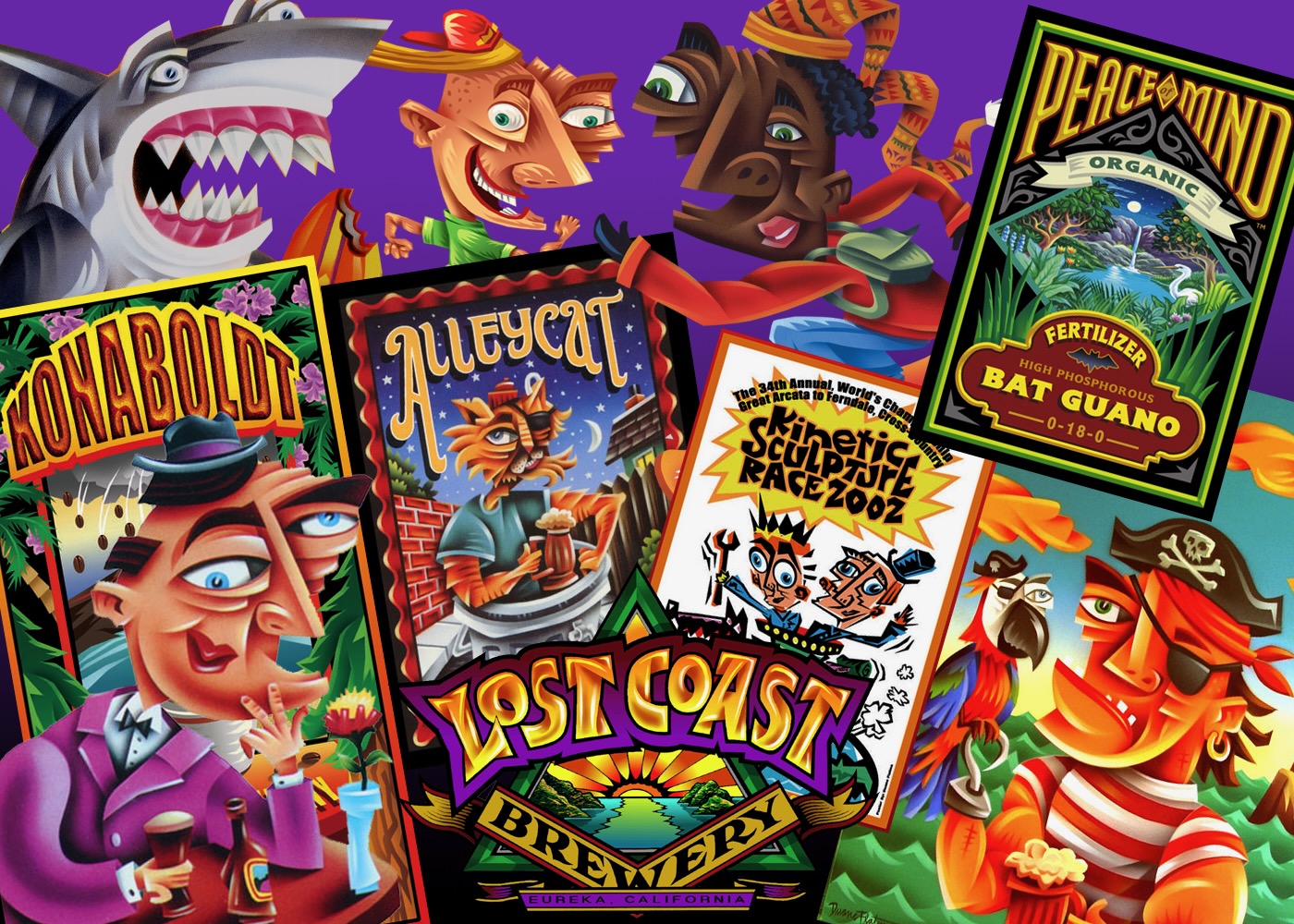
A few of the many product logos Flatmo has designed.
In his current art studio, inside the house, Flatmo fingered through a tangle of custom medals hanging from a hook. The awards were bestowed upon him during his many years of participation in Humboldt County’s Kinetic Sculpture Race (aka the Kinetic Grand Championship). Many of the medals were crafted by that event’s “glorious” founder, the late sculptor Hobart Brown.
Flatmo has recently begun looking at such things from a new vantage point, wondering what will become of it after he’s gone.
“You start looking at this stuff and you go, ‘What’s gonna happen to all that stuff?’” he said. “It’s weird. You collect all these things. Every year at Burning Man I have a box full of stuff that people gave me which I thought was really unique, and now it’s just sitting there in a box. It’s like photos; where are they all gonna go when you’re — .”
He left the question unfinished. “That’s the way I’ve been thinking lately.”
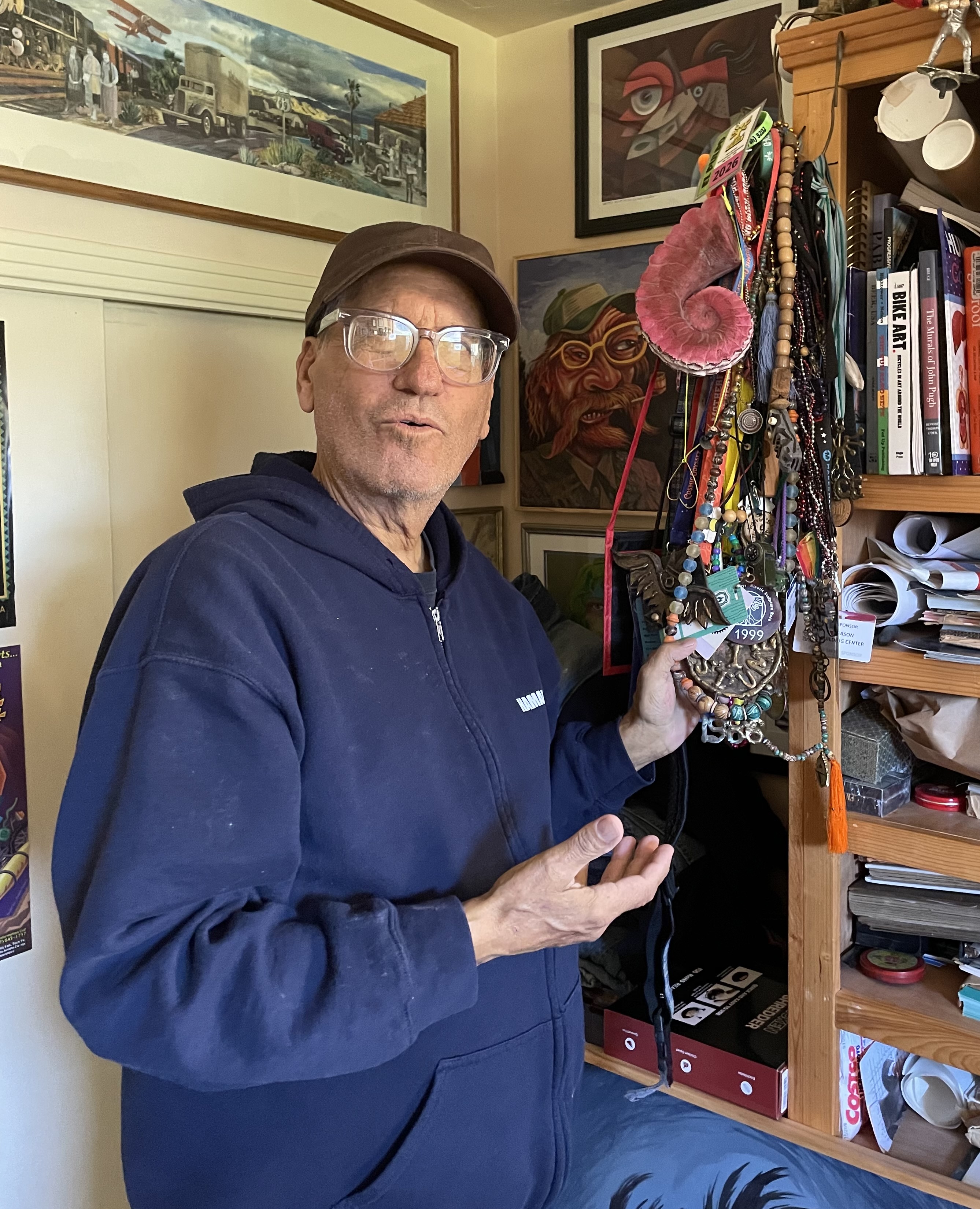
Flatmo shows some of his Kinetic Sculpture Race medals. | Photo by Ryan Burns.
Flatmo is dealing with what he describes as “disturbing health issues,” preferring not to linger on the details or the prognosis. Four years ago he underwent a liver transplant. Now, that new organ has been compromised and will likely get the better of him.
Temperamentally, though, Flatmo remains the upbeat goofball so many people love. He lights up recalling his various adventures, like the time in 2004 when he, Micki and some friends took monster art trucks to China. His gap-toothed grin flashed as he played a live track from his rock band Spudgun, which performed at bars, parties and the Redwood Run motorcycle rally back in the day, opening for the likes of Creedence Clearwater Revival, Bad Company and 38 Special.
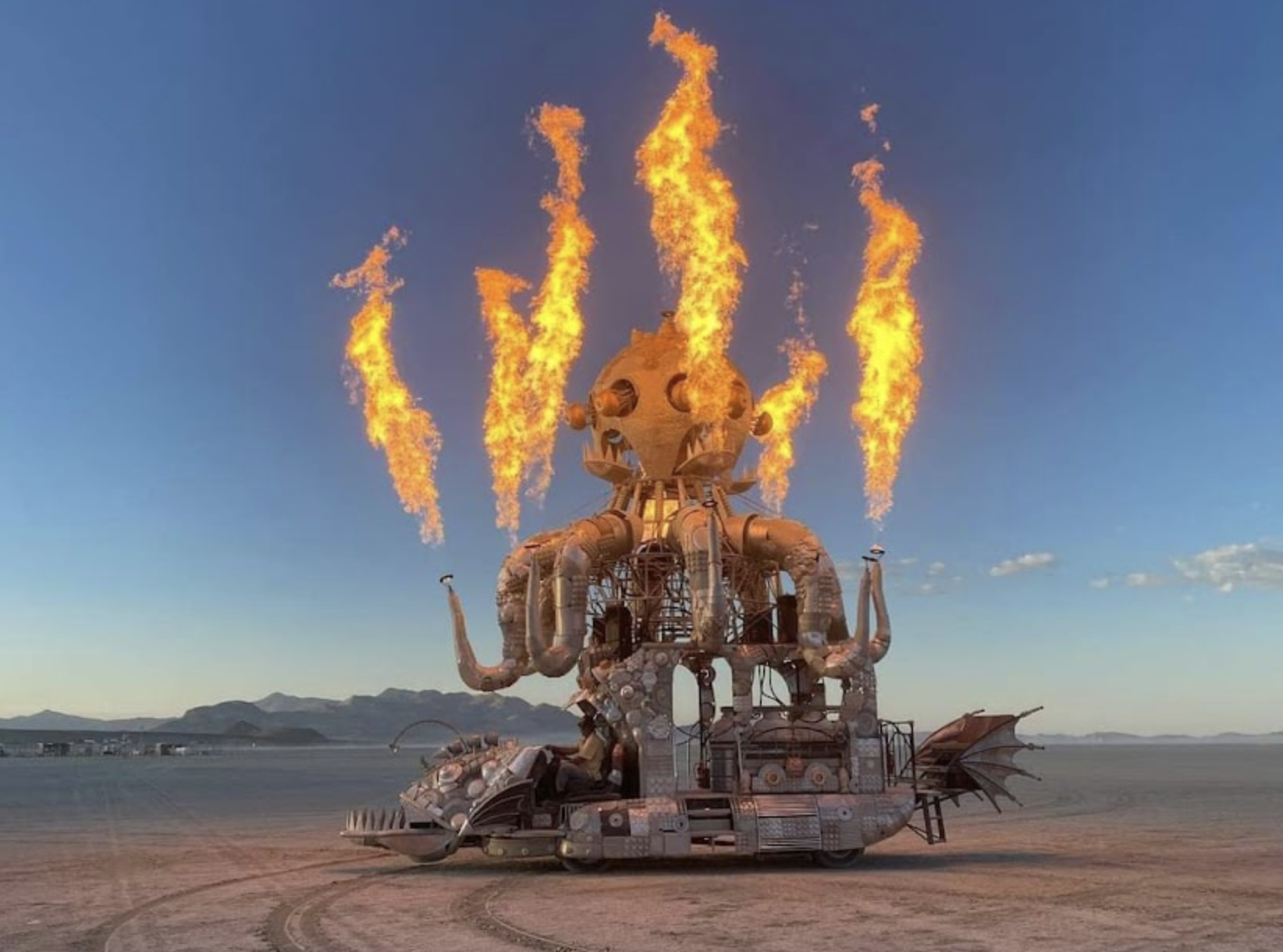
El Pulpo at Burning Man.
When the tour of his home was complete, we sat down for the actual interview. Flatmo, dressed in his casual outfit of a hooded sweatshirt, blue jeans and cadet cap, leaned back in a cushy armchair. As he talked, the light from his sun-drenched backyard danced across the lenses of his horn rimmed glasses.

Young Duane.
Born in Santa Monica in 1957, Flatmo and his three siblings (one older brother plus a younger brother and sister) later moved to Big Bear Lake in San Bernardino County, where a high school art teacher, John O’Hare, channeled his burgeoning art skills into practical applications such as lettering for sign-making.
“He told me you can go to any town and just start looking for old signs that need to be repainted, [say], ‘I’ll paint that for five hundred bucks’ and get some quick cash in your pocket,” Flatmo recalled.
When he moved to Humboldt County in 1977, it struck him as “a place you can get away with things,” like erecting a wooden plane sculpture in the mudflats of Humboldt Bay.
An early indication of Flatmo’s impish sense of humor: He built the plane nose-down, as if it had crashed after takeoff from the nearby Murray Field Airport. Soon after it was installed, the sculpture was torn apart by angry pilots, who viewed it as bad luck, according to a 2006 story in the North Coast Journal.

Big Bear High School art teacher John O’Hare with teenage Flatmo.
Periodically during the interview, Flatmo got reflective.
“All my life I’ve told my mom, ‘Mom, I’m just here temporarily.’ I feel like I’ve been allowed to be here, and all I want to do is the right thing and the good things, and do things that leave the place better after you leave, you know? I always wanted to do that. And she always wanted me to have kids.”
He never did. Not biologically, anyway. But for a dozen years, Flatmo mentored young artists through the Rural Burl Mural Bureau, the celebrated community art program that pairs professional artists with local youth (ages 14 to 24) to design and paint large-scale public murals. He thumbed through a stack of photos from the ‘90s showing him with his teenage charges, splattered with paint, as they work on various murals.

Flatmo (lower right in the red cap) instructs students on mural painting.
As he flipped through the stack of photos, he recalled students’ names and details from their lives — the big guy whose dad was abusing him at home; the kid who smeared acrylic paint into the spikes of his mohawk; the teens who introduced him to the music of Beck and the Smashing Pumpkins.
Several of the murals Flatmo and his students created, like the trio of alley dogs on F Street between Fourth and Fifth (pictured in progress above), can still be spotted around Eureka. Others, including a huge work on what’s now the George Petersen Insurance building that showed local community members helping each other after a large earthquake, have been covered up.

Flatmo and students in front of a mural depicting a post-earthquake scene. While the painting has been covered by a new wall, Flatmo believes it’s still intact.
“And this faded,” Flatmo said looking at another photo. “Nobody keeps these up; they’ve gotta keep up these murals.”
Eureka now has more than 50 large-scale murals, with more being created every year through the Eureka Street Art Festival and other initiatives. But Flatmo said that when he first got to town, there were only two: wavy imagery by artist Randy Spicer on a local waterbed store and the big sperm whale mother and calf on A Street at Fourth.
While working at Sears (first in draperies, then hardware and eventually the display department), Flatmo took an art class at College of the Redwoods that taught him a lot about cartooning and graphics. He was doing sign-making work on the side, and his big breakthrough came when the owners of Bucksport Sporting Goods hired him to redo the lettering on the building. They asked if he also did murals.
“I had learned them in high school — how to do grids — and I go, ‘Oh yeah, I could do that,” Flatmo recalled. “And so that was my first job.”
Painted in 1984, the Buskport mural is based on an L.W. Duke painting of 19th century frontiersmen. (Flatmo later added a man standing off to the side, looking up at the mural, with his shadow creating the optical illusion of three dimensions.) Los Bagels owner Dennis Rael drove past while Flatmo was painting it and asked him to create the multicultural panorama that still adorns the wall across from his Arcata bagel shop. Next came the old-timey service station scene on Finnegan & Nason Auto Supply in Henderson Center.
“So they slowly started snowballing,” Flatmo said.

Flatmo at work on a since-removed mural at Humboldt Brewery.
As for the inspiration behind his kinetic sculptures — from the googly-eyed crustacean The Crawdudes to the 11-eyeballed mutant Extreme Makeover to flame-throwing metallic beasts such as Tin Pan Dragon and El Pulpo — Flatmo traces his inspiration to a few different sources. There was Mad magazine (particularly the work of cartoonist Jack Davis) as well as Rube Goldberg, the cartoonist/inventor known for drawing elaborate chain-reaction contraptions. Also: the Southern California amusement parks he visited as a kid.
Captivated by the double-corkscrew roller coaster that debuted at Knott’s Berry Farm in 1975, young Flatmo went home and, with the help of some friends, built his own Rube Goldberg machine from materials in his parents’ garage: a wheelbarrow, shovels, bowling balls, etc.
In high school he built more kinetic displays, including one in which a marble rolled down a track and triggered a mechanism that lifted a little soldier by the noose around his neck while making a Nazi officer’s arm rise in salute.
“My mom and dad were a little embarrassed I think,” Flatmo recalled with a chuckle, “because there were demons and clowns and weird shit all through this thing. But they were intricate things. They were not the kind of obvious thing where it goes there, there and then the scoop picks it up. They were scenes that were happening.”

Flatmo dons a gas mask to protect himself from a dust storm at Burning Man.
As a youngster, he also carved wood with a pocket knife. Flatmo hopped out of his armchair and walked into his studio to show a couple of examples. He held up a handrail knob with a crudely carved frowny face, red lips and hair of purple yarn. He also pointed out a wooden spoon with a stack of human heads carved into the handle.
Other items in his studio quickly grabbed his attention: the Duane bobblehead created by local artist Kati Texas; the signed illustration of El Pulpo by Simpsons animator David Silverman (a regular Burning Man attendee); a framed Mickey Rat drawn for him personally by cartoonist Robert Armstrong, whom Flatmo met via R. Crumb.
Flatmo met Micki in the late ’70s. She was designing advertising and window displays for Bistrins department stores, and one day she walked into Promotional Arts, the t-shirt company where Flatmo worked on silk-screening, painting and shirt designs.
“You know when you see someone and you’re like, ‘Oh, my god, I want to know that person! Look at that smiling face!’” Flatmo said. “She looked great, and she wanted some signs printed.”
The two were both married to other people at the time, but they wound up working together. About six months after each of their marriages eventually fell apart, they met up with each other in Old Town Eureka.
“We got some roller skates. She met me down there. We skated all around; it was brand new asphalt,” Flatmo recalled. “And we started seeing each other.”
They shared their first kiss on a bridge near the present-day Hikshari Trail after a wave had extinguished their beach bonfire. More than four decades later, the couple regularly attends Burning Man together and, at home, they’re avid fans of the TV reality show “Survivor.”

Duane and Micki.
Back in the living room, Flatmo’s thoughts returned to the student artists he mentored through the Rural Burl Mural Bureau. Over the 12 years that he taught, he figures he worked with 80 to 100 kids.
“That’s the other thing about what I’ve been thinking about lately, too, is you want to do everything to help the next generation go forward,” Flatmo said.
That appears to be a goal he’s already achieved. He received a Father’s Day card one year from a group of former students, and he recalled another one telling him that he’d been a better dad to him than his own father. Another former student, Lucas Thornton, has become an accomplished muralist in his own right.
Flatmo believes that creating public art can be transformative for young people.
“You see the kids out painting now in a group project, and everybody that comes up and gives them a good thumbs up, it just lifts their spirits and they feel like they can take on the world,” he said. “Some people don’t get that all through their life.”

Flatmo preparing to paint his largest mural on the Arkley Center for the Performing Arts.
Flatmo’s artwork has transformed Humboldt County, not just through the murals you see every time you go to Pierson’s Building Center, the Arkley Center, the Eureka Co-Op and so many other spots. The playfully anarchic character of his creations has been entwined with the community’s own identity. His influence can be felt at every Kinetic Sculpture weekend, seen at each new street art festival and found on product labels in every local grocery store.
Some people, in the later stages of life, might feel pride or even arrogance at such achievements. Flatmo expressed only gratitude.
“One of the things I think about is how lucky I’ve been,” he said. “I started off at Sears doing butcher paper signs for grocery stores, you know, ‘Hamburger 59 cents a pound,’ and you keep building and building and building. I’ve been blessed so much, the way my life’s worked, that I can’t complain about anything. So at the end, you can really be bitter and sad or you can just … I’m just trying to be my normal self as long as I can and stay upbeat and do the right stuff, you know, do the right thing.”
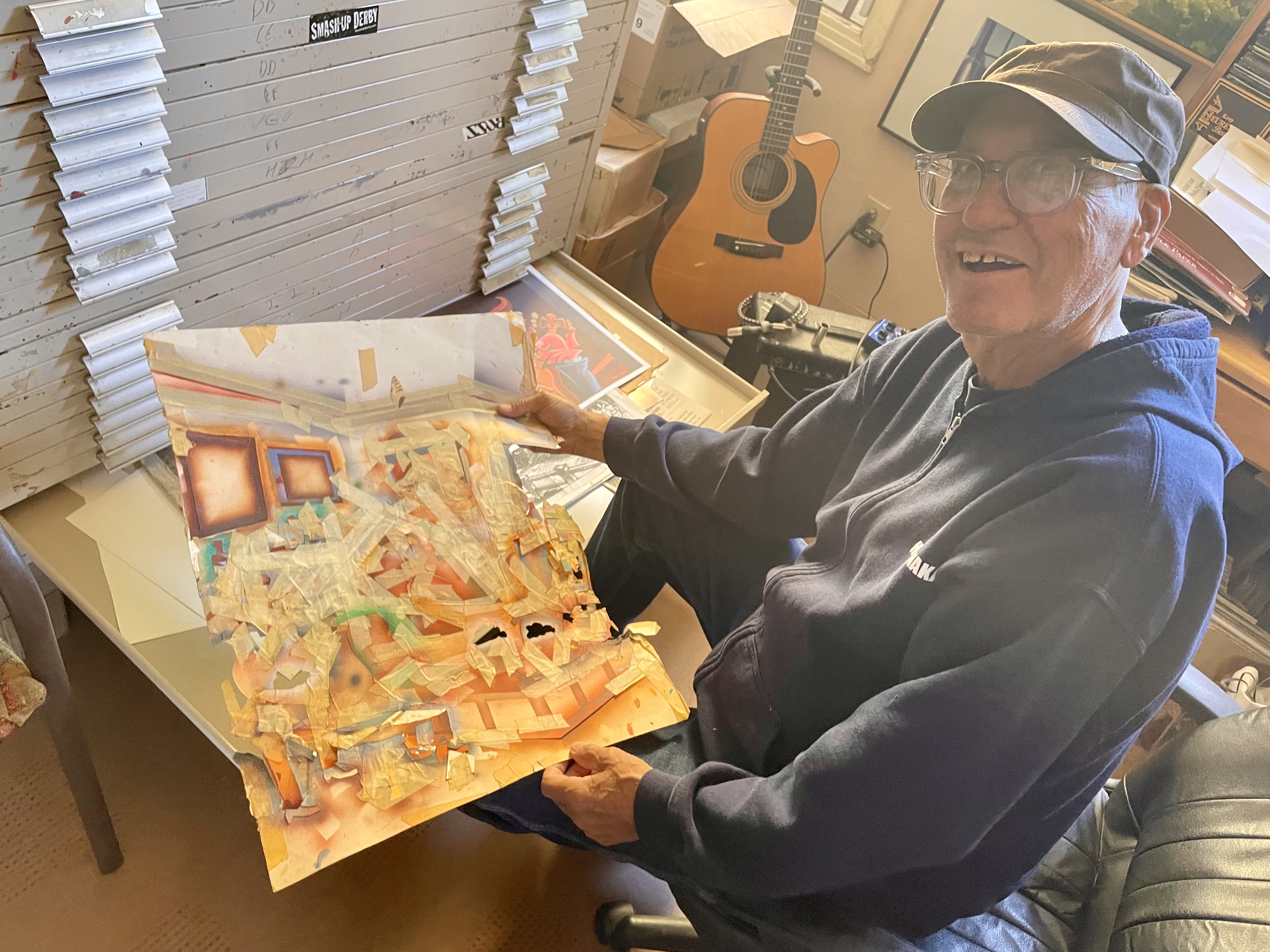
Flatmo shows what a cardstock stencil board looks like after he’s finished a painting, having used an X-Acto knife to cut out tiny pieces before airbrushing that spot and then replacing the piece with masking tape. | Photo by Ryan Burns.
A couple minutes later, he stood up and walked back into his studio, where he fired up his computer and searched through files until he found a playlist of old live Spudgun tracks. He clicked on one and pressed play on a jaunty rockabilly tune with a walking bass line and jangly electric guitar.
“That’s me singing,” he said as the vocals came in, a lyric that mentions going back home, getting out of the city and seeing his pretty. “I wrote this coming back to Humboldt,” he said.
He leaned way back in his chair, nodded his head to the beat for a few bars and smiled. As the harmonica solo kicked in, Flatmo said, “We loved getting people dancing. We were a dance band.”

El Pulpo lights up the crowd at EDC Las Vegas.
If you’d like to dance with Duane Flatmo and his 30-foot-tall, flame-throwing mecha-octopus, then clear your calendar for the evening of Saturday, June 13, from 7 to 10 p.m. The “Duane Flatmo Alley” street sign dedication will be a public celebration, complete with food trucks, music and face-warming geysers of tentacle flame.
Flatmo called earlier today to make sure this story plugs the event. “If you’ve never seen El Pulpo fire off, this is a good time to come out and see it,” he said.
More info below:

###
CORRECTION: This post was modified to correct a couple of photo captions that had misidentified locations. The Outpost regrets the errors.
CLICK TO MANAGE