
This longnose lancetfish (Alepisaurus ferox) was found washed up on Mad River Beach Thursday evening. | Submitted.
###
Here’s something you don’t see every day.
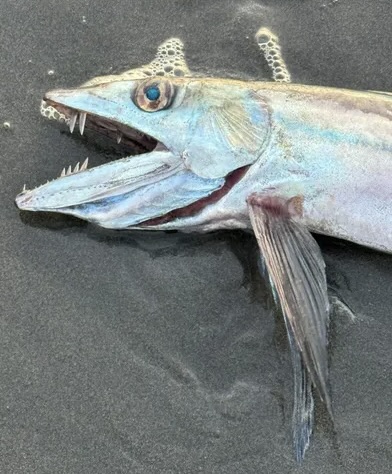
Say cheese!
LoCO reader Lilykoi Leilani sent along some photos of “this crazy fish” she found washed up on Mad River Beach Thursday evening. Leilani used Google image search to identify the toothy beast as a longnose lancetfish, and the Outpost verified that determination with Cal Poly Humboldt fisheries biologist Dr. Cynthia M. Le Doux-Bloom.
“Cool find!” Le Doux-Bloom said.
This big-eyed, sharp-fanged predator is one odd fish: Not only is it a voracious cannibal and a hermaphrodite (meaning it possesses both male and female sex organs simultaneously); it literally comes out of the twilight zone — not the T.V. show but rather the layer of ocean that extends from 200 to 1,000 meters (650 to 3,300 feet) below the surface (also known as the mesopelagic zone).
Lancetfish live mainly in tropical and subtropical waters, but they migrate as far north as subarctic areas like Alaska’s Bering Sea to feed, according to NOAA Fisheries.
With gaping fanged jaws and enormous eyes, they eat a wide variety of prey, including octopods, squid, tunicates, crustacea and other fishes. Their own flesh is described as “watery and gelatinous and not appetizing to humans.” They usually have large, ribbed, “sail-like” dorsal fins, though the one on this particular lancetfish appears to be either folded over or missing.
Lancetfish are one of the longest deep-sea fish species. Leilani estimated the specimen she came across as measuring between three to four feet long, but they can grow to more than seven feet in length.
While it’s rare to see one washed ashore like this, it’s not unheard of here in Humboldt. More than two dozen local sightings have been reported to iNaturalist (though some of those could be duplicates), and they’ve also been found along the Oregon Coast.
Tuna fishermen consider them bait-stealing pests, and data from longline fisheries has shown an apparent increase in bycatch in recent years, which researchers attribute to population reduction in commercial species such as yellowfin and bigeye tuna.
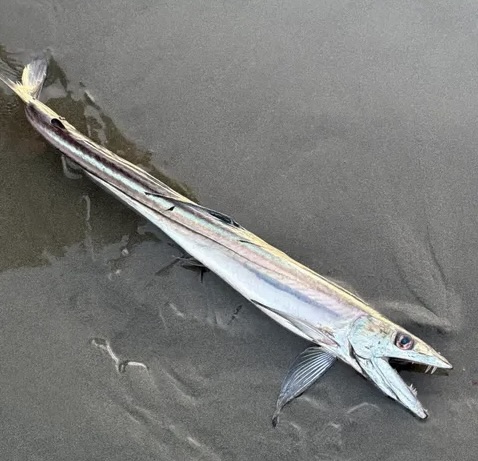
Photo courtesy Lilykoi Leilani.
CLICK TO MANAGE