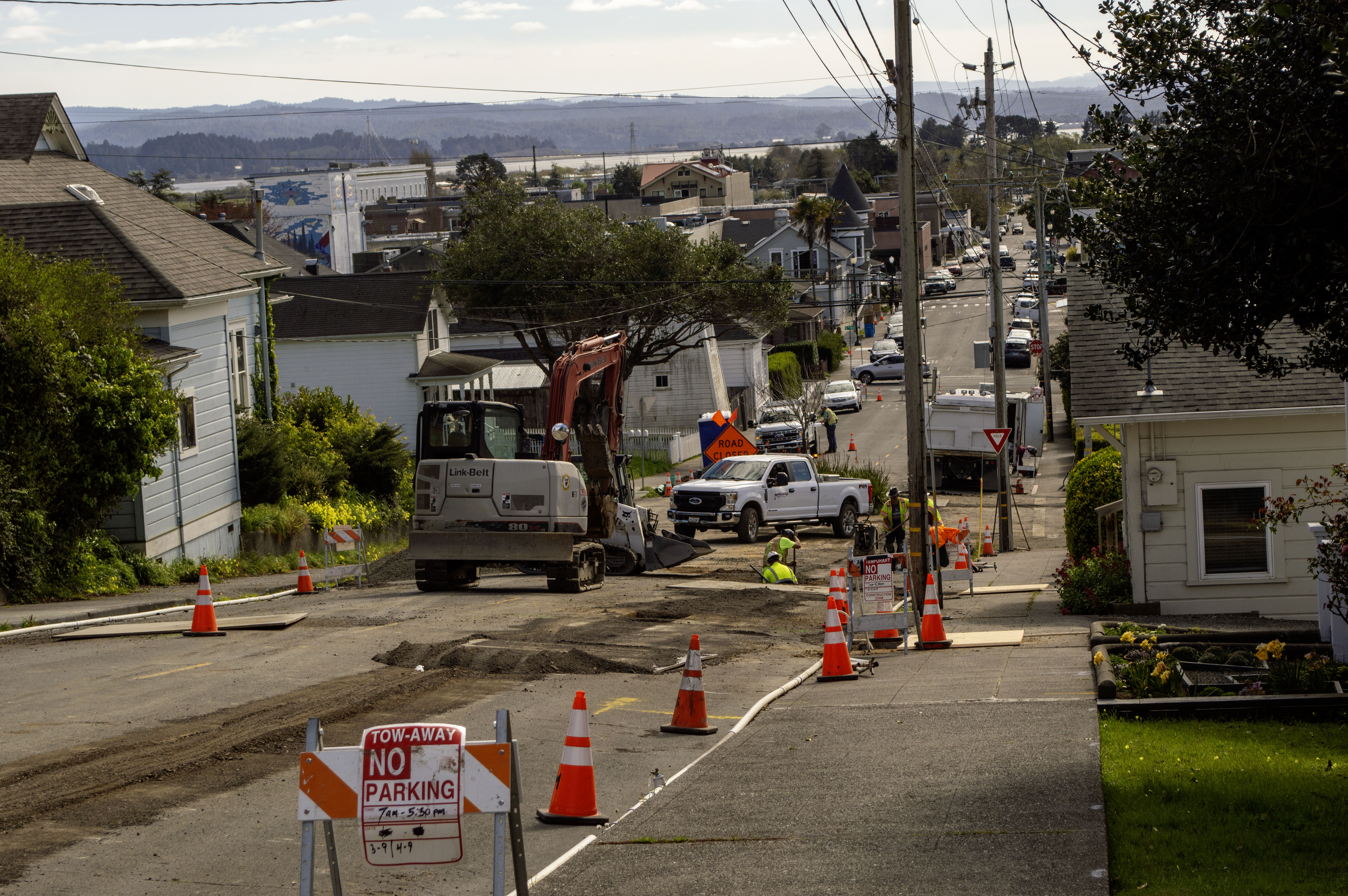
Laborers work on the steel waterline replacement project, March 13. Photos by Dezmond Remington.
Old houses have plenty of problems. Leaky pipes, cracked foundations, bad heating and worse insulation all make for hard living. But an ancient water meter can actually save owners money — at the city’s detriment.
Arcata’s housing stock is rife with them. Around 6,600 meters city-wide measure the water residents use, and all of them need to be replaced. (About 680 already have been.) When a meter turns 15 years old or so, it stops measuring the water usage accurately, almost always in favor of the customer, sometimes undercounting by huge margins. Arcata doesn’t recover costs for up to a third of the $1.7 million it spends on water bought from the Humboldt Bay Municipal Water District and resells at-cost, Finance Director Tabatha Miller told the Outpost. Arcata loses some $300,000-$500,000 annually, though the losses have mounted over time as more meters deteriorate. Some of it is lost to leaky infrastructure or from fire hydrants, like the 2.5 million gallons firefighters dumped on the Jan. 2 fire earlier this year, but around half of it is from undercounting water meters. 271 active customers have paid the monthly minimum flat fees without being charged at all for water usage within the last four months, Miller said, even though the city believes they’re using water.
“It’s a lot of water,” Miller said. “And it’s a lot of money. You can see why this is important to me.”
City council members and staff swapped anecdotes at a meeting several weeks ago, when they decided they’d attempt to snag state funds to replace the meters. Councilmember Stacy Atkins-Salazar said she’d heard the city was losing boatloads of money annually to faulty meters; some customers pay nothing and it “didn’t sit well with her.” The other council members agreed. “When I hear that somebody who can afford to pay water [bills] has a zero meter-read, that drives me crazy,” councilmember Alex Stillman said. Replacing even a few meters has had an impact; Miller said that a few customers with new meters complained to the finance department, irate that their water bill had doubled. Finance staff asked them a few questions about their usage: how many people lived in the house, how often they were there, and showed them that they had been benefiting from a faulty meter.
They’ve needed replacement for a while now. For years, Arcata didn’t have the cash. City hall chased funding opportunities for other projects as they popped up — grants for street and transportation improvements, $67 million for the wastewater treatment facility. Miller said they took advantage of what was available, and went from there. Focus on more critical infrastructure projects, like the steel waterline replacement, also sidelined meter replacement. Mustering the money for the project would also have been unpopular, Miller said.

Some fellas hard at work on the steel waterline project.
“Nobody likes rates to be increased,” Miller said. “If you can push them off a year or two because nothing’s really bad — it happens…And people hate it when you rip up their roads and streets, and they’re out of water. It’s a big deal.”
The meters are partially to blame for the imminent increase to the city’s water rates. Under California law, the revenue Arcata earns from their water service goes right back into the water fund, not its general fund. Arcata is mainly increasing the water rates to defray costs from the ongoing steel waterline replacement and other infrastructure upgrades — around $36 million total — but more money in the water fund would have allowed for much lower increases. (Several city council members have said they’d look at lowering the rates in 2030 if the meters were replaced.)
Miller estimated that it’ll cost about $13 million to replace all the meters. It’s not as simple as just loosening some bolts and swapping them out; the new auto-read transmitters are larger than the old meter boxes, which are embedded in the street. The concrete around the boxes has to be destroyed and repoured. If the city gets it, the CDBG funding they’re applying for will cover $2.9 million, and the state and federal government might kick in the other $10 million through a combination of a few different grants. If all goes to plan, the project will take around two and a half years to complete, finishing sometime in 2029.
The meters they’re planning on replacing with the $2.9 million of CDGB funding will be in low-income areas of the city, determined by census tract data. Miller agreed that it was counter-intuitive that Arcata’s effectively raising their rates before focusing on people who will have an easier time paying for it, but CDGB funds have to be used for lower-income areas. And the new meters can also tell residents if their pipes are leaking, potentially saving them money in the long run.
“If we can get money to pay for infrastructure that makes it uniform and fair across the board as far as water usage and water bills,” Miller said, “It’s a win for the customers, and that impacts almost everybody in the city.”
CLICK TO MANAGE