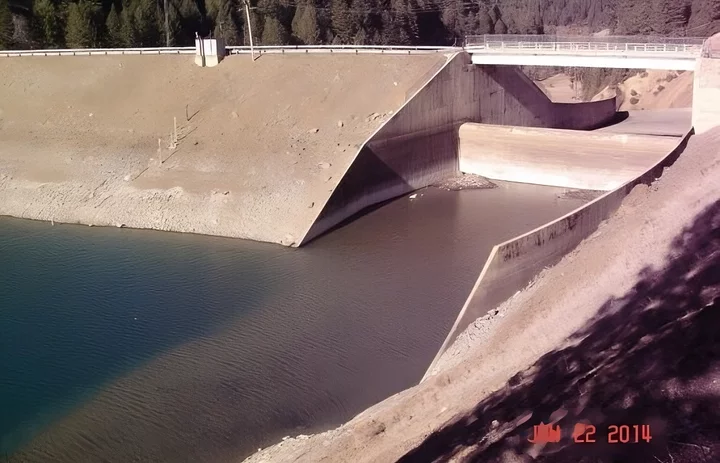
Ruth Dam — a.k.a. R.W. Matthews Dam — in 2014. Outpost file photo.
###
A hydraulic fluid leak at Ruth Lake — the reservoir that holds most of Humboldt County’s water supply — does not pose any kind of health risk for local residents, according to Humboldt Bay Municipal Water District. Nor have there been any impacts to fish and wildlife, the agency says.
Here’s what happened:
On Tuesday of last week, during a routine safety inspection of R.W. Matthews Dam on Ruth Lake, a hydraulic slide gate malfunctioned. During subsequent diagnostic work, roughly 15 gallons of hydraulic fluid leaked into an enclosed space underground. This stuff is not typical hydraulic fluid, according to the District; it’s non-toxic, plant-based and biodegradable.
Still, it’s not supposed to leak into the water.
Alas, two days ago, on March 11, a sheen was observed near the intake structure on the lake surface. Absorbent pads and containment booms were deployed, and all of the appropriate regulatory agencies were notified, the District said.
Here’s the agency’s public statement:
Key Facts
The Humboldt Bay Municipal Water District (District) is providing the following information regarding a release of hydraulic fluid at the R.W. Matthews Dam intake structure on Ruth Lake in Trinity County.
The dam is structurally sound. This event involves only the hydraulic operating system for the intake slide gate — not the dam structure itself.
- No oil has reached the Mad River. The released fluid was observed on Ruth Lake in the immediate vicinity of the intake structure and is contained within booms. District staff surveyed the entire lake and found no evidence of oil along the reservoir edge.
- There is no impact to drinking water supplies. Ruth Lake is approximately 75 river miles upstream of the District’s diversion facilities at the Essex Operations Center near Arcata. There is no risk to the water supply serving approximately 90,000 Humboldt County residents.
- The released product is not conventional petroleum-based oil. It is a plant-based, readily biodegradable hydraulic fluid that is non-toxic to aquatic life and does not accumulate in the food chain.
- No impacts to fish, wildlife, or water quality have been observed.
What Happened
On March 3, 2026, during a routine Division of Safety of Dams (DSOD) field inspection at R.W. Matthews Dam, the hydraulic slide gate at the intake structure malfunctioned while being operated. The District activated its Emergency Action Plan and notified state and federal dam safety regulators and all required agencies of a non-failure emergency condition the same day.
The District conducted diagnostic testing over the following week to determine the nature of the failure. During that diagnostic work, approximately 15 gallons of hydraulic fluid leaked from the operating system into a flooded cylinder room inside the intake structure — an enclosed space approximately 110 feet below the lake surface containing static, non-flowing water.
On March 11, a sheen was observed on the lake surface in the vicinity of the intake structure. The District immediately deployed absorbent pads and floating boom and reported the release to the National Response Center, Cal OES State Warning Center, and the North Coast Regional Water Quality Control Board. A formal notification was sent to all coordinating agencies — including Trinity County OES, Trinity County Environmental Health, CDFW, USFS, NMFS, and USACE — within two hours of the observed release.
Clarification on Timeline
Some early reporting has suggested an unexplained gap between the March 3 mechanical failure and the March 11 oil release. There is no gap in reporting. These were two distinct events:
- March 3: Mechanical failure of the slide gate. No oil entered the lake. Reported to dam safety regulators and required agencies.
- March 11: Oil sheen observed on the lake surface. Reported to NRC, Cal OES, and the Regional Water Quality Control Board immediately. Containment deployed at once.
Some coverage has also incorrectly described the equipment as a “flap gate” and stated that oil was released to the Mad River. The correct term is a hydraulic slide gate, and the oil has not reached the Mad River.
About the Hydraulic Fluid
The District specifically selected Clarion Green BIO 32 for this application because the hydraulic system operates underwater in a public water supply reservoir. This product is readily biodegradable, minimally toxic to aquatic life, and not bioaccumulative.
Specifically, this product is:
- Readily biodegradable: It is formulated from high oleic natural esters derived from renewable plant-based resources, not petroleum.
- Non-toxic to aquatic life: It meets U.S. EPA LC50 test requirements, meaning it is classified as non-toxic to fish and aquatic invertebrates.
- Zinc-free and ashless: This product contains none.
- Not bioaccumulative: It does not build up in the tissue of aquatic organisms or concentrate through the food chain.
- Not classified as hazardous under the OSHA Hazard Communication Standard (29 CFR 1910.1200).
The District selected this product to minimize environmental impact in the event of a release at this location. It represents the least environmentally impactful hydraulic fluid available for this application.
Containment and Monitoring
The District has deployed multiple layers of containment and is conducting active monitoring:
- An interlocking non-absorbent spill containment boom and oil-only absorbent boom deployed between the two spillway walls.
- Additional booms installed at the northwest corner of the dam where oil was collecting.
- Floating booms deployed directly downstream of the dam.
- Visual monitoring by District staff.
- Water sampling of the lake and river at several locations at the request of the Regional Water Quality Control Board.
The District surveyed the entire lake and found no evidence of oil along the reservoir edge. The oil appears contained within the booms.
Planned Repairs
The District has engaged a commercial dive contractor to access the cylinder room underwater, inspect the hydraulic system, and make repairs. Dive operations are scheduled to begin the next week.
Additional containment booms and environmental controls will be in place before the diver enters the cylinder room. The scope and duration of repairs will depend on what the dive inspection reveals.
Drinking Water Supply
There is no impact to drinking water supplies. Ruth Lake is approximately 75 river miles upstream of the District’s diversion facilities at the Essex Operations Center near Arcata, where water is drawn from the Mad River aquifer through Ranney collector wells. The volume of hydraulic fluid involved is small, the product is non-toxic and biodegradable, and containment is in place. The District serves approximately 90,000 residents in the cities of Eureka, Arcata, and Blue Lake and the communities of McKinleyville, Manila, Fieldbrook-Glendale, and Humboldt, and there is no risk to that water supply from this event.
Agency Coordination
The District is coordinating daily with the following agencies:
- Division of Safety of Dams (DSOD)
- North Coast Regional Water Quality Control Board (Region 1)
- California Department of Fish and Wildlife (CDFW)
- National Oceanic and Atmospheric Administration — National Marine Fisheries Service (NMFS)
- U.S. Army Corps of Engineers (USACE)
- U.S. Forest Service (USFS)
- Trinity County Office of Emergency Services
- Trinity County Division of Environmental Health
Ruth Lake Community Services District
CLICK TO MANAGE