
Gladys (“Jean”) Laverty (center) in the silent film Bachelor’s Paradise (1928). Photo: Public domain.
###
The Humboldt Standard claimed the Hollywood press described her as “the screen’s most beautiful blonde.” The Standard, in the Monday, February 17, 1930 issue, went on to report:
Gladys Laverty, former Eureka girl who is known to the screen world as Jean Bary, has a prominent role in The Cock-Eyed World, which began a five-day showing at the Rialto Theater this afternoon … she portrays Fanny, the Coney Island girl over which Sergeants Flagg and Quirt have one of their many quarrels. For several years, Miss Laverty played small roles in several productions. Recently, she was signed by the Fox Film Corporation and now seems to be climbing to the top in the film world. At the present time, she is working in “Bright Lights” and “Lilies of the Field.” She is the daughter of Mr. and Mrs. Henry J. Laverty of this city and is a graduate of Eureka High.
For several days, during the run of “The Cock-Eyed World” at the Rialto, the Standard published eye-popping photographs of Gladys, along with articles detailing her exotic adventures (such as her trip to Hawaii to appear in a Harold Lloyd production), and advertisements shouting “Eureka Girl Makes Hit,” and “Eureka’s Own Star, Gladys Laverty.”
“Miss Laverty has an excellent talkie voice and her performance in ‘The Cock-Eyed World’ will doubtless bring her more prominent roles in future Fox productions,” gushed the February 18, 1930 issue of the Standard.
Gladys Laverty was born in Blue Lake on April 3, 1904, the granddaughter of Blue Lake pioneers Francis (Francois) and Helene Douarin, who had moved to Humboldt from Brittany, France, in 1856.
Gladys’s father, Henry James Laverty, born in New Brunswick, Canada, was the son of an Irish immigrant who moved his family to Arcata when Henry was very young. The Laverty family were mainly woodworkers, but Henry instead learned the trade of barbering. In 1892, he moved from Arcata to Blue Lake, opened a barbershop, and met and married (in 1897) Francois and Helene Douarin’s daughter, Helen. Until 1912, Henry and Helen Laverty lived in Blue Lake with their children, Gladys, Henry (born in 1906 and died May 4, 1989 at the age of 83), Clyde, and Margaret (Peg Billings). Peg was born on December 11, 1911, six days after her father’s barbershop was destroyed in the disastrous downtown Blue Lake fire. (The Ferndale Enterprise reported that although Laverty didn’t own the burned building, he was uninsured for the $200 loss of his equipment and supplies). After a year at a new Blue Lake location, Henry moved his family to a house on Hillsdale Street in Eureka, where he had rented the new barber shop in the Hotel Barnum on 2nd Street, which he operated until he was over 80.
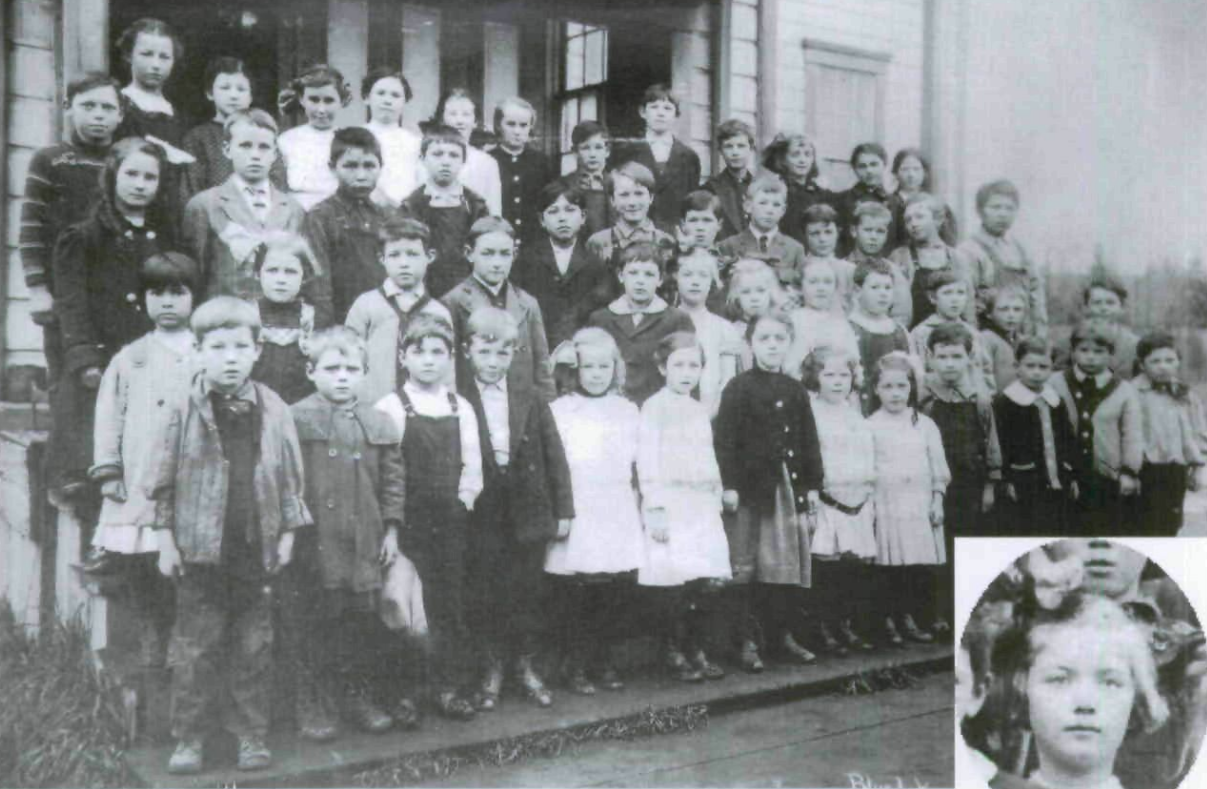
Blue Lake school in 1910 or 1911. Gladys is sixth from the left in the second row. Photo: Seely Bros., via the Historian.
Blue Lake was the lasting influence on Gladys, however, partly due to the nature of the community (a story in the Blue Lake Advocate published at the turn of the nineteenth century said, “Blue Lake is second to none in the county for dancing events, good music, good supper, and a good time”).
And Gladys was certainly guided by talented family members. Her aunt, Ida Douarin Harvey, played and taught piano in Blue Lake. According to Gladys’s niece, Loreen Laverty Eliason, Ida learned her lively style of piano playing by sneaking outside and sitting on the curb to listen to the piano music in the saloons. Ida was also a frequent performer in plays produced by the Wha-Nika club, of which she was a member.
Gladys’s older cousin, Helen Smith St. Louis, who was also born in Blue Lake, taught in local schools where she produced graduation plays, programs, and musicals “(for which she will be long remembered by her students,” according to her March 2, 1961 obituary in the Blue Lake Advocate.
By the time Gladys was eight years old, she, too, was in the Advocate. The April 20, 1912 issue reports that she sang at a program of the Woodmen of the World, and the June 8, 1912 issue tells about her performance at an eighth grade graduation: “Gladys Laverty … sang a couple of sweet songs in her childish voice which pleased everyone.” On October 26, 1912, Gladys was also tapped to sing “I’m the Guy” between acts of a play in which her Aunt Ida acted, put on by the Wha-Nika Club.
Gladys attended Blue Lake and Eureka schools, at some point sharing the same class year (1922) as her younger brother, Henry “Hank” Laverty. (Her other brother, Clyde, died as a youth.) Interestingly, at Eureka High School, it was Hank, and not Gladys, who was the performer. Editions of the yearbook, Sequoia, picture Hank in several productions that appeared as soon as public gatherings were declared safe from the influenza epidemic.
Of Gladys’s high school career, we know little, except that perhaps she was seen as a dizzy blonde, as this exchange in the 1919 Sequoia would indicate: “After explaining for the third time a problem to G. Laverty, Miss Fitzell said — Well, Gladys, is that clear now? Yes, it’s clear enough, said Gladys, only I don’t understand it.” (Miss Fitzell taught French, mathematics, and English.)
Gladys is mentioned again in a fictionalized review of the year’s events in the 1920 Sequoia. ‘Oh yes, the girls!,’ repeated President Rew dreamily, ‘and don’t you remember the next reception given the Freshmen—how the girls danced so artistically the Spanish dance?’ ‘How well I remember,’ meditated Mr. Laverty, ‘it was the Spanish Draw which inspired my sister to become the leading lady in the Ziegfeld Follies.’”
The 1922 Sequoia tells us that Gladys was a member of glee club (1, 2, 4), and track (4). She cannot be identified in the photographs and although the ‘22 yearbook lists her as a candidate for June graduation, there is no senior photo. While the Ziegfeld Follies was a literary conceit, Hank’s riposte wasn’t far from the mark.
Expressly forbidden by her father, Gladys nonetheless left Eureka for Hollywood — either before or shortly after her graduation — with a troupe of actors who had been performing in the county. (Traveling troupes, with such colorful names as “Follies and the Honey Maids,” often played at Loew’s State Theatre.)
According to Eliason, Gladys went with the troupe to San Francisco where she performed “for a short while.” The “short while,” we believe, was perhaps as long as three or four years. At this point, the chronology is confused. Although one online film site (IMDb.com) dates her first film from 1921, all evidence places her in Eureka in 1921. Further, her movie career appears to have begun in 1927, and we find it unlikely that considering her good looks and her youth, she would have had a six-year hiatus between films. Therefore, we are assuming the website dates of 1921 for her first two silents are incorrect, possibly distortions of a “7” for a “1;” we are dating her film career from 1927-1936. [Ed. note from 2026: IMDb seems to have since cleaned up its chronology, casting the above reasoning into some doubt.]
At some point between Eureka and Hollywood, she decided that Gladys was too old-fashioned for a performer and changed her name to Jean. In the confusion of her filmography, her first films are credited to Jean “Lefferty,” and the constant variety of misspellings of “Laverty” in the newspapers annoyed Gladys to the point of changing her name.
Gladys had already had another bit of good luck. While her first film, “What Happened to Father?” (1927), was a silent film and she played in several silents thereafter, she easily made the transition to talkies and was said to have a “great” talking voice.
A Jean Laverty scene in “The Cock-Eyed World.”
During her nine-year career, Gladys was in at least twenty-five movies, including a Mack Sennett silent film (“The Good-bye Kiss,” 1928). She acted with such stars as Theda Bara, Clara Bow, Bela Lugosi, Cesar Romero, Flobelle Fairbanks, William Demarest, Corinne Griffith, Carole Lombard, and Jean Harlow. In “Fugitives,” (1929), Gladys had a substantial supporting role, while Jean Harlow had only a bit part. Loreen Eliason remembers that Gladys loved to tell the story of Jean Harlow’s ermine toilet seats, an implication that she was close friends with Harlow. Given that Gladys knew Harlow before Harlow became a star, this is likely true.
Less likely is another family legend that claims Gladys was responsible for Carole Lombard and Clark Gable meeting and falling in love. In reviewing Gladys” filmography, we found one movie. “His Unlucky Night” (1928) that Gladys (uncredited) shared with Carole Lombard. Gladys was in no movie with Gable. Nevertheless, who’s to know what happened off the set? There was a busy Hollywood night life in those days of flappers and prohibition, and Gladys was a looker. In a review of “Domestic Trouble” (1928), another unidentified clipping (Gladys regularly sent clippings and photographs to her mother, Helen, who saved them, but alas, didn’t annotate them) says: “Miss Laverty … was impressive enough to send sections of the house into heavy sighs every time she moved.”
Loreen Eliason and Aleezz Laiclen say that Gladys gave up her career when she fell in love and married William Muir. We do not know how, where, or even when Gladys met her husband, but we do know that by 1936, when Gladys was making the last of her films, she was 31, an “old maid” by the vernacular of the culture at that time, and. in her last three films, she was listed as “uncredited barmaid,” “uncredited Viole.” and “uncredited chorus girl.” A career based heavily on beauty was fading with her youth.
Bill Muir was a slot machine mechanic for the Horseshoe Casino in Las Vegas. Bill and Gladys, who had no children, lived in Las Vegas until Bill retired and they moved to Pismo Beach. There, on September 28, 1973, Gladys died of throat cancer, the sad result of having been a lifelong heavy smoker. Gladys Laverty/Jean Lefferty/Laverty/Bary is buried at Los Osos Memorial Park in San Luis Obispo County under the sole name of Gladys Muir.
###
The piece above was printed in the Spring 2005 issue of the Humboldt Historian, a journal of the Humboldt County Historical Society. It is reprinted here with permission. The Humboldt County Historical Society is a nonprofit organization devoted to archiving, preserving and sharing Humboldt County’s rich history. You can become a member and receive a year’s worth of new issues of The Humboldt Historian at this link.
CLICK TO MANAGE