
Property owner Mike Duncan was recently cited for unpermitted grading in a stream-side management area at his property on Humboldt Hill. | Google Earth.
###
The truckloads of dirt just kept coming. Day after day, neighbors watched as one semi-truck after another came chugging up Humboldt Hill hauling open-top trailers loaded with soil. The drivers would downshift as their rigs crested the hill, groaned past the McMansions along London Drive and navigated the little dogleg-right onto Blue Spruce Drive.
After a few months, Humboldt County’s code enforcement office started receiving complaints about this activity.
“For the past two weeks my neighbors and I have observed between 400 and 500 full size dump trucks (from many different companies including Zabel, Kernan and many others) travel down London Avenue and deposit their load at the end of Blue Tree Ct.,” says a Sept. 15, 2025, complaint, which the Outpost obtained through a Public Records Act request. “I just want to be sure that if permits for a massive project like this were required, that they were obtained.”
Permits were required, as it turned out, but had not been obtained.
The following week, Code Enforcement Investigator Sara Quenell emailed her boss, Chief Building Official Keith Ingersoll.
“I just spoke with a neighbor who is concerned about what she said is ‘hundreds’ of dump trucks taking loads of fill to the end of Blue Spruce Drive, Eureka,” Quenell wrote. (Blue Spruce Drive and Blue Tree Court often get mixed up. The latter is only a few hundred feet long, and the three newly built houses on Blue Tree Court all have Blue Spruce Drive addresses.)
Other Humboldt Hill residents took to the social media website Nextdoor to voice concerns about all that dirt.
“Must have been over 200 loads so far,” one neighbor wrote.
“I too have been wondering,” wrote another.
A third offered an answer: “They are dumping dirt at the north of London Dr off of one of the new side streets as land fill.”
Another code enforcement complaint, submitted on October 1, included a short video, which the complainant said had been taken about a week earlier, “before the dump trucks arrived that day.” The video was shot atop a plateau of fill dirt extending from the back of a large home onsite. The dirt is covered with bulldozer tracks.
Here’s that video, which includes some image redactions from county staff, presumably to preserve the anonymity of whomever submitted the complaint.
###
Google Earth satellites captured the scene as it appeared last May, a few months before these complaints started coming in. The imagery, seen in the video below, shows a massive volume of dirt graded to form a wedge-shaped plateau just north of a three-story home. The satellites also captured a semi-truck just up the street, about to round the corner of Blue Tree Court with a fresh load of soil.
###
The property in question is owned by Mike Duncan, general manager at Schmidbauer Building Supply and a former member of Eureka City Schools’ Board of Trustees. Duncan declined to say very much when we reached him by phone earlier this week. Nor did he reply to an emailed list of questions.

Duncan. | LinkedIn.
Complaints about construction work on his parcel date back years and include allegations of unpermitted vegetation removal in the Coastal Zone; grading in a hillside stream bed without proper erosion control; and grading without obtaining the necessary permits or developing a stormwater pollution prevention plan.
Immediately downstream of Duncan’s parcel is a property called Mouralherwaqh. It’s a 46-acre coastal wetland that, in 2022, was returned to the stewardship of the Wiyot Tribe due to its cultural significance and environmental importance.
“Mouralherwaqh” (pronounced more-RAH-share-wahg or more-AW-shore-a-wah) is a Wiyot term meaning “wolf’s house.” The parcel is home to one of the West Coast’s southernmost stands of mature Sitka spruce, a verdant forest that serves as a rookery for egrets and herons. It also includes more than 14 acres of freshwater wetlands populated by sedge, cattail and countless other species.
“It’s just bountiful with wildlife and native plant species and frogs,” Wiyot Natural Resources Director Adam Canter said in a recent phone interview. The tribe’s reacquisition of the property was made possible through a $1.2 million grant from California’s Ocean Protection Council.

Screenshot from Google Earth showing the Wiyot Tribe’s 46-acre Mouralherwaqh parcel surrounded by development on all sides.
###
Wiyot Tribal Administrator Michelle Vassel said aerial photos of Mouralherwaqh, like the one above, reveal it to be one of the last undeveloped areas around Humboldt Bay, though the wetlands have suffered following the construction of Hwy. 101, which severed this former estuary from the bay. Still, Vassel said tribal elders have stories about what this area used to be like, and the land remains an important wildlife corridor.
“It’s just one of those places where, when you first open the gates and you walk inside, you mostly see the impact of humans,” Vassel said in a phone interview. “You see the dirt road, you see some invasive species around the circle of the fence — and then you dip into that forest and you’re 650 years in the past. There’s not many places like that.”
Like other neighbors, members of the Wiyot Tribe have been concerned for years about the activity on Duncan’s property. Despite recent inspections and citations from multiple agencies, the tribe didn’t know about the mass quantities of dirt hauled onsite until the Outpost called to ask about it.
Environmental scientists at the California Department of Fish and Wildlife (CDFW) consider Duncan’s parcel the headwaters (or very near the headwaters) of a creek that flows through Mouralherwaqh. Canter said the grading and construction activity could have serious consequences.
“We have concerns, because who knows what’s in all that soil that he brought in?” he said. “[We’re concerned about] the sedimentation literally filling in wetlands and converting these vegetation types, converting open waterfowl habitat to more vegetative marsh.”

Wiyot Natural Resources Director Adam Canter stands beside a Sitka spruce on the tribe’s Mouralherwaqh property. | Cal Poly Humboldt.
###
A couple of weeks ago, inspectors with the County of Humboldt, CDFW and the California Northcoast Regional Water Quality Control Board (Water Board) conducted a site visit to Duncan’s property. All three agencies found violations within their jurisdictions, according to Humboldt Planning and Building Director John Ford.
The county subsequently issued Duncan a Notice of Violation and Notice to Abate for unpermitted grading and development in a stream-side management area. The notice warns of daily $2,000 fines if corrective action is not taken within 10 days.
Ford said the county hopes to coordinate with CDFW and the Water Board to resolve the violations through a single, unified plan. Asked if Duncan is cooperating, he said, “I think he wants to resolve this.”
A history of problems
But why were things allowed to get to this point? The property inspection conducted earlier this month came nearly six months after neighbors started filing code enforcement complaints and more than two months into the Outpost’s investigation, which uncovered dozens of emails, inspection reports and photos documenting complaints, citations and negotiations dating back years. That includes a 2023 stop-work order from county code enforcement for this same infraction: unpermitted grading work within a stream-side management area.
Duncan was not yet the owner of the parcel at the time, but he was the person county staff communicated with to resolve the matter.
“As I understand the situation, the house was being built for Mike Duncan even though he was not yet the property owner,” Ford explained. Duncan officially took ownership of the parcel last May, according to records on file with the county assessor. Incidentally, the people he bought it from, Anthony Schuler and Brandy Langer, had purchased the property four years earlier from Travis Schneider and Stephenie Bode, the local couple responsible for Humboldt County’s highest-profile code enforcement scandal in decades.
Both the county and the Water Board board received complaints about the property on Blue Tree Court in March 2023. The one submitted to the county reported a range of potential code violations, including:
- grading within a live stream channel on a steep slope without adequate erosion control measures,
- grading topsoils to bare exposed mineral earth,
- construction of building pad, with maximum cut banks exceeding 8-10 feet,
- two excavated pits and two uncovered spoil disposal areas,
- major riparian and wetland vegetation removal in the coastal zone
- large spruce trees felled, with some remaining in the creek, inhibiting natural flow patterns and sediment transport, and
- grading without a county permit or stormwater pollution prevention plan.
Here are a few photos that were submitted with the complaint:


###
After reviewing the photos, the water board emailed county code enforcement with concerns, including “potential impacts to waters of the state and sediment delivery.”
A county code enforcement investigator did some research and wrote back, saying there was a building permit on file — for a single-family residence with attached garage — but it did not allow for such grading.
Code enforcement conducted a site visit on April 26, 2023, and posted a stop-work order for unpermitted grading in a stream-side management area.

Humboldt County code enforcement photo obtained via Public Records Act request.
###
Humboldt County Chief Building Official Keith Ingersoll met with Duncan and told him that, in addition to applying for a retroactive grading permit, he’d need to submit a new site plan, a grading erosion and sediment control plan prepared by a professional engineer and a biological report and remediation plan.
Efforts to address the damage onsite were complicated by the discovery that May of a massive water main leak uphill from the property, near the intersection of Blue Spruce Drive. Once that was resolved, Duncan contracted with local landscape design firm Samara Restoration, and in July 2023 the county lifted its stop-work order.
Duncan later submitted his remediation plan, which was later altered a bit to accommodate changes suggested by CDFW, and the work was completed.
Less than six months later, though, the county’s code enforcement office received another complaint, and a subsequent inspection found trouble.
“The erosion control measures that were put in place have failed, and as a result, drainage issues have arisen, which could potentially cause pollution in the state’s water sources,” the code inspection report says. “Immediate action must be taken to address this problem.”
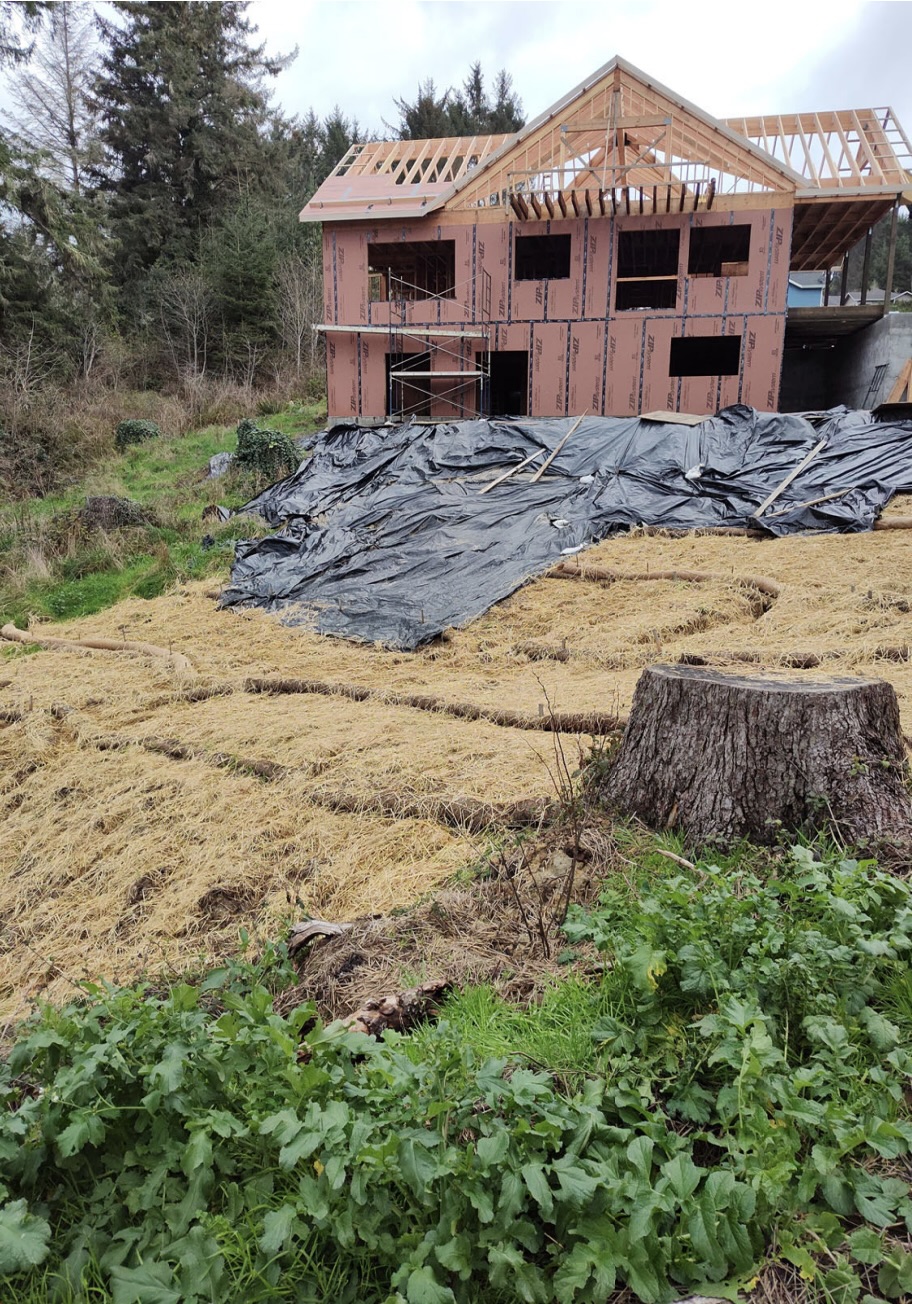
Photo from a county code enforcement inspection on Feb. 5, 2024.
###
Over the next few months, Duncan worked with CDFW and the county to resolve the issues.
“I don’t want any problems,” Duncan wrote to the county’s chief building official in June 2024. “We had to have dirt removed when this all started,” his email said. “I want this done right so I don’t have to have any calls or surprises.”
It’s not clear exactly when Duncan started bringing more dirt onto the property, but as documented by the all-seeing satellites of Google Earth, a huge volume of soil had been deposited onsite by the following May. A few months later, neighbors started submitting official complaints.
And yet, somehow, the first county employee to investigate those complaints said he found nothing amiss. It was Humboldt County Building Inspector Ross Eskra, who reported to Ingersoll and Quenell on September 29:
I visited 89 Blue Spruce today and there was nothing whatsoever going on up there related to the complaint. I was on site 2 weeks ago to final the house for Mr. Duncan and the site is the same today as it was then. Keith, can we close out this case now that the building final [inspection] has been completed?
The county did sign off on the building inspection, but three days later another complaint was filed — the one with video evidence. On October 2, the county issued Duncan another stop-work order, again citing unpermitted grading in a stream-side management area.
How had Eskra missed this during his prior visits to the property? He tried to explain it in another email to Ingersoll and Quenell, sent on January 5:
My initial drive by didn’t reveal what appeared to me to be any fresh dirt, large piles, etc. (which is what I was assuming there to be). There was just a lot of straw laid out for erosion and sediment control as I had previously recalled.
I made a case note and sent an email internally incorrectly stating that I did not observe anything substantiating the complaint. The complainant’s [sic] reached out to me by phone on October 1st asking about my findings, and I told them that I hadn’t substantiated anything.
They said they had evidence, photos and a video and I said that they could email it to me. … It turned out that it was an accurate complaint, and that a large amount of import and grading had been carried out effectively destroying the retention basin.

Felled trees on Duncan’s property in 2023.
###
Among the 575 documents the Outpost obtained through our Public Records Act request, one struck us as particularly unusual. It was a seven-page pdf that reads like a conversation without any attribution:
“How you doing?” it starts out. “Oh, not too bad for Monday. Right. Right. Oh, man. Well, not too bad. Never long enough, but it was nice. Yeah. Yeah.”
And so on.
We reached out to the county for help deciphering it. After a few days, Public Information Specialists Cati Gallardo wrote back, explaining, “This document is an AI-generated transcription from a routine meeting between Humboldt County Chief Building Official Keith Ingersoll and Code Enforcement Investigator Warren Black regarding the Blue Spruce matter. The transcript was auto-generated solely for note-taking purposes, so please be aware that some parts may not accurately reflect the exact wording of the conversation.”
Judging by the tone of the conversation, it seems likely that the two men didn’t know that their conversation was being recorded, or maybe they just didn’t expect the transcript to be released publicly. The document doesn’t differentiate between the two speakers — it’s just one long paragraph of text — but they seem to be on the same page.
The meeting was recorded on January 5. Below are a few excerpts, with line breaks added for clarity:
I don’t know if you were aware of that 89 Blue Spruce. They did a bunch of grading in the subdivision, built the house. Then the guy, when we go, they called for final inspection. So we finaled it, he had his road control, everything. But then we got a bunch of complaints over that weekend or two after, of several hundred dump trucks, supposedly. Basically, he leveled the, he did what he shouldn’t have done, dumped a bunch of fill, raised it. So we opened a new case. …
The guy hired Samara to help him do the plan. He had it all. Then he goes thinking, oh, now I can level my yard. Nope. And he did. And all the same complainants are complaining. Now we know he’s going to get hammered.
Well, yeah, especially with the state agencies right there.
But we had it figured out and now the guy just threw all that out. …
Yep. So he basically built a brand new house, got permits, dealt with the stop work order for the violation of the grading, then thought he could pull a fast one. And he did, and now he’s caught again. And this one, this time it’ll be hard to fix.
One of the two men in the meeting said the situation reminded them of Travis Schneider.
When we reached Duncan by phone on Tuesday, we asked if he could address the violations on his property and the county’s recent notice to abate.
“I don’t really think I want to talk about — I don’t know if there’s anything to really talk about,” he said. “I brought back the dirt that I had taken off the property. So I’m not sure, but I think probably not.”
We brought up the Wiyot Tribe’s concerns about impacts to their property. He thanked us for letting him know.
“I have people, friends at the Wiyot Tribe, so I’ll reach out to them and talk with them.”
We asked again if he could address the history of violations on the property.
“I’d really rather not,” he said.
Yesterday afternoon, we followed up with Ford to ask whether Duncan has complied with the terms of the county’s notice of violation and, if not, whether he’s being assessed the threatened fines of $2,000 per day. We’ll update this story if and when we hear back.
Duncan’s parcel.
CLICK TO MANAGE