
The Humboldt County Board of Supervisors (clockwise from bottom left): Natalie Arroyo, Michelle Bushnell, Rex Bohn, Steve Madrone and Mike Wilson.
###
The Humboldt County Board of Supervisors on Tuesday received a stark update on our region’s housing safety net.
Cheryl Churchill, executive director of the housing authorities for both the City of Eureka and the County of Humboldt, told the board that policy and funding changes from the Trump administration are set to reverse hard‑won gains in housing low‑income residents.
The two local housing authorities — Eureka’s and the county’s — are currently administering more than $16 million in federal housing assistance for families that mostly earn between 30% and 50% of our region’s median income. While the demand for such assistance is growing, federal housing officials have effectively frozen the Housing Choice Voucher (Section 8) program and are allowing key pandemic‑era subsidies to expire early.
Churchill explained that Humboldt County has been allocated more than 12,000 Housing Choice Vouchers on paper yet is only funded to support about 995 vouchers per month, with roughly 978 currently in use.
Since late 2024, she said, the U.S. Department of Housing and Urban Development (HUD) has barred local housing authorities from issuing new vouchers and has recaptured about $2 million in local reserves that had been fueling a significant expansion since 2024.
Special‑purpose vouchers for veterans, disabled residents and former foster youth are still being issued in limited numbers, but the larger program that serves most low‑income renters is in a “slow attrition” phase. Churchill does not expect that trend to reverse until 2027.
Compounding the problem, she warned, Emergency Housing Vouchers created during the COVID‑19 pandemic are running out of money years ahead of schedule, leaving roughly 70 to 100 local households at risk of returning to homelessness by around 2027 with no clear path to convert them into regular vouchers.
“When we talk about a good-sized group of people potentially facing homelessness and eviction over the next year, I don’t have a solution,” Churchill said. “We talk about this in our COC [Continuum of Care] meetings frequently. Nobody has a solution.”
Despite this dire state of affairs, the Eureka Housing Authority is pressing ahead with several major redevelopment projects in the city aimed at rehabbing and expanding the aging public housing stock from the 1950s and ’60s.
Churchill detailed three phases — nicknamed Green, Red and Blue (or Blue & Purple) — that will demolish and rebuild or substantially renovate older units. The Green Phase, for example, calls for a planned 44‑unit family project on Hiler Street while the Blue & Purple Phase will see a 44‑unit senior housing building at C and Clark streets. Both phases will be supported by state grants and tax credits.

Conceptual illustration of 44 new units of affordable housing slated for development at 3230 Hiler Street in Eureka, a project nicknamed “Green Phase.” | Screenshot.
###

The Blue & Purple Phase, which Churchill said “is honestly one that I am just kind of in love with.”
###
The Red Phase, meanwhile, entails the renovation of nearly 100 redwood-built public housing units from the 1950s and ‘60s, bringing them to “like-new status,” according to Churchill.
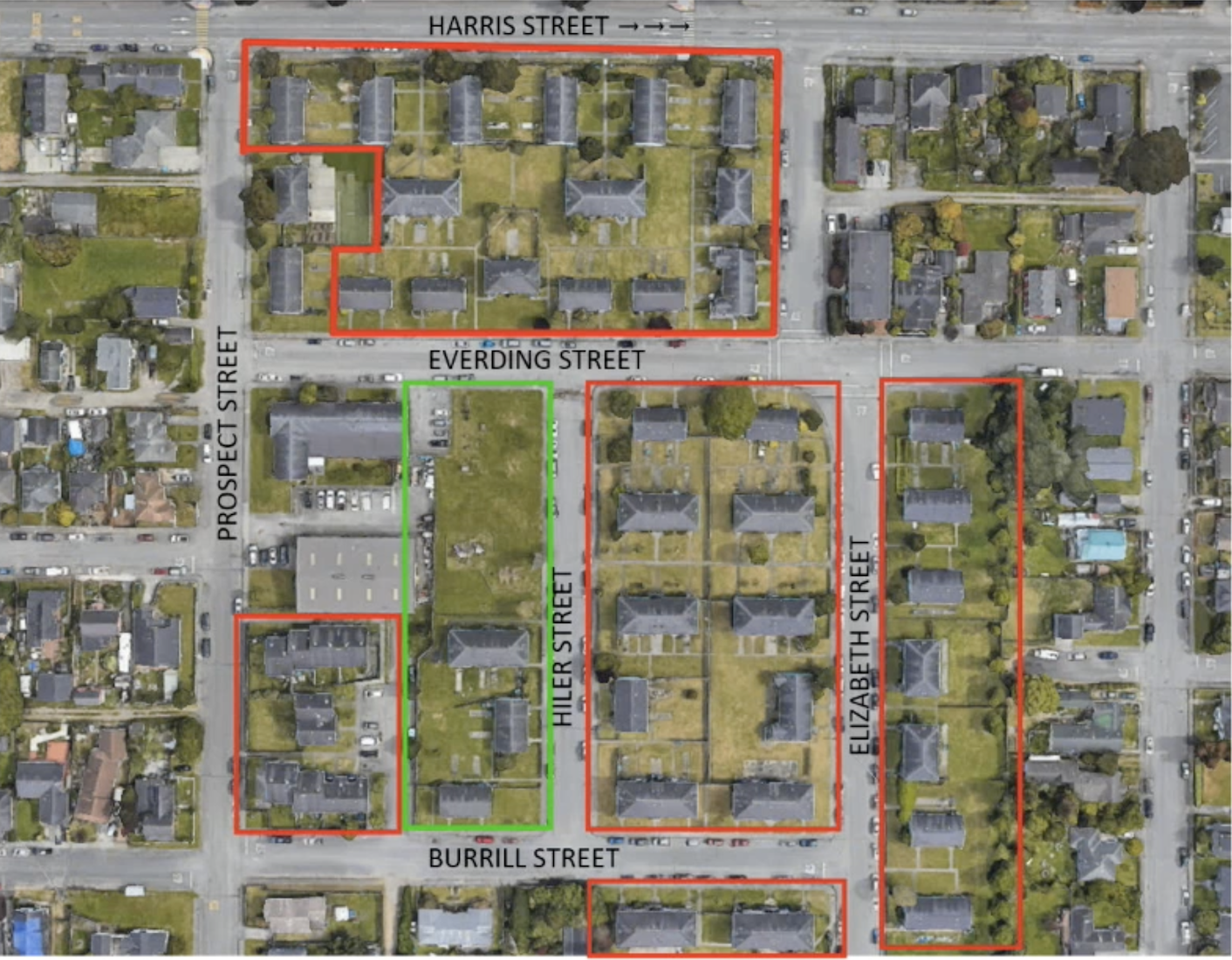
The “Red Phase” will include 98 units of rehab in the red-outlined areas.
###
Another state‑funded project will replace the undersized Boys and Girls Club facility on Prospect Avenue, near Winco, with an approximately 4,500‑square‑foot shared community space.
Waitlists for city‑owned housing units remain open, she said, even as voucher waitlists — which already hold more than 1,600 applicants — are closed until HUD allows new issuances.
Fourth Third District Supervisor and Board Chair Mike Wilson sounded off on the Trump administration, describing it as “hostile to housing people in general” and condemning recent legislation that stripped federal subsidies for existing housing.
“It’s so frustrating because the simplest and easiest way for us to keep people off the street is to house them in existing housing,” Wilson said. “[And] to have an administration that makes a conscious choice to defund that is shocking to me.”
###
Public Calls for Sheriff’s Oversight Board
Earlier in the meeting, half a dozen public commenters spoke in favor of establishing a community oversight board for the Humboldt County Sheriff’s Office, and while the assorted speakers didn’t identify themselves as any sort of official committee, they have evidently drafted a voter initiative intended for inclusion on local ballots in November.

Public speaker Caroline Griffith. | Screenshot.
“The residents of Humboldt County deserve professional monitoring and accountability of their public agencies, especially the powerful and influential Sheriff’s Office,” leadoff speaker Caroline Griffith said.
She referenced a 2024 Civil Grand Jury report advocating such an oversight body (a proposal that Sheriff Billy Honsal has publicly resisted) as well as the City of Eureka’s Board of Community Oversight on Police Practices.
The proposed Humboldt County Sheriff’s Policy and Practice Board would have subpoena power and be subject to the Brown Act and other public meeting laws.
“The board would serve as an impartial and objective, independent body that audits and assesses community complaints, jail conditions, budget and spending and certain specified critical incidents involving members of the Sheriff’s Office,” Griffith explained. By increasing transparency and providing a stronger, more independent review structure, this board would benefit both the public and law enforcement officials, she argued.
She asked the board to place the matter on an upcoming meeting agenda and then place it on the November ballot.
Other speakers endorsed this request.
“I was shocked to learn actually that the county doesn’t have an oversight board already,” Cal Poly Humboldt grad student Amy Scott said. “Eureka has had theirs since 2022; it has been useful. There was a great report about it even increasing police morale.”
Eureka mom and business owner Sierra Braggs said she works with people on the autism spectrum, many of whom “are terrified of encounters with law enforcement, because any time that they deviate from what is prescribed … literally their life is in jeopardy, and they’re very aware of the national stories of what can happen to people.”
Eureka City Councilmember Leslie Castellano was among the speakers advocating for a citizens’ oversight committee. She noted the successes of Eureka’s police oversight board, saying it has provided greater transparency, public engagement and trust in law enforcement.
“Trust is meaningful, and that trust requires community engagement and opportunities for serious public discourse,” Castellano said. “A ballot initiative would do just that and generally bring greater professionalism.”
###

Screenshot from a presentation on the latest Community Health Assessment.
Assessing Community Health
Does Humboldt County need a checkup? Couldn’t hurt, right?
Briana Sherlock, the county’s deputy director for public health, said her office routinely works on Community Health Assessments (CHA), compiling data on cancer, prenatal care, youth tobacco use, maternal and infant health, and adverse childhood experiences. This information helps to guide the Community Health Improvement Plan (CHIP) — a “treatment plan” that sets priorities every three years.
In the previous CHA/CHIP cycle, the community identified four main priority areas:
- Suicide prevention
- Substance use
- Housing instability and homelessness
- Healthy beginnings and adverse childhood experiences (ACEs)
The next cycle could be similar, or maybe not. It will depend on the data the county receives, Sherlock said, and she urged local residents to complete a new countywide health survey at livewellhumboldt.org. (You can also access it by scanning the QR code in the image above.)
As that web address suggests, this community health checkup is part of the broader Live Well Humboldt initiative, which maintains a publicly accessible community health data dashboard offering customizable data on health indicators. This dashboard is used by other government agencies, nonprofits and grant writers to track health trends and support funding requests.
Fourth District Supervisor Natalie Arroyo encouraged people to check out the dashboard, calling it “an incredible asset.”
Fifth District Supervisor Steve Madrone agreed, emphasizing the importance of taking the community’s “pulse” through regular surveys.
DHHS hopes to get at least 10% of the county’s residents (roughly 13,000 people) to complete the survey. As incentive, everybody who completes the survey will be entered to win a $30 Visa gift card.
Tidbits
- Humboldt County Aviation Director Justin Hopman is set to move back to Florida with his family after this week, after just two months on the job, but County Administrative Officer Elishia Hayes said he has “graciously” agreed to help the county through the transition process of recruiting and hiring his replacement.
- Humboldt County’s In-Home Supportive Services (IHSS) Advisory Board urged supervisors to oppose proposed state budget cuts that would eliminate emergency backup caregivers, link IHSS eligibility more tightly to Medi-Cal status and shift additional care costs onto counties. Board Chair Margaret Lewis warned of severe impacts on vulnerable residents local budgets.
- The board unanimously agreed to change the name of Cesar Chavez Day to “Farmworkers Day” in light of the recently surfaced allegations of sexual assault by the late labor organizer.
- Lisa Dugan, a member of the McKinleyville Community Advisory Committee, spoke in support of using a $50,000 state grant to fund an initial feasibility assessment for the long-discussed prospect of McKinleyville incorporating as its own city. Supervisor Madrone agreed, saying, “It’s high time we finally get the data so the community can actually have an informed discussion about revenues, expenses, pros and cons.” The board approved the proposal as part of the meeting’s consent agenda.
CLICK TO MANAGE