
The first fish hatchery at Humboldt State College. Photos via the Humboldt Historian.
###
The following piece has been adapted by the author from his book, Natural Resources at Humboldt State College — the First 30 Years. —HH.
###
In 1935-36, two events occurred which set the stage for the formation of a Natural Resources Department at Humboldt State. First, there was the 1935 authorization to expand the educational opportunities of Humboldt State College. From the time of its founding in 1913 as Humboldt State Normal School, the two- year Arcata college was primarily a teacher-training institution. Then in 1921, it became the four-year Humboldt State Teacher’s College. But in 1935, the school was renamed Humboldt State College and was authorized to expand its offerings in the liberal arts accordingly.
The second key event was the arrival of Hortense Lanphere in 1936. Hortense Marie Lanphere had just completed her master’s degree with a major in Zoology at the University of Washington. She and her husband, Professor William Lanphere, came to Humboldt State for the year in 1936, then returned permanently in the fall of 1938.
Hortense was brightly intelligent, had a strong will and a free spirit, and was intensely interested in the natural world. Probably from her awareness of the fish hatchery at the University of Washington, she was interested in researching fish culture.
However, the Prairie Creek State Fish Hatchery, which began operation in 1936, was not within commuting distance in those days. The enterprising young Hortense came up with a solution to her problem, and, without checking first with Vice President Homer Balabanis as was the usual protocol, she went directly to President Arthur Gist with her proposal. She proposed to build a small hatchery on the campus where she could do her research; it would be built without any financial support from the college; and she would volunteer to teach a class in Hatchery Biology.
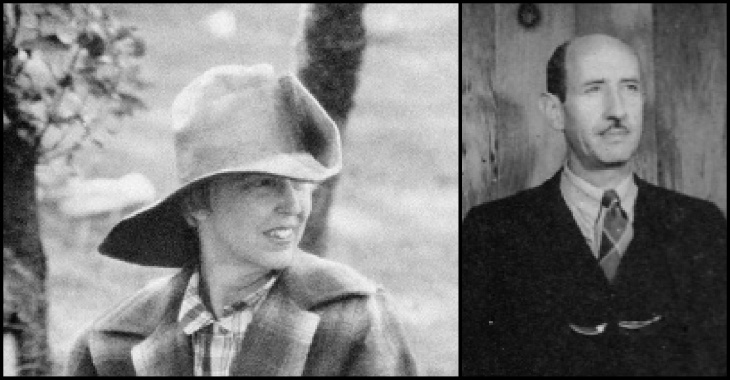
Professors Hortense and William Lanphere.
President Gist, whose primary interest at that time was the training of teachers and not applied science, was reluctant but said he would consider her proposal. He soon notified her that she could proceed the prospect of getting some students to enroll in her class at a time when the college was struggling to keep afloat likely appealed to him. He offered materials from a recently torn down dormitory for the construction of the hatchery and, if there were insufficient student interest, he offered that some of the janitorial staff could help clean the fish troughs. As Lanphere began preparing for what would be the first class in Natural Resources at Humboldt State, nobody guessed what would grow from this initial “proposal.”
Lanphere prepared plans for a building of nearly 300 square feet to contain four standard fish troughs and a small office. The hatchery would be located beside the stream just east of Redwood Bowl at the base of the existing dam creating Fern Lake. She established an account with $250 of her own funds to pay for student help and miscellaneous materials. Lumber and other supplies came from a variety of sources. Reclaimed lumber and probably plumbing supplies came from the demolished dormitory. The California Barrel Company in Arcata, managed by J. J. Krohn, a strong College supporter and avid sportsman, provided redwood bolts to make shingles for the sides and roof of the facility. Four troughs were obtained from Allan Pollitt, Foreman of the Prairie Creek State Fish Hatchery. Professor William Lanphere supervised the construction with volunteer assistance provided by William Johnson, Pete Petrovich, and Jake Relac of the College Plant Operations staff, and students including Gene German, Herb Christie, and Bob Bryan. Primarily for their work building the diversion dam, Nick Barbieri and Merlyn Allen were paid a total of $41.50 (at $0.50 per hour) from Hortense Lanphere’s fund. Lanphere’s records further indicate a total expenditure from May 1939 through June 1940 of $80.61 from her $250 for construction of the diversion dam, the hatchery itself, and miscellaneous supplies.

Hortense Lanphere’s account book for hatchery expenditures, page one.
Her class in Hatchery Biology was first offered in the Spring Semester of 1940 with a planned enrollment of 8 students. Twelve signed up. The students in that first class, each of whom paid $2.00 to help offset operational costs such as fish food, included: Merlyn Allen, Walt Farley, Herb Gomez, Axel Lindgren, Herman Jones, Harry Manning, Walt Munroe, Marshall Rousseau, Frank Sanderson, Al Simay, Richard Tinkey, and Alvin Wright.
Allan Pollitt delivered 10,040 eyed silver salmon eggs in late February. The fish started hatching within a week of their delivery and began swimming about in their troughs. When they were three weeks old, the students began to regularly feed them and clean the troughs. The effort culminated in late May when, with the assistance of Pollitt, the class planted approximately 9,000 fingerlings into Little River. This first academic effort in Natural Resources at Humboldt State was a resounding success and set the stage for the next development.
###
A second class in Natural Resources was launched when August Bade, then superintendent of the State Game Farm at Yountville, spoke to local sportsman groups in early January 1940 about the need for conservation of wildlife and showed pictures of the propagating and rearing of game birds. Later that same month, the Bureau of Game Farms of the California Division of Fish and Game was reported to be considering the development of a game farm with the involvement of Humboldt State College.

Professor Fred Telonicher.
As with the Fish Hatchery, a course of study was proposed along with the rearing project and students would be involved in the care of the game birds. Professor Fred Telonicher expressed interest and willingness to teach the class. President Gist supported developing a program of “practical instruction for students interested particularly in Fish and Game Conservation, forestry, or other related fields of study.” Dr. Homer Balabanis, Vice President of the college, and J. J. Krohn and Dr. Vernon Hunt, College Improvement Association members and avid sportsmen, undoubtedly influenced the President’s support.
Again, the avoidance of direct outlay of college finances was an essential condition for the approval to move ahead. However, due to the interest and support of local sportsmen, the development of pens to raise game birds received much greater publicity and outside assistance than had the effort of Hortense Lanphere. Building materials from the demolished dormitory were still available.
Authorization was obtained for workers from the Works Progress Administration (WPA), already on campus for other projects, to do the construction. And the Humboldt County Board of Supervisors agreed to provide funds: $640 for construction materials and $150 per year, funds available, for operations. These funds would be generated by fines levied on violators of state hunting and fishing regulations.
Work started on the new game pens in March of 1941. The pens were built immediately north of Nelson Hall (where Redwood and Sunset Halls now are located) and were ready to receive the first consignment of 250 day-old pheasant chicks from the Yountville State Game Farm in April The new Game Bird Management class had been started at the beginning of the 1941 spring semester with thirteen students: Herb Christie, Eugene R. German, Warren Haughey, Herbert Hudson, Fred Iten, Angelo Manfreda, Harry Manning, Marshall Rousseau, Elrid Spinas, Marshall M. Taylor, Ben C. Vonah, Arnold Waters, and Daniel R. Williams.
The students were assigned to teams who rotated responsibilities for the care of these birds and subsequent deliveries of chicks and eggs. By the end of the summer of 1941, 475 birds had been released at various locations throughout the Humboldt County. Local sportsmen, including Dedrick Oliver, Axel Anderson, J. R. Bicknell, Elmer Berg, Rease Wiley, C. J. Hill, Harvey Tighe, Waino Atilla, Roderick Frost, and Otto Klopp, gave a hand when it came time to release the birds in various North Coast areas from Ferndale to Orick. As in the hatchery, the hands-on instruction appealed to the students. However, sometimes extra hands were needed: Margaret Telonicher, wife of Professor Telonicher, would often have to help care for the pheasant eggs being incubated in her basement, especially when power outages necessitated that she use her oven to delicately continue the incubation.
###
The College had shown its optimism for the future of the program in the fall of 1940 with the announcement of a two-year program in Wildlife Management. The program included four courses in Natural Resources: Conservation of Natural Resources, Hatchery Biology, Game Bird Management, and Diseases of Game Birds. A Natural Resources program was up and running! Students showed enthusiasm and interest. But the advent of World War II brought the program to a virtual halt. There were fewer than 500 students enrolled at Humboldt State College in 1939 and 1940 and by 1943 and 1944 the enrollment dropped to around 200 with no more than about 50 men. Needless to say, enrollments in the Natural Resources courses declined dramatically and the Hatchery Biology course was not even offered in those years. But Vice President Balabanis saw the potential of the program and anticipated a renewed student interest as the World War II veterans returned. He later recalled that, “By then the program, in our eyes, was justified … our environment was a natural. And, one would think, ‘Why didn’t we do it before?’” He also noted that Humboldt State was the first college in the nation to boast both an on-campus fish hatchery and game pens.

Professor John Lewis.
Even though no student had yet completed the two-year program, a four-year baccalaureate curriculum with a major in Wildlife Management was developed as the war came to an end. Knowing that the program could not continue to be taught as an overload by Professor Telonicher and by Hortense Lanphere as a volunteer, a new faculty member was recruited to lead the program. Professor John Lewis began teaching in the fall of 1946, and, in fulfillment of Vice President Balabanis’ optimism, 40 students enrolled in the new degree program that fall. Professor Lewis was energetic and immensely popular with the students and the community.
As the program grew, Professor John DeWitt was hired in the fall of 1949 to lead a new and separate baccalaureate degree program in Fisheries. A tragic setback occurred when Professor Lewis died in an automobile accident that same fall. Lewis’s replacement was Professor Fred Glover who arrived at the beginning of the 1950 spring semester.
Through this transition, student interest remained high and growing numbers of students were being attracted to the program from throughout the state. Three new faculty members were hired in 1953 Professor Charles Yocom replaced Professor Glover, who had moved on to a position with the U. S. Fish and Wildlife Service. Professor Ed Pierson was hired to lead a new two-year program in Forestry-Lumbering, and Professor Mark Rhea was hired to lead a new two-year program in Agriculture- Dairying.
The size, importance, and future potential of the program was recognized in the fall of 1956 when a Wildlife Building was completed. A separate Division of Natural Resources was created with Professor Yocom as the Chairman. Though the proposed Agriculture-Dairying program never really got off the ground, the Forestry-Lumbering program generated immediate interest with enrollments growing rapidly. In 1956, the two-year program became a baccalaureate degree program with a major in Forestry. That same year master degree programs were authorized with majors in Fisheries and Wildlife Programs, such as Range Management, Oceanography, and Natural Resources Planning and Interpretation and other master degree programs would develop from these beginnings.
Hortense Lanphere clearly did not anticipate what would evolve from her first course in Hatchery Biology. In fact, when asked why she sought to build the hatchery and teach a class, it turned out that she was actually seeking a way to research Saprolegnia (a fungus) affecting salmon eggs, without having to over-expose her fingers to cold water because of her mild Raynaud’s syndrome, a circulation problem of the fingers. “Scrubbing one fish trough would be fun but more troughs would be contraindicated. Why couldn’t students do that?”
Even so, as was reported in the Arcata Union in 1944, “Through her suggestion, the hatchery was built and in the spring of 1940 she taught the first course … The opening of this course was primarily the beginning of Humboldt’s Fish and Game department.”
###
Richard Ridenhour was born and raised in Sonoma County. He attended Humboldt State College and received a BS degree in Fisheries in 1954. After attending graduate school at Iowa State College and then working for the Oregon Fish Commission, Ridenhour joined the faculty in the Department of Fisheries at Humboldt State in 1960, where he remained until retirement in 1992. His tenure included ten years as the Dean of the College of Natural Resources.
The piece above was printed in the Summer 2008 issue of the Humboldt Historian, a journal of the Humboldt County Historical Society. It is reprinted here with permission. The Humboldt County Historical Society is a nonprofit organization devoted to archiving, preserving and sharing Humboldt County’s rich history. You can become a member and receive a year’s worth of new issues of The Humboldt Historian at this link.
CLICK TO MANAGE