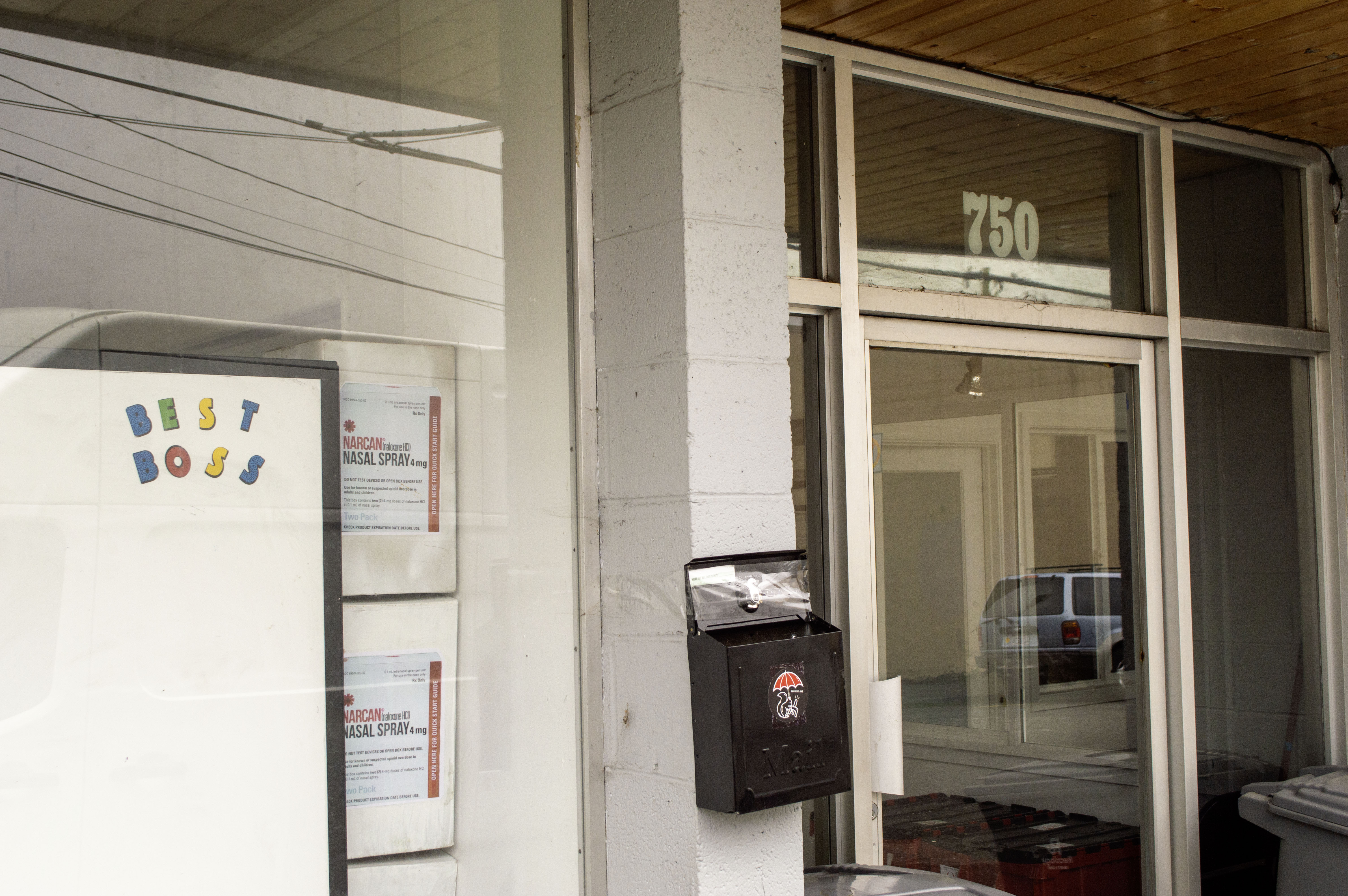
A window display at the new office. Photos by Dezmond Remington.
Adrianna Tatom had just started her own business, and she was excited. She’d sunk over $100,000 into a building a few blocks from the Arcata Plaza, outfitting it with all the equipment necessary to turn it into a bubble tea shop, Boba Monster. Sales hadn’t been astronomical, but she was hopeful that they’d grow.
At about the same time she moved in, so did another tenant, the Humboldt Area Center for Harm Reduction, who rented an office in the back of the building she shared with one other tenant. It was business as usual for a while, but she began to notice changes. People started sleeping in the bushes outside her storefront. The screen on her door went missing, as did the floor mats. Needles started showing up in her trash, and human feces on the outside of the building. Loose dogs ran rampant in the parking lot and added their own waste to the mix. People started leaving their trash in the lot and on her doorstep, “constantly” smoking cigarettes and hitting pipes. A van showed up one day; three people were living in it. Others congregated outside the office, out in the parking lot, around the clock, day and night, sometimes yelling at people walking by or her customers.
Many of them, parents or young students, told Tatom that they were uncomfortable with what was going on. Several of them said they were too scared to park in the back. Sales dropped. Tatom began to fear for her own safety.
“There were times in the winter, when it gets dark earlier, and I’m the only person here, and I’m leaving — I never know what’s gonna happen,” Tatom told the Outpost. “I remember, even in the daytime — the other day, there’s a girl out there, and I was bringing stuff in, and one of the workers was like, ‘Hey, you be nice to her.’ And I could hear her walking up behind me. And so I turned around, because she’s just out of her mind, you know? You never know what people are gonna do.”
This May, the organization left the office on 11th Street, as did the people sleeping in the bushes and frightening the customers and Tatom. Half a dozen employees and owners of businesses surrounding the lot HACHR occupied for two years shared similar stories with the Outpost. Many of the people who live and work near their new location, concerned about their safety or the health of their businesses, don’t want them there either.
###
Usually called by their acronym HACHR, the Humboldt Area Center for Harm Reduction is an advocacy group for the homeless and for people struggling with drug abuse. Founded in 2014, they provide harm reduction services, distributing free toiletries, fentanyl and xylazine testing kits, Narcan, and “safer use kits” with sterile tools for drug use.
HACHR is well known for its needle and syringe exchange program, which allows drug users to give them their used needles and syringes and swap them out for new ones. People are going to do drugs regardless of whether their tools are clean or not, the thinking goes, so it’s sensible to make using safer. Proponents argue that it’s also a public health issue. Dirty needles can transmit diseases like HIV and hepatitis, and stopping their spread helps the community at large.
It’s hard to assess the efficacy of the programs. A 1994 metastudy done by a group of Washington-based epidemiologists concluded that designing a study that could accurately judge how well a needle-exchange program stopped the spread of HIV would be extraordinarily difficult: the number of confounding factors researchers would have to factor in would be gargantuan, and asking subjects to participate in a truly randomized trial (asking one group of drug users to exchange their needles and telling another control group not to) would be unethical and logistically unfeasible. Other research has been more positive, though researchers noted similar hindrances.
HACHR’s program has a history pocked with controversy. An EPD investigation in 2020 found that they were “complicit” in allowing their clientele to use and traffic narcotics next to — and on — their property. Undercover officers reported that HACHR employees allowed people to get high in a bathroom on their premises. A long series of back-and-forths between HACHR and the city of Eureka followed, and HACHR eventually ended up leaving. It moved to a location in Valley West in 2022, next to the Harbor Freight and the Kebab Cafe gyro shop.
###
During the course of the Outpost’s reporting, many of the sources interviewed requested anonymity because they were afraid of HACHR’s ability to mobilize against organizations and officials it has deemed are working against it. Last summer, HACHR, among other organizations, brought dozens of people to two meetings of the Arcata City Council and managed to halt city business almost completely. Many of the people the Outpost interviewed are business owners and employees with thin margins; any retaliatory actions could put them in the red. “If they took an activist approach against the small business,” one said, “it could be the death knell of them.” Several residents who live nearby HACHR’s new offices, fearing damage to their personal life and homes, also requested anonymity.
Reached via email last Thursday, Ethan Makulec, HACHR’s executive director, declined a request for an interview, but, in addition to sending a short statement, they asked us for a list of questions. As of publication, they haven’t responded.
HACHR spent two years in Valley West before moving to its location next to Tatom in May 2024, at 625 11th Street in Arcata. Things were quiet for the first year and a half of their tenancy, employees at several nearby businesses said, but near the end of 2025 things started to change. People loitering in the parking lot next to their offices became a “constant” presence at all hours, playing music and dancing late into the night. They “spilled” out of the building, one person said. They camped in the parking lot, both in a van (and underneath it) and outside, in the lot and in the bushes. Cars idled for hours; human and animal waste cropped up everywhere. The list stretches on. “This place is a cesspool of filth,” one business owner said in a letter to city councilmember Alex Stillman. “…Do not be sentimental about this facility.”
Their behavior often went beyond merely soiling the parking lot. Several people told the Outpost that the campers often screamed at people walking by, sometimes forcing them to duck into a building until it stopped. They got into fights. Drug use was rampant. They smoked pipes and injected in plain sight, according to several eyewitnesses. Two sources told the Outpost that they saw the campers taking turns using the public bathroom down the street; they passed an “oily” children’s backpack between one another when they traded off using the bathroom.
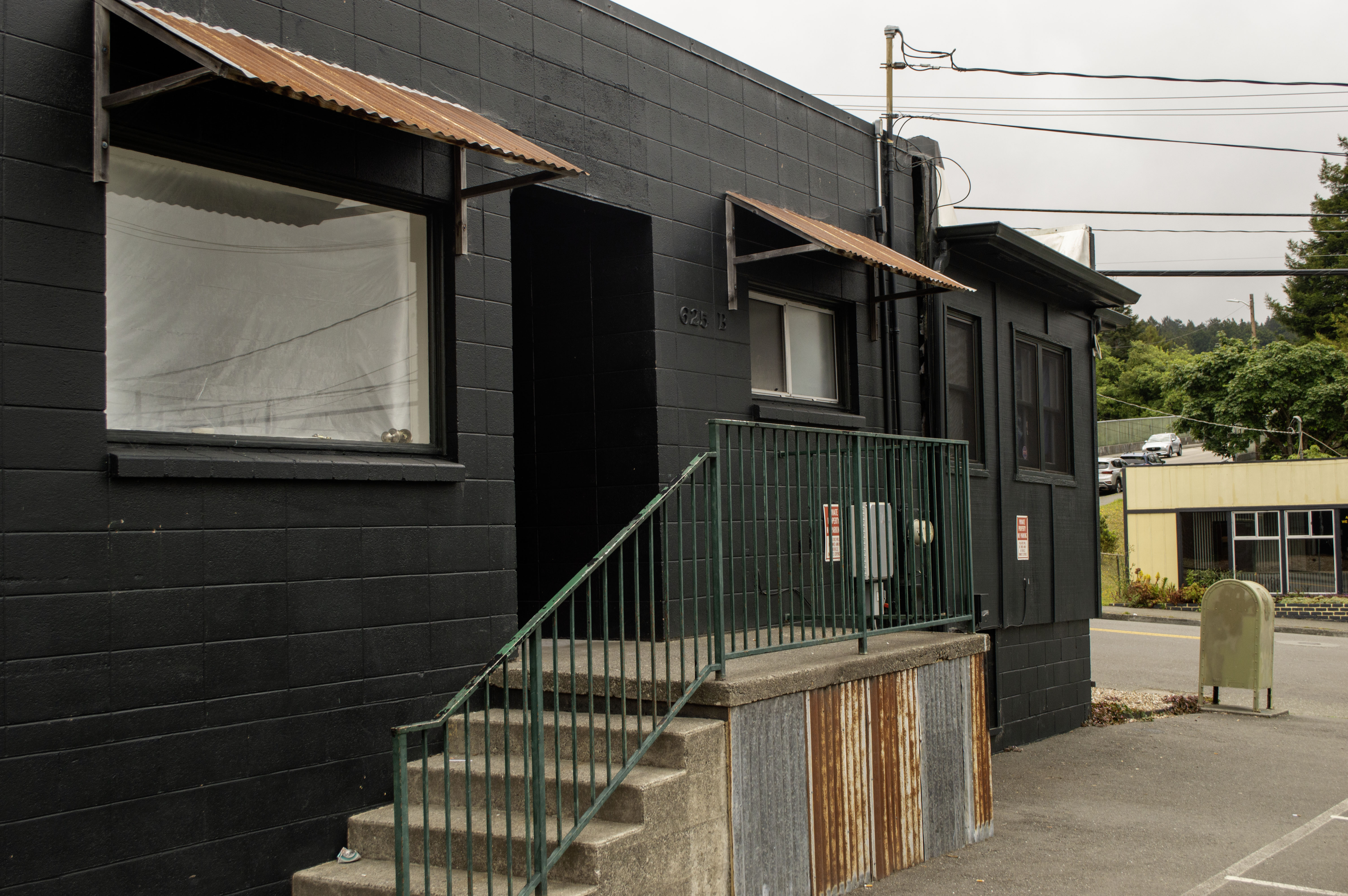
The back staircase at HACHR’s previous location on 11th Street.
HACHR’s role in allowing and perpetuating the behavior is hard to pin down. When they moved in, they told the building’s owner, Patrick Buckwalter (CEO of a local solar panel company) and its manager, Complete Property Management, that HACHR was only going to use the office for administrative purposes. HACHR operates a mobile syringe and needle exchange service out of a van as well, and told the property managers and Buckwalter that it wasn’t going to exchange paraphernalia out of the office.
Though HACHR has been accused of side-stepping needle-exchange regulations in the past, Arcata City Manager Merritt Perry sent the Outpost a statement clarifying that the city has notified the California Department of Public Health that HACHR has conducted harm reduction services outside the areas its permit allows it to, like on private property and near city parks. Arcata asked the state to “communicate with their permittee” that HACHR can only “conduct their business within the authority of their permit and only in authorized locations.”
“So far that approach seems to be working,” Perry said.
People who looked unhoused often went into the office and came out with packages, sources said. They don’t know what was inside. One source said she saw people leave items in a red tent someone set up in the parking lot and enter the building. They looked intoxicated when they left, she said.
“This is a party,” one employee of a business near the office told the Outpost. “It’s a nightclub for transients. Like, not office space. I don’t know what office space has transients partying at 10:30 at night. That isn’t an office.”
HACHR dealt with similar problems when it had office space in Valley West, sources said. Sherilyn Munger, the owner of Complete Property Management (CPM), told the Outpost that she was aware of HACHR’s reputation when they moved in, but Ethan Makulec, HACHR’s executive director, told CPM that they were looking for another place that they’d offer their harm reduction services from. Munger said Makulec was easy to get along with and paid the rent on time. “It seemed like a good idea at the time,” she said. “They qualified.”
Buckwalter, the owner, told the Outpost that he had never heard of HACHR, but he was sympathetic to what it did; he had had a friend that died from an overdose. HACHR does good work, he said, and it’s important to weigh the negative impacts they have on the community with the good ones as well.
“I was torn,” he said. “We’re very sympathetic with the work HACHR does. But, you know, I don’t want the neighborhood to suffer because of them being there.”
Neighboring businesses reached out to Buckwalter and CPM, asking them to force HACHR to clean the lot up and stop people from loitering outside and harassing store customers and passersby. Munger said that, despite Makulec’s efforts, they were unable to make a large difference. Munger said it was Buckwalter’s decision to not renew HACHR’s lease; Buckwalter said he wasn’t sure whose decision it had been. Both parties said it had been made several months before the lease ended in May.
HACHR wasn’t generally very receptive to complaints, sources said. A group of HACHR employees burst into one of the businesses that contacted Buckwalter and CPM, asking them why they “told on them” to the landlord.
The city wasn’t very helpful either, they said; one person claimed the police department told her that they couldn’t do anything about it, and she felt ignored by the officials she contacted. Tatom, fearing retribution, didn’t reach out to the city or the police.
City hall knew about the situation and was monitoring it, Perry said; police issued citations if they saw someone violating city code. “It is always harder to follow up on complaints after a violation occurs,” he wrote, “which I think may have led to perception about lack of enforcement in this situation.”
“The vast majority of our relationships with nearby businesses, our property managers, and other neighbors has been positive at both our previous and new office location,” Makulec wrote in a statement sent to the Outpost. “I would happily reach out to any of these people if you’re interested in hearing their perspective. The complaints you have listed are not supported by the reality of our time there, and sound like the commonplace prejudice and fear-mongering that the communities of marginalized people we serve are made to suffer every day. This stigmatization can threaten the health, well-being, and survival of marginalized people, so I hope this article will not spuriously exacerbate such stigmas.”
Not everyone near HACHR’s 11th Street office had bad things to say about their former neighbor. An employee of a nearby business told the Outpost that he respected HACHR for doing a job no one else wanted to do. Nobody messed with their stuff; his employer didn’t take a hit because it’s appointment-based. He didn’t enjoy seeing the poverty and drug abuse outside his window every day, but he said he recognized the need. “They’re the first line of resources that I don’t want to provide,” he said. “I’m cool with them. Fuck it! It’s gonna happen next to someone.”
“Poverty isn’t an easy thing to see,” he continued. “You look at that, you think, ‘That could be me someday.’”
Casey Waterman, the owner of New World Water across the parking lot, said that “Bobby,” one of HACHR’s employees, planted flowers and became her friend. She saw the refuse in the parking lot, saw the drugs, saw the dogs running amok, but said her experience with HACHR was mostly positive. Bobby cleaned up dog and human waste from the parking lot and near her back door, and he helped her move heavy pallets.
But Waterman had her limits, too: she later sent a letter to Arcata City Hall asking that HACHR be banned from occupying the building it’s now moved into, at 750 16th Street. It’s a few blocks from Arcata High School, and she and many other people interviewed by the Outpost are worried that its proximity, combined with the likelihood the same people will be hanging around, could have drastic effects on the hundreds of teenagers that flood by every day.
“They do attract a really rough crowd (that seems to be increasing all the time) who do hang about the premise day and night,” Waterman wrote. “Beyond their presence I haven’t personally been affected. But I have spent enough time observing that it is absolutely an inappropriate group to parade high school students past on a daily basis.”
“But mostly it is absolutely a danger to young children,” she continued. “After a year of being across the parking lot I can one hundred percent say with confidence that the safety and wellbeing of children has to come before the needs of the folks this establishment is helping…I agree their services are needed but that location is wildly inappropriate.”
Buckwalter, the owner of HACHR’s old location, agreed. He wrote a letter to the city that the Outpost obtained, claiming that HACHR told him that its use of his building would be “administrative” in nature. However, he wrote that he saw many of the things people contacted him to complain about; the amount of foot traffic the location got was also higher than he anticipated. He said he thought that a different location, farther away from the high school and the many businesses in Northtown, would be a better fit.
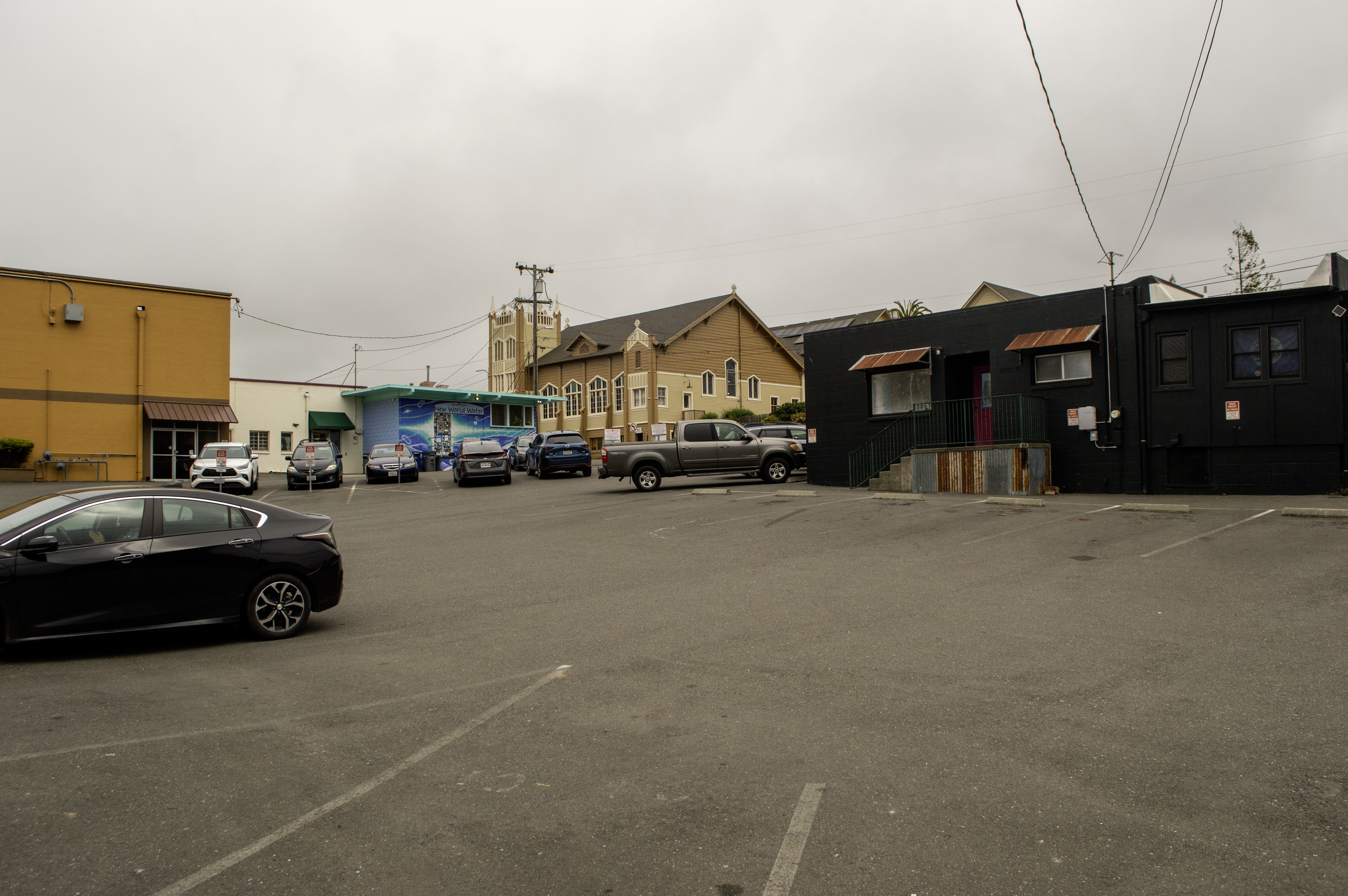
The parking lot behind the old office.
Almost all of the business owners and residents near HACHR’s new location the Outpost contacted, about a dozen total, had similar reservations. They don’t want the kids anywhere near the office, even if its tenancy is only going to be “administrative” like the previous office was supposed to be.
“Every community has drugs in it, but we have a prevalence of drugs in our community, and I don’t think it’s a wise move for the city of Arcata to expose the kids to something like that on their lunch break,” Holly Ameline told the Outpost. Her business, Northtown Coffee, is around the corner from HACHR’s new office, and she has a child graduating from Arcata High this year. “…When people are hanging out, they’re gonna talk. And if the high school kids start chatting with them, and — I just don’t know if the exposure on their lunch break is the best idea.”
Roger Macdonald is the superintendent of the Northern Humboldt School District, which includes Arcata High. He told the Outpost that he was meeting with Makulec soon to talk about the district’s expectations. Macdonald’s aware of the issues that plagued HACHR at its previous location, he said, and the district will do what it can to prevent them from repeating.
Many of the business owners are already struggling to make ends meet, and they’re worried about their bottom lines as well. Justin Brown, owner of Revolution Bicycles, said that he didn’t think the office was a good fit in Northtown. He’s dealt with multiple break-ins over the years and isn’t excited about the prospect of dealing with more.
“It’s just not what we need in this neighborhood,” Brown told the Outpost. “If they want to support that community, they should be where that community is, down by Samoa Boulevard. It’s just unfortunate. It’s really, really hard to do business in this town right now, just to keep the lights on, and it’s just expensive. I can’t afford the customers being turned away because they are being harassed, getting out of their car or whatever.”
Another businessman nearby said that a HACHR employee had visited him recently and told him that he wouldn’t see an impact. If he’s right, then he’s not against it, but, considering HACHR’s past promises, he’s not certain that’ll be true.
“There are people that, if they come here, and they have a bad experience, and there’s some scary dudes out there or something, someone’s passed out, they’re not going to stop,” he said. “They’re leaving.”
Most of them noted HACHR’s history of skirting the law and breaking rules set up for them by landlords or by the government; they don’t think any real changes in HACHR’s behavior are likely.
“I don’t see anything changing with their past patterns,” one business owner told the Outpost. “Something keeps happening in a cycle. I feel like that’s going to continue to happen. I don’t believe that it’s going to — all of a sudden — going to change their way, to rectify things.” Brian Kaneko, owner of True Nature Tattoo, pointed out that even HACHR’s business card advises that people calling 911 to save someone from dying of an overdose avoid telling first responders that an overdose happened, instead asking callers to say that they’re “with someone who is unresponsive.” [The bolding is theirs.] Kaneko said that Makulec had told him they were only moving because they wanted a bigger space, and denied that Buckwalter and CPM decided not to renew HACHR’s lease. Kaneko had seen Buckwalter’s letter, and knew that wasn’t true.

The outside of HACHR’s new office on 16th Street.
Kaneko is one of about 16 signatories of a petition being passed around the area calling on the city to force HACHR to acquire a conditional use permit that would, in their minds, stop it from allowing people to loiter outside their office, and preclude them from offering any services that attract people in the first place. (Buckwalter also signed it.) The petition’s creator, business owner Jesse Almas, told the Outpost that he hoped it would allow the public to have some input over HACHR’s operations, and also force HACHR to clarify what it’s planning on doing in its office.
“If there are conditions of approval that have taken public input into consideration, then city would actually have some teeth to ask HACHR to rectify the issues,” Almas wrote in a statement sent to the Outpost. “Other businesses are required to follow rules required by their CUP’s and there is a public process that helps officials arrive at those rules. I don’t see why HACHR should be any different.”
City Manager Perry said it was unlikely HACHR would be able to provide harm reduction services out of its offices on 16th Street. Because so many businesses and residents have expressed their apprehensions, the city would probably notify the California Department of Public Health to request that it deny HACHR permission to operate them there. Arcata doesn’t require anyone to have a conditional use permit to maintain an office.
All of the business owners the Outpost talked to said they thought the services HACHR provides are important, maybe even necessary; they just don’t want them offered anywhere nearby. A few of them suggested somewhere near a hospital would be a more appropriate location.
Not everyone cares. Ted Marks, the owner of Norcal Tattoo, down the street from HACHR’s new offices, said the uproar reminded him of his own start when he began tattooing.
“I had to deal with the same stuff,” Marks told the Outpost. “People envisioned a tattoo shop was going to be the worst thing in the world: bikers hanging out, drug addicts. I dealt with the same discrimination. They go and try and get petitions. I’ve been on the other side of that Frankenstein-kinda thing.”
Another shop employee agreed. James Kerr said he was once a “street kid on drugs”; his wife, Sarah, “saved” him, he said. Sarah was on HACHR’s board of directors from its founding in 2014 until last year. Kerr said he doubted HACHR moving to Northtown would change anything, and said what the people near their previous location were dealing with couldn’t definitively be proven to be HACHR’s fault.
“It’s hard to argue with the argument that they’re enablers, that they’re enabling drug addicts,” Kerr said. “However you define that term, it’s definitely true, right? However, they’re not gonna stop them from using. That’s a fact.”
“It’s a little more nuanced and subtle, and it’s not so black and white when you dig into the whole issue,” he continued. “It’s a very complicated issue, very emotionally charged on both sides, because, I think, both sides, all we’re trying to do is keep our community safe.”
The Outpost spoke to several nearby residents, most of whom also aren’t thrilled about their new neighbor and the people it often attracts.
“They’re not going to get in a cab and drive 10 miles away and do drugs,” one said. “No. They’ll be a foot off the curb, and they’re going to do it in the neighborhood.”
Ranika, a Cal Poly Humboldt student who lives near the office, said that she was glad HACHR was moving in. Homeless people are people too, she said, and even if they’re not well mentally, it’s still possible to reason with them and sympathize with them. She’s willing to wait and see how things go. She’s from Oakland, and she said she knows how to deal with it.
“I’m just pretty desensitized to homelessness,” she said. “Honestly, that would probably make it feel more like home for me.”