Italian aliens who passed over designated lines or broke curfew rules in Eureka and Arcata during World War II risked getting arrested. In addition, if they happened to be living on the “wrong” side of a line, they were forced to move out of their homes. As a result, some lost their homes, jobs, freedom to visit friends and relatives and were required to remove their children from neighborhood schools. In addition, stores, movie houses and other establishments in the restricted zones were off limits.
Stephen C. Fox, professor of history at Humboldt State University, outlined the plight of resident aliens in a talk to the Humboldt County Historical Society at the group’s annual dinner meeting held February 21 at Eureka Inn. Fox, who came to the university in 1969, is writing a book on the relocation of Italian aliens in California during World War II. The book is scheduled to be published next year. It is based on some 40 interviews with surviving Italians and their families from throughout Northern California, from McKinleyville in Humboldt County to Monterey.
“It was a crazy time,” is the way that Fox characterized the hasty, desperate events that followed the Japanese attack on Pearl Harbor on Dec. 7, 1941. Government officials conceived the notion that there were communities of “enemy” aliens, or Fifth Columnists, ready to strike the nation from within. Restricted areas were established around port communities, including those on Humboldt Bay, and aliens were told to leave the off-limits zones. Thus families found themselves separated from a section of their community by a boundary street or road.

In Arcata, none of the aliens could live west of G Street and in Eureka, Fourth Street and Broadway was the boundary line. Some families had to move just across the street while others had a longer distance to go. The Humboldt Bay area from Mad River on the north to Eel River on the south, was in the restricted area. The program was instituted statewide under pressure from the public, politicians, the news media and congressmen representing the West Coast. The architect of the plan was General John De Witt who was in charge of West Coast security.
Finally, reason began to prevail when a Congressional Committee conducted an investigation of the relocation system and heard on-site testimony to consider he wisdom of the plan and to check on the way it was being implemented by the Army. The committee was sympathetic to the plight of the Italians as well as some Germans who were subject to the program. Finally, in June, 1942, the Italian aliens were allowed to move back to their homes and on October 12, Columbus Day, The Attorney General declared they were no longer considered enemy aliens and all restrictions were removed. In December, the same treatment was accorded German aliens.
Some insights on what happened during the relocation period can be drawn from excerpts of two interviews conducted by Fox with Arcata residents Marino Sichi and Joe Nieri. Their comments follow.
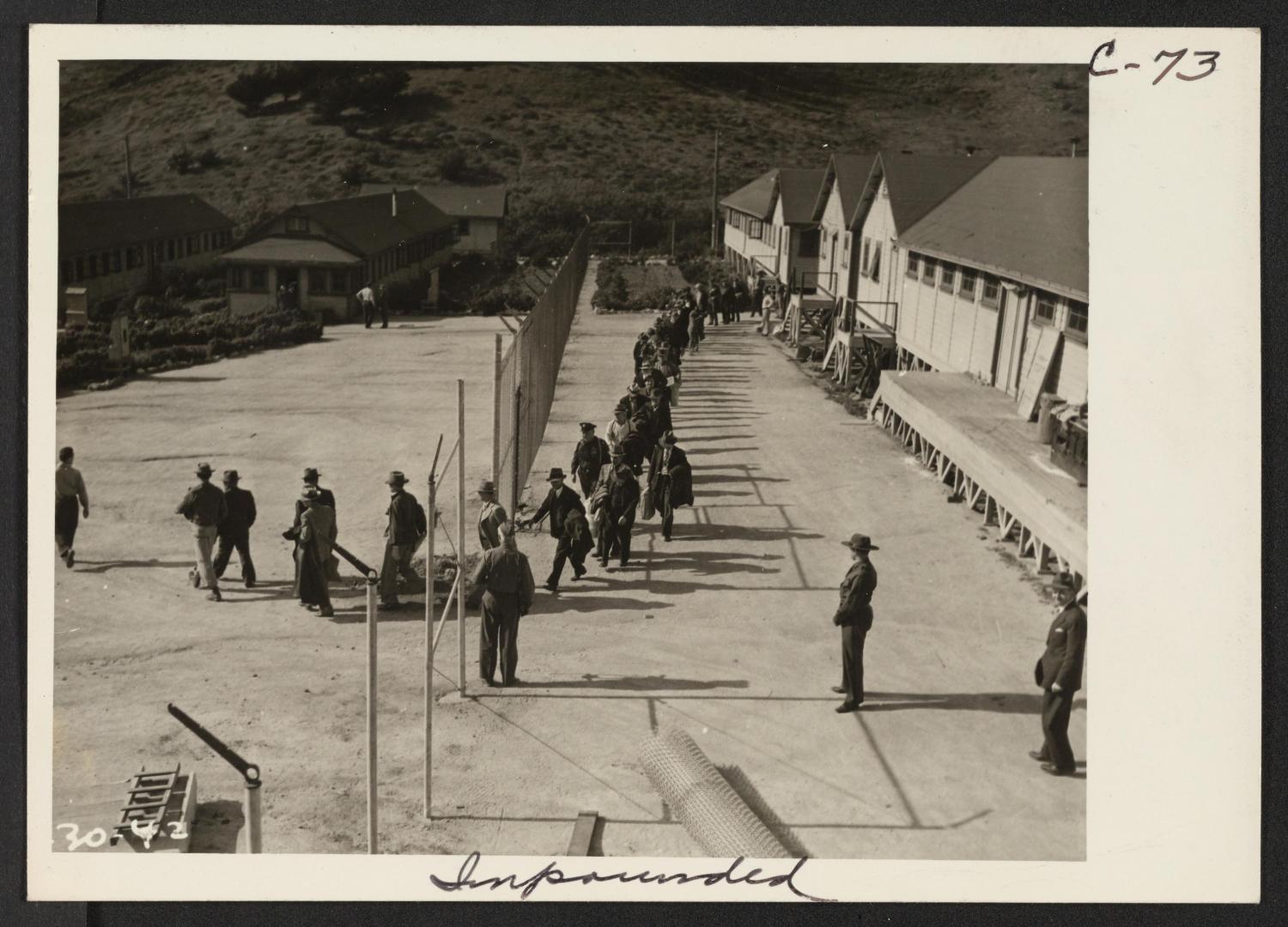
Sharp Park. Image: Public Domain, Link
MARINO SICHI
Marino Sichi was arrested by the FBI for curfew violation. He was transported first to the Immigration and Naturalization Service’s temporary detention center on Silver Avenue in San Francisco, then to Sharp Park, a larger barbed wire camp for a variety of security violators. This excerpt of the interview begins with his description of Sharp Park.
I remember the camp was divided in half. The Japanese were on the left side as you went in, and we were on the right. I don’t know, it seemed like there were thousands of people; it was quite a large gathering. There were Germans, English, French, Italians, every nationality you could think of, practically…
We didn’t get to talk to the Japanese. They had us separated by a big fence. It was a double fence, big enough to drive a truck between, and they patrolled it steadily, on foot and by truck. It must have been at least ten feet high with barbed wire coming up on the ends of both sides. Couldn’t get in or out.
We had barracks, mess halls, a camp bakery. Naturally there was a commandant’s office, and everything was enclosed by a chain link fence. There were guard towers at every corner and all around the perimeter. Those guards were armed; I found out the hard way. We were playing baseball one day, and I was out in the field. Somebody hit a ball and it got past me. I ran after it and everybody was shouting to hurry up and throw the ball in. All at once I heard a sound that made the blood kind of stop. Heard a “click-click,” and when I looked up I’m looking down the barrel of a 30 caliber machine gxin aimed right at my head. I wasn’t more than five or six feet from the fence and he was right above me, just motioning me off. He says, “You aren’t supposed to be near this fence. Back off.” I tried to explain that I was just after the baseball, but he said, “I don’t care what you were after. The next time we’re going to shoot…
I had mixed feelings about this country. I wanted to stay here. I wasn’t too happy about the situation because I figured I wasn’t doing anything wrong. So I was born on the wrong side of the ocean. It wasn’t my fault. I had applied for my citizenship papers and if things had been different I would have had ‘em. But it just didn’t work out that way. So, just because of a technicality I was thrown in the hoosgow.
I didn’t like that, and I wasn’t too happy about being drafted later on. By then I was back at work at the bakery on the “right” side of 4th Street. I was even classified as essential labor. They didn’t seem interested in me, then all at once they started after me. When I went down to San Francisco I said, “What are my options. I’m an enemy alien.” The Marines refused me. They had a desk with three people: Army, Marines and Navy. The second man, the Marine, took one look at my papers and said, “I don’t want no damn enemy alien.” I thought, “Thank God.” He threw my papers over to the Navy guy and he said the same thing. “Thank you,” I said, “You can’t dig a fox hole on the deck of a battleship.” And he threw me to the Army guy who said, “We ain’t particular. We’ll take you.” So I went in the Army. I went down a number of times before they finally took me in February of ‘44 because I was classified 4-F. I had problems with my stomach since about 1939…
One thing though, the Army handed me my citizenship papers with an M1 rifle. When I passed the physical, I asked what my options were. They said you can refuse induction and you’ll never be a citizen. We may ship you back to Italy. Or you can sign up and you can get your papers. They didn’t tell me I’d go to jail, just that they might ship me back to Italy. I was already a draft dodger from Italy. They called me up to serve in the Ethiopian campaign when I was seventeen, and I said, “Go to hell. I don’t owe you anything.” The Italian Consul in San Francisco called me up. They were calling all the Italian citizens who were born in 1920. They called it the “Class of 1920.”
If I tell you how I got my citizenship papers, though, you’ll laugh. If you could see it … Camp Fannan, Texas, middle of summer. They told us to put on our Class A uniforms; we were going to town and become American citizens. They loaded up onto these “six by” trucks and headed for the county courthouse. Deaf Smith County, Tyler, Texas. We went up to the judge’s chambers, and there was a character strictly out of Judge Roy Bean. Boiled white shirt, string tie, white suit, planters hat lying on the bench next to him, and a big mouth full of chewing tobacco which he spit into a spittoon. I remember him saying, “You all swear to uphold and defend these here — pttttt — United States of America — pttttt?” And he’d clang that old spittoon every time. You wouldn’t believe it unless you saw it. I got a little slip of paper that said I was now a citizen of the United States. That’s ail there was to it. There were Germans, Italians, you name ‘em — Austrians, French. We went down on the courthouse lawn and we rolled and we laughed; it was the most hilarious thing we could think of. This was supposed to be a solemn occasion, and here was this judge with his “pttttt.” He could hit that damn spittoon from six paces…
JOE NIERI
We came when I was three years old. The family settled here and dad worked in the lumber mills and camps. Along comes the war. World War II. My dad was not considered an “enemy” alien, because he was born in Brazil. He got his citizenship, I’d say, after the war; I can’t remember what year it was. It was after we came back from the army, though. But my mother and my brother and I had to relocate across this imaginary line — G Street in Arcata, the old Highway 101…
I was seventeen, and a senior in high school. It really hurt me ‘cause we had all gone to school with these kids from grammar school on up, and of course we knew everybody and they knew us. I was supposed to graduate with them, and was looking forward to it. Well, my brother and I lost that year of high school. I had to go back to the class of ‘43. But when the class of ‘42 had their reunions they always asked me: “Well, you were in our class, right?” I said, “Yes, but if you remember correctly they had this ‘enemy’ aliens thing, and we weren’t supposed to cross the line.” Course those kids now, they say, “Oh well, it was a stupid thing to do to a person.” There were three of them that I talked to; they kind of forgot what happened. But I said, “Do you remember when we had to go across that imaginary line?” “Oh God, yes, we forgot about it.” I said, “Well, I didn’t!” So I have to go to reunions with the kids that were behind me. It comes up every time and it brings back old memories. It bothers me, it really does. You kind of forgive, but you can’t forget. It’s embedded too deep.
I was on the first string basketball team, and that’s another thing that hurt me. I was going to get my second stripe and then a sweater. I could have walked around school with two stripes on my sleeve! I couldn’t participate in sports in ‘43 either, because technically that would have been my fifth year in high school, and they only accepted four years of athletic eligibility. That’s something that really hurt. I couldn’t even get into the yearbook, my pictures or anything like that. I didn’t try to argue with them, but I explained, “It was five blocks from this imaginary line. What harm is it going to do? Just let me go to school for another year, until the end of June.” And they said, “No. We’ve got orders to relocate you, and that’s it. You have to go…”
We couldn’t travel across the imaginary line. If we had to go to the dentist or a doctor — they were on the west side of the line — we could cross but we had to get a police escort. To go from our house to the doctor or dentist they had to call a police officer to come and pick us up after we were through. Just like we were in jail. I thought it was really foolish, or stupid, or whatever you want to call it. The dentist and doctor were on the plaza. They thought it was kind of dumb, too, but they had to go by the regulations. They were all sympathetic.
Besides not being able to cross this line, we had to be on our property by 7 o’clock at night. No later. And if we were out, well there were two or three spies around — neighborhood people — who would report us to the police. There was one guy that we know who turned us in; the police chief told us.
I couldn’t get a job; all the jobs were on the west side of the highway. All we could do was sit around the house. We used to love to go clam digging, but that was too far for us to travel. And on Sundays, all the grocery stores and other stores were closed. Before the war the family used to go on picnics out at Camp Bauer or Blue Lake. And we couldn’t even do that; we had to sit at home. The Japanese were in concentration camps; I really felt sorry for them. But we were just like in a concentration camp, too, but for a short time…
They made us go in the Army. We had to register for the draft, even being “enemy” aliens, which I could not comprehend. Course at that time I didn’t understand too much of what was going on. Whatever they told us, we did. So we registered, and I said, “Well, I’m not going into the draft because we’re ‘enemy’ aliens. We’re not supposed to be in the army or the armed forces.” We registered anyway, and got a notice to report to San Francisco. But we didn’t go. We were that bitter. So they sent a sergeant, or somebody, and the local police. They came over to our house and gave us an ultimatum: “You will go down for a physical and if you pass, you’re going to go in the Army or you’re going to prison.” So we didn’t have too much of a choice. We talked it over and thought about it, and decided we didn’t want to dirty the family’s reputation. So we said, “Don’t ruin the Nieri name. We’ll go.” So we did. We went in the Army on May the 3rd of ‘44.
At first we were in the artillery down at Camp Roberts. About two months later they took all the aliens — mostly Mexicans — over to the county seat at San Luis Obispo. They swore us in and gave us our citizenship papers. They couldn’t have an “enemy” alien in the Army, so they had to — we had to be citizens. Later we found out that because they needed more infantry for the Normandy invasion, we would have to convert to the infantry. But of all the places, we were sent to Italy! And we got into the fighting there, just above Rome. Yeah, It wasn’t very pleasant, but it was the last two weeks of the war…
I saw all the aunts, uncles, cousins. In fact, I even saw the house and the room I was born in. The people were really glad to see us. When the Germans made a final push up there by Milan I got hit in the back with mortar shrapnel. And of all the places to be sent, I was sent back to Lucca, my home village, to the field hospital. My brother was hit, too. We were in the same foxhole. They sent us to this field hospital in Lucca, and we were talking to this civilian who knew my uncle and he told him and the family came over and visited us. That’s how we got to know where they were.
###
The piece above was printed in the March-April 1988 issue of the Humboldt Historian, a journal of the Humboldt County Historical Society. It is reprinted here with permission. The Humboldt County Historical Society is a nonprofit organization devoted to archiving, preserving and sharing Humboldt County’s rich history. You can become a member and receive a year’s worth of new issues of The Humboldt Historian at this link.
CLICK TO MANAGE