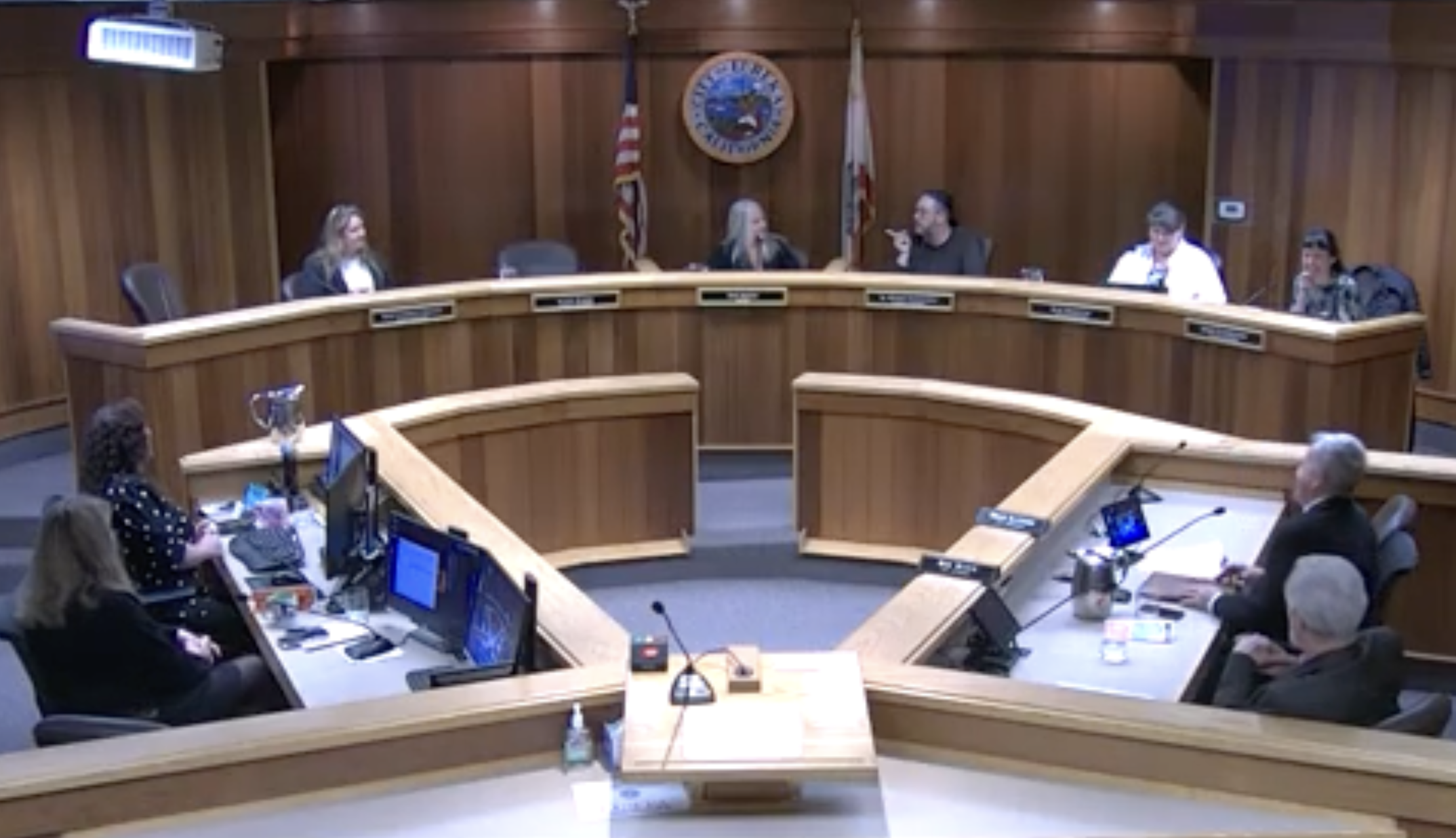
Screenshot of Tuesday’s Eureka Council meeting.
###
The Eureka City Council is pushing back on the Trump administration’s plan to expand offshore drilling to the West Coast.
At Tuesday’s meeting, the council directed staff to draft a resolution opposing the federal scheme, which would allow new leases for offshore oil and gas drilling along the California coast for the first time since 1984.
The council had originally asked staff to come up with an ordinance that would prevent the federal government and oil developers from using onshore support facilities in Eureka, but after reviewing a sample ordinance developed by the Mills Legal Clinic at Stanford Law School, the city’s legal team advised the council to consider an alternative approach.

Slattery | Screenshot
“We tried to use [that] as a template for our ordinance … [but the city’s attorneys] determined that that ordinance wouldn’t work for the City of Eureka due to the fact that we have coastal-dependent industrial property that’s in our coastal zone,” City Manager Miles Slattery explained. “By ordinance, it wouldn’t supersede our Local Coastal Program, so … trying to use that as a way of preventing onshore support facilities for offshore drilling would be a much more onerous project.”
Adopting an ordinance would require the city to amend its coastal-dependent industrial zoning district. “Right now, those types of facilities are principally permitted,” Slattery added. “We’ve talked to the Coastal Commission, and we can’t pass an ordinance that adjusts our Local Coastal Program.”
For about a year now, staff have been working on an update to the city’s Local Coastal Program (LCP), which was first approved in 1984 and last updated in 1999. Slattery said staff would be willing to incorporate changes into the LCP to prohibit certain uses in the coastal-dependent industrial zoning district that would allow support facilities to be used by oil developers.
However, if staff were to go that route, the zoning amendment would have to be carefully written to avoid impacting other industrial uses, Slattery said.
“The draft ordinance kind of used aesthetics as a reason as to why [offshore drilling] wouldn’t be amenable to their community because [they] have a tourist-type economy,” he continued. “There was concern by staff that … wind energy would have that same kind of industrial effect. So there would be a lot more thought needed to be put into how you adjust those allowances in that zoning district to make sure that it’s compatible with our community.”
Councilmember Renee Contreras-DeLoach echoed staff’s concern about using aesthetics as a basis for opposition to offshore drilling. “There’s discussion around offshore wind, which would place very large, 900-foot-tall cranes [on the Samoa Peninsula] … and clearly that would be visible, which I think demonstrates a problem with a focus on any kind of visibility issue,” DeLoach said.

Contreras-DeLoach | Screenshot
Slattery said staff could consider other strategies that would restrict the use of certain support facilities in the city that “would make it more difficult for [fossil fuel companies to develop] offshore oil drilling if they didn’t have those supports [and] access [to] our port.”
Contreras-DeLoach asked if the onshore facilities would be a potential source of pollution, admitting that she didn’t know very much about the support infrastructure needed for offshore drilling.
“It would support an industry that would potentially create widespread pollution or oil spills,” said Councilmember Leslie Castellano. “Also, just the entrance and exit of those [barges] through our harbor would increase the likelihood of that.”
Castellano asked if there would be any advantage to putting a measure on the ballot as a means of expediting an an anti-drilling ordinance. Slattery didn’t think so, adding that the LCP would still need to be approved by the California Coastal Commission.
“I would liken that to the Balloon Track,” he added, referring to Measure N and the failed “Marina Center” project that sought to redevelop the old railyard between Broadway and Waterfront Drive. One month ago, nearly 16 years after it was approved by voters, the Coastal Commission officially denied the “incomplete and inactive” LCP amendment. “While that was approved by the voters, it doesn’t happen overnight. It still requires a certification of the Coastal Commission.”
With that in mind, Slattery recommended that the council pursue an anti-drilling resolution, which is a mostly symbolic gesture that reflects the council’s opinion on an issue.
Representatives of the Environmental Protection Information Center (EPIC) and the Humboldt Waterkeeper spoke in favor of a resolution during the public comment portion of the meeting.
“The fact that there’s this big federal push now to restart offshore oil drilling off the coast of California — starting south of us, but including Northern California — is truly terrifying,” said EPIC attorney Matt Simmons. He also urged the council to consider a resolution against deep sea mining, another extractive industry the Trump administration is pushing forward.
Daniel Smith, Eureka resident and Fifth Ward city council candidate, used his three minutes to express his views on offshore wind, claiming that “a helluva lot more gas goes into these electrical systems than everyone wants to get into.”

Smith | Screenshot
Mayor Kim Bergel interjected to remind Smith that the agenda item was about offshore drilling, not wind. “Sure, but ultimately it comes down to the same thing,” he persisted. “I know that everyone wants to get in there and put their two cents in [on] what they think they know, but there’s a lot more to it, and I encourage you guys to research it a little bit more.”
Following public comment, Castellano expressed support for a resolution opposing offshore drilling and directed staff to add in language opposing deep sea mining.
“If there are other ways we can be proactive, let’s continue to think about them,” she said. “[I] definitely want to make sure that we are, you know, at the head of this potential threat.”
Councilmember Kati Moulton felt it was important for the council to take a stand, given the widespread local opposition to the proposal.
“I think that any effort we can make to oppose this as a city or utilize the city’s power to enact that will of the people would be appropriate,” she said. “I’m from the Gulf Coast side of Houston, Texas, where there are offshore drilling rigs dotting the horizon everywhere you can look. … There’s no such thing as a clean oil rig that isn’t dumping pollution into the surrounding waters. I think we should protect our coast, protect our bay, protect our fisheries, protect our tourism, and protect our environment in general.”
The council directed staff to bring back a resolution and move forward with the LCP updates but did not vote on the item.
###
What else happened at Tuesday’s meeting?
- A group of Cal Poly Humboldt students presented a report, “Unlocking Affordable Housing on Faith-based Land in Eureka.” The report centered around SB 4: The Affordable Housing on Faith Lands Act, signed into law in 2023, which streamlines the process for religious organizations and nonprofit colleges to develop affordable housing. The group of students interviewed religious leaders throughout Eureka, many of whom were interested in the prospect, but didn’t think it would be feasible to actually build housing on their sites.
- At the end of the meeting, Slattery informed the council that the council’s first budget study session would take place on Tuesday, May 26. Given the city’s budget crisis, staff has been hard at work reducing spending where possible. “We’re at about 2.23% and we plan on putting that across the board to all of our departments,” he said. “We may need to look into reductions of travel, those type of things.”
- The council also approved the Kinetic Universe’s request for a fee waiver for rental fees at Halvorsen Park, something the city does every year. During public comment, one resident sounded the alarm over dog feces at the park, urging the city to take action.
CLICK TO MANAGE