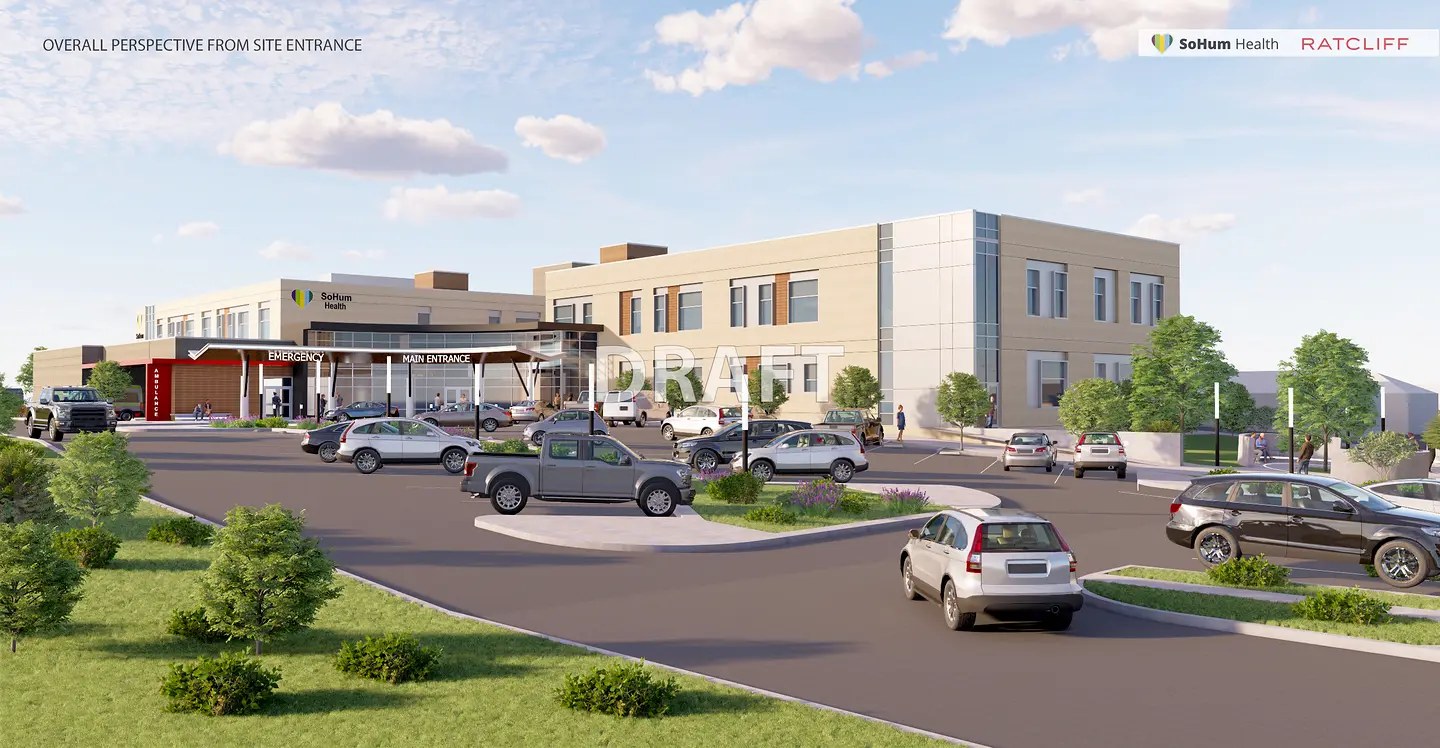
A conceptual image of the planned new hospital for the Southern Humboldt Community Healthcare District (aka SoHum Health). | Images courtesy SoHum Health.
###
PREVIOUSLY
The Southern Humboldt Community Health Care District (SoHum Health) remains in desperate need of affordable financing for its long-planned and sorely needed new hospital in Garberville.
Before Election Day, it seemed like Measure K might be the district’s best and last chance to chart a plausible fiscal pathway in time to comply with a state deadline for hospital earthquake safety.
But Measure K, a proposed new parcel tax, went down in flames. While there remains a small fraction of votes left to count, it’s safe to say the ballot measure fell about 10 percentage points shy of the two-thirds threshold it needed to pass.
And yet, when we reached SoHum Health CEO Matt Rees by phone on Friday, he sounded determined.
“It’s not doomsday,” he said, “but it steepens the hill that we have to climb.”
As previously reported, rural hospitals nationwide were dealt a major blow by the passage of HR 1, President Trump’s “One Big Beautiful Bill Act,” which included an estimated $137 billion in cuts to federal rural Medicaid spending. In the case of SoHum Health, where more than 80 percent of patients are on Medi-Cal and/or Medicare, those cuts mean millions of dollars in lost revenue. Once the law was passed, the district’s financial projections were suddenly not good enough to qualify for a much-needed USDA loan to cover construction of the new hospital.
Which brings us back to Tuesday of last week, when Democrats nationwide made sweeping and historic gains at the ballot box, taking majority control of both houses of Congress. This “blue wave” not only changed the national political landscape, it has the potential to reshape SoHum Health’s fiscal future.
Rees pointed out that one of Rep. Jared Huffman’s top priorities, should Democrats retake control of the Legislature, was to reverse Trump’s health care cuts.
“I hope that [Democrats] stay away from all this investigation and litigation and all this stuff and I hope they really get down to business and get to these important things like [reversing] the cuts to health care and [addressing] the economy and … getting some real work done,” Rees said.
With Trump still in the Oval Office, he retains veto power over any legislation Congress passes in the next two years, but Rees noted that many Republican representatives have rural hospitals in their districts.
“That was one of the reasons why it took so long to get everybody to sign on [to HR 1] is that that bill had these health care cuts in it,” he said. “So I think they’ll actually have bipartisan support, so even if it got vetoed, I think they could override the veto.”
Another promising possibility: A bill that has been wending its way through the Senate, SB 5526, incorporates text from the bipartisan Rural Hospital Revitalization Act of 2026, which requires the USDA to offer temporary 0% interest loans to eligible rural hospitals for construction and facility renovations.
As currently written, a qualifying hospital must be located in a county with fewer than 20,000 residents. Rees said he has reached out to Huffman and to California’s two U.S. senators with a request to change that wording a bit so SoHum Health could qualify.
“We’re not in a county of less than 20,000, but we’re on the border of two counties, and our service area is half of 20,000,” Rees said. A no-interest loan would save the district $150 million or more over the full term of the loan.
“So if we’re able to knock that [interest] off and just have just pay back the 60 or 70 million that we need to borrow, that is a significant savings,” Rees said.
SoHum Health has until Jan. 1, 2030, to complete construction on a new hospital that complies with California’s seismic performance standards, barring any extension.
“So, if we can get the financing [lined up] here this next year, our architects and contractors are saying it would take about 18 months to build,” Rees said. Some additional time will be required to put various aspects of the project out to bid, he added, “so we’re we’re going to bump up close to [the deadline].” But he’s heard from other health care administrators that the state is generally lenient in such matters as long as progress is being made.
Rees expects to present another funding measure to district voters sometime next year, though he said it will be a more modest request. He knew Measure K was “a big ask,” and when several vocal critics came forward, Rees realized that its prospects were slim.
Second District Humboldt County Supervisor Michelle Bushnell notably did not endorse Measure K, though she expressed support for the hospital.
“I appreciate her stand,” Rees said. “She was being honest about it, and I know that it was a big ask, especially for people like her who owned significant amounts of property. … It was going to cost quite a bit.”
Rees plans to work with Bushnell and other community leaders to develop a new financing measure to submit to voters in a special election next year.
“We’ll hopefully get something passed here shortly and get the financing all lined up — and be sticking a shovel in the ground,” he said.
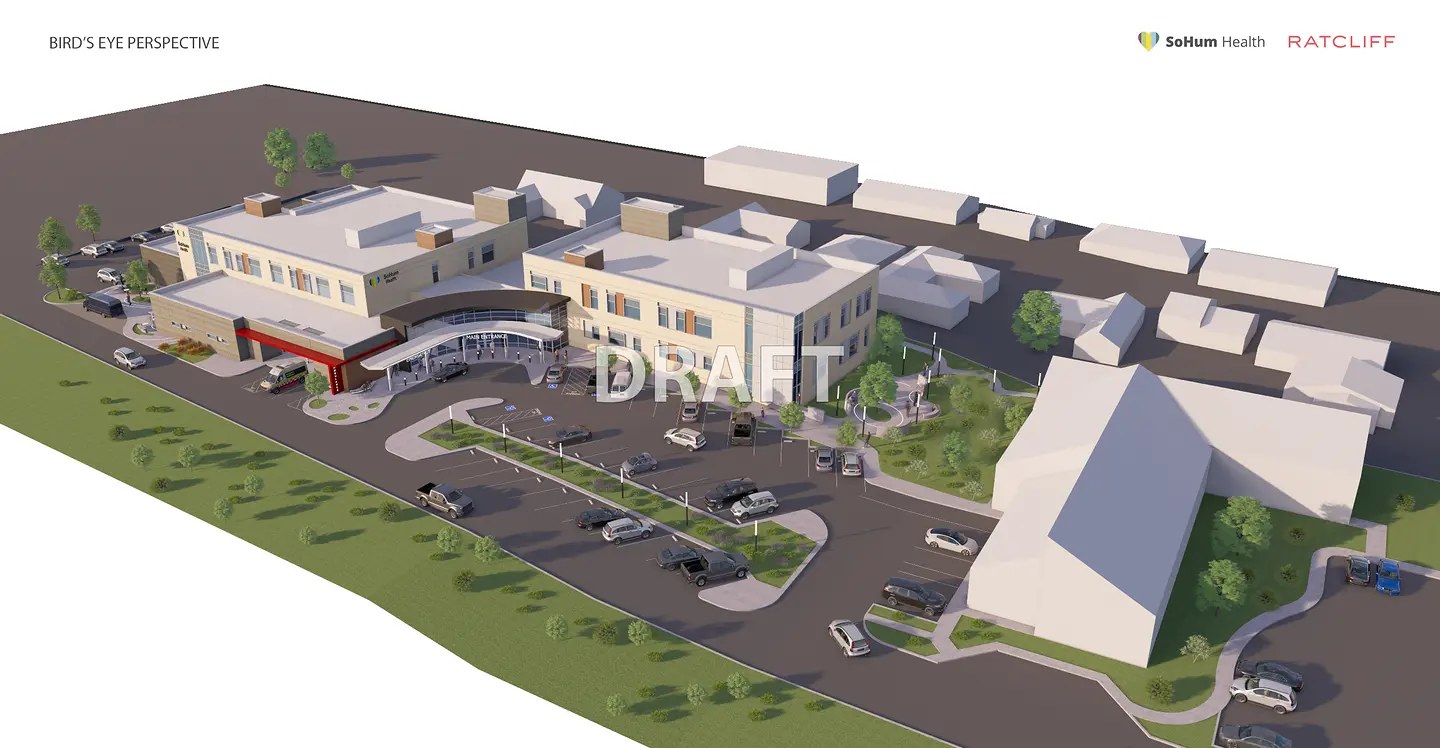
Aerial view of the planned new hospital.