
A conceptual image of the planned new hospital for the Southern Humboldt Community Healthcare District (aka SoHum Health). | All images courtesy SoHum Health.
###
The largest employer in Southern Humboldt County has “a huge ask” of the community at the ballot box this election season.
That’s how Matt Rees, CEO of the Southern Humboldt Community Healthcare District (aka SoHum Health), phrased it in a phone conversation earlier this week.
For many years now, the district has been preparing to build a new hospital and clinic — designing the facility, securing a site, raising money and pursuing a federal loan. Measure K is now being presented as a key piece of the funding plan, and a test of whether local support can help carry the project across the finish line.
At nearly 80 years old, Jerold Phelps Community Hospital in Garberville has been expanded and retrofitted over time, but such fixes only go so far, according to SoHum Health Outreach Manager and Development Director Chelsea Brown. And a deadline is looming. By January 1, 2030, all general acute care hospital buildings in California must be capable of remaining fully operational after a major earthquake.
“Our building is not able to do that,” Brown said. “There’s no way to retrofit it to make it meet those standards.”
The district’s plan is to build a replacement hospital and clinic on land it acquired next to Highway 101 in Garberville, on the parcel with the old schoolhouse that now houses Redwood Playhouse and the Garberville Pharmacy. Designs have been submitted to the state, Brown said.
The project’s financing plan has several parts. SoHum Health began a capital campaign in 2020 and raised the 10% down payment required for a USDA Rural Development loan.
“The hospital district invested several millions of dollars from their general operating funds to complete the architectural designs and all the CEQA requirements and surveys and everything,” Brown said.
And then, trouble.
“We were in the process of applying for that USDA loan … when [President Donald Trump’s] One Big Beautiful Bill (HR 1) passed last summer,” Brown said.
The loan application process required SoHum Health to make financial projections, and HR 1 messed with the math. The bill includes phased-in cuts to reimbursement for various programs, particularly ones tied to Medi-Cal and Medicare. (More than 80 percent of patients served by SoHum Health are on one or both of those programs, according to Brown.) Funding for some key programs will be cut by 30 percent, which will cost the district millions of dollars in revenues.
After redoing the math with these Trump-induced cuts factored in, Brown said, “Our financial projections no longer show that we would [have] the revenue needed to qualify for that [USDA] loan.”
That is, unless the district turns to the community for help. That’s where Measure K comes in.

The SoHum Healthcare District includes much of Southern Humboldt and a section of northern Mendocino County.
How it would work
Measure K would authorize the district to sell up to $25 million in general obligation bonds. A property tax on district residents would then fund repayment over the term of the bonds (likely 30 years). How much would the tax be? Roughly $80 per $100,000 of assessed property value per property owner, and it would replace a decades-old parcel tax of $125 (a flat rate per property).
Measure K requires a two-thirds vote to pass. If it does, Rees said, some people will will pay less than they’ve been paying under the current parcel tax, but most would pay more.
If the measure passes, though, SoHum Health can borrow less from the USDA, according to Brown.
Rees said it would also “show USDA Rural Development that there was a lot of community support for this project and would help in obtaining the financing.”
Such support has long been a hallmark of SoHum culture, Brown noted. Whether it was KMUD Radio, the Mateel Community Center or Jerold Phelps Community Hospital, she said, “They see a need and just decide, like, ‘Okay, we’re gonna make this happen.’ That’s the spirit that has really driven the success of our hospital for all these years at a time when rural hospitals are closing across the country.”
In fact, SoHum Health’s offerings have been expanding. When Southern Humboldt’s only pharmacy closed during the pandemic, forcing residents to drive to Scotia or even farther for their prescription needs, the district stepped up and decided to open its own retail pharmacy, Brown said.
“We’ve also added optometry services, and there has been property acquisition,” she added.
The hospital is currently expanding its physical therapy department, and with help from a $10 million revenue bond recently approved by the district board, the district has invested in property and equipment. But most of the district’s improvements over the past decade have been paid for without adding more debt, according to Rees.
“So, just to give you a little insight, our property and equipment value 10 years ago was under $4 million,” he said. “Now, the property and equipment value for the hospital is $45 million. … [And] instead of getting debt to finance all of that, we actually financed all that through operations. Our debt only increased $1 million. Not too many companies can do that.”
Last year, the Emergency Room at Jerold Phelps saw roughly 3,200 visits, and the district brought in $39 million in revenue. If the new hospital gets built, the district plans to significantly expand its existing skilled nursing facility (SNF) at the current hospital location.
“The SNF doesn’t fall under the seismic mandate, so we will be able to repurpose the building to increase the number of skilled nursing beds,” Brown said. “We know how important the SNF is to the community. We hear often from family members of patients at the SNF who are grateful that skilled nursing care exists in SoHum. We’re really excited about this future expansion.”
All of this growth is part of a strategic plan to increase revenue so the district can afford to make the loan payments and construct the new hospital, she explained.
And it’s not just SoHum residents who receive care at Jerold Phelps. More than a third of the district’s revenue comes from patients who live in Northern Humboldt, according to Rees. Some of that is due to injuries that happen as people are traveling through, the CEO acknowledged, but he said it’s mostly due to the district’s strong reputation and the lack of some services at the northern end of the county.
“A good number of patients coming from Fortuna, Eureka; some people come from McKinleyville to see our doctors in the clinic,” Rees said.
Brown noted this trend as well.
“There’s a lot of people that come to our hospital who are from Northern Humboldt, where you can’t even get a primary care doctor, or you’re on a waiting list for years, or you’re waiting months to get and a CT scan or things like that,” she said. “A lot of people have realized that they can just drive down to our place and get it done way faster.”

Draft site plan for the replacement hospital and clinics.
The opposition
In April, SoHum Health conducted a poll that found 70 percent support for the kind of bond measure laid out in Measure K. If that margin holds true at the ballot box, the measure will pass by a narrow margin. But on social media and at recent community gatherings, critics have ardently pushed back on the proposal.
Some area residents simply oppose higher taxes. Others see some vaguely defined conspiracy afoot. A few have complained that most of the hospital’s senior administrators don’t live within district boundaries and thus wouldn’t have to pay the property tax themselves. (Rees countered that he has committed to contributing $50,000 to the project from his own wages.)
Brown said all of the administrators donate portions of their wages to support the capital campaign. “And the reality is that the hospital just can’t find all the talent that it needs within the local small community of Southern Humboldt,” she said. “We have to have doctors and nurses and people with the licenses and expertise that we need, and not all of them are going to be born and raised in Southern Humboldt.”
Second District Supervisor Michelle Bushnell said that while she fully supports SoHum Health and considers the hospital an “absolutely necessary” part of the community, she’s not endorsing Measure K.
“My fear is that a 30-year bond is a long time,” she said. “Folks that are in their 60s could be passing that debt on to their children … and I don’t know that that’s fair to pass on debt to generations forward.”
She noted that the economy in Southern Humboldt, long tied to the cannabis industry, has collapsed, leading to rampant overdue tax bills, liens and foreclosures. Bushnell would have preferred Measure K to include a cap to prevent some property owners from paying a disproportionate share. She noted that some residents may have inherited ranches that are worth millions on paper, but that value doesn’t reflect their true financial position.
In talking to constituents, Bushnell said she’s heard similar opinions.
“A lot of folks have that same [stance] that I have,” she said. “They support the hospital, they know we need a hospital, and they’re just unsure whether they can afford it.”
She also argued that SoHum Health should have done more community outreach before now.
“I 100% know we have to have a hospital here,” Bushnell said. “[But] you can’t price your community out, because your community will leave. You have to have your community still here to support the hospital and make it work for everyone. I’m just not sure quite how to get there.”

Site of the proposed new hospital, off Sprowl Creek Road, just west of Hwy. 101.
What’s at stake
Brown noted the flip side of Bushnell’s equation: If the hospital were to close down, she said, “There’d be tons of people that would just have to leave the community because they wouldn’t feel safe living somewhere where there’s no emergency department.”
Like Rees, Brown said she understands that Measure K is a big ask.
“I mean, people’s cost of living is going up by the day, practically,” she said. “But my perception is that the vast majority of people really understand the value of the hospital to the community as an employer, as somewhere that to go in an emergency [and] as an economic driver.”
Measure K has received endorsements from Healy Senior Center, Redwoods Rural Health Center, City Ambulance, Inc., the Redwood Playhouse and state Assemblymembers Chris Rogers and Damon Connolly.
We asked Rees to consider what will happen if the district’s polling overstated community support.
“If it doesn’t pass, I mean, our chances of getting a hospital built and meeting the 2030 [seismic] deadline are — it’s basically impossible,” he said.
The district would then fail to qualify for the USDA loan, Brown said, and various other pieces of the district’s financial puzzle would fall apart. For example, a $5 million grant received by SoHum Health requires construction to begin within two years.
If the new hospital isn’t built by the time the 2030 deadline rolls around, it doesn’t mean that the existing Jerold Phelps facility will have to immediately close its doors. But it would make the district ineligible for certain permits. A health care facility in Yreka recently applied for a permit to replace its broken HVAC system and was denied because it’s not in compliance with state seismic standards, according to Brown.
“So it’s like an indirect way of making it impossible to keep providing health services at that location,” she said. “You obviously can’t operate if the HVAC goes out or the plumbing goes out or whatever.”
Asked whether the failure of Measure K could mean the end of Jerold Phelps Community Hospital, Rees responded, “It could.”
But he does have some contingency plans. He said he would try to get state legislation granting an extension for compliance with the seismic deadline. (California already offered such an extension, but SoHum Health and several other districts declined to pursue it, largely because no one saw the funding cuts in HR 1 coming, Rees said.)
He’s also working on legislation, called the Construction Renovation Reimbursement Program, that would cover about 30 percent of the cost of the bond. This legislation has support from the California Hospital Association, the Association of California Healthcare Districts and other organizations.
At the end of our conversation, Rees circled back to where he started.
“I know it’s a big ask for the community, I do,” he said. “And I appreciate any support we can get for this. I know that there’s going to be no votes, and I know there’s going to be yes votes. And hopefully we’ll have the two thirds that we need to move forward.”
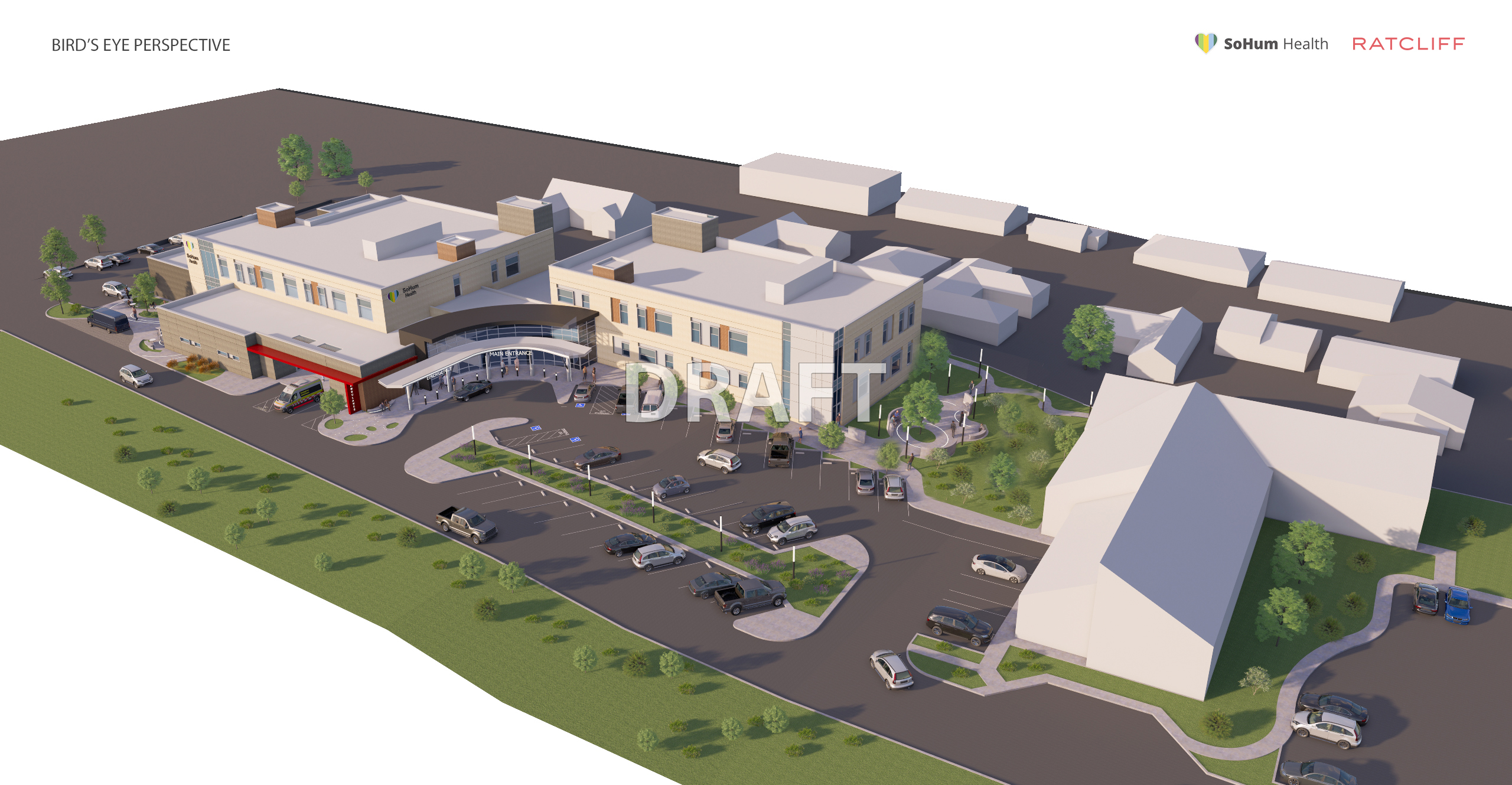
Conceptual image of the proposed new hospital.
CLICK TO MANAGE