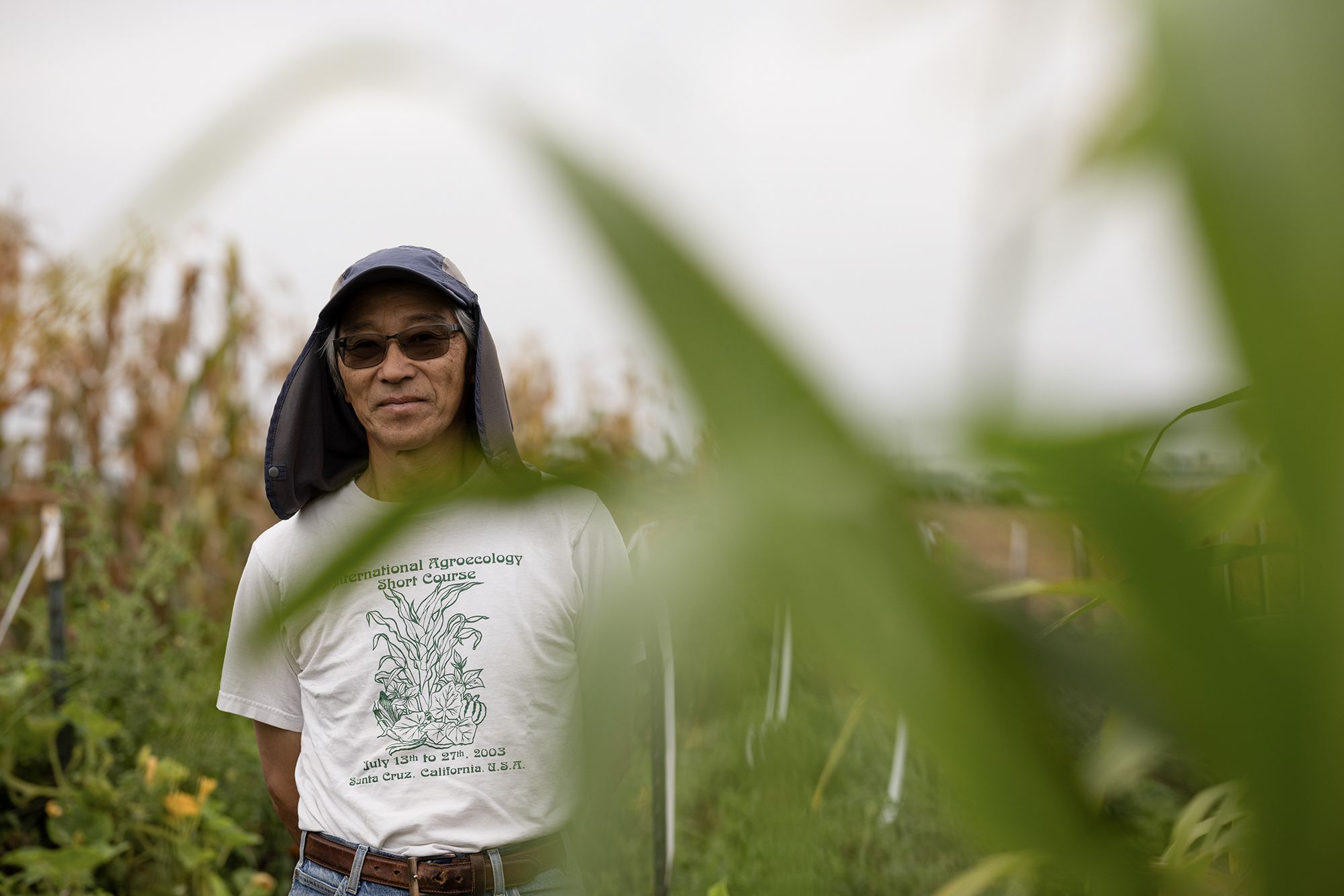
UC Santa Cruz researcher Joji Muramoto, 65, at the Hansen Agricultural Research and Extension Center in Camarillo on Sept. 24, 2026. Photo by Julie Leopo-Bermudez for CalMatters
###
This story was originally published by CalMatters. Sign up for their newsletters.
###
The sun was just starting to emerge through the fog at Hansen Agricultural Experiment Station as Joji Muramoto, 65, pulled two dozen soil sensors out of his SUV to set up his latest field trial.
When Muramoto first came to this facility east of Oxnard some two decades ago, few people thought his organic method for controlling soilborne diseases in strawberry fields would work. Now, as the specialist for the University of California’s Cooperative Extension program lays out the final field trial before his retirement next summer, the elegant fermentation-based technique is used in at least 11 states and nine other countries — not just on strawberries but increasingly for vegetables and tree crops as well.
Muramoto knelt on the soil in well-worn jeans and dug a hole for one of the sensors, measuring to be sure the bottom was precisely 9½- inches deep. He worked with the sure-handed muscle memory of someone who’s done this thousands of times, and the urgency of someone who knew his work was not yet finished.
On the drive over from his last experiment, in Coachella, he passed field after field of conventional strawberries, which are still treated with the powerful chemical fumigants that have caused hundreds of acute illnesses in agricultural workers and people living nearby.
It’s a reminder of why he came to California 30 years ago, and why he started this research in the first place.
When Muramoto was 10 years old, growing up in suburban Tokyo in the early 1970s, he found his 6-year-old sister struggling with a nosebleed that wouldn’t stop. After a scary ambulance ride and a battery of tests, she was diagnosed with leukemia. She was transferred to a pediatric cancer center, but the doctors couldn’t save her.
Devastated — and worried about how chemical exposure might have impacted her daughter’s health — Muramoto’s mother joined the burgeoning Japanese organic movement. The family became members of a consumer group that had convinced more than a dozen farmers to convert to organic methods by agreeing to purchase their produce.
It was the beginning of community-supported agriculture and a learning experience for everyone: Muramoto remembers the first box they received contained a miniscule, rough-skinned mandarin orange.
“It was delicious, but it was not pretty,” he recalled.
During his spring and summer breaks in middle school and high school, Muramoto stayed with the organic farming families to assist with chores. As he weeded and harvested, fed chickens and collected eggs, he saw that the produce was becoming more robust. The farmers had learned the secrets of growing food without chemicals, and as they repeated like a mantra, the key was properly caring for the soil.
Muramoto was hooked and eager to pursue undergraduate studies in soil science.

Joji Muramoto at the Hansen Agricultural Research and Extension Center in Camarillo on Sept. 24, 2026. Photo by Julie Leopo-Bermudez for CalMatters


Joji Muramoto studies soil-growing practices for crops, such as strawberries, to reduce or eliminate the use of fumigants. Photos by Julie Leopo-Bermudez for CalMatters
He later spent more than a decade in the soil science laboratory at the Tokyo University of Agriculture, where he earned a doctoral degree and ultimately became an assistant professor. Using the new technology of the day — an inductively coupled plasma emission spectrometer — he helped develop a new method for testing soils and crops that could analyze multiple elements at once, so farmers could quickly get a sense for whether their fields might be low in calcium or high in phosphorus.
He was delighted when these new testing methods proved helpful to the organic farmers who first taught him about the importance of soil health.
But few other researchers in the soil science lab were collaborating with organic farmers. Housed within the department of agricultural chemistry, the lab’s primary function was to prescribe fertilizers. Many of the program’s graduates went to work in the industry, and farming without chemicals was not considered feasible by the influential senior faculty.
Drawn to UC Santa Cruz research
For Muramoto, constantly cutting against this grain took a toll. When he landed in the hospital with a stomach ulcer, he realized it was time for a change.
While Muramoto was recovering, a colleague tipped him off to the field of agroecology, which focused entirely on solving farmers’ problems with biological strategies rather than chemical ones. As Muramoto pored over the references his colleague shared, he became engrossed in a paper written by UC Santa Cruz professor Steve Gliessman, who was researching organic production methods for strawberries.
Muramoto wrote to Gliessman, who agreed to sponsor him as a visiting scholar. He quit his faculty job in Japan, and in 1996, the whole Muramoto family arrived in Santa Cruz: Joji, his pregnant wife and their 2-year-old son.
Muramoto searched for research he could do to advance agroecology in the Santa Cruz area, working with Gliessman and local farmers. Initially, he focused on nutrient management, given his background in chemistry.
Meanwhile, Muramoto and his family tried to establish some stability. He had no idea how long his visa might be extended, and his position was not salaried. He had to support himself with whatever grants he and Gliessman could scrounge up and the savings and retirement he’d brought from Japan.
A year into the job, his elder son was diagnosed with autism. To Muramoto’s amazement, Santa Cruz County enrolled his son in a specialized public preschool for children with autism, then provided a one-on-one aide once the child was ready for kindergarten. The family received state benefits to buy milk and bread. Overwhelmed and grateful for the support provided by their new community, Muramoto redoubled his efforts to give back through research that could support organic farmers.
The aha moment
In 2001, the leaves on some of the strawberries at the UC Santa Cruz organic farm started to brown and wilt. One by one, the plants shriveled up and died. The farm had been stricken with verticillium wilt, a fungal disease in the soil. The farm manager, Jim Leap, had been careful to rotate crops to try to starve out any disease outbreaks: After growing strawberries, he wouldn’t plant them again in the same field for seven years.
But verticillium was wily. It could feed on more than 400 plants (including tomatoes, lettuce and potatoes) and survive in the soil for up to five years without a host plant. Leap asked the research team for help.
A visiting Dutch plant pathologist suggested they try a new method that had recently been developed in the Netherlands: spreading carbon-rich material on the soil, saturating the ground with water, then covering it with a plastic tarp for several weeks. If they could create enough fermentation, the Dutch researchers had found, they could suppress disease.
When Muramoto dug into the research, he was surprised to learn that a team in Japan had independently developed a similar process. He and professor Carol Shennan (who had succeeded Gliessman as director of the university’s Center for Agroecology) combined the most promising aspects of the Dutch and Japanese methods to see if they could curb the verticillium on the farm.
Muramoto threw himself into the details of the new method, which he and Shennan dubbed “anaerobic soil disinfestation,” or ASD. He had a ready carbon source: the remnants of the cover crop that the farm had used to recharge the soil. He worked with Leap to spread the cover crop residue on the trial field, then doused the field with water and covered it with plastic tarps.
No luck. So he tried again. And again. Still, verticillium populations remained stubborn.
Muramoto decided to try one last field trial, this time with a combination of cover crop residue and rice bran. When he took the tarp off and tested the soil, he could hardly believe it. The disease was almost completely gone.

Joji Muramoto holds sensors used to measure soil conditions at the Hansen Agricultural Research and Extension Center in Camarillo on Sept. 24, 2026. Photo by Julie Leopo-Bermudez for CalMatters
As the late summer sun beamed down, Muramoto had an aha moment. The difference had been the soil temperature. With enough heat, they had a way to control verticillium, without applying any chemicals.
Confronting the ‘fumigants or nothing’ mantra
Just a few miles from the UC Santa Cruz farm, conventional strawberry farmers in the Salinas Valley had their own solution to verticillium — the powerful fumigant methyl bromide. Because this chemical was damaging the ozone layer, however, international protocols required it be phased out. Beset with complaints from the strawberry industry, the U.S. Department of Agriculture launched a grant program to encourage researchers to develop alternative fumigants.
When Muramoto and Shennan decided to apply for the grant, they knew it would be a longshot. The reviewers were expecting research proposals focused on alternative chemicals, not an alternative to using any chemicals at all.
“‘Fumigants or nothing’ was really the mantra at the time,” Shennan said, “and so to try something this different was really a challenge.”
Their first proposal fell flat, but in 2007, they received three years of funding from the USDA, plus an additional three years of funding from the California Strawberry Commission. Now their ASD technique would be put to the test on commercial farms.
Convincing commercial strawberry growers in Salinas, Santa Maria and Oxnard — some of the most expensive farmland in the country — to try a method developed on the famously countercultural UC Santa Cruz organic farm was a tough sell.
“(Muramoto) approached me at this meeting in Watsonville with this goofy technology, nobody knew what it was,” recalled Oleg Daugovish, an advisor for the UC Cooperative Extension program and one of Muramoto’s earliest collaborators. “But he’s a persistent guy.”
Muramoto knew he’d need to demonstrate the method on working farms, but that meant finding farmers willing to participate. He started with just a couple farms on the first grant, which yielded promising enough results to spur another round of funding.
He expanded the study, with 10 replicated-field trials up and down the California coast. On average, marketable strawberry yields on the ASD-treated fields were nearly on par (99%) with yields on the fields treated with chemical fumigants. In addition to suppressing pathogens, it seemed the rice bran was acting as a slow release fertilizer to boost strawberry growth.
Then Muramoto got a big break.
In 2013, Glen Hasegawa, a prominent strawberry grower in Oxnard, agreed to host a 5-acre trial of ASD, on a field so saturated with disease that he’d all but given up on it. Hasegawa’s problem wasn’t verticillium but charcoal rot, caused by another fungal pathogen that had been spreading across California. He told Muramoto he’d be happy if ASD could increase his strawberry yields by 20%.
As a board member of the California Strawberry Commission, Hasegawa was known statewide, and all eyes were on this strange new alternative to fumigation. He spread rice bran, mixed it into the sandy soil, covered the beds with plastic mulch, and turned on the irrigation. After three weeks, Hasegawa punched holes in the tarps and planted strawberries. At harvest time, he could hardly believe it: his yields had doubled. He increased his ASD trial to 50 acres the following season, and the method took off around the state.
“That was a big turning point,” Muramoto said. “Word of mouth spread, and a lot of growers started to use rice bran.”

Joji Muramoto at the Hansen Agricultural Research and Extension Center in Camarillo on Sept. 24, 2026. Photo by Julie Leopo-Bermudez for CalMatters
Over the course of the next decade, organic strawberry production in California increased from just over 3,000 acres to nearly 5,800 acres, almost 14% of the state’s total strawberry production. Nearly half of these acres were treated with rice bran.
Muramoto saw that the success of the new method had spurred the expansion of organic production across the strawberry sector, among the most chemically intensive crops in the state. He calculated that the method had removed 565,492 pounds of fumigants from agricultural fields, reducing health risks to workers and nearby residents.
“When my sister passed, these kinds of relationships (between agricultural chemicals and health risks) were not very clear scientifically,” Muramoto told me, “but these days we have more data showing the direct relationship, the causality. Now it’s known.”
He pointed me to a host of epidemiological research linking pesticide exposure with health impacts to children and pregnant women, including a 2020 study conducted by researchers at UCLA and USC which found that exposure to certain pesticides during pregnancy may increase the risk of childhood leukemia.
In 2019, the University of California created the first Cooperative Extension specialist position dedicated to organic agriculture. When the hire was announced in May, no one was surprised they’d chosen Muramoto. This was the work he had already been doing, now for more than two decades. After 23 years on soft money, relying on grants to support his immigrant family, he finally had a secure, permanent job.
Muramoto has been busy the past seven years, visiting organic farmers across the state and designing research to address their challenges. Rice bran’s gotten pricy, so he’s been trialing variations of ASD that use wheat bran and dried food waste instead — with promising results. And he’s trying to stay one step ahead of the latest fungal pathogen, Fusarium oxysporum, which behaves differently than verticillium.
Change that takes a lifetime of devotion
As Muramoto looks ahead to his retirement next July, I asked him what he hopes will be his legacy.
He laughed. “I have no idea,” he said.
But the next day, he sent me a quote from Kanzo Uchimura’s book, “The Greatest Legacy,” challenging the idea that a person’s key contributions could be captured in tangible accomplishments, like publications or resources.
“The greatest legacy that all of us can leave for future generations” Uchimura wrote, is “a person living their life with courage and integrity.”
Reading these words brought me back to the summer of 2010 when I worked with Muramoto in his lab, as one of more than 150 students he mentored over the course of his career. As Muramoto patiently explained the research design and lab protocols, I remember being awestruck by the sheer volume of it all: the neatly organized sensors, the impeccable field data spreadsheets and the many, many soil samples.
This project, I remember thinking, will take an entire lifetime.
Working with Muramoto showed me the best of what our public universities can produce when we invest in them: painstaking, long-term science that can make a real difference in people’s lives. It made me forever appreciate the way that California has always benefited from the innovative contributions of immigrants, and what we stand to lose if we make it harder for folks to come here.
Muramoto’s devotion to developing fumigant alternatives introduced me to a form of change and social action that is underappreciated but so crucial in our current moment: a humble, quiet constancy that keeps chipping away at a problem and never gives up.