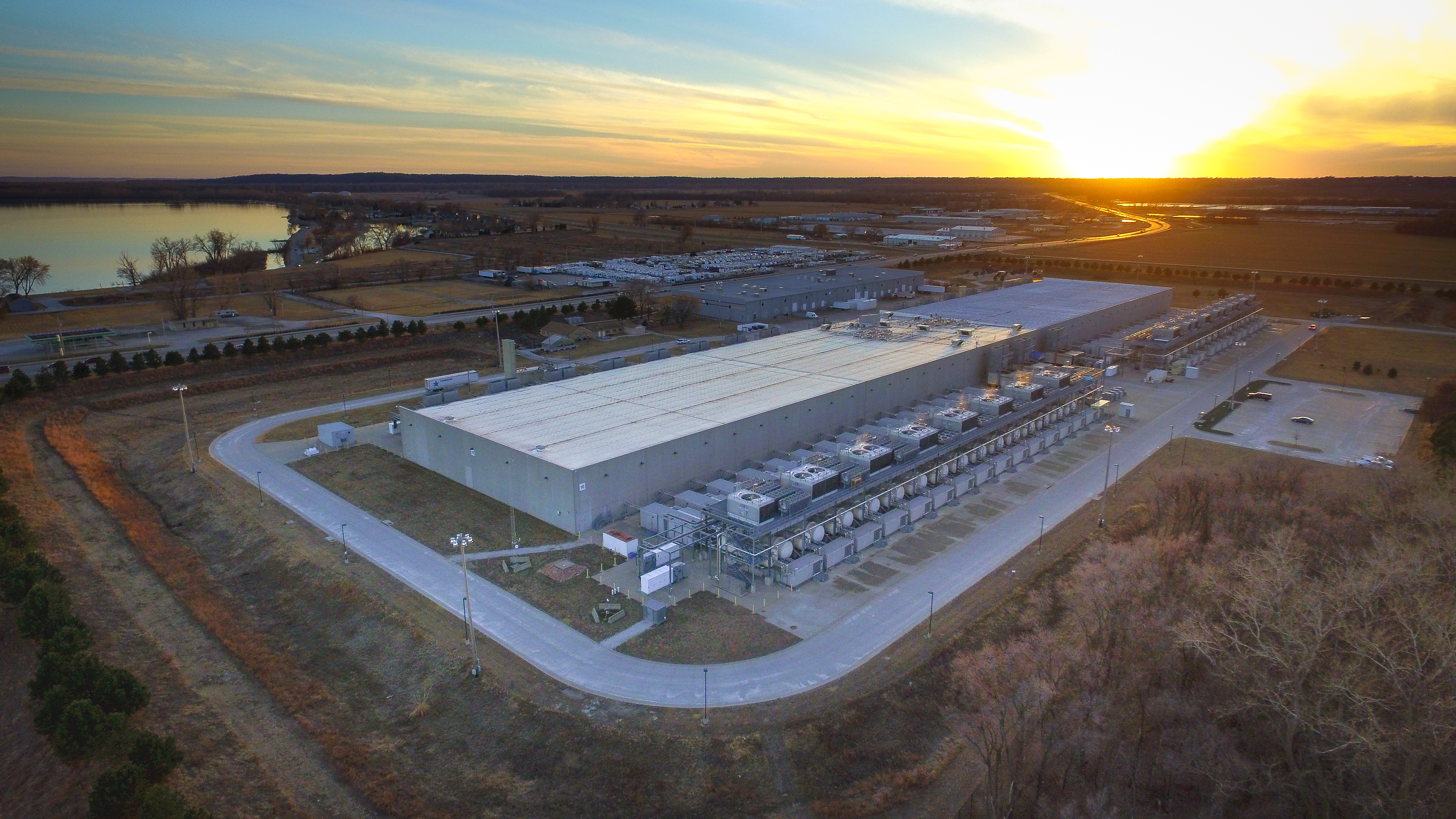
A Google data center in Iowa. | Image: Chad Davis, CC BY 2.0, via Wikimedia Commons.
###
Despite disagreement among some of its members, the Humboldt County Board of Supervisors on Tuesday voted to extend the county’s temporary ban on new data center development in unincorporated areas of the county for another 10 months and 15 days. The original 45-day moratorium, approved last month, would have expired on Friday.
The board first voted 3-2, with First District Supervisor Rex Bohn and Third District Supervisor and Board Chair Mike Wilson dissenting, to approve the extended moratorium, but because the item required a four-fifths majority, Wilson switched his vote and it passed 4-1.
Wilson | Screenshot
“Not the moratorium I wanted, but [a] moratorium nonetheless,” Wilson quipped.
During its discussion, the board argued over exemptions set in the original moratorium that would allow potential developers to submit applications for data centers that use less than 15 megawatts (MW) of power, run on 100% renewable energy generated onsite and operate within a closed-loop water system for cooling.
Overall, supervisors Bohn and Michelle Bushnell felt the moratorium was too restrictive and redundant because the county already has processes in place that regulate big developments, with Bohn noting several times that he’s tired of “saying no” all the time.
The rest of the board, however, felt the moratorium was needed to ensure a determined developer didn’t try to get ahead of the process and apply for a conditional use permit before the county gets an ordinance in place to regulate data centers. Bohn and Bushnell weren’t against the creation of an ordinance, per se, but felt the moratorium was unnecessary because the county hasn’t received any applications for data centers to date.
“I’m not saying data centers are the answer or anything else, but the question hasn’t even been asked … and we’re stopping it,” Bohn said. “And, again, as has been stated, we have six ways to Sunday to stop any of this. I mean, look what we’ve done with somebody who tried to build housing in Cutten, [and here we are] 30 to 40 years later. We’re pretty good at stopping stuff. … I won’t support it just because I think it sends the wrong idea out there that we haven’t even looked at what somebody’s presenting and we’re going to stop it.”
The board eventually agreed to an exemption that allows projects that qualify under Electric Rule 30 and use 100% renewable energy, but it doesn’t have to be generated onsite. In response to Wilson’s concerns about energy use, the board also reduced the allowable power limit from 15 MW to eight MW.
You can read the moratorium here.
###
The board also considered a 45-day moratorium that would prevent “large” redwoods from being removed outside of timber production zones (TPZ) in unincorporated areas of the county. After about an hour of deliberation, the board eventually agreed to nix the moratorium and directed staff to move forward with an ordinance that would increase protections for old-growth trees in residential areas.
Similar to the previous item, staff had originally proposed the 45-day moratorium to prevent people from cutting old-growth trees while an ordinance is being developed. However, Bohn and Bushnell felt there was no need to adopt a moratorium because there was no evidence to suggest that there would be a rush to log old-growth trees, especially on residential properties.
Bushnell | Screenshot
“I think that this moratorium came out of a process in Redway that wasn’t followed, and this is a knee-jerk [reaction] to that,” Bushnell said, referring to the controversial removal of four allegedly hazardous old-growth redwoods from a Lower Redway property. The incident sparked outrage among environmentalists who demanded the county take action to adopt stronger protections for old-growth trees across the county.
Wilson noted that the trees that were cut were in a county-designated Q Zone that provided special protections for old-growth redwoods. He asked Bushnell if she felt protections should be limited to Lower Redway. “What you’re saying is the rest of the county and the rest of the communities don’t deserve that protection. Only Lower Redway deserves that protection?” he asked.
“No, that’s not what I’m saying,” Bushnell said, reiterating that she was only against the moratorium. “What I’m saying is I don’t like the moratorium language that prohibits folks from doing things because we anticipate that there’s going to be a rush, which I don’t think that there is. I don’t disagree with bringing an ordinance forward.”
While there is a permitting structure to remove hazardous old-growth trees from residential properties, Humboldt County Planning and Building Director John Ford noted that there are regulatory gaps in county and state rules.
“There may be large old trees … in a stand of trees that are not a ‘successional stand’ [and] the preservation of the tree would not be required to protect the maintenance of the successional stand of trees,” he said. “The other thing where there’s a regulatory gap is [when] somebody comes in and applies for a building permit … and then separately they apply for a three-acre conversion. The RPF [registered professional forester] would then file the three-acre conversion, allow[ing] the removal of the old-growth tree because the county has [already] issued a building permit.”
Ford also noted in his comments that the Forestry Review Committee (FRC) didn’t feel a moratorium was necessary.
During public comment, CalFire Forester Lucas Titus acknowledged that there had been confusion surrounding the jurisdiction over the county’s Q Zone that resulted in the removal of the four old-growth trees in Lower Redway. (Titus was the professional forester who inspected the Lower Redway property last year and determined the trees were in fact hazardous, as previously reported.) Titus agreed that the moratorium wasn’t necessary.
“Moving forward, when we talk about these large trees, we’re talking about a very minute portion of trees that are harvested in Humboldt County in backyards where this ordinance would even come into effect,” Titus said. “I did a quick search of the last 100 exemptions that I have, and only two came up that [were] marked for harvest[ing] a tree over 1800 A.D. and over 60 inches diameter for redwood.”
“I think that my opinion — the state’s opinion — is we’re already covering a lot of this,” he added. “It’s already covered [in the] the harvest documents, and there doesn’t need to be another ordinance going forward.”
The board seemed reassured by Titus’ comments, and after some additional discussion, voted 4-1, with Bohn dissenting, to skip the moratorium and move forward with an old-growth tree protection ordinance. Bohn cast the lone dissenting vote.