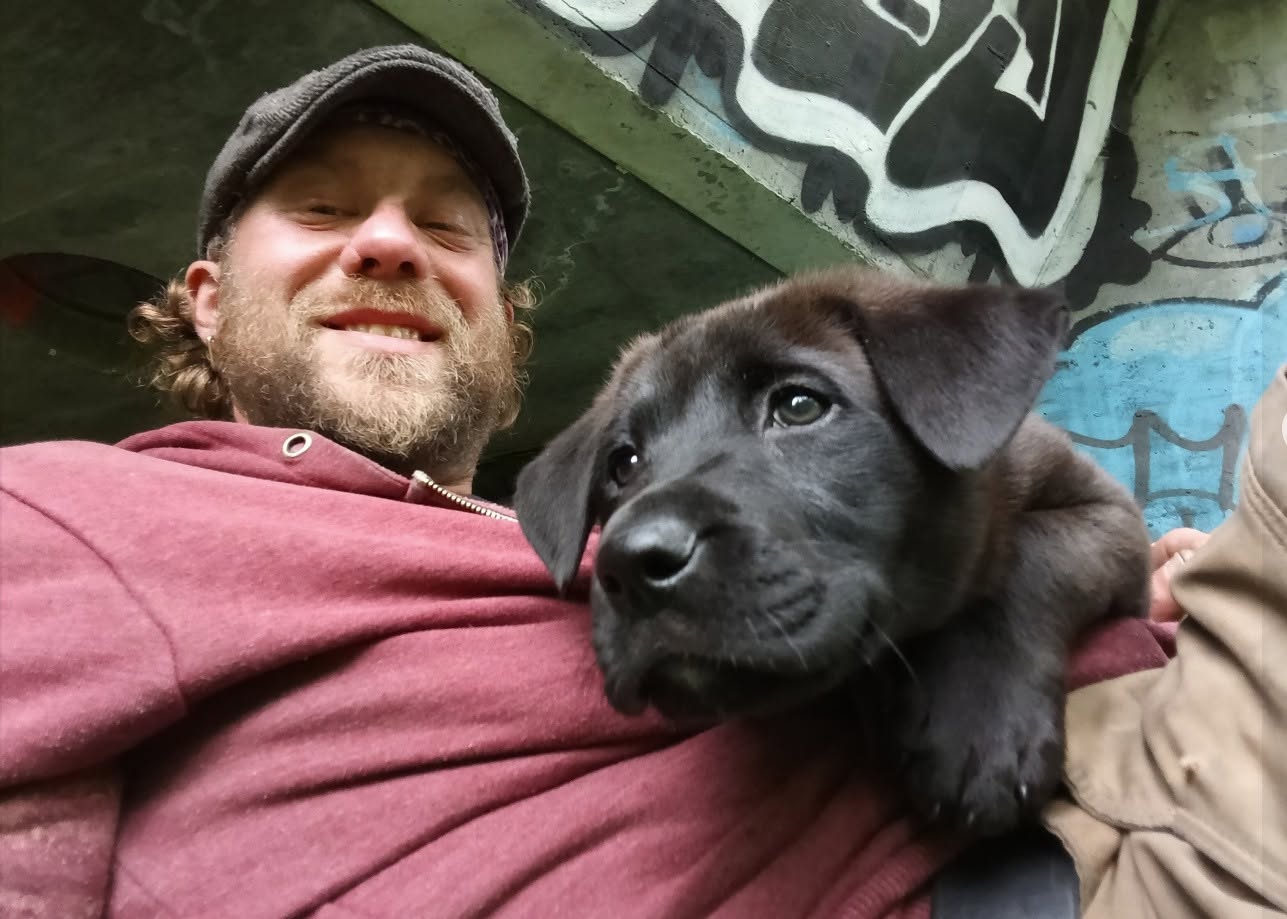
Joshua Lee McCollister and the puppy. Photo via Facebook.
###
PREVIOUSLY
- 37-Year-Old Man Shot and Killed in Glendale Last Night; Humboldt County Sheriff’s Office Seeking Suspects
- Two Arrested Yesterday in Connection With Glendale Homicide; Victim Identified as Fort Bragg Resident
###
A man living homeless in the Glendale area responded to an online ad for a free puppy. He wanted a companion, someone by his side on the streets. He picked the dog up and immediately connected with the chocolate lab he named Captain Scallywags.
Later that day, he would die from a gunshot wound he sustained in the camp he was living in.
New details about the fatal shooting of Joshua Lee McCollister, a 37-year-old man from Fort Bragg who was living in a tent until his July 2025 death, emerged during a preliminary hearing this week.
In court, a key witness to the shooting described the two suspects as arriving at McCollister’s camp. She testified that one took the puppy and the other fired multiple shots, including the bullet that struck and killed McCollister.
The preliminary hearing that began Wednesday aimed to find if there was sufficient evidence to continue pursuing charges against the codefendants.
Deunn Antoine Willis, a 40-year-old Arcata resident, faces murder and robbery charges along with sentencing enhancements for using a firearm. Danielle Durand, 43, meanwhile, faces a robbery charge. They have each pleaded not guilty.
A judge today held the two suspects to answer to the charges, meaning there is probable cause for the case to go to trial.
The witness first called to the stand by prosecutors was Stormy Petrichor, who saw the shooting.
Petrichor does “freelance street outreach” as a volunteer to help homeless people, and had met McCollister a couple months before while handing out food. She later helped him find his camping spot to escape violence he’d experienced when camping in Eureka.
She described him as kind, thoughtful, disorganized and passionate — and said he was targeted on the streets when camping near Broadway due to his personality as an expressive, autistic man who didn’t always understand social cues.
McCollister, who she knew as “J Tree,” had texted her the day of the shooting to say he’d adopted a dog, and wanted his friend to come meet her.
On July 8, 2025, sometime after 5 p.m., Petrichor and another volunteer brought supplies to McCollister in her street outreach-mobile, and the three were hanging out at his camp near the Mad River. She said the puppy, which he’d named after his deceased wife, was licking his face. She said McCollister was “glowing and happy,” but was upset over a wall of text messages she glimpsed on his phone from the person that gave the dog to him. The person who posted the ad on Nextdoor had changed her mind, and wanted the dog back.
According to later testimony from police who recovered his phone, he had responded once to a deluge of texts that evening asking for the dog back. He asked the dog’s “foster mom” to “kindly wait.”
The three — McCollister, Petrichor and the other volunteer — were sitting on a raised area in the camp when two people arrived. Petrichor identified the two arrivals as the suspects in court.
She testified that Durand told McCollister she was sorry, but needed back the dog that was sitting on his lap. He refused, saying something like they made an agreement. A man Petrichor identified as Willis then pulled a gun on the group, which she said looked like a Glock.
She testified Willis fired three shots during the encounter — an apparent warning shot in the air, a second that whizzed between the people sitting and into the bushes, and a third that struck McCollister.
The three sat, Petrichor’s ears ringing from the first gunshot, while Durand ran up the embankment, grabbed the puppy and went back down behind the man, she said.
Petrichor testified that Willis only fired the shot that hit McCollister after the woman had retrieved the startled puppy, who had scattered after the first shot and gotten tangled in her leash nearby. Upon prompting by prosecutor Roger Rees, Petrichor said, “I don’t understand why my friend was shot after that.”
During cross examination, defense attorneys Joanne Carter and Adrian Kamada probed Petrichor, and other witnesses, about weapons that McCollister had in his camp. This included a makeshift spear, a hatchet, and a knife. Police found the spear propped against the opposite side of the tree that McCollister was leaning against, and found another blade sheathed in his belt.
Kamada later noted that Willis implied to police, through hypotheticals, that McCollister had struck him in the head, and asked police if DNA testing was done on the spear. Police said the spear was visually examined but not tested — Willis’ former attorney took steps for DNA testing but it was not mentioned in court where results stand.
But Petrichor reiterated multiple times on the stand and in her statements to police that the victim never stood up or even reached for his nearby weapons.
According to Petrichor’s testimony, McCollister was gesticulating with his arms but did not stand up while Willis was pointing a gun at the group, nor did he reach for blades he had nearby during the entire encounter. Throughout the encounter, he told the others to take a picture of the two people, or to call the police.
Later, the lead investigator testified that the angle that the bullet travelled through McCollister’s body was consistent with him being shot while he was sitting.
Petrichor described the experience as one of the most traumatic experiences of her life. She mouthed ‘thank you’ to Willis after describing him pointing the gun at her — but not shooting her — after she tried to grab her phone to call the police. She described sinking to her knees, raising her hands and closing her eyes. She said he pointed a gun at her a total of five times during the encounter that she estimated lasted less than a minute.
At one point, with prompting from prosecutor Rees, she said that she was testifying only because “I’m here to honor a promise,” that she made to McCollister’s mother and his fiancée. Otherwise, she compared the judicial system to operating on a “dungeon model” and would have accepted an apology from Willis and him to complete community service.
The prosecution then called multiple law enforcement witnesses to testify about the extensive investigation that began shortly after Petrichor told dispatch her friend had been shot.
Analeese Calderon, a HCSO deputy who responded to the scene that night around 7:30, said Petrichor flagged the group of deputies down and led them through the short, unmarked footpath to the camp. There, she found McCollister leaning against a tree. He was not responsive and took shallow breaths. She’d removed his shirt and belt, and moved the makeshift spear so medical responders could get in.
McCollister was taken out on a gurney along the short trail, but was pronounced dead en route to the hospital.
Police later tracked a car with help from surveillance footage captured at a business roughly a minute’s drive away from the pullout near McCollister’s camp, HCSO Sergeant Destry Henderson testified.
The footage showed the make and model of a car and three numbers of a license plate, along with a general description of a man and a woman, he said. Using a Flock camera, police were able to track a full license plate number on a Honda Civic that matched the description. DMV records linked the car to Durand. The Arcata Police Department later located the car at her address in DMV records.
Detective Jennifer Taylor testified that, through interviews with family members of Durand’s, she learned the codefendants were in a relationship and Durand was trying to find a home for a puppy. Durand’s cousin identified Willis on the footage through his gait and his clothing — her father and Willis’ roommate were shocked to hear Willis was a suspect in a homicide, Taylor testified.
Police testified that Willis had a 9mm Glock handgun registered to his name, though Taylor noted police did not locate this gun. Two 9mm casings were found at the scene.
Sergeant Blake Massaro, the lead investigator for the case, was the last witness the prosecution brought to the stand.
He read text exchanges between McCollister and Durand aloud, and recounted parts of interviews with each suspect, both of whom were hesitant to speak to police.
Willis expressed sadness that he had thrown his life away, Massaro testified. Willis told police that the pair were concerned that the man would use the dog as a prop for panhandling. He went into hypotheticals —including asking if he was attacked what could he do — when Massaro said that could change things, he slapped the table and said “yep,” that would be his defense.
During cross examination, Durand’s attorney read from a transcript she prepared from a police interview where she told police “it was never planned, I’ll tell you that, 100 percent.” She said “I feel fucking horrible about that.” She also expressed that the puppy was her dog, and that “there were things in that campsite that would lead some to want to defend themselves.” She gave her devices to police to examine.
Attorneys for Durand and Willis argued that McCollister did not tell Durand he was homeless. Petrichor said McCollister told her he’d explained his situation to the dog’s foster mom, but defense attorneys instead said he misled the woman. They argued the dog wasn’t actually officially given to McCollister, pushing back against the robbery charge. They pointed to previous messages between the pair that indicated the dog would be given to him for a trial period.
However, the prosecution pointed to later messages about future vet appointments, and the woman asking for pictures of the puppy cozy in her “new home.” He also noted language used by Durand in texts: “I am so sorry but I think I made a huge mistake.”
Judge Kaleb Cockrum noted that if the evidence didn’t meet the standard for robbery, extortion was a possible charge.
Family members of the defendants attended the hearings. Durand, who Cockrum ruled would remain out of custody as the case progressed, appeared to be crying while Petrichor described the shooting. Willis took notes and appeared in an orange jumpsuit; he’s been in custody for over a year and has pushed for speed, as this hearing has been delayed numerous times.
The next hearing was scheduled for December 4.