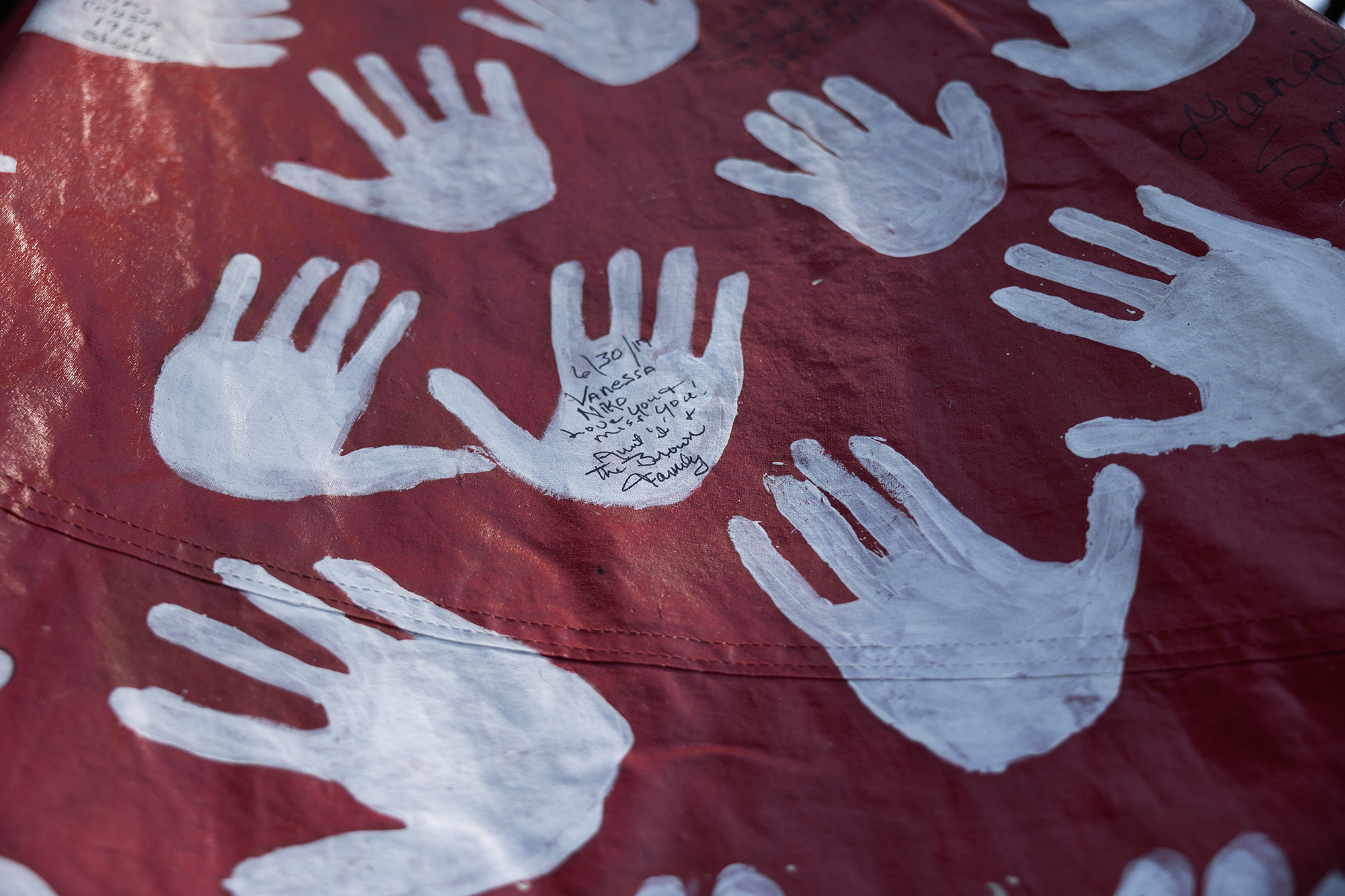
A tipi with handprints by the Missing and Murdered Indigenous Women movement commemorates the lives lost during a California Native American Day celebration at the state Capitol in Sacramento on Sept. 22, 2023. Photo by Miguel Gutierrez Jr., CalMatters
###
This story was originally published by CalMatters. Sign up for their newsletters.
###
In 2020, California legislators ordered the state Department of Justice to find out how many Native Americans and Alaska Native people in California are missing or have been murdered, and what more the state could do to report and find them.
Janet Bill, director of the department’s Office of Native American Affairs and the chairwoman of the Picayune Rancheria of the Chukchansi Indians, told an Assembly budget subcommittee in April that the report was “in the final stages of internal review.” Seven months later, there still is no report. In an unsigned statement sent by email, the Department of Justice said the report is now expected this winter.
The state set aside $5 million in 2021 for the study and for a tribal assistance program meant to help law enforcement agencies and tribal governments navigate overlapping jurisdiction on tribal lands. About $1.2 million of that remained unspent as of February, according to a document prepared for the same subcommittee. The department did not say what is in the report, what delayed it or how the money was spent.
In September, Gov. Gavin Newsom vetoed Senate Bill 891, the third attempt in as many years to create a Missing and Murdered Indigenous Persons Justice Program within the department. The program would have supported investigations, served as a liaison between families, tribal governments, and law enforcement and required the department to annually report the number of cases to the Legislature.
In his veto message, Newsom pointed to existing efforts, including the Feather Alert system for missing Indigenous people and roughly $35 million in grants to tribes for their own programs.
“This historic investment highlights the need for sustained action — and California’s continued commitment — to confront the disproportionate violence facing Native communities,” Newsom wrote. “While well-intentioned, this bill disregards those efforts and creates a new, unfunded program that is duplicative of the work already underway.”
Amid what federal agencies and Indian Country recognize as a nationwide crisis, homicide was the fourth-leading cause of death among Native American and Alaska Native men and boys ages 1 to 44 and the sixth-leading cause among Native American and Alaska Native women and girls in the same age group in 2023, according to the Centers for Disease Control and Prevention.
Still no state tally
California has no statewide office dedicated to missing and murdered Indigenous people and no official count of cases.
Assembly Bill 3099, was meant to change that. It required the state justice department to determine the scope of the problem, identify barriers to reporting and investigating cases and recommend changes, including legislation, after consulting with tribal governments, law enforcement and courts.
The law was written by Assemblymember James Ramos, a San Bernardino Democrat who is Serrano and Cahuilla and a lifelong resident of the San Manuel Indian Reservation. Ramos did not respond to a request for an interview.
The Legislature funded the work in 2021, and the department described it as a five-year effort. In January 2024, a department official told the Assembly Select Committee on Native American Affairs that the report was due in 2025.

Flyers for a candlelight vigil for Missing and Murdered Indigenous People lays on a table, during a meeting with the state Legislative Native American Caucus in Sacramento on April 18, 2023. Photo by Rahul Lal, CalMatters
Part of the delay may come down to the very problem the study was meant to measure. A 2024 Senate analysis noted that a lack of data on crimes in tribal jurisdictions kept the department from completing the report. That year, the state passed Assembly Bill 2695, which for the first time requires law enforcement agencies to collect and report data on crimes on tribal lands.
“(The Office of Native American Affairs) has raised concern about the lack of accurate statistical data and is actively collaborating on viable solutions,” Isaac Bojorquez, a specialist in the office, told the same budget committee in March 2025.
The final report will contain recommendations on how law enforcement agencies across the state can protect Indigenous communities, according to the unsigned justice department statement.
Relying on outside numbers
Lacking a state count, lawmakers and advocates at times rely on outside data. State officials frequently say California ranks fifth in the nation for the number of cases based on a 2018 study of 71 U.S. cities by the Seattle-based Urban Indian Health Institute.
The Sovereign Bodies Institute, a Humboldt County nonprofit, also tracks cases. A 2020 analysis by the group identified 165 missing or murdered Indigenous women, girls and Two-Spirit people across the state since 1900, and its data shows about 18 new cases a year.
Official records offer little help. Missing Indigenous people may appear in the federal National Missing and Unidentified Persons System, known as NamUs, in the National Center for Missing and Exploited Children’s records and in a California version of the search tool. But tribal affiliation is not searchable in the national center’s records or the California tool, and the state justice department did not respond when asked if it has a separate internal search system.
Until 2018, tribal affiliation could not be searched in NamUs, according to the federal Department of Justice. Without a system designed for Indigenous cases, investigators and researchers have trouble tracking them, especially because databases don’t record tribal affiliation in the same way.
Federal death data also undercounts American Indian and Alaska Native deaths. Coroners and law enforcement officials often fail to collect information on people’s Indigenous identity, according to lawmakers and advocates. Because death certificates often list Native people as another race, usually white, the CDC estimates the actual death rate for American Indian and Alaska Native people nationally is about a third higher than reported.
Millions to tribes, no statewide office
The state’s main response has been to award money for tribes.
Since 2023, the Board of State and Community Corrections has awarded about $35 million in three rounds of competitive grants for tribal programs on missing and murdered Indigenous people. The programs include victim services, programs to reduce risk to human trafficking, support for domestic violence victims and connecting with people at high risk, like youth in foster care.
Only federally recognized tribes can apply. California has 62 tribes that are not federally recognized, according to the governor’s office, and it does not maintain an official, single state recognition process.
The state has also given the justice department money to work on individual cases. The 2024 budget included $5 million in one-time funding for the department to help identify and investigate cases and to act as a liaison between tribal governments, families and law enforcement.
Some local and county law enforcement agencies have formed partnerships with nearby tribes to help in missing and murdered persons cases, and the department’s office of Native American Affairs sometimes works with tribal departments on cases.
Three tries
Sen. Sabrina Cervantes, a Riverside Democrat, has carried bills to create the justice program three years in a row. In 2024, Assembly Bill 2279 passed the Legislature and was vetoed and last year’s Senate Bill 4 passed the Senate but was held in committee. This year’s version, sponsored by the Yurok Tribe, also made it through theLegislature before Newsom’s veto.
Cervantes has said that although the state has expanded its efforts to curb the crisis, a statewide office focused on collecting data, working with families and tracking cases across jurisdictional boundaries is still missing.
Cervantes pointed to data from the Sovereign Bodies Institute showing that the overwhelming majority of missing and murdered Indigenous children in Southern California are girls, and that law enforcement responded in only a few cases.
“Murdered and missing Indigenous people were a serious issue that wasn’t being fully addressed,” she said to CalMatters/ICT.
Families turn elsewhere
Advocates, like Norm Sands, cofounder of Way Of The Sacred Mountain, an advocacy group for Native women, who is of Apache and Yaqui descent, says distrust between tribal communities and law enforcement, a complicated jurisdictional picture and limits on tribal police authority have deepened the crisis.
“The families feel completely alone — and they often are,” he said.
Lawmakers removed a proposed statewide task force on missing and murdered Indigenous people that would have been led by the California Highway Patrol, from Ramos’ separate Assembly Bill 31 in August. The law Newsom signed in September made permanent a program giving some tribal police officers state peace officer authority.
Teyana Viscarra, the organization’s other cofounder, who is of Piro-Tewa Pueblo, Apache and Kumeyaay descent, said confusion over which agency is responsible for looking for a missing Indigenous person makes reporting harder and adds to families’ stress.
“The families feel powerless,” she said. “They’re intimidated by law enforcement and an overly complex system.”
Families often turn first to social media and other groups to search for missing relatives since that’s a network they trust, she said.
“We’re resisting erasure,” Viscarra said. “Our public officials need to be held accountable for holding the first peoples of this land in dignity and honor.”
Meanwhile, the justice department now says the report California ordered six years ago will be released this winter.
###
This story is co-published by CalMatters and ICT, a news partnership that covers Indigenous communities in California.