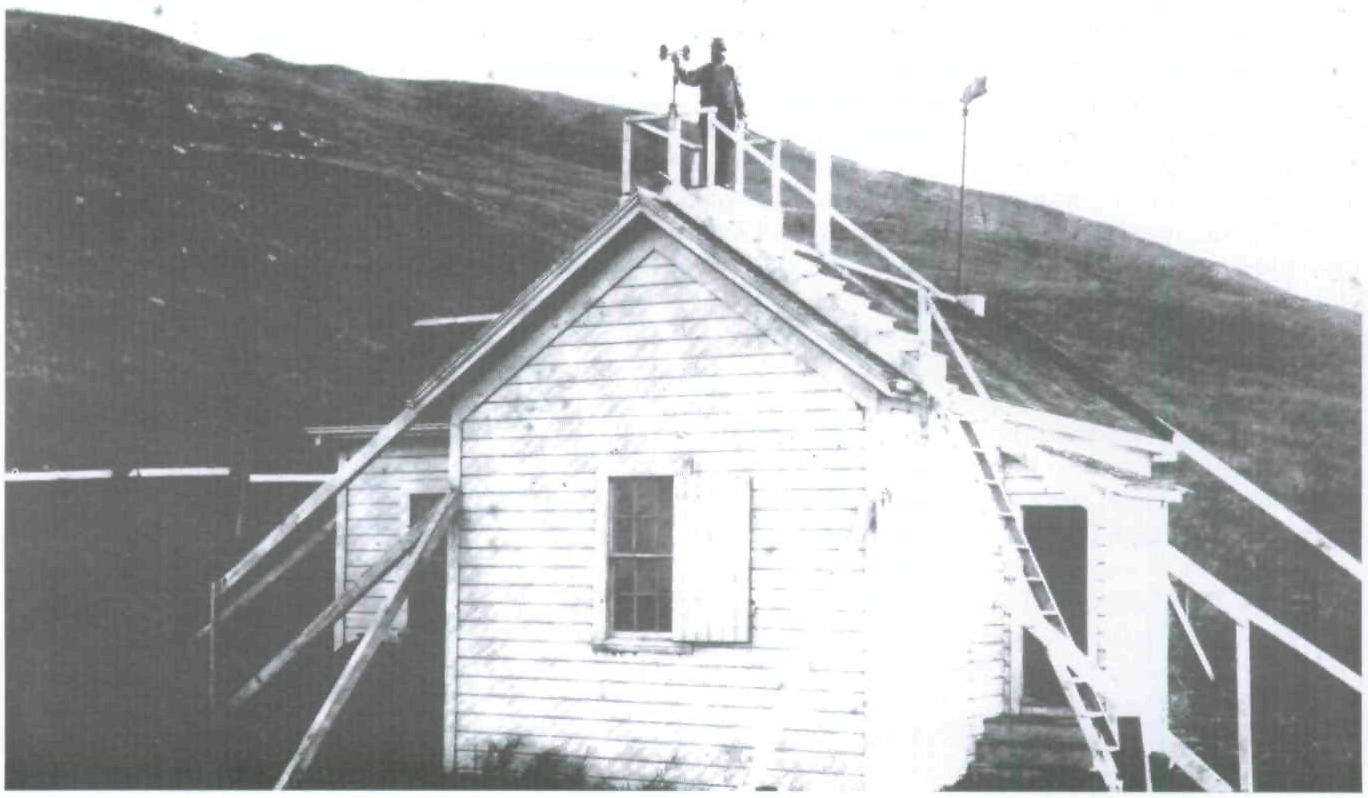
The U.S. Army Signal Corps’s Cape Mendocino weather station in 1888. Photos via the Humboldt Historian.
###
The westernmost point of the United States must have appeared to the officers of the Signal Corps of the U.S. Army as an ideal beachhead from which to gather early warnings of bad weather that could affect the ships along the Pacific Coast. A not-insignificant additional benefit of the southern Humboldt location was that it was already owned by the federal government. (The Cape Mendocino Lighthouse, which was controlled by the U.S. Treasury Department, had been operational since 1868.) A third advantage was that a federal employee — the light keeper, Archibald P. Marble, and his family — lived at the Cape in federal housing. Therefore, the Signal Corps could post an observer immediately, housing him with the Marbles until a separate facility could be built.
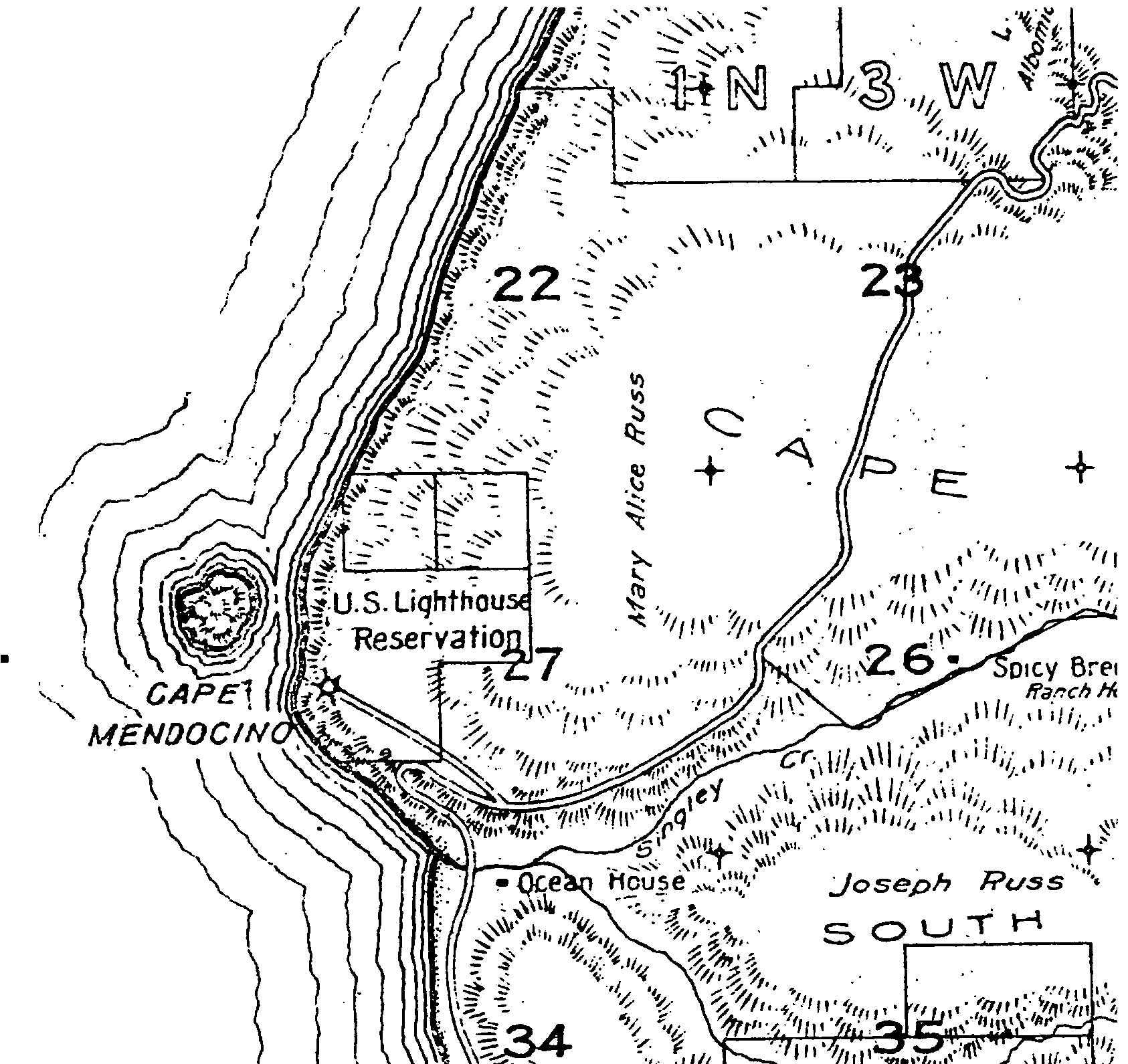
Sgt. John R. Williams, the first weather station observer, began his duties on July 25, 1882. He quickly reported the elevation of the barometer – and that all the thermometers had arrived broken. He then purchased office furniture for $17 from Mr. Frost in Ferndale and had it hauled to the Cape for $3. And then he dealt with the construction of the new house.
The contract had been awarded, based on competitive bidding, to William Butterfield in Eureka. Butterfield was notified by telegram in mid-August, and on August 17, he responded:
I find on close calculation that the house cannot be built for the amount stated in my original estimate …market price of lumber at that time [was] $18. Since then, the price has advanced and today is $25 per m. …The cost of transportation is greater than I figured upon, in fact exceeds the cost of the material. I am willing to do the work, that is put up the house, plastered inside in accordance with the original plans and specifications, for $900 which is the very lowest it can be done for.
Sgt. Williams forwarded Butterfield’s letter to Washington City with an accompanying letter mentioning a few of the practical things that were left out of the original plans:
In the specifications, no provision is made for supplying the station with water. This can be done by laying pipe to a spring nearly a mile distant at a cost of $260, or by a brick and cement reservoir of 50 barrels capacity, placed under the house, at a cost of $115, to be filled by the rainfall upon the roof – as at least 8 months’ supply must be stored away for use during the dry season…To conduct this water to the reservoir will require 75 feet of spouting and 60 feet of leaders at a cost of $25.
A pump will be necessary, at a cost of $5, and 10 feet of iron pipe at a cost of $2.50, making the total cost of the water system complete $147.50.
A water closet is necessary – not only for the comfort and convenience of those at the station, but on account of the question of police — made by the Lighthouse people. A building 4 x 5 x 8 feet will cost $20.
Owing to the fact that the depth of soil is only 18 inches, upon rock, it will be impossible to plant the Flagstaff in the ground. It will therefore have to be built into the house. A 20-foot staff so placed will cost $20.
The house will have to be braced by 2 4 x 6 timbers placed at each corner to prevent its being blown from its foundation and rolled down the mountain…it will require 12 of those timbers, at a cost of $30…
Cognizant of the impending rainy season, no doubt through warnings from Marble, Williams urged the Signal Corps to quickly authorize the changes and charges so building supplies could be hauled to the Cape before the roads were closed. A second reason for haste, as Williams pointed out, was that the station was to be his quarters as well as his office. Currently, he reminded his superiors, he was “imposing on the Light Keeper who had given him a room in his house in spite of the others who lived there: 3 men, 3 women and 13 children and several guests…” Williams added that there was no possibility of operating out of a tent, as it would “not last 48 hours at most.”
The Signal Corps got the message. Authorization for expenditures, increased to $1,117.50, arrived by telegraph on August 31. The work – Butterfield’s original plans and Williams’s additions – could begin.
Williams bought a wood stove from I. Ohman in Eureka ($20) and saved the $3 freight by having Butterfield bring it out with the building materials. He then contracted with Benjamin Flint for six cords of wood ($72). And then, fortunately, for Williams, he was ordered to another post, and Sgt. John McLean was ordered to the Cape. McLean reported for duty on November 4, 1882, and sent a letter to the chief signal officer stating, “Sgt. Williams turned over government property in good condition. Found all the records in the office filled up to date and received full instructions…in regard to the work of the station.”
As the station was still under construction, McLean noticed a few more necessary items, as he requested:
…a square box for the reception of the rain gauge flush with the ground, a pole and braces for the anemometer, a pole and braces for the anemoscope, a small platform from which to read the dial, ladders to the roof…one laid horizontally…cupboard for batteries and stand for anemograph and a few shelves for forms.
McLean chose to build these necessities with the lumber that was already on site for constructing shutters. And then there was one other, major problem, which McLean reported to his superiors:
The site of the Signal Station is part and parcel of an immense cattle range upon which there are not more than 1,000 cattle feeding. Every night, the cattle come for shelter and warmth around the building and the result can be more easily imagined than described. The braces for the house are utilized as luxurious rubbing posts, the paint has been rubbed off all around the house, and a large manure heap is gradually forming that is anything but pleasant to two senses at least.
A fence is absolutely necessary to preserve the property and keep it decently clean. A strong substantial fence similar to the one surrounding the lighthouse and taking in the water closet, 300 feet in all, can be put up for $120. A wood shed is also necessary. Six cords of wood have been contracted for and no place to put it. If this wood be left in the open air during the rainy season, it will be impossible to burn it.
McLean asked that authority for the fence and the woodshed be telegraphed as soon as possible. His request was denied.
On November 17, McLean signed off on the house with Butterfield, and sent the bill ($1,117.50, and another $35.00 for an instrument shelter) to Washington City. He said that the telegraph line would be extended to the house that day, and he hired the light keeper’s sons for $3 to help him move up the hill to the new station.
Three days later, the “rainy season” began. On November 20, a “hurricane” broke the spindle on McLean’s anemometer. (It was sent to Eureka for $7.50 worth of repairs and McLean requested a spare.) A “hurricane” on November 29 and 30 “carried away and completely demolished the water closet, smashing it into kindling wood and twisted off all the exposed rain-spouting on the east side of the house.”
After replacing the braces knocked off the house by the cattle, McLean asked again for a fence, and for authorization to add shutters. “Mr. Marble, the Lightkeeper, informs this office that the severest hurricanes are yet to come and shutters will be absolutely required.”
McLean did not acknowledge that his diversion of the lumber was the reason the house had no shutters. (The check for these requests arrived on January 16, 1883, along with the check for Butterfield. Unfortunately, no one wanted to do the work for the prices named because of the horrible condition of the roads in the winter.)
On December 15, 1882, McLean’s enlistment ended and, as he had expressed his intention to re-enlist, it was necessary for him to “proceed without delay” to San Francisco. There, he would report to his commanding officer at the Presidio, be discharged, and then re-enlisted. The station would be closed during his absence. A telegram was sent on December 15, ordering him to hire an assistant to discharge his duties during his absence, but perhaps, as McLean left on the 15th, he missed the telegram.
His trip, as he reported it, was arduous:
Left Mendocino Dec. 15, 11 A.M. Arrived in Ferndale 5:30 P.M. same date. Remained overnight in Ferndale leaving at 8:30 A.M. Dec. 16. The stage from Mendocino to Eureka does not run at night. Arrived in Eureka at 2:30 P.M. just in time to catch the Stm. City of Chester which left Eureka at 2:45 P.M. Dec. 16th. Was furnished with meals and berth on board the steamer which arrived in San Fran. Sunday Dec. 17 at about 4 P.M. Reported at the Presidio to the Commanding Officer Monday Dec. 18th at 10 A.M. Remained in San Fran. awaiting final statements and discharge until Dec. 30th when the papers were received at 1 P.M. too late for the steamer for Eureka which left San Fran. that morning at 9 A.M. Was then detained much longer in San Fran. than was desirable on account of the heavy expense, the detention being caused through no fault of my own. Started from San Fran. per Stm. ‘City of Chester’ 9 A.M. Wed. Jan 3rd; meals and berth furnished, and arrived in Eureka at 3 P.M. Thursday Jan. 4th. Missed the stage next morning Jan. 5th; oversleeping myself on account of the rough passage the preceding day and night. As the stage would not leave Ferndale for Mendocino again before the morning of the 9th; I remained in Eureka until the morning of Jan. 8th; leaving the latter place at 9 A.M. of that date and arrive in Ferndale at 3 P.M. Jan 8th. Remained overnight in Ferndale starting for Mendocino at 7 A.M. Jan. 9th; arriving at the ‘Ocean House’ below the station at 3:30 P.M.
McLean’s days were filled with the required responsibilities of the observer: taking readings from his instruments, recording the information on forms supplied by the Signal Corps, telegraphing or writing the weather information to San Francisco, keeping a daily weather journal, maintaining a journal of correspondence received, and another for correspondence sent. Much of this had to be written, by hand, in more than one copy. (This was the army.)
Further, it was the U.S. Army Signal Corps. Therefore, it was considered necessary that communications should not be understood by any unauthorized person who may see them. As others would see them — this information was being relayed by Western Union telegraph operators — the Signal Corps required that all communications be “ciphered”; that is, put into code words from lists of “Arbitrary Words Not Translatable At Sight.” Never mind that this was weather data.
The result was, for example, the report of April 2, 1884, at 11 p.m.: “Nominee. Field. Hoist. Image. Rabbit,” or the following day’s 7 a.m. report: “Moping. Fiction. Hoist. Imbibe.” Each of these code words conveyed a temperature, barometric reading, and wind, sky, or other observation, although not necessarily in that order. These ciphered codes were telegraphed by the observer at 7 a.m., 3 p.m., 7 p.m., and 11 p.m. on 75 Meridian time (roughly three hours earlier than Pacific time).
From the start, however, there had been problems with the telegraph. A telegraph line extension had been authorized to the new building in October 1882. Western Union added the loop from its line that came up the coast from San Francisco to Eureka, and the connection was made on the line between Petrolia and Ferndale.
Unfortunately, neither the main line nor the loop worked well. Dampness from fog or rain kept the signal from traveling down the line — and there was plenty of fog and rain. The notation “line down” was included almost daily in the weather journal kept by McLean.
The time was figured from a sunset table supplied by the Signal Corps. The table gave the hour and minute the sun would set each day. The weather station clock and the observer’s alarm clock could then be set by noting the sunset and using the time on the chart — except when, due to fog, clouds or rain, the sunset could not be seen — a not infrequent situation.
While McLean’s coded weather reports gave only terse facts, his journals and correspondence filled in the picture.
On January 19, 1883, he requested a carpet or linoleum to cover the floor of the house.
The lumber used in the flooring … was not thoroughly seasoned to begin with … when a gale is blowing, there are a thousand crevices through which the cool air forces itself. At first, this was only felt as a minor evil and the Observer could harden himself to endure it. But endurance has not kept up with the increasing discomfort and suffering. Since the Observer’s return from San Francisco, furious NW gales have been blowing almost continuously, the temperature gradually lowering. The wind being very dry, the flooring has warped to such an extent that the Observer had to move his bed alongside the stove and keep the fire going all night for warmth. During the day, it is even worse. The office table has been moved to within 3 feet of the stove, and the Observer sits on a chair between the table and the stove with a heavy double blanket about his feet and legs…
And, on January 24, 1883, McLean had another problem:
The cattle made so much noise around the building on the nights of Jan. 21, 22, that the Observer could not sleep, resulting in his oversleeping the morning of Jan. 23, missing the A.M. observation. Last night, a storm from the SE set in which kept the Observer awake until a very late hour, not only from the noise and roar, but from the cold and discomfort caused by the wind and rain pouring in through flooring, windows & doors…. The braces on the poles for the anemoscope and anemometer are not staunch enough, the rain spouting leading to the cistern is in a defective condition. Rain beats in all round and under the window sashes, soaking the plaster which is now ready to drop off. The front door has warped to such an extent that on one side there is an opening of fully 1/2 in. at the top gradually decreasing to 1/8 in. at the bottom and fully 1/2 an inch is open between the doorsill and the bottom of the door. The storm is now raging fearfully — seventy-two miles per hour…
On February 20, 1883, McLean received word that a woolen carpet had been made for him, and that it would be shipped through the San Francisco office. The letter had been sent from Washington City on February 5; it had taken nearly five weeks for the mail to make the round trip between Cape Mendocino and Washington.
The difficulty in getting the mail through – and the need to request money to pay for the mail to be carried – prompted further correspondence:
…The stage driver Mr. King has the contract from the Post Office Dept. to carry the mail from Ferndale, Humboldt County, to Petrolia, a distance of about 30 miles. His contract only calls for the carrying of the mail bags from Post Office to Post Office on this route and not for its distribution along the road. The only Post Office between Ferndale and Petrolia is 5 miles from Cape Mendocino at a little village called Bear River or ‘Capetown.’ Up to the present time, all the citizens, including the Observer, between Capetown and Cape Mendocino have been indebted to the courtesy of the stage driver Mr. King for the personal delivery of the mail.
If Mr. King had chosen not to deliver the mail to the weather station, McLean would have had to hire a horse to ride to Capetown three times a week to receive and post mail. McLean figured each trip would cost him at least fifty cents and enough time that he might miss one of his regular observation times. It was common practice for the army to pay for the stamps to mail business correspondence, but not to pay for delivery or pick-up. In April 1883, two days after McLean was ordered to discontinue sending his reports by telegram (because the lines were always down), he received the news that there would be no appropriations to pay J.R. King for carrying the mail from the station until the next fiscal year, beginning July 1. (In July, McLean repeated his request, and J. R. King, stage line owner and driver, received his requested six dollars per quarter to pick up and deliver mail at the weather station.)
As the authorization for repairs and improvements had been in hand since January, when the weather improved, McLean wrote Butterfield and asked him to do the work. The roads got worse, the cattle damage got worse, and McLean wrote Butterfield two more letters. All three letters went unanswered. As McLean then reported, he had written:
…to the Hon. J. Russ, the wealthiest citizen of Northern Cala. and the owner of the wild cattle, requesting his assistance in the matter of hauling material for the [fence and woodshed]. A courteous answer was received, stating that his agent Mr. Bryant would attend to the matter. Shortly afterward, the fence posts and lumber were laid right at the office, both labor and material furnished free.
T.J. Frost of Ferndale agreed to do the work for $170, and John A. Mackey of Petrolia supplied the rest of the fence materials for $15.65. The light keeper, Archibald Marble, offered to build the fence for $10. The project, not done quite as authorized, came in under budget by $4.35, but, as it happened, Mr. Russ’s agent, Mr. Bryant, ended up building the fence, as he said that Marble was not doing it properly.
The light keeper and his wife had seven children; also living in the house with them were the assistant light keeper, Frederick L. Harrington and his wife, Josephine. Records show that the Signals Corps paid Archibald’s sons for various tasks over the years related to the weather station; it also paid Mrs. A.P. Marble for cleaning the weather station (although at the time Mrs. Marble was paid, the weather station was still located in the light keeper’s house). Later, Josephine Harrington was paid 75 cents to clean the weather station one day a week.
McLean filed the weather station’s first annual report on July 1, 1883. He detailed the problems with the equipment breaking, problems completing the trice-daily telegraphic reports (which had been discontinued in April), and the need for an assistant observer. He concluded his report with these thoughts on the location of the station:
When the Observer came through Eureka on his way back to the Station in January last, he met nearly all the leading citizens of that place and one and all expressed themselves as highly interested in the working of the Station, but would much rather have had the Station established nearer the town: giving their reasons, the growing commerce of the city, numerous steamers and sailing ships plying between it and San Francisco and other home and foreign ports. The records would be of material interest to all the owners and Captains of vessels, the great and growing lumber interest, farmers and their citizens generally. As it is, the Station is of no use whatever to the town of Eureka. On the other hand, the greatest interest imaginable is taken in the reports from this Station by the leading business men of San Francisco especially during the rainy season. To the citizens of the contiguous towns and villages, the Station and its records are of no use whatever owing to its almost inaccessible and isolated position.
A month later, Sgt. McLean asked for a transfer. He was bothered by “rheumatism, confined principally to the knees.” Even summer on the Cape, he reported, was cold and foggy, and he had not improved; in fact, he had gotten worse. He was afraid that if he stayed, he would one day be unable to carry out his duties.
In October, he received notice that he could expect orders, transferring him to North Platte, Nebraska. McLean’s replacement as observer was to be Sgt. A.P. Leavitt; Leavitt had traded what he thought was an unbearably isolated post in Sitka, Alaska, for one even more isolated.
On November 29, 1883, both sergeants sent letters to the Chief Signal Officer of the Army stating that the transfer of responsibility had been made.
Sgt. Leavitt, of course, immediately experienced the same problems as had McLean: the wind constantly breaking various parts of the anemometer, finding competent repair people, and the challenges of being a weather observer on the Cape’s exposed hilltop.
As the telegraphed reports had been reinstated, Leavitt was aware of his lack of skill as a telegraph operator and practiced daily. Nevertheless, the Pacific Coast superintendent of Western Union branded him the “poorest kind of operator.” Leavitt wrote the Signal Corps and asked for it to send a good operator to the Cape. The reply he received indicates the tone of his letter had been one of a person insulted. He had, after all, by January 1884, been paying five dollars a month out of pocket to an operator twenty-five miles down the line to repeat the signals for him.
By April 1884, Leavitt, too, had had enough, and he requested a change of station to “some place in the east.” His request was denied. Leavitt was to remain at the Cape station for another twenty months – but he didn’t suffer in silence. Over the nearly two-year period, he continued to voice his complaints. He had health problems and no assistant or qualified civilian to do his work when he was sick. He was isolated, seeing only the lighthouse people and the stage which passed a half-mile away. He had to get his provisions from a village twenty miles away and cook all his own meals. His mother in Maine died. He grieved for her, and for the fact that it had been more than six years since he had seen his parents. On less personal issues, things were no better: competitive bids that were required for every new expenditure could not be secured. If there were actually enough tradesmen to acquire three bids, they would not bid without seeing the job. And they would not come to see the job without a guarantee of either securing the job or being paid to come and look at it. Finally, in March 1885, Leavitt wrote that he was unable to see to get the first and last required observations because it was too dark.
In September 1885, there was a change in the mail contract. Now, it would only be carried twice a week to and from Eureka. If the stage did not make the connection with the steamer, there would be more delays before getting communications in on time. The winter season of 1885-86 caused even more problems. A suggestion that a mailbox with lock and keys be placed where the mail carrier passed was preceded by the explanation:
…the only method the Observer has of depositing letters is to intercept [the] stage as it passes about a half a mile from the Station. The roads this winter have been impassable for wagons, and the mail has been carried through on horseback – sometimes, at night. It often occurs that it passes at observation hours when it is impossible for the Observer to leave [the] station. All reports have been ready for mailing on time, but carrier has been repeatedly missed.
At the end of November 1886, the Signal Corps informed Sgt. Leavitt that, as of December 31, 1886, the weather station at Cape Mendocino would be closed, and the operation moved to Eureka.
Both Leavitt and the Signal Corps thought their problems were over.
(To be continued…)
###
The story above was printed the Spring 2005 issue of the Humboldt Historian, a journal of the Humboldt County Historical Society. It is reprinted here with permission. The Humboldt County Historical Society is a nonprofit organization devoted to archiving, preserving and sharing Humboldt County’s rich history. You can become a member and receive a year’s worth of new issues of The Humboldt Historian at this link.