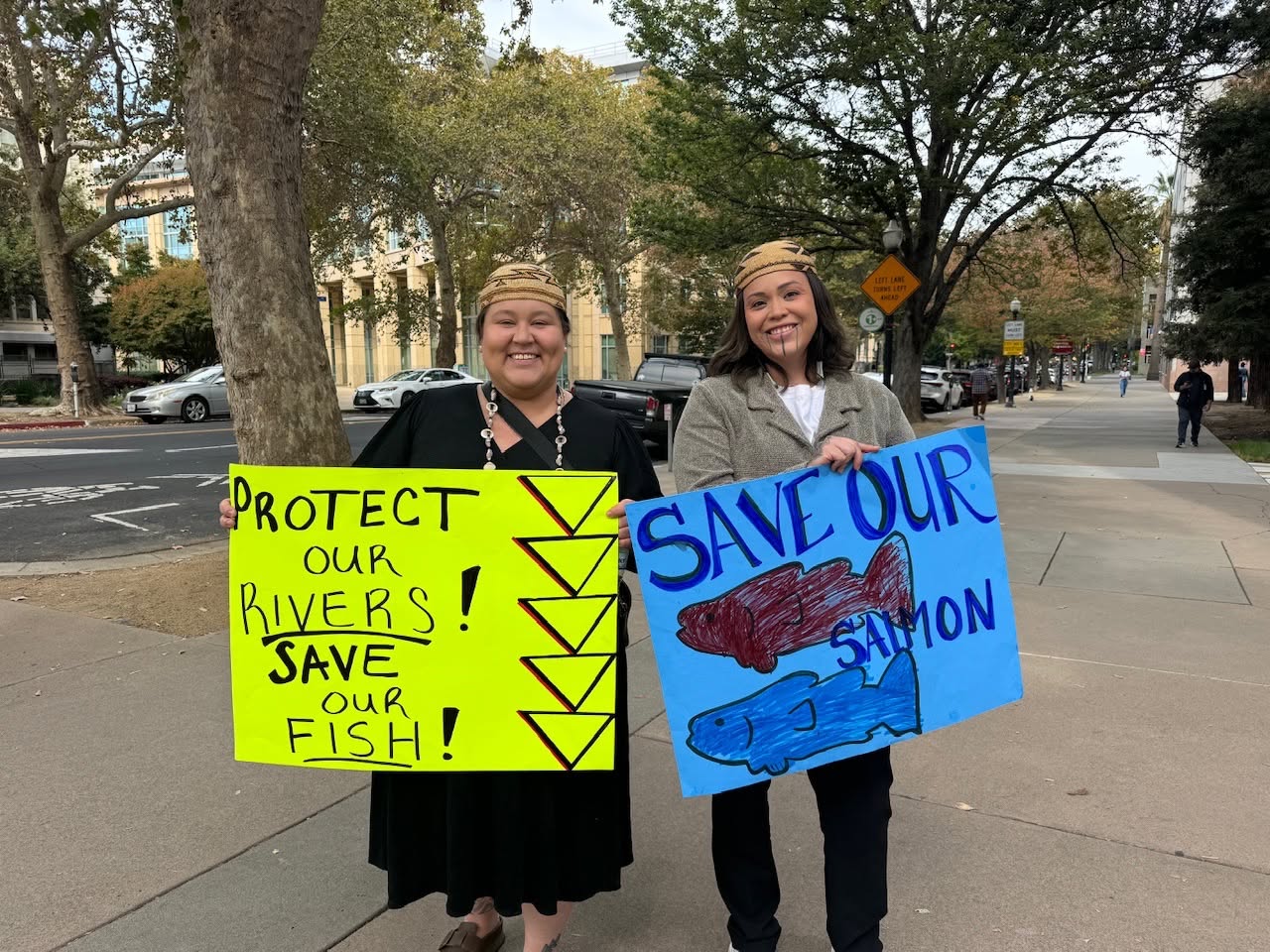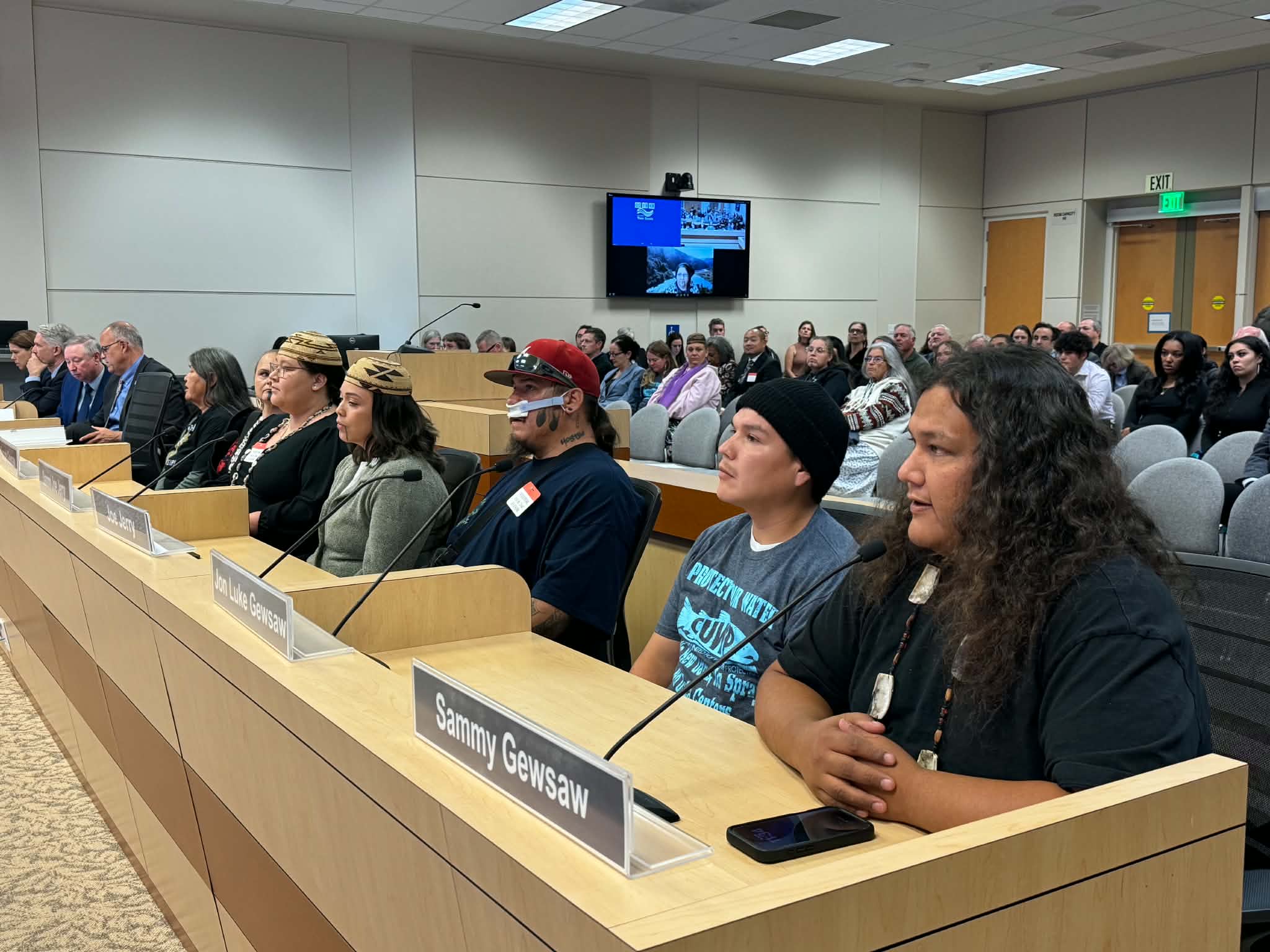
Local tribe members appear at last week’s State Water Board hearing. | Photos via Communities United for Water Protection.
###
Late last week, California’s State Water Resources Control Board approved a major update to the Bay-Delta Plan, the comprehensive water management and conservation policy governing NorCal’s largest watershed.
As one component of that update, the Water Board directed staff to conduct a public scoping workshop to consider minimum in-stream flow, temperature and other requirements for the Trinity River. This concession, aimed at protecting fish and “wildlife beneficial uses” on the Trinity, followed days of public activism from local tribal communities and environmental organizations.
Below is a press release from a coalition of such organizations, Communities United for Water Protection, which focuses on Trinity and Klamath River protections:
Sacramento, CA - After hours of debate during a October 29 hearing, the State Water Resources Control Board committed to public scoping hearings on Trinity River water quality and flow issues as part of its Bay Delta Plan Update.
The decision followed a fierce debate among board members and testimony from dozens of tribal members who stated that the Bay-Delta process had failed to address potential major impacts on the Klamath-Trinity River system.
Most of the Trinity River, the Klamath’s largest tributary, is diverted to the Bay-Delta for use by powerful agribusiness interests. Despite the fact that local tribes and rural communities depend on adequate Trinity flows for survival, the state has very few laws regulating excessive diversions. Commenters said new reservoirs and diversion projects threaten not just Trinity River releases, but also releases necessary for abating Klamath River fish kills.
“The implications of your decision today will impact our children’s children,” said Georgiana Genshaw, a Yurok Tribal member whose family are subsistence fishermen. “My kids grew up in the Un-dam the Klamath era. They have never known a life where we were not having to protest for water. Now I feel like we have our Klamath River, getting stronger and healthier. But now you want to take his sister. We, the Yurok and Karuk people, understand the Trinity is important for a multitude of reasons, including the cold water and oxygen it provides.
The specific resolution the Board added to the Bay-Delta Plan falls well short of the benchmarks the counties, tribal members and environmental advocates requested. These include: a water rights hearing, protections for federal flow decisions to restore flows and stop Klamath River fish kills, and changes in temperature standards.
“The State Water Board’s Bay-Delta decision to include a scoping workshop on the Trinity River is a step forward, but is still woefully lacking in substance,” said Tom Stokely, a policy analyst with Communities United for Water Protection. “It’s the first time in 36 years – ever since a Trinity River water right hearing to protect temperatures for salmon was promised – that it has even been discussed. We are nonetheless grateful to Board members Jared Blumenfeld and Nichole Morgan for trying to get a solid commitment for a Trinity River water right hearing.”
Despite the changes in the resolution language some of the commenters, such as Trinity County representative Trent Tuthill, consider the resolution a step in the right direction.
“Trinity County appreciates the State Board’s commitment to further evaluating the instream flow, temperature, and other requirements necessary to protect the Trinity River and its vital fish and wildlife resources. Following our participation in the Board’s hearing, we are encouraged by this commitment and look forward to working collaboratively with tribal governments, neighboring counties, state and federal agencies, and other stakeholders. As the county where the Trinity River originates, we recognize the importance of preserving and protecting this invaluable resource, its beneficial uses, and the communities that depend upon it.”
A resolution only came after hours of debate over competing resolutions that ran beyond 11 p.m. During the debate, State Board member Morgan repeatedly reintroduced a stronger resolution. She stated that she believes that communities deserve timelines and commitments.
Regina Chichizola, a representative from Communities United for Water Protection agreed. She expressed frustration that local people have fought for generations to protect the Trinity River and testified at every Bay-Delta-related hearing for the last ten years, but have yet to receive any protections from the board. She said many people drove 10 hours to testify for three minutes.
“We live in a rural area,” Chichizola said. “We don’t have much left for our economies. All of our water, all of our resources, they come down here. But nothing flows back up to us.”
Chairman Joaquin Esquivel, who voted against the stronger resolution twice, said that unlike in past years, the board made sure to hear from tribal members. Emoni Durham, a Native student, stated that native people have always fought for clean water, and the board has yet to listen.
The advocates say they will continue to push for strong protections for the Trinity River.
The final language of the resolution follows:
“The State Water Board directs staff to conduct a public Board scoping workshop to consider minimum instream flow, temperature, and other requirements for the Trinity River to provide for the reasonable protection of fish and wildlife beneficial uses within one year of the completion of the ongoing Trinity River Endangered Species Act reconsultation process, but no later than two years following adoption of the updates to the Bay-Delta Plan.The scoping workshop should be conducted in coordination with the North Coast Regional Water Quality Control Board, Trinity River tribal interests, Trinity and Humboldt Counties, the U.S. Bureau of Reclamation, state and federal fisheries agencies, and other appropriate entities to the extent possible.”