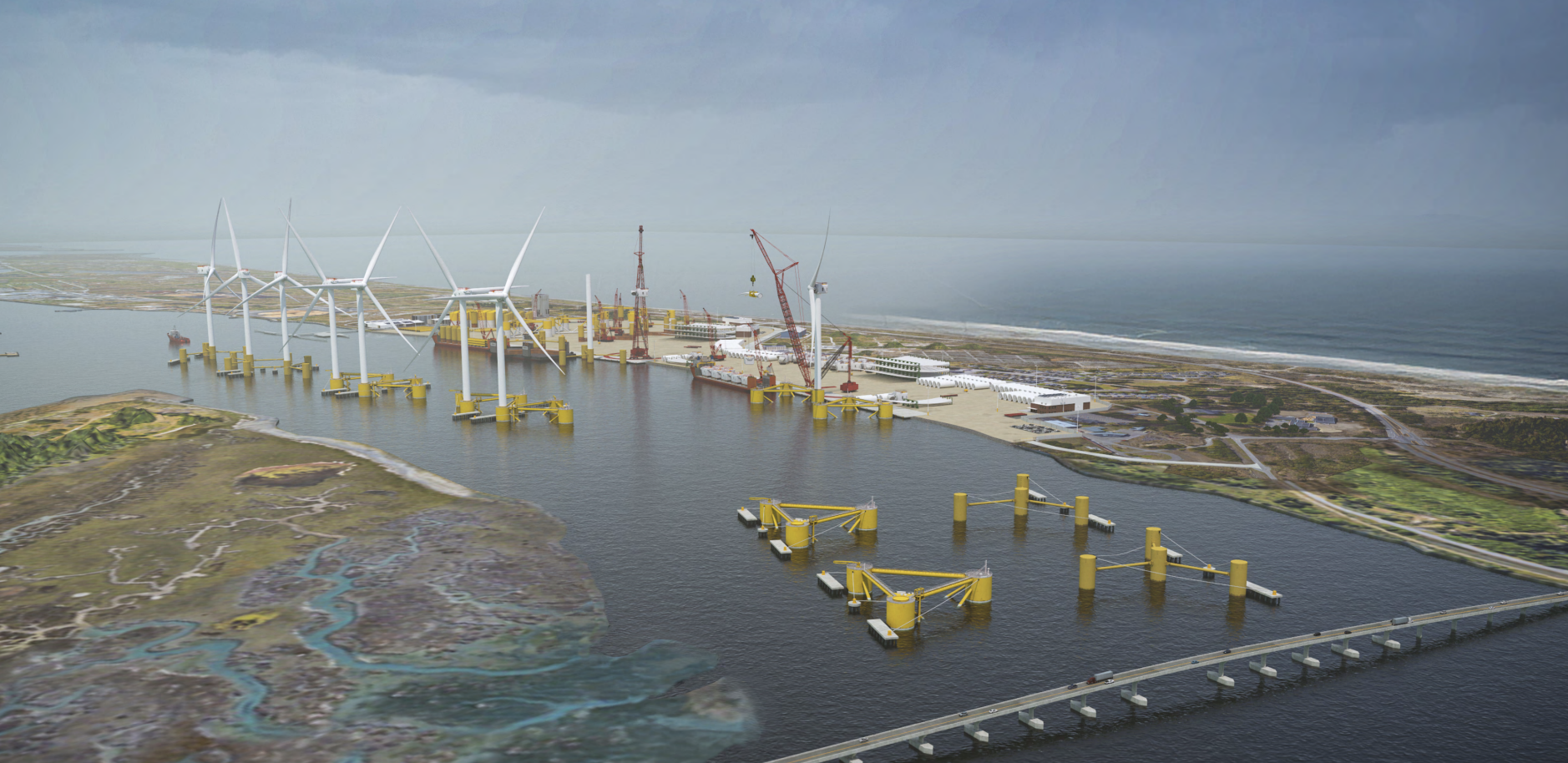
A rendering of the heavy lift marine terminal proposed for the Samoa peninsula. | Image: Humboldt Bay Harbor, Recreation and Conservation District
###
As the Humboldt Bay Harbor, Recreation and Conservation District advances plans for the proposed Offshore Wind Heavy Lift Marine Terminal slated for the Samoa Peninsula, a growing number of people are raising serious concerns about the scale of the project and what, if any, mitigation measures can be implemented to protect the environment and invaluable tribal cultural resources.
At a public scoping meeting for the port development project at the Eureka Veterans Hall on Wednesday night, dozens of residents urged the Harbor District to carefully examine potential impacts to Humboldt Bay and its surrounding communities during the upcoming California Environmental Quality Act (CEQA) review process. Some suggested a new location for the project, while others asked the district to scrap it entirely.
“I’m very glad that you showed this picture so we can see just what an abomination it is to our bay,” said resident Gail Naren, referring to the digital rendering above. “I am just enraged. We live in a precious and unique place with a fragile environment that has already experienced extensive damage and will take generations to ameliorate. Yes, we need more jobs, but this project is overwhelmingly hideous and threatening. We can do better.”
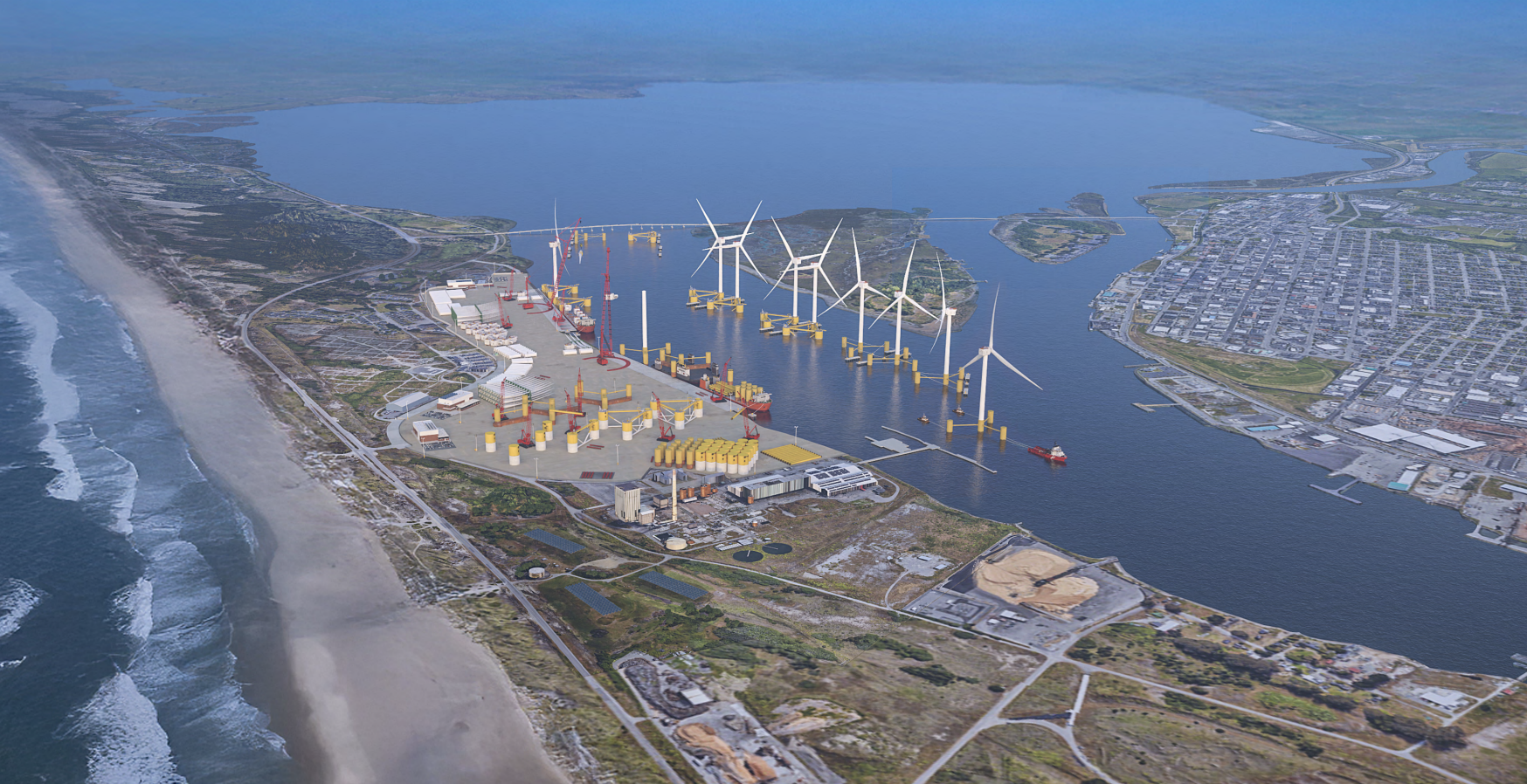
Rendering via the Humboldt Bay Harbor, Recreation and Conservation District
The primary purpose of Wednesday’s meeting was to give residents a chance to comment on the Notice of Preparation (NOP) for the project that was re-released for public review at the end of September. Comments submitted through the NOP will be incorporated into the project’s draft environmental impact report (DEIR).
When the DEIR is released for a 45-day comment period next year, community members will have another opportunity to provide feedback, and the Harbor District will be required to respond to each comment.
But before we delve into what’s new, a quick bit of background on the project:
The heavy lift marine terminal would serve as the staging and integration facility for the floating offshore wind farm planned for the Humboldt Wind Energy Area, located 20 miles west of Eureka. The facility would have the potential to assemble and ship the gigantic components needed for floating offshore wind turbines, including the floating platforms, towers, blades and nacelles (the protective housing that encases the generating components), transmission cables and mooring lines.
The Port of Humboldt Bay is the only port on the West Coast that has the capacity to host all three primary port needs of the offshore wind industry — staging/integration, on-site manufacturing/fabrication and operations/maintenance — though some of that work could also take place at the Port of Long Beach.
At Wednesday’s meeting, Shelly Anghera, a principal scientist with global infrastructure advisor Moffatt & Nichol, the project’s lead designer, went over each phase of development for the 180-acre heavy lift marine terminal.
“These phases help with the environmental analysis to understand what activities are going to occur when,” Anghera explained, noting that the EIR includes a tentative start date of 2028, with construction expected to be completed by 2037. “The construction activities start with the demolition of existing infrastructure [at Redwood Marine Terminal I].”
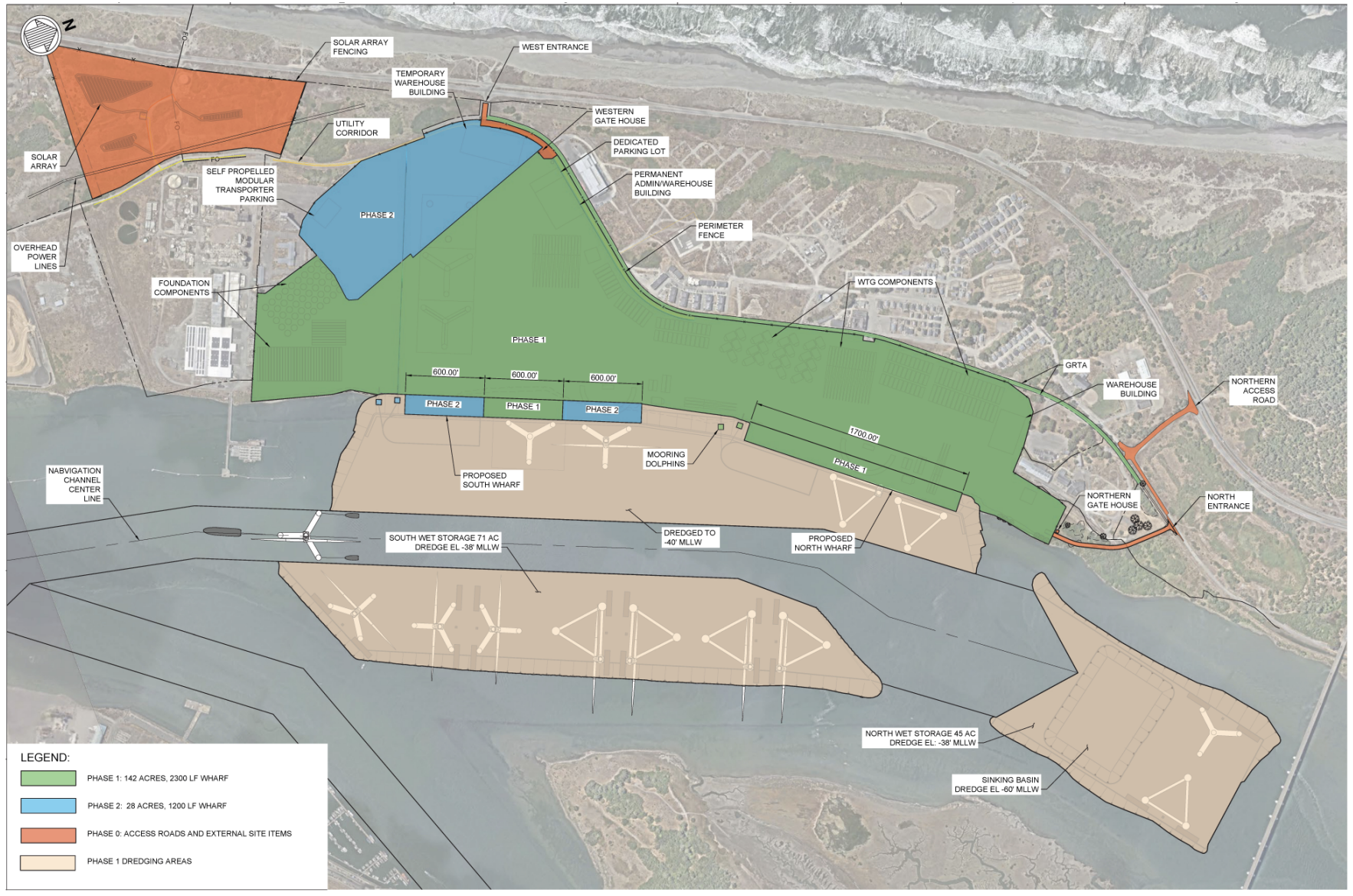
Map of phases 0-2 via the Humboldt Bay Harbor, Recreation and Conservation District.
“Phase 0” also includes development of a solar array, construction of access roads to the project site, improvements at Woodley Island and on-site habitat restoration.
“When the terminal is ready to begin construction, the terminal site itself would be the green area,” Anghera explained, gesturing to the map above. and it includes the north wharf. “It also includes all of the dredging that’s in brown, and a small portion of the wharf on the south side of the site. … Phase two is the blue areas, and those would be constructed after the green areas are complete.”
“There are environmental commitments in sustainable design and resilience that have been built into this project,” she continued. “The goal is to restore and enhance wetlands and habitat improvements where possible … that includes osprey relocation, removal and disposal of existing creosote piles, and the implementation of [best management practices].”
Before the public comment portion of the meeting, Matt Simmons, an attorney with the Environmental Protection Information Center (EPIC), reminded the audience that the “purpose of this meeting is to give advice to the Harbor District on how to make the project better.”
“The most effective way to do that is to describe the current environmental conditions, how things are right now, [and] what you’re worried about changing. … What about this project could change those conditions?” Simmons continued. “And then finally, [the community’s role is] to suggest mitigation measures or alternatives that would help address those concerns [or] ways that the project could be done better.”
Only a few people in attendance spoke in favor of the port development project, including Erik Peckar, the director of external affairs for Vineyard Offshore, an offshore wind developer with a lease off the coast of Humboldt. Before moving to the West Coast, Peckar lived on Martha’s Vineyard, where Vineyard built the nation’s first commercial-scale offshore wind farm. He described the economic boon the project brought to the coastal community.
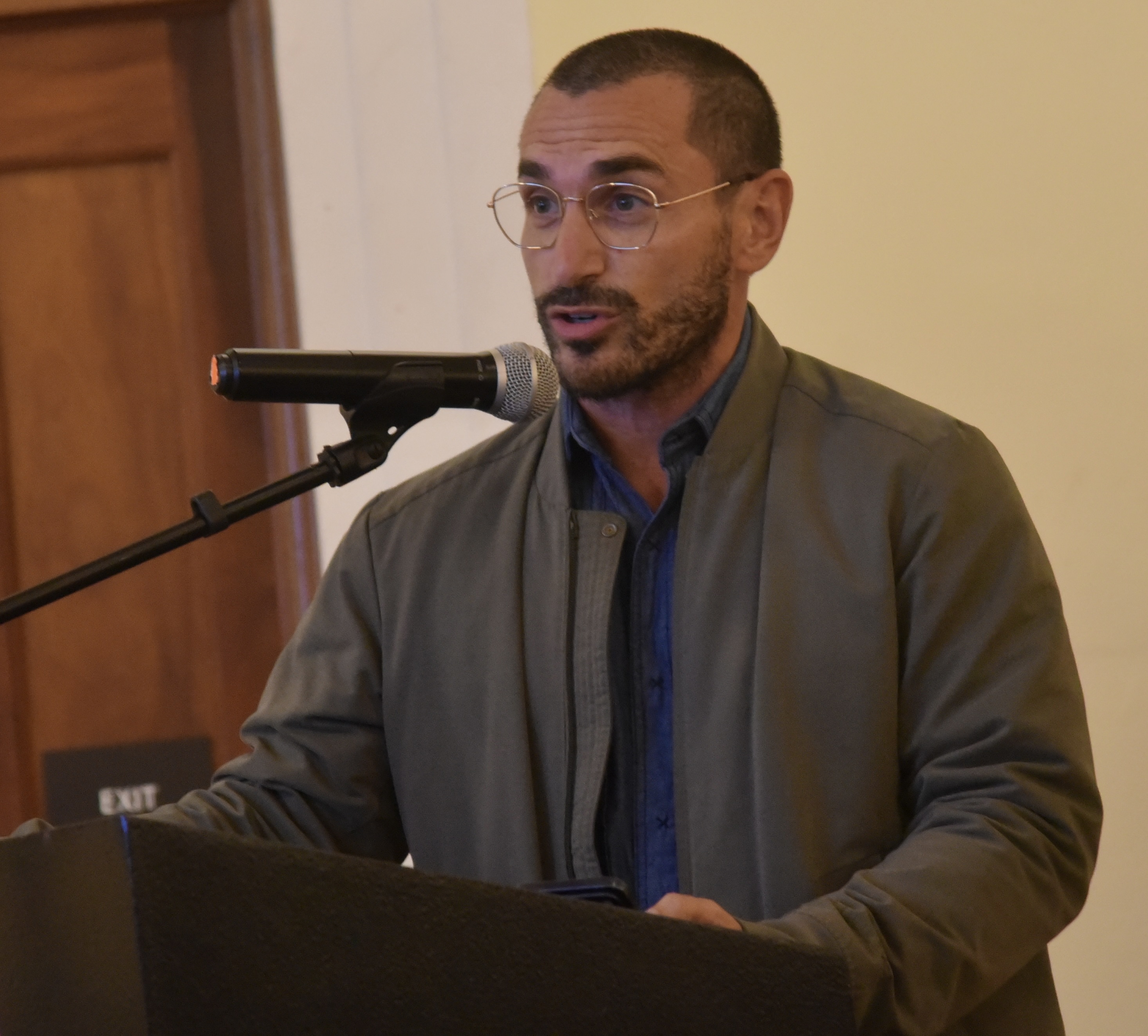
Erik Peckar | Photo: Isabella Vanderheiden
“In Massachusetts, our project has brought significant job creation to the region while using the local port of New Bedford,” he said. “Vineyard Wind has employed more than 3,700 workers, and 71% of its union labor came from the local region, which beat our goal of 51%. We also trained local fishermen and upgraded their fishing vessels, and more than 50 New England fishing boats have been hired to work on our project. In total, it has supported $1.9 billion in economic output in Massachusetts, and its operations will sustain 80 to 100 permanent jobs for decades.”
A representative of the local Building and Construction Trades Council and a couple of other union members also seemed to be in favor of the project. They advocated for more local jobs for skilled workers and urged the Harbor District to create a project that benefits Humboldt Bay communities as well as the environment.
The vast majority of speakers, however, were fiercely opposed to the heavy lift marine terminal. Many people acknowledged the need to shift to renewable energy resources in the face of climate change, but felt the current project could compromise the health of Humboldt Bay.
Jennifer Kalt, executive director of the Humboldt Waterkeeper, disputed the claim that the heavy lift marine terminal would be a “sustainable development” and criticized the Harbor District for expanding the project without public input.
“Over the past three years, many of the people here today have gone to dozens of meetings to express concerns and request changes to this project to reduce its impacts. Now, instead of responding to those concerns, the project before us is even bigger,” Kalt said. “Instead of a living shoreline, there is now a 10-foot-tall stone wall more than a mile long at the edge of the bay. … No changes to the plan to dredge two massive holes adjacent to Tulawat to store the turbines as they are built.”
“Humboldt Waterkeeper approached this project in hopes that it could be a responsibly designed renewable energy project, because we know we need to get off fossil fuels, but this is not responsible,” she added.
Several oyster and shellfish farmers expressed concern about dredging and potential contamination from buried pollutants. Brad Fletcher, a board member with the Pacific Coast Shellfish Growers Association, underscored the influence of the local shellfish industry, which, he said, supports more than $31 million in economic activity annually.
“The bay grows more than half of California’s oysters, and it is also the only bay in California cleaning up to ship baby shellfish or seed out of the state, supplying two-thirds of all West Coast shellfish farms,” he said. “This project puts all that at risk. … If this review cannot show how the bay’s health will be protected, this project, as proposed, is not consistent with the district’s own commitment.”
Several other community members expressed concern about tribal cultural resources around the bay, especially Tuluwat Island, the Wiyot Tribe’s spiritual center of the universe. Some speakers worried that dredging could increase subsidence, causing the island to wear down and essentially sink.
Derek Bowman, a tribal council member of the Bear River Band of the Rhonerville Rancheria, stated the Tribe’s opposition to the project, emphasizing that “such development must not come at the expense of irreplaceable tribal cultural resources and ancestral heritage.”
“Our opposition is grounded in the presence of two tribal village sites located within the immediately adjacent and proposed project area,” Bowman read from a prepared statement. “These sites are of profound cultural, historical and spiritual significance to the Bear River Band and other tribes in the area. They represent not only the physical remnants of our ancestors’ lifeways, but living cultural landscapes that continue to hold meaning for our tribal community today.”
A few other speakers suggested the Harbor District find another spot for the heavy lift marine terminal that isn’t so close to Tuluwat Island or Samoa Peninsula communities.
“I suggest the Harbor District evaluate wet storage sites closer to the mouth of the bay, [which] would also potentially present less risk to aquaculture and could serve as a dual mitigation,” said Rachael Smith, a program officer for CORE Hub and the Humboldt Area Foundation. “I understand the convenience of this site, owned by the Harbor District, and the complications of acquiring other land, [but] this project is so important to California’s climate goals [that] I think it’s worth a very thorough analysis of pathways to relocation.”
Smith also expressed concern about noise impacts on Samoa Peninsula communities, especially residents living in the low-income townhomes next to the project site.
“I’m asking the Harbor District to thoroughly analyze moving the loudest, noisiest and most polluting parts of this project away from that community, and to look at reorganization of the existing site as well as evaluating the acquisition of new sites,” she added.
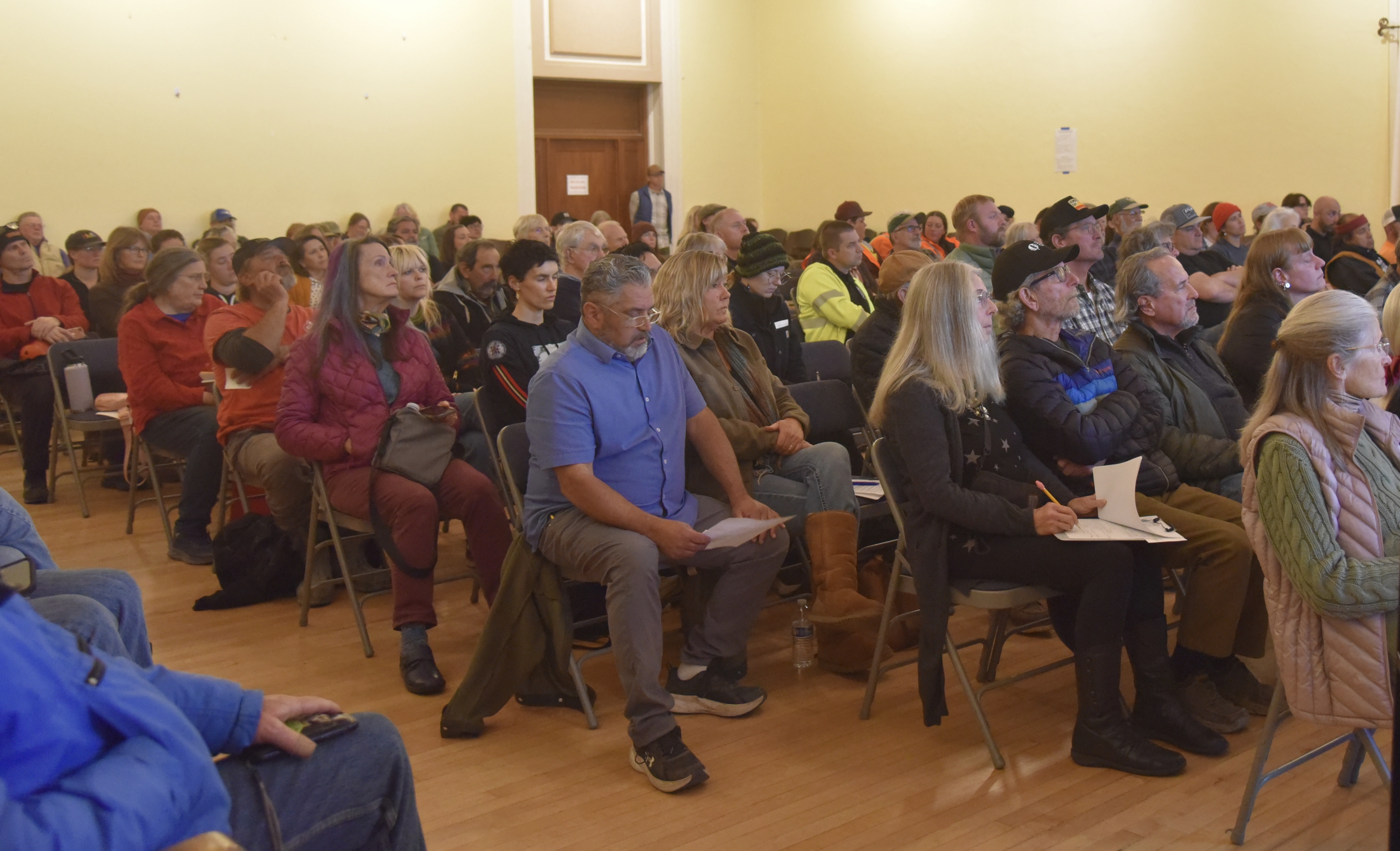
A crowd gathered at the Eureka Veterans Hall to comment on the NOP. | Photo: Isabella Vanderheiden
One of the last speakers of the night was First District Supervisor Rex Bohn, who echoed many of the concerns that had been expressed throughout the meeting.
“I’m finding myself conflicted as hell because I’m agreeing with a lot of people I’ve probably never agreed with before,” Bohn said, noting that he’s lived in the county for “eight decades” and has seen industries change in that time. “I really am challenged how you’re going to mitigate all of these things that are coming up. … I applaud the harbor for trying to find jobs, but what expense are jobs? I want jobs … I got three grandsons here … but I can’t believe we might throw everything away for just jobs.”
###
Comments on the NOP may be submitted via email to projectcomments@humboldtbay.org. Those who prefer snail mail can send their comments in writing to: Chris Mikkelson, Humboldt Bay Harbor, Recreation and Conservation District P.O. Box 1030 Eureka, Calif. 95502-1030. All comments must be received or postmarked by Monday, Dec. 7.