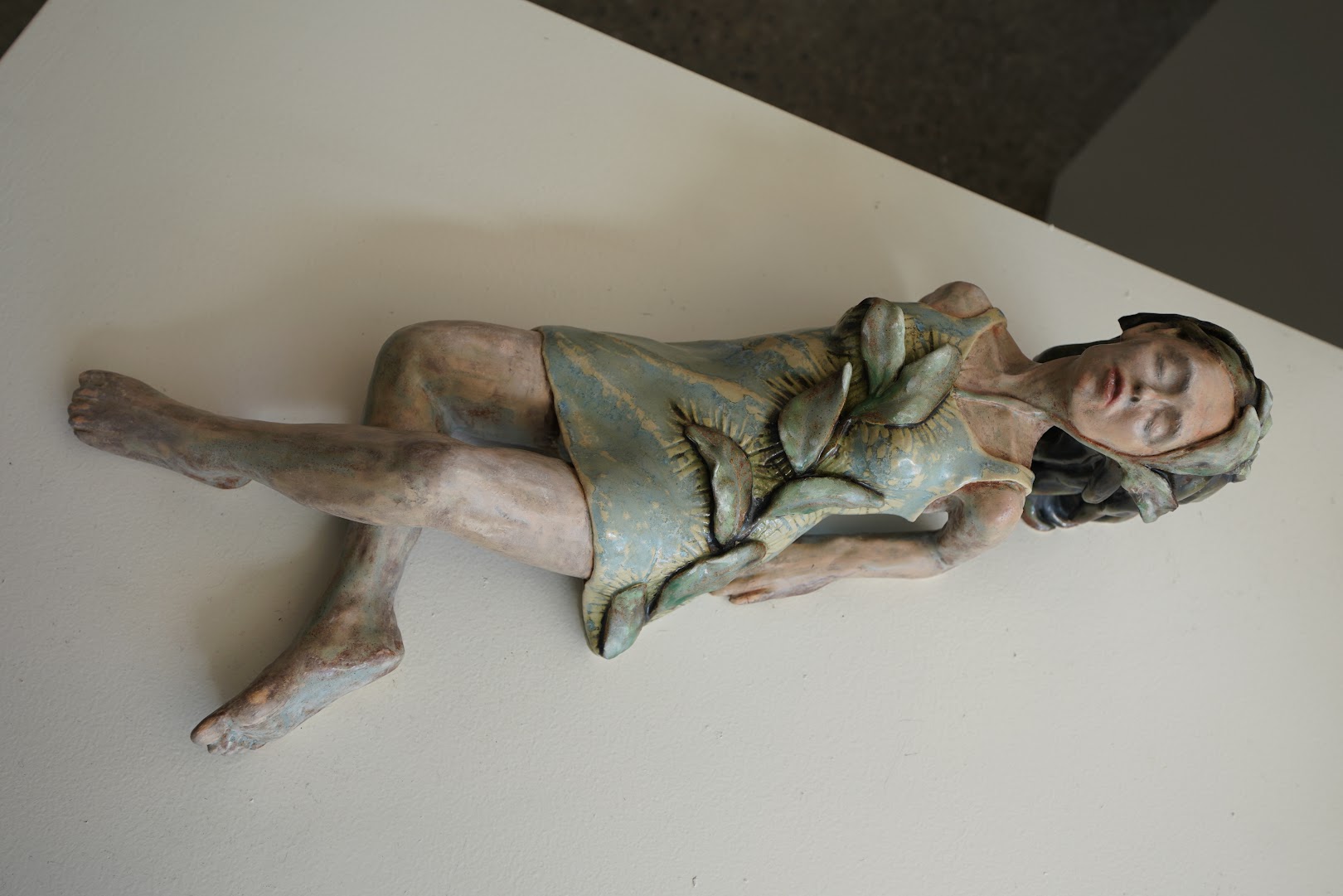
Quiet Reverie (2026), ceramic. Sculpture by Sara Kimber. Photo: Rutherford/Pearson.
###
On Thursday, October 15, 2026, at Tidal Gallery (339 2nd St., Eureka), Natascha Pearson met with Sara Kimber to discuss The Silence Within, a collaborative exhibition of paintings and sculptures by Kimber and artist Karla Austin.
Their conversation explored Kimber’s sculptures of young women, often depicted alongside natural elements in moments of quiet contemplation. Her message centers on social justice and self-preservation: the importance of authenticity and the freedom to reject assigned roles.
On a larger scale, Kimber’s work encourages collaboration among artists, community members, and leaders in society and government. Through kindness and by giving ourselves space to reflect, we can create a world where we help one another thrive rather than dominate and control.
###
Natascha: Originally from the United Kingdom, Sara Kimber moved from the Bay Area to Humboldt in 2017 and has exhibited locally at the College of the Redwoods and Cal Poly Humboldt. She is pursuing a Master of Fine Arts at Fort Hays State University in Kansas. She has served as president of the Redwood Art Association since 2020. I’m grateful to be sitting across from Sara today to talk about her collaborative exhibition with Karla Austin, The Silence Within, and the universal connection between women, nature, and the inner self explored through her sculptures and Karla’s paintings.
Natascha: Hi, Sara.
Sara: Hello, Natascha.
Natascha: How are you doing today?
Sara: I’m doing great. Beautiful day.
Natascha: Yes, it’s very warm.
Sara: Yes.
Natascha: Thank you for being here.
Sara: You’re welcome.
Natascha: Can you tell us about the meaning behind The Silence Within and what inspired the exhibition?
Sara: The exhibition was inspired by Karla Austin, my partner in this duo exhibit. It’s sort of a conversation between our art. She came here first and asked to exhibit at the gallery, and was told that they loved to have pairings with painters and sculptors. We knew our work had sort of similar colors and would complement each other. So she asked me to join her, and I was incredibly honored.
So that’s why.
The Silence Within is about that space we constantly look for inside ourselves, where all the turmoil in the world, and all the meanness just can’t get to you, where you have this silent place to rest and contemplate. It’s sort of the search for that silence within and the letting go of all the nastiness that’s sort of around us at the time. It’s very political. It’s very personal. It’s social.
Natascha: There’s a lot of energy we hold within us. What are some of the themes that we see looking at the exhibit?
Sara: The big sculpture is about breaking out of the mud. It’s called Out of Muddy Water. For me, that’s the metamorphosis of emerging from crap.
Natascha: Yeah.
Sara: Right. So the water lily, the lotus, is a great symbol of how something beautiful comes from something so murky and muddy.
That’s what this is. It started out with just the sculpture and the figure and then sort of grew and evolved. It took a year and a half to complete for this exhibition.
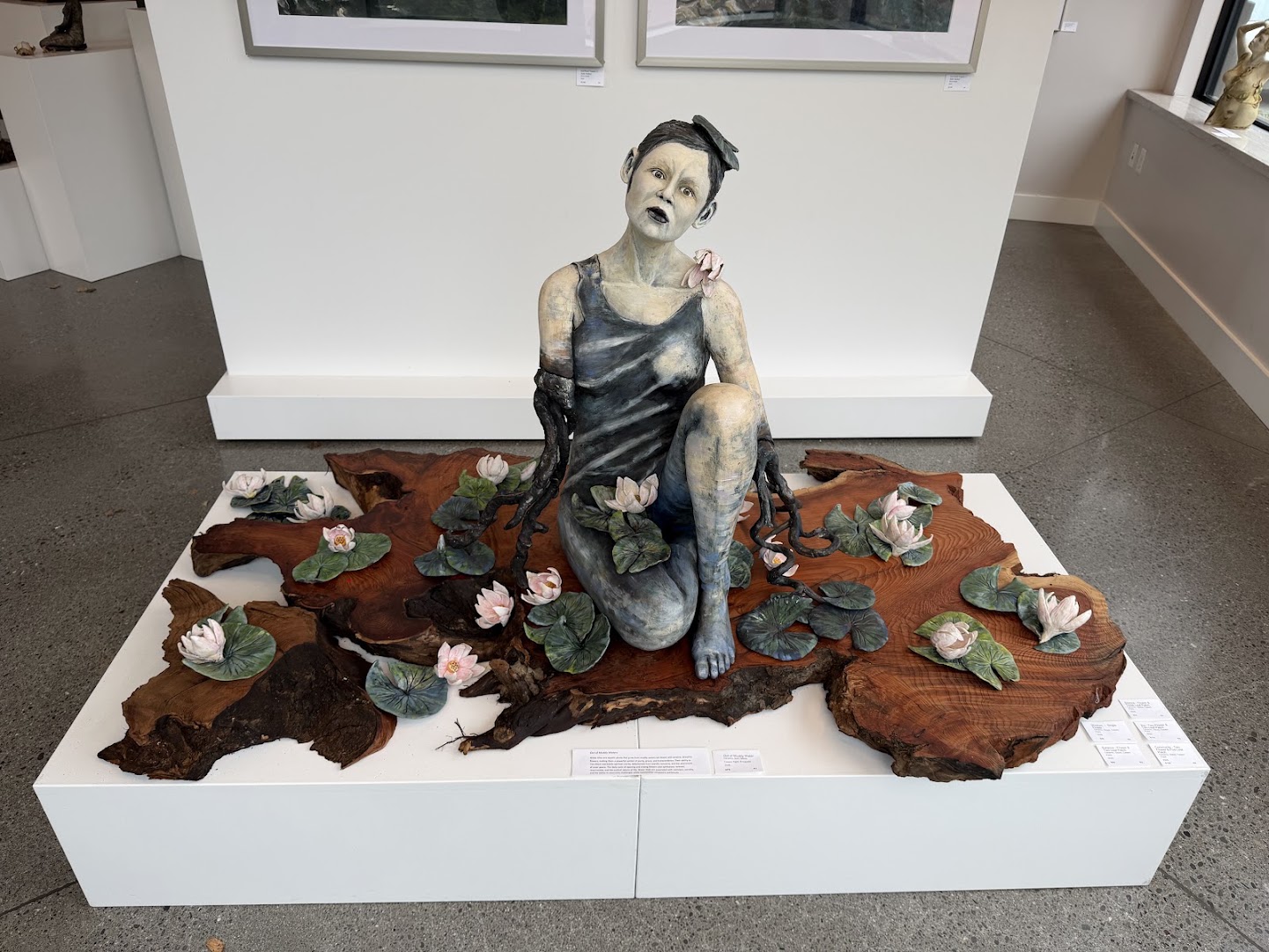
Out of Muddy Water (2026), ceramic, iron, glaze, casein paint, and encaustic. Sculpture by Sara Kimber. Photo: Rutherford/Pearson.
Natascha: Do you often use mixed media, such as wood, in your ceramics?
Sara: Quite often. I love working with metal.
I worked on this piece for about six months in a room that had a redwood bench that looks like this. I realized I was using colors that looked good with the redwood. So about a week before the installation, I went and found a redwood slice to finish the piece and place her on it. So I think it really did complete it.
Natascha: Absolutely.
Sara: Yeah.
Natascha: When you talk about the colors, they’re very calming. There are a lot of colors in nature. Why do you choose to use this color palette?
Sara: Well, obviously greens are very nature-based. I like creams because they’re sort of neutral, and you can put your own stuff on them. They also can mimic skin tones. The colors I used for this were all inspired by water, the water lilies. There’s also the pink from the water lilies. I worked to reflect all those colors up into sort of the swash around her.
Karla uses a lot of the same colors. I would call it, for me, a cobalt carbonate stain, which is one of my main colorants. She uses a lot of Payne’s Gray and deep blues that really tie our work together.
Natascha: Very complementary.
Sara: Yeah.
Natascha: I don’t often see this outside element in sculptures. You’re creating a background or a scene along with your sculpture. Is this common in ceramics? Or is this something you were drawn to on your own?
Sara: I would say it’s not common in ceramics, per se. I think it’s common in art, especially if you are tending towards being an installation artist. I really only just discovered that that’s probably somewhat what I am, because I’m never quite satisfied with them just on their own. I’m often creating these environments. Maybe it’s those years of playing with dollhouses and dolls. They need chairs and stuff like that. I don’t know, but they always feel like they need more, right? They become living in that way.
Natascha: While you’re channeling all this intense energy, is there a state of play that you find yourself in your work and creations?
Sara: That’s an interesting question because I’ve spent 30 years before art doing project management in an engineering company. So my brain’s an engineer brain. I think that’s why I’m so attracted to sculpture, because there is that engineering process in it. To me, I think of sort of what figure I want to create, and then the engineering starts. I have to construct it. I have to think about wall length and whether it’ll crack in the kiln and what things will go together. But once I get that figure built, then the art happens, and that’s when it becomes very creative. There’s the design, there’s the build, which is the engineering, and then there’s the modifications.
Natascha: It sounds like it’s challenging both sides of your brain.
Sara: Yeah. It is. It pulls them both together. Exactly.
Natascha: What drew you to ceramics? Is this something you’ve done since childhood? Did it start with drawing and a passion for art?
Sara: I’ve always been passionate about art. I was of an era. I think it even happens now. My parents wouldn’t let me study art, so I went into computer science and project management, and I came back to it after I had my daughter, as a way to have some time on my own.
Through those years of raising her, it was nice to have that escape. It just grew and grew.
I’ve always been drawn to figurative work. Almost everything I draw is the figure. Everything I sculpt is the figure, pretty well. Unless it’s a bear or something like that, which is a figure. [Laughter]
Every child learns differently. You have a passel of kids, and they’re all different. Some learn visually; some learn, you know, auditorily. I’m a tactile learner. I’m a hands-on-the-stove learner. So I think that’s what drives me to this so much, because I’m really in there. I feel alive right when I’m touching the soil, the earth. And it’s much more connected to the place I am.
Natascha: How old were you when you started?
Sara: Probably started doing clay when I was 8 or 9.
In the local community, but very little. Very little.
Mainly drawing at that point because it was very portable. We traveled a lot when I was young, so it was nice having the drawing to do in different places.
Natascha: Yeah, I think it stems from a childhood passion that maybe you weren’t allowed to fully embrace. How has your art changed over the years?
Sara: The forms have become more believable. People can connect to them more. They’ve also sort of dug in a bit more, reflecting how I felt growing up being in a quite repressive environment and always having to be a certain way and not be emotional. I think you see a lot of that in my art, the emotion of staying silent and not saying what you really feel. It’s sort of that effort of emerging from all of our conditioning.
I don’t know if that makes sense. It’s a hard thing to explain.
Natascha: Yes.
Sara: I was always “too emotional.” “I wish you were like this kid.” That was part of my emotional upbringing from English parents. Miss Stiff Upper Lip.
Natascha: Creating the ceramics puts you in a state of motion.
Sara: Yes. And connection. I feel it’s much more connected to the earth. I can’t stop now. Now that I can do it, I just can’t stop. I’m in the studio for eight to fourteen hours a day. Then I have to go to RAA and do real work. People come and visit me. Our parties are sitting in the studio, having wine, making things. It’s like the makers collaborating.
Natascha: What’s different about painting and ceramics? You mentioned that ceramics come from the earth. Can you talk a little bit more about your connection to the earth when you work with ceramics?
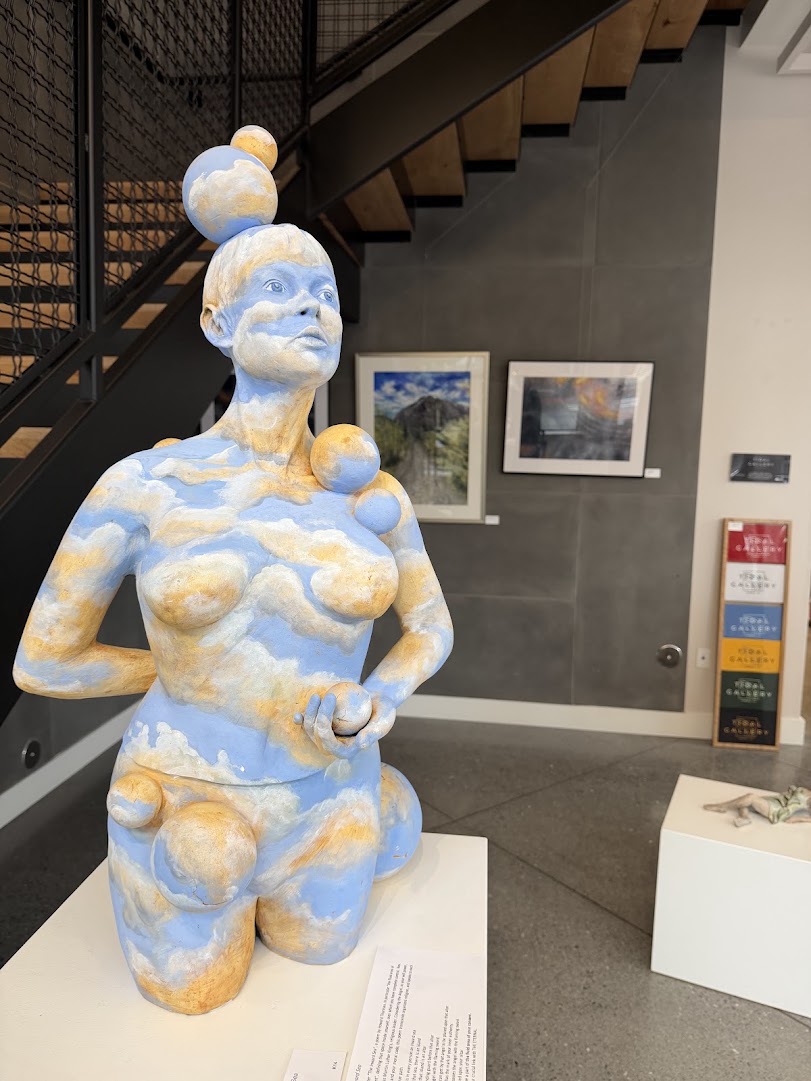
The Inward Sea (2024), ceramic and casein. Sculpture by Sara Kimber. Photo: Rutherford/Pearson.
Sara: When I use ceramics, I definitely have a connection to place. So it was very hard for me, all the moves I’ve made in my life, because I get very connected to nature and the area I’m in. Only after nine years in Humboldt County did I feel my feet connected to the ground, like I wasn’t walking on the wrong earth.
That takes me a while. I didn’t realize that until I started doing art; I think that’s why I’m answering it a different way. Yes, because of the materiality of these earth elements, whether it be metal or ceramic, they’re just part of the earth as is the wood. I do use paint on them, a casein paint, which not many people use. It’s a milk paint, and I use that for cold finishing to add some effects. I love how it’s very matte; it doesn’t have an artificial shine.
Natascha: Is that also the darker color? Does it have different layers of color to it, or is it just transparent?
Sara: So the clay, the natural clay color, is her skin color. I usually try and keep it that way unless I’m doing something like the cloud lady over there. I try to have the clay show through somewhere. So there, the sunlight, the reflections on the clouds are the clay. I try to bring the clay out. So I pick a clay that I like the color of. Then I stain it after it’s been bisque-fired. I usually use a black underglaze stain and then this cobalt carbonate stain. I start adding paint on top of that to make the narrative.
Natascha: Yes. Well, that’s what I wanted to know.
Sara: Yeah. And I really don’t have any qualms about using anything to make art. So it’s like, it’s whatever makes sense. What’s interesting is, I couldn’t explain it in detail, but Karla does the same thing. I was asking her what media she starts with because mine’s definitive. I start with clay, or I start with metal. It depends. Sometimes she starts with acrylic, sometimes she starts with watercolor, sometimes she starts with markers, right? So we both have that sort of very fluid connection with our lot of materials.
Natascha: I see. What are some of your influencers and mentors?
Sara: So probably my biggest influence is a woman called Susannah Israel, who you would absolutely love, Natascha; you should meet her. She lives in Oakland. She’s a writer, ceramicist, and art critic. I took my first serious ceramic workshop with her. I’ve taken a number of classes from her, and she’s still a mentor. I still talk to her.
Michelle Gregor, who’s another Bay Area figurative ceramicist, was also very influential for me. As for international artists I’ve connected with, Cristina Cordova, who’s well known for figurative ceramics, teaches many classes at the Penguin School of Ceramics. There’s also a gentleman called Assis Filho out of Brazil, who does anatomy workshops. Over the years, you slowly build people who are like your soul sisters, your art family. Then there’s Adrian Arleo, another gal in that space.
Natascha: What was the hardest lesson to learn in your classes throughout your ceramics education?
Sara: That’s one lesson I have not learned yet, which is that the kiln has the last word.
Natascha: Tell me more.
Sara: What does that mean? Well, when you’re working with ceramics and glazing, you have all these great ideas of what it’s going to look like. Usually you can get the form to fire. That’s usually easy to do. Going up to 2,000 degrees, it’s the first firing, then the glaze; you never quite know what’s going to happen. You can try, but the kiln has the last word. So it’s, I guess maybe I’ve learned it, but one of the lessons of ceramics is that you just have to go with it and flow with it.
Natascha: What part of your inner child shows up in your art?
Sara: I saw that question. My inner child does not feel that I’m good enough and does not feel that my emotions are okay. So much of it has been sucking that up to look like a good British woman. Not showing when I’m angry, not showing when I’m sad. That’s the hardest thing. Not showing when I’m sad. A lot of these [sculptures] are processing that and just being quiet and trying to find that space in between where maybe I won’t embarrass my mother. That’s probably how the inner child comes out in it.
Natascha: Does the inner child recognize how amazing your art is coming out?
Sara: You’re helping me. Okay. It doesn’t actually. It’s incredible. Thank you very much. It means so much. Being a part of this exhibition with Karla has been amazing for me. It’s been an amazing experience.
Natascha: Very thankful for Tidal Gallery and being in Old Town Eureka.
Sara: They’re amazing.
Natascha: The community here.
Sara: The gift that you’re giving back to the community is wonderful.
Natascha: Your art has a lot of figures, and I was wondering how the child, the maiden, and the elder show up in different pieces. How do you choose the age or who is represented in these different sculptures?
Sara: You know, it doesn’t matter much to me. When I think about what I want to do, I look for a pose I like. Then I’m pulling from multiple sources for the different aspects, like the face. I may pull from one image, and the arm I may pull from another, or something like that. So you’re pulling from multiple references.
I don’t know why. Actually, that’s a really good question. Why are they all young women? Maybe that’s where I got stuck. Okay. And maybe that’s why I’m processing through it. Right?
I noticed in some of your questions, you asked, “Why don’t I represent men?” And probably my main reason is that I’m not a man, and it’s my lived experience. It’s interesting because I believe each human being is a mix of energy, male and female. Like yin and yang, we’re not all gender-based as far as what our energy is. Right. I think it’s funny that I always pick a woman because a lot of people view me as having very masculine energy. Some aspects of my energy are very masculine. But I am a woman, and that is my lived experience.
Natascha: I noticed that the women [in the sculptures] are often alone. What does solitude mean to you?
Sara: Solitude means a sort of escape from judgment. I was always taught to accommodate everyone around me to make sure everybody was content. To me, solitude is actually being able to listen to myself and find the space within. You probably saw some of that in our work together at RAA. I’m always trying to find the balance between what everyone’s thinking rather than necessarily forcing my opinion forward. I think that may be part of it.
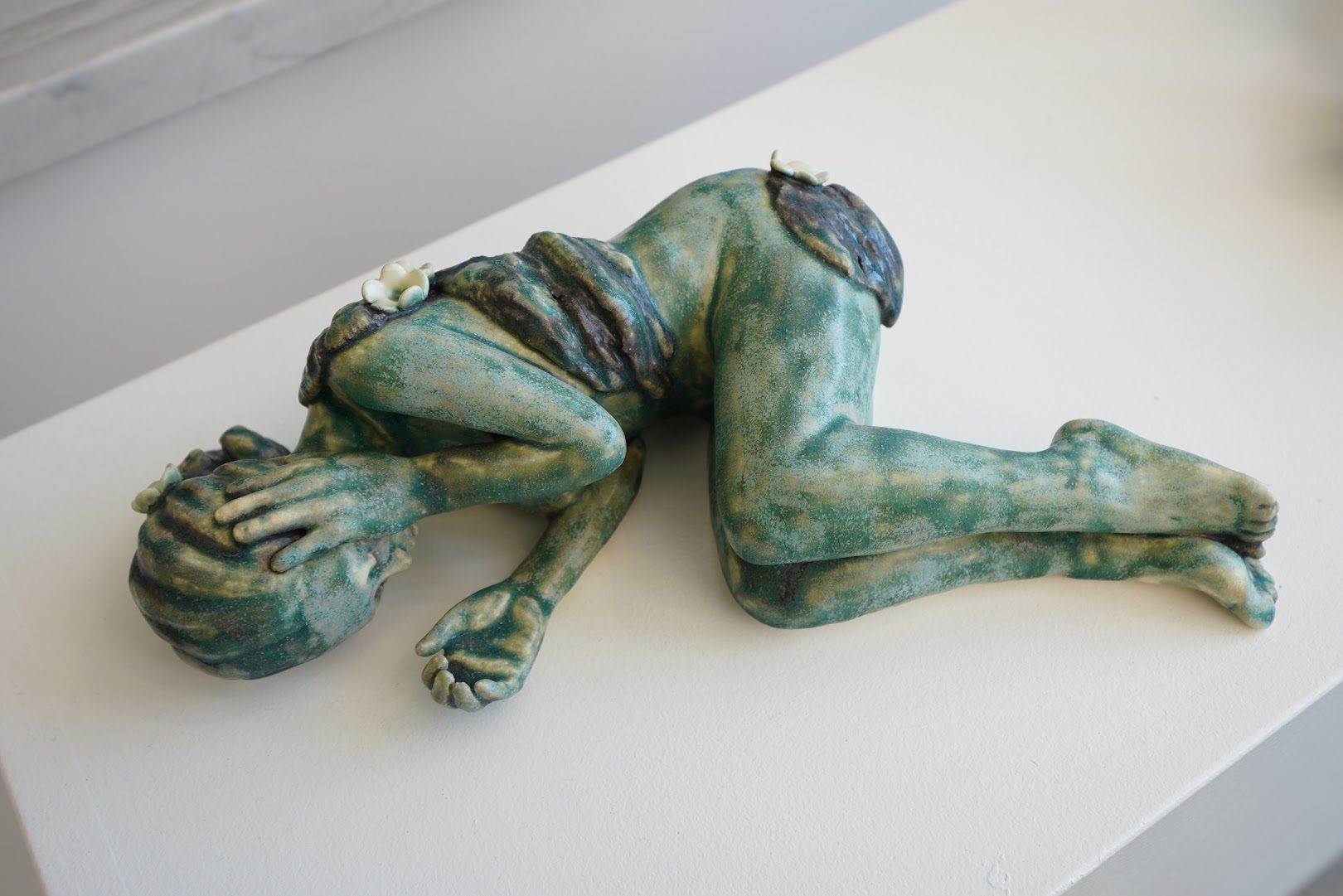
Lalalala… (2026), ceramic. Sculpture by Sara Kimber. Photo: Rutherford/Pearson.
Natascha: When you create art and are working alone, are you able to process some of those thoughts?
Sara: I’m not a fan of working on my own. There’s a number of friends, I would say now colleagues, studio colleagues, that come out. I love maker energy, where people are together in a space making. Some of my best friends and I spend five hours not saying a word, just making things.
Natascha: We’ve talked a lot about how art has influenced you. We’ve discussed community, mentors, lived experiences, and personal healing. Is there anything we haven’t discussed about how art has changed your life for the better?
Sara: So probably one thing we haven’t talked about is my MFA experience, which I think has changed my art significantly. Linda Granstrom, who’s my professor at Fort Hays State University, and then Toby Flores. Tobias Flores, he’s the sculpture professor, so it’s under his tutelage that I’ve done most of my metalwork, and under hers that I’ve learned more about ceramics and figurative ceramics because she’s a figurative ceramicist.
Another thing I’ve learned recently is that I’m a coroplastic artist, and I didn’t know that was true because, apparently, you may have heard of the Tanagra figurines from Hellenistic Greece. Well, a lot of those are mold-made figurines made by common people in various workshops spread through the city. In a lot of my work, I make the original body parts, and then I cast molds of them so I can make multiple figures quicker. I use those pieces to set the pose, then do the art.
Natascha: What I hear you saying is that your audience isn’t just the audience of today, but the audience of the future.
Sara: Well, it would be like Linda says, we all have our tribe; we have our artistic tribe, is what she says. So I’ve learned that the makers of the Tanagra figurines are part of my tribe. I’m looking forward to reading more about them and learning more.
Natascha: Lovely.
Sara: Yeah.
Natascha: Returning to the MFA, you said that you’re working with their tools, but it’s also a school in Kansas, so you go for residencies? How long are your residencies, and do you plan everything before going?
Sara: Yes. Yeah. I don’t have to be there very much. I just have to be there at the end of each semester. I do go more often because I do metal. I like doing casting work, and there’s a wonderful foundry there. I’m leaving next week to go do some more casting.
I think that MFA environment, it puts you in what I call a mosh pit, where you’re sort of swimming in this soup of stuff that you have to make sense of. I feel like I’m coming out of the soup. It’s been weird. I’ve almost quit a couple of times because it’s just been too much. I feel like things are coming together now. I’m more able to figure out what my thesis work will actually be for my thesis exhibition.
Natascha: Oh, wow.
Sara: Yeah.
Natascha: That’s what’s next.
Sara: That’s what’s really big. Next, I have my thesis exhibition. The first one will be in Kansas in June 2028. I still have a year and a half. Then I’m going to be at the Morris Graves Museum of Art after that for, I think, a month or two months. A lot of that work that was in Kansas, that thesis work, will come here so folks can see it here.
Natascha: What message would you like to offer through your work to the women in your community?
Sara: You do not have to put up with how you’re told to be. You can be who you are. The decades and centuries and millennium of grooming and roles do not need to be your script. You can find your space. You can go within and find what you want, and you can do it.
Sara: That’s really what my work is for everybody. Why don’t I seem silly? Why don’t we just get along? I mean, why can’t we just stop? Let’s just stop. There’s so much more power in collaborative, receptive leadership than there is in authoritative, dominance-based leadership. So that’s probably my biggest message. We could do better than we’re doing. And it is possible. Yeah.
Natascha: How do your culture and social justice inform your creations?
Sara: That’s a good follow-on from what we were just saying. I’ve seen myself give up what I was in order to be something I was supposed to be. You see that happening to so many people. It’s happening in government. It’s happening all over the world. I think that’s what my social message is. We just need to be kind to each other, find that quiet place, stop the anger, and really think about it. Right.
Natascha: When you paint that future, what does it look like?
Sara: It looks like leaders who are thinking about everybody, rather than just making money. That actually crosses all parties right now. Being honest, I think it’s also about taking care of people. We are perfectly capable. This world globe could feed everybody. Nobody needs to be living the way they’re living. That would be my ideal world.
Natascha: Thank you for sharing.
Sara: Absolutely.
Natascha: So what’s your experience as an artist in Eureka? What does this community do to support artists and offer them room to grow?
Sara: There’s lots of spaces there. We obviously have the two colleges, where there’s lovely, amazing opportunities to learn art and exhibit. I would say a promo for Redwood Art Association. There’s some lovely organizations where you can show your art, and Redwood Art Association does not jury work. We never tell someone their work is not good enough. Anyone can show their work if they’re a member. We have established art institutions like Morris Graves and Ink People that are dedicated to the arts. It’s a beautiful area to learn art. There’s a lot of artists.
Natascha: A lot of people to collaborate with.
Sara: Yeah.
Natascha: Yeah. Where can readers find more of your art?
Sara: I do exhibit regularly at the Redwood Art Association, but only a couple of pieces because that’s how we run our shows. My website is Sarakimber.com. I have my artist statement and bio and resume and everything out there; welcome to see all the work that’s there. Then you need to come to Morris Graves in 2028 and see my exhibition there. I’m not sure what it’s going to be called yet, but probably Be Coming or something along those lines.
Natascha: Exciting.
Sara: Yeah. Thank you.
Natascha: Last question, what advice would you offer to aspiring artists?
Sara: Just make something.
Just make something.
If you’re sitting around feeling like you don’t want to do anything, just make something. Then remember, if you want to make a living out of it, you have to think of it as a business. How do you pull in those practical aspects? But don’t give up your making for the business.
Natascha: Well, thank you, Sara, for talking with me and sharing the stories behind your work. I appreciate your time, your openness, and your contribution to our creative community.
Sara: Thank you very much. It was really lovely talking to you.
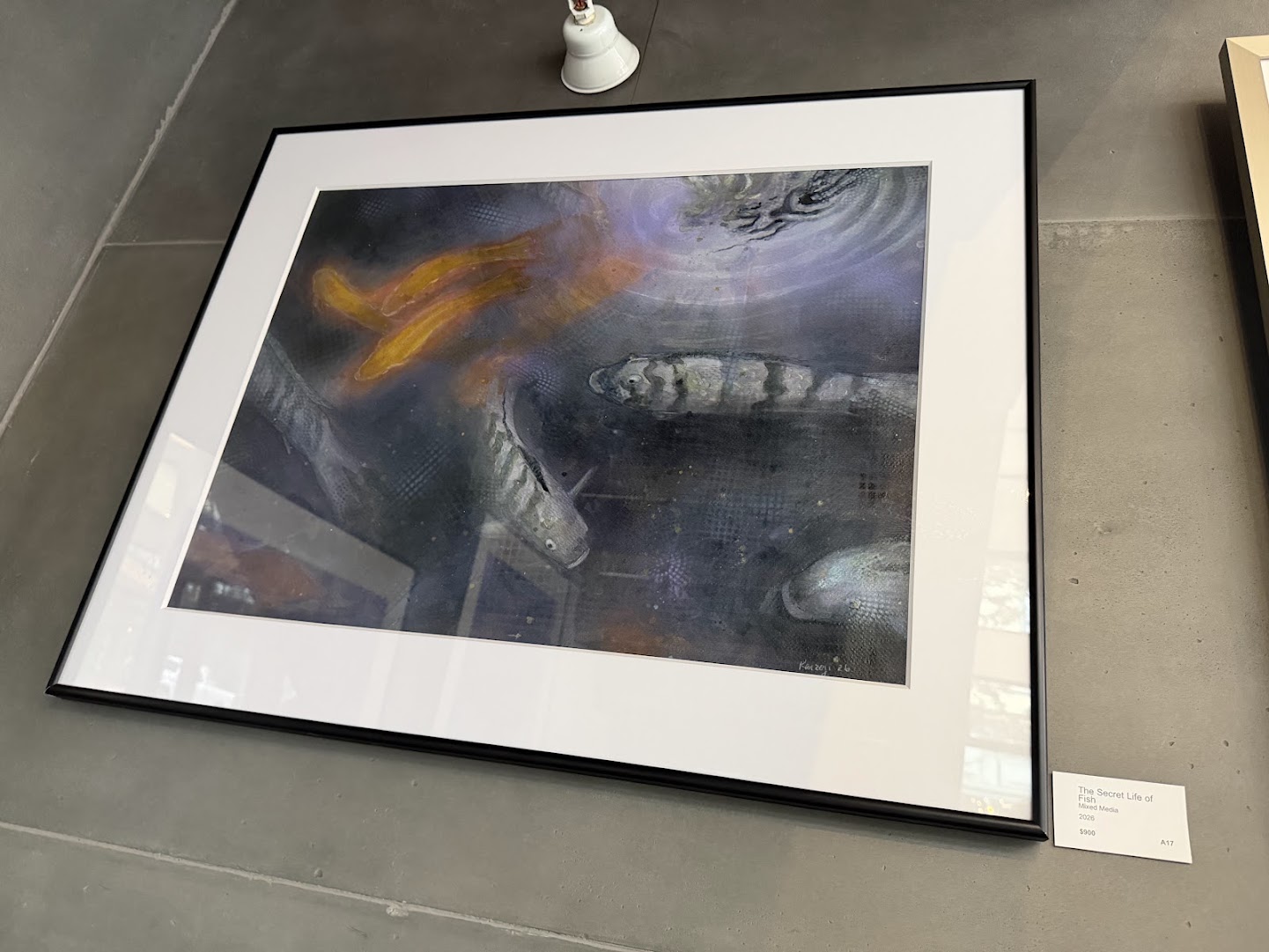
The Secret Life of Fish (2026), mixed media. Artwork by Karla Austin. Photo: Rutherford/Pearson.
###
The Silence Within is on display from October 3 through November 26, 2026, at Tidal Gallery, located at 339 Second Street in Eureka, California. The gallery is open Thursdays and Fridays from 10 a.m. to 4 p.m.
Natascha Pearson is a Humboldt County-based writer, artist, and community organizer pursuing an MFA in Creative Writing at Antioch University Los Angeles. Founder of Little Lost Forest, she explores art, identity, environmentalism, and social justice through fiction, journalism, and community storytelling.