
A view of the Renfroe ranch house and outbuildings. Photos via the Humboldt Historian.
My paternal uncle, Arthur Renfroe, and his wife, Louise, homesteaded in the Humboldt County hills above Mad River. Their access road turned off between Dinsmore’s and the old Cobb’s store. They had the courage and the determination to attempt to scratch a living from 160 acres of rocky, scrub oak-covered hillside. Early on they had a few head of cattle, the return from which must have supplied the common necessities for them. My step-brother, Donald Andreason, of Eureka, recalls assisting Uncle Art in driving the cattle to Redwood House to market. It was a thrilling experience for him and a long drive for one man and a boy.
During their early days the Renfroe’s housing was a single-walled cabin. Their house was built in about 1921, located on a knoll with a wonderful view of the surrounding hills. It was spacious and, though rustic, was quite a good house for that time and place. It contained six bedrooms and large living and kitchen areas. It was simplicity itself throughout, with no rugs nor floor coverings, no electricity and, consequently, no refrigeration. Perishables were stored in the “safe” on the north porch. The building and finishing process went on for years, an inside bathroom was the last room completed. Gravity-flow water was available from a spring located above the house.
Financially, these were surely very difficult times for them; years later Uncle Art would tell with enthusiasm of the gradual accumulation of the equipment required to survive. First a plow, then a harrow and a rake, acquisition of each a major achievement.
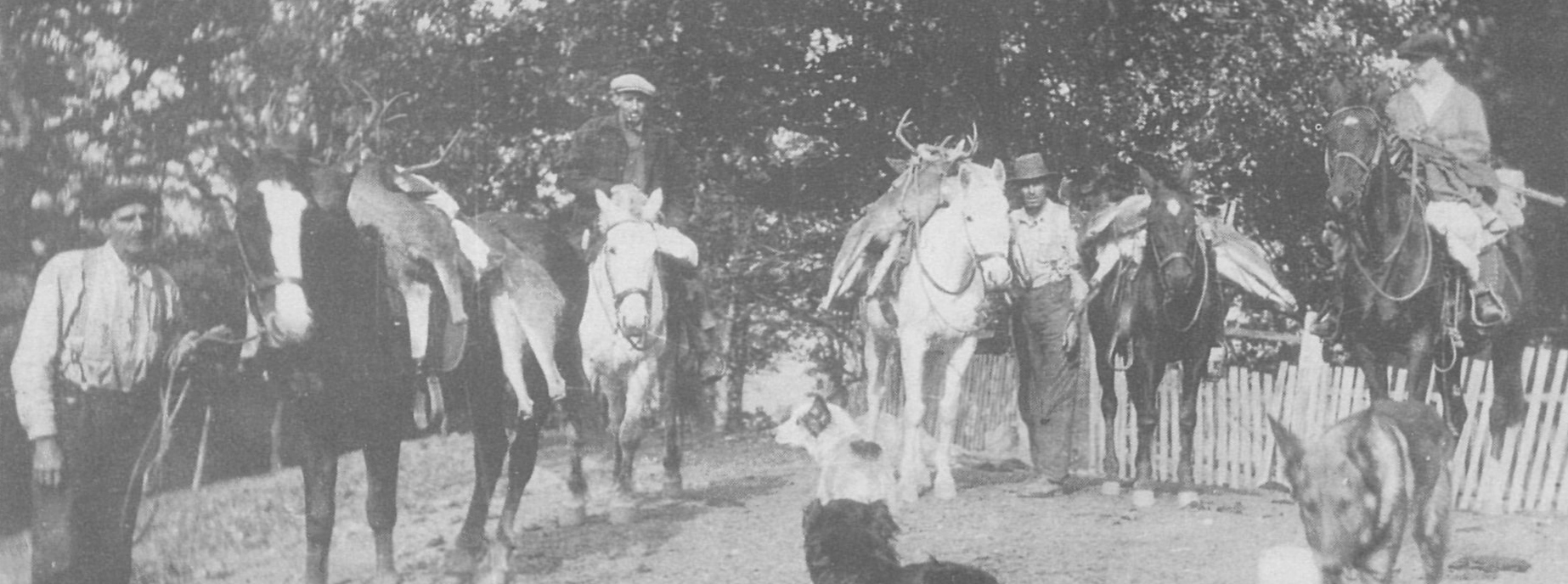
The camera records evidence in 1928 of a successful hunt by the Renfroes at Mad River. Left to right are Mode Renfroe, Ted Renfroe, Walter Renfroe and Mrs. Guy (Florence) Renfroe.
Their financial position began to improve due to a chance encounter with two deer hunters, doctors from the Bay Area, who drove in to the ranch in search of a deer-hunting ground. Uncle Art agreed to serve as their hunting guide and they boarded there with Aunt Lou. She had cooked in the restaurant at the old Star Hotel in Fortuna and was a competent and experienced cook.
This was the beginning of better days for them. The two doctors returned to San Francisco, related their satisfying experiences to their friends and returned the following year bringing others with them. In this manner “Art Renfroe’s Resort” came into being.
The men were delighted with Uncle Art (a real “mountain man”) and his ability to locate game. The lack of modern conveniences did not trouble these city dwellers at all and, in time, their wives accompanied them, and still later their children. Aunt Lou was a large, vivacious lady with sparkling eyes and a friendly manner, capable of conversing with anyone. The wives from “the City” must certainly have found her interesting.
As young children, my sister, Edna May, and I spent many a happy summer there, running over those wonderful hills, riding horseback, gathering wildflowers, tiny wild strawberries and swimming in Mad River. Few rivers had the lovely, quiet, green pools found on Mad River.

Louise Renfroe kept resort guests happy with her vivacious personality and good food.
Edna May lettered and painted a sign to be placed at the gate on the County Road: “Art Renfroe’s Resort—Good Eats.” The Bistrin family of Eureka were guests there, and a very young Bistrin boy was watching thoughtfully while Aunt Lou mixed a cake, and finally said, “I know that will be a good cake.” Aunt Lou responded, “How do you know that?” Young Bistrin; “Because it says ‘Good Eats’ down on the sign.”
Many Humboldters visited there to hunt and fish including Bobby Wise and his son, Fred, Victor Trione, Glen and Areta Curry, all of Fortuna and George Littlefield, Eureka’s Police Chief and his wife. One evening before a planned trip to “the Valley” Uncle Art rode down to Mad River and caught a limit of trout for Victor Trione. He arranged them artfully in a box lined with the sharp-edged riverside grass.
There were countless dogs on the ranch. Included were house dogs, yard dogs, outside-the-yard dogs, dogs in the big pen and dogs to hunt deer, bear and birds. A hound dog named Boomer was used to hunt coon.
To accommodate his hunting parties Uncle Art gradually acquired a string of mules and saddle horses, such as a dainty little mare named Molly, Ribbon, a big bay and a dappled gray called Gype. One wise little mule named Sparkplug had been granted his Social Security due to his age. He was a tricky rascal and couldn’t be contained anywhere. He would lie down and wiggle under the bottom wire of a barbwire fence. He relished pancakes.
Once while deer hunting, Bobby Wise encountered a rattlesnake which struck at him. It missed but a drop of venom splashed on the back of his hand, leaving a purple spot. We were so indoctrinated on the danger of the rattler that to this day I automatically watch for them in country where they don’t exist. When my sister and I encountered a rattler we killed it, first stunning it with a stick and then pulverizing its head with stones. I don’t believe Aunt Lou and Uncle Art were aware that we did this.
One hot summer afternoon we had ranged far afield on foot — Myrna Shreeve of Fortuna was with us that day—and we were plodding up hill under the harsh afternoon sun across a grassy open area, dotted with wild sunflowers. Another uncle, Walter Renfroe, who had a place on Eight Mile Ridge, rode up on horseback. To ease our uphill progress he loosened a lariat and reeled it out to us and the three of us held that rope and were towed along—a nice variation of “ride and tie.”
One of the Sibleys rode in one morning, talked with Uncle Art for quite some time, but never dismounted. He looked impressive on that horse and perhaps he knew that. At a later time George Gift and his wife, Ruth Shaw Gift, rode by. Ruth, with those big, brown Shaw eyes, was a pretty girl, slender and graceful. She wore a battered old felt hat.
The lifestyles lived out there in those hills along Mad River have long since disappeared, much like a lost culture, a self-sufficient style that no longer exists. At the time of which I write. Rye Shaw had already moved his family out and the old Bassford place was long abandoned. (Those ranches were always referred to as “places.”)
Aunt Lou churned her own butter, made her bread, “put down” eggs when they were plentiful from her hens, raised turkeys, packed quail down in lard in a crock, dried and canned meat, canned fruit and vegetables and made jam and jelly. A hog was butchered, the bacon and ham smoked in their smokehouse, lard was rendered, the cracklings saved for dog food and headcheese made from the scraps. They had delicious berries, plump purple-black loganberries such as I have neither seen nor tasted since, red raspberries and gooseberries.
Arthur and Louise Renfroe are gone, as are many of those who enjoyed their hospitality. The old house burned long ago; once well-defined trails are overgrown with brush and trees. Is the old barn still standing? Do the owls still hoot down in the woods bordering Charley Cavagnarro’s place? Surely the tiny, flavorful wild strawberries still flourish along certain sunny banks, the abundant bed of fawn lilies still bloom down below the gate and the lady slippers and tiger lilies thrive in their secret places— And, after the mad torrents of winter, the quiet, green pools form in Mad River, as “in those old days of the lost sunshine of youth.”
###
The story above was printed in the January-February 1990 issue of the Humboldt Historian, a journal of the Humboldt County Historical Society. It is reprinted here with permission. The Humboldt County Historical Society is a nonprofit organization devoted to archiving, preserving and sharing Humboldt County’s rich history. You can become a member and receive a year’s worth of new issues of The Humboldt Historian at this link.
CLICK TO MANAGE