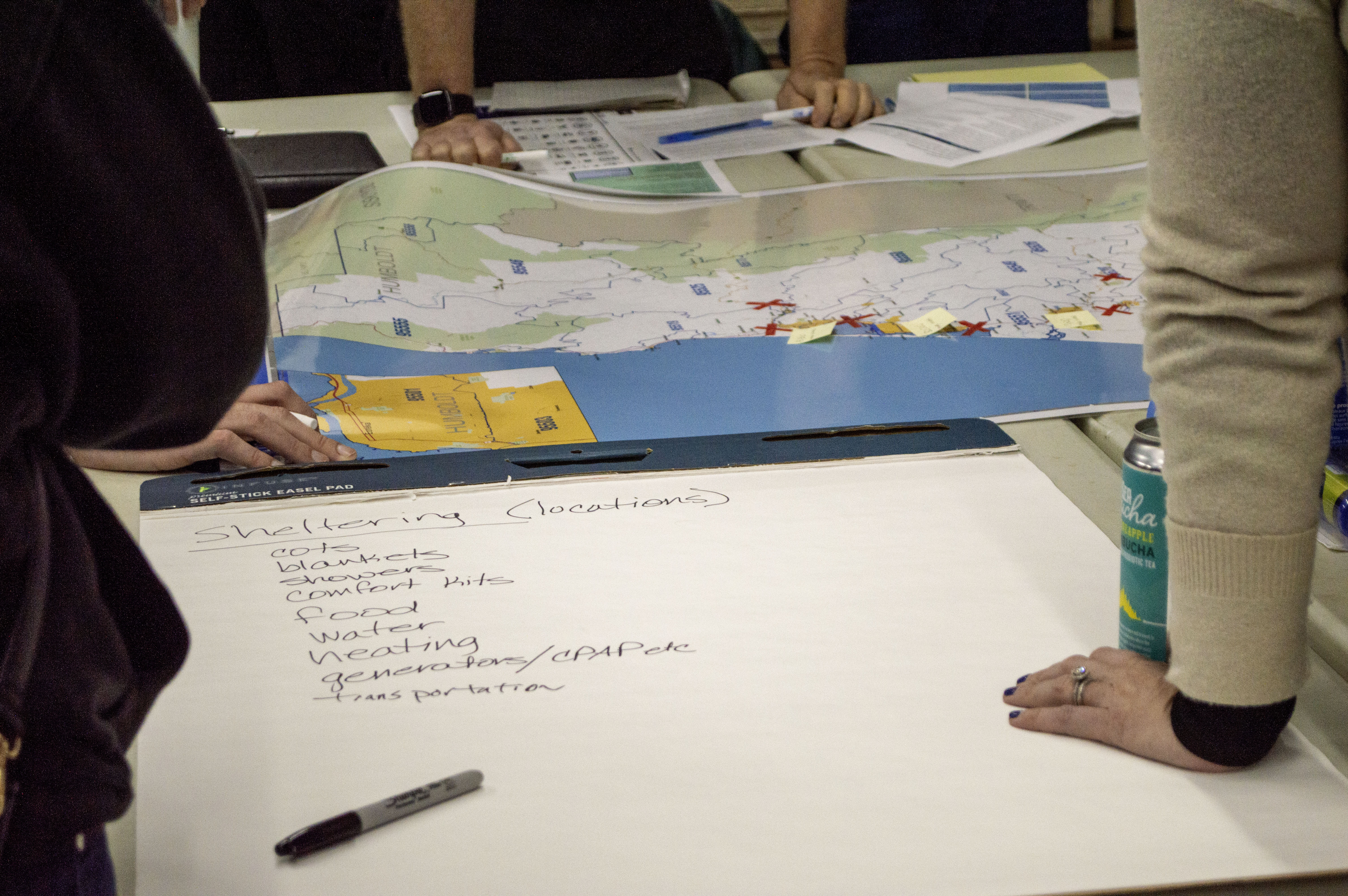
Local emergency personnel thrash out where to receive supplies after the Cascadia quake. Photos by Dezmond Remington.
Humans become data points on a map during a catastrophe, a word the organizers of a California Office of Emergency Services-led event held this week used incessantly. They gathered local government leaders from Del Norte and Humboldt, joined them with other OES representatives, plus delegates from a few other state and federal agencies, and handed them a scenario: When the Cascadia Fault slips and triggers a magnitude 9 earthquake and a tsunami that maim and trap thousands, how are you going to ship the hundreds of thousands of pounds of supplies leaving your care, and if they get where they’re headed safely, how are you going to distribute them all to the thousands of little points on that map?
Section I: Air Bridge
Dozens of emergency-response officials met Wednesday for the 2026 Cascadia Surge tabletop exercise, held at the Redwood Acres Fairgrounds. Cal OES program manager Russ Eads designed the game. He’s a tabletop board game aficionado, he told the Outpost; he’s been playing ones that simulate Civil War navy combat recently. This was the sixth edition of the game, but the previous ones had been maritime-focused. This one would entail around a week of in-game time. Participants from the state’s departments were charged with determining the best ways to ship supplies to a devastated North Coast. The locals had to figure out how to get them.
Eads set the scene at the beginning: across the North Coast, 78,100 survivors need food and water. Almost 3,000 need shelter. Another 1,600 need to be evacuated. He’d decided to knock out several roads, he announced, grinning — they ended up being all of the important highways in and out — and for the first 12-hour turn, the only way to get crucial water, food, cots, and blankets into the afflicted areas would be by eight CH-47 Chinook helicopters and several C-130 airplanes ferried over the mountains from a well-stocked Redding Airport.
Eads decided only the Arcata-Eureka airport could handle landing a fixed-wing aircraft, and listed a few other places they could handle a Chinook. The locals from Del Norte and Humboldt had to determine where they could land.
“We’re effed,” Chris Koczera, Cal Poly Humboldt’s director of risk management, informed the other Humboldtians when they crowded around a county map to discuss their next move. The picture was definitely dire, but less so, she pointed out, than if the quake had happened for real. They got to assume that their communications worked fine, that the airport wasn’t destroyed, and, of course, that the emergency services personnel (firefighters, public works employees, sheriff’s deputies, local Office of Emergency Services employees) clustered around the table weren’t dead. “We didn’t want to make it impossible,” Brendan Dolan, an emergency services coordinator with Cal OES tasked with focusing the conversation, told the group. He said they could send the affected communities satellite phones and portable repeaters.
They proposed the Chinooks could land at the airports in Kneeland and Rohnerville, and could transport enough food and water for a few days. Fuel delivery could probably wait, they decided; most of their departments have some stocked, but they’d have to figure out how fast they’re burning through it so they’d know how much to ask the state for. Smaller helicopters might be able to drop those items over populated areas while they worked out how damaged the roads were. Using them to evacuate casualties would likely be improbable, they decided. Having some structural engineers and search and rescue personnel shipped in would be fabulous.
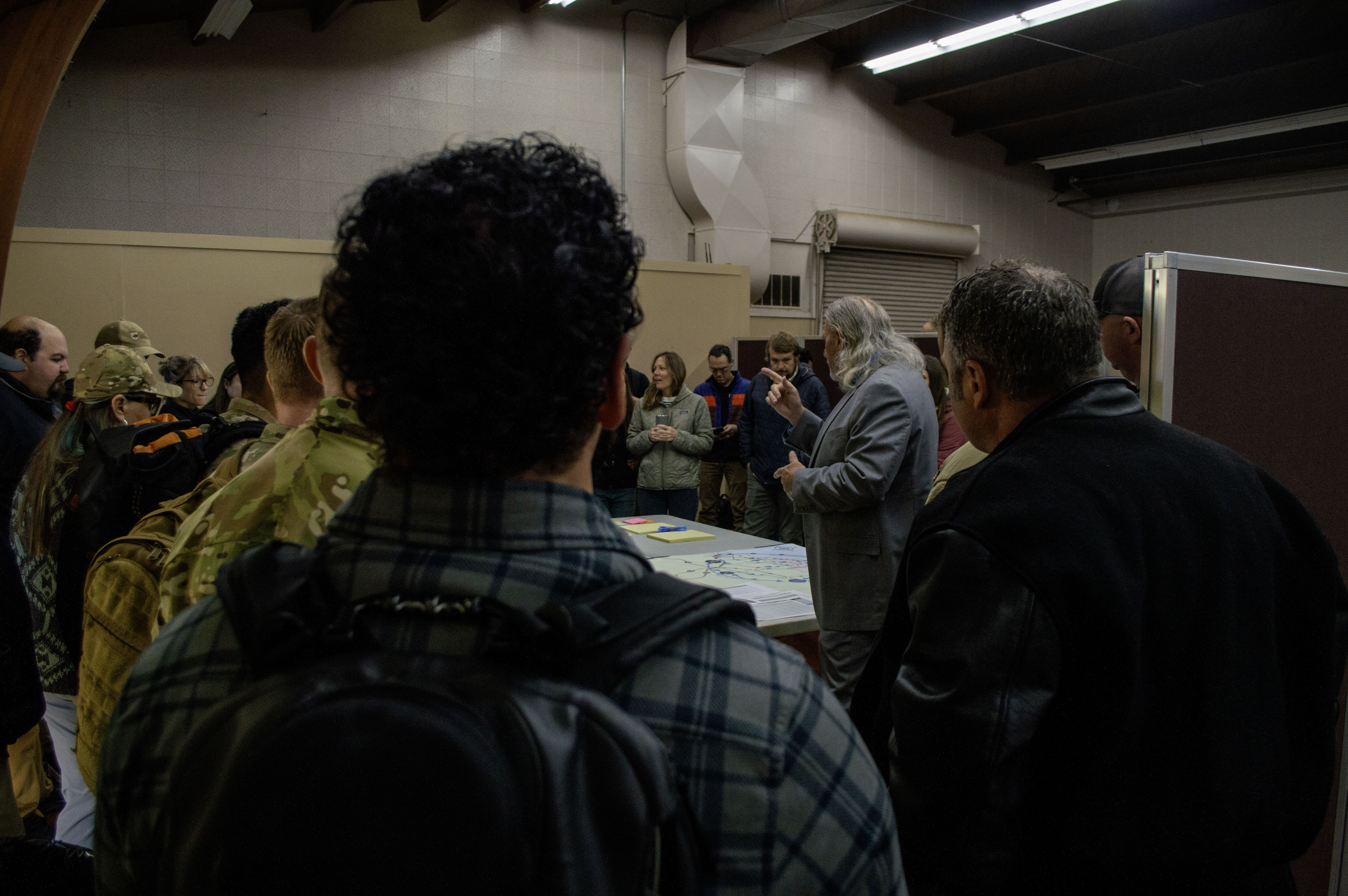
John Williams (gesturing) addresses a group of state and federal personnel planning how to ship supplies to the North Coast.
Eads shared how he decided everyone fared. Northern Humboldt did well; actually, it was overstocked. Because it was the only place with a functional runway that could land a C-130, which can carry far more luggage than a Chinook, 108% of the water and 118% of the food that was supposed to reach ACV made it: 133,056 meals, 182,910 liters of water. Far less made it to Fortuna, Crescent City, and Klamath.
One Del Norte representative turned to his colleagues. “You wanna read my notes?” he asked. “We are so screwed.” They laughed.
John Williams, a senior emergency services coordinator with Cal OES, clad in a grey suit, unbuttoned with a baby-blue button-down underneath, hoarsely addressed the group.
“Think about the earthquake in LA,” he said. “OK, there’s a few people in LA. I think a few people are going to leave, and some of them are going to hit a place called Bakersfield. Is Bakersfield ready for that? Right? Is Oregon ready for this? So, when in your planning, think about what the next step is, and where you’re going to go from point A to point B.”
They moved on.
Section II: Maritime Operations
Ships are awesome because they can transport enough supplies to last for weeks, but a tug-and-barge system that maritime authorities would likely utilize to ship them up here are slow and displace too much water to bring into Humboldt Bay. It takes anywhere from 12 to 20 hours to sail from the Bay Area to here, and they’d also have to load the barge and get the supplies off as well.
One of the biggest advantages of sea-based supply transport is the ability to move huge amounts of fuel, the diesel and petroleum emergency responders will need to power vehicles and generators to keep hospitals and other critical infrastructure online, but it’ll be hard to get to shore. In the scenario, the state was tasked with shipping some 50,000 pounds of fuel from the Port of Oakland to Humboldt via fuel barge. People spent a lot of time talking about the best way to transport it. Someone asked Williams what kept him up at night: he said water and fuel.
“They’re probably more important than the cots and the meals,” he said, “because without water, the public health risk rises significantly; without fuel, you can’t move any of us around.”
Seemingly everyone had a suggestion for the best way to maximize the pros and minimize the cons of a maritime operation. Some were outlandish — what about an aircraft carrier? one man asked. Or, another suggested, why not park a barge offshore and load its stuff onto smaller ships?
Travis, an employee of OES Maritime, explained those schemes probably wouldn’t work. 1: How were they going to get an aircraft carrier? And, 2: Ship-to-ship transfers are incredibly hazardous even in good conditions, which a post-tsunami sea won’t be in. Whichever private contractors the state hires to supply Humboldt won’t take that kind of risk. (He refused to share his last name with the Outpost.)
OK, one lady asked, what if we requisitioned a dredger and cleared enough room for the barge to enter the bay? Travis had bad news for that plan, too. It would probably be impossible to clear enough space to bring a barge in. Humboldt Bay just isn’t deep enough. But what we could do, he said, is use several small ramp barges to dump supplies on Clam Beach or on the Samoa Peninsula — but only if everyone had the ability to actually move them. “It’s my go-to motto for the day,” he said. “It depends!”
He said that the Army Corps of Engineers might be able to construct a pipeline from the barge to shore, where it’d feed into giant bags (a “petroleum over the shore” system). It would take several days to build; they’d have to activate reservists and get up here from Southern California, where the base is.
No one from Del Norte or Humboldt seemed optimistic about the practicality of shipping critical supplies via sea. The sailors might have a hard time even figuring out where’s safe to bring their vessel; a magnitude 9 quake and resulting tsunami would reshape the entire coastline and seafloor. But there are few practical, large-scale substitutes. If the Cascadia quake does occur, emergency responders will almost certainly attempt it.
In-game, it worked OK, Eads said. Humboldt utilized ramp barges, ferrying materiel from the big barge to Clam Beach. A quarter of it capsized. Everything made it into Crescent City because at least one of its docks was still usable. Half of the small boats sent to Klamath didn’t make it.
Section III: Ground Phase
Hooray! Highway 299, is, inexplicably, now open, as is Highway 36. (The Humboldters noted amongst themselves there was probably no way that’d be the case for months in the event of a real Cascadia earthquake, but whatever.) Highway 101 is still out north of McKinleyville and south of Eureka. The task now, Williams said, would be to find unloading docks for the big 48-foot tractor-trailers stuffed with more valuables the state would deploy from Redding.
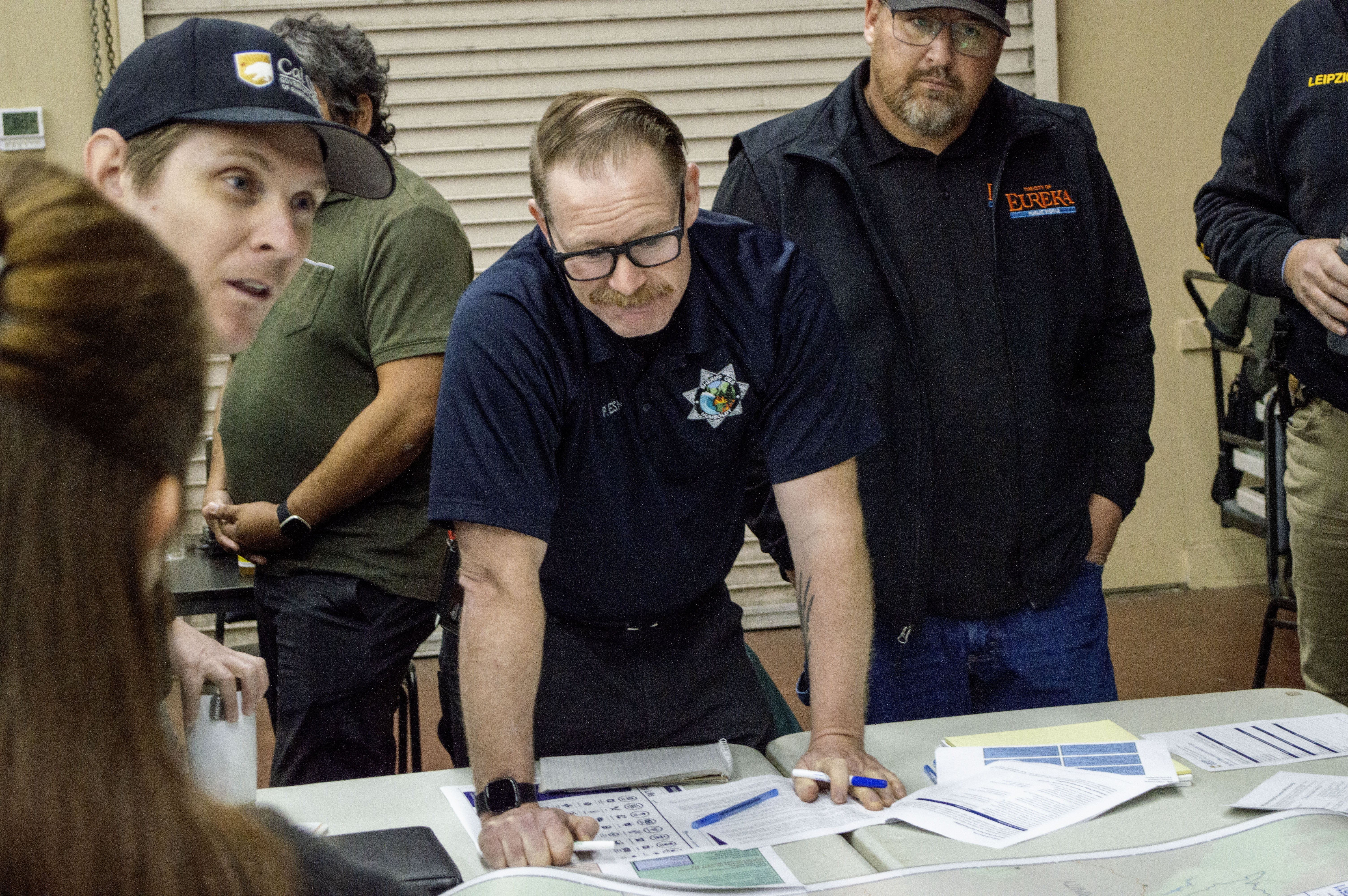
Patric Esh, a Humboldt Office of Emergency Services Program Coordinator, stares at the map.
Could we handle them in McKinleyville, at the U-Haul depot? Or at the Safeway there, a few people proposed? They’re both set up for that, they claimed. McKinleyville has plenty of big box stores with unloading docks. Or, someone else said, why not at ACV? In this hypothetical, the state is still sending things there. It’d make more sense to combine it all into one central distribution hub.
A solution for Southern Humboldt wasn’t as evident. “How viable is this?” Dolan, the Cal OES employee, asked the group, waving at Highway 36. They laughed. “Do you like to throw up?” Koczera replied. However, there didn’t seem to be any other route in. They decided the state could try to send smaller trailers on it, and they could unload at the old PALCO mill site in southern Fortuna, which is replete with hookups for utilities and places to load and unload, several of them said. They could depend on more air support from there.
###
The hyperspecific nuts and bolts of the exercise — the MREs remaining in Redding, the pallets of fuel available, the cots delivered and evacuations required — became less relevant after a couple hours of play. It was more beneficial for the players to work out the logistics of an emergency as a group than it was to play pretend with hypothetical blankets, Jason Davis, another emergency services coordinator with Cal OES, told the whole crowd; they don’t all get together often enough.
The definition of a catastrophe, Williams said at the beginning of the exercise, is an event that collapses the government and the private supply chain and people’s needs are left unmet. It was everyone’s job to figure out how to flip that, even after a horrendous natural disaster. The participants seemed disheartened by the incredible odds against that, even with a favorable in-game plot that opened up highways and airports that might not even be around after the real thing, but it’s the intangibles that could save lives, Koczera pointed out to the Outpost after the session ended. For a while, it’ll probably be up to normal people to save their neighbors, but, she said, she believed in Humboldt’s residents to rise to the occasion.