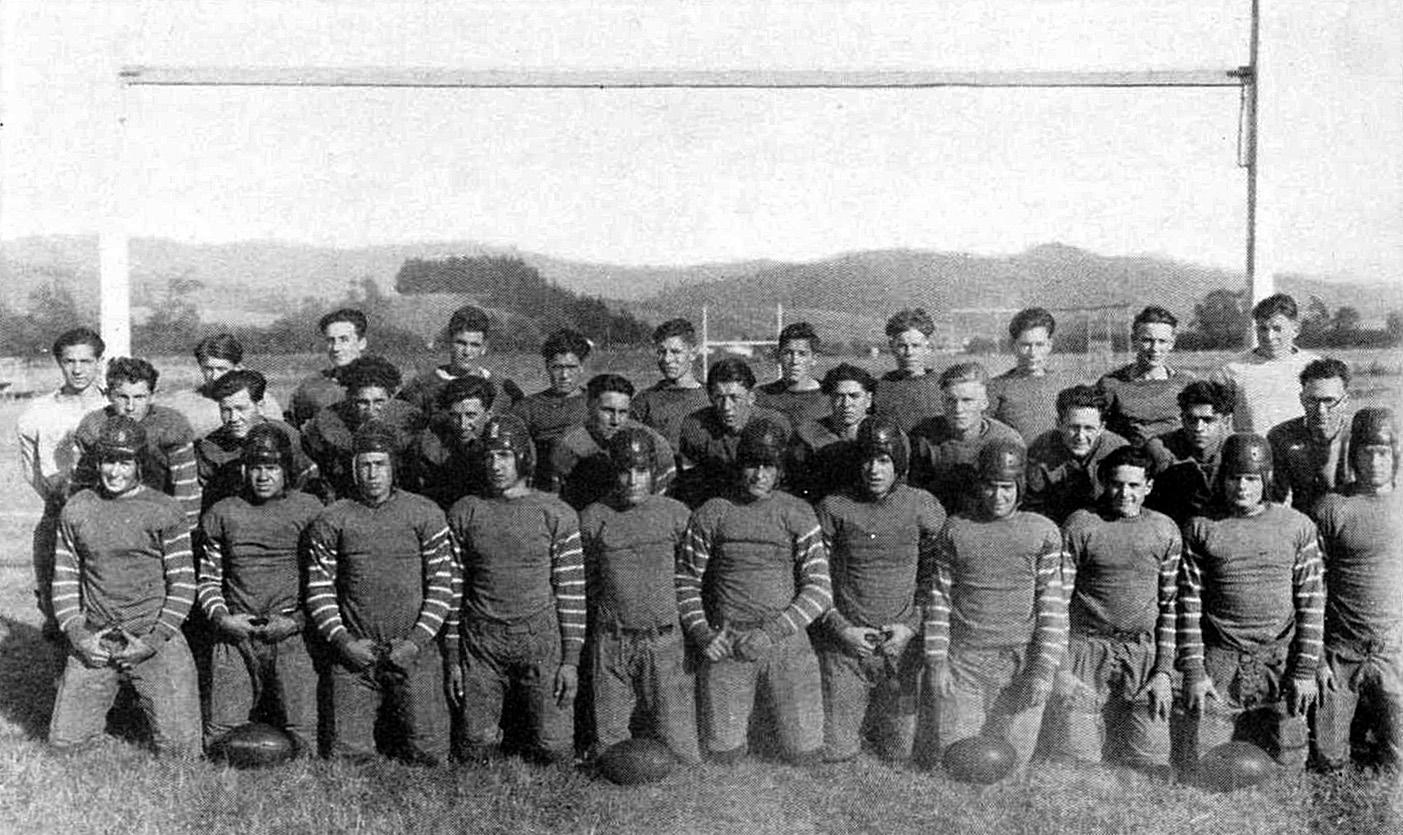
The 1928 Fortuna High football team. Gallagher is sixth from the left in the first row. Photos courtesy Fortuna Depot Museum, via the Humboldt Historian.
For generations a spooky piece of oral history has been whispered in the corridors and on the athletic fields of Fortuna Union High School: years ago, there was no football team at Fortuna High because, “a kid was killed in a football game.”
Unlike so many of the creepy legends with which teenagers love to terrify themselves, this story is true. The death had a huge impact on high school life throughout Humboldt County. And although most Fortuna High students in later decades have not known the name of the boy, the date when the incident occurred, or any of the details surrounding it, the story is enshrined in the collective memory of Fortuna Union High School.
“The kid who was killed” was Virgil Leo Gallagher, Jr., sixteen years old at the time he met his death on the field. Leo was born in Fountain, Colorado, the second of three children. In the 1920 U.S. census, the family appears in West Telluride, Colorado. Forty-four-year-old Virgil Gallagher, born in Ohio, is shown as a “Road Master, Steam Rail Road.” Listed with him are his wife, thirty-nine-year-old Genettie M. Gallagher (elsewhere written as “Jeanette” or simply “Nettie”), born in Missouri, and their children, Elwyn (age twelve, born in Missouri), Virgil Leo (age seven), and Alma L. (age five).
Shortly after this census was taken, the family moved to Fortuna, California, where Virgil Leo Gallagher, Sr. worked as a section foreman for the Northwestern Pacific Railroad. The children attended Fortuna Grammar School and Fortuna High. Elwyn Gallagher graduated from Fortuna High School in 1925. He was class president and a member of the yearbook staff, and — as his younger brother Leo would be — was very active in the school’s drama department. Elwyn went on to attend San Jose Normal [Teachers’] College, graduating in the summer of 1927.
The year of Elwyn’s graduation from high school was marred by tragedy for the Gallagher family. Virgil Leo Gallagher, Sr. died unexpectedly of pneumonia in 1925 at the age of forty-nine. The widow purchased a plot in Fortuna’s Newburg (later renamed Sunrise) Cemetery, with room for graves for the entire family. Nettie Gallagher, now forty-four years old, took a job in a Fortuna grocery store. However, it seems that the burden of suddenly becoming the breadwinner of the family left her unable to afford a gravestone for her husband, as his grave remains unmarked.
Leo Gallagher graduated from Fortuna Grammar School the year following his father’s death, and began at Fortuna Union High School in fall of 1926, as a member of the Class of 1930.
###

Leo Gallagher’s 11th grade yearbook photo.
Tall, broad-shouldered and blond-haired — and looking, from his photographs, far more mature than his age — Leo was a frequent leading man in Fortuna High’s theatricals. In the fall of his sophomore year he starred in “The Boy Comes Home,” playing a returning World War I soldier, whose modern outlook comes into conflict with the worldview of his tradition-bound uncle. The following spring, Leo played a leading role in the school operetta, “Pickles, or, In Old Vienna.” In this musical comedy, Leo played advertising agent J. Jennison Jones, whose mission is to sell American pickles in Vienna, and who falls in love with a beautiful Gypsy dancer (who turns out to be a long-lost English heiress).
Leo was also very active in the school’s music department. He played cornet in the orchestra and sang bass in the Boys’ Glee Club. Leo’s junior year, 1928-29, was the first year in which a band was organized at Fortuna High School, and Leo joined. However, before the Fortuna High School Band made its first public appearance, Leo was dead.
Leo was involved in many other school activities. He was an officer of the Boys’ League, also known as “The Knights of the Blue and White.” He was a co-chair of the Hospitality Committee for the “Student Body Athletic Dance” honoring the school basketball team in March of 1928, and was also student body Yell Leader in his sophomore year. From his obituary, we know that Leo was also an active member of Christian Endeavor, the young men’s group at Fortuna’s First Christian Church.

Fortuna Union High School Band, founded in the autumn of 1928. Leo Gallagher, back row, second from right, died before the band’s debut performance.
Newspaper articles preserved in Fortuna High School scrapbooks, kept by the librarian and students, tell us that Leo was a member of the drama class in his sophomore year and the journalism class in his junior year. The journalism students were assigned “news beats” and wrote articles that were submitted to the Fortuna Advance, Humboldt Beacon, Humboldt Times and Humboldt Standard newspapers. Leo’s “beat” was boys’ athletics for the Beacon and the Advance.
An exciting development for the journalism class occurred in the week before Leo’s death, when, according to a November 2, 1928 newspaper article,
The journalism class and the school annual [yearbook] staff of the Fortuna Union High School have received an invitation from the advisory board of Stanford University for four delegates to attend the California Scholastic Press Association convention to be held at Stanford University November 9 and 10. The school annual, the Megaphone, is to be represented by Arletta Travis, editor, and Helge Paulson, business manager. The representatives from the journalism class have not yet been selected.
One imagines that Leo must have hoped to be among the delegates chosen to attend the convention at Stanford. Fate had other plans. The students and the journalism teacher left on their trip to Stanford on the morning after Leo Gallagher’s funeral.
###
Leo did not go out for football until his junior year. One of the speakers who addressed a meeting of the Boys’ League during the 1927-28 school year was Coach Bob Damon, a much respected and admired teacher who coached all of the boys’ sports teams at the high school. Coach Damon spoke on “The necessity for sportsmanly conduct in relation to school activities.” Another program presented by Coach Damon occurred earlier that year:
Mr. Robert Damon gave an interesting talk on football at the regular student body meeting Friday, October 21 … He outlined the history of football from Greek times to the present. Football started in the United States in 1876 at which time Harvard played their first game. It was then crude but it has been improved until today it is one of our most popular sports. Mr. Damon thoroughly explained how the game is played.
Perhaps Leo was particularly impressed by Coach Damon’s presentations on football, for at the beginning of his junior year, in August 1928, Leo tried out for the school football team.
Beginning in 1927, students playing on any of the teams at Fortuna High were required to sign an “Athletic Pledge.” Some of the aspects of the pledge reveal concerns about high school life that are not very different from the issues facing high-schoolers today. The young athletes pledged: “To abstain from the use of tobacco, drugs, and liquor at all times,” and “To keep regular hours and not to attend dances and other functions which would keep me out late at night during the athletic season.” Another promise included in the athletic pledge was: “To at all times live so that I will set an example for my fellow students in clean living and right thinking.”
In fall 1928, Fortuna High’s football team had new uniforms. A newspaper article reported that “The jerseys are bright blue with large white numerals on the back, and the sleeves are blue and white stripes.” That fall, several new songs were introduced to be sung at games and pep rallies. These songs were “High O’er the Field of Battle,” “Hit the Line,” “Bring Back the Bacon,” “Bingo,” “Three Cheers,” and “Fortuna High.” The lyrics of “Hit the Line” seem particularly portentous, considering the manner in which Leo Gallagher would die. The lyrics are:
Then hit the line Fortuna High
Fortuna High wins today.
And we’ll show the sons of our
old High
That the Blue and White holds
sway.
Then plunge down that field
again to victory or die.
And we’ll give a good old cheer boys
As Fortuna teams go by.
On September 17, 1928, a newspaper article reported that “Leo Gallagher and John Mizulo, both new men for the center position are doing very well, and both should see plenty of action this season.” Early in October, an article before a Fortuna-Eureka game stated,
Gallagher is playing his first year at the snapper-back position but defensively he is playing the game like a veteran. It should be some battle between the two centers when the game starts with Gallagher having worlds of fight and the Eureka center experience.
According to an article on the October 13 Fortuna-at-Ferndale game, Gallagher, center, with hands smarting and painful from numerous lacerations, was able to make his passes good a majority of the time. He also played a good defensive game, blocking one punt, besides making several pretty tackles.
###
A newspaper article that appeared on November 3, 1928 — the day of Leo Gallagher’s fatal injury — named a “fantasy football” style All-Star Humboldt High School Football Team for the 1928 season. Leo was a “close runner-up” for the center position in this hypothetical all-star team. The article stated,
With three outstanding centers in the local high school league, the hardest task in picking the all-county team was the selection of the pivot man … This boy Gallagher at Fortuna deserves a lot of credit. Playing his first year at the pivot position Gallagher has blocked more kicks than any other player in the county. Also he has intercepted several forward passes and played a real game from every angle. Next year he should be the class of the centers in this section.
An October 27 victory over Fortuna secured the county championship for Eureka High’s football team, but Fortuna was still firmly in second place. It was the end of the season and Fortuna had just one more game to play, against Ferndale. On a Saturday afternoon, the third of November 1928, the Fortuna and Ferndale teams met at Fortuna. Rains had turned the football field to mud, causing a recent newspaper article to predict, “With a slippery field, the breaks may spell defeat or victory for either team.”
It was the first quarter, and Leo went in for a tackle:
A Ferndale player was carrying the ball and Gallagher, in attempting to tackle him, slipped just before he made the tackle. As a result he was thrown forward head first against the knee of the Ferndale ball carrier. The force of the impact caused the injury. Gallagher did not lose consciousness at any time, and when Coach Damon reached him, he informed the coach that he couldn’t move either his arms or legs.
Leo was taken at once to the office of Dr. W. H. Comfort. The young man must have had an understanding of the seriousness of his condition, for,
when being examined in the doctor’s office, he asked one of the faculty members to tell the remainder of the teachers that if he had done anything against the rules or in any way caused them any trouble, he was sorry and begged their forgiveness.
He was next carried by ambulance to the Union Labor Hospital in Eureka, where doctors determined that he should be sent to specialists in San Francisco. Accompanied by his mother, Leo headed south on the train that night.
A day and a half later, on Monday, November 5, Leo died in the early pre-dawn hours, after an operation at 2:30 a.m. That same day, Humboldt County newspapers carried the grim news of Leo’s death, accompanied by his school yearbook photo, which had been taken less than one month before.

“Front View of the New Auditorium,” as shown in Fortuna Union High School’s 1927 yearbook. The auditorium was the scene of Leo Gallagher’s theatrical appearances and also of his funeral.
Flags in Fortuna were lowered to half-mast when the news was received. Leo’s brother Elwyn had joined his mother and brother in San Francisco, and on Tuesday, November 6, Nettie and Elwyn Gallagher escorted Leo’s body home. His funeral took place the next day. The newspapers described the funeral in detail:
Nearly eight hundred friends, schoolmates, faculty members and fellow football players from the other three high schools of the county gathered Wednesday afternoon at the high school auditorium to pay tribute to the memory of Virgil Leo Gallagher, an upright young man, popular member of the Fortuna Union High School student body and a thorough sportsman. The front part of the stage upon which he had performed in many student body functions was covered with beautiful floral offerings showing the high esteem in which the young man was held by the entire community.
Fortuna and Ferndale have been under a cloud of sorrow this entire week due to the deplorable accident Saturday which cost Leo his life …
At the services, which were held at 2:30 Wednesday from the large high school auditorium, the musical selections were all numbers which the young man had loved. Concealed behind the stage the high school orchestra played one selection “Largo,” and two selections, “Abide With Me” and “Crossing the Bar” were sung by Gordon Legg.
Miss Dorothy Dale, music instructor, played Borowski’s “Adoration” on the violin.
Rev. F. H. Busher delivered the invocation, which was followed by an impressive and beautiful sermon by Dr. A. W. Young.
Leo was borne to his resting place beside his father in Newburg cemetery [later renamed Sunrise] by six of his friends, with six others acting as an advance guard …
The numerous friends of Leo join in expressing their sincere sympathy to the bereaved mother, brother and sister.
Leo’s pallbearers were Stanley Bowers and Ralph Buxton (both fellow football team members and fellow cast members in “Pickles”), Evan Dixon (a fellow orchestra member and fellow cast member in “Pickles”), football team captain Milt Lozensky, fellow football team member Everett Shaw, and fellow journalism class member Helge Paulson. The honorary pallbearers or advance guard were fellow football team members Bill Martinez, Paul Mengali, Gerald Grinsell, Bill Oliver, and Leonard Stillings, who was on the football team and also in the journalism class, and Aldred Maudlin, who had been one of Leo’s fellow committee members on the Hospitality Committee for the spring dance.
One of the articles describing Leo’s funeral contained the following description and tribute:
At every social gathering he was generally the life of the party. As one of the high school teachers said, “He was an honor to his school, to his family and to his church.”
###
The following spring, at the end of April 1929, the Fortuna Union High School student body met to vote on whether to continue football as a team sport at the school.
Through their vote, the students voiced a resounding “No.” As reported in a newspaper article on May 1:
Football was definitely dropped from athletic sports at the Fortuna Union High School yesterday morning by a decisive vote of the student body of that institution. The students voted 247 in favor of abolishing the sport and 83 in favor of retaining it.
The article reported that Ferndale High School was also discontinuing their football team, as was Crescent City, and Arcata High School was considering doing the same. Of the area schools, only Eureka High School was definitely continuing with football as a competitive sport.
The next September, it was reported:
Not to be outdone by the other schools of the county that have a fall sport, the Fortuna Union High School has selected golf as the sport next best to football, which was banished by the students last spring as being a harmful sport. Five golf clubs have been purchased by the school for instruction purposes in the gym periods.
Coach “Bob” Damon took a summer school course in golf to be prepared for immediate instruction with the beginning of the fall term.
Leo’s younger sister Alma Lois Gallagher was a freshman at Fortuna High when her brother died. Alma does not seem to have shared her two older brothers’ enthusiasm for theater, or perhaps after Leo’s death, she stayed away from the drama department in order to avoid comparison with Leo. However, like Leo, she was a member of the brass section in the school band, and she was the only girl among the nineteen-member band in her sophomore year of 1929-30. She was also a member of the photography club.
Partway through Alma’s junior year, she and her mother left Fortuna. A newspaper article reported on December 19, 1930:
Mrs. Nettie Gallagher and daughter Miss Alma Lois, left Fortuna on Sunday night for Cutler in Southern California where they will make their home with their son and brother, Elwyn, who is employed in the elementary schools of Cutler.
The Gallagher family has resided in Fortuna for several years and their many friends here are very sorry to have them leave. Both Mrs. Gallagher and her daughter were members of the Christian Church and took an active part in all activities of the church. Miss Gallagher was also an active member of the Fortuna Union High School student body.
Leo, the youngest son of this family, was the youth who was killed over two years ago while playing football for Fortuna Union High School.

Coach Bob Damon.
Football was absent from Fortuna Union High School until the fall of 1945, seventeen years after Leo’s death. The sport was banned for one year longer than Leo Gallagher lived. The senior coach who re-introduced football to the school was the same Coach Bob Damon who had been one of the witnesses to Leo’s fatal injury. Working with him as assistant coach in 1945 was Ralph “Buck” Buxton, who had been one of Leo’s teammates and had also been among the pallbearers at Leo’s funeral.
Mrs. Gallagher, in the aftermath of her husband and son’s deaths, did not have the money to purchase headstones for either of them. Further, the Great Depression had struck the country about a year after Leo’s death. Presumably the financial situation of the high school, the family’s friends, and the community as a whole was dire enough that no one felt they could afford the cost of an appropriate memorial for Leo, and the Gallaghers’ graves at Newburg Cemetery remained unmarked. Despite the impact that Leo’s death had on this community, his grave was still unmarked almost one hundred years after his birth.
EPILOGUE
In 2011, one year before the one-hundredth anniversary of Leo Gallagher’s birth, his story was rediscovered by researchers for a Halloween cemetery tour raising funds for the Fortuna Cemetery District.
Coincidentally, earlier that year, the Fortuna Union High School donated a collection of scrapbooks to the Fortuna Depot Museum. The earliest scrapbooks in the collection covered Leo’s years at Fortuna High, allowing cemetery tour researchers to follow his story in detail through newspaper coverage of school activities.
When researchers learned that Leo Gallagher’s grave was unmarked, they began a campaign to have a headstone installed.
Leo’s story had personal relevance for Shannon Lewis of Lewis Redwood Products, who, like Leo Gallagher, had played center on the Fortuna football team. Lewis carved and donated a headstone, installed at Sunrise Cemetery in October of 2011.
The Fortuna High School Megaphone yearbook from Leo’s freshman year included a tribute to FUHS Principal G. W. Hoffman, who had died during the school year. A poem by Stanford University President David Starr Jordan was included in the tribute. The poem, titled “Play Your Part,” seems equally appropriate to the short but vibrant life of Leo Gallagher.
This is your day and mine
The only day we have;
The day in which we play our
part,
What our part may signify in
the
Great world we may not
understand,
But we are here to play it,
And now is our time.
###
Dr. Alex Service is curator of the Fortuna Depot Museum.
The story above — extensively footnoted in its original publication — was printed in the Fall 2012 issue of the Humboldt Historian, a journal of the Humboldt County Historical Society. It is reprinted here with permission. The Humboldt County Historical Society is a nonprofit organization devoted to archiving, preserving and sharing Humboldt County’s rich history. You can become a member and receive a year’s worth of new issues of The Humboldt Historian at this link.
CLICK TO MANAGE