
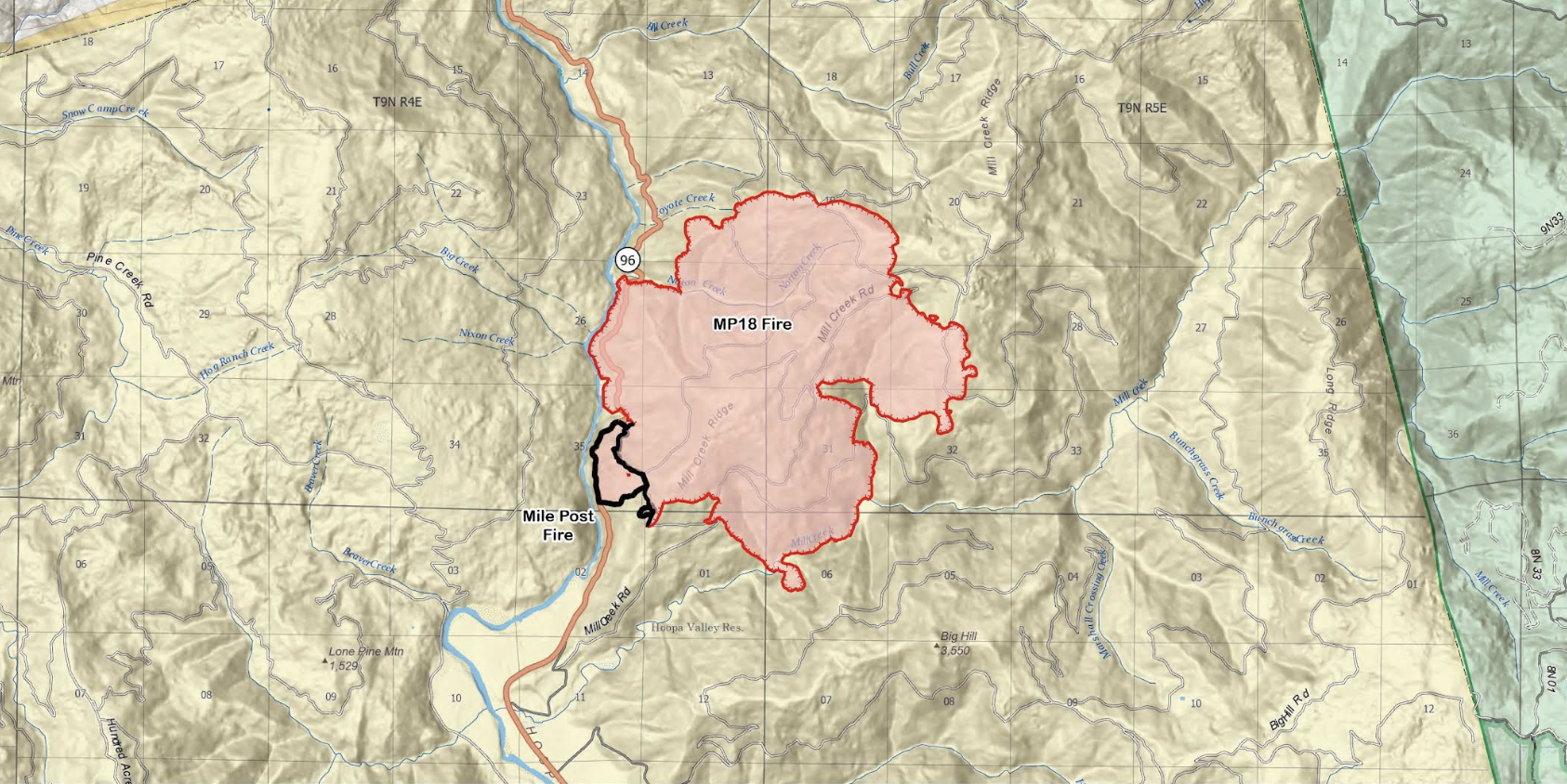
Hoopa’s Mile Post 18 Fire Grows to More Than Six Square Miles; Only Six Percent Contained With 866 Firefighters Deployed
LoCO Staff / Thursday, Aug. 13 @ 9:08 a.m. / Fire

Photos via Hoopa Valley Fire Department and OES.
###
Press release from California Interagency Incident Management Team 1:
Acres Burned: 3937
Containment: 6%
Start Date: 8/7/2026
Personnel: 866###
Active fire behavior was witnessed late into the evening as unseasonably dry vegetation and steep terrain drives growth on all sides of the fire.
Highway 96 remains closed as crews continue to hold the fire east of the Trinity River. With extremely steep terrain in all directions, fire personnel and large equipment require this limited space along the highway to safely and effectively fight the fire.
Air tankers and helicopters focused most of their efforts on the northern and northwestern perimeter to contain the fire within the Norton Creek and Coyote Creek drainages, with contingency lines already in place north of Skunk Creek.
Firing operations reinforced completed handline, effectively holding the fire east of the Hoopa Community in the Mill Creek area. Fire crossed Mill Creek Wednesday below Big Hill Lookout, and four hotshot crews assisted by helicopters directly engaged the fire there with the plan to hold it below the dozer line on Big Hill Ridge.
Fire managers would like to remind the community to please keep all personal drones grounded. Drone activity forces firefighting aircraft to land, stopping critical air operations.
Weather:
A trough along the coast has allowed marine air to spread into the Trinity River valley. Humidity values are trending noticeably higher with afternoon relative humidity values 25-40 percent and good nighttime recovery from 60-80 percent, even at higher elevations.
Evacuations:
Evacuation Order: HIA-E002-A Evacuation Warnings: HIA-E001-B, HIA-E002-B, HIA-E003, HIA- E004, HIA-E006, and HIA-E014-C
Road Closures:
Highway 96 remains closed north of Hoopa due to fire activity. Closures also are in place for Hostler Ridge Road, Mill Creek Road and Big Hill Road.


BOOKED
Today: 10 felonies, 12 misdemeanors, 0 infractions
JUDGED
Humboldt County Superior Court Calendar: Today
CHP REPORTS
Us101 S / Sr200 E Ofr (HM office): Trfc Collision-1141 Enrt
Summer Ln / E Washington Blvd (HM office): Defective Traffic Signals
Poppy Dr / Sherwood Rd (HM office): Closure of a Road
ELSEWHERE
County of Humboldt Meetings: Behavioral Health Board - SUD/Dual Recovery Committee - Sept. 10, 2026
County of Humboldt Meetings: Behavioral Health Board Executive Committee Meeting - July 1, 2026
RHBB: Judge Overturns Search Warrant in Student Activist Case: Devices Ordered Returned
RHBB: Multi-Vehicle Crash Closes South Fortuna Boulevard Near Strongs Creek Plaza
Californians Voted to Spend $1 Billion on K-12 Arts. Why Are Schools Returning the Money?
Carolyn Jones / Thursday, Aug. 13 @ 8 a.m. / Sacramento
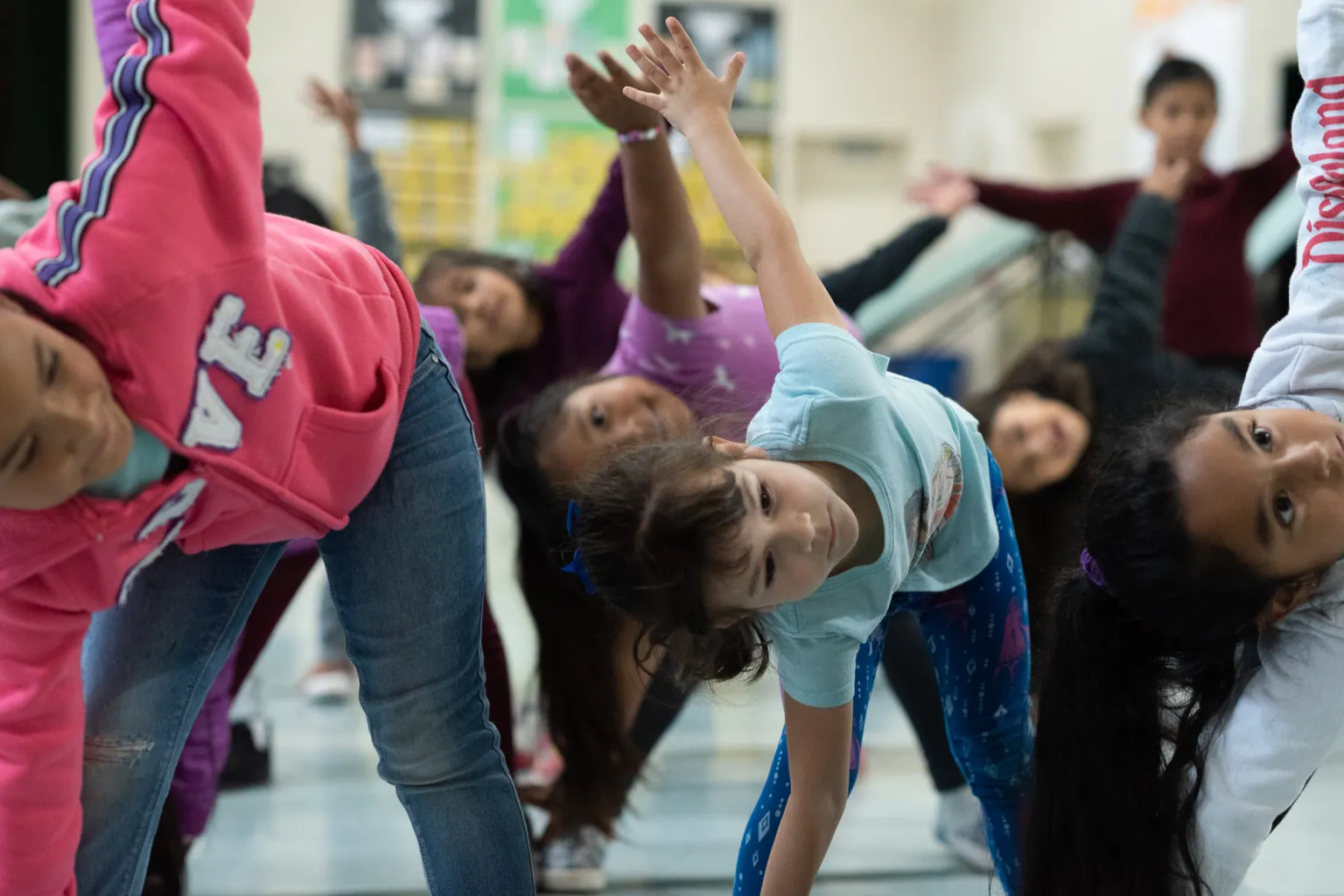
Kindergarten students participate in a hip-hop dance class at Radcliff Elementary School in Watsonville on May 21, 2024. Photo by Laure Andrillon for CalMatters
###
This story was originally published by CalMatters. Sign up for their newsletters.
###
Three years after voters passed an ambitious arts education funding measure, California’s K-12 schools were supposed to be awash in dance, music, theater and fine arts. But some schools are returning their arts money to the state, saying the rules on how to spend it are too vague and they can’t find enough arts teachers.
“The sad thing is, this means that thousands of kids aren’t getting art,” said Austin Beutner, the former superintendent of Los Angeles Unified who wrote Proposition 28. “We thought Prop. 28 was clear.”
Prop. 28, which voters overwhelmingly approved in 2022, sets aside about $1 billion a year for the arts in California public schools. Schools with more low-income students get more money, but otherwise funding is based on enrollment. Los Angeles Unified, with about 400,000 students, got about $72 million last year, while Death Valley Unified, with 21 students, got about $2,000.
Schools must spend at least 80% of their money on additional arts staff, with the rest going to art supplies and other arts expenses. Whatever they don’t spend, they’re required to return to the state after three years. The first three-year period just ended, and the California Department of Education hasn’t yet announced how much money schools returned. The state redistributes the unspent money to individual schools that are using their Prop. 28 money correctly, based on their annual spending reports.
State data compiled by Create CA, an arts nonprofit that supported Prop. 28, shows dozens, if not hundreds of schools that spent no money. Among them are charter schools, small schools, and mid-sized schools in every corner of the state.
At the other end of the spectrum, many districts have gone on spending sprees, hiring teachers and expanding programs at all schools. Bakersfield City Schools, for example, doubled the size of its folklorico and mariachi dance programs, bought thousands of musical instruments and paired local artists with classroom teachers.
Long Beach Unified has also doubled down on the arts. Its high school course catalog offers dozens of arts classes, including classics like marching band and painting as well as more obscure classes like improvisational dance, steel drums, stage technology, chamber orchestra and photography.
Too few teachers, too much confusion
But other districts, particularly smaller and rural districts, have hit some snags. Even though the state allows districts to pool their Prop. 28 money to share a teacher, the law doesn’t provide explicit language about it. Regardless, schools say there are not enough art teachers to hire. According to a recent Stanford Research Institute study, California needs at least 5,000 new arts teachers to meet the demand. Rural areas in general have a harder time hiring teachers, particularly those with specialized training.
Another obstacle is what some school officials describe as vague directions in the law. Prop. 28 broadly defines what constitutes an arts class, but it doesn’t require those classes to align with the state’s existing arts framework. And schools already get arts funding from the state, leaving some school officials wondering if they can mix their funds and still comply with the law.
“We need clarity and confidence that we’re doing this the right way,” said El Dorado County Superintendent of Schools Ed Manansala, saying schools are afraid of misusing the funds – for example, sharing a music teacher with another district but not dividing their time lawfully. “We have a long history of supporting the arts and we really want to make sure we do this right.”
Manansala and other school officials also say they’re afraid of getting sued if they don’t use the money correctly. That’s what happened to Los Angeles Unified. Beutner sued his former district last year, claiming it cut existing arts funding and backfilled it with Prop. 28 money, which is prohibited.
The lawsuit is pending in Los Angeles Superior Court. The district said that its use of Prop. 28 money was legal.
‘We should not be fighting over this’
Nonetheless, the confusion led Assemblymember Al Muratsuchi to write a bill that would clarify some of the Prop. 28 language – for example, defining what constitutes supplemental arts funding. The legislation so far has had nearly unanimous bipartisan support, but one very vocal opponent: Beutner.
Beutner said that Muratsuchi’s bill, Assembly Bill 2440, essentially guts Prop. 28 by giving schools too much leeway to spend their money. Among his concerns is that districts will not increase arts education at all school sites, but instead cluster it at certain schools or try to pawn off a physical education class, for example, as an arts class.
“I believe in the arts, and what it can do for students. Some kids only come to school because of the arts,” Beutner said. “We should not be fighting over this. Prop. 28 is very clear” in that it requires schools to add extra arts programs, not replace existing programs.
Beutner also described the bill as a “get-out-of-jail-free card” for Los Angeles Unified, because he said it would give the district more freedom in how it spends its Prop. 28 money. District spokesperson Christy Hagen said in an email that the district had nothing to do with the bill and hasn’t taken a position on it.
Beutner said he’d like to see Muratsuchi’s legislation tabled until a judge rules on his lawsuit against Los Angeles Unified. Otherwise, spending the funding could become even more confusing.
The bill is currently in the suspense file in the Senate appropriations committee, awaiting approval Thursday. If the committee doesn’t agree to hear it, it’ll likely die.
Muratsuchi said he’s open to a last-minute compromise.
“(Beutner) and I share the same goal of Prop. 28 providing arts and music to every child in California regardless of zip code,” said Muratsuchi, a Democrat from Torrance. “We want to make sure the law’s language reflects that. Hopefully I convinced him that I mean well and we have the same objective.”
Urgent need for clarity
Clarifying the languageis crucial if the law is going to be successful, said Veronica Alvarez, executive director of Create CA, a nonprofit that promotes arts education in California schools.
Too many school districts are not spending their Prop. 28 money because they’re confused about the guidelines or can’t comply with what they view as overly narrow requirements, Alvarez said.
“We want clearer statewide rules, so all kids from Shasta to Bakersfield get high-quality arts education,” Alvarez said. “Hopefully we can move forward on this.”
A Challenger in Eureka’s Fifth Ward: Retiree Kathleen Herrera Qualifies to Run Against Jeff Leonard for City Council Seat
Ryan Burns / Wednesday, Aug. 12 @ 5:04 p.m. / Elections
PREVIOUSLY
- It’s Official! Former Eureka City Councilmember Jeff Leonard Qualifies for November Ballot
- Here Are Your Eureka City Council and Mayor Candidates; Will Another Challenger Emerge to Challenge Jeff Leonard in the Fifth Ward?
###

Herrera. | Submitted
And we have another challenger!
Kathleen Herrera, a 79-year-old retiree, has qualified as a candidate for the Fifth Ward seat on the Eureka City Council. She will face off against Jeff Leonard, who previously represented Eureka’s Third Ward from 2002 to 2010.
Eureka’s Fifth Ward (see map here) is currently represented by Renee Contreras, whose last-minute announcement that she would not seek re-election allowed a few extra days for potential candidates to turn in the necessary nomination paperwork. Herrera seized that opportunity.
Reached by phone shortly after 4 p.m., she said she first got interested in pursuing a seat on the city council because of her friends’ concerns about C Street’s reconfiguration into a bicycle boulevard. They felt that it’s now “kind of a mess.”
“I ride a bike,” Herrera said. “I actually think it’s quite nice, the bike part [of C Street]. But I was quite disappointed that they made it a one-way.”
The direction of vehicle traffic on C Street’s single lane through downtown alternates between north-south and vice versa, depending on which block you happen to be on. Herrera said she’s seen several people driving the wrong way since the redesign.
“Then, I read there might be another one on G Street, but the City said they won’t make that one one-way. But some of my friends were skeptical. They said, ‘We need you on city council!’”
Herrera was still not planning on running until she heard that Leonard was positioned to run for the seat unopposed.
“That shot me to the top of the priority list,” Herrera said. “Nobody should ever be unopposed. It’s just not right.”
Walking around the city and talking to people, she found that homelessness is at the top of many residents’ lists of concerns. It’s one of hers, too.
“I hate the word homeless,” she said. “I just wish there were another term that weren’t so degrading.”
As for potential solutions, she said, “I am very much in favor of Housing First,” referring to the model that prioritizes finding permanent housing options for those living on the streets. “And I think the City of Eureka has adapted that.”
Ultimately, Herrera said she would like to see people living on the street “disappear as an option in my lifetime. I’m not talking about rounding people up or putting them in jail or giving them one-way bus tickets. But eventually [living on the street] will not be an option.”
Herrera first moved to Eureka in 1978 and lived here until landing a job in Siskiyou County in 2004. She came back to Eureka in 2024, she said, adding, “The house was mine all of the time.”
When she gave her age, 79, Herrera quipped, “Younger than Trump!”
She said she received an email today informing her that she’s been hired as an election worker with the county.
Returning briefly to the subject of bike lanes, Herrera noted that she doesn’t even own a car. She gets around on her bicycle and an e-scooter.
“You would expect me to want more bike lanes, but I’m happy with what we have,” she said.
California’s General Election will take place on Nov. 3. The Outpost will have plenty more news coverage of the local races between now and then.
Rob Holmlund to HCAOG: Former Development Director for Eureka and the Harbor District Set to Lead Humboldt Association of Governments
LoCO Staff / Wednesday, Aug. 12 @ 3:44 p.m. / Local Government
Press release from the Humboldt County Association of Governments:

The Humboldt County Association of Governments (HCAOG) is pleased to announce the appointment of Rob Holmlund as its next Executive Director, effective August 17, 2026.
With more than 20 years of planning experience in both the public and private sectors, Holmlund brings extensive expertise in transportation, housing, climate resilience, economic development, and regional planning. Throughout his career, he has demonstrated a collaborative leadership style and a strong commitment to building partnerships that deliver meaningful results for local communities.
As Executive Director, Holmlund plans to focus on strengthening HCAOG’s role as a regional leader in transportation planning, expanding collaboration with member agencies and partners, and enhancing the organization’s effectiveness in addressing Humboldt County’s transportation and planning priorities.
“I am honored to join HCAOG as Executive Director and to work alongside its dedicated staff, member agencies, Tribal governments, transit operators, Caltrans, community partners, and residents to deliver meaningful results for Humboldt County,” said Holmlund. “Transportation investment is essential to our region’s ecological health, economic vitality, public safety, resilience, and overall quality of life. I look forward to advancing projects that benefit HCAOG’s member agencies and the communities they serve.”
HCAOG welcomes Holmlund to the organization and looks forward to his leadership as the agency continues its mission of improving regional transportation, fostering collaboration among local governments, and enhancing the quality of life for residents throughout Humboldt County.

Seven Condors From the San Diego Zoo Safari Park Will Soon Join the Flock in Yurok Country
LoCO Staff / Wednesday, Aug. 12 @ 3:31 p.m. / Tribes , Wildlife
Photos and video courtesy of the Yurok Tribe.
###
Press release from the Yurok Tribe Facebook page:
This week, the Northern California Condor Restoration Program (NCCRP) received seven condors from the San Diego Zoo Safari Park.
NCCRP biologists and technicians, along with veterinarians from Sequoia Park Zoo and staff from the Safari Park removed existing placeholder wing tags from the condors, attached new NCCRP wing tags with local identifiers, and provided intravenous fluid to help the birds recover from the long drive from San Diego.
These are the first condors that NCCRP has received from the San Diego Zoo Safari Park. The program has also received birds from the Peregrine Fund’s World Center for Birds of Prey, the LA Zoo, and the Oregon Zoo.
The seven young condors represent the second largest cohort in the NCCRP’s history. The first of the three male and four female birds will be released on August 24, when they will join the NCCRP’s already 24 free-flying condors.
The NCCRP offers a huge heartfelt thanks to the San Diego Zoo Safari Park team for transporting the condors and assisting with the full day of processing. The Safari Park staff were extremely knowledgeable and spent time with the NCCRP staff sharing expertise developed over many decades of rearing this incredible species.
Northern California Condor Restoration Program
The Northern California Condor Restoration Program is a collaboration between the Yurok Tribe and Redwood National and State Parks. The NCCRP is part of the California Condor Recovery Program, which is an international multi-entity effort, led by the U.S. Fish and Wildlife Service, to recover the endangered California condor by establishing robust self-sustaining populations of condors within the historical distribution.
The Yurok Tribe initiated the Pacific Northwest condor reintroduction effort in 2008. To support the condor restoration effort, please visit https://www.yuroktribe.org/yurok-condor-restoration-program.
###

Yurok Wildlife Department Lead Biologist Elizabeth Meisman.

Yurok Wildlife Wildlife Department Biologist Madeleine Hellier.

Yurok Wildlife Department Biologist Sandra Hahn.

Yurok Wildlife Wildlife Department Biologist Madeleine Hellier.

(VIDEO) This Year’s Rumble Over the Redwoods Drew Record Crowds, Organization Reports
LoCO Staff / Wednesday, Aug. 12 @ 3:12 p.m. / Airport
###
Press release from Rumble Over the Redwoods:
McKinleyville, Calif. (Aug. 12, 2026) — Rumble Over the Redwoods concluded its third annual air show, drawing over 11,000 attendees to California Redwood Coast-Humboldt County Airport (ACV) throughout the weekend. The 2026 event featured an incredible lineup of performers, along with static displays, vendors, exhibits and family-friendly activities on show grounds.
Despite coastal weather impacting portions of Saturday’s flying schedule, thousands of guests attend the event throughout the weekend, with many of Saturday’s attendees returning Sunday for another opportunity to experience the show.
“I’ve been involved in hundreds of shows over the last 25 years, and I’ve never seen a crowd more appreciative of an air show,” said Air Show Director Dennis Dunbar. “The response we’ve seen from the community has been heartwarming and very fulfilling. It’s an honor to see the community come together to rally behind this show. Our volunteers truly put their hearts into the event, and the crowd recognized their efforts.”
Attendees traveled from 21 states and four different countries to Humboldt County for the show, with many staying at local hotels, visiting nearby attractions and supporting small businesses. While final numbers are still being confirmed, preliminary data suggests the event generated several million dollars in economic impact for Humboldt County.
As a 501(c)(3) nonprofit organization, Rumble Over the Redwoods relies on the support of its attendees, volunteers, sponsors, performers and community partners to bring the event to life. Organizers extend their sincere thanks to everyone who attended, volunteered their time, supported the event and helped make the 2026 show its largest yet.
###
About Rumble Over the Redwoods
Established in 2024, Rumble Over the Redwoods is Humboldt County’s hometown air show. The two-day event features an incredible lineup of performers, thrilling aerobatic displays and engaging activities for the whole family to enjoy. Its mission is to honor the sacrifices of those who have served and inspire the next generation. Join us as we take to the skies above California’s Redwood Coast on August 8-9, 2026 at California Redwood Coast-Humboldt County Airport (ACV). For more information or to learn how to get involved, visit www.rumbleovertheredwoods.com.
Study: Invasive Barred Owls Are Winning the Battle for California’s Old-Growth Forests; Removing Them Gives Spotted Owls a Fighting Chance
LoCO Staff / Wednesday, Aug. 12 @ 2:16 p.m. / Science , Wildlife

Barred owl. | Photo: JM Higley.
###
Press release from the Integral Ecology Research Center:
BLUE LAKE, Calif., Aug. 12, 2026 - Newly published research offers some of the clearest evidence yet of why the invasive barred owl has become one of the greatest threats to the northern spotted owl, and delivers encouraging evidence that managing barred owl populations can restore old-growth habitat for spotted owl recovery.
The study, led by scientists at the Integral Ecology Research Center (IERC) and published in the journal Biological Conservation, used GPS trackers on 56 barred owls across 4,070 square kilometers of forest in northwestern California. It is the first study to use GPS telemetry to determine, bird by bird, exactly which forest features invasive barred owls select, and how much old-growth habitat each one occupies.
The results are striking. Barred owls, native to eastern North America but now widespread across the West, consistently chose the tallest, oldest, and most structurally complex stands of forest: the same towering, dense-canopy, big-tree habitat that spotted owls need to nest and roost. On average, 64% of a barred owl’s home range overlapped with mapped spotted owl habitat, and 38% was the very highest quality nesting and roosting forest on the landscape.
Barred owls also claimed far more space in California than they do at home. Each bird’s territory averaged 6.7 square kilometers, roughly 28 times larger than the home ranges IERC researchers previously measured for barred owls in their native range in Louisiana. That means every invading owl exerts outsized pressure on the old-growth forest, and the wildlife within it, well beyond what its native ecology would predict.
The most encouraging finding, however, is what happens once barred owls are managed out of an area. Because the forest structure itself remains intact, researchers found that managing a single resident pair out of a territory reopens several square kilometers of habitat that spotted owls can reclaim. Drawing on 1,171 barred owls removed under an ongoing, permitted regional research and management program, the study conservatively estimates that more than 1,800 square kilometers of spotted owl habitat, including nearly 1,150 square kilometers of the best nesting and roosting forest, have been freed up for spotted owl recolonization.
“Every stand of that forest still shows up as spotted owl habitat on our maps,” said Dr. Vitek Jirinec, research scientist at IERC and lead author of the study. “But habitat isn’t just trees, it’s trees a spotted owl can actually live in, and barred owls have taken that off the table across much of the landscape. Managing the invader is proving just as critical as protecting the trees themselves.”
Because barred owls are generalist hunters, they compete with spotted owls for staple prey like flying squirrels and tree voles while also preying on dozens of species spotted owls rarely touch: salamanders, reptiles, and even small carnivores like the western spotted skunk. Researchers say this concentrated pressure likely extends beyond spotted owls to the broader old-growth community, an implication the team says warrants further study.
“Spotted owls are the reason this study exists, but they’re part of a much larger old-growth food web, one where every species plays a role in keeping the system intact,” said Dr. Greta Wengert, Co-Founder and Co-Director of IERC and principal investigator on the study. “This means protection of the oldgrowth biological community requires staying committed to managing this invader for the long haul. This is exactly the kind of science IERC specializes in: rigorous enough for a peer-reviewed journal, specific enough for a manager to rely on for years to come.”
The findings add scientific weight to ongoing regional efforts to manage barred owl populations, carried out in partnership with the University of Wisconsin-Madison, U.S. Department of Agriculture, Hoopa Valley Tribe, U.S. Forest Service, California Department of Fish and Wildlife, and other regional partners. The research was funded primarily by the California Department of Fish and Wildlife’s Cannabis Restoration Grant Program.
About the Integral Ecology Research Center
Founded in Blue Lake, California, in 2004, IERC is a nonprofit conservation science organization dedicated to studying and conserving wildlife and the ecosystems they rely on across California and beyond. IERC partners with tribal, state, and federal agencies, as well as academic institutions, to conduct scientific research, from field ecology to molecular ecology, that translates directly into on-theground conservation action for species such as the northern spotted owl, Humboldt marten, and Pacific fisher. Learn more at IERCecology.org.
Publication: Jirinec, V., Gabriel, M.W., Higley, J.M., et al. 2026. Invasive barred owls select old-forest structure: Functional habitat loss for spotted owls and a threat to old-forest fauna. Biological Conservation 322, 112035.
Open Access to Paper https://doi.org/10.1016/j.biocon.2026.112035


