

LIT BIT: An Excerpt from Wake Turbulence, a Mystery Novel From Local Author Stilson Snow
Stilson Snow / Sunday, Aug. 2 @ 7 a.m. / Fiction

Find below: An excerpt from Wake Turbulence, a mystery novel by local writer and photographer Stilson Snow.
Are you a Humboldt County writer who has written a book? Or a writer who has written a book about Humboldt County? You should share an excerpt with LoCO Lit Bit! Hit us up at news@lostcoastoutpost.com, and put “Lit Bit” in the subject line.
###

“We could just kill him,” the man in the right seat said. “What do you think?”
“What are you talking about?”
“Look, he’s a scumbag. You know it, I know it, everyone knows it. He’s of no earthly use to anyone. Why not just kill him?”
“Jesus. You’re serious!”
“Well, why not? What does he contribute to the society, to the economy? He’s a fucking leech. It would be a favor. We’d be doing everyone a favor. Wouldn’t have to pay to support him.”
“What about life, liberty, and the oath you took … ah, never mind.”
“What’s the matter with you?” the man in the right seat continued. “Tell me one thing he’s good for? He’s worse than the bums in the Square. Shit, we ought to off them, too. Who would miss ‘em, huh?” He looked in the back seat, then forward. “See? He’s got nothing to say. Might as well dump him right here. Nice long drop.”
The pilot shook his head slowly. “I’m delivering him as contracted. By your employer. And I’m going to enjoy the scenery. Why don’t you?” He turned his head back to look out the window.
Griffin McNab never tired of flying; never tired of watching his country roll by below. He moved easily in the cockpit, tweaking the mixture, checking the gauges. His movements had the unconscious economy of the professional. Gray was invading his black hair, though it should have started sooner. Pale azure eyes were bracketed with the crow’s feet endemic to his career. He wore wrinkled khaki pants and a soft denim shirt, frayed ancient running shoes. He had hated it when aviator sunglasses had become the fashion trend for salesmen and almost stopped wearing them. Most people would say he missed handsome by a hair. A few might mention a certain remoteness.
Huge, white, puffy cumulus clouds crowded the sky. Darting in and out of openings on the way up through the layer of grey bottomed fleece there was no way to know the beauty waiting above this lower level. Far above the small plane the mackerel sky of cirrus filtered the sunlight, dappling cloud formations as they explored this most transient of territories. There were tall crenelated spires, full and solid looking, streaked with grey and foreboding. There were wisps of white, as if some non‑Euclidian spider had hung her web in mid‑air. Mostly there was the foundation of these ephemeral structures, as folded and cleaved as a glacier.
Through the occasional hole or thin spot in the cloud floor below, the ancient forest peeked through. Steep sloped canyons and sharp ridges covered with fir and redwood slipped by, now seen through gauze, now in stark detail. Though they looked small at this altitude the world’s tallest and oldest trees still inspired the pilot. Disturbing the tranquility of his flight were bald patches on the slopes where the clear cuts, old and new, showed their scars. Each year there were more of them and each year the ferocity of the battle between the corporate giants and environmentalists increased.
He prepared to bring down the twin engine Seneca just past where the clouds ended just ahead. He looked over at the front seat passenger, about to say something, when suddenly the plane swung toward the left and started to drop.
“Dammit!” McNab stomped on the right rudder pedal and wrestled the plane level. Herman Pecheur, the deputy sheriff in the right seat, turned pale and gripped his knees until his knuckles went white. The prisoner chained to the deck in the back of the plane yelled a string of Spanish curses and pulled at the anchor bolt.
“Cut that out!” McNab yelled over his shoulder as he slapped his left knee. He muttered to himself, “Dead foot, dead engine,” following the standard procedure to identify correctly the engine that had failed. He pulled back the throttle on the left engine cautiously, to make sure he was cutting the power on the correct one. Then he shut down the engine and feathered the propeller. He looked out the window and saw oil stream out of the engine to form a trail behind. The prisoner yanked at the chain, moving from side to side. The plane rocked. “Herman, stop him! He’ll unbalance the plane!”
“Fuck. Fuck. Fuck…” The deputy didn’t move, but whispered the obscenity over and over. McNab leaned back and punched the prisoner with a right backhand. Blood spurted from the prisoner’s nose and he screamed again. He stopped trying to dislodge his shackles and reached up to hold his bleeding nose all the time swearing in Spanish. The pilot quickly returned to the controls to stabilize the plane.
Suddenly the prisoner lunged forward and kicked at McNab’s seat back, screaming epithets in Spanish, then English. “Cavron! You are dead! Hijo de la puta! I kill you fuckin’ ass!” He rolled from side to side, McNab threw the wheel from side to side trying to keep the plane level.
“Herman! Stop him!” McNab screamed over the rage of the prisoner.
“Fuck. Fuck. Fuck.” The deputy continued to repeat.
McNab reached over and slapped the deputy. “Herman! Help me!” The deputy shook his head and finally looked over at the pilot. “Stop him. Now!” Herman just looked at him.
“Shit!” McNab slapped on the controls for the autopilot, which was never meant for this situation. “Herman, if we start to go down, grab the wheel and hold it!” The pilot unbuckled his seat belt and turned to the raging prisoner.
“Dead man! You dead, man!” He kept flailing and yelling. McNab braced himself against the seat and waited for an opening as the plane rolled back and forth at ever increasing angles.
Suddenly the plane lurched and McNab was almost thrown backwards into the controls. “Herman! Grab the wheel!” The autopilot’s safety range had been exceeded and it had shut itself off. As McNab regained his balance the prisoner was losing his and the pilot saw his chance. He leaned forward and jabbed the smaller man twice in the face, stunning him, then followed with a precisely aimed blow at the solar plexus. The prisoner collapsed.
“Fuck. Fuck. Fuck.” Herman was still chanting his mantra of fear. McNab wheeled around into his seat, almost kicking Herman in the head, and grabbed the wheel. Quickly he reduced power, leveled the wings, pulled the plane’s nose up to where blue sky was the predominant color.
“Thanks a lot, Herman.” McNab finished up the lost engine procedure. The plane was running smoothly on the one good engine. “You’d better give him a handkerchief or something.”
The deputy slowed his breathing and relaxed the death grip on his knees. He looked over sheepishly at the pilot. “Ah, sure, Grif.” The deputy felt in his shirt pockets, then lifted himself a little ways up out of the seat to feel his pants pockets. “Shit, Grif, I don’t have one.” He looked plaintively over at the pilot. McNab shook his head.
“Christ. Someone is going to pay to have that upholstery cleaned up, Herman. I can’t ferry around people with blood on the seats.” He leaned back and reached into the pocket behind the deputy’s seat and pulled out some gasoline and oil smeared rags. “Here.” He tossed them to prisoner. “Hold them against the side of your nose.”
The captive, now just recovering his breath, picked the rags up and held them to his bleeding nose. “You’re dead, man.”
McNab ignored him and looked out at the forested hills, heavily checkered where the logging operations of Mountain Lumber, Inc. went on tirelessly. “Christ. I was hoping for another couple of hundred hours out of that engine.” He looked over at the deputy. “You okay, Herman?”
Sweat was still beading on the slick, high forehead of the middle aged deputy. His eyes were large and his breathing shallow. He nodded in one quick jerk.
BOOKED
Today: 10 felonies, 12 misdemeanors, 0 infractions
JUDGED
Humboldt County Superior Court Calendar: Today
CHP REPORTS
No current incidents
ELSEWHERE
County of Humboldt Meetings: Behavioral Health Board - SUD/Dual Recovery Committee - Sept. 10, 2026
County of Humboldt Meetings: Behavioral Health Board Executive Committee Meeting - July 1, 2026
RHBB: Judge Overturns Search Warrant in Student Activist Case: Devices Ordered Returned
RHBB: Multi-Vehicle Crash Closes South Fortuna Boulevard Near Strongs Creek Plaza
GUEST OPINION: Reckoning With My Occhiolism
Steven Pence / Sunday, Aug. 2 @ 7 a.m. / Guest Opinion
Occhiolism – An awareness of how small and limited our perspective is.
###
Much like gawking at car crashes, I often scan the obituaries from several of the communities I once called home. It’s not that I expect or fear I may find my name or the names of family members and close friends. I might know about those without referring to the media.
My interest, I hope, is not morbid, but in a culture that denies death and is obsessed with youth, any discussion of mortality, I have found, can be viewed as, well, deadly.
It’s hard to chalk up my searches to curiosity, since there’s no mystery. Eventually all will appear in the chronicles of time passing. Often, however, an obit provides an opportunity to remember fondly those who were once friends, neighbors or worthy acquaintances, enough so to sanction a sincere offer of condolences to survivors. While lives that end by violence or addiction, or the tragedy of a child’s death are understandingly unsettling, there is another class of obituaries that especially troubles me: The obituaries of those people whom I knew and whom I was not fully reconciled with at the time of their passing. I regret that there’s now nothing to be done to repair a failed relationship. But is there something that can be done for one’s own soul?
Can we forgive ourselves for only knowing belatedly that other choices might have been made?
The Swiss psychiatrist and father of analytical psychology, Dr. Carl Jung, said the intensity of our negative reaction to another person often corresponds to the degree that we have not dealt in our own lives with the darkness we see, and detest, in them. The young man that I was would have said “nonsense.”
Jung wasn’t the first to theorize about our projection of our failings on others. A 13th century poet/mystic named Rumi wrote:
Many of faults you see in others,
dear reader,
Are your own nature reflected in them.
As the
Prophet said,
The faithful are mirrors to one another.
When I think of those who have just passed and the fact that I never got over my dark feelings about them, I ask myself, why is that?
And what is the cost of not letting go of an eternal grudge?
For a decade, “Bill” and I shared the political stage in a small town. Recently, Bill, a decade my senior, died.
Although 25 years had passed since I last saw Bill, I still viewed him in an unfavorable way.
Now, belatedly, I consider the reality of our political rivalry and conclude, “You idiot, of course in politics people are going to oppose you. Especially those whose perch you threaten. You were very young (age 29) when you first took political office and, in your arrogance, did you really think your views on every subject were unassailable?”
Of course I did.
What were the things you didn’t like about Bill? His claim of unquestioned integrity? His “virtue signaling”? The seeming differences between his private life and his public proclamations?
Yes, all of that.
Have I ever done hypocritical things? Let me count the instances and describe the myriad ways. This could take some time.
Now I understand that I was shaped and made a better office holder by knowing my reasoning would be challenged by Bill and others, forcing me to make better decisions. Today I am grateful. My first term in political office featured success, failure and many near misses. It would’ve been worse, but for the opposition that shaped my judgment.
And what good has my stubborn refusal to move on done me or anyone else?
Multiple peer-reviewed articles in scientific journals note that when a person perseverates about old hurts, the amygdala, the portion of the brain that deals with emotions, treats the ancient memory as if it was a current threat.
Did I really need decades of that occasional, if fleeting, but always unpleasant, sense of existential stress?
Thoughts of old hurts will shape our reality, until we reframe them. Finally, I understand — we see things, not as they are, but as we are. And when we deny our darker side, we undeservedly put ourselves on a pedestal, a place without hope for a growth that offers peace.
I’m not saying that I was wrong in viewing Bill as a mortal enemy of my inadvertent political career — I was appointed to a job that I really didn’t want — but once I left that position, he was just a bad memory.
“Bad” because we were both smart enough to make things better, but we never did.
In The Dictionary of Obscure Sorrows, the invented words “Nodus Tollens” appear. (Aren’t all words invented?) The phrase is defined as the realization that one’s life story, the things we say to ourselves about ourselves, no longer makes sense. How absurd to think of ourselves on a hero’s journey, with everyone in opposition an enemy rather than as people who, regardless of intent, might serve to instill a sense of humility.
And eventually, wisdom, which is a far better foundation for a peaceful life than a mind contaminated by hurtful memories from a time of foolish, fiery, youthful passions.
###
Steven Pence retired from Michigan, where he served as an attorney with legal services, was an elected prosecutor and a county commissioner, seven years ago. He finished his legal career in private practice. He is married and lives in Ferndale with his wife, Teresa. He’s been a freelance writer, both in Michigan and California.
THE ECONEWS REPORT: Trump’s Plans to Disrupt Dam Removal Get FERC’d
The EcoNews Report / Saturday, Aug. 1 @ 10 a.m. / Environment

Cape Horn Dam. Photo: Izzy Vanderheiden.
Remember how a shady Southern California water agency, the Elsinore Valley Municipal Water District, announced that it wanted to take over the Potter Valley Project on the Eel River, seemingly to thwart dam removal? We have some good news. Earlier this month, the Federal Energy Regulator Commission (FERC) denied the Elsinore Valley Municipal Water District’s petition to “intervene” in their proceedings. This means that the Water District would lack “standing” to sue over the final determination by FERC.
While welcome news, that doesn’t mean that Elsinore is out of tricks it can play. Alicia Hamann, Executive Director of Friends of the Eel River, joins the program to give the latest news on Eel River dam removal.
For the latest on Eel River news, be sure to go to eelriver.org
HUMBOLDT HISTORY: Eureka’s Biggest Contribution to the War Effort Was a Massive Bayfront Shipyard That Built Floating Dry Docks
Glen Nash / Saturday, Aug. 1 @ 7:30 a.m. / History
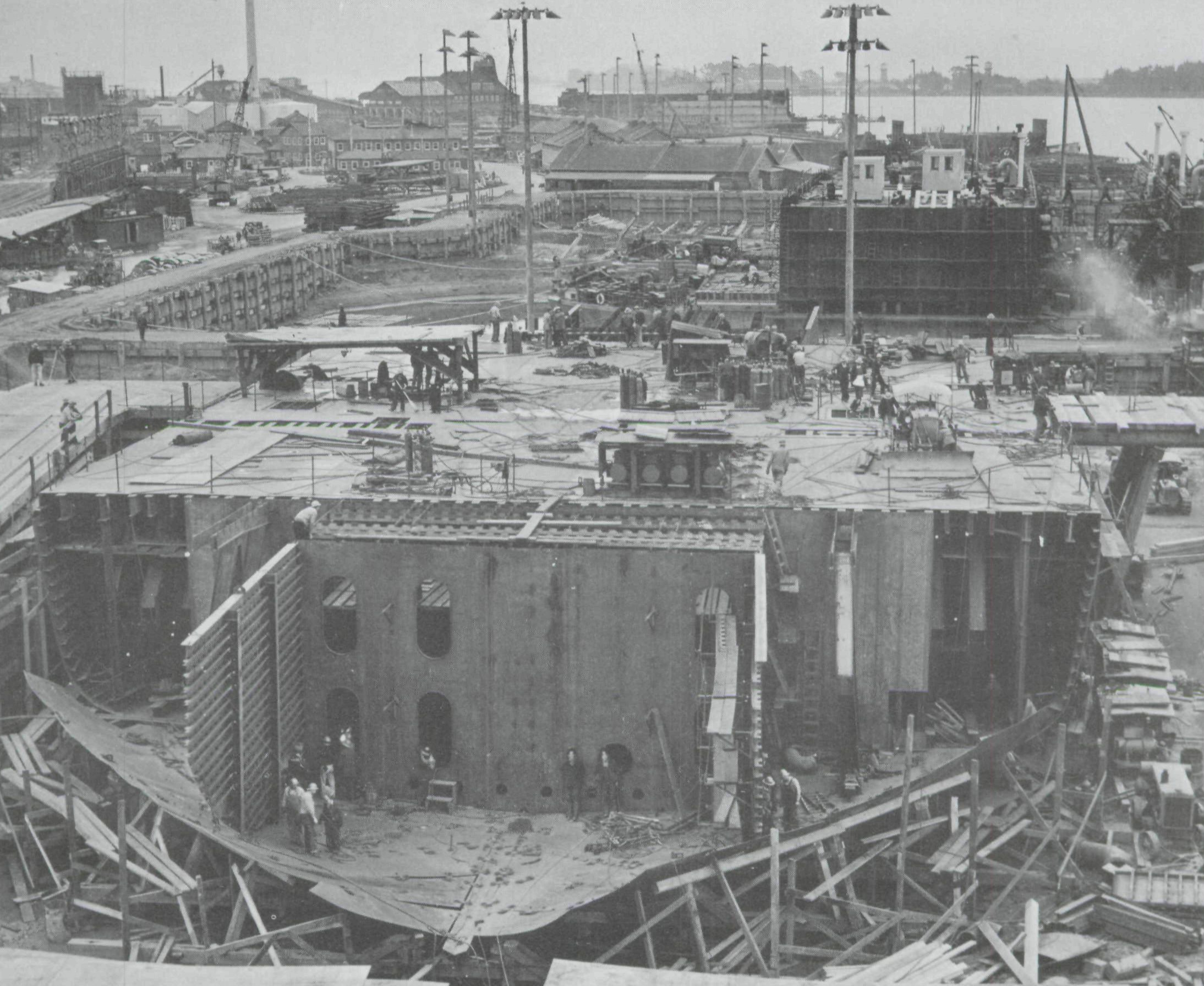
The Chicago Bridge and Iron yards on Humboldt Bay. Photo via the Humboldt Historian.
###
January 1942: The United States was beginning a war with Japan. The entire country was preparing for a long conflict. The citizens of Eureka, like all the people of the nation, were stunned by this terrible action.
The U.S. Navy had suffered a severe loss at Pearl Harbor. Realizing such conflicts would require some way to repair ships that might be damaged during battle, the Navy picked Eureka on Humboldt Bay as a place to build the large, floating dry docks for use in the Pacific. Eureka was chosen because it had the harbor and the necessary labor force to accomplish this task.
A “yard floating dry dock” (YFD) is built for the purpose of raising a damaged ship up out of the water so that it may be worked on and repairs could be made to whatever damage it had suffered. This was accomplished by sinking the main pontoon deck below the surface of the water to a depth which would allow the damaged ship to float between the wing walls. Then, when the ship was well centered in the dock, the crew could then raise the pontoon deck — with the ship on it—to a level above the surface of the water. Workmen could then make necessary repairs, save time and avoid long trips back to Navy shipyards for repairs.
The U.S. Navy Bureau of Yards and Docks selected the Chicago Bridge and Iron Company to build these huge floating dry docks at Eureka. This company sent O.A. Bailey, C.W. Hines and Donald E. Larson, engineers, to Eureka to select a suitable site for constructing floating dry docks. The site selected was a large area of about 60 acres of desolate land and mudflats at the foot of Washington Street. This site stretched almost one-half mile along the waterfront and was marked by the Humboldt Bay tides which ebbed and flowed.

YFD-64, the U.S.S. Richland, a yard-floating dock built at the Eureka yard. US Navy photo - Link, public domain.
With O.A. Bailey heading the yard design, the Mercer Fraser Company started building a road into the site in February 1942. This required filling and surfacing this low land so heavy equipment could be moved onto the site.
In March a temporary office was established and construction facilities were started by a carpenter crew beaded by Don Larson, resident manager. There were less than 50 employees on the payroll. On March 26,1942, a building permit was taken out for a office building and watchman’s building.
In April a welding school was opened under the supervision of T.B. Baker. Fifteen welding machines were used by many students anxious to learn the art of welding with electric arc. The welding classes were at first conducted at the high school but later, when the welding school came under the direct supervision of the state of California, the students received their training in the yard with five instructors.
In May 1942 a permit was taken out for construction of a blacksmith shop, a compressor house and a storage shed. A large Northwest crawler crane was assembled and placed in service and the first carload of dry-dock steel arrived and was unloaded.
During June the keel was laid for the first end-section of YFD-20 and the payroll increased to 212 employees, including 47 qualified welders; a swing shift was also established.
The construction of the center section of YFD-20 was started in July 1942. Some 4,000 tons of dry-dock steel was received to date. The U.S. Navy sent Comm. James T. Reside from Washington, D.C, to inspect the Eureka yards.
During August 1942 a large crawler crane was placed on top of the center section buoyancy chamber to start the wing wall erection. To speed up the work, a graveyard shift was established and the number of employees was increased.
The U.S. Navy sent Lt. L.D. Burky to serve as resident officer-in-charge under Lt. J.C. Sease, officer-in-charge at Alameda. During this month of September, there were 600 employees on the payroll. Keels were laid for battleship dock sections “No. 5” and “No. 6.”
The winter rains began and portable shelters were set up. A hydraulic suction dredge called Oscar McGee was purchased from the Hammond Lumber Co. and was used to deepen the bay as needed for launching dry docks.
During November work was stopped on the battleship sections in order to concentrate all available manpower on completion of YFD-20. There were, at this time, 1,200 employees, including nine women who had passed the Navy test for welders (they were good). A building permit for a welding school building was taken out in December. All three sections of YFD-20 were launched during the week before Christmas and outfitting work was rushed to completion.
On Wednesday, January 13, 1943, YFD-20 was tested and delivered months ahead of schedule. A ceremony was held to honor this event, complete with speeches by notables and officers of the company and U.S. Navy. This YFD was given the name Reclaimer.
The men and women of YFD-20 soon saw the U.S.S. Sioux, a new Navy tug measuring 205 feet long, and featuring a 38-foot beam and nearly 1,700 ton displacement, come to town. She was high-masted and bluff-bowed and featured 3,000 horsepower delivered to the propeller from four big diesels. She was ugly but efficient. Commissioned Dec. 8, 1942, at United Engineering in Alameda, an 85 percent Naval Reserve rookie crew had signed on. Less than a month later she was on her first “assignment” — a voyage to Eureka to bring back a dry dock. It was a glum January day when she left the Alameda docks and pushed her way out under the Golden Gate Bridge and headed up the coast.
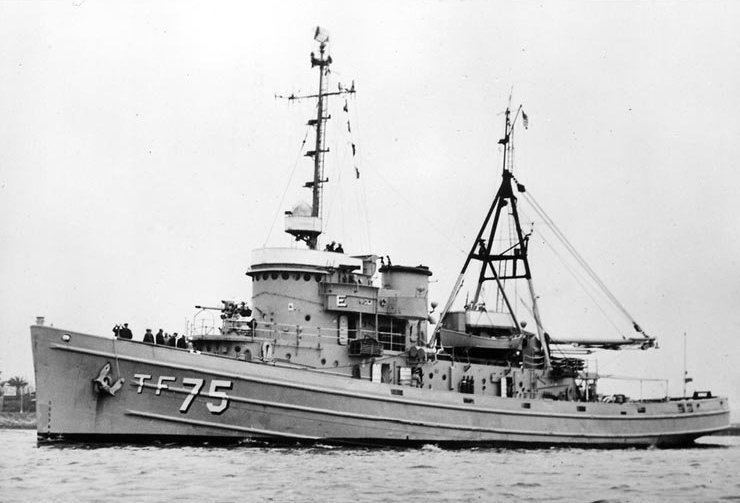
The Sioux. US Navy photo # NH 99487, Public domain, via Wikimedia Commons.
The Sioux sailed into Humboldt Bay and tied up at the Hammond Lumber Co. dock; the next morning she lay on her beam ends in the mud. There was a nine-foot tide and this ship drew 16 feet!
She lay there at a rakish angle which put the auxiliaries out of commission. There was no heat, no light and only cold grub. The morning tide flowed in with the fog, allowing the crew to move sheepishly out into the stream and drop anchor.
During their liberties some of the young sailors found friendly girls and others wandered bar-to-bar. A few straight arrows went down to the USO, where they made out alright. After two or three days, the dry-dock Reclaimer was finally ready to go. To the rookie sailors on the Sioux, this dry dock, YFD-20, loomed bigger from the bay side than downtown Eureka. It was some four stories high and a city block long.
On Wednesday, Jan. 13,1943, with the aid of two old steam-powered tugs, the dry dock was maneuvered down toward the bar and found the wind, tide and weather favorable. The Reclaimer was a beautiful sight as she was towed down the bay, out through the narrow entrance and into the wide Pacific.
The big, square-ended dock pushed three-foot wave ahead of it. The Sioux shuddered and shook. She was making barely three knots, which was not enough to outrun a storm that was catching up from the Northwest. The wind was picking up and the barometer was dropping fast.
By the time they were off Cape Mendocino, the wind was howling and the seas were breaking over the stern. One of the escort tugs, U.S.S. Bagaduce, was steaming to the windward as night fell. The storm was gathering in fury. The captain then signaled by blinker to make an oil slick, a measure which was supposed to help calm the water, but in reality did not help much. Everything was battened down.
At 10 minutes after 10 p.m. on Friday, Jan. 15, the 10-inch steel tow line snapped. Five minutes later one of the main engines quit. The Sioux took off for Treasure Island, leaving the dock adrift.
The ship’s crew loaded new tow gear, a food and water, and by midnight they went charging out of the Golden Gate into raging seas in pursuit of the Reclaimer.
In no time, 30-foot seas were breaking over the bridge. They made 12 knots south toward Monterey Bay, off of which the Reclaimer had floated. By Sunday noon, they caught up with the dock, then shot a line to the U.S.S. Ute, which had it in tow. The crew tried to make a tandem pull but heavy seas soon snapped the tow lines. The wind and seas showed no signs of abating and the dock began drifting south again. The Sioux and Ute could do nothing except guard the dock. Late Monday they managed to get another line on the dock. At midnight the S.S. Skinner, a big merchantman commandeered by the U.S. Navy as a rescue vessel, arrived and the tow line was handed over to the Skinner crew at 1:30 a.m. Tuesday.
What happened to the dry dock? The Skinner lost the tow in the fog and the Reclaimer crashed on the rocks off Point Bonita. It sank without a trace. The 13 men on the dock, had any escaped? So much for scuttlebutt; nothing was ever confirmed or denied and it remains a mystery of the sea. The YFD-20 also was no more and to this day, no official record exists.
Back in Eureka, work, however, resumed on the battleship sections at the plant. A building permit for construction of a lunch and commissary building was taken out and in February, work started on construction of a employment office and machine shop. During this month, the Eureka yard was awarded the first Army-Navy “E” flag for outstanding performance on the production front. The CB&I had a baseball team, a bowling team, a softball team and boxing team. This company printed a monthly publication, the Chi-Bridge Minute Man, which contained reports from all departments as well as scuttlebutt around the yard.
During March and April, some Unionmelt automatic welding machines were purchased, installed and put to work. These machines helped to speed up the work. The plant at this time had 1,700 employees on the payroll.

Eureka Chicago Iron & Bridge workers proudly display the flag. Photo via the Humboldt Historian.
By May and June 1943, two battleship sections had been launched and four keels laid. There were now 2,200 employees on the payroll. Ed Lax was made head of the mechanical department. During the next two months, July and August, the first battleship section was delivered. The Army-Navy “E” award was extended with the first star added. By the end of August there were some 2,800 employees on the payroll.
During September several YFDs were launched and keels laid. The big news at the time was “Italy Unconditionally Surrenders.” A Federal Housing project of 320 units was started in Eureka, where the Eureka Mall stands today. This housing was built by L.H. Hanson and Son, contractors out of Fresno, Calif. (This writer did work on the job.)
The yard continued to prove to be a hubbub of activity. During October, a CB&I football team was organized. A second story was added on the Navy office building. In December two battleship sections were launched and two auxiliary power substations were installed to accommodate more electric welding machines. Construction was started on a new cafeteria as well, creating even more jobs. There were at this time over 3,000 employees.
In May the public was invited to witness the launch of “YFD-64.” The CB&I bowling team won the Eureka major league bowling championship. In June a second star was added to the Army-Navy “E” flag. Lt. Replogle succeeded Lt. Wallace James as assistant to officer-in-charge.
During October Lt. Comm. John D. Burky left for overseas duty after completing two years outstanding work as officer-in-charge and Lt. Comm. Replogle took over. The CB&I yard was now working two, nine-hour shifts.
During February 1945, the Eureka yard was awarded additional contracts covering construction of 17 floating crane barges and two, 18,000-ton floating dry docks. Though the material for the barges arrived in March, the payroll dropped to less than 800.
The big news, “Germany Surrenders Unconditionally,” was announced May 8, 1945. Two months later, the first crane barge was launched. The Eureka yard received the fourth star on their Army-Navy “E” flag.
When Japan was defeated August 14th, all Eureka work was cancelled four days later, except for the construction of six crane barges and two barge hulls. On Sept. 2, 1945, the formal surrender of Japan was celebrated with whistles, bells and fireworks.
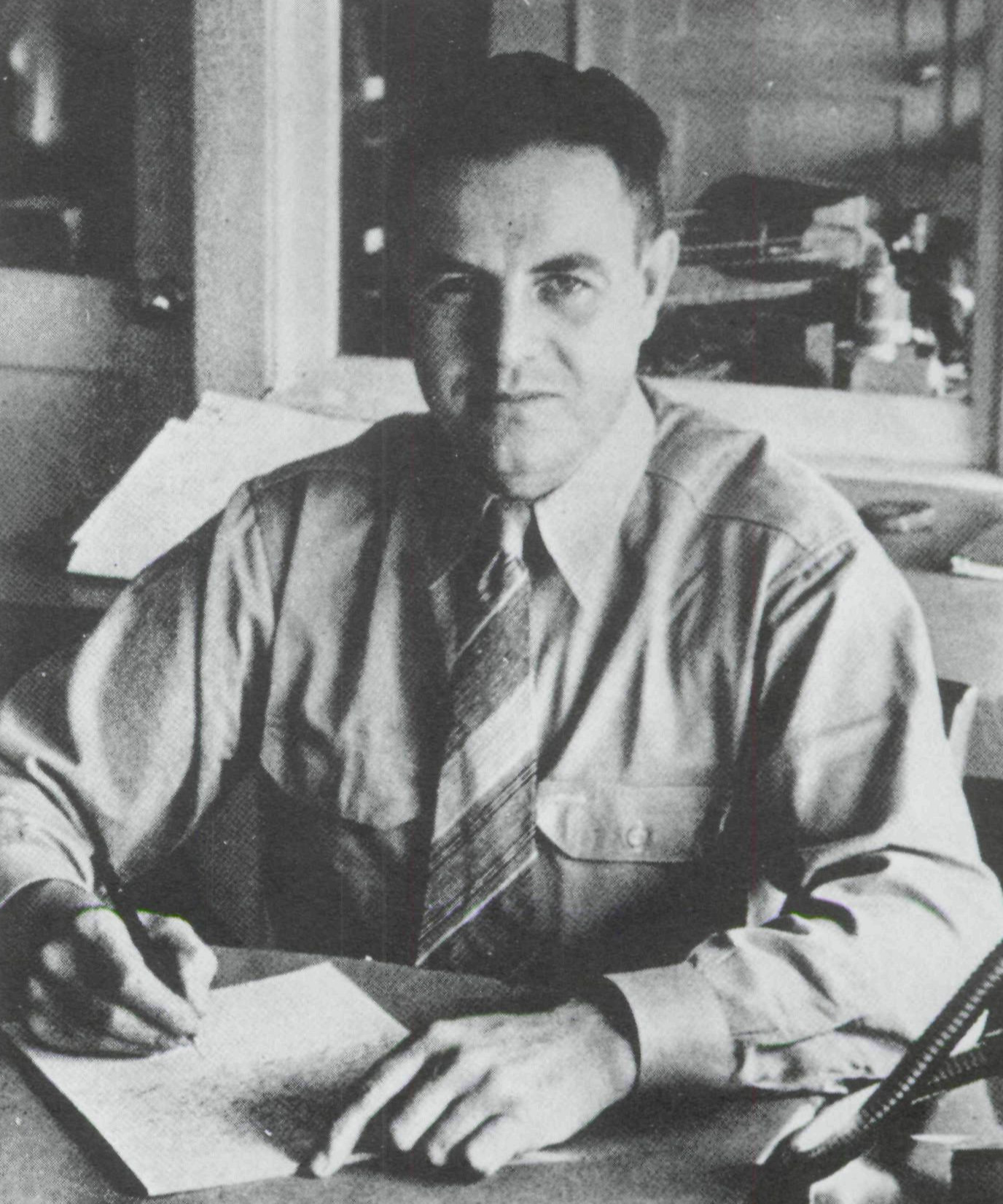
Donald E. Larson. Photo via the Humboldt Historian.
In October 1945 the sixth crane barge was launched. There were now 500 employees on the payroll; operations were winding down. During November, the first crane barge was accepted by the Navy following extensive tests. Don Larson, manager since inception, handed the reins to Neil Burdick, then left for Chicago to take up new duties. There were 450 employees on the payroll at the time.
During its nearly four years in Eureka, the Chicago Bridge and Iron Company turned out 18 complete floating dry docks or dry dock sections, and six floating crane barges. These dry docks were in service in every part of the Pacific during WWII.
More than $20 million was dispersed in paychecks in a period of four years. An average of $5 million a year was given to local employees to spend in local businesses. In addition, the firm spent over $6 million for materials supplied by local businesses.
Today the site is cleared, the money has long been spent but the Humboldt Bay tides still ebb and flow on the shore.
###
Author’s note: Most of this information and photos were provided by people who had been employed at the CB&I, including James Greivelding, Mrs. Helen James and Jeff Littleboy.
###
The piece above was printed in the November-December 1993 issue of the Humboldt Historian, a journal of the Humboldt County Historical Society. It is reprinted here with permission. The Humboldt County Historical Society is a nonprofit organization devoted to archiving, preserving and sharing Humboldt County’s rich history. You can become a member and receive a year’s worth of new issues of The Humboldt Historian at this link.
OBITUARY: Ronald George Webster, 1941-2026
LoCO Staff / Saturday, Aug. 1 @ 6:56 a.m. / Obits

In
Loving Memory of Ronald George Webster
April
23, 1941 –
July
27, 2026
Ronald George Webster was born on April 23, 1941, in Tacoma, Washington, to Lois Freudenstein-Webster and Truman Russell Webster. He began his journey home on July 27, 2026.
Ron moved with his family to Southern California before settling in Klamath, Calif. in 1958, where he grew up making memories with his brothers. They were always outside, getting into a little mischief and enjoying every adventure they could find.
Ron loved the outdoors. Whether he was camping, fishing, hunting, or cruising the mountains, that’s where he was happiest. One of his favorite stories was coming home with four elk after a hunt. He worked as a woodsman and later for BART in San Francisco. He loved concerts, especially AC/DC and Bob Seger, and had a passion for gardening and growing things.
Ron shared 37 wonderful years with the love of his life, Debra Carpenter-Webster. He took great pride in his yard and garden, loved road trips, especially to Montana, and never missed a chance to visit friends or make new ones. He stayed close with his good friend Jeff in Florida, always texting and sharing pictures.
Even in his later years, Ron kept busy taking care of fish and deer, making nets, and working on whatever project came next. Most of all, he loved spending time with his family.
Ron lived life his way, always busy, always outdoors and always making the most of every day. He will be deeply missed and lovingly remembered by all who knew him.
Ron was preceded in death by his parents, Lois and Russell Webster; his mother-in-law, Susanne Little; his children, Janet and Albert Webster; his brothers-in-law, Duane Carpenter, Albert (Silvia) Carpenter, Richard Carpenter and Charles Carpenter; his nephew, Dale Webster; and his good friends Don Natt, Jerry McCovey and Walt McCovey.
He is survived by his wife of 37 years, Debra Carpenter-Webster; his siblings, Jerry (Sandy), Ben (Myra) and Barbara Webster, Susie (Glen) Sanchez, Shelly Carpenter, Tonya (Eldon) Yazzie and Bruz (Mary Jane) Aubrey; his children, Tina Webster and Ticmil (Tabitha) Ashley; his grandchildren, Thomas and Peter (Rebecca) Marceau, Ronald Thomas “RT” Jones, Tasha (Latrell) James, Cassandra (Chaygee) Charles, Michael Wamblee (Tearnie), Amos, Kalvin and Iola Tsisnah Ashley; his good friends Duane and William Proctor, George Smoker, Artie Jones, John and Alice Chenault, Matt Douglas, Ricky Nova, Nancy and Ron Lake, George Wilson, Curt Dempewolf, Fred Tuttle, Jade Reyes, Howard “Ducky,” Marty Barber Sr. and Marty Barber Jr., Christina Phillips, Craig Super, Sean “snack” O’Neil and Corky Simms; as well as many nieces, nephews, extended family members and friends.
Please forgive us if we have missed anyone. Ron had a big heart, and there were so many people he cared about throughout his life.
A viewing will be held on Monday, August 3, at 10 a.m. at Ayres Family Cremation in Eureka.
Following Ron’s wishes, his ashes will be spread alongside his parents at Blue Creek. Family and friends who wish to join are invited to meet at 9 a.m. on Tuesday, August 4, at the boat dock in Klamath. Seating on the boats will be limited to family members, but anyone with a boat who would like to travel with the family is warmly welcome to do so.
Afterward, please join the family for a potluck reception at 1 p.m. at the Keehl Community Room, 111 Huckleberry Lane, Klamath Glen. Please bring your favorite dish, your memories and your stories of Ron to share as we celebrate a life well lived.
###
The obituary above was submitted on behalf of Ron Webster’s loved ones. The Lost Coast Outpost runs obituaries of Humboldt County residents at no charge. See guidelines here. Email news@lostcoastoutpost.com.
Sheriff Honsal Responds to Shannon Miranda’s Accusations: ‘The Facts Will Ultimately Speak for Themselves’
Ryan Burns / Friday, July 31 @ 3:10 p.m. / Animals , News
Earlier today, Shannon Miranda issued a public statement, through his attorney, about the ongoing criminal investigation into his animal rescue operation in Fortuna. In that statement, Miranda makes several allegations of impropriety by Humboldt County Sheriff William Honsal and his staff.
The Outpost emailed Honsal and invited him to respond to those allegations. He sent along the following statement:
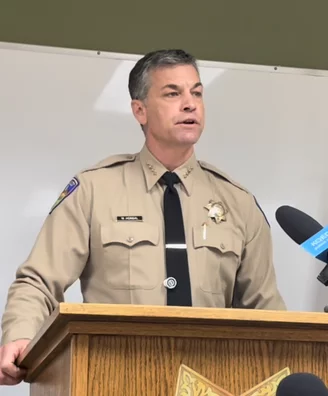
Honsal. | File photo.
Following the service of each search warrant, an inventory of the items seized was completed and provided as required by law. Those inventory lists are part of the court record and are available to anyone who wishes to obtain a copy through the court.
Mr. Miranda and his media team are free to make whatever public statements they choose regarding this matter. They may present their version of events as they see fit. The Humboldt County Sheriff’s Office, however, has remained committed to releasing only the limited factual information that is appropriate for an active criminal investigation.
I have no personal vendetta against Mr. Miranda, nor is this investigation driven by anything other than the facts. Our responsibility is to conduct a thorough, objective, and impartial investigation, wherever the evidence leads. The facts will ultimately speak for themselves.
This criminal investigation remains very active and is being handled with the seriousness it deserves. Our detectives and investigative teams are working diligently with our law enforcement partners to gather and analyze all available evidence. We are conducting a comprehensive review of physical evidence, financial and business records, digital evidence, and other relevant documentation, while continuing to interview witnesses and consult with subject matter experts as necessary.
Given the complexity and scope of this case, we will not rush the investigative process. Our priority is to ensure that every lead is thoroughly examined, every piece of evidence is carefully evaluated, and every Witness is interviewed so that any decisions regarding criminal charges are based on a complete and accurate understanding of the facts. We remain committed to conducting a meticulous, professional, and impartial investigation that seeks only the truth and ensures accountability under the law where the evidence supports it.

‘I Will No Longer Stay Silent’: Shannon Miranda Issues Statement Decrying ‘Gestapo Tactics’ by Law Enforcement and ‘Lies’ From Critics
LoCO Staff / Friday, July 31 @ 1:55 p.m. / Animals , News
UPDATE, 3:13 p.m.:
Shortly after this post was published, Humboldt County Sheriff William Honsal emailed a response to Miranda’s statement. You can read that response here.
###
Original post:
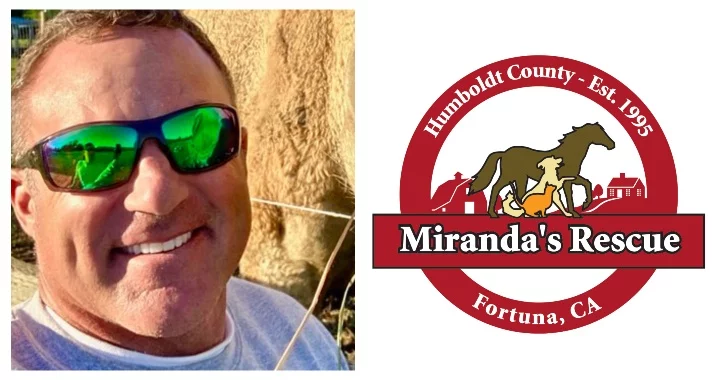
Miranda (left) and his animal rescue’s logo. | File photo.
###
The following statement was emailed to the Outpost by Harland Law Firm attorney Allison Jackson on behalf of her client, Shannon Miranda:
Media coverage, social media posts, and law enforcement have continued to distort the truth about Miranda’s Rescue and me. I have fully cooperated with the investigation and provided everything requested, including my records, computers, and phones. I have been forthright and honest. The same cannot be said of the Humboldt County Sheriff’s Office or my neighbors, Jenna Moore (aka Chris Jenna) and Jennifer Raymond.
Because of the investigation, I have not spoken publicly in my defense. However, the inaccurate information and lies circulating about this case have fueled rumors, threats, and hostility toward my family and me.
Law enforcement, particularly Sheriff Honsal, has become part of the rumor mill, so I will no longer stay silent. Many facts have not been released, and what has been released has been distorted. They are using Gestapo tactics in this investigation, including ransacking my house at 10 p.m. and frightening my family. Despite numerous requests, the Sheriff still has not provided me with the list of items taken from my home and the Rescue property during their searches, as promised. They continue to stonewall me while bending over backward to appease Jenna Moore.
These women claim to have insider information and present it as fact. Sheriff Honsal, his officers, and investigators seem willing to speak with my accusers but not with me. In addition, Sheriff Honsal’s wife, Jodi Honsal, is actively involved in Moore’s and Raymond’s elaborate scheme to discredit me.
The authorities are selectively releasing information for publicity rather than to reflect the truth, and they are using inflammatory language in doing so. It appears the Sheriff is using me to help his re-election campaign rather than conducting this investigation with integrity.
Several social media pages by Moore, Raymond, and others claim to be sources of truth, but they are not. The two main perpetrators of total lies are Moore and Raymond. They are clearly making things up for clicks, reactions, and to position themselves as avengers, when they are merely bullies and stalkers. In addition, numerous of their vigilante friends and followers are posting death threats and lies.
Moore and Raymond are profiting from this scheme by selling merchandise branded with their lies to raise funds for themselves, including T-shirts and scented candles. If they are truly honest and honorable, why are they doing this?
This began as a personal vendetta by Jenna Moore, who, for reasons I do not understand, began blatantly harassing me. She and her family trespassed on my property multiple times, dug up buried dogs, illegally videotaped and photographed them, and posted these images on multiple social media sites without any factual information or even the slightest context. She continues to act aggressively, spreading lies and claiming ongoing abuse.
Let me lay out some of the facts:
- Not releasing the whole truth: One example of Sheriff Honsal not providing all the information is the bin of used dog collars found in the barn. Honsal failed to mention that the collars were donated to the Rescue, many still tagged, for use with incoming dogs. These were NOT collars and tags from dogs that came to the Rescue.
- The mission of my rescue organization is to provide a final opportunity for dogs that had been slated for euthanasia in municipal shelters. These animals were transferred into my care as a last resort, with the understanding that I had full legal authority and responsibility for all medical and adoption decisions in their best interests and in compliance with applicable laws.
Every decision was made after careful evaluation of each dog’s medical condition, behavioral history, and public safety considerations. While many dogs could be rehabilitated and successfully placed in loving homes, not every dog could be safely or legally adopted. Some adopted dogs were returned because of aggression.
Under county ordinance, a dog that has bitten a person or attacked, seriously injured, or killed another animal may be classified as “potentially dangerous” or “dangerous.” In such cases, the law imposes restrictions that can make adoption unlawful or impossible. As the responsible party, I was legally and ethically obligated to comply with those requirements.- Personal opinions, emotions, or public pressure cannot override established laws or my legal obligations. Placing a dog that could not legally be adopted would have violated the law and jeopardized the safety of people, other animals, and the rescue. My responsibility was to act within the law while making difficult decisions in the best interests of the animals in my care and the community.
No matter how badly someone wants to keep dogs from being euthanized, they can’t do so if the law stands as it is. If I place an aggressive dog for adoption, I am breaking the law.- Shelters sent dogs to Miranda’s Rescue drugged and sedated. Many dogs sent to my rescue by metropolitan shelters arrive heavily drugged and sedated. Once they arrive, the dogs are kept safe until the drugs wear off so we can properly evaluate them. Often, the paperwork accompanying the dogs does not reflect the animal’s aggressive behavior. In such cases, we are working blind with these dogs and must take precautions to prevent them from biting someone or maiming or killing another animal. By law, these dogs cannot be put up for adoption if they demonstrate these behaviors.
- Shelters refused to take their dogs back when notified. When we notified the city shelters that their aggressive dogs were not adoptable and offered to have them pick them up, very few did.
The rescue business is about saving dogs that were slated for euthanasia at the shelters. My rescue was the last resort for these dogs. I was given these animals with full control over their medical and adoption decisions. We worked diligently to retrain them, but some couldn’t change, no matter how hard we tried.- Money received from shelters was used to care for the animals. I have never taken money from shelters for dogs only to put them down to make room for more dogs. I have always taken dogs when asked, trained them, and given them another chance with a loving family. If a dog was untrainable due to aggression, after giving them plenty of time to adjust, they would then be euthanized. If dogs from the shelters were adopted, I often notified the shelter. A number of those dogs were returned by the adoptive family and could not be readopted due to their aggression. I was under no legal or contractual obligation to notify the shelters of their return.
- The authorities were notified when dogs were euthanized. Whenever I have had to euthanize an animal, I have contacted Rob Patton, the manager of the local animal control office (part of the Sheriff’s Office), beforehand to advise them of the situation. Even when I was told that such notification wasn’t required, I continue to do so because I believe it’s important to maintain a record of these actions. Rob Patton has also inspected Miranda’s Rescue numerous times over the years. We have never received a negative review.
- All animals have been buried legally. I have followed the law when an animal has been euthanized and buried. Miranda’s Rescue has operated for more than 20 years. During this time, by far the majority of the dogs I have received from shelters have been retrained and placed in loving homes. Of the thousands of dogs that have come through the Rescue, fewer than 5% were not adoptable and were euthanized.
This is not the community I have called home and loved. People who have known me my whole life are vilifying me based on what they have read in the media and on social media. I have been an upstanding citizen in this community, and now that is being erased by lies, rumors, and false accusations.
I have spent my entire career caring for animals, and I remain committed to placing them in safe, loving homes, even as I fear for my life and my family’s safety.
I ask that you consider the source of what you see and read, avoid jumping to conclusions, and let this play out. I remain committed to cooperating fully and to setting the record straight.
###
Before publishing this, the Outpost reached out to the Humboldt County Sheriff’s Office as well as Jennifer Raymond and Jenna Moore. We have yet to hear back from HCSO or Moore. [See update at the top of this post for Sheriff’s Honsal’s response.]
Reached by phone, Raymond said, “I have no idea what the [supposed] lies are. Everything I have said is the truth. I’m willing to swear in a court of law that what we’re saying is the truth.”
Moore later called and said she agrees with Raymond.
###
PREVIOUSLY
- Search Warrant Served at Miranda’s Rescue Amid Allegations of Felony Animal Abuse, Fraud and Conspiracy
- Fortuna, Ferndale and Rio Dell Pause Animal Services Contracts With Miranda’s Rescue as Sheriff’s Office Investigation Continues
- Miranda’s Rescue Search Warrant Reveals Eight Dead Dogs Have Been Recovered; Sheriff’s Investigator Believes Miranda Killed Them for Financial Gain
- ‘This Case Remains a Priority’: Sheriff’s Office Issues Update on Miranda’s Rescue Investigation, Asks Public to Come Forth With Information
- BREAKING: At Miranda’s Rescue, Multiple Agencies, Including the FBI, Execute Search Warrant Authorizing Excavation
- (VIDEO) More Than 700 Dogs From Miranda’s Rescue Remain Unaccounted For, Sheriff Honsal Says; Excavation of Grounds to Continue for Several Days
- ‘It’s Gruesome’: Investigators Dig Up More Than A Dozen Dog Carcasses at Miranda’s Rescue on Day Two of Excavations
- ‘This Investigation is Just Getting Started’: Sheriff’s Office Uncovers 117 Dog Carcasses, 21 Skulls and ‘Hundreds of Bones’ at Miranda’s Rescue
- Humboldt County Explains Why It Hasn’t Yet Shut Down Miranda’s Rescue
- (VIDEO) Humboldt County Sheriff Details Evidence From Barn ‘Kill Zone,’ Offers Updates on Miranda’s Rescue Criminal Investigation
- Shannon Miranda Admits Sending Fake Adoption Texts About Dogs He Shot Dead, Affidavit Says
- Microchips From Dogs Exhumed at Miranda’s Rescue Tied to 38 Registered Owners, Including Six Shelters or Rescue Orgs
- Oakland Nonprofit Dog Rescue Sues Shannon Miranda and ‘Co-Conspirators’ for Animal Cruelty and Fraud
- Two of Four Miranda’s Rescue Thrift Stores Closed Today as Animal Cruelty and Fraud Investigation Continues


.jpg)