

OBITUARY: Benjamin Lee Lewis, 1954-2025
LoCO Staff / Wednesday, March 5, 2025 @ 6:56 a.m. / Obits

Benjamin Lee Lewis passed away on February 25, 2025 at the age of 70, surrounded by his loving family.
Ben was born in Hokkaido, Japan and immigrated to the United States at the age of two with his younger brother Ken and his mother Toki after the tragic death of his father. His father Robert was killed by lightning while serving for the United States Armed Forces in Japan.
Ben was a graduate of Freshwater Elementary, Winship Junior High, and Eureka High Schools. He was very active in athletics, football being his favorite. He was very proud of being on an undefeated football team while at Eureka High.
After high school, he joined the United States Air Force, where he served for four years and earned a honorable discharge.
After serving his country, he gained employment with PG&E as a certified welder at the King Salmon Nuclear Power Plant. He proudly retired after 33 years of service.
Ben loved spending time at his family’s cabin. As a young boy his grandfather took Ben and his brother Ken to the cabin teaching them to hunt, fish and log. This encouraged Ben’s life-long love of spending every free moment at the cabin. He carried on this tradition by teaching his children the same love of being at the cabin especially fishing.
Ben’s other passion was being a Corvette owner. He looked forward every week to Corvette Coffee.
Ben was also a proud member of the Calvary Baptist Church.
Ben is survived by his loving wife Sandy of 32 years. They were married after reconnecting at their 20th high school class reunion. Ben is also survived by his five children: Robert Lewis, Sarah Lewis (Ben), Matthew Hillyard (Sara), Jeffrey Hillyard (Roxana), Jamie Stokes (John) and numerous grandchildren and great grandchildren. He is also survived by his sister Heidi, nephew Ken and many other family members. And we can’t forget his loving dog, Pearl.
He was predeceased by his grandfather Emmett Lewis, his father Sgt. First Class Robert Milton Lewis, his mother Toki Hipner, his step-father Ray Hipner, his brother Kenneth Lewis, mother-in-law Beverly Thompson, and his mentor Smitty.
His family would like to thank Hospice of Humboldt and UC Davis medical staff for their care. We would also like to give special thanks to son-in-law Ben and nephew Ken for their unending support at UC Davis and for being bedside with Ben through his final moments.
Services followed by a celebration of life potluck will be held on Saturday, March 15 at 11 a.m. at the Calvary Baptist Church 3400 F Street Eureka.
In lieu of flowers donations can be made in honor of Ben Lewis to Hospice of Humboldt 3327 Timber Fall Court, Eureka 95503.
###
The obituary above was submitted on behalf of Ben Lewis’ loved ones. The Lost Coast Outpost runs obituaries of Humboldt County residents at no charge. See guidelines here. Email news@lostcoastoutpost.com.
BOOKED
Today: 11 felonies, 14 misdemeanors, 0 infractions
JUDGED
Humboldt County Superior Court Calendar: Yesterday
CHP REPORTS
No current incidents
ELSEWHERE
Governor’s Office: Governor Newsom statement on compromise to address wildfire risk, support fire survivors, and create stronger accountability
RHBB: CDFW Announces Angling Closure at Mouth of the Klamath River
RHBB: Humboldt Bay Area Plan Planning Commission Workshop on Thursday, Sept. 3
(AUDIO) Brett McFarland Talks About Upcoming ‘Straight Outta Humboldt’ Tour, Time in Prison and How Music Saved His Life
Andrew Goff / Tuesday, March 4, 2025 @ 4 p.m. / On the Air

Brett McFarland live in the KSLG studio
(AUDIO) Brett McFarland on KSLG
Brett McFarland has been having a bit of an extended moment here in Humboldt. Four months ago, the local farmer-turned-viral local music video star grabbed ahold of the regional consciousness with the release of the clip for his song “Humboldt” — off the album Humboldt, of course. That video has racked up over 300,000 views on YouTube as of this writing and he’s subsequently churned out a handful of highly produced follow-ups.

Is it time to take this show on the road? Brett thinks so.
This week, Brett stopped by the KSLG studios in Old Town to talk with DJ Rhi Marie about his plans to tour with his newly assembled band The Freedom Riders. The plan is to kick off said tour — we’re going with the “Straight Outta Humboldt Tour” — with a show at the Arcata Theatre Lounge on March 22.
How’d we get here? In the interview above, Rhi Marie digs into Brett’s musical beginnings, his time in prison and how a return to music after a long time away revitalized his spirit. They also discuss his latest song, “Street Signs,” which Brett wrote to commemorate 165 years since the Wiyot Massacre.
Tune in.


For More Audio Interviews From the Humboldt Airwaves,
-GO HERE-
Yurok Tribe Issues ‘Urgent’ Measles Announcement, Then Clarifies: No Confirmed Cases in Humboldt or Del Norte Counties
Ryan Burns / Tuesday, March 4, 2025 @ 3:57 p.m. / Health , Public Safety
An “urgent health advisory” posted to the Yurok Tribe’s Facebook page this afternoon sparked alarm by referring to “a measles outbreak affecting our region,” but public health officials later clarified that there have been no confirmed cases of the highly contagious virus reported in Humboldt or Del Norte counties.
The initial message, signed by Yurok Director of Health Services Dr. Jacqueline J. Bae, was meant to convey general public health guidance in response to a measles outbreak that began in Texas and has since spread to nine states, including California (which was apparently the “region” being referred to in the post).
The Tribe’s Facebook post was later edited to add more information, including the following clarification: “Three cases [statewide] occurred in February, with no new cases reported in March. The California Department of Public Health has not specified the exact locations of these cases.”
The Del Norte County Public Health Department announced this afternoon that there have been no confirmed cases of measles in the county recently, though it advised, “now is the time to make sure you and your children are up to date on vaccines.”
A spokesperson with Humboldt County’s Department of Health and Human Services likewise confirmed that there have not been any measles cases in Humboldt County this calendar year.
Here’s the Tribe’s Facebook post:
St. Vincent de Paul’s Leadership Issues Urgent Call for Donations Amid ‘Severe Financial Shortfall’; Weekly Services Could Drop From Five to Three Days Per Week
LoCO Staff / Tuesday, March 4, 2025 @ 1:53 p.m. / Community Services

St. Vincent de Paul’s dining facility in Old Town Eureka. | Photo: Ryan Burns
###
Letter from the Society of St. Vincent de Paul - Redwood Region:
On behalf of the Board of Directors of the Society of St. Vincent de Paul’s Redwood Council, we are reaching out to the Humboldt County community with an urgent message. For 44 years, our Dining Facility has proudly served as safe haven to the displaced and low-income residents of northern Humboldt County, providing hot meals, clothing, hygiene kits, and access to essential services like healthcare, showers, and navigating shelter.
However, due to a severe financial shortfall during the past couple years, we are facing the heartbreaking possibility of reducing our service days from five to just three per week. This reduction would dramatically impact the individuals and families who rely on us for their daily nourishment and basic needs. Many of our guests face ongoing challenges, including behavioral health issues, prolonged exposure to dysfunction, or the overwhelming struggles of life on the streets. Our facility offers not just a meal, but a place of community, respite, and care.
The need for our services is greater than ever, and we cannot continue without the support of our community. We urgently call for donations, volunteer assistance, and spreading awareness to help us maintain our vital work. We have served over 3.5 million meals since 1981, but to continue our mission, we need your help.
We invite all community members to visit our Dining Room, located at 35 W. Third Street, Eureka, to see our work in action and experience the radical hospitality provided within our walls. We welcome everyone, which is rare in the modern world. Join us in our mission to create a safe place for the most vulnerable in our community. There is room for you at our table.
Please visit our website at svdp-redwoods.org to learn how you can make a difference, or email Bob Santilli directly at raps56@hotmail.com to see how you or your organization can contribute. Your support will ensure that we can continue to provide these essential services to those who need them most.
Thank you for your continued support.
Sincerely,
The Board of Directors
The Society of St. Vincent de Paul - Redwood RegionBob Santilli
Russell Shaddix
Georgeanne Fulstone-Pucillo
Stephanie Holmes
Juan Velazquez
Hannah Ozanian
###
Check Out the Election Office’s Cool New Tool, Which Gives You a Billion Charts and Graphs to Show How Humboldt Voted
LoCO Staff / Tuesday, March 4, 2025 @ 12:13 p.m. / Elections

How Humboldt voted for president last fall. Click to enlarge.
Gone are the days of downloading PDFs. Press release from the Humboldt County Office of Elections:
The Humboldt County Office of Elections is proud to announce the launch of its new election results search tool, ElectStats, designed to provide voters and researchers with enhanced access to local election data.
ElectStats allows users to easily search and analyze election results through multiple entry points, including specific elections, individual contests and candidate names. This user-friendly system represents a significant upgrade from previous methods of accessing election data.
By offering immediate public access to historical election data, ElectStats helps reduce the time and staff resources needed to fulfill records requests, while empowering the public with detailed insight into the history of our local elections.
“This new search tool demonstrates our commitment to transparency and accessibility in the democratic process,” says Juan Pablo Cervantes, Humboldt County Registrar of Voters. “We’re making it easier than ever for our community to access and understand election results.”
ElectStats features:
Comprehensive search capabilities across all digitally archived election results.
Filter options by election date, contest type and candidate.
User-friendly interface designed for both casual voters and detailed research.
ElectStats is available today, Tuesday, March 4, and can be accessed through the Humboldt County Elections website at electstats.humboldtgov.org. Users will be able to search election results from 2013 to the most current General Election with older data to be included in the coming months.
For more information about the new search tool, please contact the Office of Elections by email at this link or by phone at 707-445-7481.
Police Reality TV Show ‘On Patrol: Live’ Has Wrapped Up Filming in Humboldt. What Did Sheriff Honsal Learn From the Experience?
Isabella Vanderheiden / Tuesday, March 4, 2025 @ 9:49 a.m. / Crime , Local Government

Source: “On Patrol: Live”
###
After spending nearly three months trailing on-duty Humboldt County Sheriff’s deputies, last month, camera crews with “On Patrol: Live” packed it in and headed home. For now, at least.

Honsal
The sheriff’s office made its debut on “On Patrol: Live” — a reality TV show that follows on-duty police officers and sheriff’s deputies from departments across the United States — on Nov. 8. The show, which strives to give viewers a glimpse into the day-to-day duties of law enforcement officers, airs live (with a 10-minute broadcast delay) every Friday and Saturday night on Reelz, a digital cable and satellite TV network that offers an assortment of crime-related programming, including “Cops” and “Sheriffs of El Dorado County.”
Many of our readers will recall last year, when the Humboldt County Board of Supervisors unanimously approved a one-year contract with the show’s production company, Half Moon Pictures, LLC, despite hesitation among some board members who worried the camera crews would distract deputies from their duties or cause reputational harm to the county. At that time, Humboldt Sheriff William Honsal made the case that the show would “highlight the professional law enforcement services” his deputies provide and, hopefully, improve recruitment for the department, which has been understaffed for years.
In a recent interview with the Outpost, Honsal said it’s “too early to tell” if “On Patrol: Live” has impacted recruitment, though he said the department is currently “near full staffing on the patrol side.” Still, he spoke favorably of the whole experience and praised the professionalism of the deputies who featured on the show.
“I feel like it was, overall, a great experience,” Honsal said. “[Our deputies] represented the county, they represented our department — and law enforcement in general — in a highly respectful manner. … You look at the professionalism [of departments] in other parts of the nation, you know, when it comes to how they handle people or patrol operations, and I’m just thankful to say that our deputies did it very, very well. … And the more people can see that, the more trust is garnered in our community.”
Asked how the sheriff’s office first caught the attention of the show’s producers, Honsal said he was approached in 2020 by the executive producers of “Live PD,” — a near-identical show dreamed up by the same production company as “On Patrol: Live” — at the beginning of the pandemic. (Perhaps they caught this episode of the Joe Rogan Experience?)
“[The producers] just saw how we were handling the pandemic … and kind of being the leaders of the community during the pandemic, and they thought it would be a good thing to highlight [HCSO] on ‘Live PD.’ I was starting to talk to [the producers] and then George Floyd happened at the end of May and all the protests [started],” Honsal said, referring to the national outrage over police brutality that followed the in-custody death of George Floyd. “At that point in time, ‘Live PD; was taken off the air by A&E, but I still kept in touch with [the producer].”
It didn’t take long for the show to make a comeback. “On Patrol: Live” premiered on Reelz just two years later. (Not long after the show premiered in July 2022, A&E sued REELZ for copyright and trademark infringement. The lawsuit was settled in October 2024.)
The HCSO made its debut on the program in November 2024 during a particularly slow time of the year, which is what ultimately led the department to take a break from the show.
“After about eight weeks, they wanted to continue [but] I said, you know, at this time of year, there’s not a lot going on and our guys are busy with training,” Honsal said. “I said we could use a break, and then we’ll come back and do the show again at the end of 2025. We’re looking at that as definitely a possibility.”
Looking through old episodes of “On Patrol: Live,” I noticed that the sheriff’s office didn’t get much airtime on the show, which seems to focus on the busiest departments in its lineup. During the first episode I watched, HCSO Deputy L. Bonilla is seen approaching a vehicle parked near the bathroom at the disc golf course in Manila where a man appears to be sleeping in the driver’s seat.
“It looks like he’s just dozing off, but [I’m] just gonna do a welfare check to make sure everything’s okay,” Bonilla tells the crew as he peers into the driver’s side window with his flashlight. “Usually, people come out here and [we] respond to people OD’ing.”
After confirming the man isn’t in distress, the deputy asks to see the driver’s ID, which he doesn’t have. The deputy then gives him a look and asks if he’s made contact with him before. “No, I don’t think so,” the man responds. The feed cuts and goes back to the “On Patrol: Live” studio where the show’s host, Dan Abrams, playfully asks his in-studio guests, “Do I know you from somewhere?” and the feed cuts to a police chase.
A little later in the episode, we see Bonilla approaching a silver SUV he’s just pulled over in the Eureka Wing Stop parking lot. As he walks up to the driver’s side window, a woman can be heard saying, “I was on the phone doing 20 things at once,” and he calmly tells her that she shouldn’t be on the phone while she’s driving.
She leans out the window, looks directly at the camera crew behind Bonilla, and asks if she’s on camera, accidentally handing him her debit card instead of her ID. “Oh my goodness, are we really on camera? Why?” she asks. The deputy asks her to move her vehicle to accommodate traffic trying to get into the parking lot, and the feed cuts again.
In another episode, HCSO deputies respond to a suspicious house alarm and, with the homeowner’s permission, take the camera crew through the house to ensure no one is hiding inside. The feed cuts to Richland County, S.C., where a man is being detained for letting his vehicle run while unattended in a gas station parking lot.
Honsal acknowledged that a lot of the content featured on the show is pretty routine stuff.
“Some of [the content] is the stuff that happens in between the calls for service, you know, when we’re stopping for a cup of coffee, talking with someone at a gas station or on the side of the road and they’re broken down,” he said. “There’s not police sirens or really anything exciting about that, but [it shows] the interaction and us treating people with respect and dignity. … I feel like that’s the side of law enforcement that a lot of people don’t understand. I think [the show] captures that well.”
How did local folks feel about their mugs being broadcast on national television? It’s difficult to say because we weren’t able to track down anyone willing to share their account.
I came across a post from an anonymous user on r/Humboldt who described their encounter with the “On Patrol: Live” crew after they were pulled over for a busted headlight. “The cop has a camera man with him, which weirded me out, but also the cop was acting hella intense for just a headlight, which seemed to … be because he was being filmed,” the poster wrote.
Other anonymous users in the comment section called the show “embarrassing” and asserted that it’s illegal for people to be filmed without their consent, which isn’t true. Others suggested that the sheriff’s office was just participating in the show for a little extra funding.
To be clear, HCSO was not paid for its participation in the show. The only money exchanged between producers and the departments featured on the “On Patrol: Live” is an insignia fee, which is usually paid directly to the city or county government that is hosting the show, as stated in the show’s FAQ section.
No money is paid by the producers to the departments in exchange for their appearance on ON PATROL: LIVE. Committing to a season of ON PATROL: LIVE can be demanding on a department’s resources, especially for smaller agencies. In an effort to make a department’s appearance on ON PATROL: LIVE cost-neutral for taxpayers, and upon discussions with the department regarding their specific needs, the producers employ the industry-wide practice of paying a nominal Insignia Fee, which is a standard television licensing practice involving a specific payment for the rights to air an agency’s name or logo. Frequently, Insignia Fees are paid directly to the city government, not to the police department itself.
[ADDENDUM: In an emailed response to the Outpost’s previous inquiry about insignia fees, HCSO Spokesperson Meghan Ruiz said the sheriff’s office has not taken any fees from the show to date.]
Honsal couldn’t say for sure if and when “On Patrol: Live” would return to Humboldt County, but if it happens, it would probably be sometime in the fall.
“We still have an active marijuana season, and there’s definitely things that occur during harvest season — whether it’s robberies [or] violence — where we just have an uptake in crime in general,” he said. “It’s an up in the air thing, but [the producers] know they are welcome back here.”
###
PREVIOUSLY:
‘Too Damn Hard to Build’: A Key California Democrat’s Push for Speedier Construction
Ben Christopher / Tuesday, March 4, 2025 @ 7:49 a.m. / Sacramento
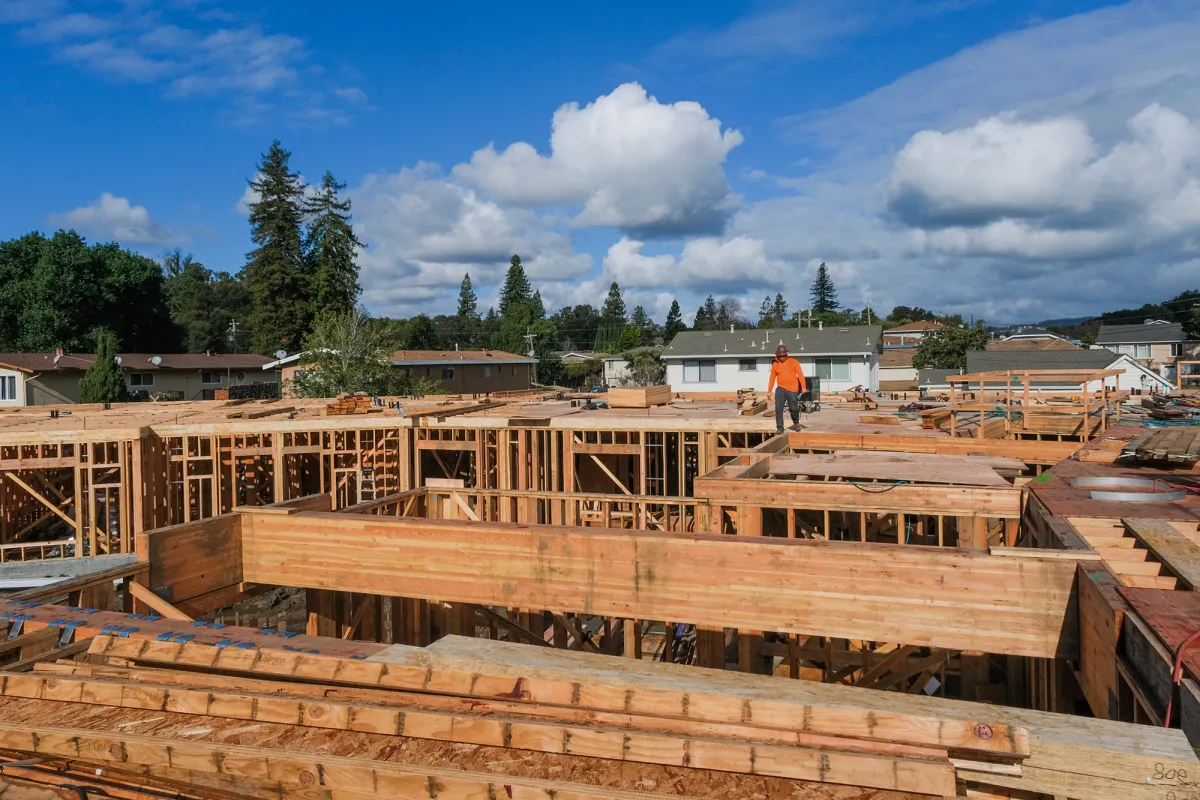
Framers work to build the Ruby Street apartments in Castro Valley on Feb. 6, 2024. The construction project is funded by the No Place Like Home bond, which passed in 2018 to create affordable housing for homeless residents experiencing mental health issue
###
This story was originally published by CalMatters. Sign up for their newsletters.
###
A California legislator wants to solve the state’s housing crisis, juice its economy, fight climate change and save the Democratic Party with one “excruciatingly non-sexy” idea.
Oakland Democratic Assemblymember Buffy Wicks sees the slow, occasionally redundant, often litigious process of getting construction projects okayed by federal, state and local governments as a chief roadblock to fixing California’s most pressing problems, from housing to water to public transportation to climate change.
Last year, Wicks helmed a select committee on “permitting reform” — a catch-all term for speeding up government review at all stages of a project’s development, not just its literal permits. The committee went on a state-hopping fact-finding mission, taking testimony from experts, builders and advocates on why it takes so long to build apartment buildings, wind farms, water storage and public transit, to name a few notoriously slow and desperately needed project types.
Today, that committee released its final report. The summary, per Wicks, is that “it is too damn hard to build anything in California.”
The report stresses the need for the state to build millions of new housing units and electric vehicle chargers; thousands of miles of transit; drought, flooding and sea level rise projects; and renewable energy projects “built and interconnected at three times the historical rate.”
Though the jargon-laden technical analysis isn’t likely to go viral, the report tees up what could be one of the biggest legislative battles of the coming year. Wicks said lawmakers in both chambers are hammering out 20 bills on permitting snags for housing construction alone. Other bills to speed approvals for transit, clean energy and water projects are reportedly in the works too.
Lawmakers regularly pass one-off bills aimed at making it easier for favored projects to get built. Nearly every legislative session for the last decade has seen at least a handful of “streamlining” bills for dense housing.
This political moment may be primed for something bigger, said Wicks. In the capitol, an aggressive red-tape snipping mood seems to have set in. More California officials, especially in Los Angeles and especially in the wake of January’s wildfires, want to re-examine how buildings get permitted.
President Trump’s unambiguous, if modest, electoral victory in November, riding a wave of public anger over Biden-era inflation, has pushed many Democrats to reorient their policy platforms toward cost of living issues.
Assembly Speaker Robert Rivas, a Salinas Democrat, kicked off this year’s legislative session by urging lawmakers to “consider every bill through the lens” of affordability. Gov. Gavin Newsom more recently acknowledged “the inability of the state of California to get out of its own way” on big, important projects. He suspended certain environmental regulations for fire prevention projects last Saturday.
In California and across the country, concurrent housing and climate crises have convinced many lawmakers and Democratic-leaning policy commentators to prioritize building lots and lots of things: apartment buildings, EV charging stations, electric transmission lines, solar and wind farms, rail lines and bus networks. The quicker the better.
The catastrophic Los Angeles firestorms from January highlighted just how difficult it can be to rebuild. Newsom has named cutting environmental regulations and speeding up entitlement and permitting processes in the burned areas as his top priority.
In Sacramento, a new batch of state lawmakers, elected partly by mad-as-hell voters and unscarred by past legislative battles over permitting changes, may be newly receptive to making big changes too.
“All of that combined makes, I think, a unique opportunity for us to actually have some pretty significant change,” said Wicks.
The report itself does not offer precise recommendations, but its analysis is often tellingly specific, offering clues about the changes that lawmakers can expect to debate this spring.
Described as “opportunities for reform,” these are, in Wicks’ words, often “excruciatingly non-sexy.” For example, the report notes that lawmakers could be more specific about when a certain type of housing application is deemed “complete” in order to shield developers from future legal changes. Another “opportunity”: Allow for third-party experts to sign off on a project’s plans.
Current policies that could be a template for regulatory revamping, according to the report: the state’s bolstering of accessory dwelling units, electric vehicle charging stations and certain environmental restoration projects.
But those “success stories” share a trait that points to what could be the most contentious aspect of the coming legislative package. All three are exempt from the California Environmental Quality Act, a 1970 law that requires governments to study and publish findings on the environmental impact of any decision they make, including the approval of new housing, transit or energy projects.
The act, pronounced see-kwah, is among the most fiercely debated in California politics. Opponents contend that the law is regularly hijacked by special interest groups, such as NIMBY property owners or organized labor unions, to stall projects for decidedly non-environmental reasons. They point to high profile court battles as examples of the act’s abuse, such as the case resolved by the state Supreme Court last year in which Berkeley neighborhood groups argued that the noise predicted to come from college student housing amounted to a pollutant under the law.
“If we want to reach our climate change goals, CEQA needs to be reformed,” Wicks said. “If we want to reach our housing goals, CEQA needs to be reformed.”
Defenders of the law say it is vital to deliberation, public input and transparency, keeping local and state governments and developers from running roughshod over vulnerable communities.
“Sometimes, for vulnerable communities, the act is the only tool available to have a seat at the decision making table,” said J.P. Rose, a policy director at the Center for Biological Diversity. “To brush all of that aside to say ‘that’s just permitting,’ I think that’s a misguided lens to address this issue.”
Lawmakers often carve specific exemptions into the law, but historically, making across-the-board changes to CEQA has been a heavy lift in Sacramento. Two years ago, Newsom rolled out plans to overhaul the law in order to speed up the approval of big, infrastructure projects. Many of its most ambitious proposals were sidelined. Last year, the Legislature tried to rush through a bill aimed at getting clean energy projects up and running more quickly (it failed).
“Right now, there are too many opportunities in the process to put a wrench in the gears.”
— Buffy Wicks, Assemblymember, Oakland
Lawmakers are likely to spend plenty of time arguing about the act, no matter what happens to the permitting package. One bill, already in print, by San Francisco Democratic Sen. Scott Wiener, would make it easier for urban housing projects to exempt themselves from the law and for local and state governments to avoid having to conduct full environmental reviews for every aspect of each project. The senator dubbed it “the fast and focused CEQA Act.”
Rose, at the Center for Biological Diversity, said the bill “fires a shotgun at the heart of CEQA.”
Carter Rubin, a public transportation advocate with the Natural Resources Defense Council who testified to the select committee last year, said there ought to be a difference between the way regulators review projects that help achieve the state’s housing and climate goals and those that emphatically do not.
“We certainly would not support streamlining highway expansion or sprawl development that impacts ecosystems,” he said in a phone interview. “It’s really important that the Legislature focuses on shovel-worthy projects, not just shovel-ready projects.”
Wicks said she will put forward a housing bill on CEQA as part of the overall package.
“Right now, there are too many opportunities in the process to put a wrench in the gears,” she said. “There will be a cost for us Democrats on the ballot in the future if we don’t fix that problem.”


