

OBITUARY: Thomas Hunt, 1958-2026
LoCO Staff / Wednesday, July 1 @ 6:57 a.m. / Obits

If you knew Tom, you knew two things: he loved the freedom of the open road on his Harley, and he never passed up an opportunity to make someone laugh.
Thomas Dee Hunt, born in 1958, passed away leaving behind a legacy of faith, hard work, laughter, and unwavering love for his family. A true California boy, Tom spent much of his life in the Alameda and Lake Tahoe areas before eventually making Humboldt County his home, where he spent his later years.
Tom worked for many years as a cook, serving in casinos, resorts, and diners throughout his career. He took pride in doing things the right way and found satisfaction in providing for those he loved. Whether at work or at home, he believed that if something was worth doing, it was worth doing well.
He shared a deep love with his wife, Chrissy, whose memory remained close to his heart throughout the rest of his life. He was a devoted father to Tommy Hunt, Brad Harris, and Kami Edmonds, and a proud grandfather to Isabella, Penelope, and Piper Hunt; Jaden and Isaac Harris; and Kelsey, Hayden, Liam, and Charlotte Edmonds. Time spent with his family—especially his grandchildren—was time he treasured most.
Outside of work, Tom found happiness on his Harley, around a campfire, with a fishing pole in hand, tinkering in the garage, or enjoying a meal at one of his favorite local restaurants. He appreciated life’s simple pleasures and was happiest when surrounded by the people he loved.
Tom was the kind of man people knew they could call. He answered the phone, showed up when he was needed, and never hesitated to lend a hand. Friends and family knew they could always rely on him. He gave freely of his time, expected nothing in return, and quietly made life easier for those around him.
He never lost his playful spirit. His quick wit, corny jokes, playful teasing, gorilla suit antics, and unforgettable train horns became legendary among those who knew him. He loved catching people off guard just to hear them laugh, and even his train horn had a purpose—if he spotted someone doing something they probably shouldn’t, he’d give it a blast in hopes of ringing their conscience as loudly as their ears. Bringing joy to others came naturally to Tom, and his laughter was as memorable as his kindness.
Later in life, Tom developed a deep appreciation for the Bible and the hope it offers. His favorite scripture was Proverbs 27:11 because it reminded him that each day was an opportunity to prove he was on Jehovah’s side and prove Satan a liar. His faith gave him purpose and guided the way he treated others—with honesty, humility, kindness, and a strong sense of responsibility toward his family.
Tom was preceded in death by his beloved wife, Chrissy; his parents, Gary and Sue; and his Uncle Tom.
Whether he was riding his Harley, casting a fishing line, surprising someone in a gorilla suit, or sounding one of his famous train horns, Tom had a way of leaving people smiling. He will be remembered for his generous heart, steadfast faith, unwavering dependability, and the joy he brought to so many. His life was a blessing to those who knew him, and his memory will continue to live on in the family and friends who loved him so dearly.
A special thank you to Larry Griffith. Though your friendship with Tom began later in life, it quickly became one he deeply cherished. Thank you for the friendship, laughter, companionship, and unwavering support you gave him. You were a true blessing to Tom and to our family, and we will always be grateful for the difference you made in his life.
A memorial celebrating Tom’s life will be held on Saturday, August 1, at 2 p.m. at 1580 Betty Court, McKinleyville, Calif. Family and friends are warmly invited to join us as we celebrate his life, share memories, and honor the lasting impact he had on all who knew and loved him.
The family would like to thank Ayres Family Cremation for handling the arrangements.
###
The obituary above was submitted on behalf of Tom Hunt’s family. The Lost Coast Outpost runs obituaries of Humboldt County residents at no charge. See guidelines here. Email news@lostcoastoutpost.com.
BOOKED
Today: 7 felonies, 18 misdemeanors, 0 infractions
JUDGED
Humboldt County Superior Court Calendar: Today
CHP REPORTS
No current incidents
ELSEWHERE
Governor’s Office: Governor Newsom visits CHP Academy, highlights next generation of officers and California’s public safety progress
The Guardian: The long read: ‘If you build something vastly smarter than you, it better be on your side’: can we stop AI from deceiving us?
Washington Post: I solo-hiked 138 miles at 74. The payoff was profound.
The Atlantic: Hegseth’s Pentagon Lurches off the Rails
OBITUARY: Lilla Compton, 1927-2026
LoCO Staff / Wednesday, July 1 @ 6:56 a.m. / Obits

Lilla May Compton left this earthly home for her heavenly one on June 6th, 2026, just one month shy of her 99th birthday.
Born July 6th, 1927 in Greeley, Colo., Lil was the youngest of four daughters. She met her late husband John Kent in high school, was married and had two sons, Ken & Jerry.
She and her husband grew flowers commercially, and Lil became adept at designing arrangements for the florist shop there, something she enjoyed doing throughout her life. She could grow anything, was a Master Gardener, and always had a garden and beautiful houseplants everywhere she lived. A firm believer in alternative medicine, she made her own salves, oils, etc. and thought there was almost nothing that comfrey, cod liver oil or duct tape wouldn’t cure.
In her youth she roller-skated competitively (which is where she learned to fall without hurting herself!). She was a graceful dancer, a great bowler, and a great golfer, as evidenced by the many trophies and awards she collected throughout the years. A very independent and hardworking woman, she raised her sons mostly on her own, working many different jobs, but bartending was perhaps her favorite. She “learned a lot about people” there, she always said.
After Ken joined the Navy, Lil and Jerry moved around a bit, finally ending up in Paonia, Colo, on a working ranch with her friend Karla Tschoepe. Farther down the mesa was a 40-acre property with a 2,000-tree apple orchard owned by Bert & Becky Tucker, with a beautiful home that Lil began cleaning, and then lived in while they spent time in Mexico.
She eventually moved to a little cabin on the property and ended up managing the orchard for several years. She loved to tell how God helped her in the orchard when she was all on her own, and she often said that God had always taken good care of her throughout her whole life. It was during this time that she also bought and worked in the Malt Shop in downtown Paonia, where many young people were affected by her no-nonsense motherly love and counsel. She later bought and ran a gift shop and beauty shop a few doors down.
Her son Jerry moved to the Lighthouse Ranch in California in 1979, was married, and eventually started a family. Lil moved to the nearby town of Willow Creek, Calif., where she was active in the golf course, worked for the Ruckers at their orchard and property there and in Eureka, and then was called up to Whitefish, Mont., to care for an ailing relative. She lived there for 15 years, caretaking the Lindeburg’s property, volunteering at the hospital, bowling, making & selling jewelry, and enjoying friends.
In 2011 she moved to Eureka, Calif., and eventually moved in with her son Jerry and his wife Martha, where she lived with her beloved white Maine coon cat, Babe. She continued to bowl well into her 90s, gardened indoors and out, and enjoyed feeding and watching the birds outside her window. Lil also made sure to remember every single birthday of her 2 sons, 5 grandchildren, and 11 great-grandchildren.
As Lil could not bring herself to attend funerals, even for family members, she wished there to be no public service. Her family will gather privately to scatter her ashes.
The family wishes to thank all the Hospice nurses and staff who so diligently cared for Lil in her final weeks; Rachel Hatchimonji, NCP and Timothy Pentecost, DDS, who cared for her for years with such patience; and our extended church family who have cared for and held us up in prayer all along the way. We give thanks for God’s great love and the gift of his Son, Jesus Christ, through whom we have received the forgiveness of sins and eternal life.
###
The obituary above was submitted on behalf of Lilla Compton’s family. The Lost Coast Outpost runs obituaries of Humboldt County residents at no charge. See guidelines here. Email news@lostcoastoutpost.com.
(PHOTOS) New Eureka Theater Mural Showcases Student Spray Paint Artists
Isabella Vanderheiden / Tuesday, June 30 @ 2:57 p.m. / Art

One of many student spray paint murals the Eureka Theater has hosted over the years. This one is from June 2024.| Photo: Ananda Oliveri.
###
If you’ve driven past the Eureka Theater in recent years, you’ve probably noticed the ever-changing art on its southern wall, along that little alley next to the Morris Graves Museum. Over the years, the wall has served as a blank canvas for aspiring spray paint artists, showcasing kaleidoscopic shapes, fruits, cartoon characters and various renderings of “I like Eureka.”
Earlier this month, the wall underwent yet another transformation, with the debut of “Moderne Art,” a permanent mural that puts student art on center stage.

A picture of “Moderne Art” before the spray painting students got to it. | Photo: Ananda Oliveri.
The mural, created by local spray paint artist and teacher Ananda Oliveri and his daughter, Zaila Rook Barba-Oliveri, depicts a theater stage framed by red velvet curtains and metallic, rail-like motifs inspired by the Eureka Theater’s Streamline Moderne architecture.
“The folks from the Eureka Theater thought I was the obvious choice to do the mural, because they didn’t want to take the wall away from the spray painting class I teach,” Oliveri told the Outpost in a recent interview. “So, with that in mind, the design was made to accommodate the class and frame their final projects as a presentation piece with the theater curtains … and the design above the mural was inspired by the theater itself. … The tile work at the front of the theater is referenced in the piece as well.”
One of the main features of Streamline Moderne architecture, a late phase of Art Deco design that emerged in the 1930s, is the gently curved aluminum and stainless steel accents and railings. These elements can be found throughout the Eureka Theater.
“Coincidentally, a lot of my recent art has incorporated that three-line motif, so it was like this real kind of synthesis of things,” Oliveri said, referring to the murals he’s done with Faux Real Design Group, a partnership with his cousin Dana Owens. “I wanted to create this faux three-dimensional anamorphic design that stands out when seen from its proper angle.”
The mural project, a partnership between the Eureka Theater and the Humboldt Arts Council, was funded through a grant from the Eureka Cultural Arts District.

The best spot to view “Moderne Art” is from this spot on the sidewalk, almost directly in front of the Morris Graves Museum of Art. | Photo: Isabella Vanderheiden
After nearly two decades of making aerosol art and hosting exhibitions through the Accident Gallery in Eureka with his former partner, Phyllis Barba, Oliveri began teaching spray painting at the local juvenile detention center through the Ink People Center for the Arts’ Jump StArts program.
“I had no real teaching experience prior to that, and I said yes because it sounded like a great subversive way to bring spray paint art to a disenfranchised population; the irony still makes me giggle,” he said. “That parlayed into also teaching at the community schools, including McKinleyville, Arcata, Eureka and Fortuna. … I started working at the Morris Graves Museum about five years ago … and I figured I’ve got nothing to do in the summer with school being out, so I started doing classes here.”
Oliveri now teaches three two-week spray painting sessions each summer. Most of his students have zero experience with spray paint, and the first couple classes largely focus on how to hold the paint can properly.
“I’m working with straight novices,” Oliveri laughed. “Some of them are already into drawing or painting, but even still, spray paint is kind of removed from a lot of traditional material. I tell them that I’m not teaching them how to spray paint, I’m teaching them how to think about spray painting. It is a challenging medium, especially in those first few days. … It’s just a matter of teaching them to look out for things that they wouldn’t normally be aware of until they do it for a long time, so it’s like I regard myself as a shortcut to that thought process.”

Top: Oliveri works on block lettering with three students during a lesson last week. Bottom: A little spray paint how to. | Photos: Isabella Vanderheiden

Oliveri teaches adults as well, but said teaching teenagers is more fun because “they’re not predisposed to how things should be.”
“There’s a little bit more freedom there,” he continued. “And it helps keep me young, I think, because we talk about music and what’s happening in the world right now, and I get an idea of their level of anxiety about the universe. … I don’t really come at it as either a teacher or a parent, I’m just, hopefully, a cool dude to talk to.”
Asked how he feels about his work being referred to as “graffiti,” Oliveri said he shies away from using the term because of its negative connotation.
“That being said, graffiti as we know it started in the late ‘60s or early ‘70s, and it’s ubiquitous in so many areas of our lives right now that we don’t even realize it,” he said. “You see it in commercials, in fashion, in movies, in music — it’s everywhere. The stigma, to some extent, I think, has been taken care of, but I do think presenting the work as legitimate, as just not a criminal pursuit, is important.”
As our interview wrapped up, three students arrived for their spray painting session, and Oliveri asked them to pick a color to start the day’s lesson, which focused on building out block lettering.
Oliveri will teach two more sessions this summer, one from July 13-24 and another from August 3-14. More information can be found in the flyer below.
###


Humboldt County Has Invited You to Participate in Planning for Proposed Amazon Distribution Warehouse as Environmental Document Prep Begins
LoCO Staff / Tuesday, June 30 @ 2:39 p.m. / Local Government

Computer rendering of the proposed distribution warehouse and parking lot. | Image via County of Humboldt.
###
Press release from the County of Humboldt:
On Oct. 21, 2025, the Humboldt County Planning & Building Department received an application for a Coastal Development Permit to construct a 40,290 square-foot commercial warehouse and several parking lots. The proposed project would operate as an Amazon Distribution Facility that spans across six parcels, located at 3110 Boeing Ave. within the Airport Business Park in McKinleyville.
The County of Humboldt’s Planning & Building Department has circulated a Notice of Preparation of an Environmental Impact Report (EIR) for the proposed project. The notice of preparation serves as an opportunity for the public to make comments regarding the potential environmental effects of the proposed project.
How to Participate
The county invites all interested parties to review the proposed project and provide written comments about specific concerns related to the project’s potential environmental impacts.
The notice is available for review at HumboldtGov.org/MajorProjects.
Comments will be accepted now through Wednesday, July 29 at 5 p.m. and can be sent by mail to Steve Lazar, Senior Planner, Humboldt County Planning & Building Department, 3015 H St., Eureka, CA 95501 or by email to slazar@co.humboldt.ca.us.Written comments should identify specific topics of environmental concern and your reason for suggesting the study of these topics in the EIR. These comments will be included in the appendix in the draft Environmental Impact Report when it is completed.
Public Scoping Meeting
The Humboldt County Planning & Building Department will host a virtual public scoping meeting to receive public comment from the community on the scope and content of the EIR. The meeting will be held over Zoom on Tuesday, July 14 at 6 p.m. and will include a brief presentation of the proposed project, a summary of the general EIR process and the opportunity for attendees to provide input.
Access the meeting by visiting Zoom online and entering the meeting id: 810 6499 9815 and passcode: 200525. To access the meeting by phone, please call 669-900-6833 and enter the webinar id: 81064999815.
All interested community members are encouraged to attend and to note that no final decisions regarding this project will be made at this meeting. Additional opportunities for public comment will be provided before a final decision is reached.
The County of Humboldt is committed to providing equal access to all county programs, services and activities through the provision of accommodations for individuals with qualified disabilities as required under the Americans with Disabilities Act (ADA). With 72 hours prior notice, a request for reasonable accommodation for the public meeting can be made by calling 707-445-7541.
For more information about this proposed project, visit HumboldtGov.org/MajorProjects.
Legislators Mike McGuire and Chris Rogers Condemn Miranda’s Rescue Dog Killings, Thank Sheriff’s Office and Concerned Neighbors
LoCO Staff / Tuesday, June 30 @ 2:31 p.m. / Government

McGuire (left) and Rogers.
Press release from the California State Legislature:
SACRAMENTO—Last week the Humboldt County Sheriff’s Office announced that remains of 117 dogs were found in two excavated areas of the Miranda’s Rescue Animal Sanctuary property. The Humboldt County Sheriff’s Office has been investigating the facility since April after receiving evidence of animal abuse, animal cruelty, fraud, and conspiracy. According to reports, hundreds of additional animals remain unaccounted for.
Senate Pro Tempore Emeritus Mike McGuire and Assemblymember Chris Rogers issued the joint statement below:
“What’s happened at Miranda’s Rescue is absolutely sickening and the operators must be held accountable to the fullest extent of the law. This horrific incident has exposed a blind spot in our animal welfare system, and enhanced transparency is needed. We commend the Humboldt County Sheriff’s Office and local law enforcement officials for their thorough investigation and for concerned neighbors that trusted their gut and asked authorities to step in. We are exploring every legislative avenue to help ensure a tragedy like this never happens again and will have more to report soon.”
The Sheriff’s Office Reminds You That Aerial Firework are Illegal Almost Everywhere in the County
LoCO Staff / Tuesday, June 30 @ 1:40 p.m. / Crime , Public Safety

Some of these are illegal here. | Photo by Judgefloro, CCO 1.0, Public Domain.
###
Press release from the Humboldt County Sheriff’s Office:
The Humboldt County Sheriff’s Office reminds residents and visitors that aerial fireworks are illegal in most areas of Humboldt County and is urging everyone to celebrate safely this Independence Day.
“Fourth of July is one of our nation’s most celebrated holidays and an opportunity for families, friends, and neighbors to come together,” said Humboldt County Sheriff William Honsal. “As we celebrate our nation’s independence and America’s 250th birthday, we ask everyone to celebrate responsibly. Illegal fireworks can cause serious injuries, start devastating fires, and negatively impact veterans, individuals with sensory sensitivities, older adults, pets, and wildlife.”
There is no safe place to launch illegal aerial fireworks in Humboldt County. Individuals who ignite illegal fireworks may be held responsible for any resulting fire suppression costs, property damage, injuries, or loss of life. Violators may face criminal prosecution, civil liability, and significant financial penalties.
The Sheriff’s Office encourages everyone to think about the safety of their family, neighbors, and community before using fireworks.
Residents can celebrate Fourth of July weekend with “safe and sane” fireworks purchased from vendors. Before igniting them, please pay attention to your surroundings and be mindful of people, animals, traffic, and dry vegetation. It’s also important to lock up your pets and give them a quiet place to retreat, as fireworks can cause stress in animals.Those wishing to enjoy aerial fireworks are encouraged to attend one of Humboldt County’s professionally produced public displays. These events are conducted by licensed pyrotechnicians with fire personnel and emergency resources on site.
Public Fireworks Displays
- July 3: Newburg Park, Fortuna
- July 4: Old Town Eureka Fourth of July Festival
- July 4: Benbow State Recreation Area Fourth of July Celebration
If you see any dangerous and reckless activity related to fireworks, please contact your local law enforcement agency. “It is everyone’s responsibility to help keep our communities safe,” said Sheriff Honsal. Due to the call volume on Fourth of July, dispatch will be prioritizing calls for service. Please only call 911 when there is an immediate danger to life or property.
“Public safety is a shared responsibility,” Sheriff Honsal said. “By celebrating responsibly and leaving aerial fireworks to the professionals, we can help ensure everyone enjoys a safe and memorable Fourth of July.”
For more information about firework safety visit the CALFIRE webpage: Fireworks Safety: Celebrate Safely & Prevent Wildfire | CAL FIRE
Many California Fishermen Are Nearing Retirement. Can the Industry Save Its Graying Fleet?
Deborah Brennan / Tuesday, June 30 @ 12:52 p.m. / Sacramento
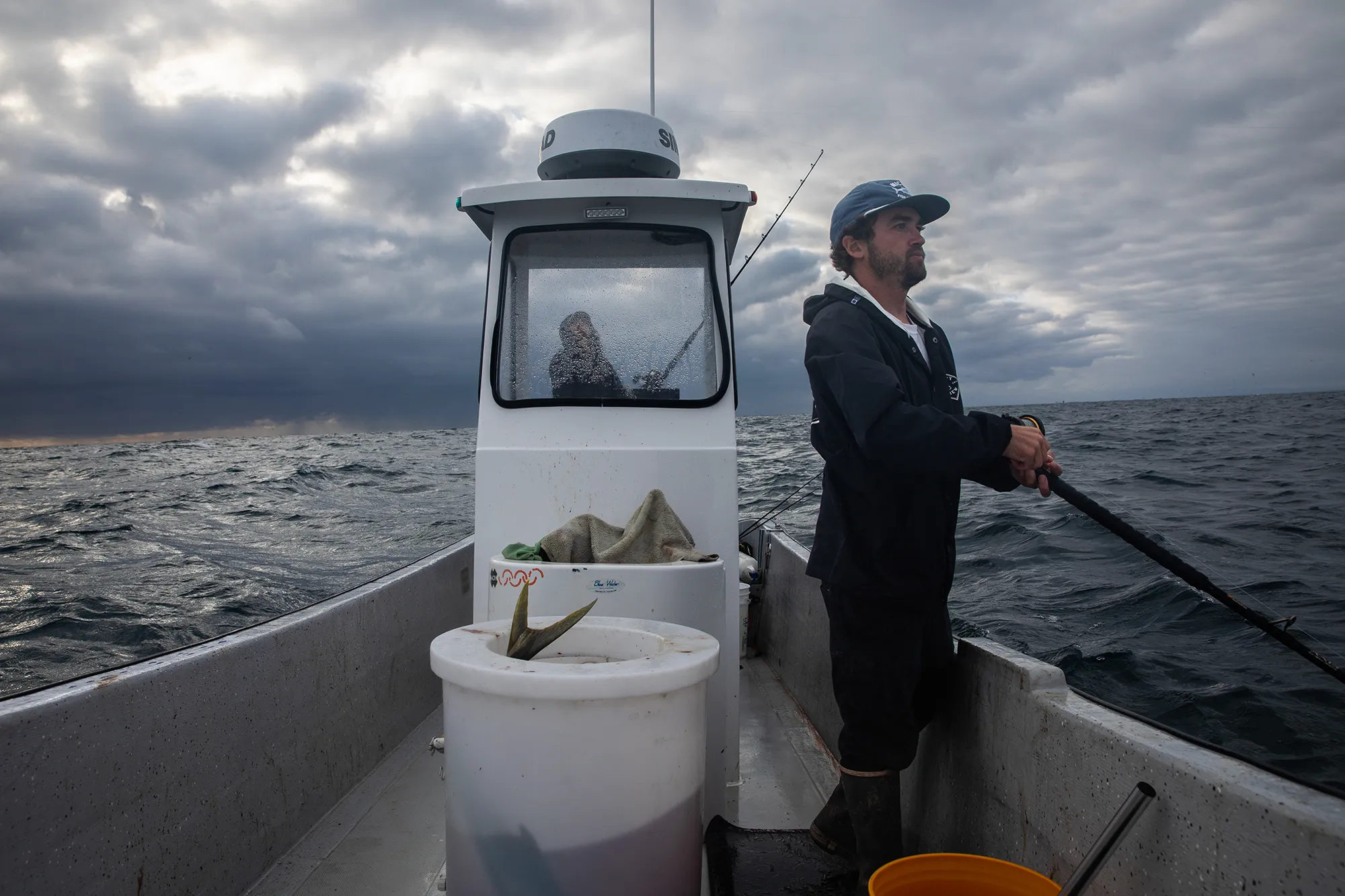
Right to left, fisherman Shane Volberding and deckhand Destiny Louise Silva look off into the distance as dark clouds cover the coast of La Jolla in San Diego on May 26, 2026. Photo by Adriana Heldiz, CalMatters
###
This story was originally published by CalMatters. Sign up for their newsletters.
###
In choppy surf off of La Jolla, fisherman Shane Volberding fought to land a yellowtail, a silver and gold fish prized in the sushi seafood trade.
Gulls wheeled above the water as the fish dove and darted against him, dragging the line. One crank at a time, Volberding reeled it in, jabbed it with a gaffe and then hoisted it on deck. As he grappled with the thrashing fish, his deckhand Destiny Louise Silva hauled in another yellowtail and dunked it in a bucket, tail up.
The swift, back-to-back catch was the highlight of an unusually productive day on the water that yielded seven yellowtail and other fish, not counting the ones snatched by thieving sea lions.
“That’s a really good day for yellowtails,” Volberding said. “They’re usually very hard to catch.”
That lucky happenstance belies the unpredictability of California’s commercial fishing sector, where the speculative nature of the catch collides with complex regulations, economic hurdles and a graying fleet.
Volberding, 27, is one of the younger captains in a fleet in which the average age is 48 and many captains are looking toward retirement. And he’s one of relatively few who didn’t enter the trade through family connections.
To address those shortfalls and protect the supply of locally caught seafood, UC San Diego Scripps Institution of Oceanography launched a fishing apprenticeship, designed to train new commercial fishermen on fishing techniques, rules and safety protocols.
The program has propelled careers for a few, including Volberding. But it has also exposed gaps in the industry that prevent fishermen from making a living and discourage newcomers to the trade.
Pay for commercial fishermen across the West Coast has plummeted over the last decade, according to data from the National Oceanic and Atmospheric Administration. Median annual crew pay dropped by about a third, from $90,468 in 2014 to $61,592 in 2024. Captains’ earnings plunged from $173,271 to $108,972 over that period. In San Diego, pay rates are even lower.
“It’s revealing a lot about what needs addressing within the industry, if we really want a resilient, sustainable food system with seafood as a part of it,” said Theresa Talley, a coastal specialist with California Sea Grant, who coordinates the apprenticeship.
Training the next generation of fishers
Despite its coastal locale, San Diego’s fishing industry and seafood supply are more tenuous than you might imagine.
At least two-thirds of the seafood that Americans eat is imported, and some estimates paint an even bleaker picture. In a 2016 report, Talley estimated that just 10% of seafood consumed in the city of San Diego comes from local fishermen, and only 8% of San Diego’s 86 seafood markets consistently carried San Diego-sourced seafood.
“Once dubbed the ‘Tuna Capital of the World,’ employing more than 40,000 people directly or indirectly in the tuna industry… the county is now home to just 130 local commercial fishermen,” Talley wrote.
These days, the tuna on your plate might come from Mexico, while your salmon fillet was likely farmed in Chile, Norway or Canada. Imported seafood is often cheaper than U.S. caught fish, which is subject to strict environmental rules and catch limits. Competing with less regulated fisheries puts additional strain on American fishing fleets.
To sustain locally caught seafood and backfill the declining ranks of California’s fishing fleet, Scripps introduced its apprenticeship in 2020.
 Birds surround a fisherman’s boat near the coast of La Jolla in San Diego on May 26, 2026. Photo by Adriana Heldiz, CalMatters
The program provides instruction in key aspects of the fishing trade, including Coast Guard safety protocols and emergency drill conductor training, fishing regulations, methods and conservation. It guides fledgling fishermen on how to market and sell their seafood.
“Fishing isn’t just dropping your line in the water,” Talley said. “You need to know navigation and safety and fishing and engine repair and business”
This was never going to produce large numbers of new deckhands for the fishing fleet. Classes are small, with just a handful of students per session. The program took a hiatus during the pandemic between and then came back on line in 2024.
So far, 11 people have graduated and six are still fishing, Talley said. Four more students are in training now.
Apprentices participate in what Talley calls a “boot camp style” course over the course of two or three months.
It started in 2020 with 130 hours of shore-based training, then added hands-on sessions on diesel engine repair and marine mechanics in partnership with the San Diego-based Maritime Institute. Then apprentices spend 1,000 hours on-the-job with local fishermen.
“They’re training across these topical areas that the fishing communities and the fishing industry helped us identify,” Talley said. “And then we help connect the apprentices with commercial fishing vessels.”
That’s where things get tricky. Although commercial fishing captains urged Scripps to create the apprenticeship, few ultimately stepped up to mentor graduates, Talley said. Some captains worried about losing time showing beginners the ropes. And the insurance cost of taking on a new crew member can be prohibitive.
 Deckhand Destiny Louise Silva works to reel in a yellowtail while fishing near the coast of La Jolla in San Diego on May 26, 2026. Photo by Adriana Heldiz, CalMatters
For apprentices, it’s unsteady gig work. Deckhands get a percentage of the catch, so their pay depends on the size of the haul. They’re also expected to help ready the boat for fishing trips, scrub barnacles from the hull and prepare gear. Those tasks are typically unpaid.
Without another job, pension, or family support, it’s tough to earn enough to live on, fishermen acknowledged.
A deckhand in San Diego earns about $15,000 to $50,000 net per year, said Peter Halmay, 85, a founder of the San Diego Fishermen’s Working Group, and an urchin diver for more than half a century. That’s below the per capita income of $57,083, and insufficient for housing and other expenses in one of the country’s costliest cities.
“It goes to show you that a deckhand in the fishing business can’t afford to live in San Diego,” Halmay said. “And that’s the problem we’re getting at.”
A fishing captain can make $100,000 to $200,000 annually he said, but that’s gross income, and permits, gear and other expenses take a big chunk out of that.
“If you’re entirely reliant on commercial fishing for all your economic needs, that’s a hard puzzle to put all the pieces together to make that work consistently year after year,” said Peter Brownell, 53, an earlier Scripps apprentice who left a career as a PhD sociologist at a San Diego nonprofit to become a fisherman.
Halmay said fishermen need to support each other, build their ranks and engage the public. He helped develop the apprenticeship program with that goal in mind.
“You’ve got to change the fishing culture and you have got to make the fishermen and the public appreciate this culture,” he said. “These are professionals that take pride in bringing in their catch, and they bring in the best catch and they harvest sustainably because it’s in their best interest to do so.”
A day at sea
Volberding got hooked on the ocean early. Born in San Diego, he lived in Idaho for a few years as a child before returning to his hometown, where he “fell in love with surfing.”
He stayed near the water, working at a fish market cutting and selling fish, in seafood restaurants and on sport-fishing boats. In 2020 he joined the Scripps apprenticeship program, which covered the basics of commercial fishing. But he really cut his teeth with his mentors, who set him to work pulling spot prawn traps, taught him fishing techniques and instilled the “work ethic thing.”
“I owe them huge, dramatic credit for my success,” he said. “They work harder than anyone I know.”


 Fisherman Shane Volberding fishes and catches a mako shark, left, and a mackerel, right, near the coast of La Jolla in San Diego on May 26, 2026. Photos by Adriana Heldiz, CalMatters
He fished from a jet ski for a while then got his own boat, a 25-foot Imemsa panga. Last month he sailed out in mid-morning fog to fish off La Jolla. As rough waves rocked the narrow boat, Volberding and Silva pulled in a small mako shark and dozens of mackerels while hunting for yellowtail to a party music soundtrack of The Commodores’ “Brick House” and Taio Cruz’ “Dynamite.”
Fishing has always come naturally to him: “When I was in Boy Scouts I was the kid catching all the fish and the other kids were wondering, how I was catching all the fish? I had a knack for it.”
Near La Jolla, Volberding moved frequently across the water, reading ocean color and temperature, monitoring atmospheric pressure and watching for birds gathering and fish flopping. Small splashes were mackerel. Bigger splashes meant yellowtail.
As soon as he hooked one, he reeled hard as the powerful fish fought against the line. Several times sea lions beat him to it.
“We got more bites – a big, big yellowtail, like a 30-pounder – and they got stuck in the kelp and a sea lion stole the yellowtail,” Volberding. “And then it broke the line and then ate it with all his friends.”


 Fisherman Shane Volberding catches and performs shinkei-jime on a freshly caught yellowtail near the coast of La Jolla in San Diego on May 26, 2026 Photos by Adriana Heldiz, CalMatters
As soon as they got fish on deck, Volberding and Silva euthanized them using a Japanese technique called shinkei-jime. Inserting a wire into the spinal cord they killed the fish instantly to prevent the meat from spoiling and preserve its buttery texture and flavor.
That’s just part of the job. Volberding markets his fish to high-end restaurants and sells them at the Tuna Harbor Dockside Market at the Port of San Diego on Saturdays.
He offers what he calls “value-added” products, including the shinkei-jime killed yellowtail and filleted mackerel, which command a higher price. Sometimes he crews on friends’ boats, buys tuna from them and sells those fish.
“You gotta be good at fishing,” he said. “Be smart. Yeah, being good at sales”
 From left, fisherman Shane Volberding and his employee Christopher Ceballos sort through fish at Tuna Harbor Dockside Market in downtown San Diego on June 20, 2026. Photo by Adriana Heldiz, CalMatters
Not everyone can make it work
For Brownell, fishing was a mid-career switch from his previous job as research director for the Center on Policy Initiatives, an economic justice nonprofit based in San Diego.
“I definitely was interested in being in the water and operating boats, in my efforts to not be operating a desk,” he said.
He worked on habitat restoration in San Diego and got a seasonal job with the U.S. Forest Service in Alaska, before turning his attention to fishing. Brownell went through the Scripps apprenticeship, where he was introduced to Dan Major, a fisherman with Plan B Sustainable Fisheries in San Diego.
Brownell crewed for Major, fishing for crab, rockfish, sanddabs and lobster.
The two eventually partnered on an experimental fishery for brown box crab, a chunky crustacean known for its sweet, delicate meat. In return for the opportunity to catch the spiky crabs, they gathered data for fisheries scientists.
“He was a good mentor, and I think we were a good team,” Brownell said.
Eventually Brownell bought his own fishing boat and marketed his fish at Tuna Harbor Dockside Market. Then the bottom dropped out of his business.
“Most of what I was making on my own was fishing sanddabs, but then that fishery closed,” he said. “That’s part of the vagaries of commercial fishing, is that you work on something that may not continue to be available to you.”


 Fish for sale in fisherman Shane Volberding’s booth at Tuna Harbor Dockside Market in downtown San Diego on June 20, 2026. This week’s catch includes mackerel, yellowtail, bottomfish and mako shark. Photos by Adriana Heldiz, CalMatters
That’s a common problem. While a boat’s catch varies from day to day, the mere opportunity to fish is also speculative.
In addition to a commercial fishing license, fishermen need specific permits for most species. The permits are competitive and boat captains tend to hold them as investments, which means newer fishermen may be cut out of the fishery. Halmay said only a fraction of the captains who hold urchin diving permits actually use them each year.
Even holding a permit for a species doesn’t mean they’ll get to fish for it. State and federal regulators manage fisheries to maintain healthy populations, and shut them down once the annual quota is met, or if environmental conditions threaten the species.
After winding down his fishing operation, Brownell moved to the Bay Area to run a debris removal boat for the Army Corps of Engineers, deploying navigation and mechanical skills he acquired in San Diego.
Brownell still keeps his own boat docked at Fisherman’s Wharf in San Francisco and maintains his commercial license in hopes of fishing the coveted salmon season. That fishery was closed for three years, but partially reopened this year. He plans to try his luck with salmon this summer when weather conditions permit.
“I do love both the fishing and the bounty of the sea and providing for people from the sea,” he said. “I’m hoping the fisheries continue to rebound and we’re allowed more generous use in the years to come, fingers crossed.”
 Customers gather in front of fisherman Shane Volberding’s booth at Tuna Harbor Dockside Market in downtown San Diego on June 20, 2026. This week’s catch includes mackerel, yellowtail, bottomfish and mako shark. Photo by Adriana Heldiz, CalMatters
Janelle Louie, another Scripps apprentice who fished for several years with the late San Diego Captain Doug Dirkse, started selling t-shirts on a GoFundMe page to support their business after salmon fishery closures decimated the industry.
“I wasn’t aware of this issue when I started, but now understand how difficult it can be to stay afloat as a full-time small boat commercial fisherman,” Louie wrote on the GoFundMe drive.
Other apprentices have tried their hand at fishing before moving onto more stable employment. Darian Schramm, owner of Paramount Fish Co, mentored one of the Scripps apprentices, but found he couldn’t offer steady enough work to keep him on.
A few years back Schramm, 48, made a similar career u-turn as Brownell, turning in his laptop after 15 years in computer programming. The remote tech job allowed him to combine work, travel and hobbies, but he wanted to do “something potentially more useful.”
“I could surf and fish and travel,” as a programmer, he said. “Then the computer thing just kind of soured for me. Now I’m part of the food system here in San Diego, and I can give back to the community through fresh, local food.”
He was happy to take on an apprentice, Sebastian Torreblanca, and thought they worked well together. But he understood when Torreblanca took a full-time job with a local city instead.
“For Sebastian, he was into it, he loved it,” Schramm said. “But at the end of the day he had a mortgage, he had to support his family.”
It would help if Scripps could subsidize apprentices while they get started, Schramm said. And he warned that new crew members should view the job as a starting point that requires investment of time before it pays dividends.
“This is getting your feet wet,” he said. “You can’t halfway do it, you have to fully believe in it.”
 Fisherman Shane Volberding pulls a yellowtail onto his boat near the coast of La Jolla in San Diego on May 26, 2026. Photo by Adriana Heldiz, CalMatters
Part of the reason fishermen face tough odds is because they seldom join forces. Working on the water or the wharf, out of wifi and cellphone range, they have little opportunity to organize, attend meetings or lobby lawmakers.
“A lot of fishermen are kind of solitary, so it’s not easy to get them together,” Schramm said.
They guard their best spots and fishing methods, wary of giving away secrets to competitors.
Volberding declined to reveal certain techniques for landing and handling fish. But as he hauled in yellowtail throughout the recent fishing trip, he alerted friends by radio to let them know where fish were biting.
It didn’t compromise his own catch. Around sundown it began to sprinkle and Volberding headed for shore. At dock he laid out a mako shark, two barracudas, a bucket of mackerel and seven yellowtail with gleaming, gold fins and tails, valued at roughly $250 each, or around $13 per pound.
The apprenticeship aims to foster that kind of knowledge sharing by pairing novice fishermen with experts who can guide the next generation.
“We’ll get together, and we’ll talk about it,” Halmay said. “We’ll share our experiences, and we’ll all rise together. And that’s how you’re gonna succeed is by working together.”


