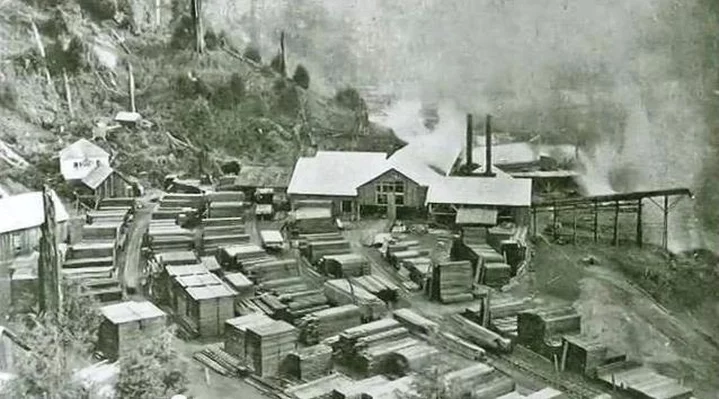
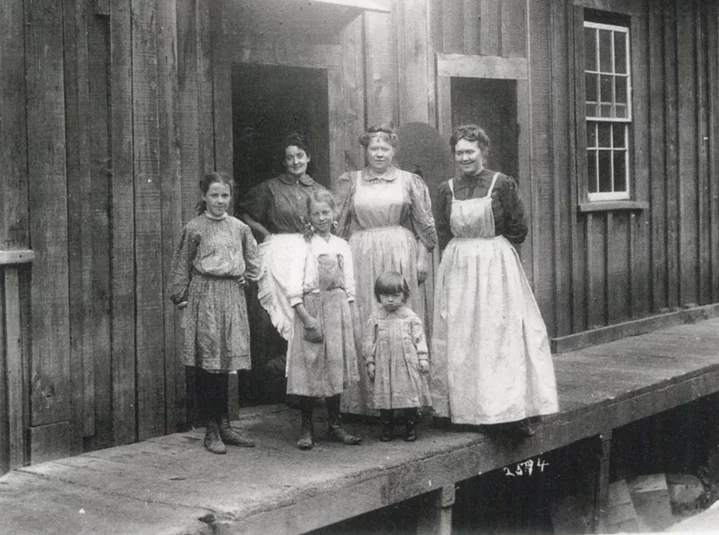
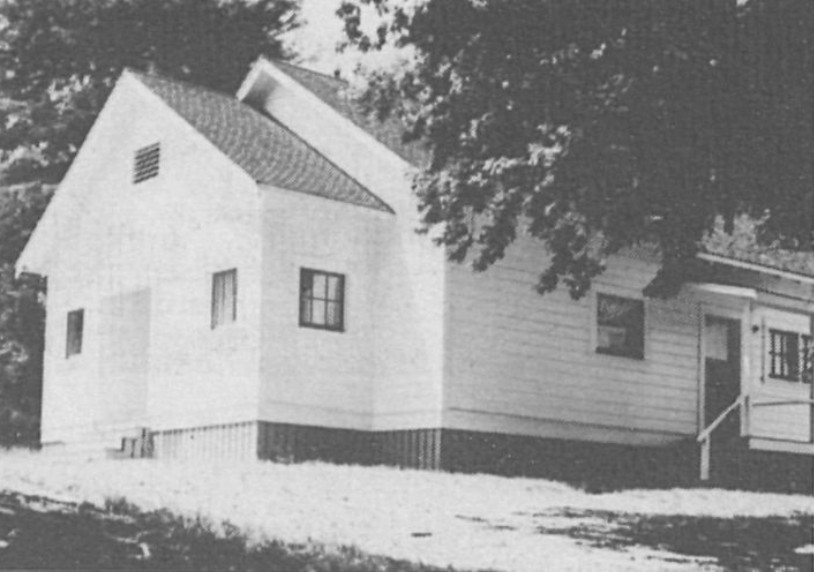
Noah Falk (left)—who emigrated from the Midwest to California during the gold rush only to be lured to the state’s other lucrative resource, lumber aka “red gold”—who founded the company town in 1884.
Cal Poly Humboldt release:
Nearly 100 years after the Humboldt County logging community of Falk became a ghost town, the National Park Service announced its addition to the National Register of Historic Places this year.
The designation is thanks to decades of excavation and research from faculty, staff, and students at Cal Poly Humboldt’s Cultural Resources Facility (CRF) and Anthropology department, and the Bureau of Land Management (BLM).
The 19th-century town, now an archaeological district, is in the Headwaters Forest Reserve.
Above: Falk in its heyday | Photos: BLM; Below: Falk location in the Headwaters Forest Reserve.
The recognition officially acknowledges the town’s local, state, and national significance, and is part of a nationwide effort to identify and protect America’s historic and archeological resources, according to the National Parks Service, which oversees the register.
It joins nearly 60 other sites in the county—including Hotel Arcata, Fernbridge, and parts of old town Eureka—on the register.
Like many communities along the North Coast, the town started as a lumber camp. In 1884, entrepreneur Noah Falk established the company town by building a mill and an entire community to support it, according to the Humboldt County Visitors Bureau. With a population of 400, Falk had its own post office, cookhouse, school, general store, dance hall, and a railroad. Called the Bucksport and Elk River Railroad, it connected Falk to the town of Bucksport, now the site of the Bayshore Mall. The mill shut its doors and the once thriving community was abandoned as a result of the Great Depression. Much of the town’s structures were later demolished.
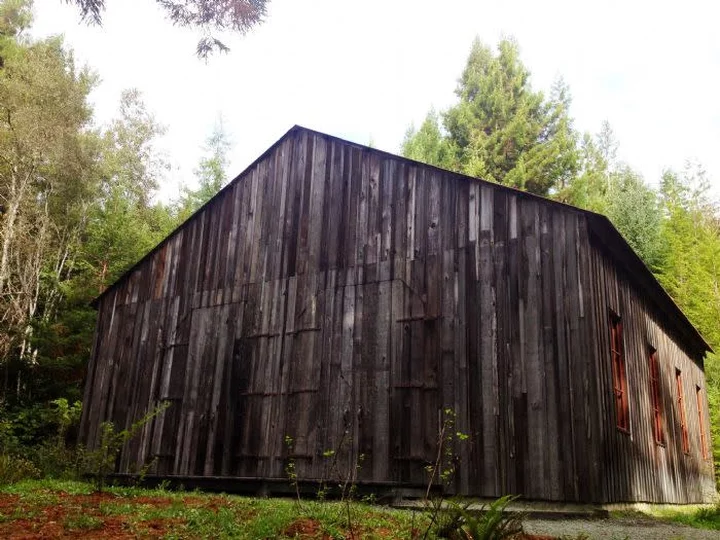
As the forest reclaims the town, only the ruins of Falk remain. Interpretive signs mark some of its remnants on the Elk River Trail. One restored building, a locomotive barn, stands as the BLM’s education center.
The former town is now an archaeological district that has offered opportunities to learn about extractive industries and the history of life on the North Coast.
Between the late 1990s and 2012, Cal Poly Humboldt faculty and student interns and volunteers with the CRF conducted research at the site, according to Mark Castro (‘10, Anthropology), Cal Poly Humboldt Anthropology instructor and co-director of the CRF.
The facility specializes in historic preservation, and offers services such as: archaeological surveying, GIS, remote sensing, site mapping, excavations, construction monitoring, historical research, heritage interpretation, and ethnographic consulting, according to the CRF.
As an undergrad, Castro participated in the excavation of the town’s engine house and a bachelor’s cabin, and conducted research on the pianos found in Falk.
Undergraduates earned much needed archaeology practical skills by participating in excavations; working with different agencies including the BLM; taking museum-quality photos; developing site sketches, aerial maps and timelines; and collecting, identifying and cataloging artifacts. The process has yielded hundreds of historic artifacts, now used for learning purposes.
For example, students learn how to date sites throughout Falk with artifacts like round or square nails and glass bottles found during excavations, Castro explains. By examining the items, they learned about residents’ lifestyles—what they ate, what medicines were available to them, and more.
Other items found on site include medicine bottles, kitchenware, logging tools and equipment, and instruments.
While there are not currently any active projects at Falk, the BLM artifacts continue to provide valuable learning opportunities for Cal Poly Humboldt students.
In addition to hands-on experience, the research was also integral to the establishment of the site as a historic place. The recognition, says Castro, helps preserve and protect Falk for current and future generations.
“We can bring the story of Falk together,” Castro says.
Kiran Thakkar, a volunteer at SMVS Shri Swaminarayan Mandir Hindu Temple in Newark, walks past a sign that was vandalized in 2023 on the temple property on July 31, 2024. Photo by Florence Middleton, CalMatters
On a morning just days before the New Year, Kiran Thakkar received a worrying phone call. A friend had found anti-India graffiti overnight on the Newark Hindu temple he co-founded. Someone sprayed phrases disparaging India’s prime minister and hailing a secessionist movement for the country’s Sikh minority.
Support rushed in from Indian American community leaders and politicians. But Thakkar and the rest of the quaint suburban temple’s board had little disagreement about how to move forward. They didn’t want to make a fuss. They painted over the vandalism within the day.
“We didn’t want to politicize,” said Thakkar, who’s called the Bay Area home for more than a decade. “So we were clear from day one that, yes, it was a hate crime or fringe incident, and let’s just move on from there.”
The Newark Shri Swaminarayan Temple was one of three California Hindu houses of worship desecrated in 2023, when a record eight anti-Hindu hate crimes were reported in California, according to data released by the Department of Justice in June.
Kiran Thakkar, a volunteer at SMVS Shri Swaminarayan Mandir Hindu Temple, at the Newark temple on July 31, 2024. Photo by Florence Middleton, CalMatters
Separately, California is collecting more anecdotal reports of hate incidents through a new civil rights hotline that’s intended to connect people with resources that could help them. A disproportionate number of incidents involving Hindus were reported in its first year, according to state data.
But Hindus aren’t the only ones in California’s Indian community who are seeing a rise in hate crimes and bias against them. Sikhs, members of the ethno religious minority whose separatist slogans appeared on the Newark temple, reported six hate crimes against them — the highest number since the state justice department began displaying that data in 2014.
The potential for escalation has left Thakkar, a key figure in the local Hindu community who moved from India to the Bay Area in 2012, feeling a responsibility to avoid stoking tensions. While there were a few devotees who expressed fear after the attack, by and large, he said, his temple members were ready to move on.
“I have not personally experienced anything,” he says when asked if he’s ever faced discrimination in California.
Other Hindus are not willing to forget the temple vandalism. Instead, they’ve petitioned the Legislature to recognize that Hindu Californians are the subject of “pro-Khalistan extremism.” That’s a reference to the name of an independent state that some Sikhs want to carve out of India.
They also opposed two bills in the California Legislature over the past year that they believed would have discriminated against them. One would have explicitly prohibited caste discrimination in California, and the other would have named India as a sponsor of international political repression. Neither proposal became law.
First: A crowd celebrates after SB 403 passes at the Assembly Judiciary Hearing at the state Capitol in Sacramento on July 5, 2023. Last: Proponents and opponents of SB 403 battle for a spot to get their voices heard outside the state Capitol in Sacramento before the Assembly Judiciary Hearing on July 5, 2023. Photos by Semantha Norris, CalMatters
“Nearly all documented anti-Hindu hate in California comes from pro-Khalistan activists who employ violence and harassment to advocate for an independent theocracy in India,” wrote the Hindu American Foundation in a letter opposing the political repression bill, citing the temple vandalizations as an example of such harassment.
“They’re using these broad terms, like Hindu Americans, to justify killing a bill against transnational repression,” said Karam Singh, advocacy director for the California Sikh Youth Alliance, which supported both bills. “I think most Americans of all stripes would be clearly in favor of having protections for Californians to not be intimidated, harassed and targeted by a foreign government.”
Is anti-Hindu animus on the rise in California?
California is especially equipped to track incidents of hate and bias because of the hotline that Gov. Gavin Newsom launched in 2023. The so-called “CA vs. Hate” hotline reported receiving over 2,000 calls in its first year, according to a May 2024 report from the California Department of Civil Rights.
During that period, hotline researchers said they documented 24 acts of verified anti-Hindu bias, around 23% of all acts of religious hate that investigators verified. Nearly 37% were anti-Jewish and 15% were anti-Muslim. No anti-Sikh figures were listed.
The numbers jolted California Hindus across the political spectrum. Extremist and hate-motivated acts are not new for Sikh and Muslim Americans, who have endured decades of hate crimes in the United States since 9/11. There have been isolatedcases, but Hindu Americans have largely not been disproportionate targets of such crimes.
Pushpita Prasad, a spokeswoman for the Coalition of Hindus of North America, is no fan of the state’s civil rights department. The department holds anti-hate partnerships with major Sikh, Jewish and Muslim organizations, but no Hindu groups. Her organization opposed last year’s caste bill.
But she called the hotline data “one more validation” of the “experience of Hinduphobia.” Her group encouraged Hindus to use the hotline during debates over the caste discrimination bill, she said. They also told people to use it after temple vandalizations in Newark and Hayward.
“Anti-India issues are constantly conflated with Hinduism,” she told CalMatters. More non-Hindus are becoming aware of caste and Indian politics, and “there’s a double standard in play that we all subscribe to, and some of us push back but most of us don’t.”
Learn more about legislators mentioned in this story.
Analysts with the state offered few details on the anti-Hindu incidents. They are not necessarily criminal acts; some of the incidents could allege workplace discrimination or other kids of bias.
“I’m not sure there is too much more I can add on the specific questions regarding anti-Hindu acts,” Arvind Krishnamurthy, a postdoctoral scholar at UC Berkeley, wrote in an email. “Any data on reports to CA vs Hate should not be used to make generalizations about the extent of any particular kind of hate across California.”
Five Indian American lawmakers, meanwhile, have cautiously attempted to address the fears of both communities. None are Sikh.
In March, they requested a briefing from the federal justice department concerning attacks on Hindu temples and anti-Hindu hate. They also in December called federal prosecutors’ allegations of the foiled plot against a Sikh activist in New York “deeply concerning” and welcomed an India-led investigation into the matter.
“There needs to be other actors,” said Sangay Mishra, an associate professor of political science at Drew University who studies South Asian Americans. “Not necessarily government agencies, but other kinds of nonprofit or civil rights groups who are willing to invest in this and make sense of what’s happening so that it doesn’t become such a deeply partisan, polarizing issue.”
A spokesperson for Rep. Ro Khanna, who signed onto both letters and represents Newark in Congress, declined an interview request and did not respond to written questions. He condemned the vandalism at the time on social media.
Anti-Hindu incidents are ‘taken very seriously,’ authorities say
Thakkar said elected officials did everything right at the Newark temple. He never had to call a hotline from the state to get help from the local community.
“The temple vandalisms were taken very seriously,” wrote Newark Police Capt. Jolice Macias, in a statement. A similar vandalism took place at a Hindu temple in Hayward a few weeks later, and investigators combed through security footage from nearby businesses for leads. Officials from the FBI and Department of Justice were in attendance. “Every possible investigative lead was followed up on.”
First: A Ring camera outside one of the SMVS Shri Swaminarayan Mandir Hindu Temple doors in Newark on July, 31, 2024. After a vandalism incident in 2023, the temple community installed additional cameras around the property. Last: Inside the SMVS Shri Swaminarayan Mandir Hindu Temple in Newark on July 31, 2024. Photos by Florence Middleton, CalMatters
One of the bills that some Hindu groups opposed would have given law enforcement agencies more training on how to combat and respond to incidents of foreign governments harassing American citizens, a trend that is known as transnational repression. Some Hindu leaders opposed it because it listed India alongside Russia, Iran and China as states of particular concern for law enforcement. It died in the Senate Appropriations Committee in August amid the opposition and a price tag of over $600,000.
In opposition letters to Assembly Bill 3027, the transnational repression bill, the Hindu American Foundation and Coalition of Hindus of North America argued that the legislation would usurp federal law and give police officers further leeway to ignore acts of violence from the separatist movement.
The bill’s author, Assemblymember Jasmeet Bains, a Democrat from Bakersfield, is the Legislature’s only Sikh. She has said that California is a safe haven for immigrants that should take more steps to make good on that promise. She has also reported threats and intimidation at her office, similar to Sen. Aisha Wahab, the Democrat from Hayward who sponsored the caste discrimination bill last year.
Assemblymember Jasmeet Bains, a Delano Democrat, on the Assembly Floor during session at the state Capitol in Sacramento on July 13, 2023. Photo by Rahul Lal for CalMatters
But it hasn’t always been clear from where the threats and violence are coming. In fact, the graffiti on the Newark temple misspelled the name of an infamous Sikh leader from India.
One Sikh media group suggested in October that a man who stormed a Fremont gurdwara and tore down a poster devoted to Nijjar was an “Indian nationalist extremist” and Hindu. In fact, his family told the house of worship he was experiencing mental health issues. And in June, federal authorities charged a Hindu man from Dallas for sending threats to a Sikh nonprofit group about separatist activism while often using anti-Muslim language.
“The citizens themselves are in some sense all victims of this phenomenon, whether Sikh, Muslim or Hindu or any other religious tradition,” said Nirvikar Singh, co-author of “The Other One Percent: Indians in America,” and a professor of economics at UC Santa Cruz. “Democracy allows us to work through differences in nonviolent and equalizing ways, but we’re seeing a lot of disruption.”
Tensions in politics or online, though, are far less palpable on the ground in California. The Bay Area defacings did not spark direct or immediate protest. Rallies led by Sikh separatists in California have by and large avoided counter protests and violent clashes. That’s a contrast from demonstrations over the war in Gaza after Oct. 7, which saw a subsequent spike in Islamophobic and antisemitic hate crimes.
Thakkar, nowadays, is less concerned with the temple vandalism, and can often be seen preparing the temple for dozens of attendees to come pray and eat on weekends. Just a quick drive away from Newark, local Sikh leaders came from a Fremont house of worship and helped paint over the graffiti, he said.
This year, he’s planning on applying for the state’s next round of security funding for vulnerable houses of worship. The only other remnants of the attack are the new security cameras all around the perimeter, and splotches of off-white paint covering the front sign.
“We informed the regular devotees that we have taken some measures. We are careful,” he recalls. “We are working with the police department to get immediate attention if anything were to happen again. So we are safe, secure, and you shouldn’t be worried.”
###
CalMatters.org is a nonprofit, nonpartisan media venture explaining California policies and politics.
It’s easy to spiral when thinking about all that dooms our planet:
forever chemicals, climate change, species extinction and so on.
Feeling overwhelmed by overwhelmed by eco-distress is normal.
And there are ways to lessen that anxiety. Eco-chaplain Hanna
Nielsen joins the show to discuss how to become a more resilient (and
more impactful) person.
Hanna, together with
the Good
Grief Network, is also hosting a 10-week program this fall
on building community and personal resilience. Sessions run weekly,
each Sunday starting September 15, from 2-4pm. And thanks to our
friends at Queer
Humboldt, the series is free! Space is limited. If you are
interested, please email hannanielsen@goodgriefnetwork.org.
The New Mitchell School built in 1932 following destruction of the old school by fire. Photos via the Humboldt Historian.
When Ellen Sarlund gave up her first
school to become Ellen Groves, the
trustees of Mitchell School, just across
Mad River from Blue Lake, began to
look for a teacher to take her place. This
was 1930 with the Depression not yet six
months old. I had been applying for
schools but had not thought about this
isolated one. When the summer bridge
to Blue Lake went out in the fall the only
access to the school at West End was the
gravelly road from Warren Creek.
Just prior to graduation from Humboldt State, I was informed that two
school trustees were waiting to take me
to the area to apply for the school at a
meeting to be held that night. I was
promptly excused from my afternoon
practice teaching class.
The trustee who met me at the college
door advised, “Don’t apply any lipstick
or the trustee in the car will not vote for
you. He believes schoolmarms should
not be painted.”
The car was an old Model T Ford from
the early 20s and the trustee in the car
was a portly, aged Irishman. After leaving the Arcata area we chugged
through the redwoods and along the pasture fences until we came to the home of
the school clerk where I made formal
application. The first trustee’s wife invited me to dinner and entertained me
during the evening. I was duly accepted
as teacher of the eight-grade school and
then taken to my home in Samoa.
During the summer I checked out
supplies in the school building and
learned that I could expect students to
be in grades ones, two and three, and six,
seven and eight. There were adequate
supplies but this school was without
water and there was no means of lighting the classroom. In Samoa we burned
our electric lights 24 hours a day and we
had never seen a water shortage.
I soon learned that water was carried
to school every day in a pail. The boys
had this job and carried wood from the
woodshed to the woodbox every day. We
had a big dipper in the water bucket and
each child brought a jelly glass to school
from which to drink. A community
basin served for washing hands.
Radios had been on the market for
about four years, but no one in this area
had one because there were no power
lines. At night there was nothing to do
but correct papers. All the families were
in bed by 8 p.m. because they had to be
up early to milk the cows before the
creamery truck came. Dairying was the
sole occupation. All the children knew
how to milk cows.
I had never seen such a variety of
spiders as the book closet contained. The
building itself had three very narrow
windows on each side of the classroom.
All were covered with screens one-eighth inch thick to prevent breakage
when the students were playing ball
games.
Mitchell School students of 1933-34 were, front row, left to right, Mary Nunes, Dorothy
Nunes, James Moore, Americo Foglio, Leslie Christopberson, Patricia Moore. Second
row, Jennie Foglio, Dorina Foglio, Gene Fusi, Antone Pegolotti, Henry Nunes, Tony
Vierra, Mary Vierra, Jean Gray, Henry Fusi. Back row, Elvin Jackson, Ralph Fusi, Lucy
Foglio Dolores Pegolotti, Mary Foglio, Joe Fusi, James Kane and teacher Evelyn
McCormick.
School opened the first week of August with all 22 students appearing
quite early to get a glimpse of the new
teacher before school started. Five were
first graders who seemed frightened.
Their parents had informed them what
could happen to them if they misbehaved.
Later in the day, the older boys found
a spider outdoors and placed it on my
desk. I abhorred the creatures but in as
calm a voice as I could muster suggested, “He doesn’t like it in here. He
would rather stay outside.” Much disappointed at my reaction, they dutifully
removed the creature to the outdoors.
The school district was a melting pot
of European nationalities. Most of the
parents had been born in Norway, Finland, Ireland, Italy and Portugal. The
foreigners followed old country traditions for the most part. At school the
children got along together very well
unless for some reason the parents intervened.
Hearing a knock on the school door
one day, I opened it to find one of the
fathers. He offered me a horsewhip to
use on his children. I refused it and told
him I would never use a whip to punish
children.
About the second week of school, children sitting along the west wall were
scratching because of poison oak.
Cracks in the wall permitted the vines to
crawl along and unfold their beautiful
leaves inside the building. I felt there
was only one thing to do and that was to
snip the stems and clear the wall which I
did in short order. My skin was apparently immune to the oils.
A pot-bellied stove in the middle of the
schoolroom burned cheerfully on cold
days. In late afternoon on cloudy days,
when the sun went down behind the hill,
we could not see to read but I dared not
close school until 4 p.m. On those days
we had spelling bees or played games.
Being more than 12 miles from a barbershop during the winter was a hardship for these people. One mother sent
her clippers to school telling her children they should have me cut their hair.
I had done this for my family at home so
I tackled the job and no one objected to
the soup bowl look. Once in a while an
adult came to the ranch where I lived
with the trustee’s family asking me to
cut hair. One of these adults was “Tiny”
Abbott, who had been well-known in
boxing circles. He received a terrible looking haircut but he did not complain.
He was just glad to get rid of his long
locks.
About once a year a so-called big goat
from one of the ranches ambled down
the road to the school. It was a male
South American llama that had been
brought into the country before the 1932
llama law was passed. In looking for a
non-existent mate it smelled out his
owners who were attending school. They
were Tony and Mary Vierra, first and
second graders. Everyone stayed inside
until these tots could push the animal
outside the gate and get it headed for
home. Llamas are noted for their meanness at times and for their habit of spitting at their enemies.
Following my first year of school, I
splurged and purchased a two-year-old
Model A Ford which I used to commute
to school.
At the end of this year I found real
trouble. It was late April 1932. I arrived at school to find only a heap of
ashes and a few rows of cement blocks.
Undoubtedly an earthquake sometime
before had cracked the chimney. Bystanders the night before reported the
ceiling had fallen in and with no water
on the premises they had no choice but to
watch it burn. Nothing was saved.
With four weeks more of school before
summer vacation the trustees hurriedly
rented the only vacant farmhouse in the
area. It had previously belonged to Milton (Tiny) Abbott and his wife, Ernestine, who had been involved in dairying for a time.
School supplies were hard to get this
time of year but we managed. The Blue
Lake School offered their double desks
which had been used before and after
the turn of the century. They had been
stored in the basement. Two bedrooms
became classrooms — one for the upper
grades the other for the lower grades.
The county library had loaned nearly all
their school books out but had a room of
books from the late 1800s which they
gladly shipped to us. With double desks
and ancient books we had stepped back
into history. Our improvised school, too,
was without water and electricity. Added to this was no stove, thus no heat and
only one outhouse which we shared.
Nothing was important enough to interrupt school in those days. In making the
transition, we missed only one school
day.
We had all been looking forward to
graduation day when we would have a
picnic and graduation ceremonies on
the river bar with all the families pre sent. Graduates this year, 1932, were
Mary DeMello Brazil (now of Fortuna)
and the late Walter Gray. That morning
the Humboldt skies opened up for a last
spring deluge.
With no let up by 11 a.m. the entire
community moved into the adjoining
cowbarn for games, lunch and graduation ceremonies. It was a day to remember.
Three girls had graduated the year
before. All three now reside in Southern
Humboldt. After 54 years, the three
girls and I met as a group for the first
time since 1931. They are Virginia Mell
Costa of Loleta, Alva Townsend Hawkins of Ferndale, and Evelyn Kane Ingham of Pepperwood.
Following the burning of the school,
Frank Kelly, county surveyor, drew
plans for a new school. He had been a
former resident of the area and owned a
dairy ranch which he leased. With his
help and adequate insurance, the new
school was ready for occupancy by the
last day of July. The building still stands
as a private residence.
I taught two years in the old school
and two years in the new school. While
there I was married and the children
put on a grand charivari beating their
big pans and kettles with their large
spoons. The older children had no
trouble in transposing Miss Jones to
Mrs. McCormick but the smaller children found this quite a mouthful with
the result that I became Miss Cormick.
As was usual in those days, a husband’s duty was to support his wife. Unmarried young women had to fend for
themselves, so after a couple of years of
married life I was told that my place
was at home, as I was keeping a single
girl out of a job. During the Depression
there were many teachers for every
teaching job.
My replacement was Ruth Carroll, who later taught at Arcata High. This
was her first school. Other teachers who
had Mitchell as their first school were
Leslie Stromberg and Ellen Groves.
During the war there was a teacher
shortage and I went back into the profession in the Rolph School at Fairhaven, between the ocean and the bay on
the North Peninsula, where I had a
handful of students in the first six
grades.
###
The story above is from the May-June 1987 issue of the Humboldt Historian, a journal of the Humboldt County Historical Society. It is reprinted here with permission. The Humboldt County Historical Society is a nonprofit organization devoted to archiving, preserving and sharing Humboldt County’s rich history. You can become a member and receive a year’s worth of new issues of The Humboldt Historianat this link.
Connie Merise Pires (Voreis) was born March 31, 1955 to Irene and Billy G. Voreis at Balboa Naval Hospital in San Diego. Her father was in the Navy and was at sea when she was born. When she was three years old, she moved to Hawaii with her family. She spent four years in Hawaii and then moved to Empire, Oregon near Coos Bay. She was there for 3 1/2 years then moved back to Hawaii and back into the same home on the base she had been in before. She attended Barber Point Elementary School at Barber Point Naval Station. Her teachers always said she was a very helpful student.
When her father retired from the Navy, they moved to Fortuna, and that is where she met the love of her life, Robert Pires, at Fortuna High School. On July 7, 1974 she and Robert got married. They went on to have two beautiful children, Michael and Trisha Pires, and stayed married until September 23, 2017, when Robert lost his short fight with cancer.
Many people knew Connie from the many years she spent working at Ross Dress For Less, and before that at Joann Fabrics. Connie was a seamstress and could do anything from replacing a zipper to making a beautiful wedding dress. She would proudly tell you about the time she made Garth Brooks a country-western shirt, and went to his concert to deliver it.
Connie was such a loving mother, grandmother, great-grandmother and friend. She enjoyed bowling with her husband in their younger years along with her son Michael. She loved cooking with her daughter and granddaughters, and would often say how we needed to try her new recipe. Connie could often be found on the sidelines at the football field, in the bleachers on the basketball court, or right behind the lanes of the bowling alley. She was such a proud grandmother and was always her grandchildren’s and children’s biggest supporter.
On June 6, 2024 Connie lost her seven-month battle with leukemia and went on to spend her next life with the love of her life.
Connie is survived by her mother, Irene Voreis; son, Michael Pires (Elena); her daughter, Trisha Pires; her grandchildren Michael Pires, Mikaylah Bengtson, Prince Latimer and Kharma Latimer; her sisters, Debra Voreis, Donna Voreis and Teresa Voreis; her brother Loren Voreis; and many other nieces, nephews, family members and bonus children she acquired over the years.
We will be having a family reunion style celebration of life at Rohnerville Park in Fortuna on October 6, 2024 at 12 p.m.
###
The obituary above was submitted on behalf of Connie Pires’ loved ones. The Lost Coast Outpost runs obituaries of Humboldt County residents at no charge. See guidelines here.
Longtime Humboldt County fisherman Ron Sturm, who lived most his life in Fairhaven, passed away on August 13, 2024 in Eureka.
Ron was a commerical fisherman and worked on many boats in the bay and up and down the West Coast. Ron was a crabber. Ron long-lined for black cod and dragged for bottom fish. Ron trolled for both salmon and tuna, and also fished for swordfish. Ron was a good addition on any deck and a great storyteller and a great friend. Ron was a US Marine veteran and was very talented. He knew how to sing and play his guitar.
He was preceded in death by his parents Sharril W. Sturm and Rosella Sturm and brothers Ross Sturm and Eddie Sturm, all from Fairhaven. Ron is survived by his daughters, Heather Sturm and Veronica Sturm; three sisters, Sharylin Roberts and husband Clarence and niece Eva Mills; sister Shelly Hernandez and her husband David; and Lori Genelly and husband Robert and nephew Ian; niece Amii Orton and nephew Andrew Benson; and numerous other nieces and nephews. Ron’s ashes will be spread by friends in the fishing grounds where he spent much of his life.
Rest in peace, brother.
###
The obituary above was submitted on behalf of Ron Sturm’s loved ones. The Lost Coast Outpost runs obituaries of Humboldt County residents at no charge. See guidelines here.
Katherine Longshore vividly remembers when Sharlya Gold, a children’s book author, visited her class at Bloomfield School in 1981. At the time, Longshore and her peers were making their own story books, stapled together and illustrated by hand. Gold, who was participating in the Humboldt County Children’s Author Festival, wrote a note in Longshore’s project: “I hope you enjoy writing your own books.”
“I still have the book,” Longshore said in a recent interview with the Outpost. “It really stuck with me – that this is something that people actually do. People actually write the books that are the stories that I love to read.”
Longshore eventually published a young adult novel herself and returned to the festival as an author. She visited Arcata High and McKinleyville Middle, where Longshore led a small workshop with students who were interested in writing.
“It was like the highlight of my career, to feel like it kind of came full circle,” Longshore said. Now, she is a member of the Humboldt County Children’s Author Festival committee and serves as its communications person, working to connect authors from around the nation to Humboldt’s youngest readers – even those in the most rural corners of the county.
Every other year, the festival brings 25 authors from far and wide to as many Humboldt students as possible. Each author travels around the area to visit two or three schools, where they lead writing workshops, teach art classes, play music or simply talk about their book with the students. Afterwards, all 25 authors gather for a public book sale and signing celebration at the Humboldt County Main Library in Eureka.
For the festival’s 50th anniversary this year, the writers will visit 59 schools in total, on Oct. 17 and 18, then convene at the Humboldt County Main Library in Eureka on Saturday, Oct. 19, from 10 a.m. to 2 p.m. See who’s who here, and where they are going here.
As it turns out, being a children’s book author is a darn cool job. Many full-time children’s authors spend half their time considering what it’s like to live as a child and the other half meeting actual children. Because writing children’s books isn’t usually a profitable job, some authors supplement their income via school visits. Those can cost a school hundreds to thousands of dollars, depending on who the author is and where they are going.
But the Humboldt County Children’s Author Festival is different. Something about it inspires authors to visit for free.
“Our festival is unique,” Longshore said. “As far as we know, there are no other children’s author festivals that operate this way in the entire country.”
There are a few things that make it special.
“One of the things that I really like – I do a lot of speaking – and one thing that’s very different about speaking in Humboldt is that I get to speak to these tiny schools out in the middle of nowhere,” said Gennifer Choldenko, a veteran author of the festival who is returning this year.
The festival is also unusual because it is entirely volunteer-powered – from the organizers to the authors, no one gets paid – and it has survived a remarkably long time. [CORRECTION: The authors do get a small honorarium, funded by a grant from the Humboldt Area Foundation.]
“Places will try to do it, and it lasts maybe three years and then collapses,” said Wendelin Van Draanen, an author who is new to Humboldt’s festival this year but has been visiting schools for more than two decades. “So 50 years is extraordinary.”
It’s a big undertaking. Planning the whole thing – from securing travel and lodging, to selecting the authors, to coordinating with schools – takes the full two years in between each festival, Longshore said. But the event has drummed up more and more popularity over the years, drawing donations, sponsorships and support from dozens of local businesses, nonprofits and community members. Though the authors aren’t paid for the school visits, their travel expenses and accommodations are covered.
Over the years, the festival has brought no shortage of whimsy and joy to the county. Linda Lorvig, a coordinator who has been involved with the event for more than 30 years, recalled some of her favorite memories of the festival during a recent phone call. There was the time Bruce Hale, an author whose books sometimes concern insects, visited Kneeland School and the superintendent pranked him by setting out edible bugs for lunch with the students.
“He grabbed all of the different bugs and put them on his plate, sat down and ate the bugs, and kept commenting: “crunch, crunch, ooh, these are just like popcorn!” Lorvig recalled. “The kids just sat there, I guess, in awe of an author that would do that.” Some kids ended up trying the bugs, too.
There are the legacy authors, like Robert D. San Souci, who used to write a thoughtful inscription in every book he signed. The line at his table was always long, Lorvig said, and San Souci often stayed to autograph books long after the event was over. He almost missed a plane because of it once.
“He was a wonderful man. He loved coming here to see us,” Lorvig said of the author, who passed away in 2014. “He said we were his family up here.”
Perhaps that’s why the festival has survived for half a century; it’s become a celebrated piece of Humboldt’s community, which knows how to show the authors a good time. (It is said that one author, Pamela Service, was so charmed by the area that she decided to move to Humboldt from the Midwest after visiting for the festival.) This year the authors will visit the Redwood Skywalk and stay at the Carter House Inn.
“We do have such a beautiful county and such a good community here that I think that that’s really appealing, even to somebody who might not normally consider doing school visits without some kind of recompense,” Longshore said.
Of course, the main purpose of the event is connecting authors with young readers, which is valuable to both.
“I’d never met an author when I was a kid. It would have made such a difference in my perception, I think,” said Van Draanen.
Meeting an author “has a long-lasting impact that goes far beyond that day or that book or that year, even,” Van Draanen said. “It impacts kids in a way it’s almost hard to describe.” Van Draanen is best known for her 2001 chapter book “Flipped,” which has been translated into several languages and adapted into a film. But Van Draanen especially loves meeting fans of her 18-book Sammy Keyes series, which is about a witty 13-year-old who solves mysteries.
“There’s an immediate love that you feel for each other – like I’m the creator of this thing that impacted them so much, and they are somebody who has embraced it and has led it into their heart and their life,” Van Draanen said. “There’s no way you can really describe how that is. It’s awesome.”
The author visits – and children’s books in general – are also an opportunity for kids to learn and talk about current events and misunderstood topics.
Maureen McGarry, a local watercolorist and art teacher, will be a participating author for the first time this year. Her self-illustrated book “Louie Learns a Lesson” is about Aleutian Cackling Geese, which migrate from Alaska to Humboldt Bay each winter. They were once endangered but have since bounced back – both thanks, in part, to humans.
“It is a conservation success story – that we actually can fix some of the messes we’ve made, and how important it is to focus on doing that,” McGarry said.
“That feeling of empowerment is so important for, especially, young people to feel.”
Meanwhile, Choldenko plans to share her new book “The Tenth Mistake of Hank Hooperman” with the middle school-age students she visits. One character in the book is in the foster care system.
“It’s hard enough being a foster kid without kids thinking you’re weird, and so gaining some compassion in the audience [is a goal],” Choldenko said. “I think there’s not a lot of understanding about what it is like.”
At the end of the day, though, what matters to Choldenko is telling a good story.
“I want to create characters that the kids really respond to, that they see parts of themselves in, or see kids that they know in,” she said. “My first job is to make kids love reading.”
All are invited to the book signing celebration on Oct. 19 at the Humboldt County Main Library in Eureka. Throughout the month of October there will also be a display about the history of the festival at that library, and the Morris Graves Museum will open a poster display from festivals past.
A page from Maureen McGarry’s book “Louie Learns a Lesson.”