

Civil Grand Jury: Humboldt County’s Jail and Other Facilities Suffer From Under-Staffing. And They’re Old.
LoCO Staff / Friday, May 31, 2024 @ 10:29 a.m. / Local Government

Photo via Facebook.
###
Press release from the Humboldt County Civil Grand Jury:
The Humboldt County Civil Grand Jury has released the third report of their 2023-2024 term, entitled Humboldt County Custody & Corrections Facilities.
By law, every year the Grand Jury must inspect any jails or prisons in the county. Traditionally we have not limited our inspections to custodial facilities, and this year is no different. Between October 2023 and January 2024, we toured and inspected:
- The Humboldt County Animal Shelter
- The Sempervirens Psychiatric Health Facility
- The Humboldt County Juvenile Detention Center
- The California Department of Corrections and Rehabilitation, Eel River Conservation Camp
- The Humboldt County Correctional Facility
- The Humboldt County Sheriff’s Office Coroner - Public Administrator facility.
- The Humboldt County Sheriff’s Office Work Alternative Program – Sheriff’s Farm
At every facility we saw a persistent problem: short staffing. Positions have been “frozen” by the county, leaving jobs unfilled for the foreseeable future. Positions that are already allocated and funded have vacancy rates as high as 37%. Several facilities are using mandatory overtime to help close the gap. Despite this the state and county staff were pleasant, helpful, and demonstrated dedication to their jobs.
Many of the facilities are old, some dating from the 1950s, but all of them were clean and orderly. There are some important deferred maintenance issues that should be fixed, the most urgent being the leaking and damaged roof at the Humboldt County Animal Shelter. The leaking roof was also documented in last years Grand Jury report.
Taken as a whole, these facilities appeared to be fully functional despite the challenges they face.
If you want to serve your community in a unique way that could improve local government, this is your opportunity. Applications to serve on the Humboldt County Civil Grand Jury can be found at https://humboldtgov.org/510/Civil-Grand-Jury. Additional information provided by the Civil Grand Jurors Association of California can be found at https://cgja.org/.
###
DOCUMENT: HCCGJ Report: Custody and Corrections
###
PREVIOUSLY in 2023-24 Civil Grand Jury Reports:
BOOKED
Today: 10 felonies, 12 misdemeanors, 0 infractions
JUDGED
Humboldt County Superior Court Calendar: Today
CHP REPORTS
No current incidents
ELSEWHERE
County of Humboldt Meetings: Behavioral Health Board - SUD/Dual Recovery Committee - Sept. 10, 2026
County of Humboldt Meetings: Behavioral Health Board Executive Committee Meeting - July 1, 2026
RHBB: Judge Overturns Search Warrant in Student Activist Case: Devices Ordered Returned
RHBB: Multi-Vehicle Crash Closes South Fortuna Boulevard Near Strongs Creek Plaza
Raising a Kid in California? They May Have a College Savings Account You Don’t Know About.
Jacqueline Munis / Friday, May 31, 2024 @ 7 a.m. / Sacramento

Student graduates walk through the aisles to receive their degrees at the Fresno State Chicano/Latino Commencement Celebration in the Save Mart Center in Fresno on May 18, 2024. Photo by Larry Valenzuela, CalMatters/CatchLight Local
Nearly 3.7 million students and 667,000 newborns in California have money invested in a savings account to help pay for college. But most families don’t know the money is there.
Citlali Lopez, a second-year psychology student at Sacramento State, found out a few months ago she had $500 sitting in a California Kids Investment and Development Savings Program (CalKIDS) account. Although she’s been eligible to use the funds since she graduated high school in 2022, she had no idea until her sister, who works at a nonprofit that supports low-income students with scholarships and financial aid, told her to check her eligibility. Lopez was skeptical at first, but found she was eligible and registered her account.
“I was just really surprised that I was able to get some extra help,” she said.
Financial aid had been top of mind for her and guided her decision to go to Sacramento State. She plans on using the money to finish general education classes over the summer if financial aid will not cover it.

Citlali Lopez is a second-year student at Sacramento State University and a beneficiary of the state’s CalKIDS program. May 9, 2024. Photo by Miguel Gutierrez Jr., CalMatters
So who gets money? Under CalKIDS, all babies born in California receive a sum. Babies born between July 1, 2022 and June 30, 2023 received $25 deposits, and all babies born after July 1, 2023 receive $100 deposits.
As part of the program, all low-income first grade students receive a one-time deposit of $500. First-graders who are in foster care receive an extra $500 and homeless first-graders receive $500 more, totalling $1500 for some students. All the accounts are tax-free, and the money is invested whether or not families claim their accounts.
Additionally, the state spent $1.8 billion in the 2021-22 budget to provide a one-time deposit to all low-income students in grades 1 through 12 in 2022.
Yet, of the 4.3 million student accounts created, only 313,445 accounts have been claimed by families, meaning they have registered online and seen the amount in their accounts. Only 6.3 percent of newborn accounts have been claimed and 7.4 percent of student accounts have been claimed as of March 2024.
The state is slowly building awareness about college savings
CalKIDS is run by a three-person team led by Julio Martinez, the executive director of the Scholarshare Investment Board, an agency within the State Treasurer’s Office. It administers the state’s 529 college savings accounts, which allow families to invest money tax free to cover education related expenses in the future. The team is responsible for creating the accounts, notifying families about the accounts and explaining what CalKIDS can provide to families.
“With these programs, it takes time to kind of build brand awareness, and also to break down the skepticism that often exists when you get a letter in the mail that says you have free money,” Martinez said. CalKIDS staffers go to college fairs and financial aid nights and host online informational sessions to reach families and students.
The state allocated $22 million in the 2022 and 2023 budgets to market the program. In Los Angeles, Riverside, Fresno, and Sonoma counties, CalKIDS program info is sent to all families that request a birth certificate, according to Joe DeAnda, the director of communication at the State Treasurer’s Office. During the first three months of this year, registration in the newborn program has more than doubled, from 20,608 to 42,312 newborns.
In April, CalKIDS began targeting high school seniors, through social media, email and direct mail, according to DeAnda. By May, the number of claims among high school seniors increased by 74%. They have partnered with school districts, such as Hawthorne School District in Los Angeles County, where 87% of seniors have claimed their accounts.
Still, most of the funds for marketing CalKIDS remain unused. The 2023-24 California state budget reappropriated $8 million to CalKIDS for a statewide media campaign, and the Scholarshare Investment Board is currently soliciting proposals for marketing services, which were anticipated to start on April 1, but have not begun.
“If families are not aware of this program, then it’s not going to have the impact that we think it’s going to have,” Martinez said.
The fact that many families don’t start thinking about college until high school is one cultural obstacle that college savings programs like CalKIDS run up against, says Willie Elliott, a professor of social work and founder of the Center on Assets, Education, and Inclusion at the University of Michigan.
“So, we can’t expect that we put one of these programs in place, and, instantly, people get it and start functioning in that way,” Elliott said.
Elliott has helped develop state and local college savings programs in Pennsylvania, New York City and Washington, D.C. He says that enrollment is not the best measure of success of programs like CalKIDS, especially this early on in the program.
“What you have in place in California is the infrastructure and now you have to do the work of making communities aware,” Elliott said.
He suggests that creating a culture around college savings through programs like CalKIDs will lead to positive outcomes. Those include increased account enrollment, more family conversations about going to college, and generally less stress for families who will be hopeful for their children’s future.
The conversations about college are as important as the amount of money actually in the account, Elliott said. Elliott’s research has shown that low-income students with a college savings account are three times more likely to attend college and four times more likely to graduate than students without an account.

A screenshot of the CalKIDS website. Image via CalKIDS
Amanda Cook, a mother of six who has four children eligible for CalKIDS, is the homeless student advocate at Marysville Joint Unified School District in Yuba County, where she works to support homeless students and help them graduate. She said a lot of the families she works with don’t have college at the top of their mind because they’re thinking about urgent concerns like where they will sleep.
She said if schools were able to register students, it would be helpful for the families she supports. She also said training for school staff and counselors on the program as well as outreach from California Health and Human Services would help build awareness for schools and families.
CalKIDS joins local programs investing in students’ education
For many students, CalKIDS can be coupled with one of more than a dozen local child’s savings account programs in California. Launched in 2010 by then-mayor of San Francisco Gavin Newson, Kindergarten to College was the first program in the country to include automatic and universal enrollment.
Over the last 14 years, the program has been able to refine its outreach efforts to meet the needs of San Franciscans, said Amanda Fried, the chief of policy and communications at the San Francisco Office of the Treasurer & Tax Collector. Students are eligible no matter their documentation status and can easily make cash deposits into their accounts.
“People have so many things on their plate, and so many competing priorities, and I think a huge mistrust of the financial system, which is totally warranted,” Fried said. “So this program just kind of eliminates so many barriers for families.”
The program’s five-person team hosts weekly online office hours in English and Spanish, texts resources and reminders to parents and trains teachers and counselors as school ambassadors to explain the program and answer questions. Students take field trips to Citibank to make deposits into their accounts, so they can physically contribute to their futures.
“We really have an intentional focus on schools where typically students are much less likely to go to college. That’s where we focus our in-person resources,” Fried said. ”We’re on the ground at those schools, talking to families constantly.”
Oakland Promise has a child’s savings program that starts in kindergarten, also called Kindergarten to College, alongside a program for newborns for Medi-Cal eligible families called Brilliant Baby. Veena Pawloski, the chief program officer at Oakland Promise, said they use community-based organizations to act as enrolling partners.
Can college savings accounts help combat poverty?
The aim of college savings programs like CalKIDS is not for money deposited by the state to grow enough to pay for college entirely. Rather, the program intends to ease some of the burden of college costs and help students create a college-bound identity.
Last year, UCLA opened the CalKIDS Institute in partnership with the state to boost outreach as well as research the program’s reach and which demographics they should be targeting based on enrollment. The institute’s director, Nayiri Nahabedian, said that, ultimately, the point of all these programs is to make college seem like an attainable goal for students and show them that the state, their community and their family believe that they can pursue higher education.
“CalKIDS made me realize more how much people are willing to help students,” said Lopez, the Sacramento State student.
“For a lot of students [the money] can make the difference between deciding to go and not deciding to go. It can be the difference between having a laptop and not having a laptop, having WiFi at home and not having WiFi at home,” Martinez said.

Recent graduates walk up the Hilmer Lodge Stadium ramp, while students take selfies after recieving their associates degrees at Mt. San Antonio Community College’s 75th commencement ceremony, on June 11, 2021. Pablo Unzueta for CalMatters
In addition to registering, students can connect their CalKIDS account to a ScholarShare 529 account where families can contribute their own money, which is invested. Six percent of claimed student accounts and 35% of claimed newborn accounts have been connected to a ScholarShare 529 account. According to Martinez, families have, on average, $2,890 in their Scholarshare 529 account connected via their CalKIDS account.
Evelyn Garcia Romero, a senior at Calistoga Junior-Senior High School, did not know before talking to CalMatters that she could add her own money into a Scholarshare 529 that has accrued $32 in addition to the original $500 deposit.
“I feel like every cent counts and makes a difference,” said Garcia Romero, who plans on using her CalKIDS money and future savings to go to law school. “So, having an extra $500 would be so helpful and will definitely encourage me to attend college even more.”
Resources
- See if you or your child is eligible
- Claim your CalKIDS account
- Get answers to frequently asked questions
- Contact CalKIDS for help
###
Munis is a fellow with the College Journalism Network, a collaboration between CalMatters and student journalists from across California. CalMatters higher education coverage is supported by a grant from the College Futures Foundation.
The Calmatters Ideas Festival takes place June 5-6! Find out more and get your tickets at this link.
CalMatters.org is a nonprofit, nonpartisan media venture explaining California policies and politics.
California Sides With Big Utilities, Trimming Incentives for Community Solar Projects
Julie Cart / Friday, May 31, 2024 @ 7 a.m. / Sacramento

Solar panels at the Kettleman City Power solar farm on July 25, 2022. Photo by Larry Valenzuela, CalMatters/CatchLight Local
California’s utilities regulator adopted new rules for community solar projects on Thursday, despite warnings from clean energy advocates that the move will actually undercut efforts to expand solar power options for low-income customers.
The state’s biggest utility companies advocated for the new rules.
Community solar projects are generally small-scale, local solar arrays that can serve renters and homeowners who can’t afford to install their own rooftop solar panels. They are one part of the state’s overall strategy to eventually run the power grid entirely by renewable energy.
The California Public Utilities Commission’s 3-1 ruling preserves and expands programs that will allow any ratepayer to subscribe to a pool of projects and receive a 20% rate reduction, said Commission President Alice Reynolds. But it also reduces future compensation for solar providers and residents.
The commission calculates the benefits derived from distributed, small-scale solar power projects, which provide a ‘service’ by sending clean energy to the power grid and reducing transmission costs by serving nearby communities. Solar developers are compensated for the value of the benefit their project provides.
The formula adopted essentially reduces the value of distributed small scale renewable energy in the future, providing less of an incentive for new community solar projects to be built.
In the near term, the subsidies and incentives that help promote community solar installation will remain in place, paid for by a recent $250 million federal grant California received under the Solar For All program.
One of the concerns for solar advocates is what happens after that pot of funding runs out and the financial incentive to develop solar evaporates.
“The foundations of a sustainable program should not be built on one-time money,” said Derek Chernow, Western Regional Director for the Coalition for Community Solar Access.
While California has been a leader in promoting solar energy and advocating for an electric grid running carbon-free, the state’s efforts to encourage smaller solar projects has been lackluster. One example of a missed opportunity that critics point to is not requiring community solar projects to have battery storage systems that would allow power to flow after the sun sets.
“We are not done here today, ” Reynolds said, adding the programs can be modified and improved in the future.
With electric bills soaring for many Californians, she also was critical of the impact of “cost shift,” the idea that the subsidies provided to community solar projects are costs borne by all ratepayers. It’s a fundamental fairness argument that the commission has applied in other proceedings, to justify reducing subsidies.
But changing or reducing the subsidies and other incentives to a still-maturing industry, advocates argue, will result in fewer solar installations, ultimately cutting out low-income ratepayers from the benefit of renewable energy. Community access solar programs are supposed to ensure that at least 51% of the energy derived from the projects serve disadvantaged customers.
Late last year the commission overhauled incentives for owners of apartment buildings, schools and businesses that install solar panels. Those regulations were another in a string of recent decisions the commission has taken to reduce financial incentives for rooftop solar. In late 2022, the commission reduced payments to homeowners who sell excess power from newly installed solar panels on single-family homes.
Advocates have been bemoaning what they say is California’s lagging clean energy leadership and criticizing Gov. Newsom, who last week delivered a keynote speech at the Vatican Climate Summit, for not holding the state’s powerful utilities and oil companies to account.
The commission’s community solar decision was quickly added to the list of what critics say is a concerning pattern of backtracking on critical renewable energy policies.
“The CPUC’s recent series of decisions threatens to unravel California’s clean energy progress,” said the Solar Energy Industries Association in a statement. “It’s past time for Governor Newsom and state leaders to reign in the commission before it inflicts more damage on customers and the state’s clean energy economy.”
As it had in earlier closely-watched decisions, the commission heard from a myriad of organizations, including the solar industry and environmental justice groups, advocating for programs that would expand access to clean energy and reduce power bills.
There was scant public comment during the morning hearing but at least two state legislators voiced their opposition to the proposal. Assemblymember Christopher Ward noted that the updated proposal had only been released this week and decried it as “fatally flawed.”
“This does not reflect the intent of the bill,” Ward, a Democrat from San Diego, told commissioners, referring to legislation he authored that required the commission to review its rules. The unintended result of Thursday’s decision, he said, would be to discourage new projects.
An aide to Sen. Josh Becker, a Menlo Park Democrat, read a letter from the lawmaker saying that experts doubt the policies will expand access to clean energy.
In extensive remarks, Commissioner Darcie Houck outlined several concerns about the decision, including her view that it didn’t go far enough to benefit ratepayers in low-income communities. Much of the commissioner’s dissent centered on provisions that she said will disincentive adoption of solar and won’t allow for a “ just and equitable energy transition.”
###
The CalMatters Ideas Festival takes place June 5-6! Find out more and get your tickets at this link.
CalMatters.org is a nonprofit, nonpartisan media venture explaining California policies and politics.
Arcata City Council Discusses Final Updates to the Gateway Area Plan and General Plan
Jacquelyn Opalach / Thursday, May 30, 2024 @ 5:14 p.m. / Local Government
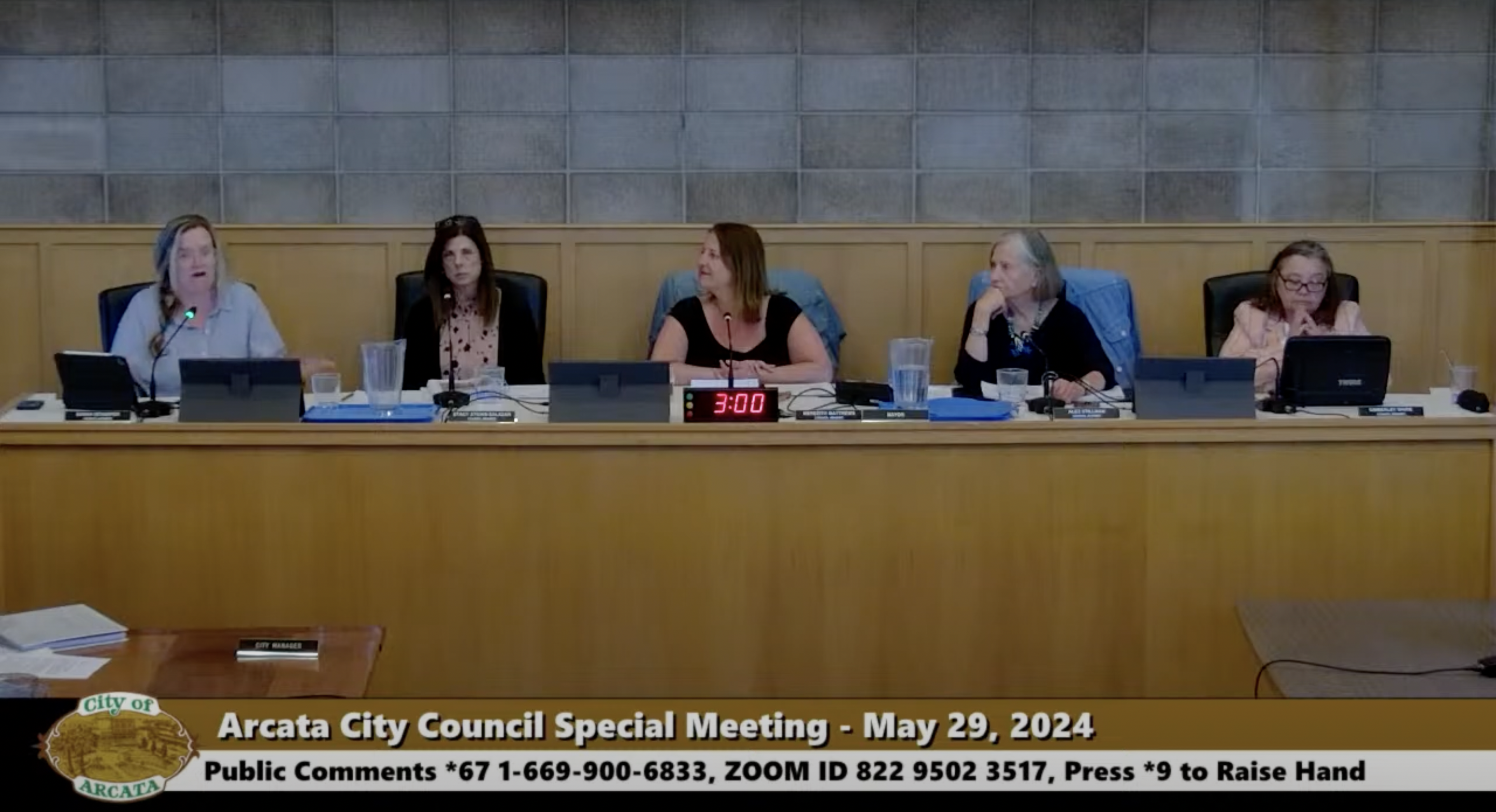
Screenshot of Wednesday’s Arcata City Council Meeting.
At a public hearing for the Gateway Area Plan and General Plan last night, Arcata City Council members discussed final changes they’d like to see before ratifying the documents. The plans, which establish policies and zoning changes that will likely change Arcata’s housing landscape in the coming decades, will come before the Council twice more in the coming months.
Because Vice Mayor Alex Stillman and Councilmember Stacy Atkins-Salazar have recused themselves from Gateway Area-related topics due to conflicts of interest, discussion on the Gateway Area Plan and General Plan were split into two agenda items.
Here’s a quick rundown of what they talked about.
Gateway Area Plan and Code
Over the first half of the meeting, Mayor Meredith Matthews and Councilmembers Sarah Schaefer and Kimberley White discussed the Gateway Area Plan and Gateway Code, which will rezone 139 acres of southwest Arcata to pave the way for mixed-use and high-density housing development.
During the public comment period, quite a few folks advocated for a linear park along the L Street trail. Afterwards, the three non-recused Councilmembers discussed ways to protect and further develop the existing bike and walking path on L street, from Samoa Boulevard to Alliance Road. They decided to add language that guarantees protection of the L Street path in the plan, and to add a measure for the development of a linear park along the L Street path over the next two years.
To increase transparency, the Council also changed the review process for taller buildings. Instead of the Zoning Administrator, the Planning Commission will hear proposals for buildings four stories or higher, which will include a public administrative hearing.
General Plan 2045
The full Council convened to discuss the General Plan 2045 comprehensive update during the second half of the meeting. They requested a few minor changes to the Plan, and also discussed some concerns related to sea level rise and the Arcata Fire District.
The General Plan’s policy on pedestrian pathways and multi-use trails calls to “retain and expand” total trail feet in Arcata, and says that if developers ever want to remove or relocate a trail, the final call is up to the City. After Community Development Director David Loya clarified it would be specifically the City Council’s discretion in those cases – not the zoning administrator’s, as some community members have feared – the Council opted to change the language of the policy to affirm the Council’s authority over trail relocation and removal.
“I feel like in our community, trails are a big deal to everyone,” said Councilmember Atkins-Salazar. “I think that it’s important that there is a process – if we need to, for whatever reason, consider moving a trail, then it should be a process – and it’s my understanding that it would be a process.”
The Council also agreed to change a detail in the Land Use Policy. An implementation measure titled “Residential-Low Density Rezone” directs the City to, in a couple of years, consider allowing more mixed-use and housing development in certain neighborhoods, including Bayview, Northtown, Arcata Heights, and Sunset. Councilmember White worried that new development permitted by the potential rezone wouldn’t “fit” with the neighborhoods, and suggested removing the measure.
Loya clarified that the policy wouldn’t rezone those neighborhoods – it would just commit the City Council to surfacing the idea a couple years into the implementation of the General Plan.
“I 100 percent support this policy,” said Councilmember Schaefer, noting that the affected neighborhoods have desirable access to schools, parks and services, and that limiting more affordable housing options there would be exclusionary. Referring to mixed-use neighborhoods, Schaefer said: “That is true community, and that is what good neighborhoods look like.”
The Council chose to delay consideration for the rezone policy from year two to year four of the General Plan’s implementation, in part to see how development of the Gateway Area pans out.
Other topics didn’t result in changes to the Plan. Councilmember White worried how the Plan will affect areas that will, sooner or later, face sea level rise. Loya clarified that the Local Coastal Plan, projected for completion around early 2025, will overlay the General Plan and account for those concerns.
“The current version of the local coastal program actually does not allow for densification in areas that are subject to sea level rise,” Loya said. While that version does allow land use changes, “those zoning changes are really geared towards early incentives to put us on the path towards longer term adaptation and retreat from that area.”
Other than that, the Council talked a bit about the Arcata Fire District (AFD), which has raised concerns about its ability to respond to disasters in large buildings. AFD has asked the Council to delay approving the Gateway Area Plan pending a Standard of Coverage Study, which will evaluate future needs of AFD and should be complete by the end of the year. Councilmember White read a letter outlining AFD’s concerns, which AFD Board President Eric Loudenslager sent to the Council earlier this week.
Some members seemed confused by the AFD’s most recent letter given the City’s efforts to collaborate. Because the issue is tied to funding, it’s largely beyond the City’s control. Noting that the plan can be amended after its ratification, and that the fire marshall will have to sign off on all new buildings anyway, the Council moved on without requesting changes.
Given the late hour, the Council decided to continue discussion on the plans at their June 5th and July 17th meetings. You can check out the Gateway Area Plan here and the General Plan here, where recent changes are marked in red.
Sheriff’s Office Reports That the Body of the Young Man Drowned in the Trinity Two Weeks Ago Was Finally Located Yesterday
LoCO Staff / Thursday, May 30, 2024 @ 2:49 p.m. / Crime
PREVIOUSLY:
###
Press release from the Humboldt County Sheriff’s Office:
The Humboldt County Coroner’s Office has positively identified human remains discovered in the Trinity River near Sugar Bowl in Hoopa on May 29, 2024, as that of 23-year-old Jeshua Wilkinson (DOB 02/13/2001) of Arcata, CA.
Wilkinson was reported missing to the Humboldt County Sheriff’s Office on May 15 after being swept away in the Trinity River near Kimtu Beach. HCSO search teams were able to locate Wilkinson on May 29 after a multi-weeklong search and rescue operation in the area.
The Humboldt County Sheriff’s Office extends our deepest sympathies to Jeshua Wilkinson’s family during this difficult time.

McKinleyville-Area Hunter Earns World Record With Largest Roosevelt Elk Antlers Ever Recorded
Ryan Burns / Thursday, May 30, 2024 @ 2:20 p.m. / Wildlife

Timothy Carpenter poses with his record-breaking antlers. | Submitted.
###
On a hunting trip this past September, McKinleyville-area resident Timothy Carpenter shot and killed a Roosevelt bull elk so improbably massive that he still has trouble wrapping his mind around it.
“The antlers on the bull are so large it’s a little confusing,” Carpenter told the Outpost in a phone interview this week.
He estimates the elk’s weight at somewhere around 900 pounds, and photos reveal its tree-like antlers to be as tall as a pair of teenage boys. It’s a genetic anomaly, like the Shaquille O’Neal of elk.
“Exactly,” Carpenter agreed. “Honestly, I’m still trying to figure it out.”
Earlier this month, a special judges panel convened by the nonprofit Boone & Crockett Club carefully measured the elk’s rack, tallying the length of its two main beams and their numerous forked tines. (The elk was an 8x9, in case you’re counting.)
Once the judges completed their measurements and added up the numbers, Carpenter’s elk was confirmed as the new world record. The official score of 455 2/8 inches smashed the previous world record by more than 30 inches.
In the weeks since, articles and photos of Carpenter with his record-breaking catch have proliferated across the surprisingly large number of hunting websites and periodicals, from Field and Stream and Game & Fish Magazine to more niche publications like Bugle Magazine: Journal of Elk Country and the Hunt.
“There’s a lot of them, actually; it’s kind of crazy,” he said. “My friend’s mom sent me one from Illinois the other day. It was in her hometown newspaper, printed. I said, ‘What?!’”
Carpenter, a hunting outfitter and wildlife biologist, grew up in the Bay Area and later earned his degree in wildlife management from Humboldt State University. He believes hunting goes hand-in-hand with conservation and has worked with ranchers, timber companies and other landowners to build tolerance for the prolific subspecies.
“I feel very fortunate to be doing what I’m doing … to establish those relationships where we can talk about conservation, where we can talk about management with hunting,” he told Bugle Magazine.
Carrington Hilson, an environmental scientist with the California Department of Fish and Wildlife, oversees elk research and management on the North Coast. She said hunting is one of the main management tools that humans have for elk in our region and across the state.
“We are privileged in the fact that we have a population of [Roosevelt] elk that has rebounded,” she said when reached by phone Thursday. “We now have approximately 2,500 [Roosevelt] elk on the North Coast,” meaning in Del Norte and Humboldt counties. While the agency didn’t start tracking population data for the local population until 2016, Hilson said their numbers have increased significantly in recent years.
While she and other wildlife managers want to enable continued population growth and range expansion for these local herds, their increased numbers have caused problems. Certain populations along the coast are increasingly involved in property damage and conflicts with humans.
“These elk along the coast are in high densities, and they’re also highly habituated, so they lack fear of humans,” Hilson said. “So we’re having situations where they are in people’s yards. They break fences; they destroy ornamental plants and fruit trees. We also have the situation where they are on larger ranches, and there [are] issues with production in regards to cattle and hay.”
CDFW issues a limited number of tags each elk hunting season. (Harvesting an elk without a tag is illegal.) Some tags are awarded on a point system based on information submitted in applications while others are distributed via lottery.
Carpenter, who also holds the archery world record for Roosevelt elk, said the odds of getting a tag in any given year are pretty low. Having grown up in the more urban confines of the Bay Area, he developed a love of the outdoors when his dad got him into the Boy Scouts and took him on hunting and fishing trips. His brother, who also studied wildlife management at Humboldt State and later got a job working in the woods, got Carpenter into hunting.
“I didn’t have much time to hunt for myself, and I just feel extremely fortunate to have been able to fill my tag with such an incredible animal,” he said. After harvesting the large bull at an undisclosed Humboldt County location, he and his friend quartered the carcass in the field and hauled every last bit of meat to the truck they’d arrived in, he said.
“Nothing left in the field but some bones that were picked clean,” he said. “I have been enjoying sharing and cooking the meat with many friends and family.” He added that he’s grateful that this mature bull had many years to spread its “incredible genetics.”
Later this year, the elk’s antlers will go on display in Springfield, Missouri, during the Boone and Crockett Awards. Carpenter still marvels at their size.
“The elk’s unbelievable,” he said. “Still my main feeling is I’m just extremely fortunate.”
Rio Dell Also Has a New Police Chief
LoCO Staff / Thursday, May 30, 2024 @ 1:51 p.m. / Community

Jeff Conner (left) receives a special proclamation alongside Deputy District Attorney Carolyn Schaffer (right) from Mayor Debra Garnes (Center) for their work resolving the homicide case of Johnny Renfro.
EARLIER:
City of Rio Dell press release:
On Tuesday, May 21, 2024 the Rio Dell City Council confirmed the appointment of Jeff Conner as the Interim Chief of Police. Former Chief of Police Greg Allen has taken the position of Associate Vice President for Safety & Community Wellbeing (Chief of Police) for the Cal Poly Humboldt Police Department. The City wishes him well in his new role.
Conner has a long association with the Rio Dell Police Department going back many years, including serving as Chief of Police from December 2017 to July of 2022. During that time Conner implemented several reforms and improvements to modernize the Department.
Since his tenure as Chief he has remained part-time with the department as a Sergeant, mostly handling investigations. Conner will step down from the Interim role before the close of August this year and anticipates retiring from law enforcement altogether by the end of 2024.
The City of Rio Dell is currently recruiting for a new Chief of Police. Applications are currently open.
Photo caption: 2022. Jeff Conner (left) receives a special proclamation alongside Deputy District Attorney Carolyn Schaffer (right) from Mayor Debra Garnes (Center) for their work resolving the homicide case of Johnny Renfro.


