

(UPDATING) Cal Poly Humboldt Issues Hard Closure of Campus; Law Enforcement Converges
Isabella Vanderheiden / Saturday, April 27, 2024 @ 1:02 p.m. / Activism , Cal Poly Humboldt
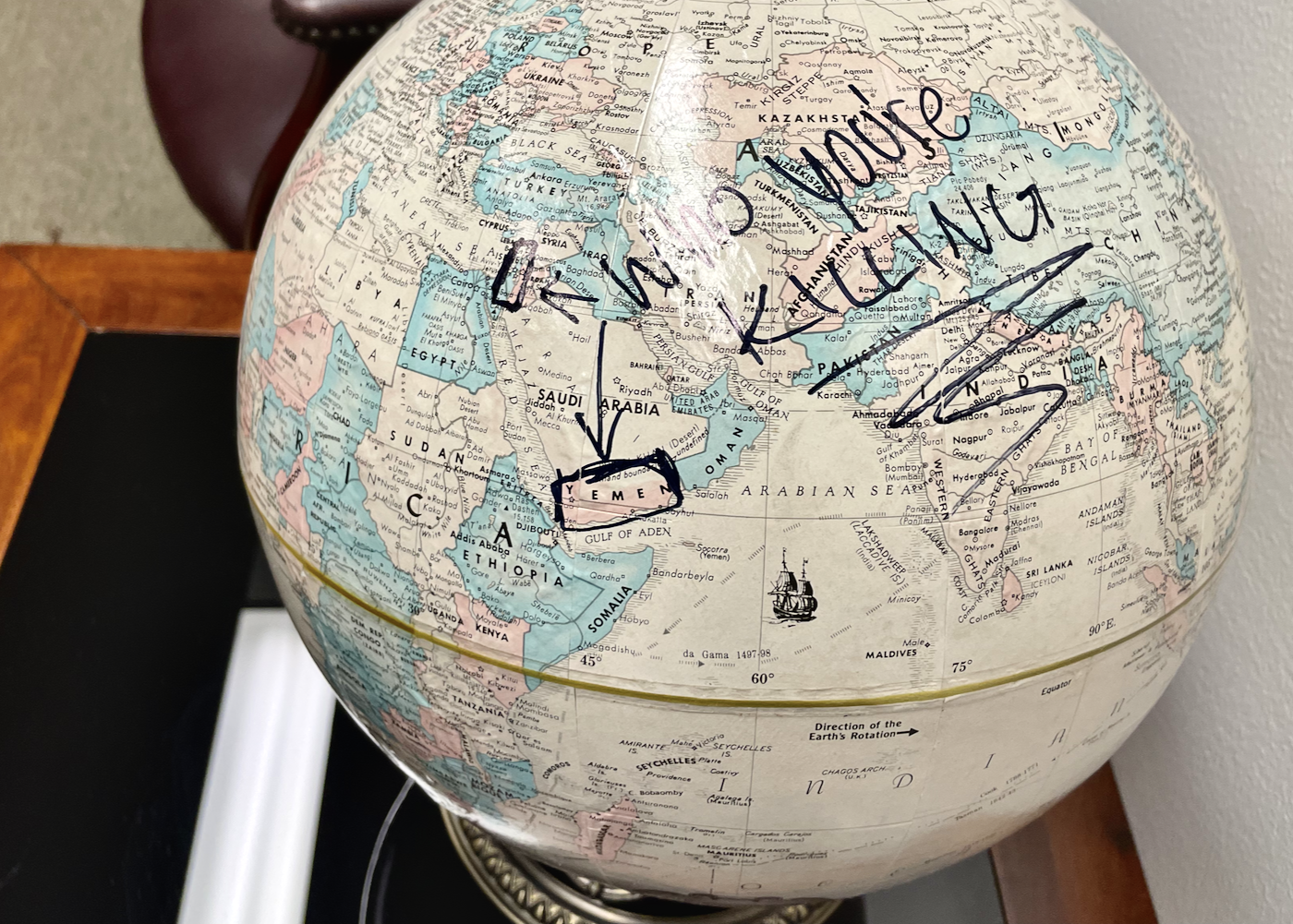
UPDATE, 9:47 p.m.: As promised… Gooseneck.
###
UPDATE: 7:42 p.m.: Protesters have spent the past hour or so gathered at the site of the police barricade at the intersection of Plaza Avenue and LK Wood Boulevard. As they were chanting, a U-Haul truck parked across the street. The occupants exited the vehicle and rolled up the vehicle’s rear door to reveal… a drum set. And guitars.
Yes, the members of Arcata hardcore band Gooseneck have arrived at Cal Poly Humboldt and plan to bring the noise for the demonstrators. They are setting up now, but seem to be having trouble with their generator.. We will update when their shredding is commences.
— Andrew Goff
###
UPDATE, 6:15 p.m.: A crowd continues to hold space on the UC Quad, dining together, listening to music, and adding to the collection of chalk art. Another group of protesters has opted to take the message to the streets of Arcata (see above).
Meanwhile, a pair of Arcata City Council members have released a statement in support of a non-violent resolution to the continuing situation. Read that below:
As City Council members, and more importantly as humans, we support peaceful resolutions and open dialogue. It is essential to respect the rights of our community members, including and especially students, to peacefully express their views. We believe in the power of de-escalation and constructive conversation to promote understanding globally and foster solutions locally.
We send our young people to universities such as Cal Poly Humboldt to foster critical thinking and encourage them to make the changes in the world that they deem necessary. This is what they are doing. In this emotionally charged situation, a non-violent approach should, and must be used by all parties involved. As a council, we heard from and worked with community members, including students, to have an open dialogue and create a cease-fire resolution for Arcata. This type of dialogue and conversation can bring our community together without violence.
Stacy Atkins-Salazar & Sarah Schaefer, Arcata City Council
—Andrew Goff
###
UPDATE, 5:00 p.m.: The Outpost just received word from Michihiro Clark Sugata, an associate professor of sociology who has been helping students with negotiations, that the student protestors are willing to leave Siemens Hall if Cal Poly Humboldt administrators meet the following demands:
- Descalate: The students want the police and the threat of police violence to be removed. As a part of that, they want to ensure there are no academic penalties, according to Sugata.
- Disinvest: The students want the university to disinvest from all interests connected to Israel.
- Declare: The students have also asked for the university and CSU leadership to call for a ceasefire in Gaza.
The Humboldt Chapter of the California Faculty Association (CFA) has released the following statement in response to the university’s decision to shut down the campus. The CFA is calling for the resignation of Cal Poly Humboldt President Tom Jackson and his Chief of Staff, Mark Johnson. The CFA has also asked for law enforcement officials to leave campus.
Press release from the CFA:
The Cal Poly Humboldt Chapter of the California Faculty Association (CFA), a labor union that represents teaching, counseling, library, and coaching faculty of the California State University System, strongly condemn today’s actions of Cal Poly Humboldt (CPH) Administration as yet another dangerous escalation of their response to a peaceful campus demonstration.
Just after 12:30pm, Saturday, April 27th, CPH Administration sent an email that the campus was officially under a “hard” closure. As of the writing of this email, a strong police presence has been sighted on campus, barricades have been erected to prohibit access to campus, and students who live on campus are being restricted to the resident halls and the dining hall.
This campus closure represents a dangerous escalation of the administrative response to this week’s student demonstrations against the Israeli government’s relentless assault on the people of Palestine. Student protestors and their numerous allies including faculty and staff, are still in the central campus area, now isolated and vulnerable to the kind of police violence that occurred April 22nd, the first night of the demonstration. The students and their allies are engaged in a peaceful protest, closing campus and introducing unneeded police presence puts students and others at an unnecessary risk of both physical and emotional harm.
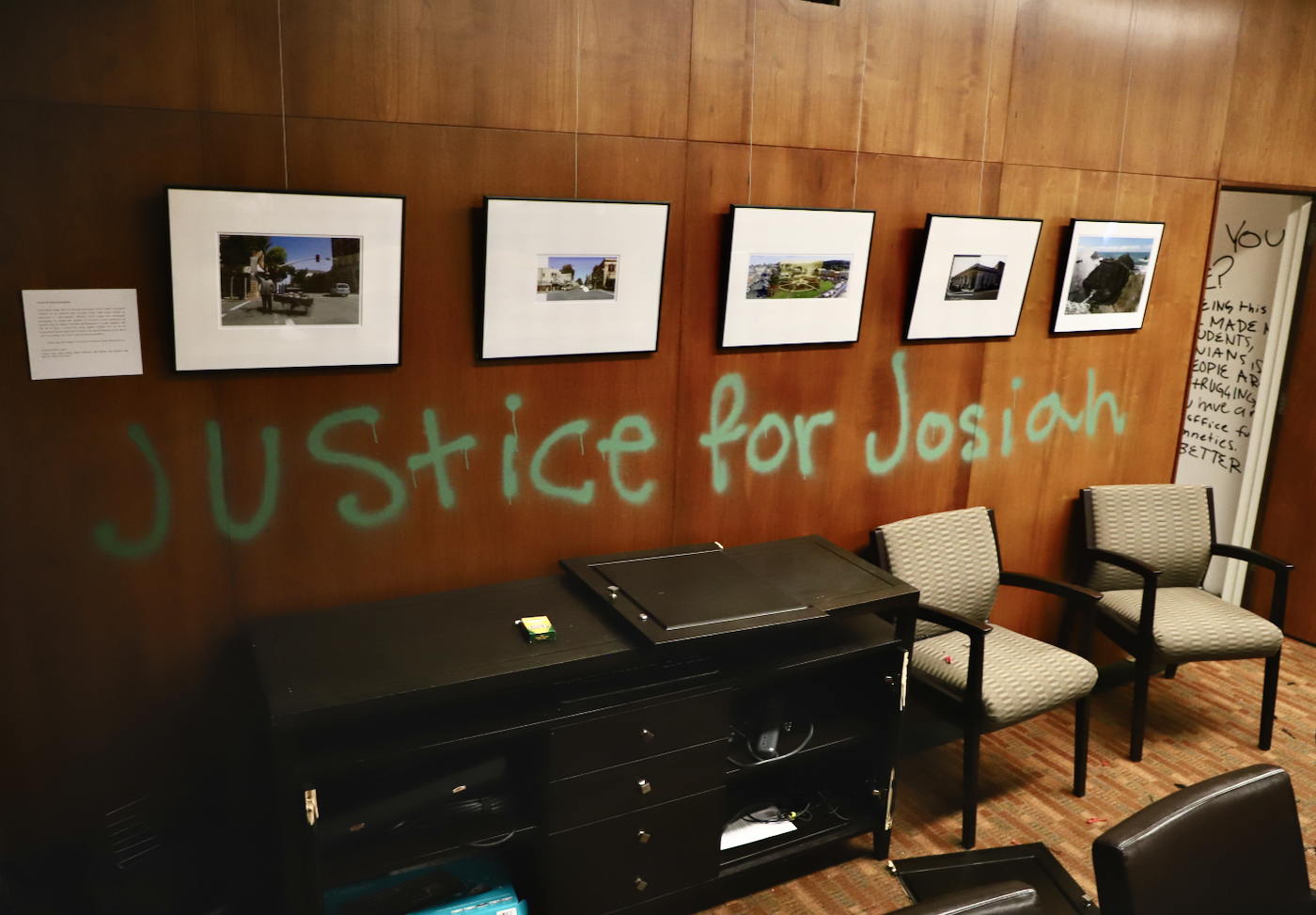
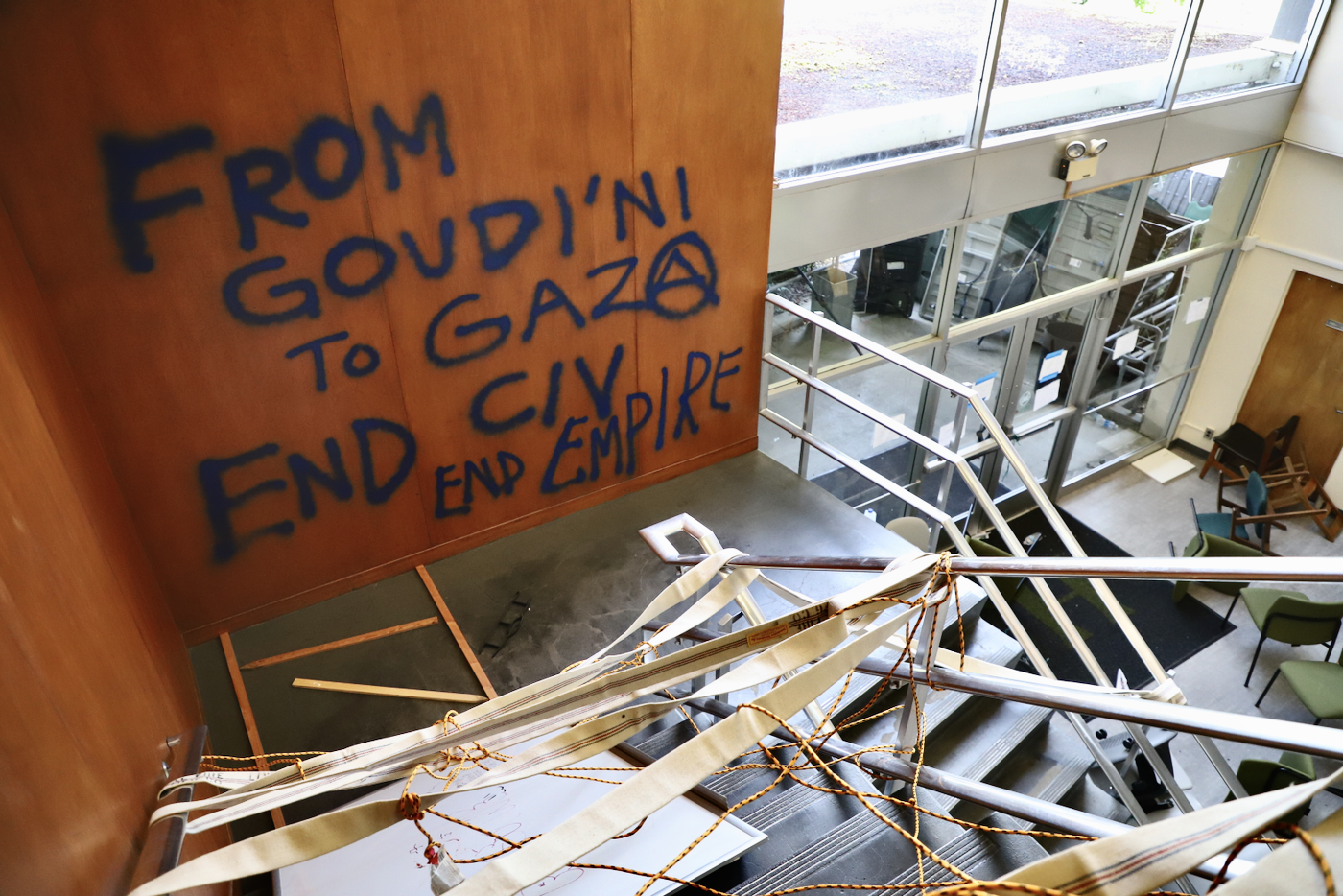
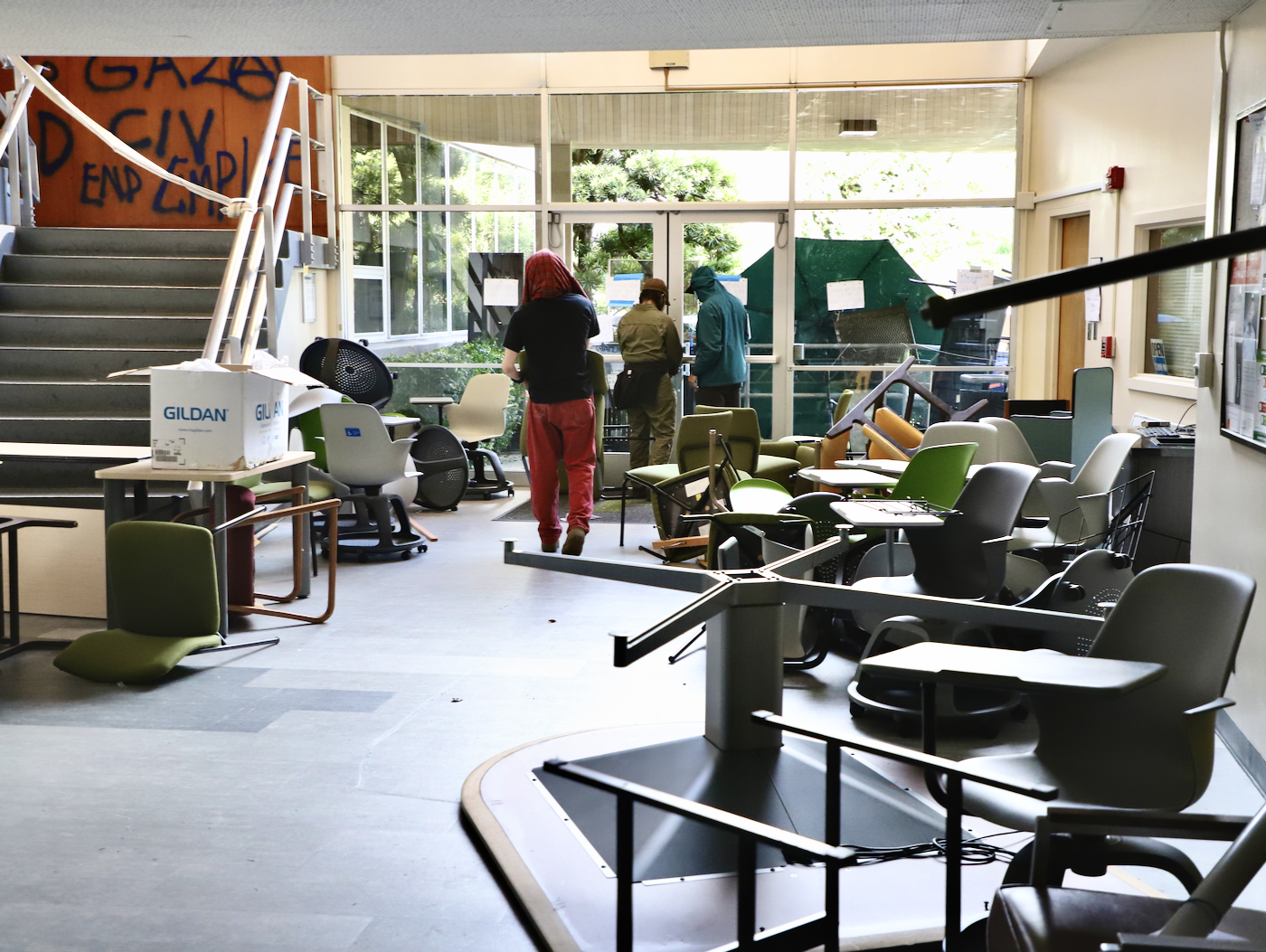
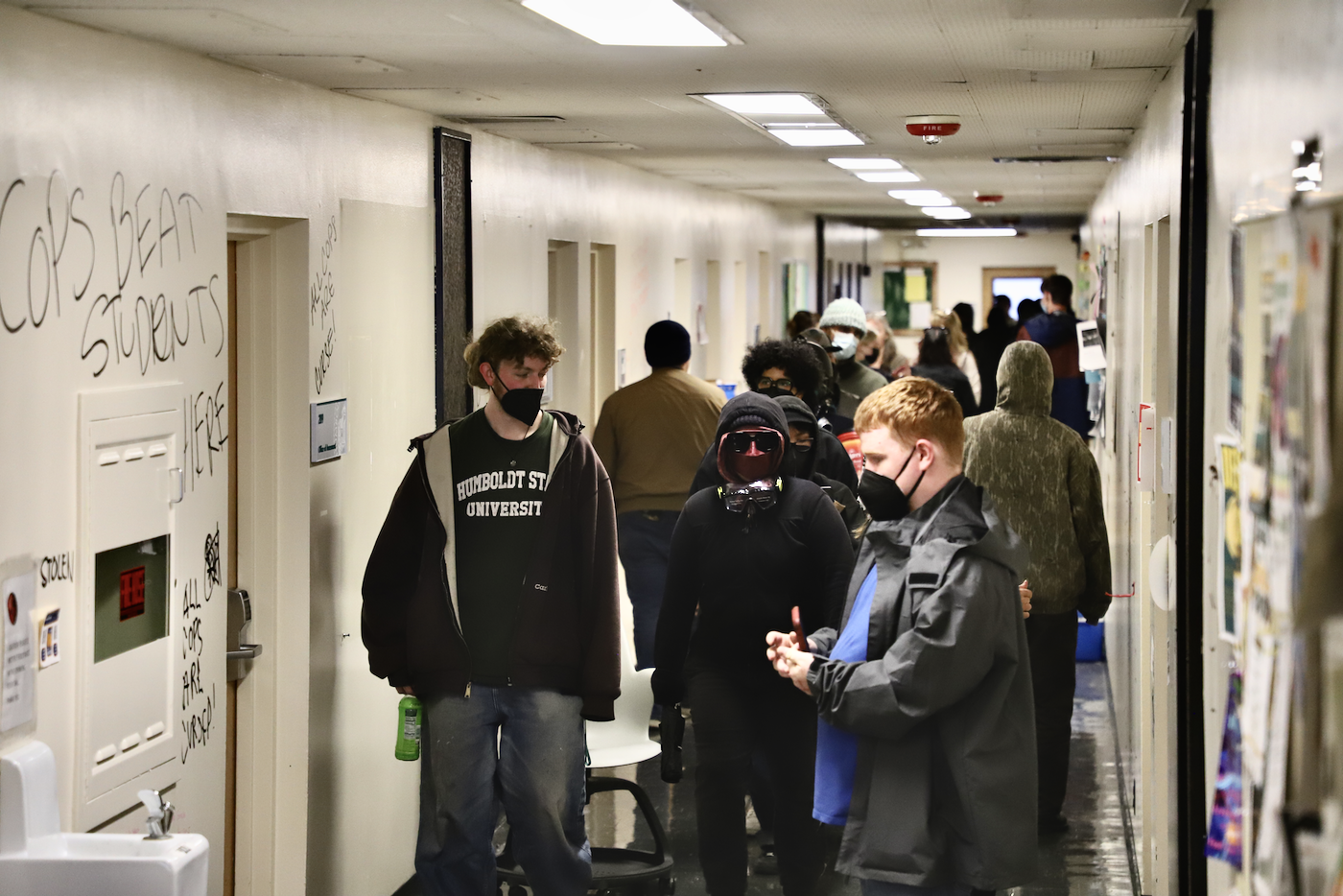
Last evening, student protesters opened Siemens Hall, the administrative building they have been occupying, so that all could see that, while there is graffiti on the walls, there has been little other property damage. Contrary to what was insinuated by CPH administration earlier this week, no confidential files have been compromised. Nearly all administrative offices remain locked. Students are demonstrating on behalf of the people of Gaza and all Palestinians and are not interested in administrative paperwork.
CFA Humboldt demands that:
• Tom Jackson, who has been asked to step down from his role as CPH President, must immediately resign.
• Mark Johnson, who has been asked to step down from his role as Chief of Staff of President Tom Jackson, must immediately resign.
• Barriers to Campus need to be immediately removed and campus needs to be reopened. All members of the university community need access to campus.
• Police officers must leave their stations on campus and return to their home offices.
• Cal Poly Humboldt administration needs to commit to student safety and agree to continue to respectfully and in good faith negotiate with student protesters.
In the words of CPH Professor Gabi Kirk, “I have seen this happen in Palestine to restrict freedom of mobility and attempt to quash protest. Our students who are protesting for justice, peace, and an end to killing in Palestine are now having it happen to them.” Restricting freedom of movement, speech, and peaceful demonstration will not make our campus safer nor will it heal our campus community of recent events. CFA Humboldt asksCPH Administration to open the campus, support students, and allow faculty to do the job we were hired to do, teach students.
— Isabella Vanderheiden
###
UPDATE, 4:10 p.m.: As protestors wait for the cops to show up, Michihiro Clark Sugata, associate professor of sociology at the university, urged protestors to be realistic about what happens next.
“Any stand at this point is symbolic,” he said to a crowd gathered around the UC Quad. “You can choose to deal with that however you want but … [for] legal counsel to protect you as best they can, the most effective thing you can do is to sit down, lock arms and not resist. … Once you fight back – even hitting with another water bottle – you will be charged with assault and everything escalates.”
—Ryan Burns
###
UPDATE, 3:40 p.m.: One of the protestors – as seen in the video above –provided some additional information about the administration’s decision to end negotiations, adding that police intervention is imminent.
“We don’t know when that is, but we can confirm it is going to happen,” she said. “So, do with that information what you feel is best. I don’t want anyone to compromise their safety more than they are willing, but if you plan on staying make sure you have a plan.”
UPDATE, 2:30 p.m.: Michihiro Clark Sugata, an associate professor of sociology at the university, told the Outpost’s Ryan Burns that he’s been working with the protesting students to “push for some form of negotiation” with administrators. Students were in active negotiations with administrators when the police showed up this afternoon and “disrupted that process,” he said.
“This is incredibly disheartening because there was engagement,” he said. “There was a good faith effort by the students there to actually consider very tangible outcomes to try to bring this to a close.”
A student protestor shared the following statement in response to the administration’s decision to impose a hard closure on campus:
We are disappointed to receive an email from campus administration announcing a “hard close” of campus. Allowing only those with permission to enter campus at this time. Anyone on campus is subject to citation or arrest. Police were present at the time the email went out, setting up concrete barriers at all campus entrances. Students living on campus are restricted to their dorms and residential areas.
We have and remain to be a peaceful protest. In negotiations with administration yesterday we were given the impression that negotiations would continue however, they have recently informed us that they refuse to negotiate further. We are concerned for the potential of police escalation at this time. We showed good faith in our negotiations and deescalation yesterday but reopening Siemens Hall. Administration has not kept their end of the agreement.
We love and care for our community and continue to stand in solidarity with other campuses for a free Palestine. Shame on administration for silencing the free speech of our brave students. We, as ever, are not afraid.
— Isabella Vanderheiden
###
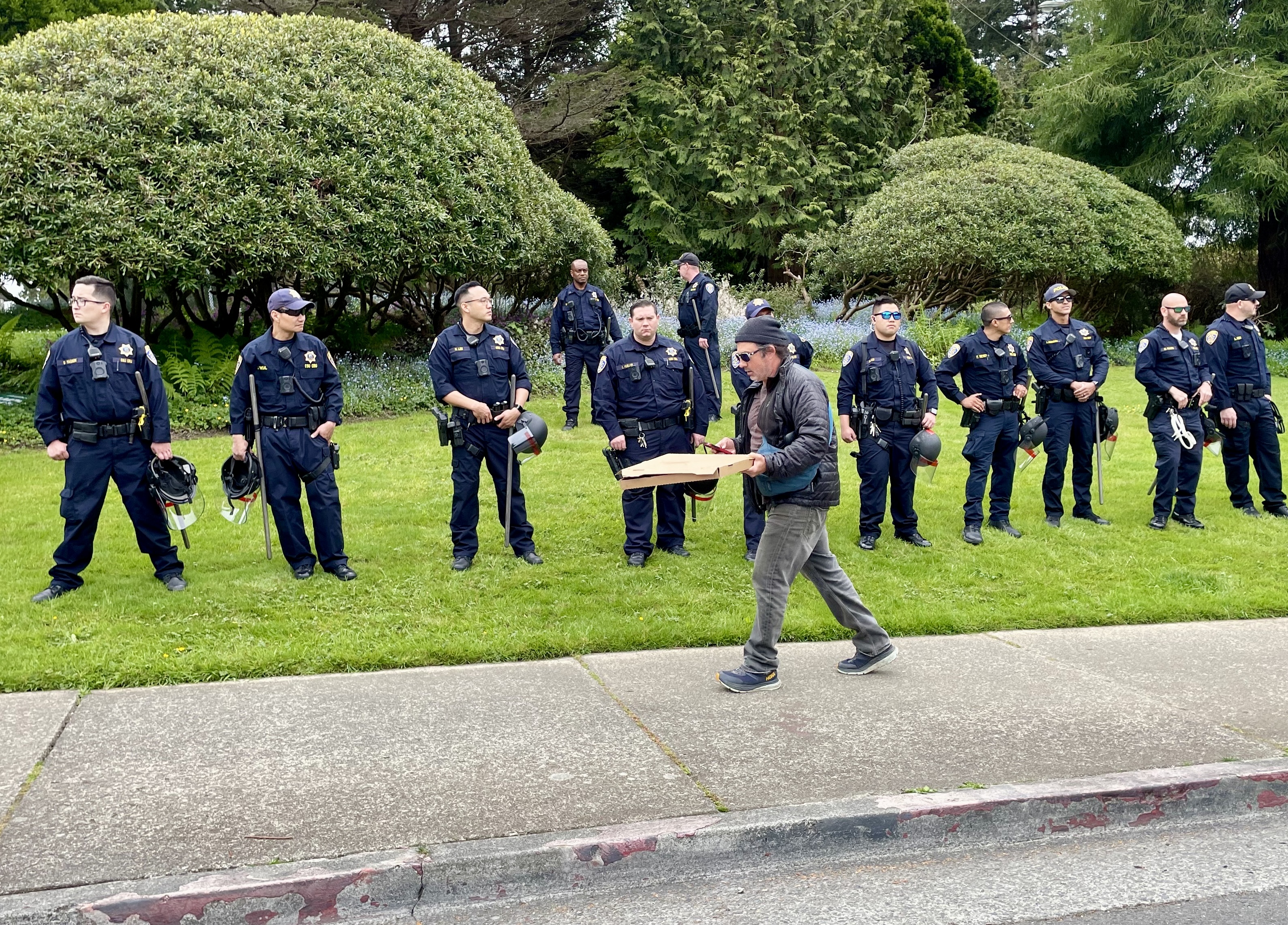
California State University police stage at the perimeter of Cal Poly Humboldt campus Saturday afternoon | Photo: Ryan Burns
UPDATE, 1:29 p.m.: The Outpost is at Cal Poly Humboldt where numerous officers with California State University insignia have begun staging on the outskirts of campus. We will continue to update.
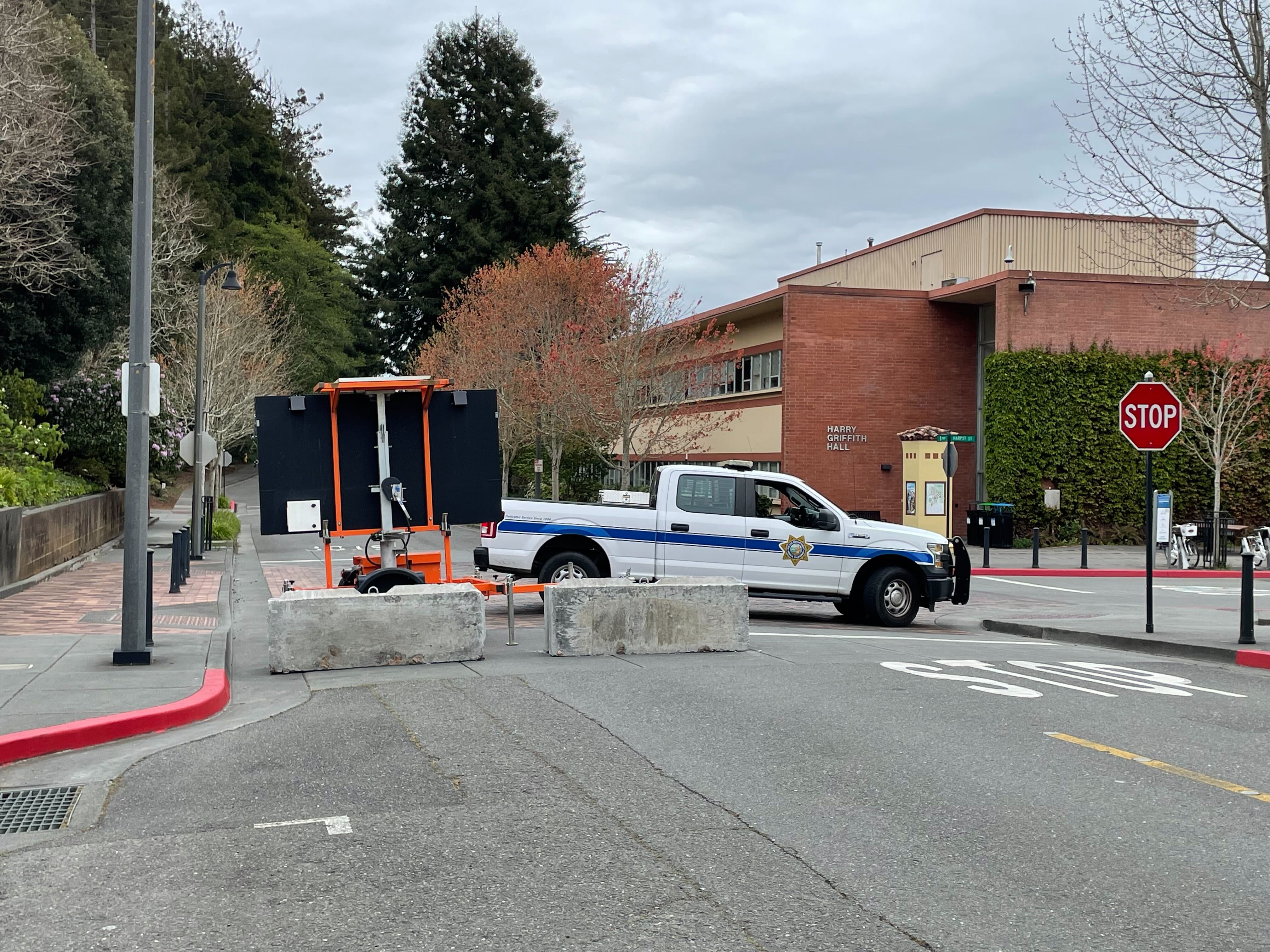
A police vehicle blocks the B Street entrance to campus at Harpst Street. | Photo: Ryan Burns.
###
Original Post: Cal Poly Humboldt administrators have imposed a “hard closure” of campus in response to the ongoing pro-Palestine occupation of Siemens Hall, prohibiting any individuals from entering campus without authorization from University Police. According to the full announcement:
A hard closure of campus is now being enforced. Individuals are prohibited from entering or being on campus without permission.
This includes road closures at Harpst and B as well as Plaza and LK Wood.This closure means that nobody without authorization by University Police is allowed on the campus. Anyone on campus without permission is subject to citation or arrest.
Students who live on campus in residence halls are presumed to have permission to remain in the limited area of the hall they live in and dining facilities. Until further updates, student residents do not have permission to be in other parts of campus.
The campus is closed due to ongoing occupation of Siemens Hall and Nelson Hall, as well as continued challenges with individuals breaking laws in the area surrounding the buildings and the quad.
Ongoing updates are available at humboldt.edu/emergency.
— Isabella Vanderheiden
###
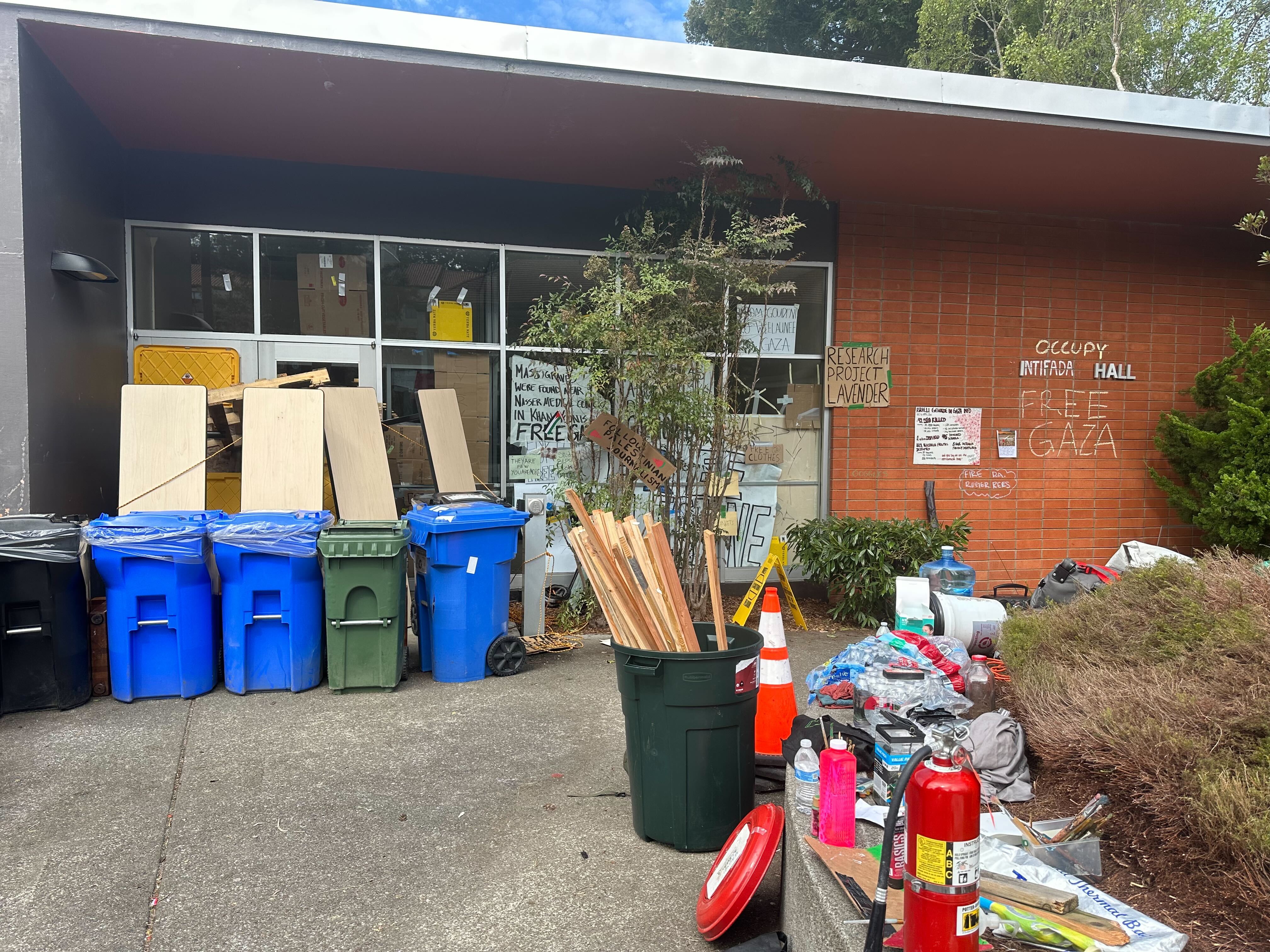
The barricade at the east entrance of Siemens Hall was back Saturday morning | Photos/video: Andrew Goff
University administrators and protestors were in active negotiations on Friday afternoon, according to Jackie, one of the students involved in the occupation. Protestors spent much of the morning preparing for a police attempt to expel them from the building, but the anticipated raid never came. Instead, protestors decided to remove the barricade from the main entrance of Siemens Hall and allow other campus dwellers to come inside.
In an interview this morning with the Outpost’s Andrew Goff, Jackie confirmed that the occupation is ongoing and criticized administrators for mischaracterizing protestors’ actions.
“We opened [the barricade] mainly to show that the university is lying about our actions,” she said. They have accused us of looting and mass destruction of property and we [wanted] to show that that wasn’t true. … There is no destruction beyond graffiti which we are discussing painting over right now. … We haven’t been destroying computers … or taking anything.”
As of this writing, the Outpost has received word that law enforcement has been seen on campus. We’ll continue to update this post.
— Isabella Vanderheiden
###
PREVIOUSLY:
- DAY FIVE: Protesters Open Cal Poly Humboldt’s Siemens Hall After Day of Tension Waiting For a Raid That Has Yet to Come
- DAY FOUR: Occupy Cal Poly Humboldt Protester Details Group’s Demands, Motivations and Views on President Tom Jackson, Law Enforcement and Their Campus Impact
- Cal Poly Humboldt Faculty Pass Vote of No Confidence in President Tom Jackson Amid Ongoing Student Protest
- DAY THREE: (PHOTOS) Student Protesters List Demands, Expand Graffiti Messaging and Voice Camaraderie on Third Day of Cal Poly Humboldt Campus Occupation
- Cal Poly Humboldt Says Campus Will be Closed Through at Least the Weekend Due to Ongoing Pro-Palestine Protests
- DAY TWO: The Morning After Cops Clash With Student Protesters, CPH Campus is Closed, Occupied Building Barricaded
- Legendary Rebellious Rapper Chuck D’s Cal Poly Humboldt Event Canceled By In-Progress, On-Campus Rebellion
- DAY ONE: Major Pro-Palestine Protests at Cal Poly Humboldt Provoke Massive Police Response; Protesters Occupy Siemens Hall; Reports of Violent Force Between Activists and Law Enforcement
BOOKED
Today: 4 felonies, 7 misdemeanors, 0 infractions
JUDGED
Humboldt County Superior Court Calendar: Today
CHP REPORTS
Miranda Onr / Us101 N (HM office): Traffic Hazard
Wildwood Ave / Painter St (HM office): Trfc Collision-Unkn Inj
1811 Northcrest Dr (HM office): Trfc Collision-1141 Enrt
ELSEWHERE
RHBB: Wildfire Burning Near Highway 101 South of Laytonville
Governor’s Office: California reminds voters to check their mailboxes and return their ballot ASAP!
County of Humboldt Meetings: Oct. 8, 2026 - Humboldt Housing and Homelessness Coalition General meeting
RHBB: CHP Pursuit Ends With High-Risk Stop at Highway 299 and 101
HUMBOLDT HISTORY: In the Early 20th Century, a Weird Wonderland of an Estate Stood on Ryan Slough, and it Was Built By an Eccentric Russian Emigre
Glen Nash / Saturday, April 27, 2024 @ 7:30 a.m. / History
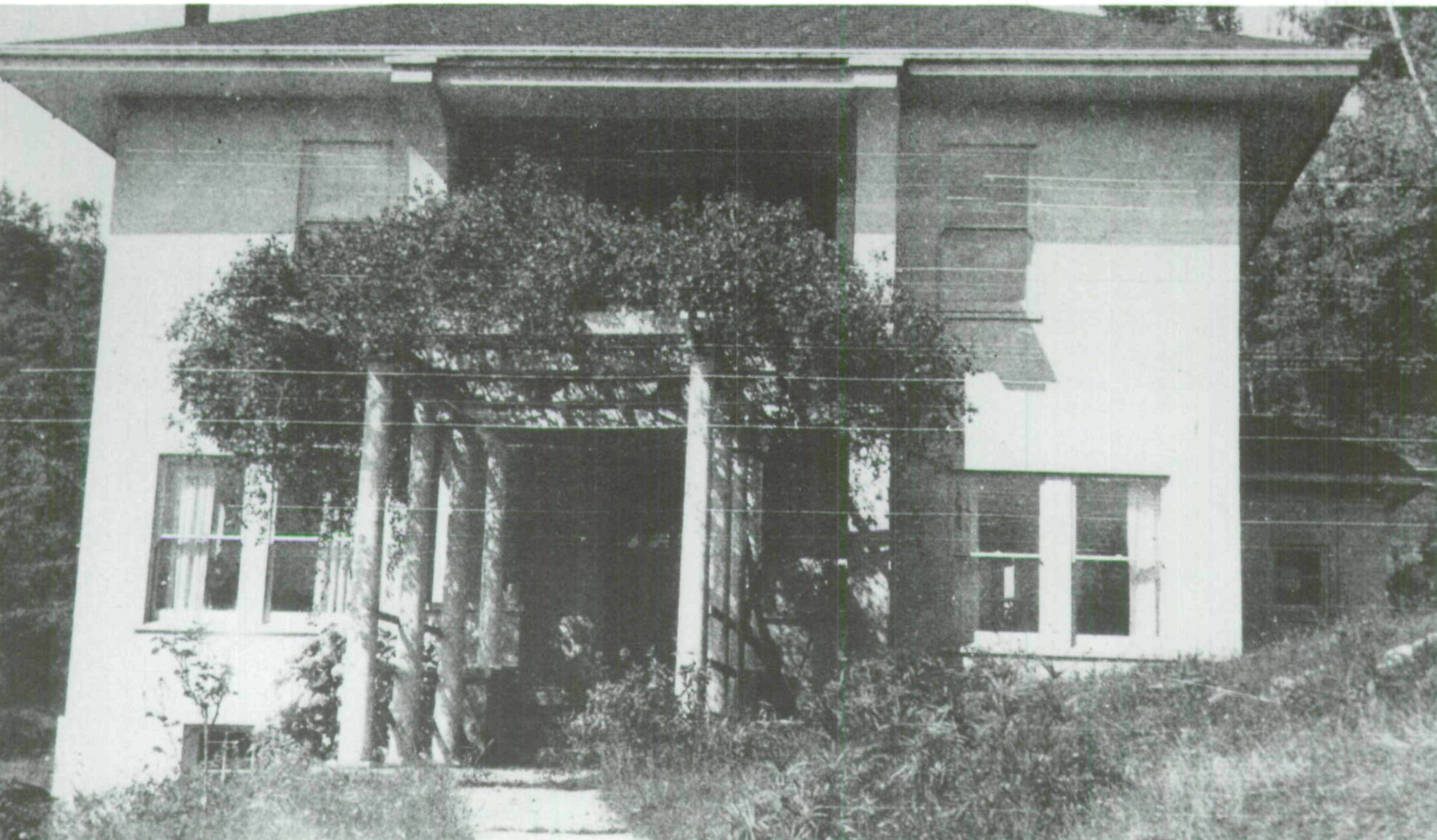
Lovely, yet unassuming, the Lunds’ Ryan’s Slough Hill home off of Myrtle Avenue housed many wonders. Photos via the Humboldt Historian.
In the year 1853, the only way people had of getting to Arcata was by boat across the bay. By 1860 a road was built starting in Eureka around the bay and ending in Arcata. Now known as Myrtle Avenue, it was the only road connecting the two towns until 1920.
People traveling this road after 1915 — and even up until today — could not help but notice the large, beautiful house located at the bottom of Ryan’s Slough Hill, nestled in a likewise beautiful but small valley. (Ryan’s Slough Hill is just a short distance east past the Worthington School, on the outskirts of Eureka.)
When I was a very young boy I would pass by this place and marvel at the beautiful park-like yard, complete with a lake, bridge and pergola, miniature lighthouse, archway and carved figures that adorned this picturesque estate. I often wondered: Who could have created all this beauty? I was later to find out …
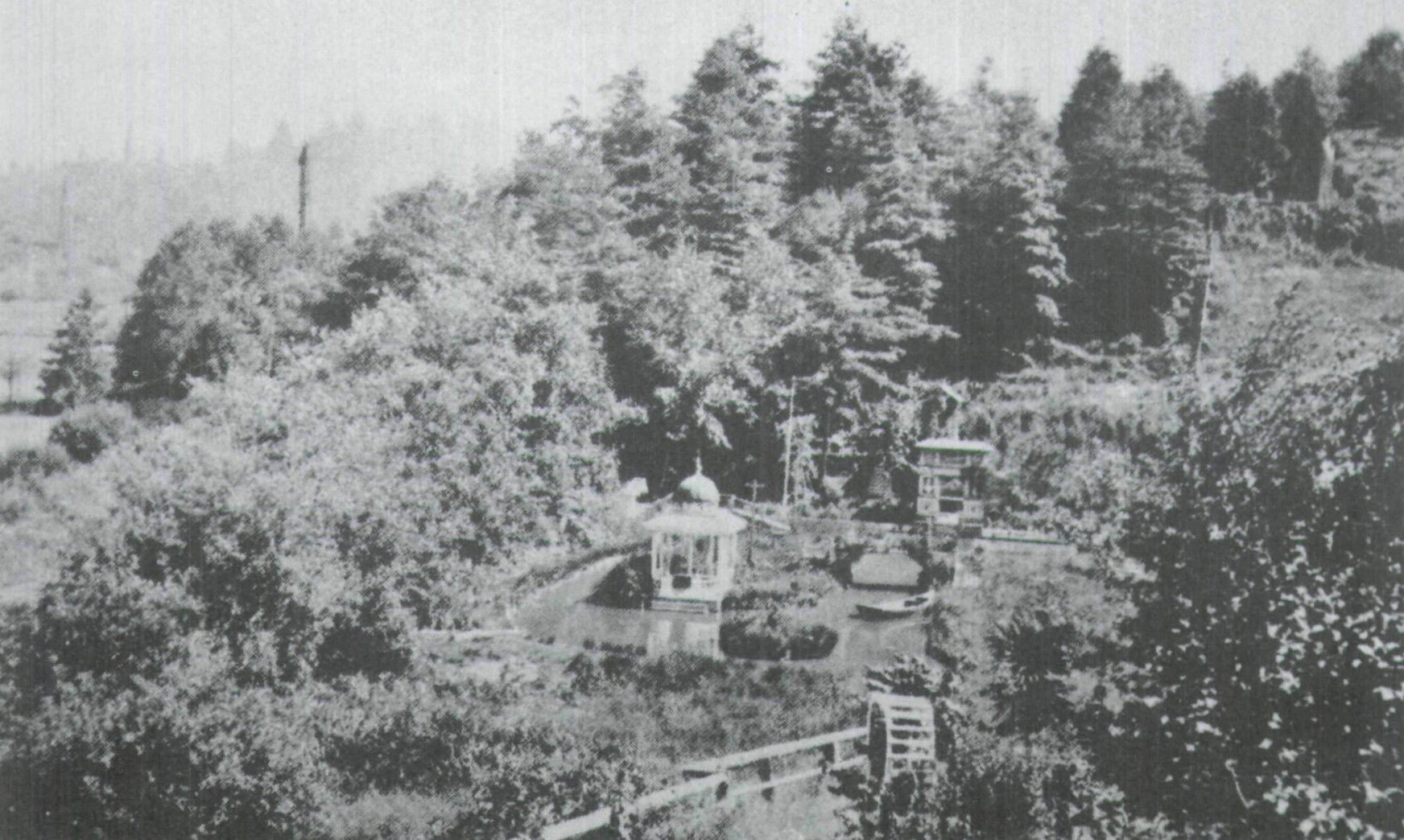
An overview of the Lunds’ “backyard” reveals the lusciousness of the estate.
In the year 1927, I was a young carpenter working for Halsby and Lax Contractors. They had a job building a two-story building on the southeast corner of Fifth and L streets in Eureka. The building permit issued October 21, 1927, was in the amount of $3,975. The owner of this building was Herman A. Lund, known to most of his friends as Harry. A sign painter and artist, this building was to be his studio and workshop with his residence located upstairs. Lund came to see our progress with his building almost every day, so I got to know him by sight. Upon investigation I found this same Mr. Lund had been owner, designer and builder of the beautiful estate at the bottom of Ryan Slough Hill.

Petra and Herman Lund with Shirley Anderson.
Herman Alfred Lund was born in 1859 in Petrograd, Russia, of Finnish parents. He attended school in Turku (Abo), Finland, where he learned the trade of sign painting. He came to San Francisco in 1881 as a sailor on the ship Young America. He married a young Finnish girl, Aurora, in 1882, and they came to Eureka in 1883. He loved this part of the country and decided to make his home here, opening a small sign shop in Vance Alley downtown.
On Jan. 2,1891, when he was 32 years old, he and his wife had a baby girl named Marcella Neva, after the Neva River in Russia. The same year, Lund purchased a lot on the northwest corner of Seventh Street and Myrtle Avenue for $650. Here he built an elaborate, two-story home, proof that he had prospered in his trade as sign painter during the relatively brief period of time he had been here.
It is thought that Lund was influenced in his design by the house across from the Carson Mansion, The Pink Lady, and indeed there is a similarity in the stairway and other architectural features. Lund could in no way duplicate the elegance of the Carson home, but he did manage to create a beautiful house on a smaller scale on Seventh Street.
The Lund house featured a life-sized wood carving of a woman’s head with a smiling face, presumed to be of his wife, mounted in the front gable of the house. Over each window on the first floor, outside, were smaller carvings of the Empress Josephine wearing a Spanish mantilla. In one of the arches of the front porch stood a carving of Napolean, complete with his familiar tri-cornered hat. These carvings, all done by Lund, were finished in gold leaf, an art which is nearly lost today.
Inside the house stood the front staircase which was also elaborately carved by Lund. On the walls were stencils and plaster castings of the “Rampant Lion,” double-headed eagle of the House of Romanoff (czars of Russia) and the French fleur-de-lis. Also featured were Napolean’s laurel wreath of victory, some 10 inches in diameter, complete with a rampant lion on a rectangular shield, and a side view of Napolean on a circular background. All was covered in gold leaf done by Lund, an artist who never lost his affection for the czars of Russia and the affluent life they led.
During the year 1900, Lund lost this beautiful home due to a bank failure. Here are a few of the details:
In January 1892, Alpheus W. Randall made his way to Eureka, where he opened a new bank in the Carson Building on Third and F streets (the entrance is on F Street next to the entrance of the Ingomar Theatre). There were some very prominent local men involved in this bank, including John Vance, David Evans and J.M. Sass. Within a few years this new bank had gained a fair proportion of the patronage of the public. However, by Jan. 11, 1900, the tune had changed; the Randall Bank had fallen to its knees due to mismanagement.
Randall and his associates were subject to suit and scorn. There were foreclosure proceedings and many people were hurt in the long, drawn-out events to follow. Victims included Mr. Herman Lund and his wife, who suffered the loss of their beautiful home at 1645 Seventh Street. This beautiful house was converted to apartments by new owners and rented out to various families until the year 1960 when it was torn down. The land now stands vacant. [UPDATE, 2024: This seems to be the site of the new Laurel Canyon Apartments, a senior housing complex.]
The Lunds moved back downtown, off of G Street in the Vance Alley into his sign shop (there were several businesses housed in this alley). Nearly every business in Eureka of the 1890s and up to the 1930s engaged his services, and a few of his signs remain standing today.

Herman Lund, an aeeomplished sailor, eould be seen boating in Humboldt Bay on his own vessel, Marcella.
Lund was a member of the Humboldt Yacht Club. He owned a trim boat on Humboldt Bay named Marcella for his daughter. He would often sail this boat up to North Bay, up Eureka Slough, then up Ryan’s Slough to his home. He had been a sailor as a young man and loved sailing ships. He made several models of sailing ships, one of which, Old Ironsides, he gave to the Eureka Elks Lodge where he was a member (this model was in the Elks Lodge Hall for many years). He made a model of Pierre La Grande, a ship in which Peter the Great, Czar of all Russia, made a trip in 1712 to visit all the rulers of Europe.
Lund also built a model of the ship Young America, in which he sailed to San Francisco in 1881. The fastest clipper ship on the seas in its day, it went down in the Atlantic Ocean in 1886. These models were carved to scale and correct to the finest detail, even with sailors on board.

Among the model ships built by Lund was that of Pierre la Grande, the vessel in which the Czar of Russia, Peter the Great, toured around the world in 1712.
Mrs. Lund had been suffering with tuberculosis for a year when, in 1908. the couple and their daughter made a visit to Mrs. Lund’s family home in Finland in hopes it might help her. They sailed on the R.M.S. Caronia. While on board this ship, Lund wrote to the editor of the Humboldt Standard newspaper, describing their train ride across the states, life on board ship, and the trouble he had getting a visa. His letter was printed in the July 8, 1908, issue of the newspaper.
Soon after her return, Mrs. Lund was forced to bed and never regained her health. Aurora died Dec. 28, 1910, at the age of 41 years.
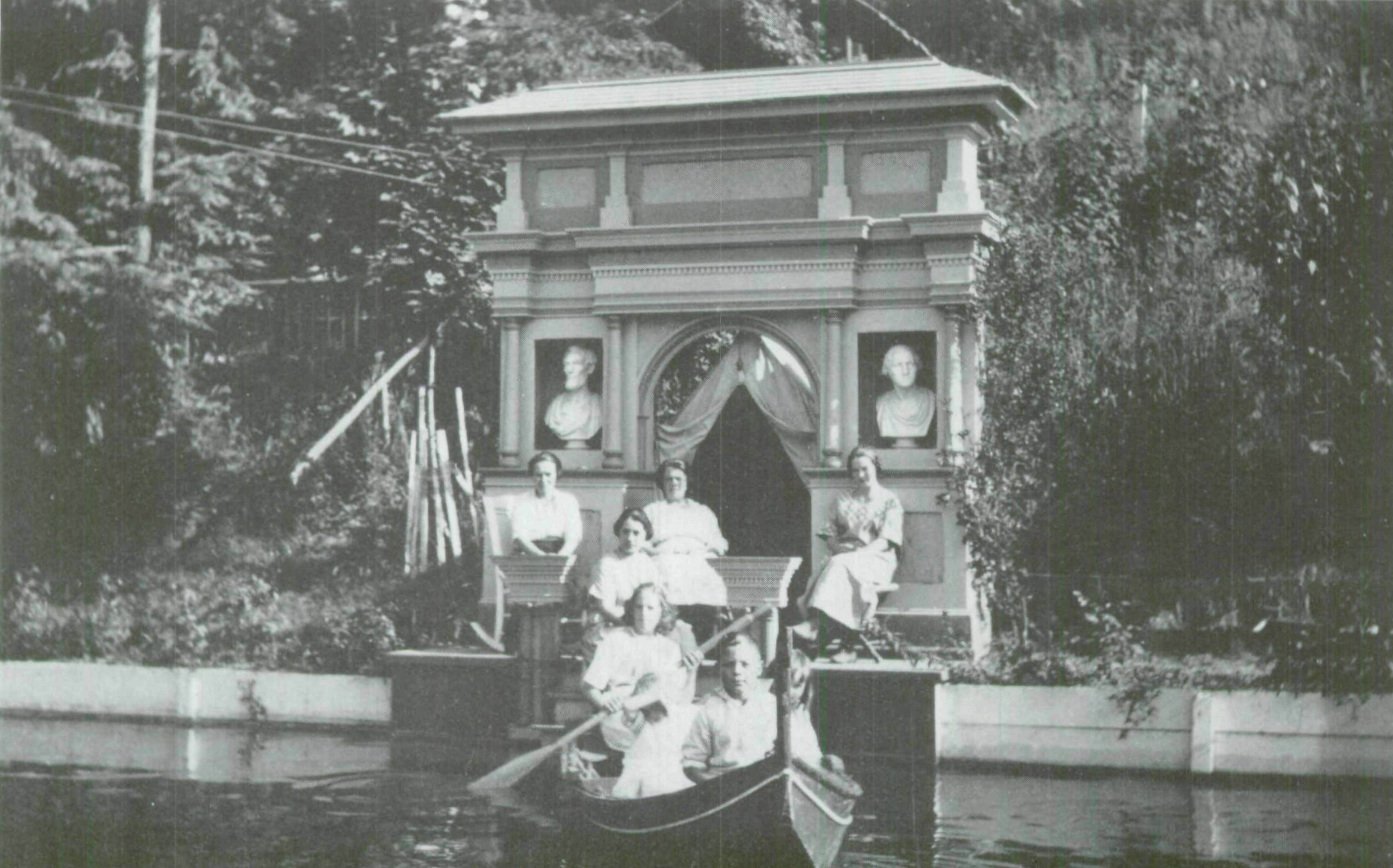
The lush and fanciful backyard lake sported a faux “Arc de Triomphe” featuring busts of Abraham Lincoln and George Washington.
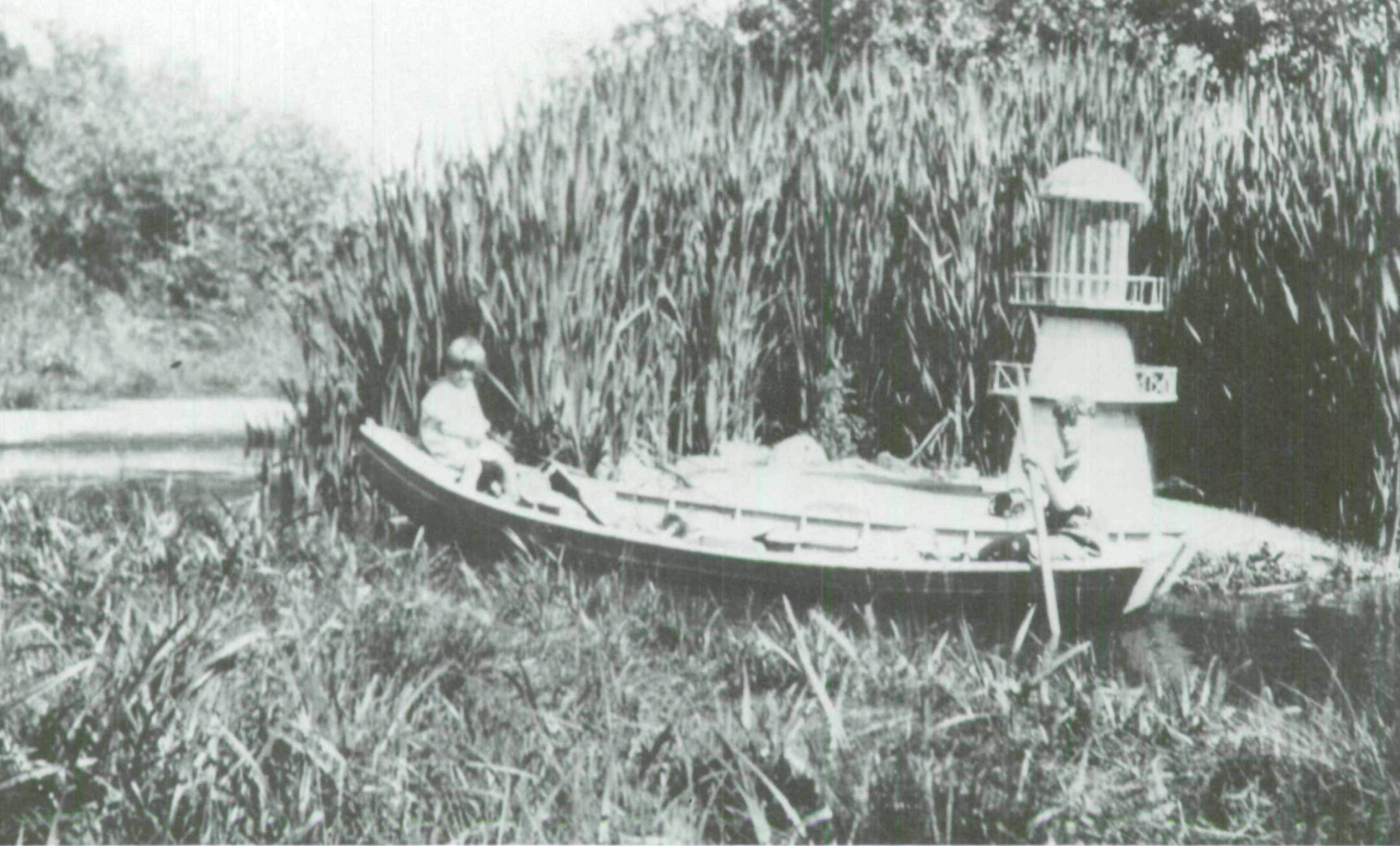
A miniature lighthouse in the middle of the lake was a favorite of the children.
On June 24, 1914, Herman Lund purchased a little over five acres of land
from Charles W. Hall, property which
commenced from Hall Avenue, thence
east to the bottom of Ryan’s Slough
Hill. This parcel contained several good
springs of water, which he used for both
a water supply and to create a small,
beautiful lake at the lower end of his
property.
He built a spacious, two-story home, facing east and overlooking the flatlands of the Eureka Slough and Freshwater. A fireplace along with the kitchen stove provided the heat for this home, and an arbor graced the front along with a balcony over the entrance. The exterior is stucco and the style is very similar to the home located at 2200 D St., built by the same builder, Dennis Simpson.
On his lake he built a pergola, an arched bridge, and a miniature lighthouse along with a Viking boat which could be rowed around. An elaborate paneled archway similar to the Arc de Triomphe in Paris, complete with carved busts of George Washington and Abraham Lincoln set in a recess on each side, was an added attraction. All of these were designed and decorated with carvings by Lund, which could be viewed even at night thanks to special lighting. Unfortunately, all are gone today.
Herman Lund and his new wife Petra spent 12 years building up this beautiful home and estate. When he reached 67 years old, he grew tired of the work of keeping up this place. He thought he would like to retire in the “old country,” so the couple put their beautiful estate up for sale. With much regret they sold this Ryan’s Slough home to Joseph and Margaret Mabry on Sept. 28, 1926.
The Lunds did make a trip back to Europe and Russia, but things had changed; it was not like they thought it would be. They eventually came back to the good old United States with Eureka as their final destination.
A year later they built a new studio and residence at 503 L St. where they lived for three years. Mr. Lund was not happy with this place and they soon sold the home to Mr. and Mrs. Amador Rossi in August 1929.
On Sept. 28, 1930, Lund took out a building permit for a new house to be built at 1518 H Street, Eureka, by a contractor, Frank Johnson. When it was completed, the Lunds moved to 1518 H Street, where they lived for a few years. Mr. Lund eventually became ill and checked into a hospital in Ukiah. Mrs. Lund moved to San Pedro, California, to be near some relatives.
An article appeared in the Humboldt Times on July 31, 1938, stating that Mr. Herman A. Lund, after a long illness, had died July 29, 1938, at the age of 79. His body was brought to Eureka.
The pallbearers were Mr. John Halsby. Axel Anderson, Leland Morgan, J. Weimars, G.Y. Henderson and J.N. Henderson. He was buried at the Ocean View Cemetery, beside his first wife and daughter in Lot #5, Block #86. Their grave markers have been removed.
So ended the life of a fantastic man.
###

The Lunds’ family dog, Michailovitch, a Russian wolfhound.
POSTSCRIPT: Through friends I found that Mrs. Martha Eley now owns and lives in the beautiful home at the bottom of Ryan’s Slough Hill and has been there since 1946. She has spent a great deal of time during her 46-year residency searching for information about the first owner and builder of her home. She has accumulated vast amount of information and pictures about this man and his life, much of which was used for this manuscript.
I recently met Mrs. Shirley (Anderson) Butler who, as a child, visited the Lunds many times at their Ryan’s Slough home. She has many fond memories of the good times she had with them and told how Mr. Lund liked to play Santa for the kids. She, too, had many pictures of the Lunds and their lovely home, information which she shared in this story.
I recently wrote to Mrs. Helen (Halsby) James who, as a child, lived across the road and on the hill just above the Lund home. She and her twin sisters visited the Lunds many times and she recalls the many good times, the candy and cookies they gave to visiting children. She also recalls playing with “Michailovitch,” Lund’s Russian wolfhound.
###
The story above was originally printed in the January-February 1993 issue of the Humboldt Historian, a journal of the Humboldt County Historical Society. It is reprinted here with permission. The Humboldt County Historical Society is a nonprofit organization devoted to archiving, preserving and sharing Humboldt County’s rich history. You can become a member and receive a year’s worth of new issues of The Humboldt Historian at this link.
(PHOTOS/VIDEO) Protesters Open Cal Poly Humboldt’s Siemens Hall After Day of Tension Waiting For a Raid That Has Yet to Come
Hank Sims / Friday, April 26, 2024 @ 2:34 p.m. / Activism
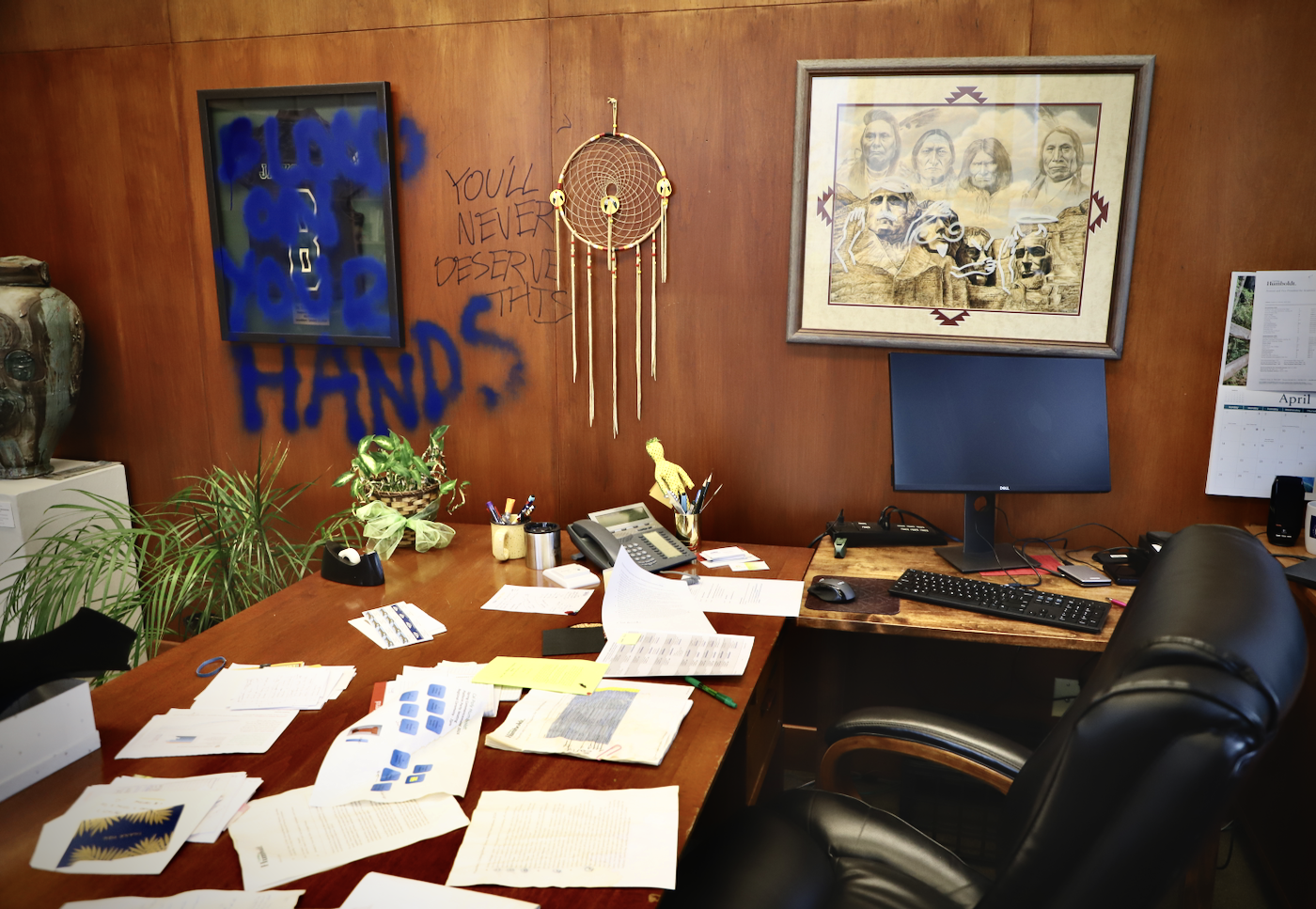
Photos: Andrew Goff
###
UPDATE, 6 p.m.: The Outpost joined curious students inside Cal Poly Humboldt President Tom Jackson’s office. Have a look.
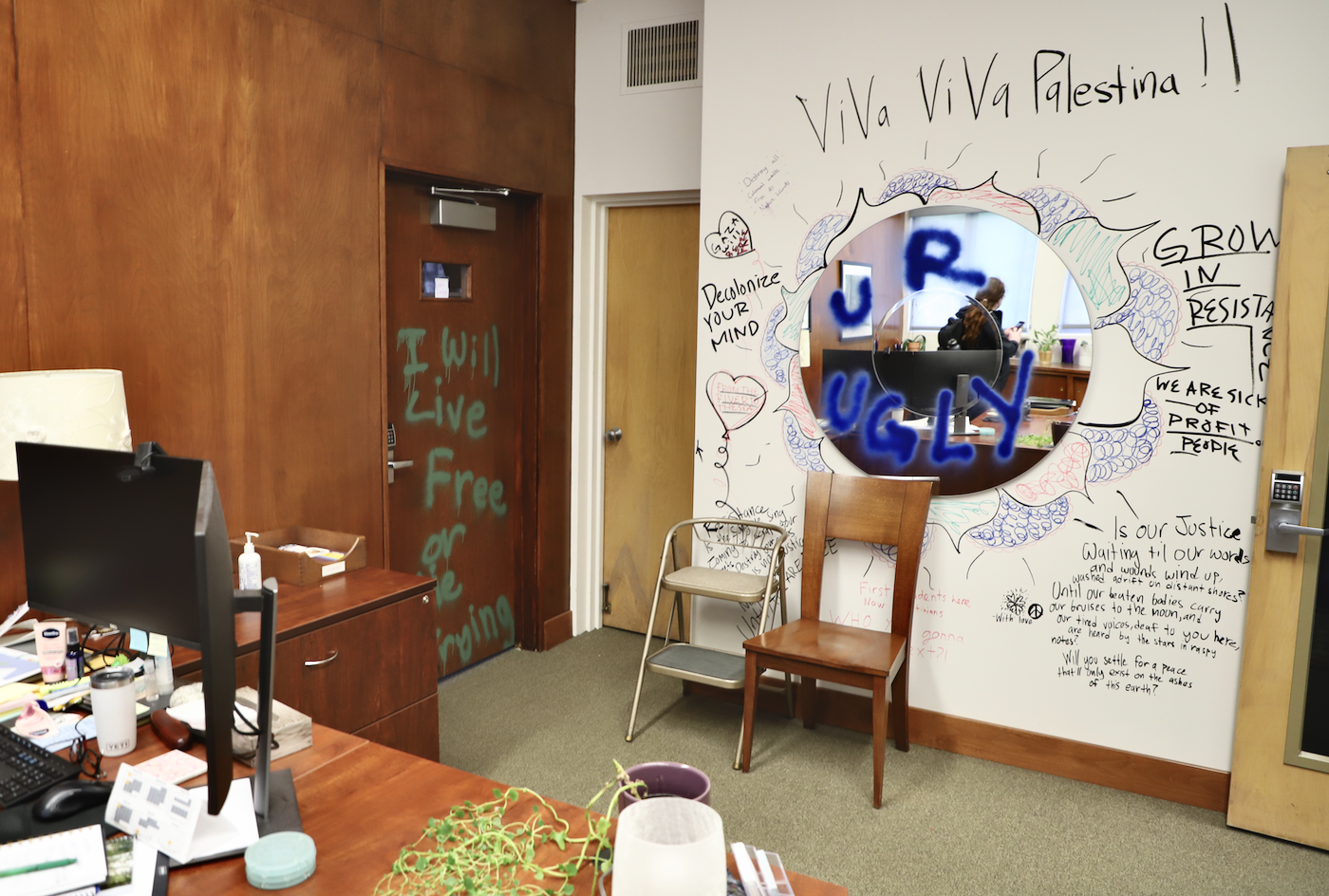
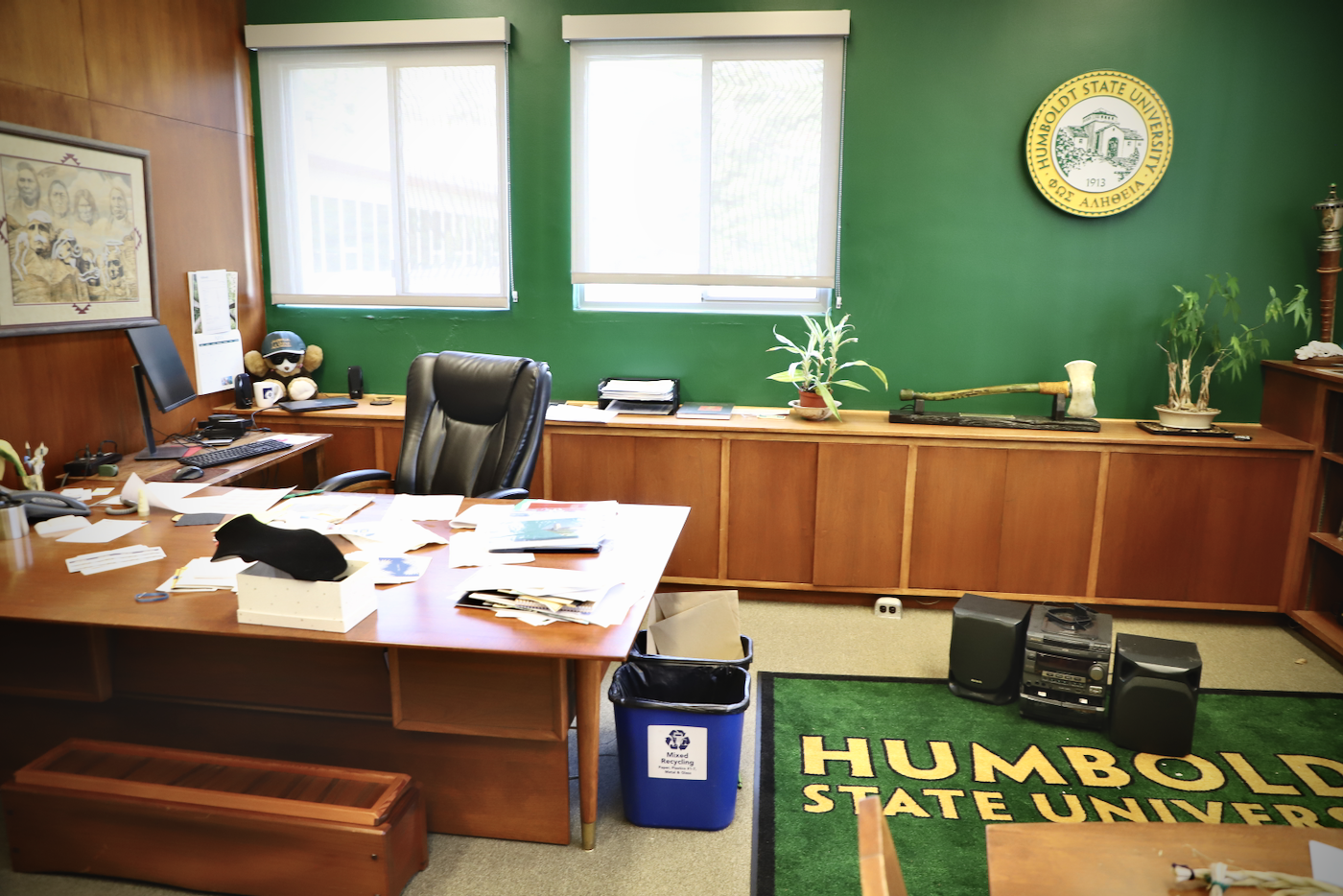
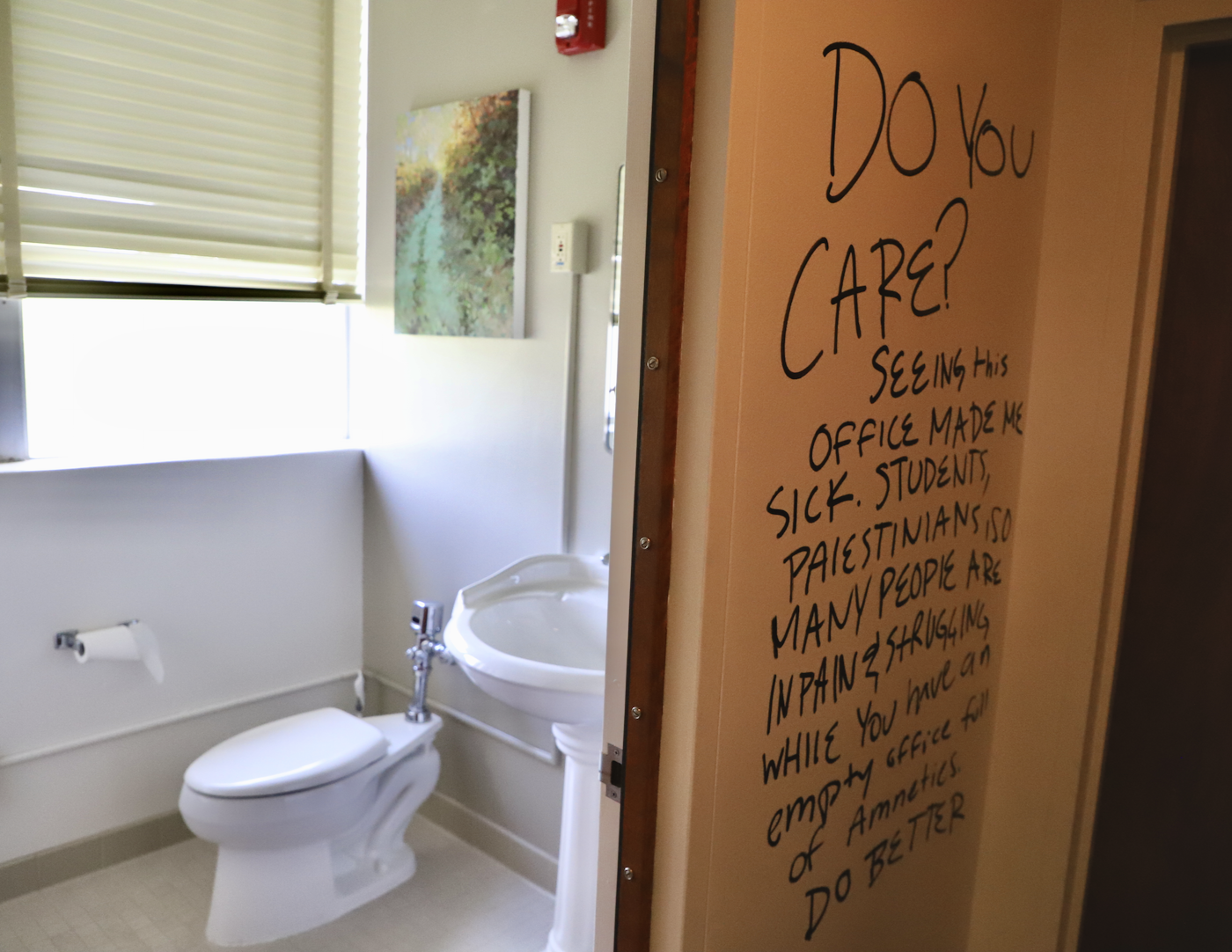
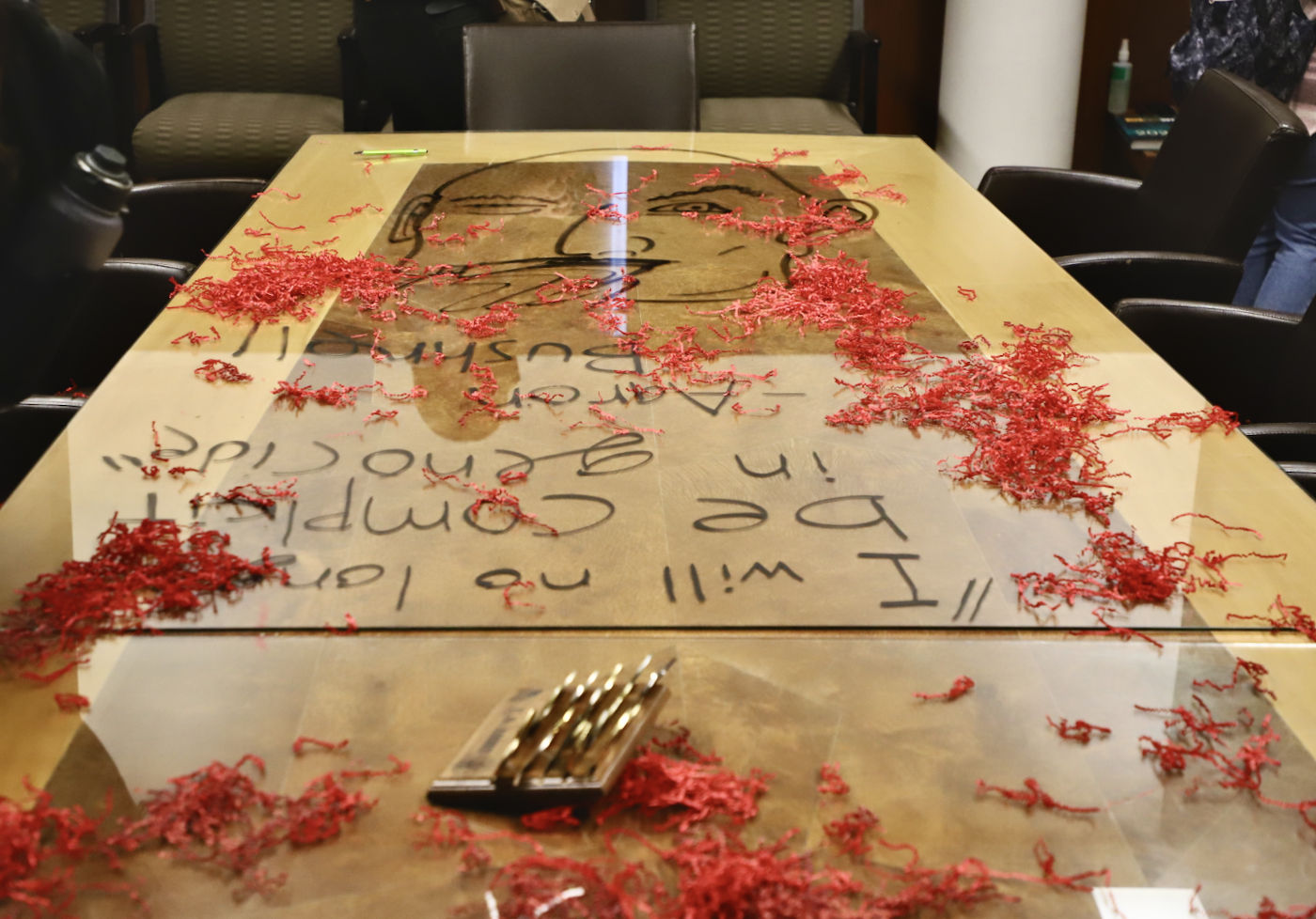

A protester inspects an axe emblazoned with President Jackson’s name
###
UPDATE, 5:34 p.m.: And just like that Siemens Hall is open. Around 5 p.m. an announcement was made on the UC Quad that the student protesters had decided to open the occupied building to all. Protesters the Outpost spoke with wanted to make clear to us that the occupation is ongoing, just not confined to the building.
The Outpost was part of the first Siemens Hall walkthrough. Wander the halls with us below.
Photos/video by Andrew Goff.
###
UPDATE, 4:40 p.m.: Humboldt County Sheriff William Honsal is on campus and hoping to speak with protestors. “We’ve been in contact with President Jackson and we are definitely trying to work on trying to find a resolution,” he told the Outpost’s Ryan Burns.

Sheriff William Honsal and Undersheriff Justin Braud speaking with protestors.
###
UPDATE, 2:35 p.m.: It appears that the university’s offer to students who surrender includes suspension from school.

###
###
Pro-Palestine activists holding Siemens Hall at Cal Poly Humboldt are actively preparing for a police attempt to expel them. Earlier today, they erected barricades with whatever they could find and constructed riot shields from dumpster lids.
Nevertheless, university administration says the campus will remain closed through the end of the semester — the second week in May. At the same time, the administration just extended an offer to students who may wish to surrender: If they do so by 4 p.m., the administration says, they will not face immediate arrest.
Press release from Cal Poly Humboldt:
As part of an ongoing and urgent effort to protect life and safety in the ongoing crisis of occupied buildings, Cal Poly Humboldt is offering any of those currently in the buildings the opportunity to leave with a guarantee of no immediate arrest. This does not, however, eliminate University conduct-related sanctions or legal implications.
Those who walk out peacefully by the deadline will not be immediately arrested and will be able to leave campus without being arrested. In addition, voluntarily departing in this way will be considered as a mitigating factor in University conduct processes and may reduce the severity of sanctions imposed.
This offer is open until 4 p.m., Friday, April 26.
The offer applies to both students and non-students who are currently occupying buildings and illegally camping around them.
The individuals inside the buildings were told about this opportunity earlier today. They are also being notified by email and other communications channels.
A number of individuals have continued to occupy Siemens Hall since Monday, and have made efforts to occupy other buildings on campus. While the situation is largely stabilized, there is continuing destruction of property and other lawlessness in the central part of campus. This has caused complex operational challenges that require the closure of other facilities on campus. The occupation is having a negative impact on other students, who are trying to complete classes at the end of the semester
The Cal Poly Humboldt campus is closed through the remainder of the semester, and work and instruction continue to be remote.
Riot shield training. (NOTE: The individual in the green hat is not a legal observer and does not represent the National Lawyers Guild in any capacity.)
Protesters receive the university’s offer.
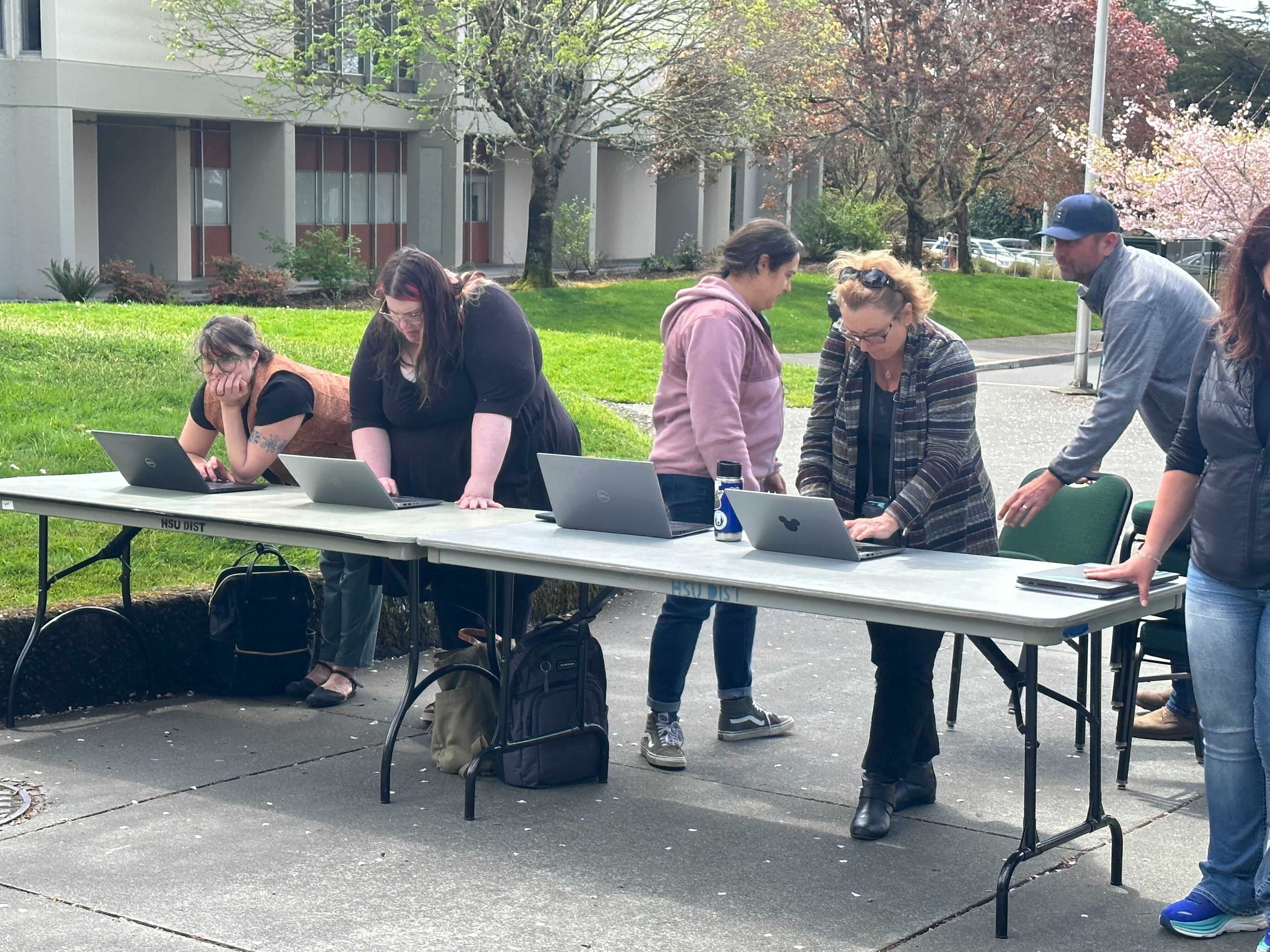
University employees set up a table where students may surrender if they so wish.
If You Have Strong Feelings About Julia Morgan’s ‘Federation Hearthstone,’ a Four-Sided Fireplace in Humboldt Redwoods State Park, You’re Going to Want to Get Your Ass to Sacramento Next Week
LoCO Staff / Friday, April 26, 2024 @ 10:37 a.m. / History
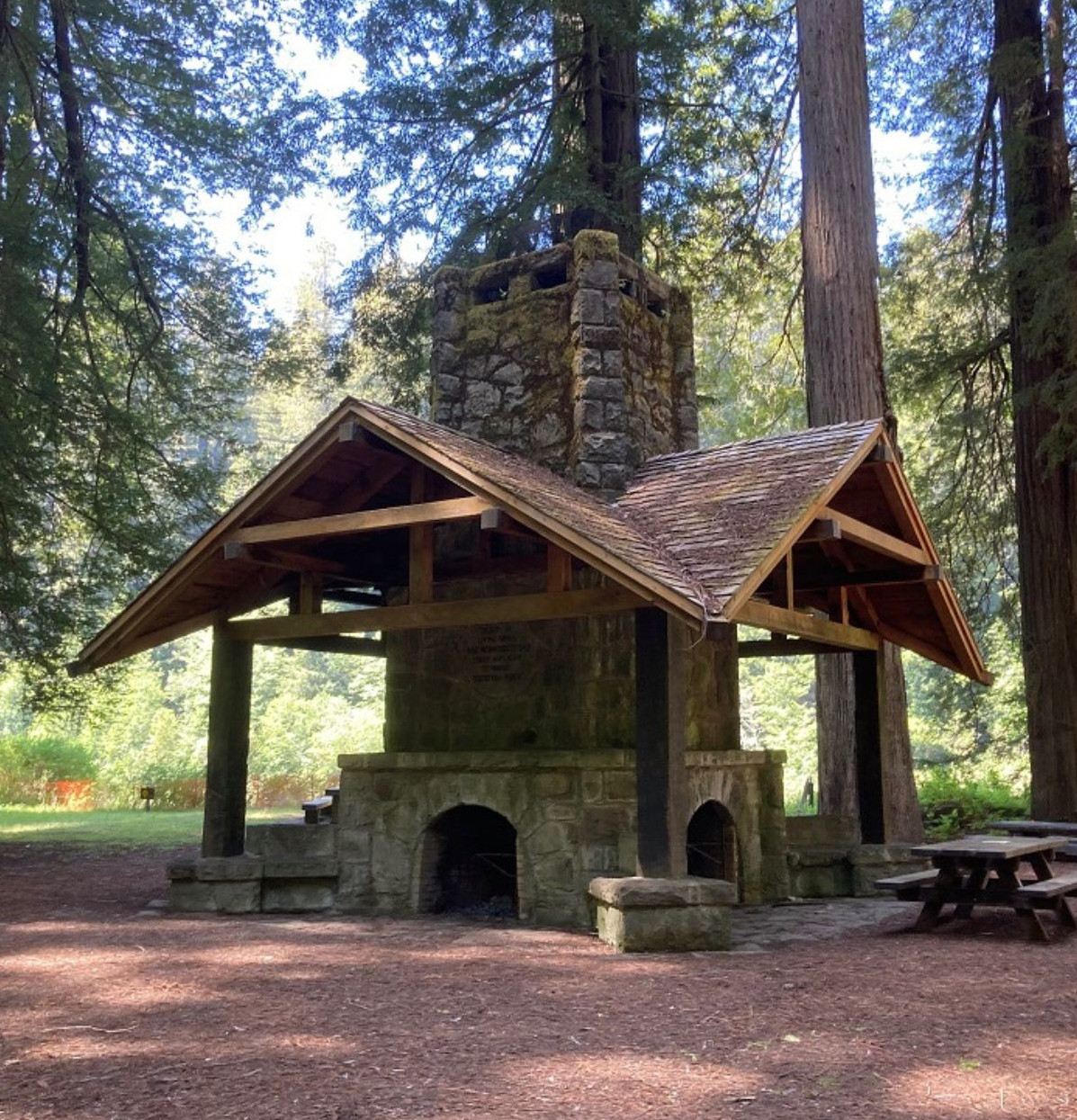
Photo: Stacey De Shazo, via California State Parks.
Or, actually, you can just join the Zoom too, looks like. Either way.
Press release from the California Department of Parks and Recreation:
The State Historical Resources Commission (Commission) will meet in Sacramento on Friday, May 3, at 9 a.m. and will consider nine properties recommended for placement on the National Register of Historic Places. Properties nominated include the Bell Canyon Equestrian Center and Scarlett Ranch, both in Ventura County, a four-faced fireplace designed by famed architect Julia Morgan located in Humboldt Redwoods State Park, and a Craftsman style clubhouse designed for the Petaluma Woman’s Club by architect Brainerd Jones. The Commission will forward properties nominated to the National Park Service for final consideration by the Keeper of the National Register of Historic Places.
WHAT: State Historical Resources Commission Meeting
WHEN: Friday, May 3 at 9 a.m.
WHERE: California Natural Resources Agency Auditorium, 715 P Street, Sacramento, CA 95814.
WHO: State Historical Resources Commissioners, Office of Historic Preservation staff, and members of the public.ADDITIONAL DETAILS: The full agenda and information for attending the meeting in person or joining virtually through Cal-Span or Zoom is available at parks.ca.gov/PublicNotices. For more information about the Commission and the Office of Historic Preservation, visit ohp.parks.ca.gov.
California State Parks supports equal access. If you are in need of a reasonable modification or special accommodation for the meeting or in accessing the agendas or submitting comments, please contact the Office of Historic Preservation at (916) 445-7000 or email calshpo.shrc@parks.ca.gov.
Cal Poly Humboldt Responds to Protesters’ Demands, Explaining Investments and Principles While Promising Consequences For Those Who Break the Law
Ryan Burns / Friday, April 26, 2024 @ 10:27 a.m. / Activism , Cal Poly Humboldt
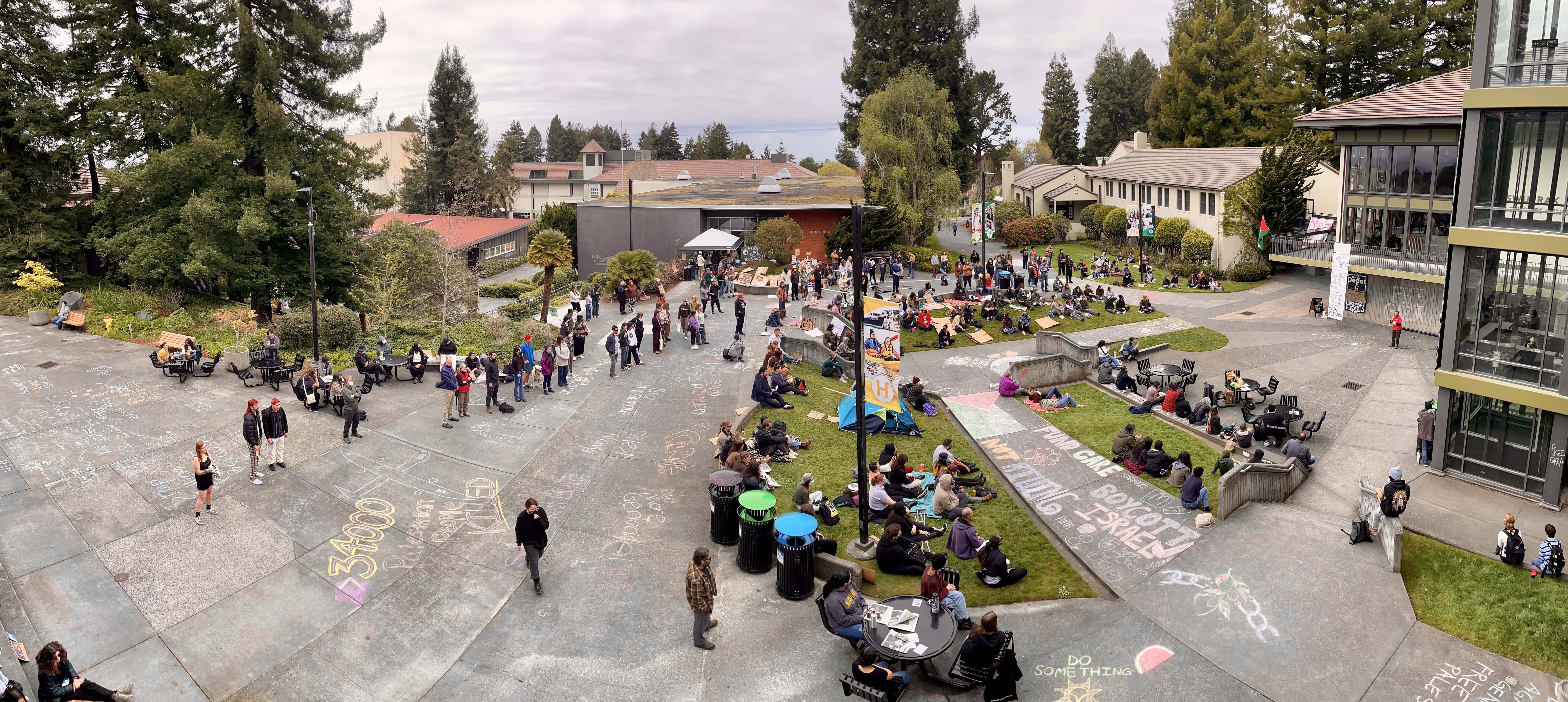
Photo by Ryan Burns.
###
Shortly after 10 o’clock this morning, Cal Poly Humboldt posted the following response to demands from the protesters who have been demonstrating on campus and occupying Siemens Hall in support of Palestinian liberation:
The following was shared yesterday during a conversation with student protestors.
This is an initial response intending to make a good faith effort to respond, and is meant to lead to additional dialogue.
###
The Cal Poly Humboldt pro-Palestine protests have elevated a remarkable number of important questions, opened a space for difficult, meaningful conversations, and also raised concerns about what principles of the community we bring into spaces of disagreement. Even in the midst of this challenging period for our community, we remain firmly rooted in our University’s purpose: to provide the highest quality and affordable college education built on the contributions of diverse students, staff, and faculty who are committed to a just and sustainable world.
We write today in this spirit, while also reasserting our responsibility for civil discourse and fact-based debate. In particular, we would like to provide context and feedback to the stated demands of the protesters. They have asked the campus to:
1. Disclose all holdings and collaborations with Israel.
It is important to highlight that Cal Poly Humboldt is among the higher education leaders in environmentally and socially responsible investing. In 2014, with extensive student involvement, an investment strategy focused on reducing investments in the fossil fuel industry and in tracking investments in socially concerning sectors was adopted. Last year, again with student involvement and assistance, a new policy focused on Environmentally & Socially Responsible (ESR) investing was adopted. This policy takes a “positive investment” approach to select funds with strong environmental, social, and governance practices, and again puts Humboldt at the leading edge of responsible investing within higher education.
The investments in the University’s endowment does not include any direct investment in defense companies or any securities issued by Israeli companies or organizations, or to defense firms. In fact, because of the relatively small size of the endowment, the investment strategy does not include direct investment in any specific companies or securities. Instead, the portion of the investment in securities is in mutual funds, which are bundles of many securities that reflect the portfolios of numerous different investment managers.
So any holdings of the securities in question would represent indirect investment. Our estimates put the potential indirect investment in the areas that are asked about at less than 1% of the investment portfolio of more than $51 million. Of this, our estimate of potential defense investment is less than 0.5% of the entire portfolio, though that can fluctuate over time. This estimate is probably high as these companies do not produce weaponry but rather components of various industrial products (like wind turbines and aviation parts). The portion of the indirect investment in Israeli companies or organizations is likewise less than 0.5%, and can fluctuate over time. These securities, which again are bundled in different mutual funds, are software companies and banks, and there is also less than 0.1% in bonds. Any of these holdings could be sold by the fund manager at any time.
We would welcome the opportunity to discuss the investment policies in the future.
2. Cut all ties with Israeli universities.
Cal Poly Humboldt has a commitment to global engagement. While we have no current ties with Israeli Universities, we are open to connecting with universities across the world in an effort to build connections and expand understanding. The Cal Poly Humboldt catalog listing for a study abroad program with the University of Haifa in Haifa, Israel is a California State University International Study Abroad (CSU IP) program, not a Cal Poly Humboldt program. The CSU IP Haifa program is not currently enrolling students. Current Bilateral Exchange Programs with Cal Poly Humboldt are listed online.
Information about agreements with other universities is also available on campus websites or with an email to the Dean of Extended Education & Global Engagement. We encourage our students to speak and engage with faculty as well as campus administrators. Our doors are always open to our students.
3. Divest from companies and corporations complicit in the occupation of Palestine:
Please see the investment information in #1. We do not have a way of measuring the specific language included in this request.
4. Drop charges against and halt the harassment of student organizers by law enforcement.
University policy and conduct violations will follow established procedures, and there will be consequences for actions that violate policy or law. However, students who elect to evacuate the building and support efforts to clear the building will have their actions considered as a mitigating factor within those processes.
5. University to publicly call for a ceasefire and end to the occupation of Palestine.
Cal Poly Humboldt is committed to social justice and the Graduation Pledge to guide everyone’s social and environmental consequences of their decisions. We are supportive of a peaceful and just world which affords the opportunity for all human beings to flourish and achieve their potential.
6. “We want the university to either amend or remove the time, manner or place clause [of its free expression policy] which allows them to call the police on students for organizing in ways that they deem inappropriate.” (Link)
The University’s Time, Place and Manner (TPM) policy exists to protect the rights of the entire campus community to a secure environment that is conducive to the pursuit of knowledge, freedom of inquiry, freedom of speech and freedom of assembly. The policy is content-neutral in its approach to speech and assembly, protecting our freedoms while also ensuring that the rights of the rest of the campus community to a safe and secure environment are protected. Part of protecting our rights is protecting the health and safety of persons, and the security of property, for which uniformed police officers may be required.
###
PREVIOUSLY:
- (VIDEO) DAY FOUR: Occupy Cal Poly Humboldt Protester Details Group’s Demands, Motivations and Views on President Tom Jackson, Law Enforcement and Their Campus Impact
- BREAKING: Cal Poly Humboldt Faculty Pass Vote of No Confidence in President Tom Jackson Amid Ongoing Student Protest
- DAY THREE: (PHOTOS) Student Protesters List Demands, Expand Graffiti Messaging and Voice Camaraderie on Third Day of Cal Poly Humboldt Campus Occupation
- Cal Poly Humboldt Says Campus Will be Closed Through at Least the Weekend Due to Ongoing Pro-Palestine Protests
- DAY TWO: The Morning After Cops Clash With Student Protesters, CPH Campus is Closed, Occupied Building Barricaded
- Legendary Rebellious Rapper Chuck D’s Cal Poly Humboldt Event Canceled By In-Progress, On-Campus Rebellion
- DAY ONE: Major Pro-Palestine Protests at Cal Poly Humboldt Provoke Massive Police Response; Protesters Occupy Siemens Hall; Reports of Violent Force Between Activists and Law Enforcement
A New California Rule Tries to Hold Down Your Health Care Costs. Here’s How It Works
Kristen Hwang / Friday, April 26, 2024 @ 7:40 a.m. / Sacramento
You won’t notice it right away, but a new California state agency took a major step this week toward reining in the seemingly uncontrollable costs of health care.
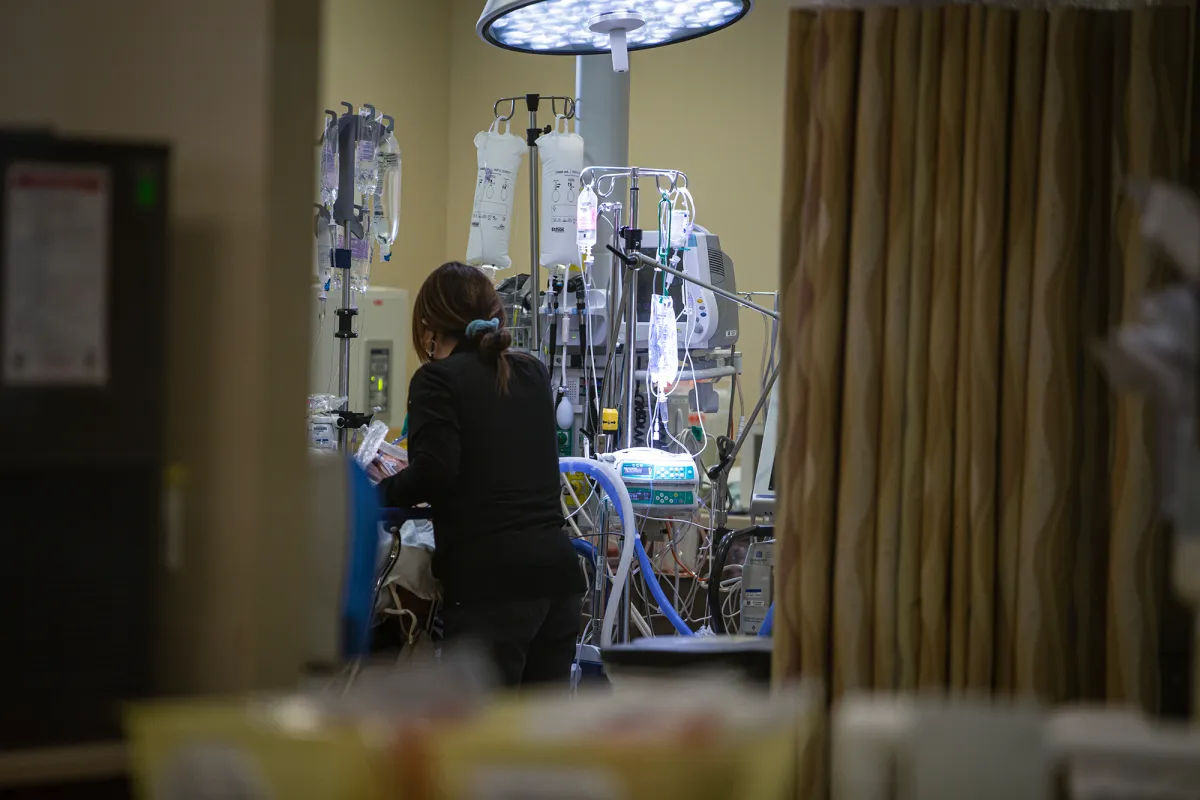
The Office of Health Care Affordability approved the state’s first cap on health industry spending increases, limiting growth to 3% by 2029. This means that hospitals, doctors and health insurers will need to find ways to cut costs to prevent annual per capita spending from exceeding the target. Between 2015 and 2020, per capita health spending in California grew more than 5% each year, according to federal data.
A board appointed by Gov. Gavin Newsom and the Legislature on Wednesday approved the new regulations in a 6-1 vote.
Health and Human Secretary Dr. Mark Ghaly, who chairs the board, said the regulations recognize that Californians are struggling every day to pay for health care and the state has a role in helping them.
“We have a place in making sure it becomes more affordable,” Ghaly said.
Hospitals, doctors and insurers battled over the regulations for months, arguing that rising inflation and labor costs would make the target impossible to achieve. An earlier proposal would have moved more aggressively to cap costs. The final version gives the industry time to rein in spending.
Ghaly said he is confident health care industry leaders will be able to find solutions to meet the new target. “When that happens, it’s going to be great for Californians.”
How does it work?
Increased health spending most often translates to higher out-of-pocket costs for consumers in the form of premiums, deductibles and copays. The annual spending benchmark would require health care providers to limit spending growth to 3.5% next year, decreasing to 3% by 2029. Providers — including hospitals, doctors groups and health insurers — will have to submit spending data to the state to demonstrate that they are complying with the cap.
The affordability office also has authority to enforce penalties, including performance improvement plans and fines, for organizations that exceed the benchmark. It will not enforce penalties until 2029.
Assemblymember Jim Wood, a Democrat from Ukiah, at the meeting urged the board to send a clear message to Californians that the state is taking affordability seriously. Wood spearheaded the legislation that created the office in 2022.
“It is not an exaggeration to say that people are deciding whether to get food on the table or get their medicines,” Wood said. “This is not an exercise. This is an effort to impact the real life experiences of people in California.”
How will providers lower health care costs?
Ultimately, it’s up to the health care organizations.
The board hopes health care organizations will crack down on inefficient and wasteful health spending, such as administrative inefficiency and redundant or poorly coordinated testing. But it doesn’t want to discourage spending on primary care and behavioral health. The affordability office will monitor spending in those areas to ensure organizations do not reduce services or access to preventative care.
Will Californians see cheaper health care?
Yes, but it may not feel like it.
The growth cap is not a mandate for providers to lower prices. Californians will not pay less for health insurance next year than they did this year. For those who already can’t afford health care — some estimates peg that number at more than 50% of Californians — the cap won’t bring any immediate relief.
The goal of the cap is to prevent future prices from increasing uncontrollably. This year, health insurance premiums on the state’s Affordable Care Act Exchange increased an average of 9.6% statewide with double-digit increases in many regions. Personal health care spending shot up 60% between 2010 and 2020, reaching $405 billion, according to federal data. That’s $10,299 per person. Household health spending has also grown twice as fast as wages, according to the Kaiser Family Foundation.
In an effort to recognize how many Californians can’t pay for health care, the affordability office tied the cap to the average annual median household income growth, which has historically been about 3% over the past two decades.
Will California succeed?
California is not the first state to try to bring health care costs down. Eight other states have similar cost benchmarks, although California’s is one of the more aggressive targets.
Massachusetts, the first state to set a health spending benchmark, has largely met its target growth rate of 3.6% over the past 10 years.
In recent years however, with the impact of the COVID-19 pandemic, states have found it harder to contain costs. Connecticut, Delaware and Massachusetts significantly surpassed their spending targets between 2020 and 2021 primarily because of increased health care use, according to a report by the policy journal Health Affairs.
Who opposed the spending cap?
Former state Sen. Dr. Richard Pan was the sole no vote on the new regulations, arguing that the state needed to recognize how changing population needs like aging would affect future health care spending.
Pan and groups representing hospitals and doctors have argued that the state should have set a more “realistic” target rather than one most organizations will fail to achieve.
In a letter to the board, the California Hospital Association proposed a 6.3% target for 2025 and urged state regulators to consider how inflation, aging and a new law that raises the state minimum wage for health care workers would drive up costs. Association President Carmela Coyle said in a statement after the vote that the new regulations will worsen access to care as organizations are forced to make cuts.
“The office is charged by law to do more than limit spending,” Coyle said. “It’s imperative that the board analyze the impact of its decision on patients and create a process to reconsider future targets to protect access to equitable, quality care for every Californian.”
The California Association of Health Plans, representing most insurers, and the California Medical Association, which represents doctors, each voiced support for the phased-in 3% target this week but have previously pushed the affordability office to consider other options.
“Adopting a 3% health care spending growth target, which most physician practices and health care entities will be unable to meet, will negatively impact access to health care for Californians,” medical association President Dr. Tanya Spirtos wrote ahead of the vote.
Who supported the health spending cap?
The new regulations are largely supported by unions, employers and consumer advocates. Supporters turned up in force at the vote to give examples of how housekeepers, bartenders, teachers, carpenters, nurses and other workers cannot afford health care even with insurance and frequently forgo raises to pay for ever-growing medical spending.
Learn more about legislators mentioned in this story.
“Consumers, particularly people of color, are burdened by record medical debt and are making daily choices between health care, housing, and food,” said Kiran Savage-Sangwan, executive director of the California Pan-Ethnic Health Network, at the meeting. “If we want a different outcome, we need to change the incentives in our system.”
Anthony Wright, executive director of Health Access California, said the new spending target was “long-awaited, but welcome news for Californians.”
“California consumers, patients and payers have been screaming for years about the cost,” Wright said. “This will provide some downward pressure on what has been ever-increasing hikes in our health care costs.”
###
Supported by the California Health Care Foundation (CHCF), which works to ensure that people have access to the care they need, when they need it, at a price they can afford. Visit www.chcf.org to learn more.
The Calmatters Ideas Festival takes place June 5-6! Find out more and get your tickets at this link.
CalMatters.org is a nonprofit, nonpartisan media venture explaining California policies and politics.
OBITUARY: George ‘Jim’ Habib, 1945-2024
LoCO Staff / Friday, April 26, 2024 @ 6:56 a.m. / Obits
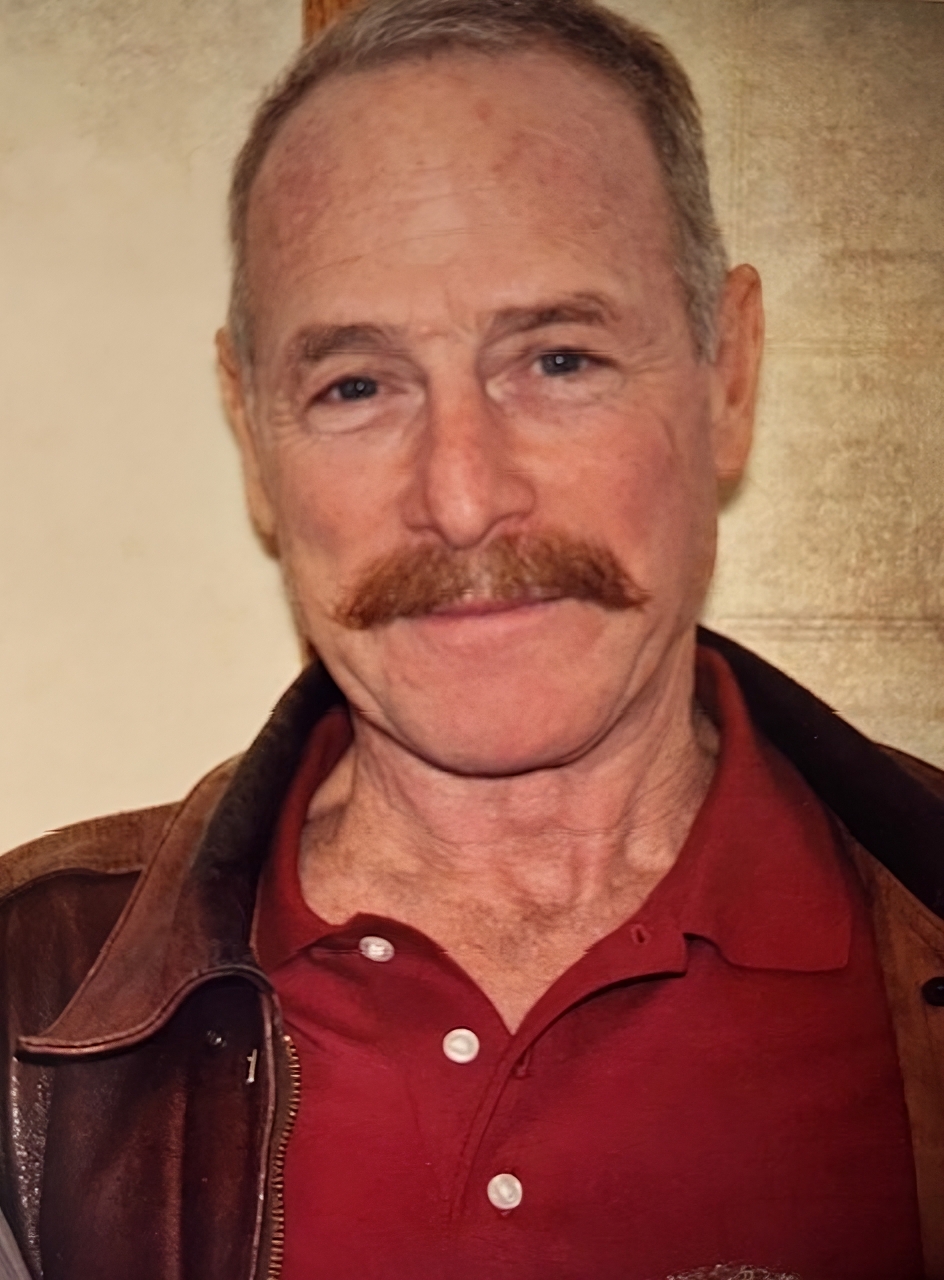
On February 2, 2024 George “Jim” Habib passed away peacefully surrounded by his loving
family and closest friends.
Born on June 22, 1945 in Oxnard, Jim quickly developed a reputation for his penchant to conquer the unknown and to be involved in all things adventure. As a young man, he was often found fixing up old cars, sailing around Catalina Island or hitchhiking his way across the U.S and many parts of Europe. A devoted duty to his country, Jim enlisted in the Marine Corp in July of 1966 and shortly after, was deployed to Vietnam with Marine Aircraft Group (MAG) 13 as an aircraft maintainer in Chu Lai.
Propelled for exploration, Jim moved to Humboldt County where he met his beloved wife of 48 years, Gloria Wood (nicknamed Jake), who was also searching for an untethered, fulfilling life many parts of the rugged North Coast of California offered. Establishing a budding life together, Jim was drawn to the ocean and began fishing in 1972 on the F/V Jumping Jack. Those that know Jim well, would not be surprised as he quickly became the skipper of his own boat, named the Shirttail until 1976, and then the legendary Challenger from 1977-2008. After many successful seasons, as well as some breathtaking moments, he was always known to be one of the first to go out and the last one to come back, earning his nickname, “White Water Jim”.
In 2008, a major winter storm tested Jim’s fortitude once again as the Challenger was ripped from its moorings and subsequently beached and ultimately destroyed. Later, he was quoted in the Times-Standard for saying, ”It was still upright, wallowing around, but it was done.” Despite this tragedy, Jim forged ahead by building his prized fishing vessel, aptly named the Defender. Still to this day, Jim’s influence can be felt throughout Humboldt’s tight-knit fishing community and echoed on the original Trinidad pier.
Jim’s passionate curiosity and innate nature to reveal the wonders of the world to those he held dearest, are reflected in his daughters and granddaughter’s willingness to capture life to the fullest. He will always be remembered for lending a hand to those in need, from towing wayward fishermen back to harbor, to being a steady hero in his daughter’s lives. He was always ready and willing in the moments that mattered no matter how big or small.
Jim’s legacy will be his kind heart, honest nature, pride in workmanship, and his unconditional love for his daughters, granddaughters, and beloved wife.
Jim is survived by his wife of 48 years, Gloria “Jake” Habib, daughters Corinna Mosher (Habib) and JoAnna Pifferini (Habib), granddaughters Cleo Pifferini and Josie Pifferini, sons in-law Tim Mosher and Travis Pifferini, sister Linda Liker, nieces Amy Moore, Heidi Barrett and nephew Karl Lepper.A celebration will be held July 13 at 1 p.m. at the Trinidad Town Hall after the scattering of Jim’s ashes at sea. This will be a time for family and friends to honor, share stories and celebrate the legend of Jim Habib.
###
The obituary above was submitted on behalf of Jim Habib’s loved ones. The Lost Coast Outpost runs obituaries of Humboldt County residents at no charge. See guidelines here.


