Young lungs breathing pristine Humboldt County air. | Photo: Stephanie McGeary.
###
Rejoice, Humboldt. Step outside, breathe deep and shout “Hooray!” When you’re done, go ahead and take a few more deep inhales, because unless you’re standing near a vehicle tailpipe, a 4/20 party or the business end of a local farm animal, the air you’re breathing might just be the cleanest in the entire state.
That’s according to the American Lung Association’s 2023 State of the Air report, which issues letter grades to counties across the country based on two air quality measurements: ozone and particle pollution.
Ozone pollution, the main ingredient in smog, can trigger a variety of health problems, leading to coughing, difficulty breathing, inflamed airways and increased frequency of asthma attacks.
Humboldt County is virtually smog-free.
With 49 out of California’s 58 counties providing data analyzed in the report, Humboldt is one of just nine counties to receive an “A” grade, with 0.0 high ozone days tallied over the time period covered. (The data from the report, collected in 2019, 2020 and 2021, was taken from the 10,000-plus air quality monitors in the EPA’s Air Quality System. Not all counties have monitors for either ozone or particle pollution.)
As for particle pollution, Humboldt County received a B grade, which may sound sorta “meh” until you learn that it was the highest grade in class. Yolo County got a C; Imperial, Lake and Ventura counties all got Ds; every other county on the report received a failing grade.
While Humboldt County experienced a bit of air pollution in recent years as smoke from inland wildfires drifted our way, most days here are pristine. In contrast, the vast majority of Californians live in communities with unhealthy levels of smog or fine particles.
That may surprise you, but the truth is that much of California’s air is very, very bad. As CNN notes, the Golden State accounts for six of the 10 worst cities in the country in terms of annual particle pollution. California also has four of the five worst cities for ozone pollution: Los Angeles-Long Beach, Visalia, Bakersfield and Fresno-Madera-Hanford.
Nationwide, nearly 36 percent of Americans — 119.6 million people — live in communities with failing grades for unhealthy levels of ozone or particle pollution, according to the American Lung Association. That’s actually 17.6 million fewer people breathing unhealthy air than in last year’s report.
The authors attribute the country’s falling levels of ozone pollution to the success of the Clean Air Act. Since President Richard Nixon signed that act into law in 1970, emissions of outdoor air pollutants have fallen 78 percent, according to the EPA.
“However,” the State of the Air report says, “the number of people living in counties with failing grades for daily spikes in deadly particle pollution was 63.7 million, the most ever reported under the current national standard.”
People of color and those in western states are disproportionately affected, the report found. Of the nearly 120 million people living in areas with unhealthy air quality, more than 64 million (54 percent) are people of color.
What’s causing all this pollution? Driving is the big one. Transportation, including fuel production and the engined of our gas-powered vehicles, is responsible for roughly half of greenhouse gas emissions and 80 percent of air pollutants in California, according to the California Air Resources Board.
Another factor? Wildfires, which lead to more ozone and particle pollution. Nationwide there were 14,407 fires in 2021 alone, according to the National Interagency Fire Center. “Those fires are why the regions with the highest concentrations of air pollution are largely in the West,” CNN says.
As noted by the Los Angeles Times, California is taking action. “Following a 2020 order from Gov. Gavin Newsom, the California Air Resources Board developed a plan to ban sales of new gas-powered vehicles by 2035,” the paper says in a story published earlier today. “Similar state restrictions on diesel-burning big rigs were also recently given the green light by federal regulators.”
How do we improve matters further? The report includes a list of suggestions for both individuals and governments. For people they recommend that you prioritize walking, biking and public transit for your transportation. Also, conserve electricity, purchase your power from clean sources and refrain from burning leaves, trash and wood whenever possible.
For local governments, the researchers recommend that jurisdictions adopt a climate action plan. (Humboldt County supervisors are working to adopt one.) They also suggest buying zero-emission fleet vehicles and set purchasing goals for renewable, non-combustion energy.
Of course, most residential customers in the county already get their electricity through Redwood Coast Energy Authority, which has a goal of purchasing 100 percent renewable power by 2030. And before long we could have massive floating wind turbines generating power off our coast.
As two California higher education systems continue to feud, lawmakers have entered the equation using a route usually reserved for irate retirees: A strongly worded letter.
The matter at hand — the 1,300-student Feather River College in rural Plumas County offering a bachelor’s degree in applied fire management — has become a lightning rod issue, sparking delays and anger on both sides.
“I was quite frankly shocked and disheartened,” said California StateUniversity Interim Chancellor Jolene Koester at a trustees’ meeting, claiming that the community college system had “acted unilaterally” and out of accordance with the law by approving the bachelor’s degree program at Feather River.
At the same meeting, Koester stressed that each component of the state’s higher education system — the 116 community colleges, 23 California State Universities campuses, and 10 University of California campuses — play a distinct role.
Koester’s objection stems from the Master Plan for Higher Education California adopted in 1960 and tweaked occasionally since. In that plan, the University of California system has sole jurisdiction to award doctorate degrees; the UC and CSU systems should both award bachelor’s degrees; and community colleges are supposed to function as vocational instruction, plus undergraduate education for students who then transfer to a UC or CSU.
The crux of the current kerfuffle is a law that went into effect last year that allows the Community College Chancellor’s Office to establish as many as 30 new bachelor’s degree programs every year at any one of its 116 colleges, with certain caveats. Most importantly, the bachelor’s degree program cannot be “duplicative” of “existing baccalaureate programs offered by state universities.”
Cal State officials have argued that the applied fire management program at Feather River duplicates a bachelor’s program at Cal Poly Humboldt, though Humboldt’s doesn’t yet exist. The two colleges are roughly 270 miles apart, a five and a half hour drive. The Feather River program would theoretically enroll 20 to 25 students in its first year.
A ‘red herring’
To the CSU Academic Senate, the debate is also about enrollment and money.
In a resolution last year, it called on the CSU system to study the financial impact of allowing community colleges to award bachelor’s degrees, which they fear could lead to “reduced enrollment in CSUprograms, a reduction in revenue from student fee and potentially a reduction in State support.”
Community college administrators see a different challenge. “A great example is nursing,” said then-Community College Chancellor Eloy Oakley at a July 2022 meeting: “It is clear that there is a need (for nursing degrees), that the CSU cannot fulfill that need, so why wouldn’t we be able to fulfill that need?”
The pushback from CSU officials towards bachelor degrees, Oakley said to his colleagues, is a “red herring“. In reality, he said, it is about “perceived competition for enrollments.”
“I wasn’t expecting (the legislators’ letter).” — lizette Navarette, interim chancellor of California Community College
Koester argues that the proposed fire degree at Feather River College is essentially the same as the one Cal Poly Humboldt plans to offer. Moving forward with the program would jeopardize the “trust” between the two higher education systems, Koester wrote to the Community College Chancellor’s office on Jan. 23.
Community college leaders decided to proceed anyway.
As new applications for bachelor’s programs poured in this year, and the leaders from both systems refused to budge on a plan to resolve future disagreements, Senate Education Committee Chairperson Josh Newman, a Brea Democrat, and Assembly Higher Education Chairperson Mike Fong, a Monterey Park Democrat, issued a joint letter on Tuesday, asking the community college system to put the new applications to a “pause.”
Wildfire country
“I wasn’t expecting (the legislators’ letter),” said Lizette Navarette, interim chancellor of California Community College, in an interview with CalMatters today. “Is this signaling towards legislation that they’re going to run? Is this an indefinite ‘pause?’”
Although the letter comes from the Legislature, she said the language is “consistent with some of the other letters the CSU has sent.”
Nonetheless, she affirmed that her office would “of course want to work with the legislature” on its requests.
Neither Newman nor Fong responded to questions from CalMatters regarding the letter. A CSU spokesperson said the Cal State system wouldn’t speculate about what it would do if the community college system doesn’t pause, per the legislators’ request.
“We expect that the final approved bachelor’s program will not duplicate a CSU or a UC regardless of location,” the legislators wrote, which runs counter to the interpretation that the community colleges have made.
The colleges see “relative geographic location” as one reason why a school may deserve to award a certain bachelor’s degree.
“You have a ready-made (wildfire) laboratory here that nobody is focusing on.” — Kevin Trutna, president, Feather River College
Feather River College is a prime example. Nestled in the High Sierra two hours north of Lake Tahoe, Feather River is a small, rural school with the setting to prove it.
“I can walk out on my campus and look at the hill across the valley and see a burnt hilltop,” Kevin Trutna, president of the college, told CalMatters. “Plumas National Forest, Lassen National Forest, Lassen National Park. Three-fourths of our county is federal or state forest. You have a ready-made (wildfire) laboratory here that nobody is focusing on. This is our speciality.”
Both the Camp and Dixie fires tore through the Feather River Valley in 2018 and 2021, respectively, leaving nearby towns like Greenville in ashes.
“We cannot sit here and let Humboldt State (Cal Poly Humboldt) or Cal Poly San Luis Obispo or Chico or anybody say ‘Hey, this is our business. We’ll send you people out there,’” Trutna said. “We need to do something to be proactive to preserve the rest of our national forest.”
When Feather River College submitted an application in January 2022 to offer a bachelor’s degree in “Ecosystem Restoration and Applied Fire Management,” two professors from Cal Poly Humboldt, as well as professors from Cal Poly San Luis Obispo, Cal State Chico, UC Davis, and the nearby UC Cooperative Extension school all submitted letters in support.
Four months later, then-Associate Vice Chancellor of the Cal State University system Alison Wrynn objected to the Feather River program, arguing that it duplicated Cal Poly Humboldt’s soon-to-be fire management program.
Other California community colleges face scrutiny
While the Feather River program has become the most contentious, other community colleges faced similar pushback. Out of the nine colleges that were approved to offer bachelor’s degrees under the new law, at least four faced objections from CSU campuses.
Cal State San Marcos, for example, said that San Diego City College’s application to award bachelor’s degrees in “Cyber Defense and Analysis” would be duplicative of a program that San Marcos intended to build.
The nearby CSU campuses later dropped their opposition to San Diego City College’s program, but communication hiccups between the CSU and community college administrators led to additional delays to the program’s approval, the Voice of San Diego reported.
If there’s disagreement about whether a community college should proceed with a bachelor degree program, the administrators at each higher education system establish a “written agreement” that explains whether the objections have been resolved, according to the 2021 law.
The new law stipulates that the entire approval process, including any conflict resolution, should take no more than five months. It ultimately took more than a year for the community college and California State University officials to reach agreements regarding eight of the nine proposed bachelor’s degree programs.
The agreement that wasn’t agreed to
The Feather River dispute was never resolved.
“A written agreement was shared with the CSU and we didn’t really get a response back,” said Navarette.
That’s because the CSU system didn’t agree to it, said Nathan Evans, a CSU associate vice chancellor.
In the legislators’ letter, they take aim at the community colleges’ actions, writing that “written agreements” need to be signed by the “impacted parties.”
Instead of moving forward with the fire management program, Evans wants to see Feather River College and Cal Poly Humboldt collaborate on a joint degree. He pointed to programs across the state that help students work towards a certain major through two years of school at community college and two years at a four-year university. In another scenario, he referenced how professors from Cal State Fullerton and San Bernadino travel to Riverside City College or teach remotely so that community college students can get a bachelor’s in nursing in less than three years.
But Trutna doesn’t see those options as realistic. “Our students just can’t move over there for two years,” he said, adding that “this is a hands-on vocational degree, not something you can do remotely.”
And so, in March, the community college board of governors approved Feather River’s program. The law grants the community college board with the ultimate decision-making authority, leaving CSU leaders to search for a different recourse.
Meanwhile, the 14 colleges that just applied to launch their own bachelor’s degree programs will go on hold as they wait and see what agreements, if any, the two higher education systems can reach.
###
CalMatters.org is a nonprofit, nonpartisan media venture explaining California policies and politics.
Press release from the Humboldt County Sheriff’s Office:
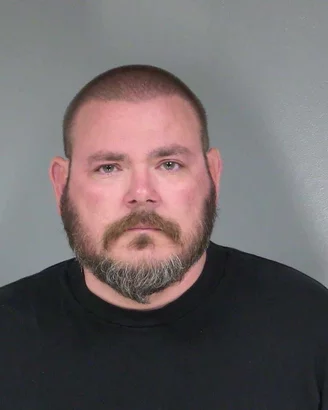
On March 24, 2023, at about 5:14 a.m., the Humboldt County Sheriff’s Office was contacted regarding a domestic disturbance at a McKinleyville residence. The incident involved an off-duty Lieutenant who is reported to have brandished a firearm and made threats to his estranged wife and her boyfriend inside the home. When deputies arrived at the residence, the parties were separated, and one involved person had left the scene. No one was reported to be injured during this incident.
Humboldt County Sheriff’s deputies conducted a thorough investigation into this case in conjunction with the Humboldt County District Attorney’s Office. The investigation was then forwarded to the District Attorney for review and prosecution decision. The District Attorney filed charges and an arrest warrant was issued. Today, the employee, 46-year-old Samuel David Williams, turned himself in to the Humboldt County Correctional Facility where he was booked on charges of brandishing a firearm (PC 417(a)(2)) and criminal threats (PC 422). Williams has been on paid administrative leave since this incident and a Sheriff’s Administrative Investigation is also underway. Williams was hired on April 30, 2001.
“The Humboldt County Sheriff’s Office will not tolerate criminal behavior in its ranks and will hold employees accountable for their actions,” Sheriff William Honsal said. “We are committed to holding our employees to a high ethical standard. Acts such as this do not reflect our values, principles or commitment to our communities. We take these obligations seriously and strive to be a trusted law enforcement organization.”
Proponents of the Humboldt Cannabis Reform Initiative released a letter this morning calling out “numerous inaccuracies” and “inflammatory statements” made by the Board of Supervisors and various county officials in relation to a ballot measure that seeks to reshape the county’s cannabis industry.
If passed, the measure would restrict the size and number of new cannabis-growing operations across the county and impose a host of stringent rules that would forbid farms larger than 10,000 square feet, ban mixed-light and indoor grows, and limit cultivation permits to one per person/corporation per parcel.
Though county government had hoped to reach an accord with proponents that would forestall the initiative, one of those proponents — Betsy Watson — told the Outpost recently that they fully intend to put it before voters on the March 2024 ballot.
Proponents of the initiative argue that the “flawed conclusions” outlined in a recent analysis of the ballot measure “create a strong impression that the analysis was not intended to provide neutral, balanced factual information to the public, but rather to influence public opinion on a ballot measure” and could potentially violate the Political Reform Act.
“The county’s analysis is packed with factual errors, untruths, and distortions,” Mark Thurmond, one of the initiative’s authors, said in a prepared statement. “We’ve been talking with the Board’s ad hoc committee about the unfounded assertions and false statements in an effort to correct these misunderstandings of the Initiative, but it’s time to let the Board of Supervisors and the public know how wrong the county’s analysis is about the Initiative.”
The analysis, prepared by Planning and Building Department staff and presented to the board at its March 7 meeting, maintained that the county’s existing cannabis regulations “encourage a well-regulated cannabis industry,” whereas the initiative “could have the opposite effect by making compliance so difficult that the legal market is rendered not viable in Humboldt County.” While the initiative is “well intended,” staff’s analysis asserts that the measure, if passed, “will have dire consequences to the cannabis industry in Humboldt County.”
Many local cannabis farmers fear the ballot initiative would decimate their livelihoods and destroy what is left of Humboldt County’s storied cannabis industry. Others feel increased regulation would force cultivators back into the black market and have the opposite effect of the initiative’s stated intent.
“We know our community is hurting economically, but a lot of the headwinds facing the industry are beyond local control,” Watson wrote in a prepared statement. “Our initiative simply restores some environmental balance and removes the burden on watersheds from the county’s plan to triple the current number of permits, while protecting small farms and their vested legal rights.”
The letter touches on each issue identified in staff’s analysis of the initiative, ranging from permit renewal to the definition of “large-scale” cannabis operations to existing enforcement practices outlined in the county’s Commercial Cannabis Land Use Ordinance.
“The initiative is very, very, very clear in four different places that it does not mess with vested rights,” Watson told the Outpost in a recent phone interview. “If you’ve got a 20,000-square-foot grow on a crummy road – you’re fine. … The other thing is multiple permits. … [The initiative] does not affect any permit other than cultivation. … If you want to put in solar, you want to put in more water storage, it just doesn’t affect these things.”
On top of that, Watson pointed to a specific section in the initiative that grants the Board of Supervisors “as much flexibility as possible.”
According to Section 7. F. of the initiative, “The Board of Supervisors is authorized, after a duly noticed public hearing, to adopt implementing ordinances, guidelines, rules, and/or regulations, as necessary, to further the purposes of this Initiative.”
Proponents of the initiative have requested that the county “either withdraw the analysis or promptly correct the errors therein and refrain from using any public resources to further disseminate its inaccurate conclusions.”
Proponents of the Humboldt Cannabis Reform Initiative today released a letter from their legal counsel to the Humboldt County Board of Supervisors and County Planning Director John Ford. The letter details numerous inaccuracies and mischaracterizations in the County’s “Analysis and Recommendations” regarding the Initiative, which Planning Department staff presented at the Board’s March 7, 2023 meeting.
“The County’s analysis is packed with factual errors, untruths, and distortions,” said Initiative proponent Mark Thurmond. “We’ve been talking with the Board’s ad hoc committee about the unfounded assertions and false statements in an effort to correct these misunderstandings of the Initiative, but it’s time to let the Board of Supervisors and the public know how wrong the County’s analysis is about the Initiative.”
The letter refutes many of the County’s inaccurate claims that have been echoed by cannabis industry groups and the local press. For example, the letter rejects the County’s extreme interpretation of the Initiative as precluding environmental improvements on existing cultivation sites. The letter also explains that the Initiative will not require existing cultivators to upgrade their roads or prevent growers from obtaining tourism, dispensary, or bed-and-breakfast permits. Indeed, as the letter demonstrates, the Initiative will provide legal support for several uncodified practices the County claims it’s already following, such as phasing out generators, analyzing effects of new irrigation wells on streams and neighbors, and holding public hearings.
“We know our community is hurting economically, but a lot of the headwinds facing the industry are beyond local control,” said Initiative proponent Betsy Watson. “Our Initiative simply restores some environmental balance and removes the burden on watersheds from the County’s plan to triple the current number of permits, while protecting small farms and their vested legal rights.”
The letter also points out that further efforts to disseminate the County’s argumentative and inflammatory statements may run afoul of the California Political Reform Act, which prohibits public agencies like the County from spending public money to influence ballot campaigns.
“The County can’t use our tax dollars to take sides in this fight,” concluded Thurmond. “They have to be thorough, accurate, and fair—and that’s why the Board needs to retract its analysis of our Initiative. The seven thousand people who signed our petition deserve to be represented too.”
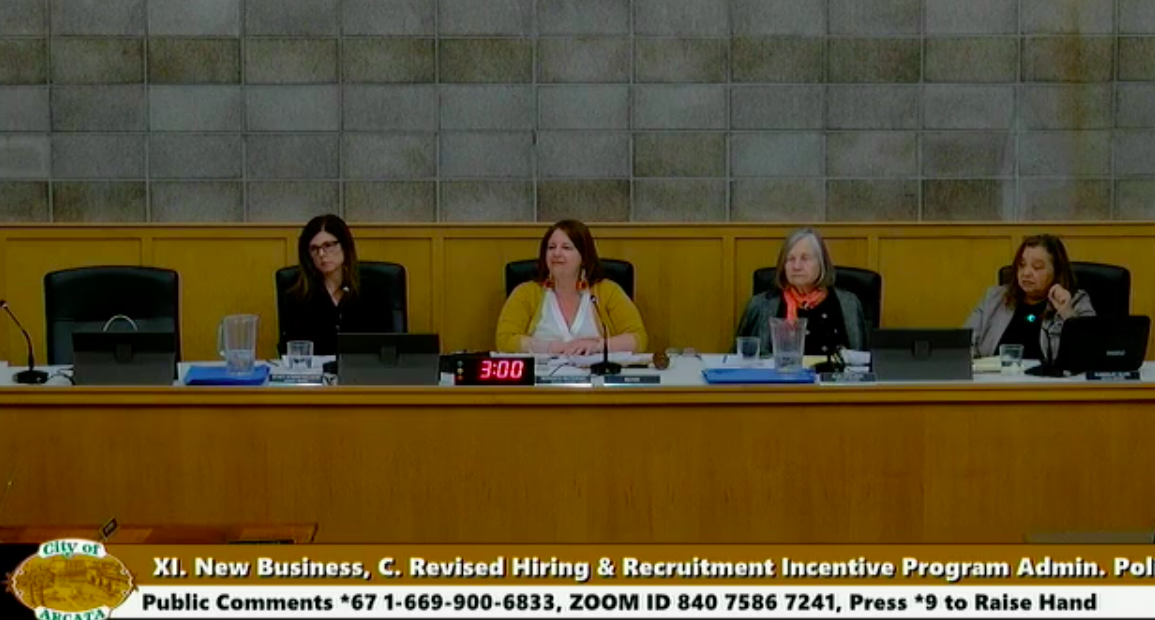
The Arcata City Council (from left) Stacy Atkins-Salazar, Meredith Matthews, Alex Stillman, Kimberly White (Sarah Schaefer was absent) | Screenshot from meeting video
###
The Arcata Police Department will now offer a $50,000 bonus for officers transferring from another California police department, after the Arcata City Council unanimously improved the large bonus increase during its Wednesday night meeting.
The APD has been struggling to hire and retain staff for a few years and the department has tried to increase its recruitment efforts and has already been offering a $15,000 transfer bonus for trained officers. But the department has continued to see a decrease in staffing and is currently down to 19 officers from 29 in the beginning of 2020.
Danette Demello, Arcata’s assistant city manager, told the council that there is one confirmed hire who is entering into the law enforcement academy, and there are two more potential hires who are currently going through background checks. But even with three new hires, APD will still be understaffed. Plus it will take at least three or four months for the new hires to be on patrol, Demello said.
This is why the department is pushing for lateral transfers – trained officers moving over from another police department, who can be in the field much sooner. Many other cities across the state have recently increased their bonuses to address short staffing, and Arcata Police Chief Brain Ahearn said that Arcata needed to increase their bonus significantly to remain competitive in the market.
The $50,000 bonus will be offered to police officers who are currently employed in the state of California, have successfully completed law enforcement academy and are “performing satisfactorily” in their current employment. The bonus will be spread out over two and a half years, with $10,000 paid on the first paycheck.
In addition to the increased transfer bonus, the council also approved a temporary $7,500 retention bonus to be paid to officers currently employed by APD once a year for the next three years, and $60,000 for the department to make improvements to its facilities. Some of the expenses will be covered by the revenue the department has saved since being understaffed and the rest will come out of the city’s general fund.
A few community members spoke during public comment, most of them praising our local police force and speaking in favor of granting the department’s requests.
“I do think we need to have more police on duty in our town,” Joanne McGarry, an Arcata resident and frequent city council meeting commenter, said to the council. “But I also think one of the things we need to do is not rely on the police so much for things that could be prevented.”
One commenter, Leslie Johnson, was not in support of more funding to the police department. Referencing a recent Times-Standard article about reports of roofies in Arcata, in which Chief Ahearn said he was not aware there was a problem with roofies, Johnson said that Arcata’s police are not doing their job effectively.
“Police are obsolete,” Johnson said during the meeting. “You are the army of the rich… cops have lost the privilege of protecting us. The entire police force is wasteful, ineffective and abusive.”
But the four councilmembers present (Arcata Mayor Sarah Schaefer was absent) all agreed that the police department was in dire need of additional staffing and felt that providing the funding for these recruitment efforts was absolutely necessary.
“APD is working incredibly hard and is stretched dangerously thin,” Councilmember Stacy Atkins-Salazar said during the meeting. “I believe it is our responsibility to keep not only our community supported and safe, but to do the same for APD.”
On April 19, 2023, at approximately 1112 hours, CHP Humboldt Communications Center received a report of a vehicle off the roadway, and down a steep embankment into a creek bed, on Price Creek Road west of Blue Slide Road. Emergency personnel responded to the scene and located a 2006 Ford Escape down a steep embankment, and on its roof. The reporting party, who was on scene and is a family member of the driver, stated she had located the driver deceased inside of the vehicle prior to the arrival of emergency personnel.
The driver, 60 year old Gene Stuart of Fortuna, had unfortunately sustained fatal injuries as a result of the crash and appears to have been the only occupant of the vehicle at the time of the crash. At this time, it is unknown exactly when this crash occurred, though family reports they had not had contact with him for several days and were actively searching for him at the time they located his vehicle.
The California Highway Patrol extends its sincere condolences to the family and thanks all responding agencies, to include the Ferndale Police Department, Rio Dell Police Department, Humboldt County Sheriff’s Department and Clyde’s Towing, for their assistance in managing the scene. The CHP Humboldt Area office is continuing its investigation and asks anyone who may have additional information to contact the California Highway Patrol at 707-822-5981.
Illustration by Miguel Gutierrez Jr., CalMatters; iStock
If you want to visit the Great Wolf Lodge in Manteca, there’s the price you’ll see when you first search for a room — and then there are add-ons and fees you’ll discover as you click through the booking process.
When Leslie Harvey took her kids to the hotel and water park last November, she paid a “resort fee” of $39.99 per day on top of the rate for the room. That fee doesn’t cover water park passes, which are included in the cost of the room, according to the Great Wolf Lodge’s website; it covers “amenities” including life jackets, towels, Wi-Fi, and the coffee makers and mini fridges in rooms.
The fee “provides for amenities and services that enhance the guest experience, and are very much in line with guests’ expectations when visiting a family resort destination,” wrote Jason Lasecki, vice president of corporate communications for Great Wolf Resorts. “Great Wolf Lodge fully discloses room rates and any fees to our guests throughout the booking process… and in the final estimate before customers complete their reservations,” and it requires third parties to inform customers about mandatory fees. When CalMatters went through the booking process for the Great Wolf Lodge in Manteca, the resort fee only became apparent after selecting dates, choosing a room, making a decision about late check out, and clicking through options to add activities and dining credits.
The fee didn’t take Harvey, who lives in the Bay Area, by surprise. She’s savvier than most — she’s been writing about travel on her blog, Trips with Tykes, for more than a decade. But, she said, she hears often from friends and readers who start planning their vacation, searching online, talking with their family about it, and “then they actually go through the booking screen, and they’re like, ‘Oh, gosh, this is going to be 20% more than we were budgeting.’”
Resort fees are increasing, Harvey said, and she’s now seeing fees at hotels that don’t have many amenities, including city hotels that are adding “urban destination fees.”
“They don’t do enough to justify that fee. I think it’s a ripoff.” — Brian Teeter, Sacramento Kings fan
It’s not just hotels. Fees and surcharges pop up at the end of all sorts of purchases. When a federal government agency said it was considering a rule to crack down on “junk fees,” Californians wrote in complaining about everything from fees at Pizza Hut to a $5,000 “paint protection” charge tacked on to a car purchase.
Figuring out the full price of a rental car or hotel can feel like a journey with unexpected twists and turns. A group of California state lawmakers have proposed a raft of bills that would require companies in several industries — including live events and apartment rentals — to be more transparent about total prices. Research mostly shows that people spend more when fees are tacked on to the end of a purchase compared with when all inclusive prices are listed up front.
When Brian Teeter bought tickets for the April 15 NBA playoff game between the Sacramento Kings and Golden State Warriors on Ticketmaster, each $749 ticket came with a $172 service fee. The tickets were expensive in part because it was the first time since 2006 that the Kings made it to the playoffs. Teeter, Sacramento resident and Kings fan, said he’s bought sports tickets before on other platforms, but he didn’t remember the fees being “that outrageous,” he said. “They don’t do enough to justify that fee,” he said. “I think it’s a ripoff.” He wishes the total price was clear on the front end, he said. Once you get far enough into the booking process to see the fees, most people, he said, are already committed to going.
Last-minute fees lead to splurging
When economist Stephen Tadelis worked for eBay in the early 2010s, executives were talking about switching ticket sales on Stubhub, a ticketing platform owned by the company, from a strategy known as “drip pricing,” where taxes and fees were revealed later, to displaying an all-inclusive price, Tadelis said in an interview with CalMatters. Executives hoped that the switch, which was made in 2014, would make customers more loyal and help Stubhub gain market share, Tadelis said. That’s not what happened. “Turns out that customers were not flocking to Stubhub” because it had all-inclusive pricing, said Tadelis, currently a professor at UC Berkeley.
Before executives switched back in 2015, Tadelis and some colleagues got permission to run an experiment, revealing fees at checkout for half of Stubhub customers while maintaining all-in pricing for the rest. They found customers who only saw the fees at final purchase wound up spending 21% more, and were 14% more likely to make a purchase than customers who saw the total price up front.
Other studies have found similar results. For a 2009 study, economists at UC Berkeley and the Federal Reserve Board added, in one supermarket, price tags to deodorants, hair accessories, and cosmetics that included the price after the 7.4% sales tax was applied. They found that sales of those items fell by about 8% compared to two control groups of products. In a 2006 study, researchers at Hong Kong University and UC Berkeley auctioned off CDs and Xbox games. They found that when a product was offered at an opening bid of one cent with a shipping cost of $3.99, it attracted more bidders and brought in more revenue compared to when they set the opening bid at $4 and the shipping fee at $0.
But not every study has the same finding. For example, in 2019, researchers at German universities manipulated how a three euro surcharge for 3D movies was presented online to customers of a large German multiplex cinema. For some customers, the fee was incorporated into the ticket price; others saw a note about a fee, but didn’t see the amount until later. They found that customers with the note were more likely to put a ticket in their online cart, but they also dropped out more often once the total price was revealed.
In general, though, the finding that people spend less when they’re presented with an all-inclusive price is “very consistent,” Tadelis wrote in an email.
The fees can pad out businesses’ bottom line. When Marriott was sued over its alleged “deceptive pricing tactics,” unsealed court documents showed that the hotel company had brought in more than $220 million from resort fees between 2012 and 2019.
Lawmakers in DC, CA fight fees
After years of proliferating fees, we may have entered the backlash. President Joe Biden has called on federal agencies and states to focus on the issue and discussed it in his State of the Union address. The Federal Trade Commission is exploring regulations that would crack down on “junk” fees; and Congress is considering bills on the subject.
Efforts by California lawmakers include:
Twobills aimed at the ticketing industry which, among other provisions, would require ticket sellers to disclose the total cost before the event is selected for purchase;
Twobills aimed at greater transparency in advertised rates for hotels, short-term rentals, and more;
A bill that would require rental car companies to only advertise rates that include mandatory taxes and fees;
A bill that would require landlords that advertise or provide quotes to include any mandatory fees.
And an overarching bill that would make it unlawful to advertise or display a price for a good or service that doesn’t include mandatory fees, besides taxes.
“Whether it’s ticketing of concerts, sporting events, whether it’s renting a car, whether it’s booking a room or staying at an Airbnb…the people who lose are consumers,“ said Robert Herrell, executive director of Consumer Federation of California, which coordinated a handful of the bills. “And disproportionately the people who pay the brunt of this are low- and moderate-income consumers, and consumers and communities of color,”
It’s still early in the legislative process — some of the bills haven’t yet gotten a first hearing — but groups are already lining up in opposition and support.
Consumer groups and Ticketmaster come down on different sides of the two bills aimed at the ticketing industry. Live Nation Entertainment, which owns Ticketmaster, opposes one bill not because of the price transparency provision, but because it would “regrettably steer more tickets to secondary markets where resellers and brokers get fans’ money instead of the artists and venues putting on the show,” wrote Jonathan Lamy, the company’s senior vice president of public affairs and policy, in a letter opposing the bill. Artist groups, including SAG-AFTRA and Music Artists Coalition, also oppose the bill.
The Consumer Federation of California, CalPIRG, and other consumer groups support that bill. The federation opposes another proposal, which is supported by LiveNation Entertainment and the same music industry groups. The consumer group says it doesn’t give consumers ownership over their tickets, giving them limited options if they need to resell their tickets, and defines “ticket sellers” in a way that “fails to get at the heart of the issue, which is the control exercised over consumers by those marketplace participants such as the monopolistic Ticketmaster/Live Nation that control the industry.” Stubhub and Vivid Seats, two ticket resale companies, also oppose the bill in its current form.
The California Chamber of Commerce, which lobbies on behalf of businesses, opposes a couple of the bills, including the two requiring greater price transparency for hotels and short-term rentals. Robert Moutrie, an advocate for the group, said the Chamber didn’t take issue with requiring companies to be up front about mandatory fees that businesses themselves add. But, he said, including government-imposed taxes in the initial price could put California at a disadvantage when travelers are weighing a trip to California versus Washington or Nevada. He’s working with the bill authors, he said, and has shared proposed amendments with them.
“They’re not going to move to all-in pricing until these bills start passing.” — Lauren Wolfe, counsel, Travelers United
Alyssa Stinson, regional government affairs manager for Expedia Group, which owns VRBO, a vacation rental site, wrote that Expedia will “work collaboratively” with lawmakers on the bills.
Airbnb did not comment on the short-term rental bills, but a spokesperson shared that in December the company began rolling out the option to display a total price in countries without existing requirements. Hosts set room rates and cleaning fees and Airbnb sets the service fee, which is “under 14.2% of the booking subtotal” for “most stays,” according to the company’s website.
One of the reasons that Airbnb might have started offering all-inclusive pricing is because Airbnb doesn’t really have major competitors, said Lauren Wolfe, counsel at Travelers United, a consumer protection nonprofit. Hilton, Hyatt, and other hotel chains that compete against each other won’t decide on their own to add fees into their room prices, making them look comparatively expensive.
“They’re not going to move to all-in pricing,” she said, “until these bills start passing.”
###
CalMatters.org is a nonprofit, nonpartisan media venture explaining California policies and politics.