You’re tuning into “The Humboldt Chronicles,” right?
No?
Well, earbuds on, brethren and sistren, because this monthly show — which airs on one of LoCO’s cousins of the radio dial, 94.1 The Lounge (KLGE-FM), every third Wednesday at 6 p.m. — is Humboldt’s premier audio vehicle for news and discussion about the cannabis industry.
Hey, if you lived in rural Illinois you’d be listening to the Farm Week report on the RFD radio network. But you don’t, praise Jesus, and one of the many blessings of that fact is that you can (and should) listen to Chuck Rogers and Larry Trask chop it up with pros from all different walks of the weed industry instead.
What’s on tap this month? Let’s let Chuck and Larry explain it in the third person:
The July episode features a NEWS ROUNDUP, during which Chuck and Larry discuss federal, state and local regulatory changes, potential November ballot initiatives and a solid showing for Humboldt cannabis at the California State Fair.
The state fair, eh? Well, well. I’m old enough to remember when they didn’t allow cannabis at the State Fair at all — much less as the subject of a blue-ribbon competition!
When not chronicling Humboldt, The Lounge serves as your radio home for syncopation and style, with the swankiest record collection in the county, or maybe in the world. I mean, check the last five songs on the playlist as of this writing:
Style Council - Dropping Bombs On The Whitehouse
The Mills Brothers Ft. Louis Armstrong - Boog It
Valaida Snow - Where Is The Sun
Peggy Lee - My Old Flame
Emilie-Claire Barlow - Stompin’ At The Savoy
My god. Tune in live — here’s a convenient link — as soon as you get done listening to that THC episode. You cannot afford to miss a moment.
Sure, your heart has been warmed by the historic releases of four California condors into our region over the last couple months. But how much do you know about these birds’ individual personalities?
If you are just realizing that you are woefully unprepared to distinguish your new feathered friends from each other, never fear. The U.S. Fish and Wildlife Service’s Rebecca Fabbri files the following helpful Prey-go-neesh profiles so you may better grasp the temperaments of the specific majestic creatures soaring over your head:
For the first time in more than a century, endangered Prey-go-neesh (California condors) can now be seen flying over Northern California’s redwoods.
On May 3, 2022, the Yurok Tribe successfully released the first pair of condors, out of a group of four, in Redwood National and State Parks, establishing the northernmost condor release area to date, and reclaiming a significant part of their former historic range, from which they’ve been absent since 1892.
“This journey towards restoration began in 2003, when a panel of Yurok elders made the decision that Prey-go-neesh was the highest priority land-based animal to return to Yurok ancestral territory due to the Yurok’s deep cultural connection to the birds,” said Yurok Wildlife Department Director Tiana Williams-Claussen.
The reintroduction effort builds on over a decade’s worth of planning and preparation initiated by the Yurok Tribe with support by the U.S. Fish and Wildlife Service, the National Park Service, State and other partners.
“For countless generations, the Yurok people have upheld a sacred responsibility to maintain balance in the natural world,” said Joseph L. James, the Chairman of the Yurok Tribe, in the days leading up to release. “Condor reintroduction is a real-life manifestation of our cultural commitment to restore and protect the planet for future generations. It is a historical moment in the Yurok Tribe, as we introduce our condors back home, providing that balance for us. Our prayers are answered.”
The four condors, including one female and three males, are between two and four years old, an ideal age range where they would leave the care of their parents in the wild. Although it will take several years until these birds are at an age to reproduce in the wild, we believe we have a model for success with future northern reintroduction efforts. Learn a little more about each condor below.
# # #
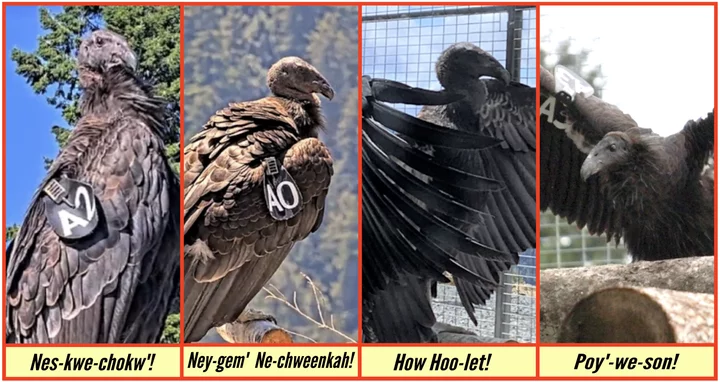
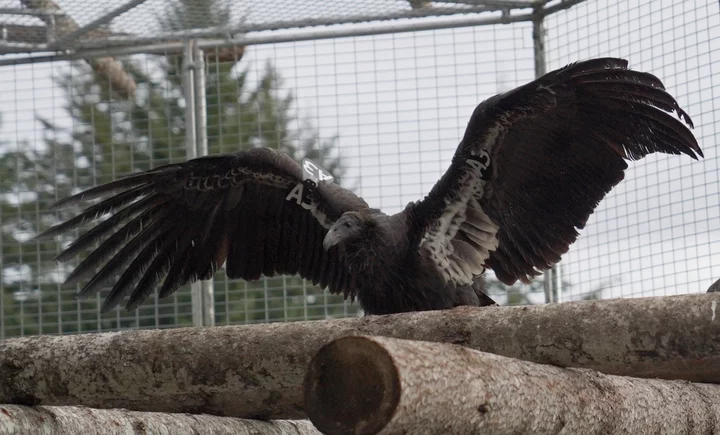
Poy’-we-son
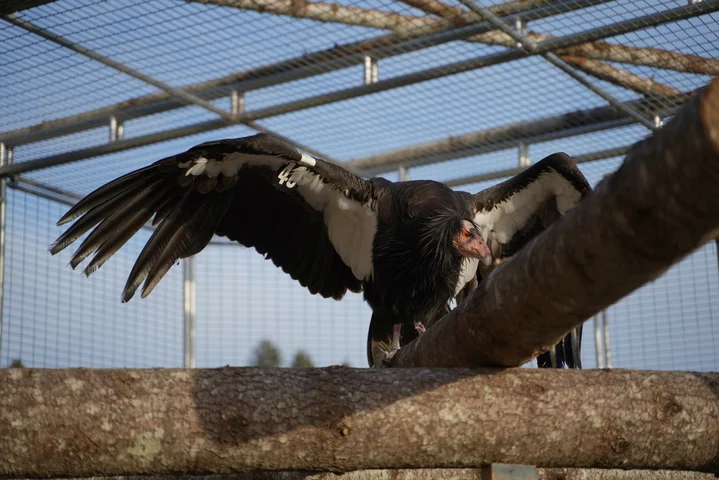
Poy’-we-son was the first California condor to take flight into wild. Photo courtesy of Matt Mais/Yurok Tribe
Hatched: Peregrine Fund’s World Center for Birds of Prey
Wing Tag: A3
Age: 2-year-old male
About me: First out the holding pen, we have Poy’-we-son, which literallytranslates to, “the one who goes ahead,” but also harks back to the traditional name for a headman of a village, who helps lead and guide the village in a good way.
“A3 is one of the more dominant birds, and I expect that he’ll be a leader amongst this flock and for new birds coming in,” said Williams-Claussen.
True to his name, Poy’-we-son was adventurous right from the start, boldly exploring the area surrounding the release facility for two weeks before returning to the release enclosures. His sojourn will have equipped him with valuable knowledge which he will share with his fellow cohort-members, as the small flock expands across the landscape.
Studbook number: 1045
# # #
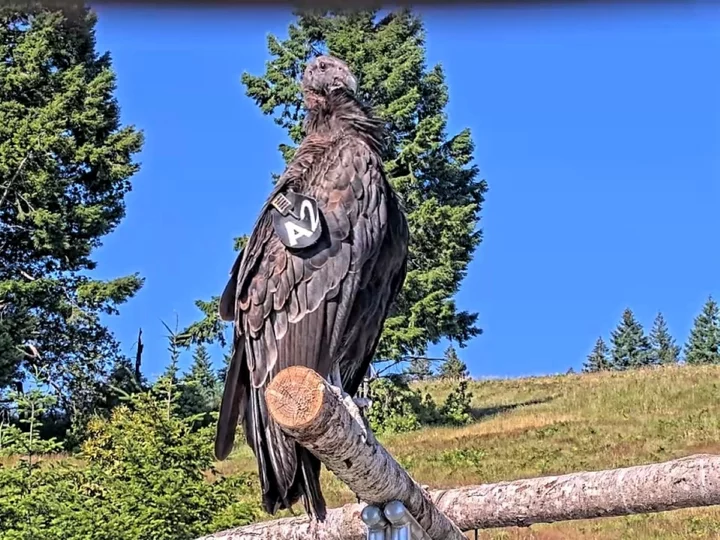
Nes-kwe-chokw’
Nes-kwe-chokw’ perches outside of the flight pen. Photo courtesy of Patrick Myers/Yurok Tribe
Hatched: Oregon Zoo
Wing Tag: A2
Age: 2 1/2-year-old male
About me: “Nes-kwe-chokw,’ which translates to ‘He returns’ or ‘He arrives,’ is a representative of the historic moment we just underwent, and condors’ return, free-flying, to the Yurok and surrounding landscape,” said Williams-Claussen. “He is a confident bird, often jockeying with A3 in play, but also to help establish his place in the hierarchy and with the will to do well in the wild.”
Also proving true to his nickname, Nes-kwe-chokw’ initially has stuck more closely to “home,” the release enclosure, seemingly awaiting the release of the rest of his flock. Though growing increasingly comfortable ranging farther from the release facility, he has largely shown himself content to stay close to the facility, visiting with the birds remaining in captivity and agreeably taking advantage of food proffered by biologists to keep the far-ranging birds interested in the facility, which will be used for ongoing management.
Studbook number: 1010
# # #
Ney-gem’ ‘Ne-chweenkah
Ney-gem’ ‘Ne-chweenkah’ takes in her new home. Photo courtesy of Patrick Myers/Yurok Tribe
Hatched: Oregon Zoo
Wing Tag: A0
Age: 3-year-old female
About me: Ney-gem’ ‘Ne-chweenkah’ which translates to “She carries our prayers” is the only female of the first released cohort. “She represents the creative life-force energy that females bring to the world,” said Williams-Claussen. “It’s powerful. I envision her as the start of a whole new life and possibilities, both for our flock and for condors throughout their range. We also imbue this name with our prayers for her specifically, her cohort brothers and for all condors. She carries those, wherever she goes. We are incredibly grateful that Prey-go-neesh have come home to carry our beliefs, our energy, and our prayers when we’re asking for the world to be in balance, as a critical part of ecological community.”
Though she struggled a bit with the mechanics of flying free in her first forays, as her first time to spread her wings in the wild, she’ll figure it out soon and has integrated well with both Poy’-we-son (A3) and Nes-kwe-chokw’ (A2). All three are comfortably sharing resources and will continue to learn from and teach each other.
Studbook number: 969
# # #
Hlow Hoo-let
Hlow Hoo-let was the last to join the cohort with his friends, who together will take flight toward reestablishing a California condor population in the Pacific Northwest. Photo courtesy of the Yurok Tribe
Hatched: Peregrine Fund’s World Center for Birds of Prey
Wing Tag: A1
Age: 3-year-old male
About me: “A1 has been nicknamed ‘Hlow Hoo-let’ which means ‘At last I (or we) fly!’ In line with the heavier names this first cohort carries,” said Williams-Claussen. “I interpret that as reference to the joyous day that all four of our first cohort fly free together.
On a lighter note, it’s definitely also a reference to poor A1’s extended wait to be let out, due to his faulty transmitter! We welcome Hlow Hoo-let to the skies of Yurok and surrounding lands, and look forward to his journey with us.”
On July 14, 2022, he was the last to join the cohort with his friends, who together will take flight toward reestablishing a California condor population in the Pacific Northwest.
Studbook number: 973
# # #
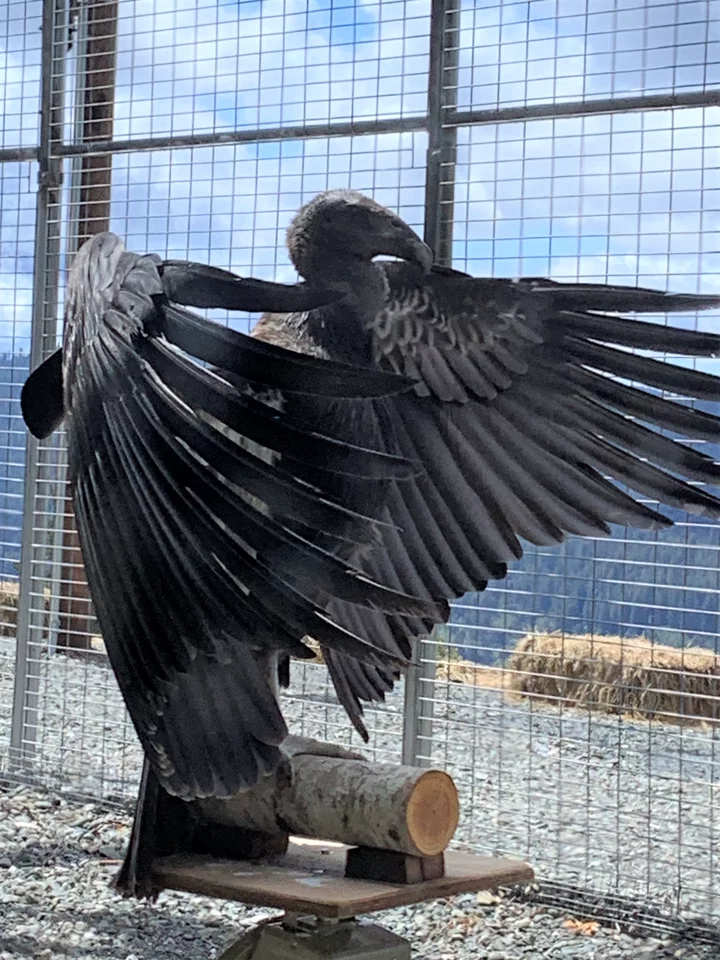
Paaytoqin (Mentor Bird)
Paaytoqin was chosen as a mentor bird because of his calm nature and good disposition. Photo courtesy of Matt Mais/Yurok Tribe
Hatched: Peregrine Fund’s World Center for Birds of Prey
Age: 8-year-old male
About me: “His name Paaytoqin (pie-toe-quin) means ‘come back’ in Nez Perce language because he returned to World Center Birds of Prey, one of the recovery program’s captive breeding facilities, after being at Oregon Zoo for three years,” said Leah Esquivel from the Peregrine Fund.
Hatched in 2014, he was selected to be held back for captivity based on genetics and is unreleasable.
“We do not release captive adults that have never had any wild experience,” said Steve Kirkland, California condor field coordinator for the U.S. Fish and Wildlife Service. “He could be paired with a mate in the future, if necessary; however, as for now, his role as a mentor will be an important influence on the younger birds.”
Paaytoqin was chosen as a mentor bird because of his calm nature and good disposition. Prior to arriving to the Northern California Condor Reintroduction Program Facility, he proved to be a steady and centering influence on young birds, helping them become acclimated to their new region and with their development of critical social behavior before their release. He regularly charges turkey vultures outside of the pen feeding, showing the condors stature in the feeding order.
“He will eventually return to captivity to help contribute to the health and vitality of the overall flock as part of the captive breeding program after his stint in Northern California,” said Williams-Claussen.
# # #
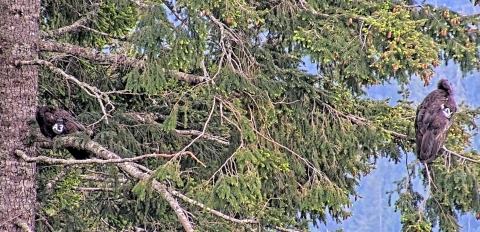
Poy’-we-son and Nes-kwe-chokw’ spotted exploring their new home. Photo courtesy of the Northern California Condor Restoration Program | Image Details
Comprised of biologists and technicians from the Yurok Tribe and Redwood National Park, the Northern California Condor Restoration Program will collaboratively manage this flock from a newly constructed condor release and management facility in Northern California, near the Klamath River in Redwoods National and State Park.
“The return of the condors to the skies over the Redwoods represents a significant milestone in the restoration of this magnificent forest to its former glory,” remarked Redwood National and State Park Superintendent Steve Mietz. “This project is a model for listening to and following the lead of the park’s original stewards, healing both our relationship with the land and its original people.”
With the release of these birds, the Northern California Condor Restoration Program team officially joins the larger California Condor Recovery Program led by the U.S. Fish and Wildlife Service. The recovery efforts include three additional release sites in California, one in Arizona and one in Baja Mexico. Each release site is championed by a partner in condor recovery.
“The reintroduction of condors into Northern California is truly a monumental moment,” said Paul Souza, Regional Director for U.S. Fish and Wildlife Service’s Pacific Southwest Region. “This effort builds upon the program’s collective knowledge and history of releasing condors and showcases the benefit of partnering with tribes and others to implement recovery of listed species. We are proud to support this collaborative and innovative partnership with the Yurok Tribe and Redwood National Park. Together we can recover listed species for future generations.”
“PREY-GO-NEESH KEECH KE-ME’-YEHL – CONDORS HAVE COME HOME.” – The Yurok Tribe
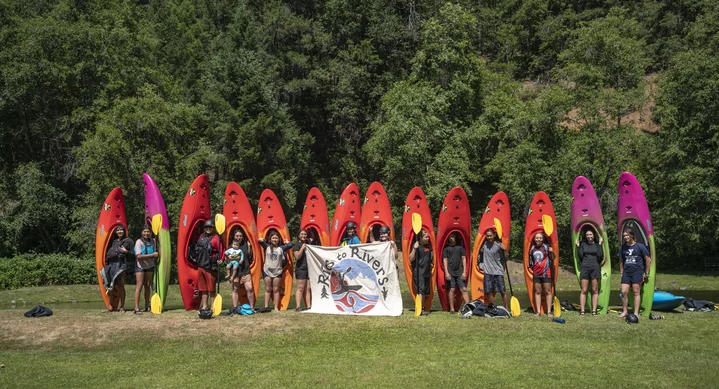
At
1:00 pm on Tuesday, July 26 at the Requa Boat Ramp, the Yurok Tribe
will greet fourteen local indigenous youth who recently completed an
intensive whitewater kayak training to prepare to lead the first
decent of the Klamath River following the much-anticipated removal of
four dams. Representing the Yurok, Karuk and Hoopa Valley Tribes as
well as the Klamath Tribes of Oregon, the teens are expected land in
Requa just before 1pm. Please come out and show your support for the
courageous local youth!
Maqlaqs
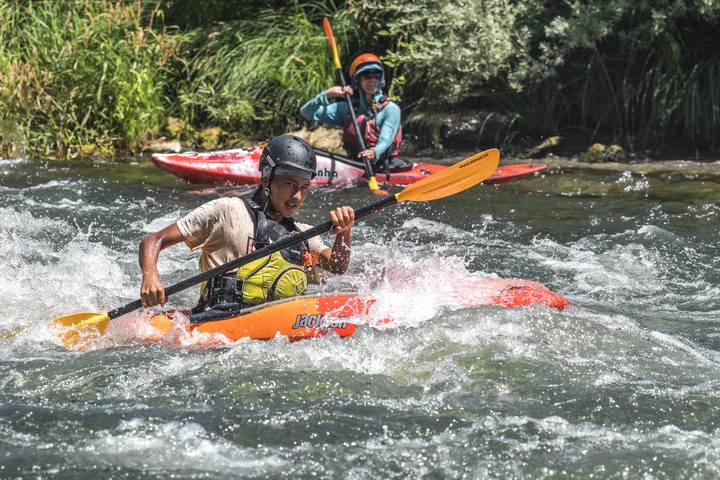
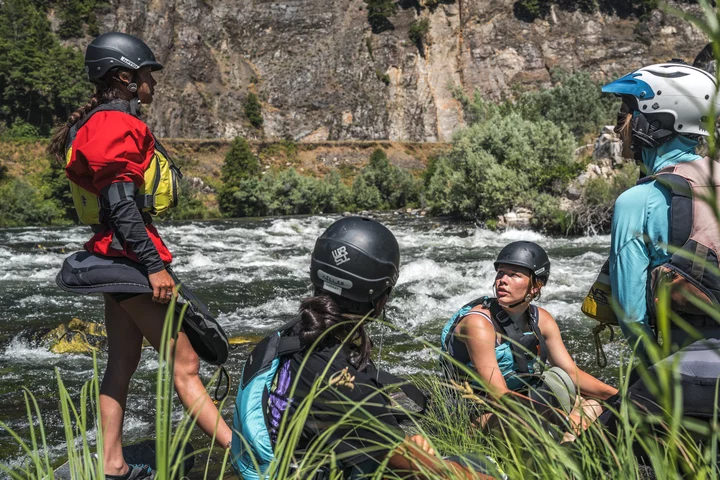
Paddle and Ríos to Rivers organized the two-and-a-half-week-long
Paddle Tribal Waters Program, which provided participants the
diversity of skills required to safely run the river in a kayak. The
acclaimed World Class Kayak Academy and local Otter Bar Lodge Kayak
School taught the teens every aspect of swift-water boating, such as
how to identify risks and maneuver through large rapids. The group
also learned self-rescue techniques, how to read the water and much
more. During the skill-building exercise, the youth worked on
developing river advocacy skills too.
“Tribal
people from the Klamath’s headwaters to the coast have fought so
hard for dam removal because it is the single biggest action we can
take to restore the river for our youth and the generations to come,”
said Joseph L. James, the Chairman of the Yurok Tribe. “I can’t
wait to see these kids paddle down the free-flowing river.”
“As
a teen of the Klamath River Basin I’ve been hearing about the
removal of the dams almost whole life. I went to my first protest
about the dams over 10 years ago and I’m starting to build a career
around protecting my homelands because of this fight. Being a part of
The Paddle Tribal Waters Program has been one of the most inspiring
experiences of my life, watching the youth of the Klamath basin enjoy
their home rivers and learn how to protect them has reminded me why
we fight so hard for these things. We fight so that our future
generations can have these opportunities to connect with their homes
and people, including our past and future generations.” Danielle R.
Frank, Hoopa/Yurok Youth and Save California Salmon Youth
Coordinator
“Paddling
has given me a way of experiencing rivers outside of just showing up
to fight for rivers’ health or for our traditional food systems. To
also be able to recreate on my ancestral waterways inspires me
endlessly,” added Paul Wilson, Ríos to Rivers Chief Storyteller,
Co-founder of Maqlaqs Paddle, and Klamath Tribes Member.
In
previous years, Ríos to Rivers has organized river trips with
indigenous youth from North and South America, including teens from
local tribes. This year, in anticipation of dam removal, the river
advocacy organization decided to invite tribal youth from the Klamath
Basin.
Fourteen
local youth between the ages 14 and 18 completed the Paddle Tribal
Waters Program. Many of the Program participants learned how to kayak
for the first time. Jackson Kayaks donated 16 high-end, fully
furnished boats for the training. Werner Paddles donated kayak
paddles and Northwest River Supplies (NRS) donated life jackets,
helmets and other safety gear. The kayaks and gear will remain in the
Klamath Basin for more local youth to learn boating skills before the
dams are removed.
Filmmakers
Paul Wilson and Rush Sturges are making a documentary film about the
process of the tribal youth learning to kayak and preparing to be the
first people to navigate the river after dam removal.
The
Federal Regulatory Commission along with PacifiCorp, the State of
California, and the State of Oregon are expected to soon sign off on
the removal of the lower four dams on the Klamath River, which
include: J.C. Boyle Dam in Oregon and Copco 1, Copco 2, and Iron Gate
Dam in California. Representing the largest river restoration project
in US history, the removal of the dams will open up more than 300
miles of historic salmon spawning habitat. It will establish a more
natural flow regime and other important natural processes. The
decommissioning of the antiquated structures will also greatly reduce
concentrations of toxic blue-green algae, making the river safe for
recreational activities, such as whitewater kayaking.
Maqlaqs
Paddle
-
Paddle Tribal Waters is led by Maqlaqs Paddle, a kayak club founded
by Ríos to Rivers alumni Paul and Ashia Wilson in 2018. The club was
founded to provide community access to the waters and marshlands of
the Klamath Tribes in Southern Oregon. They use donated kayaks to
harvest wocus and elk – two of their staple First Foods. The
gathered foods are shared both locally and inter-Tribally, which
initiate ceremony, revitalization, and community gatherings.
Ríos
to Rivers
-
Founded in 2012, Ríos to Rivers exchanges’ have connected 224
underserved and indigenous students from 20 endangered river basins
in seven countries. The programs have included students and community
leaders from 14 indigenous nations. Ríos to Rivers mission is to
facilitate place-based educational experiences that inspire and
empower the next generation of river stewards.
World
Class Kayak Academy
-
World Class Kayak Academy is a traveling high school for students who
want to earn their education while exploring unique rivers and
cultures around the world. WCKA is providing its kayak training
curriculum, coaches who have years of experience teaching teenagers
to kayak, vehicles, kayak trailers, and administrative support to
make Paddle Tribal Waters possible.
From the Humboldt County Department of Health and Human Services:
There are currently more than 350 monkeypox cases in California, but locally officials say there are still no confirmed cases in Humboldt County.
With recent outbreaks in the U.S., the federal government has allotted specific amounts of the difficult-to-obtain vaccines to states throughout the country. Counties in California such as San Francisco and Santa Clara have seen large enough allocations to hold mass vaccination clinics. Humboldt County’s current allocation stands at 20 vaccines. In addition, a small number of vaccines were sent to Humboldt County Public Health for laboratory staff who will be testing monkeypox samples in the lab.
Sofia Pereira, the Department of Health & Human Services Public Health Director, said, “With no confirmed cases currently in Humboldt County, our small allocation of vaccines will be used in case of a local outbreak.”
According to the Centers for Disease Control and Prevention (CDC), vaccinating people who have had direct contact with someone with a confirmed case of monkeypox within four days of exposure can help prevent onset and further spread of the disease.
She said the local health jurisdictions across the state and the California Department of Public Health are currently petitioning the CDC for more vaccine.
Monkeypox is a rare zoonotic infection caused by the monkeypox virus, which is in the same family as smallpox, but less severe than smallpox. Monkeypox is endemic to many Central and West African countries, however, there have been recent cases of monkeypox reported in non-endemic countries including the U.S., Canada and the U.K., as well as other parts of Europe and Australia.
The monkeypox virus is spread to humans from infected humans, animals and materials contaminated with the virus. Although the risk to the general U.S. population is low, the following tips can help keep you safe:
Practice good hand hygiene
Always talk to your intimate partner/s about any recent illness, and be aware of new or unexplained sores or rashes on your body or your partner’s body, including on the mouth, genitals and anus
Avoid intimate contact, including sex, with people with symptoms like sores or rashes
Avoid contact with infected animals and materials contaminated with the virus
Infected people should isolate until their symptoms, including rash, have gone away completely
Use appropriate personal protective equipment (PPE) like a mask, gown and gloves when caring for people with symptoms.
SACRAMENTO – State Controller Betty T. Yee today published her team’s detailed review of Humboldt County’s internal financial controls, which found a backlog of journal entries and lack of bank reconciliations contributed to the county’s inability to complete timely financial reports — compounded by insufficient staffing, inadequate training, and a lack of updated policies and procedures.
Established in 1853, Humboldt County covers more than 4,000 square miles of California’s North Coast and had a population of more than 136,000 at the last census. Among the State Controller’s most significant findings:
The county does not reconcile its bank balances and the county treasurer’s accounting records, nor does it reconcile cash and investment accounts pursuant to GC 26905. Timely reconciliations allow an entity to ensure cash transactions have been recorded properly, assist in monitoring cash flows, and detect errors and fraud.
The county amassed a backlog of journal entries required to finalize financial statements. In addition to delaying reports, the backlog rendered county accounting data unreliable. For example, in September and October 2021, Auditor-Controller’s Office (ACO) staff posted journal entries totaling $106 million to the FY 2019-20 general ledger. As a result, county management may have made financial decisions based on outdated data throughout FY 2019-20.
Insufficient staffing has kept ACO from fulfilling its duties and responsibilities. With only 13 full-time positions, the fiscal team has had an average of three vacancies throughout the review period, even as a realignment of payroll functions to ACO increased its workload.
The report emphasized that an organization’s commitment to competence is a key principle of an effective internal control system. While staff interviewed during the review expressed eagerness to successfully complete their assigned duties, they felt sufficient training had not been provided. Additionally, the ACO Department Policy & Procedure Manual has not been updated since 2012 and does not reflect current processes.
The report includes county responses to SCO findings and SCO recommendations for improvement. Controller Yee has requested a progress update in six months.
With a commitment to government transparency and accountability, Controller Yee and her Audits team have identified more than $7.25 billion in waste, fraud, and abuse of public funds since January 2015.
###
As the chief fiscal officer of California, Controller Yee is responsible for accountability and disbursement of the state’s financial resources. The Controller has independent auditing authority over government agencies that spend state funds. She is a member of numerous financing authorities, and fiscal and financial oversight entities including the Franchise Tax Board. She also serves on the boards for the nation’s two largest public pension funds. Elected in 2014 and reelected in 2018, Controller Yee is the tenth woman elected to a statewide office in California’s history. Follow the Controller on Twitter at @CAController and on Facebook at California State Controller’s Office.
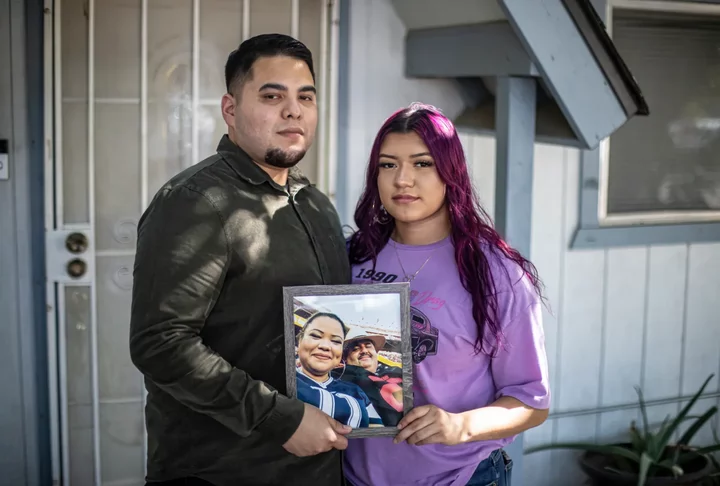
Two of the three Basulto Siblings whose parents died of COVID, Martin (left) and Miranda, pose for a photo in front of their home in Coalinga on June 28, 2022. Miranda is eligible for a state bond given to kids who lost a caregiver (or both) because of COVID. Photo by Larry Valenzuela, CalMatters/CatchLight Local.
###
In a small town in California’s Central Valley, a trio of siblings lost both their parents to COVID-19 within two weeks of each other in 2021. Their deaths made the oldest son a pseudo-parent to his teenage siblings overnight and forced the brothers and sister to figure out a future without their mom and dad.
In California, 32,000 children under 18 have experienced the death of a parent or primary caregiver from COVID-19, according to research by the Global Reference Group for Children Affected by COVID-19. Those children — so-called “COVID orphans” — are likely to face not just financial hardship but a lifetime of mental health, educational, relational and emotional challenges, researchers say.
Now, California has become the first state to create a financial safety net for some COVID orphans when they reach adulthood. The state has allocated $100 million in its recently adopted budget for the Hope, Opportunity, Perseverance, and Empowerment for Children Trust Account Fund, which will seed trust funds for low-income children who lost a parent or primary caregiver to COVID-19. Trust funds will also be created for long-term foster youth.
The funds, known as “baby bonds,” would be started with state money and allowed to grow until the child turns 18. At that time, the young person would be able to access the fund for housing, education or other expenses.
“It will make it so that people who are in the most need, who’ve lost a parent or caregiver to COVID, will have a little bit of extra help,” said Emily Walton, policy director of COVID Survivors for Change, a national organization advocating for benefits for Americans impacted by COVID-19. “The lack of several thousand dollars could stop a child from jumping on to the next thing and getting an education or getting a job in a place where they know they can be successful.”
The details of the plan will be laid out later this summer in one of several trailer bills, which add specifics to the state budget. Advocates say eligibility will most likely be tied to enrollment in Medi-Cal, the state’s health insurance system for low-income Californians. Amounts deposited are expected to reflect the age of the child and how long before that person turns 18.
“It will make it so that people who are in the most need, who’ve lost a parent or caregiver to COVID, will have a little bit of extra help.” — Emily Walton, policy director of COVID Survivors for Change
In the Central Valley agricultural town of Coalinga, Martin, Angel and Miranda Basulto felt lost after both of their parents died in January of 2021.
Their father, Martin Basulto, a truck driver, thought he was exposed to COVID-19 at work. Their mother, Rosa Garcia Cortez, who worked as a front desk receptionist at a local hotel, got sick after taking care of their dad. Basulto, 44, and Garcia Cortez, 46, were taken to a local hospital and within weeks they were both dead.
Overnight, Martin, now 27, was in charge of his family. He moved back home from Fresno to take over responsibilities like paying the mortgage and making sure his sister Miranda got to high school on time.
“In the beginning, I didn’t care about school. I was so angry,” said Miranda, now 17 and about to start her senior year. “We are all going to die someday so what is the point of trying in life?”
But then someone asked her if she wanted to die without living up to her full potential.
“That hit me because I know my parents wanted to do a lot of things in their life they couldn’t do,” she said. “So, I want to live my life to the fullest potential.”
She’s on the honor roll now and looking forward to college — a dream her father had for her.
The baby bonds are critical for their family, Martin said. He remembers their parents would help him with groceries or step in when he could not pay his own phone bill when he first moved away.
Now it’s his turn.
“The smallest amount can go a long way,” Martin said. “I want her to be prepared for when she goes to college and I’ll help in any way I can so any other help available is greatly appreciated.”
Latino children account for the majority — 66% — of COVID orphans in California. Many of them are the sons and daughters of essential workers who were already facing economic uncertainty before the pandemic.
Across the country, non-white children lost parents or caregivers at four times the rate of their white peers, according to a report titled “Hidden Pain, Children who Lost a Parent or Caregiver to COVID-19 and What the Nation can do to Help Them,” released in December by The COVID Collaborative. Nationally, 250,000 kids have been left orphaned by the death of at least one parent or primary caregiver as of March 2022,reports the Global Reference Group for Children Affected by COVID-19.
Children who have lost a primary caregiver to COVID-19 have unique needs, said Marlo Cales, executive director of the Mourning Sun Children’s Foundation, an Apple Valley-based support organization for youth and their families who are grieving a death or loss of a loved one through abandonment, imprisonment or other types of separation. Cales said that for COVID-19 survivors, bereavement was intensified because many could not gather or grieve their loss with others. The ongoing pandemic is prolonging grief, she said.
“They are really feeling more alone and isolated,” she said. “Not only have they lost their person, they seem to be struggling with the inability to be able to connect with or find services that are meeting their particular needs of loss and grief because of the pandemic.”
California’s new program for COVID orphans is part of a long-standing broader effort to provide trust funds for all low-income children who qualify for Medi-Cal regardless of COVID’s impact on their families, said Shamika Gaskins, president and CEO of Grace and Child Poverty California, which advocated for the money.
“This is really a part of our longer-term vision to end child poverty in California by closing the racial wealth gap and providing opportunities for our most vulnerable children,” Gaskins said.
Delaware, Washington, Connecticut, Washington D.C., New York and Iowa are considering or have created their own trust fund programs for low-income children. Eligibility for most of the programs or proposals is tied to qualifying for the Medicaid program in each of those states.
Connecticut and Washington D.C., approved baby bond programs last year. The Connecticut program begins in July 2023 and includes deposits up to $3,200 for each child. The D.C. program started with babies born October 2021 and the funds are seeded with $500 plus annual deposits as long as the family’s income qualifies.
California’s new program is the first in the nation to provide trust funds for COVID orphans and long-term foster youth. Walton, of COVID Survivors for Change, said the organization is working with a handful of states to consider scholarships or similar trust funds for children who have lost a parent or caregiver to COVID-19.
“This is really a part of our longer-term vision to end child poverty in California by closing the racial wealth gap and providing opportunities for our most vulnerable children.” — Shamika Gaskins, president and CEO of Grace and Child Poverty California
As a teacher in Marin County, Kate McLaughlin doesn’t think her daughter, Éala, would qualify for the trust fund, but she is reassured that should her daughter need the support in the future, she could access it. Her husband, Jason McLaughlin, died from the pandemic virus last year when their daughter was 3. He was 48.
“Our people are not just a number,” she said about those who died from COVID-19. “I want people to know Jason McLaughlin was a really great guy and an incredible father and he was on this planet and his life mattered.”
A kidney transplant survivor, Jason was immune compromised.
The family hunkered down when the pandemic began. Kate believes Jason was exposed on one of their quick runs to a grocery store or Home Depot. He was sick at home for 10 days before being hospitalized. Kate and Eala both tested positive too but only Kate had symptoms.
Around Valentine’s Day of 2021 Jason’s working kidney started to fail. He was put on dialysis but died within days.
“I was able to be with him in his last moments,” Kate said. “The biggest challenge for us is adjusting to the gigantic loss in our lives.”
When Jason’s hometown Boston Celtics recently played the Warriors in the playoffs, Kate felt a wave of heartache. He had looked forward to watching games with his daughter.
“He would be loving it. He should be here to watch this game, to watch it with her,” Kate said. “Dealing with those constant reminders that he is gone is terrible.”
A study published in the medical journal Pediatrics in October found that orphanhood is a secondary tragedy brought on by the pandemic. Researchers say that children’s lives are forever changed by the loss of a parent or caregiver and addressing it needs to be a top priority. It is considered an adverse childhood experience that is linked to mental health challenges, lower self-esteem, suicide and other problems later in life.
California’s trust funds began as a bill introduced by Democratic Sen. Nancy Skinner of Berkeley that was sailing through the Legislature. In May, Skinner pulled the bill because the funds for COVID orphans were going to be included in the budget proposal.
“At a time when California has immense wealth, we can afford to ensure that children who have suffered an inconceivable loss will be comforted knowing they’ll have a little help at a time when they no longer have parents to rely on,” Skinner has said.
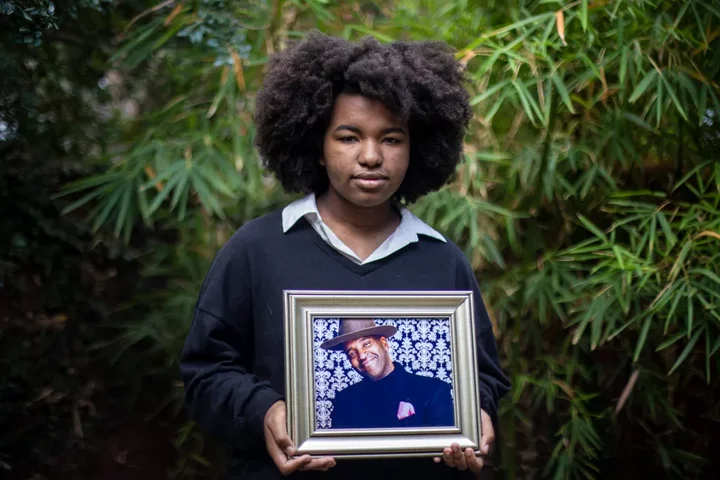
MacLemore Porter, her father whose father died of COVID, poses for a photo in her backyard in Bakersfield on June 22, 2022. Photo by Larry Valenzuela, CalMatters/CatchLight Local.
In Bakersfield, Hillary Porter is keeping an eye on the progress of the trust fund program. She is one of the surviving parents who advocated for the program.
In March of 2020, Hillary, her husband Lloyd Porter and their daughter MacLemore were packing up their home in New York City for a move back to California.
Then Lloyd, an actor, got sick with COVID-19. Six weeks later he died.
“He really fought the good fight. He kind of rallied back,” Hillary said. “I was in the process of planning rehab for him and suddenly he was gone.”
Hillary and their daughter stayed the course and moved back as the family had planned.
Lloyd grew up in Bakersfield and Hillary in Salinas. College sweethearts, the couple met at Fresno State when they were officers of Black student organizations.
Lloyd was the kind of guy who literally took off his sweatshirt and gave it to a young man arriving in San Francisco who didn’t realize how cold it would be, his wife said.
“Because my husband passed away in May of 2020 we couldn’t have a funeral, couldn’t gather with friends or family. It was very much that we were in a bubble,” she said. “That adds another layer of trauma or grief.”
She is looking to the trust fund to help kids with mental health support as well as college.
“The kids, when they are turning into adults, can now dream a little bigger,” Hilary said. “It could change the trajectory of their goals at 18.”
###
CalMatters.org is a nonprofit, nonpartisan media venture explaining California policies and politics.
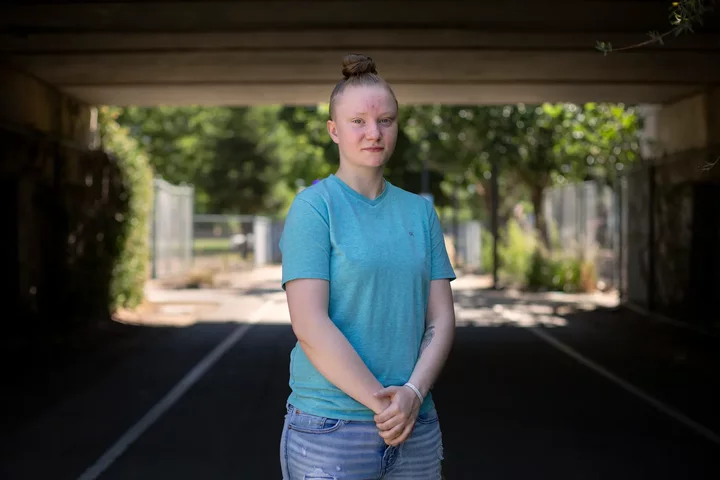
Kristina Tanner at the Sacramento State campus on June 29, 2022. Photo by Miguel Gutierrez Jr., CalMatters.
When she was 15 and had been a ward of the courts for half her life, Kristina Tanner learned the cost of her stays in group homes and with foster families was coming out of her own pocket.
She had qualified for monthly survivor benefits checks, a Social Security program for children whose parents had died.
Instead of the hundreds of dollars a month going to her or toward savings, it went to Butte County, she said, to cover checks issued to her foster care providers.
Now Tanner, who works three part-time jobs while attending Sacramento State University, wonders why the government needed to take her money.
“You’re pretty much saying I’m paying for my time in care, and there’s other people that are getting their time in care for free,” she said. “It’s not like we have our parents to fall back on.”
California county child welfare agencies regularly reimburse themselves for caring for foster youth by applying for and taking the children’s Social Security benefits — money that advocates say should instead be going to the children.
Some children in foster care have disabilities and are from low-income families, qualifying them for a Social Security program called Supplemental Security Income, or SSI. Others are like Tanner, eligible for survivor benefits because one or both of their parents died.
The state does not track how much money is withheld from these children, who make up a fraction of California’s 55,000 foster kids.
In Los Angeles County, which cares for about a third of the state’s foster children, the Department of Children and Family Services receives the benefits of about 600 children in its custody in any given month. Last year $5.4 million of children’s SSI and survivor benefits went toward defrayingfoster care costs, DCFS said.
“They are so hungry to minimize their own financial liability that they are identifying assets belonging to the child.” — Amy Harfeld, national policy director for the Children’s Advocacy Institute
Advocates say taking the money hurts young people who are most in need of financial support, while it covers only a drop in the bucket of California’s child welfare system, which consumes nearly $5 billion in federal, state and local funds a year.
Offsetting costs
State and county child welfare officials say they’re using the money as intended – to provide for foster children as if they were their parents.
Federal dollars only pay for foster care for some children whose families meet strict poverty criteria, and states and counties must pay the full costs for other kids in their custody.
The Social Security benefits, when they’re available, are viewed as an offset of those costs.
“It’s not debatable that the government is required to pay for the upkeep of a child; it’s a legal obligation the state takes on when they remove a child” from their home, said Amy Harfeld, national policy director for the San Diego-based Children’s Advocacy Institute. “In this particular case they are so hungry to minimize their own financial liability that they are identifying assets belonging to the child,” she said.
But when young adults age out of foster care they are often at greater risk poverty and homelessness. One long-term study in California found in 2020 that a quarter of former foster care youth reported sleeping in shelters or being temporarily unhoused since exiting foster care.
Tanner said Butte County, as her guardian, took her survivor benefits of about $1,200 a month until she graduated high school and was no longer eligible for them. The money likely totaled tens of thousands of dollars over her time in state custody.
Now at 21 she has aged out of the state’s extended foster care system.
“Those benefits … would have been a game changer,” she said. “I would, if I had those funds, be able to support myself … It could be sitting in [an account] that’s just growing for you. It could be retirement.”
The average California child receiving Social Security supplemental income gets less than $800 a month. Those receiving survivor benefits get about $980 monthly.
Nationwide practice
A growing number of states are considering ending the practice of taking this money as reimbursements.
In 2018, Maryland passed a law requiring the state to set aside Social Security checks for foster youth to use in the future. New York City’s child welfare agency said it would do the same this year.
Similar legislation was proposed in Philadelphia and in Nebraska, Minnesota and Texas. And Alaska was embroiled in a class action lawsuit over the issue last year, according to a report by The Marshall Project and NPR.
California has not proposed ending it,despite the state’s recent focus on financial safety nets for foster youth.
Lawmakers did pass a $1,000 tax credit for former foster youth last month, and last year they started a $35 million program to fund direct cash payments to low-income residents — with a preference for aiding former foster youth.
The state has made other moves to stop intercepting payments from poor families. Starting in 2025 California plans to phase out a longtime practice of “recouping” child support payments from families that also receive cash welfare.
Even so, state and county officials said taking Social Security benefits is perfectly legal.
“Neither federal nor state law prohibits the offsetting of foster care benefits for youth,” said Scott Murray, California Department of Social Services spokesman. “The county may use those funds for the youth’s daily care and maintenance.”
Butte County’s Department of Employment and Social Services officials refused to answer questions about Tanner’s case.
How much money is taken?
CalMatters contacted several other counties with high foster care caseloads about the practice. Besides Los Angeles, three others responded.
Kern County said it reimbursed itself last year more than$313,000 with Social Security benefits from 56 youth and that amount has been higher in previous years.
In its latest fiscal year, San Diego County reimbursed itself about $137,000 in benefits from 13 foster youth, the county reported.
“We just want the counties to be talking about this with the kids.” — Sabrina Forte, director of policy and impact litigation at the Alliance for Children’s Rights
San Francisco’s Human Services Agency hired a company to apply for benefits on foster youths’ behalf. A 2019 memo requesting a contract extension, said the agency was handling the benefits of 67 youth and “applies the SSI to placement costs in the majority of situations or gives directly to the caregiver.”
State law requires counties to receive the money on the child’s behalf if no alternative exists. However, federal regulations set up a preference for a parent, relative or close friend to receive the money and use it in the child’s best interest, if possible.
Social Security spokesperson Patricia Raymond said the agency monitors foster care agencies’ use of the benefits.
In the state budget Gov. Gavin Newsom signed last month, lawmakers included new requirements that counties help young adults transitioning out of foster care apply for Social Security benefits.
And the L.A. County Board of Supervisors last year passed a resolution to ensure that county welfare officials set up bank accounts for foster youth to receive the benefits when they age out.
Some youth advocates want counties to screen foster children for eligibility for benefits. Without that help through the arduous application process, they say eligible youth will miss out on the money in adulthood.
Maximizing funding
Taking the money while the youth are still in foster care, some advocates say, is the counties’ financial incentive to apply.
“Counties understand this as a way to get kids connected to federal benefits but also maximize federal funding streams,” said Sabrina Forte, director of policy and impact litigation at the Alliance for Children’s Rights. “We just want the counties to be talking about this with the kids.”
Tanner, the Sacramento State student, said she found out about her survivor benefits by chance.
Tanner’s mother died of breast cancer when Tanner was 6, and she was removed from her father’s custody when she was 7. She said she remembers he was in a deep depression, she missed a lot of school, and she and her siblings were taken out of a filthy house.
When she was 11, she was on the way to see him when the visit was abruptly canceled because he had died. She learned only recently that it was cancer.
By the time she was 15, Tanner had crisscrossed the state, moved from foster home to group home to juvenile detention center. She had just moved into another placement in Chico when her new guardian got a check in the mail from the Social Security Administration.
“This check is different from every other check my foster parents get,” Tanner recalled. “It had a little memo, it said ‘Survivor Benefits.’”
A few months later, the typical payments from Butte County to her new foster parent resumed.
Throughout high school, Tanner said, she contacted her social workers, Butte County officials, the state and the Social Security Administration. She learned the federal government had been sending her survivors benefits to child welfare agencies since 2011, the year her father died.
“They said as a ward of the court they get it, because technically they’re my guardians,” she said of the county officials.
‘Nobody to fall back on’
If counties have money left over after taking a reimbursement, state law says they should set it aside to use in the child’s best interests.
Tanner said she never saw any of it.
When money was tight in her foster homes, she remembers asking the county for funds to pay to play basketball or enroll in other activities at school and was told to apply for grants from nonprofits.
When she turned 18, she asked Butte County to send her the survivors benefits directly, she said. But because she was part of the extended foster care program, she remained in the county’s care.
Now a rising senior studying biomedical sciences, Tanner said she barely can afford her rent in Sacramento.
She wants to apply for medical school and become a trauma doctor, inspired by childhood trips to the hospital when her mother underwent cancer treatment.
“She was strong-willed,” she said of her mother, memorialized in a tattoo on her forearm. “Because of my situation and having nobody to fall back on, it’s like you’re pretty much out here on your own. So your choice is to fail or not to fail.”
###
This article is part of the California Divide project, a collaboration among newsrooms examining income inequality and economic survival in California. CalMatters.org is a nonprofit, nonpartisan media venture explaining California policies and politics.