

Two Men Ultimately Arrested on Weapons Charges After One Fled Traffic Stop on Foot, EPD Says
LoCO Staff / Thursday, June 30, 2022 @ 5:45 p.m. / Crime

Eureka Police Department press release:
On June 30, 2022, at about 1:45 p.m., an officer with the Eureka Police Department was conducting a traffic stop near Hodgson and Q Streets when the male passenger exited the vehicle and fled on foot.
The passenger had what appeared to be a handgun concealed under his shirt. The officer detained the driver while providing the passenger’s description to responding officers.
Based on witness information, a perimeter was set up around the area and a reverse 911 was sent to surrounding residents to shelter in place. Based on additional witness information, a residence and yard on the 1600 block of Glatt Street was thoroughly searched. The male passenger was not located.
During a search of the vehicle, EPD K9 Bodhi alerted to a firearm in the vehicle. The driver, 33-year-old Jacob Swagart was arrested for possession of an assault style rifle.
Officers reviewed surveillance footage from the neighborhood and were able to identify the male passenger as 34-year-old Shawn Gallagher Jr. At about 3:45 p.m., officers located Gallagher near 14th and A Streets.
Gallagher was taken into custody without further incident and booked into Humboldt County Correctional Facility for felon in possession of a firearm.
BOOKED
Yesterday: 6 felonies, 12 misdemeanors, 0 infractions
JUDGED
Humboldt County Superior Court Calendar: Today
CHP REPORTS
No current incidents
ELSEWHERE
RHBB: HAF+WRCF Opens Fall Grant Round for Artists, Seniors and Holiday Programs
RHBB: State Parks Urges Safety Precautions Ahead of Labor Day Weekend
Chinook Salmon Sport Fishing Season Opens July 1 on Portions of Klamath, Trinity Rivers
LoCO Staff / Thursday, June 30, 2022 @ 3:39 p.m. / Fish

Contributed: California Department of Fish and Wildlife
###
The following is a press release from the California Department of Fish and Wildlife:
Sport fishing for Chinook salmon in the Klamath River Basin is set to begin July 1 and will continue through the fall according to salmon quota and fishery regulations that were adopted by the California Fish and Game Commission during its May teleconference meeting.
The season begins with a shortened spring-run Chinook salmon fishery enacted in response to the state listing of “Upper Klamath/Trinity River Spring Chinook Salmon” as threatened under the California Endangered Species Act. The truncated spring-run Chinook salmon recreational fishery will open July 1 and run through Aug. 14 on the lower Klamath River (downstream of the Highway 96 bridge at Weitchpec) and through Aug. 31 on the Trinity River (upstream of the confluence of the South Fork Trinity River). The daily bag limit remains one Chinook salmon (no size restrictions), with a possession limit of two Chinook salmon. This shortened season structure eliminates the core months of April, May and June when the majority of spring-run move through the Klamath and Trinity rivers on their way to natal areas where the most at-risk spring-run populations spend the summer and spawn.
The fall-run Chinook salmon recreational fishery in the Klamath River will continue Aug. 15 as Klamath River fall-run Chinook begin to enter the river in larger numbers. In the Trinity River, the recreational fall-run Chinook season begins Sept. 1. The fall-run Chinook basin in-river quota for this fall period is 2,119 adult Chinook salmon for the 2022 season. Klamath River fall-run Chinook numbers remain low, requiring limited opportunity for harvest while this stock of salmon rebounds from the effects of challenging environmental conditions.
The bag limits will remain the same as in 2021, with a two-fish daily bag limit, with no more than one fish over 23 inches (such as one adult and one jack). The possession limit remains the same at six fish, with no more than three fish over 23 inches (effectively three daily bag limits).
The in-river recreational adult fall-run Chinook salmon quota is divided among four sectors in the Klamath River basin:
Klamath River
There is a sub-area closure at the mouth of the Klamath River when 15 percent of the basin allocation has been harvested – 318 fish harvested below the Highway 101 bridge triggers this closure.
- 3,500 feet downstream of Iron Gate Dam downstream to the Highway 96 bridge – 360 fish.
- Highway 96 bridge downstream to the mouth of the Klamath River – 1,060 fish.
Trinity River
- Old Lewiston Bridge to Highway 299 West bridge at Cedar Flat – 350 fish.
- Denny Road bridge downstream to the confluence with Klamath River – 349 fish.
Anglers may keep track of the quota status of open and closed sections of the Klamath and Trinity rivers by calling California Department of Fish and Wildlife’s information hotline at (800) 564-6479.
For more information regarding Klamath River fishing regulations, please consult the 2022-2023 California Freshwater Sport Fishing Regulations, which will be available online in July at wildlife.ca.gov/regulations.
[UPDATED] Karen Paz Dominguez’s Resignation is Official; Dillingham Ready to Step In as Auditor-Controller, County Administrative Officer Says
Ryan Burns / Thursday, June 30, 2022 @ 3:25 p.m. / Local Government
UPDATE, 4:10 p.m.:
The county issued the following press release, with a link to the separation agreement:
The County of Humboldt today executed a separation agreement with current Auditor-Controller Karen Paz Dominguez stating Ms. Paz Dominguez is resigning effective July 1. Per the Board of Supervisors action on Tuesday, the Board has appointed Auditor-Controller-elect Cheryl Dillingham to serve as interim Auditor-Controller effective upon resignation.
Notable terms of the separation agreement include:
- Agreement of Ms. Paz Dominguez to facilitate a smooth transition and cooperate with any appointed Auditor-Controller who succeeds her through Jan. 2, 2023.
- Compensation paid to Ms. Paz Dominguez in the amount of $92,368.32, comprised of her salary through Jan. 2, 2023, payments in lieu of insurance benefits, and a flat amount of $15,000.
- The county will pay for reasonable attorney fees she incurred related to the State of California’s case (CV 2200584) against Ms. Paz Dominguez and fees of $13,254.85 she incurred with respect to Humboldt Superior Court Case CV 2001430.
- The county will dismiss its cross complaint against Ms. Paz Dominguez in the above-referenced State of California case, and will defend and indemnify her in the case.
- Should the City of Eureka sue the county and Ms. Paz Dominguez for failure to distribute when due property taxes for Fiscal Year 2021-22, the county will defend and indemnify her in that suit, and any other suit against her arising in the course and scope of her service. As it relates to this matter, the county is poised to execute a tolling agreement with the anticipation of avoiding litigation.
Per the Board’s action, the separation agreement and appointment will return to the Board at its next available meeting, likely July 12, for final approval.
Going forward, Ms. Dillingham is scheduled to begin serving next week. The county appreciates Ms. Paz Dominguez’s cooperation with this transition.
A quick read-through of the agreement reveals one interesting tidbit not mentioned in the county’s press release: While Paz Dominguez and the county agreed to a limited release of liability, Paz Dominguez “retains her claims against the County for defamation, discrimination, and other wrongs.”
The county does not admit to any of those claims, but litigation between the two sides sounds likely.
###
Original post:
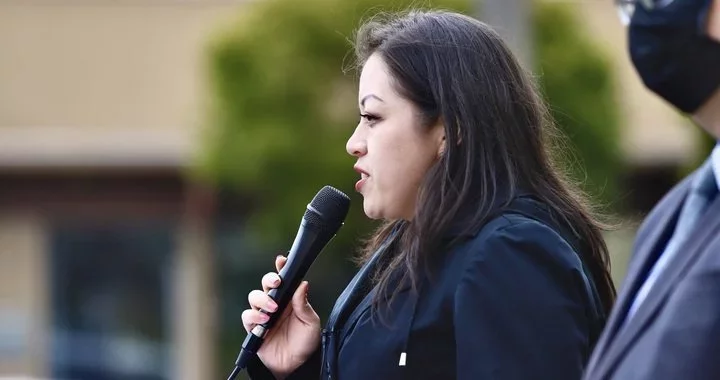
File photo.
###
###
After three and a half tumultuous years in office, Humboldt County Auditor-Controller Karen Paz Dominguez officially resigned from her elected position today, a full six months shy of completing her inaugural term.
At precisely 2 p.m., County Administrative Officer Elishia Hayes, who on Tuesday was given authority to execute a separation agreement with Paz Dominguez, emailed county supervisors and department heads to tell them it was done: The agreement had been executed and the auditor-controller’s resignation was now official.
In a text, Paz Dominguez said the county reached out to her lawyer “almost immediately after election day.” She added that she spoke with the employees in her office and with Dillingham before agreeing to updated terms in the separation agreement. Her resignation is effective as of tomorrow.
As planned, the Board of Supervisors has appointed Cheryl Dillingham as interim auditor-controller. Dillingham, who currently works as finance manager for the City of Rio Dell, defeated the incumbent in a landslide last month, though the election results have yet to be certified.
But according to Hayes’ email, Dillingham “is still working on her transition” away from Rio Dell and won’t be able to work full-time until “probably September.”
In the meantime, Hayes says, Assistant County Administrative Officer/Chief Financial Officer Tabatha Miller will step in to serve as the interim assistant auditor-controller “so that someone may always be available to make decisions.”
Hayes, whose office frequently clashed with Paz Dominguez, expresses unqualified elation at this latest development, calling it “a really great day for the county.”
The Outpost has requested a copy of the separation agreement and will follow up with details.
Here’s the email from Hayes:
Hello Board (bcc’d) and Department Heads,
This week the Board provided me with authorization to execute a final separation agreement with Ms Paz Dominguez to allow for her resignation before the end of the year. That agreement has been executed and her resignation is official.
In addition, the Board has appointed Cheryl Dillingham as Interim Auditor-Controller effective upon resignation. Cheryl and I have been in close communication and she is ready to step into her position. Since Karen’s resignation has occurred a little sooner than expected, Cheryl is still working on her transition with Rio Dell and will be working part time until probably September.
In the meantime, she has asked Tabatha Miller to serve as the Interim Assistant Auditor-Controller so that someone may always be available to make decisions.
Please be patient over the next few weeks as Cheryl assumes her role with the organization and please let either of us know if you have any questions or feedback to offer. This is a really great day for the county and I look forward to this next stage of recovery.
I hope you all have a safe and happy 4th of July!
###
Note: This post has been updated to include a response from Paz Dominguez.
A Member of the Hoopa Valley Tribal Police Department is Under Investigation by the Humboldt County Sheriff’s Office
Isabella Vanderheiden / Thursday, June 30, 2022 @ 11:20 a.m. / Crime

The Humboldt County Sheriff’s Office has launched an investigation into an unidentified member of the Hoopa Valley Tribal Police Department.
According to a press release posted to the Hoopa Valley Tribal Police Department’s Facebook page on Wednesday afternoon, “the investigation is in its early stages and no determinations have been made” about the accused individual.
“We do understand the need for transparency and for the community to be made aware,” the statement continued. “At this time, we are not at liberty to release any details of the investigation and ask for patience as investigators continue forward.”
Reached for additional comment this morning, Humboldt County Sheriff’s Office spokesperson Samantha Karges said she could not elaborate on the details of the investigation but did note, “There is no perceived threat to public safety at this time.”
“The primary interest of the Humboldt County Sheriff’s Office is to seek justice for victims by conducting thorough and impartial investigations,” Karges wrote in an email to the Outpost this morning. “The premature release of information could jeopardize the successful adjudication of the case, in addition to putting the safety of those involved at risk. …We ask for the community’s patience as our agency works to conduct this investigation.”
The Hoopa Valley Tribal Police Department declined to comment on the ongoing investigation as well.
[Note: This article originally ran with a photo of officers from the Hoopa Valley Tribal Police. A reader informed us that several of the officers pictured are no longer with the department, thus we have removed the image at our reader’s request.]
‘We’ve Got to Wake Up’: Newsom, Huffman React to Supreme Court Decision Limiting EPA’s Ability to Tackle Climate Change
LoCO Staff / Thursday, June 30, 2022 @ 10:39 a.m. / Courts , Government

Photo by Chris LeBoutillier on Unsplash
###
Press release from Gov. Gavin Newsom’s office:
SACRAMENTO – Governor Gavin Newsom today issued the following statement on the Supreme Court’s ruling on West Virginia v. Environmental Protection Agency:
“The Supreme Court sided with the fossil fuel industry, kneecapping the federal government’s basic ability to tackle climate change. Today’s ruling makes it even more imperative that California and other states succeed in our efforts to combat the climate crisis. While the court has once again turned back the clock, California refuses to go backward – we’re just getting started. California will remain the tentpole for this movement with record investments and aggressive policies to reduce pollution, to protect people from extreme weather, and to leave our children and grandchildren a world that’s better off than we found it.”
California’s forward-thinking climate policies have seen the state exceed its 2020 climate target four years ahead of schedule while growing our economy, and spurred partnerships across the U.S. and around the world. Under Governor Newsom’s leadership, California is taking bold action to further advance California’s progress toward an oil-free future and bolster the state’s clean energy economy.
- $53.9 billion California Climate Commitment
- Booming ZEV market that leads the nation in every category
- Driving toward 100% ZEV sales by 2035
- Preventing harmful oil production in communities and moving to phase out oil drilling and fracking
- International climate partnerships with Canada, Japan, China and New Zealand
- Innovative nature-based solutions to tackle climate change, protect biodiversity and expand access to nature
###
Press release from Rep. Jared Huffman’s office:
Washington, D.C. – Today, Representative Jared Huffman (CA-02), member of the Select Committee on the Climate Crisis, released the following statement in response to the Supreme Court of the United States ruling on West Virginia v. Environmental Protection Agency:
“Today a radical and corrupt Supreme Court handed another major deliverable to the rightwing dark money machine that has worked for decades to bring us to this moment. After stripping women of their fundamental right to reproductive choice, inventing a new fundamental right to carry guns in public just for the heck of it, and dismantling the wall separating church and state, the Kangaroo Court is now shielding the fossil fuel industry from direct federal regulation of planet-killing carbon pollution, effectively hijacking and rewriting the Clean Air Act for corporate polluters,” said Rep. Huffman.
“Clearly nothing matters to this Court except the sacred checklist for reshaping our republic into a conservative dystopia – not the law, not the needs of the American people, not even the existential threat of the climate crisis. As terrible as today’s decision is, we will not give up the fight against carbon pollution because we can’t – the ability of our children and grandchildren to live on this planet literally depends on us taking bold climate action in this decade. It will be harder without the full force of the Clean Air Act, but we must now double down on the other tools to decarbonize the global economy and save the planet.”
Former Sizzler Building in Eureka, Now Showing ‘Obvious Signs of Transient Activity,’ Catches Fire
Ryan Burns / Thursday, June 30, 2022 @ 10 a.m. / Fire
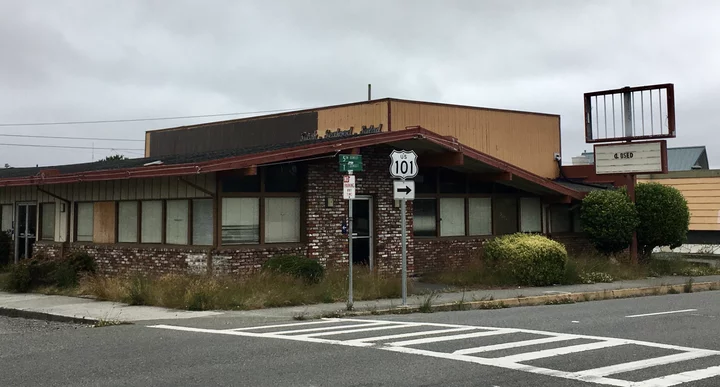
The charred roofline of Eureka’s vacant Sizzler building. | Photo by Stephanie McGeary.
###
Eureka’s abandoned former Sizzler building, on the corner of Fifth and T streets, caught fire overnight. According to a press release from Humboldt Bay Fire, the structure showed “obvious signs” of transient activity, including “bedding, trash, numerous hypodermic needles and human waste.”
The fire crew got the blaze under control within 20 minutes. The release said the fire caused an estimated $30,000-worth of damages, though as the Outpost reported back in February, this building is slated for demolition, along with the other two on that block, to be replaced by a new Starbucks and an as-yet-unidentified drive-thru restaurant.
###
Press release from Humboldt Bay Fire:
At 12:58 A.M. this morning three engines, a ladder truck and a Battalion Chief from Humboldt Bay Fire responded to a reported commercial structure fire on the 1900 block of 5th St. in Eureka.
The first arriving engine reported smoke was visible from the several blocks away and arrived on scene and found a single story commercial building with heavy smoke and fire showing from the rear of the building.
A commercial 2nd alarm was requested for additional resources to the scene to assist with firefighting operations and coverage of Humboldt Bay Fire’s jurisdiction. Crews initiated an interior fire attack and searched the structure for any potential occupants. The fire was controlled in 20 minutes and there were no civilian or Firefighter injuries.
Firefighters remained on scene for an additional 2 hours to ventilate the building of smoke, check for extension of the fire into hidden spaces and ensure the fire was completely extinguished.
The building had not been occupied for approximately two years and during the origin and cause investigation there were obvious signs of transient activity around the building and in concealed exterior storage areas against the building. This includes bedding, trash, numerous hypodermic needles and human waste.
Firefighters were able safely navigate these hazards to get hose lines in place to extinguish the fire. Due to the signs of transient activity and results of the fire investigation it is determined the fire was human caused and the fire started in an exterior storage shed that was directly attached to the building. Estimated damage to the building is $30,000.
Humboldt Bay Fire would like to thank the following agencies for their assistance: Arcata Fire District, Samoa-Peninsula Fire District, Eureka Police Department, City Ambulance and PG&E.
California Will Require Health Facilities to Start Sharing Patient Data With Each Other
Kristen Hwang / Thursday, June 30, 2022 @ 7:46 a.m. / Sacramento

Registered nurse Kristie Scheidt walks past some of the rooms in the intensive care unit inside El Camino Health Mountain View Hospital in Mountain View on Tuesday, Dec. 22, 2020. Photo by Randy Vazquez, Bay Area News Group
In March 2020, as Californians hunkered down for what many expected to be a two-week lockdown, high-ranking health officials were scrambling to find out how many COVID-19 patients were hospitalized, how many were in intensive care and how many beds remained available.
With no system in place for hospitals to report this information to the state and share it, Secretary of Health and Human Services Dr. Mark Ghaly, the state’s public health director and other staff had to call 426 hospitals to assess the situation.
Now, officials hope to avoid similar scenarios in the future by changing the way patient data is collected and shared. Legislation passed last year requires all health and human services providers to sign a statewide data-sharing agreement. This includes hospitals, doctor’s offices, nursing homes, public health agencies, laboratories, mental and behavioral health providers, substance use treatment facilities, insurance plans, public health departments and emergency services.
The final version of the agreement will be published July 1. Most participants will have six months to sign the agreement and a year to begin sharing data.
If implementation goes as planned, a doctor or case worker could request a patient’s full medical and social services history in real time. Patients could view their own records easily, and government agencies would also have access to more reliable aggregate data on patient outcomes and demographics — rendering the pandemic scramble obsolete.
“Myself along with our (California Department of Public Health) director and lots of staff were reaching out to hospitals across the state,” Health and Human Services Secretary Dr. Mark Ghaly said. “We depended early on on phone calls and asking charge nurses and the shift managers at different hospitals ‘What is your COVID burden in the emergency room and around the wards?’”
The health care industry already amasses incredible amounts of patient data. John Ohanian, chief data officer for the state Health and Human Services Agency, likens it to “freeways of information.” The problem is, not everyone has an on ramp to the freeway.
“Our goal was — and the governor’s goal was — to make it mandatory that people exchange information and provide rules of the road and guidelines so it can be done well,” Ohanian said.
It’s a huge endeavor for the state, and not everyone is on board.
In a public comment responding to a draft of the agreement, the California Hospital Association and California Association of Public Hospitals and Health Systems complained that the requirements exceed the statutory authority of the law that established the data-sharing requirement. When contacted for clarification, hospital association spokesperson Jan Emerson-Shea said there was nothing to add beyond what was in the letter.
The California Association of Health Plans also commented that parts of the draft proposal go beyond the scope of the new data-sharing law, including the proposed governing body that would oversee compliance. The association also pointed out potential conflicts with a parallel federal effort to create a national data exchange for health data.
Other groups, including the County Welfare Directors Association of California, County Behavioral Health Directors Association and Planned Parenthood Affiliates of California, raised concerns about data privacy and security. They also want patients to be given the ability to choose whether their data is shared and noted that addiction and mental health records are more strictly protected than other health data. In a letter to the state, Planned Parenthood asked to delay implementation by one year.
Ghaly said there are no plans to extend the timeline, and that other states have already executed similar plans.
“I often take a lot of pride in how California leads and innovates, but we are not innovating here. We are in some ways catching up,” Ghaly said.
Ohanian acknowledged the timeline was “aggressive,” but said the pandemic drove home the need for public health and social services data to be accessible instantly.
“There’s a reason why we’re pushing for an accelerated timeline. It’s because people need to have this information in their hands,” Ohanian said.
According to a state analysis, the proportion of medical and social services organizations that currently use digital records and share that information with other providers varies widely based on sector and location.
While 97% of family physicians used electronic record-keeping methods in 2020, those who didn’t tended to be small independent practices or they were in rural areas. Likewise, 90% of medium and large hospitals also used electronic-only patient records, but only 70% of small hospitals in the state used digital records.
The report found a little more than a third of addiction treatment centers used electronic records to document treatment plans and view laboratory results. Less than half of nursing homes used electronic records and only 10% reported that their systems connected with local hospitals.
Some of the organizations with the fewest digital record-sharing systems are government agencies like county public health and social services departments. “Many types of public health data are collected and transmitted via paper-based, phone, fax, or other non-machine-readable formats,” the report said. It also noted that hospitals frequently cited the inability of local public health offices to send or receive digital records as a major impediment. This caused problems early in the pandemic when public health labs were the only ones able to conduct COVID-19 tests, Ghaly said.
“That information, unless it was carried by paper or shared by fax…it was invisible, gone. It didn’t exist for those on the health care services side,” he said.
The state Legislature’s approved budget includes $50 million over two years to help small doctor’s offices, rural hospitals and community organizations invest in the technology needed to comply with the law.
Even before the pandemic, community clinics and social services providers like homeless shelters say disconnected record-keeping systems caused chronic problems.
“On average our staff spend 50% of their time doing paperwork and administrative stuff and 50% doing direct service. If the government eliminated some of the bureaucracy, we could double services with the same number of employees,” Bay Area Community Services CEO Jamie Almanza said.
Community Services provides emergency housing, intensive case management and mental health services for seven Bay Area counties. Working in all three fields allows it to see the “breakdowns in the system,” Almanza said.
On any given day, 2,000 people live in Community Services shelters, but each of the seven counties it works with uses separate systems for medical, mental health and housing records — all of which differ from the organization’s internal software. This creates duplicative work, especially when its clients access services in multiple counties, which is a common occurrence.
“Just in Alameda County I’m putting data into four different systems,” Almanza said. “Say a client needs to leave Oakland and we enroll them in housing in Contra Costa County: I have to redo the same thing even though it’s the same client five minutes away.”
Almanza sits on the data exchange advisory group, which has met nine times since the legislation passed last year. He said while there are concerns about what implementation will look like, most stakeholders agree that improvements need to be made.
“The bureaucracy is a killer. The data exchange committee is trying to collapse that for the whole state, but I think they’re still trying to give a lot of leeway to the jurisdictions,” she said.
On a broader scale, the patchwork of digital accessibility has made it difficult to reduce health disparities for conditions like heart disease and diabetes, both before and during the pandemic, said Kiran Savage-Sangwan, executive director of the California Pan-Ethnic Health Network and a member of the data exchange advisory group.
Pacific Islanders statewide experienced the highest death rates from COVID-19 in the past two years, and Black Californians saw their death rates increase as vaccination rates stagnated.
Communities of color make up 63% of the state’s population but represent more than 80% of all enrollees in Medi-Cal, the state’s health system for people who can’t afford health insurance. According to a California Health Care Foundation report on health disparities, Black and Latino residents are far more likely to experience preventable hospitalizations for conditions like asthma, heart failure and diabetes than white residents. The same groups are also the most likely to report delaying health care due to cost or lack of insurance.
“The other thing that this system really has the potential to do is to improve our ability to see disparities both on an individual clinical level and on a population health level, because this will require all providers to collect standardized demographic information about consumers,” Savage-Sangwan said.
In recent years, the state has launched ambitious plans to transform the Medi-Cal system through an initiative called CalAIM, which aims to address the root causes of failing health, like food insecurity and housing instability. It offers coverage for services not typically thought of as medical needs, such as housing. CalAIM, along with the state’s Healthy California for All Commission, which is exploring what a single-payer health care system could look like in California, relies on data.
“I can’t think of a thing on our list of huge transformations that won’t either depend on or benefit from this effort,” Ghaly said. “All of these data systems having some ability to come together around the individual is going to accelerate — whether it’s a social worker or an emergency room nurse — their ability to provide more comprehensive and coordinated services.”
###
CalMatters.org is a nonprofit, nonpartisan media venture explaining California policies and politics.


