

Supervisors Decide to Leave Payroll Duties With Auditor-Controller for Now, Hire an Outside Firm for Payroll Audit
Ryan Burns / Wednesday, April 27, 2022 @ 4:51 p.m. / Local Government

Auditor-Controller Karen Paz Dominguez addresses the Board of Supervisors Tuesday. | Screenshot.
On Tuesday, in a rare instance of communal accord, the Humboldt County Board of Supervisors voted unanimously to support a proposal backed by both County Administrative Officer Elishia Hayes and Auditor-Controller Karen Paz Dominguez — namely, to keep payroll management duties under the A-C’s office through the end of the current fiscal year (June 30).
In the same motion, the board voted (unanimously) to hire outside accounting firm CliftonLarsonAllen (CLA), to the tune of $279,000, to conduct a payroll audit. According to Hayes, the firm will take a “holistic view” of the county’s payroll operations in an effort to find sources of recurring errors and identify measures to fix them.
If you’re just tuning in, the county’s payroll function has been a source of problems and controversy for years now. In late 2018, shortly before Paz Dominguez assumed office, the county moved payroll out of her office and over to the Human Resources Department. Problems ensued, and in 2020 the board briefly outsourced payroll responsibilities to private firm Automatic Data Processing (ADP), only to find — after paying the firm $146,000 — that the company couldn’t get its systems to work with the county’s systems.
Since then, payroll duties have been shifted back to Human Resources, and finally, last August, returned to the Auditor-Controller’s Office, despite objections from a number of county employees.
Snafus have persisted, despite assistance from outside firm KOA Hills, and when the board last considered this matter, on March 2, the meeting proved acrimonious — another flashpoint in the ongoing conflagration between Paz Dominguez and other county personnel, including supervisors and department heads.
The board failed to reach a decision at that meeting over whether to leave payroll duties in the A-C’s office, move them over to the CAO’s Office or do something else altogether. Instead, the board continued the matter and directed Hayes and Paz Dominguez to work together, along with Human Resources Director Zachary O’Hanen, in hopes of finding a potential solution.
On Tuesday, staff presented the board with three options:
- keep payroll in the A-C’s Office for the foreseeable future and continue working to improve matters
- move it over to the CAO’s Office, or
- sit tight, leaving payroll in the A-C’s Office for the next couple of months, at least, before re-evaluating matters in July.
Chief Financial Officer and Assistant CAO Tabitha Miller ran the board through a list of pros and cons for each option, noting that Paz Dominguez didn’t necessarily agree with the lists. Staff’s recommendation, she said, was Option 3.
Miller also urged the board to direct more resources toward addressing the $28 million in unreconciled transactions from the 2019-20 fiscal year, a looming problem, discussed earlier in the meeting, that’s holding up the county’s submittal of its long-overdue 2019-20 single audit report.
“We keep talking about how far behind we are in the single audit report and our other reporting requirements and the handicaps and the impacts to the county,” she said. “And I think we’re minimizing the potential damage that’s there to our federal and state funding.” Continued delays could wind up costing the county millions more dollars, she said, and she asked the board to authorize the CAO’s Office and Treasurer-Tax Collector’s Office to work with the Auditor-Controller’s Office to wrap up work on those discrepancies.
“We’re not at a point where it’s rocket science,” Miller said, and she explained that the remaining work is mostly a matter of simple searches and data entry, tasks that staff could handle.
Returning to the matter of payroll, Fifth District Supervisor Steve Madrone thanked Paz Dominguez, Hayes and O’Hanen for working together as requested.
Paz Dominguez delivered a presentation, telling the board that she’d heard them “loud and clear” when they asked for improvements in communication. She recounted the recent efforts of a payroll “think tank” she’d organized, saying personnel from various county departments gathered to address and categorize problems and agree on an objective.
The think tank members plan to keep meeting after each payroll goes out. Paz Dominguez shared a screenshot showing a collection of Post-it-style notes from a recent think tank meeting that had been organized via a proprietary program called Stormboard, saying, “It’s a tangible result from these efforts at communication.”
She also updated the board on changes she has made with payroll duties, including a new organizational system facilitated through another proprietary software product called a Trello Board, which will allow county staff to track each step in the payroll process.
Paz Dominguez then boasted that out of more than 2,500 W-2 tax forms her office issued for the 2021 fiscal year, only 30 had errors requiring correction. This, she said, amounted to an accuracy rate of 99.99 percent.
This led to a brief dispute with First District Supervisor Rex Bohn about the underlying math.
See the video clips below. First, here’s Paz Dominguez’s statement:
A couple minutes later, Bohn challenged her calculations, saying the accuracy rate actually works out to more like 98.8 percent, not 99.99, prompting Paz Dominguez to offer to do the math right there in front of him:
Who’s correct? We’ll let readers do their own calculations.
Madrone later asked if all the W-2 issues have been resolved, and Paz Dominguez replied that all but three have been fixed, with those remaining three referred to the vendor that sells the county’s financial software.
“That’s great progress,” Madrone said. He then asked, skeptically, who exactly is included in the “staff” that was recommending Option 3. He sounded delighted when Hayes told him that she and Paz Dominguez had discussed the matter and were in agreement on the recommendation, as was O’Hanen.
“Sounds to me like Door No. 3 has all kinds of prizes behind it, so I’m looking forward to that one,” Madrone said.
Third District Supervisor Mike Wilson made a motion to accept the staff recommendation for Option 3, agree to a $279,000 contract with CLA for a payroll audit and authorize the County Administrative Office and the Treasurer-Tax Collector’s Office to work with the Auditor-Controller’s Office on resolving the $28 million-worth of unreconciled transactions.
The vote was 5-0 in favor.
BOOKED
Today: 7 felonies, 6 misdemeanors, 0 infractions
JUDGED
Humboldt County Superior Court Calendar: Today
CHP REPORTS
Us101 S / Kenmar Rd Ofr (HM office): Traffic Hazard
ELSEWHERE
Coalition for Responsible Transportation Priorities: A Mixed Bag for Transit
RHBB: Family Searching for 25-Year-Old Man Released from Involuntary Hold at Eureka Hospital
KINS’s Talk Shop: Talkshop September 4th, 2026 – Pam Powell
Governor’s Office: California’s public safety strategy works: Governor Newsom’s commitment helps lower crime as new study shows violence prevention saves lives
MEASURE K: Humboldt County Wants Voters to Re-renew the Abandoned Vehicle Abatement Program
Isabella Vanderheiden / Wednesday, April 27, 2022 @ 7:56 a.m. / Elections

A bullet-riddled abandoned car in rural Humboldt County. Photo: HCSO
###
We are all aware of the issue of abandoned vehicles in Humboldt County. You’re on your way to work or to drop the kids off at school and there it is: a once-loved Dodge Neon carelessly dumped on the side of the road. Ah, yes, you begrudgingly whisper. The cycle begins.
The severity of the dumped car lifecycle generally depends on where you’re located in the county. If you’re in town, the damage tends to be relatively minimal, but if you’re on the Samoa Peninsula or out in the hills, that aging sedan will be ravaged by hellions in a week’s time.
The windows usually go first. Then the tires and catalytic converter are stolen. The car is bashed up a bit, gutted, and usually spraypainted or tagged in some way. Destruction often culminates in the car being used for target practice and/or being set on fire. And there it will sit, sometimes for months.
The county has tried to address this issue for decades. Most recently — in 2012 — voters passed Measure Y, the Humboldt County Abandoned Vehicle Abatement (AVA) Program ballot initiative, to renew the county’s existing efforts to deal with the problem. The measure asked voters to approve a vehicle registration fee of $1 per vehicle and $2 for certain commercial vehicles to fund a program to reduce community blight by removing and disposing of abandoned, wrecked and dismantled vehicles.
Measure K, an initiative to re-renew the AVA program for another 10 years, will be up for voters’ consideration in June. If passed, the ballot initiative would continue to generate approximately $160,000 annually for vehicle abatement purposes.

The Humboldt County Sheriff’s Office (HCSO) functions as the administrator of the county’s AVA fund and oversees a budget to cover vehicle abatement after state funding had been exhausted.
“We have in the past been granted supplemental money from the [county’s] general fund to help cover the costs of vehicle abatement, as it has been identified as a big, costly issue here in Humboldt,” HCSO spokesperson Samantha Karges wrote in an email to the Outpost. “…What people don’t realize is when they abandon their vehicles, the Sheriff’s Office is the one that has to pay to get rid of it. We have to pay the tow company for towing the vehicle, Eel River Salvage for disposing of the vehicle, and the personnel time. This adds up quickly.”
Disposal can range anywhere from $125 to $600, depending on the size and condition of the vehicle. Motor homes are “extremely expensive,” she said, and often cost between $1,500 and $4,000 to dispose of because they are often filled with garbage and hazardous materials.
The Sheriff’s Office spent $118,057.35 on AVA in Fiscal Year (FY) 20-21 and $164,108.57 in FY 19-20. A total of 1,862 vehicles were abated by the Sheriff’s Office between 2019 and 2021.
Those statistics do not apply to cities with their own AVA programs. For example, the Eureka Police Department (EPD) towed 439 abandoned vehicles within the City’s limits in 2021 through its volunteer AVA team, according to EPD spokesperson Brittany Powell.
“Abandoned autos can quickly become a nuisance and target for criminal activity,” Powell wrote in an email to the Outpost. “If a vehicle is abandoned and not quickly taken care of, parts slowly start to get removed, catalytic converter taken off, graffiti and trash.”
One of law enforcement’s biggest concerns with abandoned vehicles is people setting them on fire. “These vehicles have the potential to spark major wildfires,” Karges added.
The AVA process is generally complaint-driven and focused on vehicles that have been “truly abandoned and [are] causing a nuisance.” This does not apply to vehicles that are on private property or to vehicles that are being lived in.
When a vehicle is reported, it is marked with a bright yellow abatement notice and a letter is sent to the last known registered owner of the vehicle to inform them that the vehicle will be towed and crushed if it is not picked up within 10 days, or 15 days for out-of-state owners.
“Once the waiting period is over, we go out there and confirm that the vehicle is still where it was when marked,” Karges said. “If it’s still there, we fill out a tow request with a local towing company. Depending on how busy the towing company is, it could take up to a week to tow the vehicle. …Towed vehicles are transported to Eel River Transport and Salvage where they are crushed and disposed of.”
However, costs for disposal continue to rise. If the AVA program is not renewed through Measure K, most local agencies will not have adequate funds to keep up abatement services.
“Our Board [of Supervisors] and local cities all agree that the program is beneficial and should be put before voters for renewal,” deputy County Administrative Office Sean Quincey wrote in an email to the Outpost. “The program provides funding to help offset some of the costs related to removing abandoned vehicles from public areas. Most local agencies do not have alternate funding for such a program and without it they would need to either stop offering these services or locate other funding.”
More information on Measure K can be found here.
###
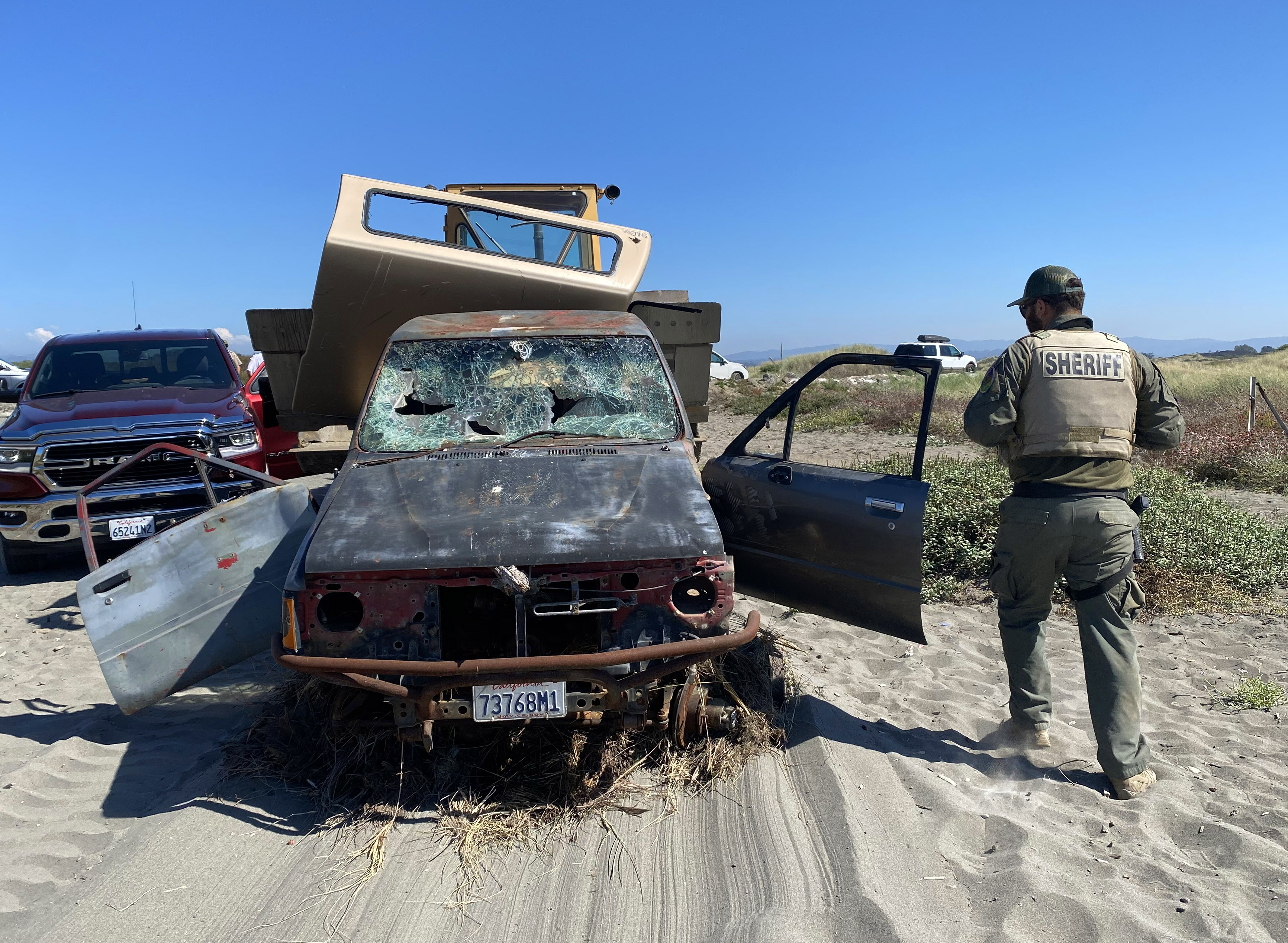
Deputies remove an abandoned vehicle from Samoa Beach. Photo: HCSO
California Sports Betting Initiative Backed by FanDuel, DraftKings Would Block Small Competitors
Grace Gedye / Wednesday, April 27, 2022 @ 7:51 a.m. / Sacramento

###
One of the measures Californians will likely get to vote on this fall does more than just allow betting on sports: Critics are concerned it will effectively block smaller gaming companies and startups from operating in the state.
Those are high stakes for an industry that could rake in over $3.5 billion each year from California bettors — and for a state that prefers to see itself as the startup capital of the world.
Of the four sports betting initiatives competing to make November’s ballot, one, paid for by online sports betting giants FanDuel, DraftKings and BetMGM, would allow gaming companies and Native American tribes to provide sports betting online across the state.
But embedded in the initiative are requirements that would be very difficult — if not impossible — for the companies’ smaller competitors to meet, experts say.
If the initiative passes, gaming companies would have to pay a $100 million licensing fee to do business in the state, as well as already be licensed in 10 states, or be operating in five states and running 12 casinos.
“I think it’s absolute nonsense,” said John Holden, a professor at Oklahoma State University who studies sports gambling policy. “I think what’s effectively happening is, basically, the 5 to 10 frontrunners in the market have decided ‘Alright, let’s ensure that there’s no one else who can compete by agreeing to pay these exorbitant license fees.’”
The $100 million fee, Holden said, essentially ensures no startups will be able to operate in California.
The fee is one way the measure generates “significant revenue to fund homelessness housing and mental health treatment and provide financial support for California Tribal nations,” Nathan Click, a spokesperson for the initiative’s campaign, wrote in a statement.
“California is best served by creating a safe and tightly regulated sports betting market, one where customers can know they are working with experienced platforms with a proven track record of safe and responsible operation in other markets,” Click wrote.
FanDuel and BetMGM did not respond to CalMatters’ request for an interview. DraftKings directed CalMatters’ interview request to Click, the campaign spokesperson.
Here’s what the initiative does
The initiative backed by sports betting companies would:
- Allow adults 21 or older to bet on sports events online, as well as on some non-athletic events like awards shows and video-game competitions, outside of Native American lands
- Enable tribes to offer online sports betting under the tribe’s name and branding. Tribes would have to pay a one-time $10 million licensing fee to the state and $1 million renewal fee every five years
- Allow gaming companies such as Fanduel and DraftKings to offer online sports betting if they strike a deal with a tribe to access the California market, pay a one-time licensing fee of $100 million plus a $10 million renewal fee every five years, and they are also licensed to operate in 10 states (or are licensed to operate in five states and operate 12 casinos)
- Create a new division within the state’s Justice Department to regulate online sports wagering
- Impose a 10% tax on all companies or tribes offering sports betting. After covering the state’s regulatory costs, most of the revenue from the tax and the licensing fees would be used to address homelessness and create interim and permanent housing. Of the funds, 15% would go to Native American tribes that aren’t involved in online sports betting.
The state’s Legislative Analyst’s Office wrote in its assessment of the measure that it’s uncertain how much money the new taxes and fees would generate for the state, but it could reach the mid-hundreds of millions per year.
The measure hasn’t qualified for the ballot yet — it’s still gathering signatures. But Click, the spokesperson for the campaign, said the measure is well ahead of where it needs to be to qualify.
Other measures that legalize sports betting could make the ballot — or are already eligible. One, backed by a coalition of tribes, would allow sports betting at tribal casinos and four horse race tracks only, while another, backed by a separate coalition of tribes, would allow tribes to offer online and in-person sports betting exclusively. Native American tribes have long had the exclusive right to offer certain forms of gambling in California. Many tribes are campaigning against the gaming companies’ initiative arguing, among other things, that it would threaten tribes’ sovereignty and self-reliance.
If one of the initiatives passes, California would become one of over 30 states to legalize betting on sports. The industry could generate $3.57 billion per year in net revenue for entities offering sports betting to people in California if online and in-person betting is legalized and many companies are able to operate, according to projections from Eilers & Krejcik Gaming LLC, a research firm. That’s larger than the firm’s projections for Texas, New York, or Florida.
So much for the sports betting startups
The $100 million licensing fee is much higher than what any other state has on the books, said Becca Giden, director of policy for Eilers & Krejcik. Now, New York’s $25 million licensing fee is the highest, she said. Most states that have legalized sports betting have licensing fees in the low single-digit millions or hundreds of thousands — and no other state requires companies to already be licensed in other states, according to Giden.
The requirement that a company already be licensed in 10 states would cut off smaller companies and startups that are only licensed in a few states, Giden said. That, combined with the fee, would “meaningfully limit the ability of small companies and startups” to participate in the market, she said.
Early-stage startups that get money from venture capitalists generally raise around $5 million to $20 million in their first round, said Olav Sorenson, a sociologist at UCLA’s Anderson School of Management who studies entrepreneurship. But only about 1 out of every 100 startups get any venture capital money, Sorenson said. When you include startups that rely on credit card loans and other sources of funds, the amount of money new companies have at their disposal shrinks.
“Very, very few startups would be able to afford that kind of fee,” Sorenson said. “I think it’s going to dramatically limit competition.”
A few companies already dominate online sports betting. FanDuel commands 31% of the U.S. market, followed by DraftKings with 26%, BetMGM with 16% and Caesars with 12%, according to research from Eilers & Krejcik.
“Very, very few startups would be able to afford that kind of fee. I think it’s going to dramatically limit competition.”
— Olav Sorenson, sociologist, UCLA Anderson School of Management
“The goal of this seems to be to create an oligopoly market for sports betting,” said Marc Edelman, a law professor at Baruch College who specializes in sports, gaming, and antitrust law. It would, he said, benefit a limited number of companies “to the detriment of smaller companies and consumers.”
MaximBet, a sports betting company launched in 2021, is so far licensed in one state: Colorado. The company tries to set itself apart by offering bettors in-person experiences — glitzy masquerade parties, meet-and-greets with pro players, or the opportunity to drive a Ferrari around a race track, said Doug Terfher, vice president of marketing for the company.
Because the company is licensed in just one state, it wouldn’t be able to operate in California yet under the initiative backed by the gaming companies — or the initiatives backed by the tribes. “We want (California) to be as open and available to as many operators as possible with where we are in our growth journey,” Terfher said.
MaximBet is working on getting licensed in 10 states and in Ontario, Canada, but the process is slow. If the company is able to get licensed in five states this year, “it’ll be an amazing year,” said Terfher.
Most states are restricting the number of companies that can offer sports betting, said Daniel Wallach, a Florida-based gaming lawyer who has testified in front of state legislatures considering legalization. States do this with other forms of gambling too. It’s commonplace, he said, for gaming not to be a free for all, where any company can participate. There have to be some baseline standards, he said, that ensure that a company’s integrity, experience, and track record are closely scrutinized.
Historically, organized crime groups have been involved in the gambling industry, Wallach said, so state legislatures and gaming agencies “are very careful to limit who can operate in this heavily regulated industry.”
What are the practical effects?
If smaller companies can’t do business in California, that means fewer options for would-be bettors and potentially less innovation.
“You’d basically end up with a lot less choice,” said Holden.
One up-and-coming product Holden cited is exchange-based wagering, where bettors can trade wagers with each other throughout a game, similar to how day traders buy and sell stocks.
Sporttrade, a Philadelphia-based startup that offers stock-market-like sports betting, is working on getting licensed in New Jersey, Colorado, Indiana, and Louisiana. Could it cough up $100 million and get licensed in 10 states in order to come to California?
“No chance,” said Alex Kane, the company’s CEO. He’s all for regulations that protect consumers, he said, but thinks a $100 million licensing fee doesn’t have anything to do with that. Instead, Kane said he thinks the bigger companies writing the initiative don’t want to face competition. “They’re looking at ‘What would we be willing to pay to get rid of competition altogether?’” Kane said. “You can see that it’s worth a lot of money to them.”
And if it’s difficult for new companies to reach customers in California, that could wind up shaping not just what services are offered, but who offers them. “Such a high financial barrier to entry makes it nearly impossible for minority-owned businesses — or new businesses or entrepreneurial ventures — to even attempt to compete,” said Edelman, the law professor at Baruch College. If there’s not a lot of competition between sports betting vendors, that might also lead to worse prices for customers, he said.
“To presume that a company that could spend a lot of money is ethical and a company that could spend a small amount of money is not ethical is very dubious logic.”
— Marc Edelman, law professor, Baruch College
If the initiative backed by the gaming companies passes, California wouldn’t be the most restrictive state — not even close. Delaware has essentially limited sports betting to three casinos. Washington D.C. enabled one app, run by the DC Lottery, to offer online sports betting city-wide, while other companies are limited to the geographic areas surrounding sports arenas they’ve cut deals with. Somes states have set limits on the number of licenses they’ll offer. Washington state made sports betting the exclusive domain of Native American tribes, and Maine seems poised to make a similar decision.
Regulators can make rules that protect consumers and ensure gaming companies act responsibly without limiting the number of companies that can operate. The fact that many states have limited the number of licenses they’ll give out isn’t necessarily because that’s the optimal set up for consumers. It’s because they’ve been lobbied by casinos, racetracks, and other groups that already have a stake in gambling, said Giden.
If the goal is to ensure that companies operate ethically, then regulators should be reviewing companies’ past business practices across all lines of business, said Edelman, the gaming and antitrust law professor.
“To presume that a company that could spend a lot of money is ethical and a company that could spend a small amount of money is not ethical is very dubious logic,” he said.
###
CalMatters.org is a nonprofit, nonpartisan media venture explaining California policies and politics.
(UPDATE) Two Fishermen Missing on Humboldt Bay; Coast Guard Conducts Search Overnight
LoCO Staff / Wednesday, April 27, 2022 @ 7:05 a.m. / Emergencies
UPDATE, 8:42 a.m.:
HAPPENING NOW: Deputies are assisting the @USCG with a search for two missing fishermen in the Humboldt Bay area. The men’s boat was located partially submerged approx. 1/2 mile NE of King Salmon shortly after midnight today. Numerous agencies are assisting in the search.
— HumCoSO (@HumCoSO) April 27, 2022
###
From the US Coast Guard Sector Humboldt Bay Facebook page, posted at about midnight:
COAST GUARD SEARCHING FOR MISSING FISHERMEN - USCG aircrews, boat crews, and Humboldt County Sheriff’s Office personnel are searching for two men who went fishing in Humboldt Bay Tuesday and have not returned.
Scott Arbaugh, 70, of Eureka, and his son Josh Arbaugh, 50, of Arcata, are believed to have launched their 16 foot jon boat late Tuesday morning from Fields Landing to go fishing and were reported missing earlier this evening. Family have not heard from them since.
Coast Guard MH-65 helicopter aircrews, 29’ RBS-II boat crews, and HCSO personnel are actively searching. Anyone with information is requested to contact the Coast Guard command center at 707-839-6113 or the Sheriff’s Office immediately.
OBITUARY: John Kent Morgan, 1954-2022
LoCO Staff / Wednesday, April 27, 2022 @ 6:56 a.m. / Obits

John
Kent Morgan
June
28, 1954 – April 20, 2022
John was born and raised in Riverside, California, the oldest of three, and son of the Honorable John B. Morgan (attorney/judge) and Gertrude Murdoch Morgan (elementary school teacher). While growing up in Riverside, he had a paper route, played flag football with the neighborhood kids, little league baseball and football at Poly High School, where he graduated in 1972. Thereafter, he attended the University of Southern California where he earned a bachelor’s degree in Marketing. While at USC, he enjoyed life in a fraternity and earned spending money working as an extra in the TV series Happy Days, among others, and movies that were being filmed in LA, one of which was Baby Blue Marine with Jan-Michael Vincent and Richard Gere.
After John’s graduation from USC, his dad happened to represent a Humboldt man in his divorce… John’s Dad asked this gentleman to tell him all about Eureka… it sounded like a magical place, full of beauty and wildlife, where the redwoods meet the sea. It seemed so far away from the concrete jungle of Southern California. John’s Dad was mesmerized by the vision, being an avid outdoors man himself – and, thus, the seed was planted in his mind to get up to Humboldt and check it out. His dream was to commercial fish with his sons.
Alas, in 1978, John relocated up to Eureka He met an old fisherman, Bill Kay, who lived on Indian Island and operated the Indian Island Boat Ways. Well, this old-timer took John under his wing, and told him he was ready to retire – and asked him “would you take over the boat ways business and live on the island?” Well… Yes! Life on the island was not easy. Off the grid – no hot running water; cooking/baking off a wood stove; and transport to and from town was by boat. When John wasn’t working on refurbishing commercial fishing boats, he enjoyed playing with his goat, Casey. Shortly thereafter, John’s younger brother, Dave, would join him. John would boat into the Old Boat Basin and meet up with commercial fishermen and friends at the Vista Del Mar, playing cribbage, dice and throwing darts.
It was around this time, that John’s dad played matchmaker and set John up on a blind date with a local Riverside girl, Brenda Multhauf, and after a long-distance-relationship, she ended up moving to Eureka, and joined John and Dave on the island. A real pioneer woman, she grew a beautiful vegetable garden; cooked/baked on the wood-burning stove; and even attended nursing school. They married in 1981 and continued to live on the island until Brenda became pregnant with their first child, Michael, and moved to a craftsman in the Henderson center area in 1984, where John would remain for the rest of his life.
Their second child, Travis, was born in 1985 and thereafter, John went back to school and obtained a teaching credential. He taught at Pacific Union Elementary and Zane Middle School. He also ran the on-campus school suspension program for Zane; chaperoned school dances and led several after school groups, one of which had their own Relay for Life team for years. He received the Apple Award for Excellence in 1998. He coached basketball and little league baseball, and frequently would announce baseball games at the Babe Ruth ball field – he had a great ‘radio voice.’ Many times, his sister would tell him “You missed your calling and should have gone into radio.”
However, John was also especially good at working with at-risk youth. So, it was a natural transition for him to move into probation and work for the rest of his career at juvenile hall.
In May 2019, John married his beloved Milagros Rosales and lived happily for the rest of his short life, traveling internationally, working on upgrades around the house and yard, and dancing salsa with his beautiful Peruvian wife.
John would routinely be seen routinely on his front porch, smoking self-rolled cigarettes, watching Giants baseball through the window, enjoying a cocktail, working crossword puzzles and waving at/or visiting with folks passing by.
John was preceded in death by his father, Honorable John B. Morgan, his mother, Gertrude Murdoch Morgan and brother, David B. Morgan. He is survived by his wife, Milagros Rosales; his sons, Michael and Travis (Evelyn) Morgan; his sister, Melanie Gosselin (Paul); his granddaughters, Kaitlyn and Lillian Morgan; his grandson, Aiden; his nephews, Steve (Whitney), Brad (Kathy) and Will (Brianne) Morgan; his nieces, Crystal (Jeff) Mayberry and Lynzi McIntyre Morgan; his Auntie Liz; and cousins Jan and Ted Ford of South Carolina, and John (Christina) Paxton of Roseville, CA; as well as, many grand nephews and nieces.
Our family is grateful to Dr. Chung and the hematology/oncology departments at UCSF for their stellar and compassionate care of John during the last month of his life. As well as, the unwavering care that his youngest son, an ICU nurse, provided him during the final months of his life. Our family’s combined heart is bursting with gratitude for Travis Morgan, as well as UCSF.
Youth sports was a huge part of John’s life for many, many years. If you’d like to donate to one of our local youth baseball programs in his memory, please feel free to do so.
A Celebration of Life will be held this Friday, April 29th, at the Eureka Woman’s Club, located at 1531 J Street in Eureka at 4 p.m.. Hope to see you there – bring your John stories!
###
The obituary above was submitted by John Morgan’s loved ones. The Lost Coast Outpost runs obituaries of Humboldt County residents at no charge. See guidelines here. Email news@lostcoastoutpost.com.
OBITUARY: José L. Valadão, 1935-2022
LoCO Staff / Wednesday, April 27, 2022 @ 6:56 a.m. / Obits

On
April 23, 2022, we lost a good man, devoted father, loving
grandfather, brother, uncle, cousin, and dear friend. José
L. Valadão
(lovingly
known as Joe) was born
in the village of the Punta Fajã
Grande, Flores, Azores, Portugal
on September 16, 1935 to João
and Avelina Mateus.
Joe passed away on the 10th anniversary of his beloved wife Lucia (Lucy) Valadao’s death.
He leaves behind two sons and their families.
David
(Jennifer) granddaughters Jordan and Alyssa Valadao (Eureka).
Donald,
granddaughter and grandson Janée and Justin Valadao (San Diego.)
Brother
and sisters and numerous nieces and nephews.
Sal
(Linda) Mateus (McKinleyville)
Mary
Silva (Arcata)
Inez
(Otto) Storr (Meridian, Mississippi)
Carmen
Valadao (Massachusetts)
Regina
(John) Goodrow (Salem, Oregon)
Joe immigrated to the United States on December 11, 1960 and arrived in San Francisco. His first employment was milking cows in Chowchilla, Calif. Later that year, at the request of his cousin, José Silveira, he moved to Arcata, where he got employment with the Louisiana Pacific Lumber Company (L.P) as a Redwood Grader. In 1965, after obtaining his U.S. citizenship, he traveled back to Flores to marry the love of his life, Lucy. The story of their marriage and devotion to each other is admired by all those who knew them. Joe and Lucy were married for 46 years.
He was very proud and involved in the local and state Portuguese community. He served as Supreme President (1974-1975) and I.D.E.S. Council No. 85, as Council Secretary, for over 35 years. Joe retired from L.P. in 1997 at the age of 62, where he began his travels around the world with his wife Lucy. Together they toured Italy, Portugal, Azores Islands, Panama Canal and the Caribbean, to name a few. They also went on multiple cruises to various locations around the world.
Joe was a wonderful man and friend who would always lend a hand. He even went on Costco runs for friends when they couldn’t go for themselves and bought turkeys for the Humboldt Food Bank at Thanksgiving. Joe will be greatly missed by his loved ones and everyone whose lives he touched.
Joe was preceded in death by Lucy Valadao, João and Avelina Mateus,
Visitation will be on Thursday, April 28, 2022, 5-7 p.m., at Paul’s Chapel in Arcata, with a Rosary to follow.
The memorial Mass will be at Saint Mary’s Catholic Church in Arcata on Friday, April 29, 2022 at 1:30 p.m.
Celebration of Life will be at the Portuguese Hall (Arcata) following the Mass.
Burial will be at Sunset Memorial Park (Eureka) at 11 a.m., Saturday, April 30th.
Donations can be made to your favorite charity.
###
The obituary above was submitted by Joe Valadão’s loved ones. The Lost Coast Outpost runs obituaries of Humboldt County residents at no charge. See guidelines here. Email news@lostcoastoutpost.com.
Supervisors Agree to Forward Workforce Development Board’s Concerns Over Paz Dominguez, Funding Issues to State Agencies
Ryan Burns / Tuesday, April 26, 2022 @ 5:47 p.m. / Local Government
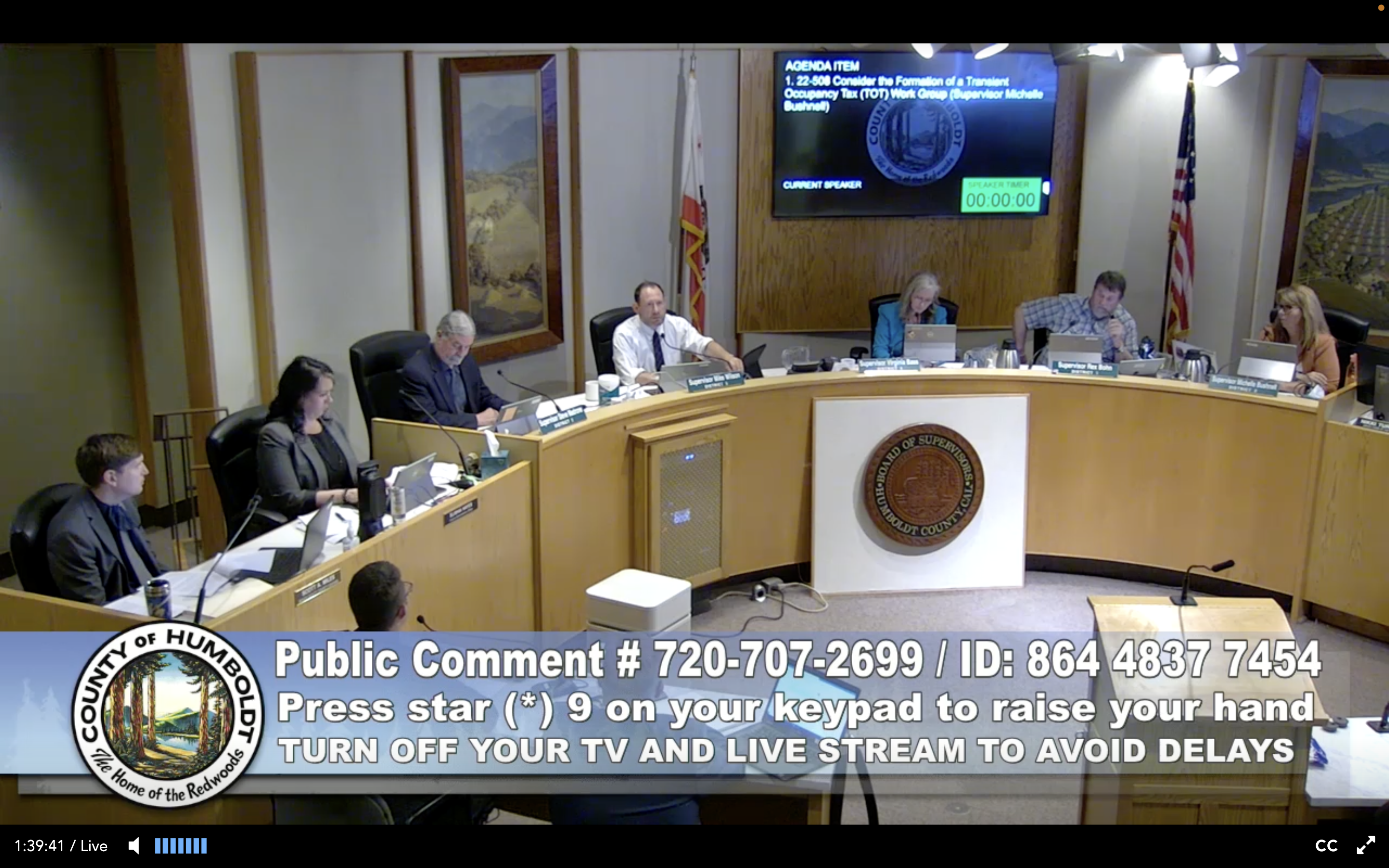
The Humboldt County Board of Supervisors. | Screenshot.
###
Fallout from the county’s fiscal management problems just keeps spreading.
On Tuesday, following another contentious hearing with Auditor-Controller Karen Paz Dominguez, the Board of Supervisors unanimously agreed to authorize a letter referring one of those problems to the state — specifically, to the Fair Political Practices Commission and the Department of Justice.
The problem, according to the county’s Workforce Development Board, is that the state’s Employment Development Department (EDD) has issued a cash hold, freezing some of the county’s most important workforce program funding, because the county has yet to submit its long-overdue single audit for fiscal year 2019-20.
Scott Adair, the county’s economic development director, said at today’s meeting that when the Workforce Development Board first learned that those funds were at risk, back in November, they invited Paz Dominguez to a meeting in hopes of getting “additional detail and an explanation” for the report’s delinquency.
“The auditor-controller at that time made a commitment to have the single audit report completed by March of this year,” Adair said, adding, “That did not occur.”
Shortly thereafter, he noted, the Workforce Development Board adopted a resolution of “no confidence” in the Auditor-Controller’s Office.
The cash hold has since been put into effect, Adair said, and since the Workforce Development Board is merely an advisory body, it needs the supervisors’ approval to communicate with state authorities in hopes of resolving the matter. Ideally, the state will release the hold with an assurance that the single audit is all but complete, he explained.
In the meantime, with the state funds now frozen, the county’s economic development division has been forced to dip into the county’s general fund to keep operating its workforce development program, with the hope that those expenditures will be eligible for reimbursement down the line, according to Adair. “We have been told by the state that we have until the end of this fiscal year [on June 30] to remedy the single audit issue, after which expenditures may not be available for reimbursement,” he said.
Appearing via Zoom, Paz Dominguez disputed Adair’s take on the situation, saying his characterization of matters was “not correct.” She said the funding in question has not, in fact, been placed on a cash hold because no requests have actually been submitted and rejected by the state.
Paz Dominguez also said that the single audit report has now been completed by outside accounting firm MGO, though she added that the firm is still waiting on a couple of items related to payroll and cash reconciliations.

“I don’t want the impression to be that this is something the Office of the Auditor-Controller is holding up purposefully or that it’s something within our control to do at this point,” Paz Dominguez said.
Given a chance to respond, Adair pushed back. He read from a March 15 email from the regional EDD representative informing the county that the cash hold went into effect on March 4 and will remain in place until the agency receives proof that the county’s 2019-20 single audit is complete.
This argument over the basic facts of the situation continued. County Administrative Officer Elishia Hayes disputed Paz Dominguez’s claim that the single audit is complete, saying that won’t technically be the case until the county’s financial statements are completed. There is $28 million in transactions from the 2019-20 fiscal year that have yet to be reconciled, Hayes said. Those transactions — upwards of 700 or 800 of them, altogether — appear on the county’s bank statements but not in its financial system. Hayes said she’d be asking the board later in the meeting for permission to have her office’s staff step in to help identify those transactions.
“We would like to put all resources possible [toward] completing the audit,” Hayes said. “It is of the utmost concern at this point in time, and it’s our hope to have it done by June 30, if not sooner.”
The board’s discussion on the Workforce Development Board matter was complicated by the fact that, in the corresponding staff report, it was lumped together with a couple of documents that weren’t directly related to the questions at hand.
One was a recent memo in which 13 of the county’s 19 department heads say Paz Dominguez “has failed to fulfill the duties and responsibilities of her position.” The other was a “fact sheet” prepared by the CAO’s Office that lists upwards of 40 “deficiencies” with which Paz Dominguez’s tenure as auditor-controller’s has allegedly been “marred.”
Paz Dominguez argued that the “fact sheet” is “not actually factual,” and she suggested that any letters submitted to the state about the workforce program funding situation should be written jointly, with her own involvement.
“I would be more than happy to have them come in and investigate the operations of this county so that they can see the challenges that we face as a county together,” she said.
Third District Supervisor Mike Wilson said he was disappointed with the “fact sheet” and would not want it forwarded to the state. Second District Supervisor Michelle Bushnell, who serves on the Workforce Development Board, clarified that the “fact sheet” would not be sent.
Hayes discouraged the board from accepting Paz Dominguez’s request for a joint letter, saying that while the auditor-controller should feel free to submit her own correspondence, the Workforce Development Board’s request was simply to forward their concerns to state agencies.
A clearly annoyed First District Supervisor Rex Bohn said Paz Dominguez could write “as many letters as she wants … or she could do the single audit, or we could get this stuff done timely.”
Bushnell made a motion to have staff forward the Workforce Development Board’s concerns to the state. She later amended it to “recognize and accept” the memo from department heads expressing dissatisfaction with the Auditor-Controller’s Office.
Paz Dominguez again voiced objections, saying that the Workforce Development Board’s stated concerns aren’t based in fact.
“There’s one person who is named and accused” in the board’s communications, she said, referring to herself. “And I think it’s important that we all recognize that is not appropriate or correct, because this is a county-wide issue. It’s a systemic flaw in this county.”
During the public comment period, regular commenter Kent Sawatzky suggested that the “fact sheet” constitutes slander, and that Paz Dominguez has every right to sue the county over it. He also suggested that the county should commission a forensic audit from the state to truly understand the source of its fiscal issues.
Connie Stewart, the executive director of initiatives at Cal Poly Humboldt and regional organizer of the Humboldt Workforce Coalition, called in to tell the board that the cash hold is indeed affecting workforce program funding. “And I’m not sending invoices in right now because I don’t want them to go to collections,” she said.
Stewart added that there are “millions and millions of dollars” in grant funding that will be up for grabs in the next couple of months. “And [with] some of those grants, it requires the Workforce Development Board to be the sponsor,” she said. “And unfortunately, because we do not have the single audit, it is very unlikely that we will get those grants.”
After the public comment period, there was yet more argument about the underlying facts of the situation, with Hayes and Paz Dominguez offering conflicting characterizations of the $28 million in unreconciled transactions, with Hayes saying county departments have submitted all necessary documentation while Paz Dominguez insisted that other departments — notably, the Department of Health and Human Services — have yet to reconcile their own transactions.
At the end of this convoluted and quarrelsome discussion, the board voted unanimously to authorize staff to send along the Workforce Development Board’s concerns to the state.
There was a lot more discussed at Tuesday’s meeting, including a deliberation over which department should be managing county payroll and the board’s decision on how to distribute Measure Z revenues for the upcoming fiscal year. Check back Wednesday for more coverage.


