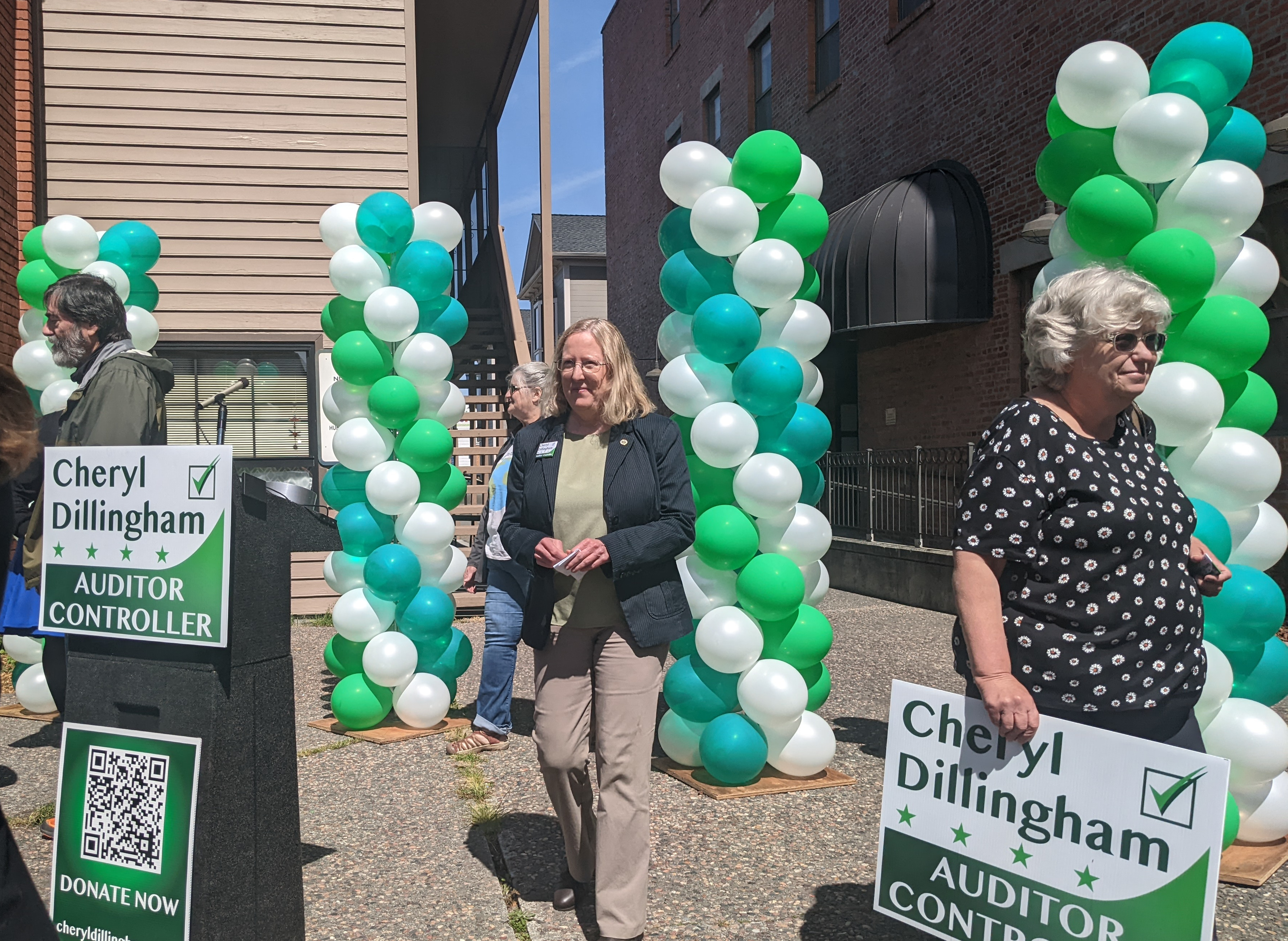
On a sunny afternoon, in front of an enthusiastic Old Town crowd, Cheryl Dillingham — finance manager for the city of Rio Dell — officially announced that she would challenge incumbent Karen Paz Dominguez for the office of Humboldt County Auditor-Controller.
“I don’t like public speaking or politics,” said the candidate, kicking off a four-minute campaign speech. “I’m really most comfortable doing accounting and dealing with numbers. I’m here today, speaking to you, because there is an urgent need to fix the county’s accounting and reporting, and I’m asking for your vote as your Auditor-Controller.”
A 12-year employee of the Auditor-Controller’s office and former interim leader of the department, Dillingham holds a bachelor’s degree in math and an MBA from Humboldt State, and said she has performed every job in the office. She said her experience makes her “uniquely qualified” to understand “the challenges facing the department and how to correct them.”
“Audits and financial reports may sound dull and unimportant, but that’s the job,” Dillingham said. “Not getting the work done on time does not create transparency for the public. It does not foster trust in government.”
Under Paz Dominguez, the Auditor-Controller’s Office has been chronically late in submitting required reports to state agencies, which has placed grant funding at risk, and Dillingham sought, late in her speech, to make this concrete.
“Children’s services, social programs, homelessness issues, food insecurity, trails, roads, conserving forests, economic development, environmental protection, affordable housing — all of these important programs are put at risk by the failure to get annual audits done on time,” she said.
Dillingham was introduced by three speakers: Department of Health and Human Services employee Mychal Evenson, who briefly ran for the position before dropping out in favor of Dillingham; former Third District Supervisor Mark Lovelace; and Rio Dell Mayor Debra Garnes. Each of them attested to the candidates bona fides.
“I’ve really stayed out of politics since dropping off the Board of Supervisors six years ago,” said Lovelace. “But when I heard Cheryl Dillingham was running to be our next Auditor-Controller I had to get involved. Because I had the opportunity to work with Cheryl for eight years when I was on the board, and I know her to be extremely capable, competent, responsible and easy to work with. And she’d be a great Auditor-Controller for Humboldt County.”
In keeping with the tenor of the event, Lovelace’s references to Paz Dominguez’s rocky stewardship of the office over the last three years were kept oblique. He talked about the critical importance of the office to a vast array of local services, including those not offered directly by the county, and lauded Dillingham’s hard-working ethos and her aversion to “drama.”
“The better the Auditor-Controller is doing her job, the less you’ll be hearing her name in the news,” Lovelace said.
Rio Dell Mayor Debra Garnes — who led the crowd in a chant of “Dil! Ing! Ham!” before commencing her comments — praised the candidate for her work with the city, especially singling out her timeliness and her ability to communicate complicated ideas to the council.
She also warned that Humboldt County stands to lose out on the massive amount of funding trickling out to local governments from the federal infrastructure unless it gets its financial house in order.
“Probably the largest infrastructure bill of our generation has been signed by the president,” she said. “Humboldt County has to get its books in order, and it has to do it fast, so we get all the benefits. All the cities, all the townships, everyone in Humboldt County can benefit if Humboldt County gets its books in order. And that’s what Cheryl Dillingham can do.”
Numerous notable government employees and elected officials were in attendance, including Supervisors Virginia Bass and Rex Bohn, Department of Health and Human Services Director Connie Beck, Economic Development Director Scott Adair, Treasurer Tax-Collector John Bartholomew and more.
Find a Facebook video of the event posted by North Coast News below:
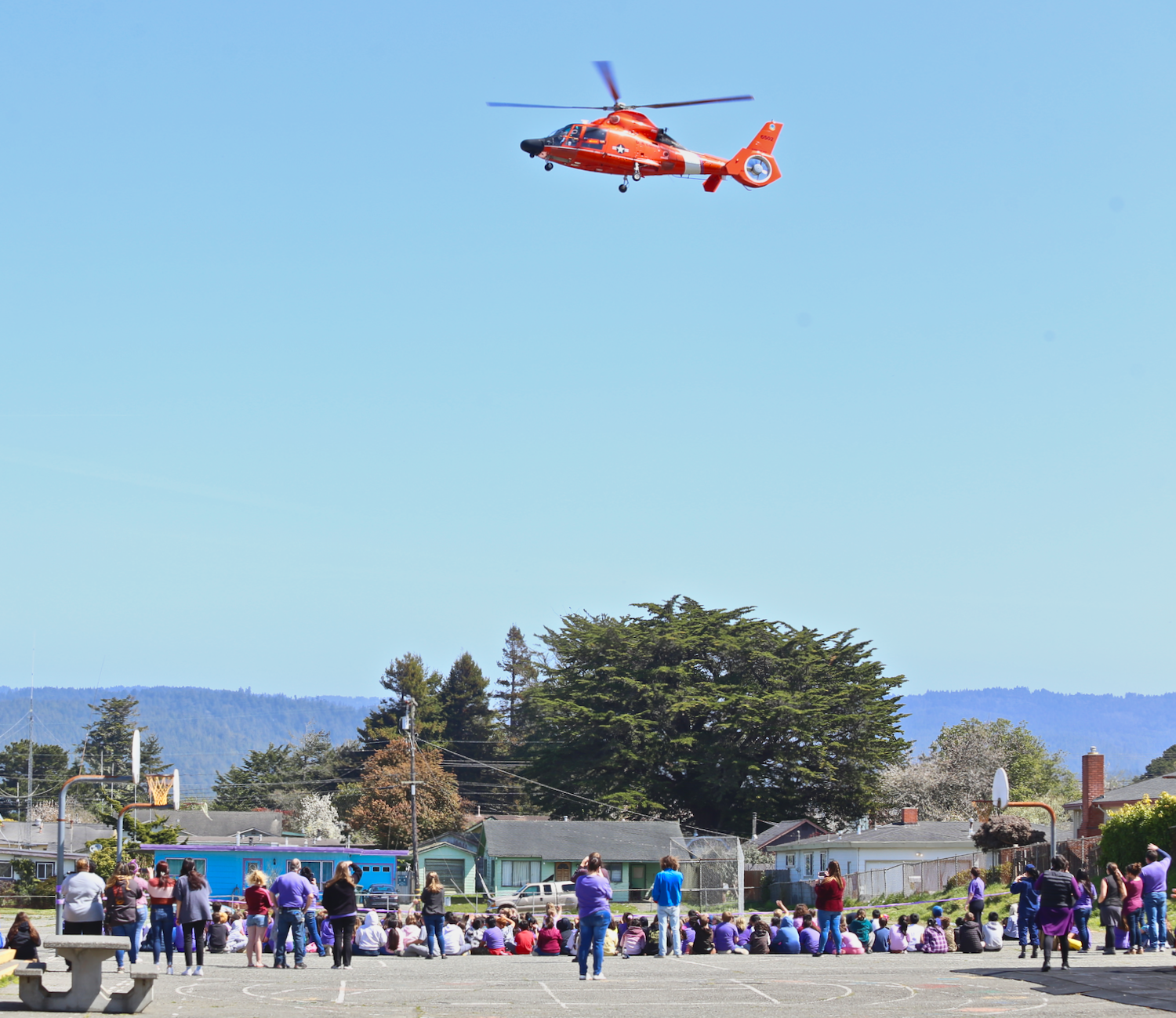
Lafayette students watch as the US Coast Guard helicopter lands in their school field | Photos: Andrew Goff
###
Eager children gathered outside at Lafayette Elementary School on Wednesday afternoon to witness an unusual event – a helicopter landing next to the school playground. The helicopter was flown in by the US Coast Guard Sector Humboldt Bay to give the kids a chance to see the aircraft up close.
After the helicopter successfully landed, Quincy Brownfield, principal of Lafayette Elementary, addressed the students. “To begin, we would like to extend a HUGE thank you to these skilled pilots for such a spectacular landing,” Brownfield said to the crowd. “Not only is this helicopter landing a great way to celebrate our military connected students but it is also a perfect opportunity to celebrate Lafayette’s partnership with the US Coast Guard.”
The partnership Brownfield was referring to is a Partners in Education (PIE) program – an educational partnership that some schools have adopted as a way to promote community engagement and bring schools and other organizations closer together, while providing the students with additional learning opportunities. The agreement between the USCG Sector Humboldt Bay and Lafayette includes classroom presentations from Coast Guard members on things like water safety, a mentor program, and guided field trips to Coast Guard facilities. The USCG also participates in school events and assemblies (like the one on Wednesday) and provides the school with emergency supplies, Brownfield told the Outpost.
Some of Sector Humboldt Bay’s personnel stay in housing right across the street from Lafayette Elementary, which is part of what prompted the partnership, Brownfield said. Several of student’s parents also serve with the Coast Guard, so it is also a way to get some of the parents more involved with the school. After a couple of false starts prior to COVID, Brownfield said, the program was officially launched last August and will continue until one of the parties decides to end the agreement.
April is the Month of the Military Child and Wednesday’s event was also held to celebrate the children whose parents serve, not only in the Coast Guard, but other military branches. At Wednesday’s event many of the children, teachers and administrators wore purple shirts in support of the military kids and the military students of Lafayette were honored during an assembly on Wednesday morning, Brownfield said.
“Because it’s not just the people in uniform who serve, it’s the entire family,” Brownfield told the Outpost.
After the helicopter was safely landed in the school’s field, several students presented the coasties with a gift — a piece of collaborative artwork created by Lafayette’s fifth grade class. After that, the students took turns touring the helicopter (with strict instructions not to flip any switches) and asking the coasties questions.
Ryan O’Neill, an aircraft commander for Sector Humboldt Bay, thanked the students for showing their appreciation to the Coast Guard. “We’re very happy to be here today and we really appreciate this awesome artwork,” O’Neill said to the students. “It’s gonna go up at the base and it’ll be there probably forever.”
Scroll down for more photos from Wednesday’s event.
The coasties admire the students’ artwork
Ryan O’Neill of USCG Sector Humboldt Bay talks to the kids
This could be you! Bird e-scooters will roll out in Eureka this spring. | Bird Rides Inc.
###
To the delight of many and the chagrin of some, Eureka will embrace a more sustainable way to move about and explore the city this spring with a new e-scooter system.
The City of Eureka entered into a contract with Bird Rides Inc., a Santa Monica-based electric vehicle company, late last year to launch a one-year e-scooter pilot program.
“Our mission is to improve the quality of life in cities by reducing traffic congestion, improving air quality, and providing affordable and reliable alternative transportation options,” Bird representative Michael Covato said during a presentation to the Eureka City Council on Tuesday. “The way our system works is very similar to some of the bike-share systems you might already be familiar with.”
To access the scooters, users will download the Bird app on their smartphone, create an account, watch a brief safety tutorial video and scan a QR code to unlock the device. Those without smartphones will be able to access the device through Bird’s text-to-unlock feature.
“At the end of their ride, the user is required to photograph the scooter to prove that they have parked it appropriately,” Covato said. “Part of our technology includes a real-time [artificial intelligence] feature that can detect whether the scooter is actually in frame within that photograph. If an individual tries to pull a fast one and snap a photo of their feet, the system will actually kick them back and oblige them to take a photograph of the scooter itself.”
Wheeeee! | Screenshot from Bird’s presentation to the council.
The scooters cap out at 15 mph and are equipped with a headlight and brake lights to ensure high visibility during low light conditions. They are also subject to geo-fencing technology that determines where the scooters can and cannot go.
Bird will employ a local fleet manager with an annual salary of about $70,000 to oversee the day-to-day operations of the 100 scooters and make necessary repairs.
To further incentivize safe riding behavior, Bird introduced the industry’s first “helmet selfie feature,” which provides a credit to the user’s next ride if they snap a pic while donning a dorky helmet.
“This is done in combination with an ongoing helmet campaign that we have throughout the entirety of the United States, where any of our users can request — right from our company website or right through the mobile application — to have the helmet shipped directly to their door for no cost other than $9.95 shipping and handling,” Covato said. “I’m a little biased, but I think they’re pretty cool.”
One hundred scooters zipping around Eureka might sound a little overwhelming, but fear not: Bird plans to deploy the scooters in increments during the initial rollout.
“On an average day, you could expect to maybe see somewhere between 65 to 80 out,” Covato said. “That number, again, will fluctuate, but the city will have access to all that information and a live map of where those vehicles are and how many are alive at any given time.”
Best of all, it’s free (to the city)! The agreement will automatically renew for another 12 months unless either party provides non-renewal notice before the end of the term.
“Functionally what this is is a public transportation network,” Covato said. “Given the analysis that we’ve done long-term and given the sheer volume of microtransactions we can be profitable, meaning that we will not be requiring any subsidy from any party within the city of Eureka.”
Turning to questions from the council, Councilmember Natalie Arroyo asked about the rate of theft of e-scooters and how the company handles vandalism of its devices. The rate of stolen, or “churned,” vehicles hovered between 0.42 and 0.44% throughout 2021, Covato said, noting that the company has developed a “sophisticated set of parameters” to mitigate the risk of theft.
“What that means for a fleet the size that we’re looking at for Eureka is you might not lose a single device throughout the course of the entire year,” he said.
Councilmember Scott Bauer said he’s ridden the scooters while visiting Sacramento and enjoyed the experience so much that he actually bought one. “I love the service,” he said. “…I’m sure I’ll still use scooters when they come up.”
Councilmember Kim Bergel asked where the scooters could be ridden since vehicles are not allowed on public sidewalks or along the Waterfront Trail. City Manager Miles Slattery noted that motorized vehicles with combustible engines are not allowed on the trail, but said electric scooters are good to go.
“These are supposed to be used just like a bicycle,” he said. “They’re not supposed to be ridden on the sidewalk and they follow the same rules and regulations as it relates to a bicycle.”
Covato acknowledged that every city is unique and said the company would be willing to make adjustments to Eureka’s fleet to best suit the city’s needs.
“I think it is important for us to make sure that we are approaching Eureka from a fresh perspective and making the adjustments based on the riding behavior once we see a little bit more of that transportation data,” he said. “We are, as I mentioned, operational in over 400 cities globally, so we can take some of the experiences that we’ve had from 100 million-plus trips to make sure that we introduce as much as possible to the implementation.”
During public comment, Colin Fiske, executive director of the Coalition for Responsible Transportation Priorities, raised concern that the scooter fleet would detract from efforts to create a regional bike share system with the City of Arcata and CalPoly Humboldt.
“The research shows that for these micro-mobility options to be most effective in diverting car trips, they really need to be integrated with transit,” he explained. “I hope that the city will do whatever it can to encourage and incentivize the integration of both this system, as well as a bike-share system, with the transit system.”
Fiske asked how the scooter fleet would impact parking in Eureka, noting that geofencing technology “has not yet grown enough” to differentiate between parking on the sidewalk and a parking space.
“I think that the city needs to figure out some method if there isn’t one already for ensuring that the public access on the sidewalk isn’t blocked, particularly for people with disabilities or people who have vision issues where that can be a major issue,” he added.
The council did not vote on the item as the City has already entered into an agreement with Bird. The launch date has yet to be determined but Bird said the scooters will roll out sometime this spring.
You can learn more about the e-scooters in the informational video below.
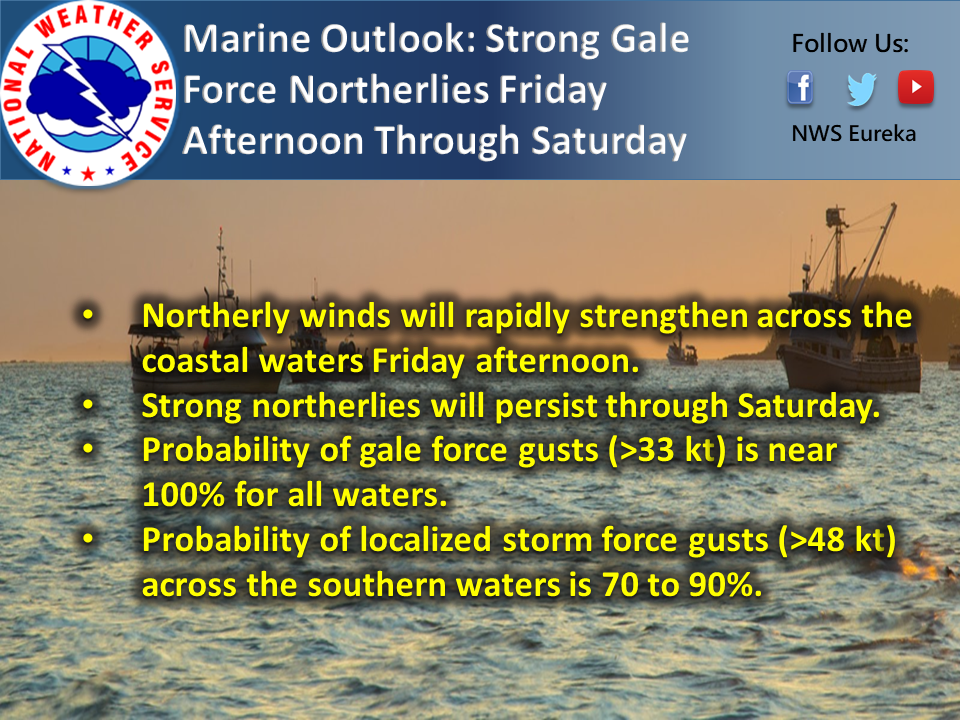
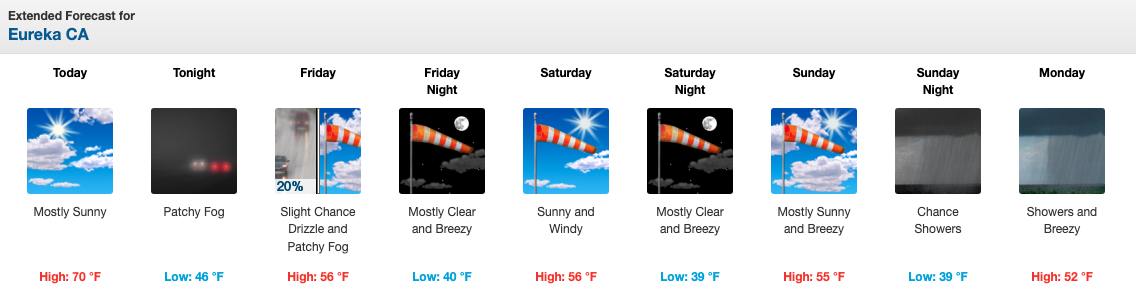
Today’s beautiful 70-degree weather will be will be short-lived, as rain, Gale-force winds and mountain snow will all be possible in the coming days.
Eureka’s National Weather Service office predicts that temperatures will cool significantly by tonight across the greater Humboldt Bay Area, with an anticipated low of 46 degrees.
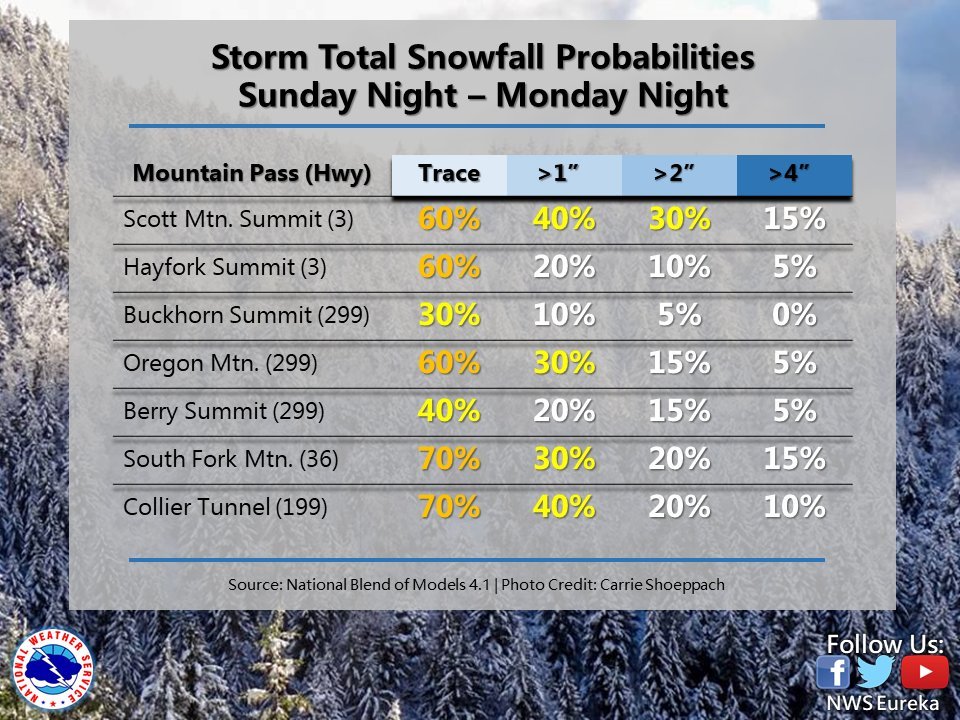
Graphics provided by the NWS.
Gale-force winds along Humboldt’s coastal waters will produce 16 to 30-mph onshore winds tomorrow. Gloomy weather will also return, with patches of fog, possible rain and a high of 56 degrees in Eureka.
On Sunday night, light mountain snow is expected across highway passes in Trinity, Del Norte and Humboldt Counties. The snowfall will persist through Monday.
Rainy weather is forecast for the Humboldt Bay Area starting Sunday and is expected to persist through Wednesday.
Remember that advice from the state’s Fair Political Practices Commission that resulted in a press release announcing that Arcata Mayor Stacy Atkins-Salazar would have to recuse herself from all matters relating to the city-altering Gateway Area Plan process? (If not, catch up here.)
Well, two out of six current candidates for Arcata City Council would very likely be in the same position, if either of them are elected. That’s because like Atkins-Salazar, those two candidates — Alex Stillman and Dana Quillman — also own real property that lies within 500 feet of the Gateway area.
If either of them are elected, that would leave the council with a bare quorum — three out of five councilmembers — able to consider and weigh in on the largest-scale and most ambitious planning projects in recent Humboldt County history, and certainly the most important topic facing the next iteration of the council. With only three members able to vote, any council actions on the project would have to be unanimous.
In the map above, the Gateway Area, as mapped by the City of Arcata, is in red. The green area is everything that is within 500 feet of the Gateway Area. The blue area is everything within 1,000 feet.
The map also shows properties owned by Stillman, a longtime property owner and landlord in the city. The parcels she owns are colored solid black. The properties owned in part by Dana Quillman, who lives on H Street south of Samoa Boulevard, are in solid purple.
As you can see, both Quillman’s home and at least one property owned by Stillman — the one on 12th Street, between J and K — are solidly within 500 feet of the zone that the city has drawn up as the Gateway Area. In addition. Stillman’s H Street buildings fronting the Arcata Plaza are partially (and just barely) within the 500-foot limit, at least according to the geographic files that city government sent us yesterday.
This matters because the California Fair Political Practices Commission currently takes a hard line on what people call its “500-foot rule,” in which elected officials are considered to have a conflict of interest in consequential planning decisions are taken within 500 feet of an official’s property. The rule is spelled out in Section 18702.2(a)(7) of the FPPC’s regulations, which states that an elected has a conflict when property in which they have a financial interest is
… located 500 feet or less from the property line of the parcel unless
there is clear and convincing evidence that the decision will not have any measurable impact on
the official’s property.
Atkins-Salazar owns property located within 500 feet of the Gateway Area; Stillman and Quillman do as well. Therefore they are almost certainly bound by the same state conflict of interest guidelines that prevent Atkins-Salazar from deliberating on the Gateway Area Plan.
There is an exception, in the regulation quoted above: There is no conflict if there is “clear and convincing evidence” that the city council’s work on the Gateway Area Plan will have “no measurable impact” on the candidate’s properties.
But according to Shute, Mihaly & Weinberger, a San Francisco-based law firm focusing on municipal government in California, that is a very difficult hurdle to clear, especially since the FPPC revised its regulations in 2019. In a review of FPPC advice letters issued since those revisions were adopted, the firm found that the exception does not apply when “there was evidence of increased intensity of use, traffic, noise, and changed market value of the official’s property.” If Stillman or Quillman are elected and wished to participate in the Gateway Area planning efforts, they would have to present “clear and convincing” evidence that the plan — which foresees thousands of new residents in the area — would have none of those effects on their properties.
Furthermore, it seems probable that Stillman’s commercial properties downtown would also disqualify her from participating in Gateway planning, whether or not the ones on the Plaza are counted as being within the 500-foot limit. Section 18702.2(a)(8) of the FPPC’s regulations deals with real property between 500 feet and 1,000 feet away from a project — the area shaded blue in the map above — and says that an elected official has a conflict if property they own meets the following conditions:
Involves property located more than 500 feet but less than 1,000 feet from the
property line of the parcel, and the decision would change the parcel’s:
(A) Development potential;
(B) Income producing potential;
(C) Highest and best use;
(D) Character by substantially altering traffic levels, intensity of use, parking, view,
privacy, noise levels, or air quality; or
(E) Market value
Stillman told the Outpost today that she has written to the Fair Political Practices Commission to ask for a solid determination on whether or not she has a conflict in this matter. But she says that even if the FPPC does make that determination, as it did in Atkins-Salazar’s case, there would still be much more that she could work on.
[UPDATE: Stillman writes to say that she has received this not very helpful response from the FPPC: “[S]hould you become an elected official you would need to seek advice in regard to the proposed plan and its potential financial impact on your holdings prior to engaging in any discussions or taking any actions in relation to the plan.”]
“There is more than the Gateway for the council to deal with,” Stillman said. “It’s slapped in front of everyone’s faces right now — the Gateway and homelessness — but the city has a lot more going than those two things.”
“I think that’s really screwed,” said Dana Quillman when reached this morning.
Quillman said that she believes the Gateway Area Plan, and other urbanist developments like it, is just one piece of a “globalist” plan that includes COVID, 5G technology and many other recent world developments with the aim of cowing the citizenry.
Quillman said she does not necessarily expect to be elected in a “city that has lost its soul,” but said that if she is she would continue to use her voice as a citizen and activist to advocate against the plan. She also would be open to supporting one of other candidates if they shared her views, she said.
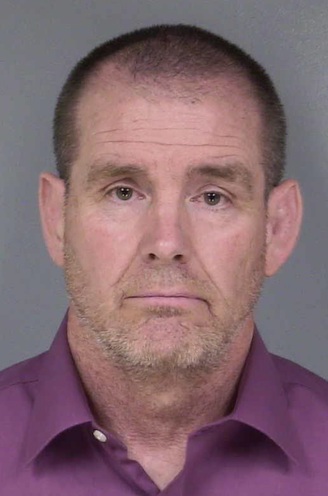
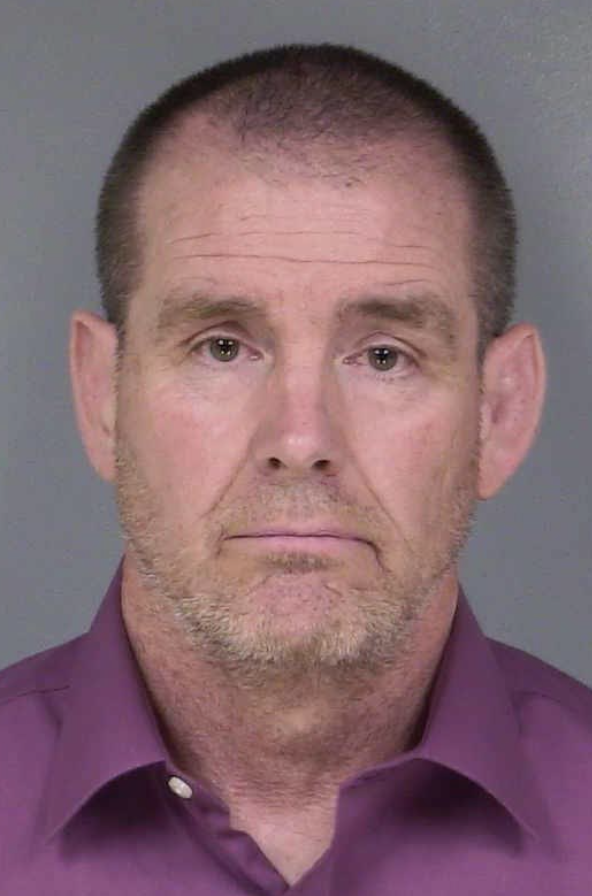
On Wednesday, April 6th, 2022, Fortuna Police Detectives arrested 56 year old, Gary F. Landergen on
allegations of sexual battery on a minor. Landergen, who is a local teacher and coach in Fortuna had been
placed on administrative leave by his employer just prior to the arrest by police Wednesday afternoon. At
least two students came forward reporting they had been the victim of inappropriate and unwelcomed
groping and/or fondling by Landergen. During the course of this investigation, detectives were able to locate
and identify witnesses who had observed some of the alleged misconduct.
Landergen was transported to the Humboldt County Correctional Facility where he was booked without
incident for the following charges and suspected violations of the California Penal Code:
243.4(a) Sexual Battery.
647.6(a)(1) Annoying, Harassing, or Molesting a Child.
The Fortuna Police Department is asking for any assistance in identifying any other potential victims.
Victims and their families are urged to come forward with any information and to immediately contact
school administrators and the police department.
# # #
If you or someone you know has been affected by sexual violence, the North Coast Rape Crisis Team has local counselors who are available 24-hours a day:
Students at Piner High School complete a class assignment on Aug. 14, 2019. Photo by Anne Wernikoff for CalMatters
###
As efforts to provide a guaranteed income spring up around California, a lawmaker who has pushed for such state-funded pilot programs has set his sights on another population he says should benefit — low-income high school seniors on the brink of adulthood.
State Sen. Dave Cortese, a Democrat from Campbell, is sponsoring a bill for the state to give no-strings-attached checks to about 15,000 high school seniors who have experienced homelessness, starting from around the time of graduation to their fall enrollment in college or vocational school or their entry into the workforce.
About 183,000 California K-12 students were homeless at some point during the 2020-21 school year, according to the California Department of Education.
The proposed legislation does not specify how high school seniors would apply for the payments or how much they would be. Cortese said he’s hoping the pilot program would offer $1,000 monthly checks for four or five months for the 2023 graduating class, possibly costing the state about $85 million a year.
The legislation passed out of the Senate Education Committee on Wednesday with little opposition and heads to the Senate Human Services Committee.
Cortese said he’s proposing it for graduating high school seniors instead to avoid interfering with students’ financial aid calculations; the bill could help students living in poverty rent an apartment or pay for food during college if they enroll, but there’s no requirement to do so.
Christina Torrez, a Bakersfield College student and former foster youth who experienced homelessness in high school, told lawmakers on Wednesday that a basic income program would allow students to concentrate on their schooling.
“Honestly, school wasn’t important to me at the time, because I had to figure out where I was going to eat, where I was going to sleep,” Torrez said. “What this does, it allows a whole burden to come off a youth that is homeless.”
It’s the latest guaranteed income proposal for California, which has seen several local governmentsstart pilots after a highly publicized experiment in Stockton from 2019 to 2021 giving 125 families $1,000 each month.
The aim is to alleviate poverty and give recipients more flexibility on how to spend the money than is offered by traditional social services. Critics have raised concerns the checks would discourage work.
“School wasn’t important to me at the time, because I had to figure out where I was going to eat, where I was going to sleep.” — Christina Torrez, a Bakersfield college student
Early results of the Stockton study found full-time employment increased 12% in the full year and participants reported less financial instability and improved health outcomes. Former Stockton mayor Michael Tubbs is now an adviser to Gov. Gavin Newsom.
Many of the local efforts are privately funded, but some cities are using federal COVID-19 relief funds.
Cortese said he’s looking for ways to incrementally expand the program toward other groups who could use a “soft landing” on the path toward financial independence, such as high school seniors.
“My vision is that you start installing guaranteed income at the proper point in a person’s life,” to avoid the need for them to cycle through shelters, he said.
“It feels a lot more like a movement,” Cortese said of basic income efforts across the state. “I just need to come back each legislative session and try to add another brick in the wall.”
###
This article is part of the California Divide project, a collaboration among newsrooms examining income inequality and economic survival in California. CalMatters.org is a nonprofit, nonpartisan media venture explaining California policies and politics.