

Humboldt-Del Norte League Bans Spectators at School Basketball, Wrestling Events Over the Next Couple of Weeks
LoCO Staff / Wednesday, Jan. 5, 2022 @ 4:17 p.m. / Education

Photo by Andriyko Podilnyk on Unsplash.
###
Humboldt-Del Norte League Commissioner Jack Lakin sends along the following announcement:
Based on the recommendation of the Humboldt - Del Norte League (HDNL) Commissioner, the member Districts voted 6-4 to impose a temporary “no spectators” mandate for all HDNL athletic events starting Friday, January 7 and running through Sunday, January 23. This will impact attendance at any scheduled Basketball and Wrestling events during that time period.
The number of positive tests being reported from local school districts and recent updates from Humboldt County Public Health (188 new COVID cases in the Jan. 4 press release) indicate this is likely the beginning of a surge. Given this information, the League took this action in an attempt to slow down and possibly minimize the spread of COVID in both our school and local communities. Additionally this decision was approved by a majority of the HDNL districts as an effort to preserve on-site in-person instruction for students as well as preserving the opportunity to compete for our student-athletes.
As conditions change during this temporary period of “no spectators”, the League will continue to moniter local data and re-evaluate the “no spectators” requirement.
Please know that most HDNL athletic events can be accessed online. Contact your local school to receive information regarding online viewing.
The League understands the disappointment that comes with this announcement, but given the circumstances, it appreciates your understanding, patience and cooperation.
BOOKED
Today: 12 felonies, 16 misdemeanors, 0 infractions
JUDGED
Humboldt County Superior Court Calendar: Friday, Sept. 4
CHP REPORTS
Singley Ln Onr / Singley Ln (HM office): Trfc Collision-Unkn Inj
ELSEWHERE
RHBB: CDPH Issues Immunization Recommendations for 2026-27 Respiratory Virus Season
RHBB: Redway Transfer Station to Close an Extra Day for Construction
RHBB: Dows Prairie Road to Close for Two Months for Culvert Repair
Safe Parking Program: Arcata City Council Will Consider Leasing Property on Samoa Boulevard to Provide a Legal Place for Homeless People to Sleep in Their Vehicles
Stephanie McGeary / Wednesday, Jan. 5, 2022 @ noon / Homelessness , Local Government
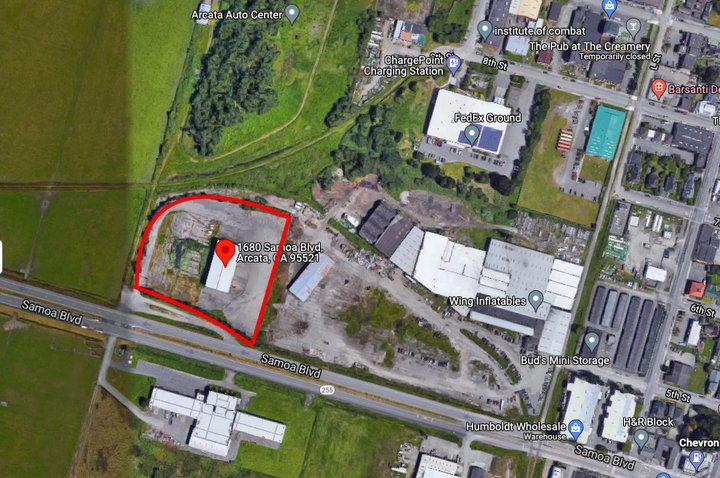
The property at 1680 Samoa Blvd, Arcata that will soon hold the City’s Safe Parking Program | Edited screenshot from Google maps
###
During tonight’s meeting the Arcata City Council will again address the important and often controversial issue of homelessness and will take steps to establish a Safe Parking Program, which would allow unhoused people to legally stay in their vehicles in an industrial lot on Samoa Boulevard.
The council will consider authorizing City Manager Karen Diemer to execute a month-to-month lease with the owners of the property – located at 1680 Samoa Boulevard, formerly home to Soilscape Solutions – that would allow the City to use a portion of the property to park up to 40 vehicles and provide on-site support services. The rent would be up to $6,500 a month, according to the staff report.
The City has been looking at establishing a Safe Parking Program for some time and during a meeting in September, 2021 the city council allocated $685,000 in American Rescue Plan Act (ARPA) COVID relief funds to launch the program. Since then, the City has been working on identifying a suitable location and finding a provider for the program operations. A request for proposals (RFP) is currently being circulated to find the right agency to run the program. The deadline is Jan. 13.
During the council meeting in September, Diemer explained that finding people to move into the Safe Parking Program will largely be done through outreach to the homeless community. Similarly to when the City and Arcata House Partnership established temporary tent shelters during the shelter-in-place orders prompted by the pandemic, the Safe Parking Program staff will seek out and invite people who are staying in their vehicles to move to the established sheltering area. Diemer mentioned during the meeting that one area the City has received many complaints about is the parking lot next to HealthSPORT, where homeless people have been parking their cars and camping for months.
Until the Council selects a proposal – which will likely occur at the council’s next meeting – it’s hard to say exactly what the program will look like. But it will likely be based on other Safe Parking Programs, which have been implemented by several cities, including Eugene and Los Angeles. Generally the safe parking location allows homeless individuals to sleep in their vehicles safely and legally, providing some sort of on-site management and security and access to basic services.
During the September council meeting, staff said that the ARPA funding would go toward staffing the program and providing services to the site – including porta potties, electricity, a potable water station and access to an off-site laundry facility.
The Arcata City Council will discuss this and other important issues – including considering allowing biennial adjustments to campaign contribution limitations and will recieve an update on the 2021/22 City Budget – during its regular meeting tonight (Wednesday), Jan. 5 at 6 p.m.
You can view the full agenda and directions on how to watch or participate in the meeting here.
School Districts Seek Help From State to Avoid Sudden Loss of Funding
Joe Hong / Wednesday, Jan. 5, 2022 @ 7:23 a.m. / Sacramento

A new classroom at Burnt Ranch Elementary School in Trinity County on Dec. 13, 2019. Photo by Dave Woody for CalMatters
###
As they await the release of Gov. Gavin Newsom’s proposed 2022-23 state budget, school district officials across California are worried about losing millions of dollars all at once, resulting in staffing cuts in a time when students need more attention than ever.
After two years of not being penalized for declining enrollment during the pandemic, school districts are bracing for a sudden drop in revenues next year as their funding gets recalibrated to match current enrollment, which plummeted since COVID-19 first closed California’s schools.
“I’ve never ever seen a drop in enrollment come all at once like this,” said Andy Johnsen, superintendent at San Marcos Unified in north San Diego County. “The pandemic changed everything.”
“I’ve never ever seen a drop in enrollment come all at once like this. The pandemic changed everything.”
— Andy Johnsen, superintendent at San Marcos Unified in north San Diego County
In 2020, state lawmakers decided to allow districts to use their pre-pandemic, 2019-20 enrollment and attendance figures to calculate their funding for the next two school years. But starting in the fall of 2022, funding levels will be determined by this year’s enrollment and attendance.
“Just to put it into perspective, we lost a few hundred students each year before the pandemic,” said Harold Sullins, an associate superintendent at San Bernardino City Unified School District. “Last year, we declined by 2,000 students. That’s about eight years’ worth of decline.”
Without assistance from the state, San Bernardino City Unified could lose $27 million in funding due to the enrollment decline, a hefty chunk of the district’s $971 million budget. Districts statewide stand to take similar blows.
The impact of such cuts can vary by district. It could mean laying off employees or cutting language and art programs. Ultimately, it’ll mean eliminating services many students need, especially in the coming years as they try to recover from the challenges of virtual learning.
In 2018-19, California schools statewide lost about 23,000 students. Between the 2019-20 and 2020-21 school years, public school enrollment in California dropped by nearly seven times that figure, with more than 160,000 students dropping out.
To calculate what it pays to individual districts each year, the state uses average daily attendance, so not only does enrollment matter but so does making sure students are in class every day. A new bill introduced on Monday by State Sen. Anthony Portantino, a San Fernando Valley Democrat, seeks to change this policy and fund schools based on enrollment, which would generate $3 billion for schools statewide.
Before COVID-19, low birth rates and migration patterns caused the annual shrinkage of public school enrollment. During the pandemic, kindergarten enrollment fell by about 61,000 students, accounting for much of the overall decline.
“Kindergarten is not compulsory,” Sullins said. “At our earlier grade levels, a lot of our parents opted to hold their students back.”
When physical classrooms reopened in the fall of 2021, stringent rules about quarantine and independent study also hurt attendance. Districts failing to offer independent study to students in quarantine were required to count those pupils as absent, losing out on their attendance-based funding. Sullins said this policy had a “tremendous impact” on attendance rates.
District leaders said a sudden drop in funding would punish districts for both drops in enrollment caused by the pandemic and for failing to comply with unreasonable independent study requirements.
“The public doesn’t understand,” said Lisa Gonzales, the chief business officer at Mt. Diablo Unified. “We’re all facing colossal funding decreases next year.”
Gonzales said her 30,000-student, Northern California district could lose $24 million if the state does nothing.
Gonzalez declined to comment on exactly where the district would make cuts, but she said she expects to issue layoff notices. She said when making cuts, school districts first figure out what they absolutely need to keep by law, like a teacher in every classroom and transportation for students with disabilities. Then they look at how they could enlarge class sizes and eliminate certain positions.
“You don’t have to have a librarian and a counselor,” she said. “Are they important and valuable? Absolutely.”
“Could they have really known there was going to be such large numbers of students who weren’t coming? I don’t think so.”
— Jonathan Kaplan, senior policy analyst at the California Budget & Policy Center
Administrators interviewed by CalMatters raised several possible solutions, but they fell under two general categories — and seek to take advantage of the fact that the state anticipates a big budget surplus.
First, the state could increase overall funding to schools by adjusting the formula that determines most of the money districts receive from the state. The formula consists of “base” funding for all students and additional “supplemental” and “concentration” grants for districts serving English learners, foster children and students qualifying for free or reduced-price meals.
“In an ideal world, what would benefit is an increase to the base,” Gonzales said. “It could reverse the attendance issue we’re having.”
A second option: The state could cut funding gradually, giving districts more time to downsize.
A spokesperson for the governor declined to comment on the contents of the forthcoming proposed budget. The state Legislature is aware of the fiscal crisis looming over districts.
Mike Fine, the chief executive officer of the state’s Fiscal Crisis and Management Assistance Team, spoke at a Nov. 30 hearing for the state Assembly’s Education Finance Subcommittee and recommended that districts be temporarily funded based on their three-year average attendance rates.
Fine said that pre-pandemic, about 60% of districts were declining. Last year, all but one of the 58 counties in the state had a decline.
The governor and Legislature have tried to help districts recover from the pandemic. The 2021-22 state budget ushered historic investments in K-12 education. Much of that went to ongoing funding like sending more money to districts with higher concentrations of at-risk students.
Jonathan Kaplan, a senior policy analyst at the California Budget & Policy Center, said these commitments signal that lawmakers in Sacramento are aware of just how hard some communities were hit by COVID-19.
“The governor and Legislature deserve credit,” Kaplan said. “The bump in the concentration grant acknowledged there’s a legitimate need out there. Students in these communities need support.”
Even so, both the state and local districts underestimated just how low enrollments and attendance rates would plummet this year.
“Could they have really known there was going to be such large numbers of students who weren’t coming?” said Kaplan. “Could they really know how much hardship there would be? I don’t think so.”
###
CALmatters.org is a nonprofit, nonpartisan media venture explaining California policies and politics.
Afternoon Blaze in Boarded-Up Home Causes $75k in Damage, Humboldt Bay Fire Says
LoCO Staff / Tuesday, Jan. 4, 2022 @ 7:19 p.m. / Fire
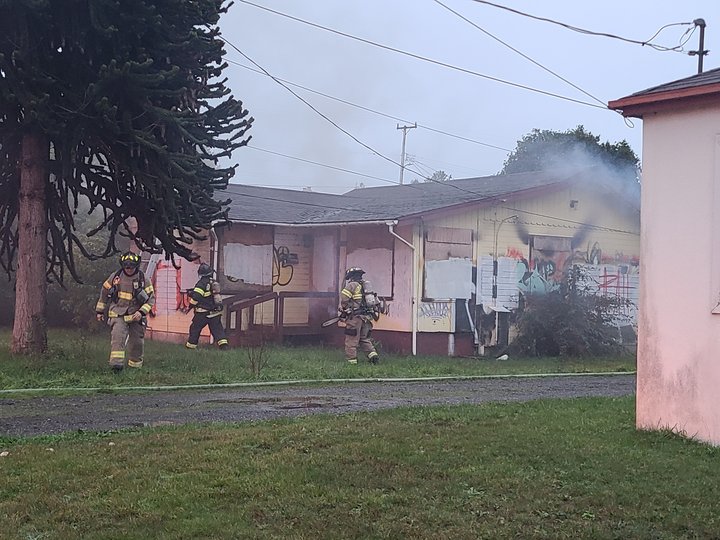
Photo: Humboldt Bay Fire.
###
Press release from Humboldt Bay Fire:
At about 4:43p.m. on Tuesday, January 4, the sight and smell of smoke coming from a boarded-up home on the 900 block of West Harris Street alerted a neighbor to call 9-1-1, hoping that no one was trapped inside. Humboldt Bay Fire crews responded quickly. Even before they reached the home they could smell the fire as smoke crept down the block. Once in view, they saw thick grey smoke billowing from a single-story home and began attacking the fire.
Crews worked offensively, extinguishing the flames and searching for any occupants. Thankfully, the home was unoccupied and no civilians or firefighters were injured. Crews were able to fully extinguish the fire and prevent any spread to nearby homes and vegetation.
The estimated worth of the home is $150,000 and damage is estimated at $75,000.
The cause of the fire remains under investigation at the time of this publication.
Humboldt Bay Fire would like to thank Eureka Police Department, City Ambulance, and Humboldt Bay Fire Support for their assistance on scene. We would also like to thank the diligent neighbor who saw something and called it in right away. The value of knowing your neighbors and participating in a system where you look out for one another and your neighborhood is invaluable.
This fire marks the third structure fire of the year for Humboldt Bay Fire with two previous fires occurring on January 2 and January 3, 2022. Home heating is a large source of fires during this season. We urge the public to practice extra vigilance when heating your home during this inclement weather. Ensure your chimney is inspected and your floor heaters are clear of combustibles. Humboldt Bay Fire is always here to answer your questions or come by for a home safety check. The safety of this community is our top priority.
TODAY in SUPES: Bass Moves Popular Public Comment Period to the End of Meeting Agendas; Staff Presents Groundwater Plan for Eel River Valley
Ryan Burns / Tuesday, Jan. 4, 2022 @ 5:04 p.m. / Local Government
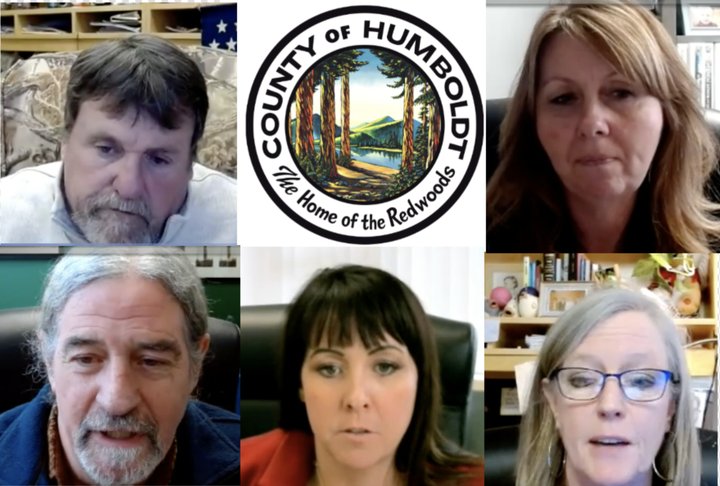
Screenshot from Tuesday’s meeting (clockwise from top left): First District Supervisor Rex Bohn, the county seal, Second District Supervisor Michelle Bushnell, Fourth District Supervisor Virginia Bass, County Administrative Officer Elishia Hayes and Fifth District Supervisor Steve Madrone.
###
We headline this (mostly) weekly report “TODAY in SUPES,” but occasionally the Humboldt County Board of Supervisors wears other hats, fulfilling duties as the governing board of some other agency. The process of transitioning from one government body to another always sounds a bit odd. The chair will say that the board is “adjourning as the Board of Supervisors” and “reconvening” as this other agency, though no one moves. The adjournment and reconvening happens abstractly, within the brains and designated authority of each individual board member.
Today was such an occasion, as the humans who have been elected supervisors heard an update about a state-mandated sustainability plan for groundwater in the Eel River Basin. (Minus one supervisor: Third District representative Mike Wilson was absent for today’s meeting.)
Therefore, the Lost Coast Outpost proudly [?] presents …
TODAY in the HUMBOLDT COUNTY GROUNDWATER SUSTAINABILITY AGENCY
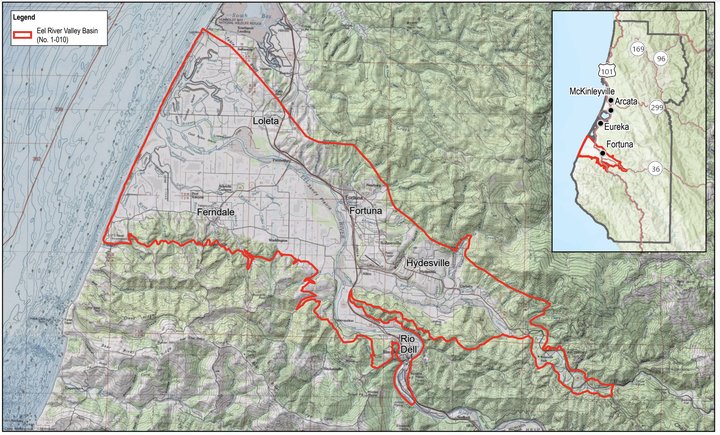
Map of the Eel River Groundwater Basin. | Image via County of Humboldt.
Hank Seemann, the county’s deputy director of environmental services, delivered a lengthy and detailed update on the status of the Eel River Valley Groundwater Sustainability Plan. This plan, as noted above, is required by California law — specifically the Sustainable Groundwater Management Act of 2014.
That law says certain jurisdictions must form their own groundwater sustainability agencies, and in Humboldt County the supervisors fill that role. The plan itself, Seemann explained, provides a framework for managing the groundwater resources in that fertile valley for economic, social and environmental benefits. It must be submitted to the state’s Department of Water Resources by the end of the month.
Since groundwater is such a complex resource, developing the plan required extensive fieldwork, data collection, computer modeling, stakeholder consultation and professional evaluation. “This really was a big undertaking,” Seemann said.
The Groundwater Sustainability Plan must include a detailed water budget of inflows and outflows — an accounting of the Eel River Valley’s interconnected system of groundwater and surface water. County staff created a computer model to answer questions about the dynamics of that system, another very big undertaking, Seemann said.
One of the major goals of these sustainability plans is to identify “undesirable results” in the groundwater — poor storage, bad water quality, seawater intrusion, etc. — and lay out some measures to rectify those problems within a 20-year timeframe.
Agricultural uses — primarily irrigation of pastures and crops — represents 80 to 90 percent of groundwater usage in the basin, with municipal and domestic use accounting for much of the remainder. Of course, the water is also critical to fish-bearing streams (the Eel River is a migrating corridor for adult salmon and steelhead), riparian vegetation and wetlands.
“We’re really fortunate just in terms of our natural assets in Humboldt,” Seemann said. “The aquifers in the Eel River Valley are deep and productive. They can really store vast amount of water.” The groundwater levels are stable and replenish quickly, he added.
Still, the management plan has to include sustainable management criteria. The county plans to keep tabs via a system of monitoring wells with minimum thresholds, Seemann explained.
County staff intends to finalize the Groundwater Sustainability Plan in the next two weeks and bring the final plan back to the board on January 25 for possible adoption. The plan must be updated every five years.
After the presentation, First District Supervisor Rex Bohn said the county already has 60 years of well data that wasn’t given the consideration it deserves. “I’m less worried about saltwater intrusion than I am about government intrusion,” he quipped.
Second District Supervisor Michelle Bushnell said it seems like gravel pack in the river basin has increased noticeably in recent decades. Seemann said he’s not sure it’s changed significantly in recent decades, but the 1964 flood certainly caused a lot of alterations.
Fifth District Supervisor Steve Madrone commended Eel River Valley farmers for increasing their water conservation efforts.
After taking public comment, the Humboldt County Groundwater Sustainability Agency adjourned and the Board of Supervisors reconvened — without moving a muscle.
###
There wasn’t a whole lot else on the board’s agenda. The main item, which we previewed yesterday, concerned possible changes to the board’s agenda template.
Fourth District Supervisor Virginia Bass explained that as the board chair, she was interested in looking at ways to ensure the county’s business gets done during these meetings given the dramatic increase in public participation ushered in by Zoom technology and the polarized COVID-19 debates.
Should the public comment period on non-agenda items be moved to the afternoon? The end of the meeting? Should the time limit for each person to speak be cut from three minutes to two?
Such conversations are happening in counties across the state, Bass said. Kathy Hayes and Tracy D’Amico, the clerk and deputy clerk of the board, respectively, recently attended a statewide conference where “best practices” for public participation were discussed.
D’Amico said she also polled some other county governments to see how they’re handling the increased volume of public feedback. Seven of the nine counties that responded schedule the public comments on non-agenda items for the end of the meetings, after the rest of the business has concluded, D’Amico said. Boards can also adopt measures on the fly — say, by limiting public commenters to one minute apiece if 150 of them sign up to speak.
Bohn, Bushnell and Madrone all said they’d support whatever the chair decides to do, though Madrone later said he’d prefer to keep the public comment period at the beginning of the meeting while Bohn suggested moving it to the end and limiting people to two minutes apiece.
After deliberating back-and-forth a bit and hearing from the public — several members of which spoke to the importance of hearing from constituents — Bass made the decision to move public comments on non-agenda items to the end of each meeting while keeping the three-minute time limit in place.
McGuire’s Bill to Help Stop Coal Train Project Passes Senate Transportation Committee
LoCO Staff / Tuesday, Jan. 4, 2022 @ 1:49 p.m. / Government

A freight train carrying coal. | Photo: CSIRO via Wikimedia Commons, Creative Commons License.
PREVIOUSLY:
- Aiming to Ship Coal Out of Humboldt Bay, Shadowy Corporation Makes Bid to Take Over NCRA Line
- Sen. Mike McGuire Introduces Legislation Meant to Derail Proposed Humboldt Bay Coal Train Route
- ‘Coal Does Not Align With Our Values’: Wiyot Tribe Executives Say Proposals Did Not Specify Cargo, Council Would Not Support Project
- Huffman, Thompson Pen Letter to Buttigieg Opposing Federal Loans for ‘Disastrous’ Coal Train Project
- Supervisors Pass Resolution Opposing Potential Coal Exports Through Humboldt Bay
- Eureka City Council Approves New Ward Map, Ranked Choice Voting; Bans Coal on City-Owned Property
###
Press release from Senator Mike McGuire’s office:
Senator Mike McGuire’s legislation to stop one of the largest environmental threats the North Coast has seen in decades — a proposal from a secret, clandestine operation that wants to ship millions of tons of coal through Northern California — passed with bipartisan support in the Senate Transportation Committee today.
“The proposed toxic coal train is an environmental disaster in the making. The midwest coal would travel through the Sierras, across the Golden State through the heart of our thriving communities, ancient redwoods, and directly along the banks of the Eel and Russian rivers which are the main drinking water source for nearly 1 million residents. It is crucial we stop this dangerous proposal – it transcends politics, and I am grateful for the bipartisan support today.”
SB 307 will protect California by preventing all state funding from initiating improvements on the now defunct North Coast rail line north of the City of Willits. Further, it bans state money from being spent on the buildout of any new potential bulk coal terminal facilities at the Port of Humboldt.
The bill passed in the Senate Transportation Committee today with an 11-0 bipartisan vote. The bill will now be sent to the Senate Appropriations Committee for approval.
No, California’s Drought Isn’t Over. Here’s Why.
Rachel Becker / Tuesday, Jan. 4, 2022 @ 12:16 p.m. / Sacramento
In a clear sign that the drought persists, California today adopted new emergency regulations aimed at stopping residents from wasting the state’s precious water.
The rules ban practices such as hosing down sidewalks and driveways with drinking water, washing cars without a shutoff nozzle on the hose and irrigating lawns and gardens too soon after rain.
Approved unanimously by the State Water Resources Control Board, the mandates could take effect as soon as Jan. 15 and have a one-year expiration date unless extended. Fines can reach as high as $500, but enforcement will be spotty: Local governments and water agencies are allowed to enforce them at their discretion, and they will largely be complaint-based.
“There’s not going to be like a statewide force of water cops or anything like that,” said Eric Oppenheimer, the water board’s chief deputy director.
California’s drought is not over despite a bounty of snowfall and rain over the past month: California’s snowpack — a critical source of water — is 150% of average for Jan. 4. But with three months left of the wet season, it’s not enough to bring an end to the severe drought and water shortages.
California still needs about another foot of snowpack by the end of March to reach its historic seasonal average, according to the state data. Almost 16 inches had accumulated by today.
“December alone will not end the drought, clearly,” said Jeanine Jones, interstate resources manager for the Department of Water Resources. “December was wonderful, but now we just hope it keeps on going.”
The amount of water now stored is actually worse than last year at this time: The state’s reservoirs in December were projected to contain about 78% of average — compared to about 82% in 2020.
Moderate to exceptional drought still grips the entire state, and a soggy start to the rainy season does not guarantee even an average water year. California has felt that false hope before: In 2013, during the last record-breaking drought, a wet December turned into a dry January and February.
Climatologists predict that the state will dry out during the rest of the winter and spring.
“After we get through this weather system this week, things go dry. And the expectations are a drier than average January, February and March,” said California’s state climatologist Michael Anderson.
And conservation still lags. California Gov. Gavin Newsom in July called for Californians to voluntarily cut water use by 15% in the face of the ongoing drought. But state officials today announced statewide savings of only 6% from July to November compared to last year.
November, a dry month, saw only a 6.8% reduction in water use — down from 13.3% in October, which saw torrential rains. The greatest savings came from the northern half of the state; water use increased slightly by 0.8% in Southern California.
“You want to kiss every snowflake and every raindrop that comes down, because it was just so bad,” said Felicia Marcus, who chaired the State Water Resources Control Board under Gov. Jerry Brown during the last drought. “At the same time, we’ve got to exercise our efficiency muscles every way we can, all the time.”
Similar restrictions on wasteful water use were temporarily enacted during the last drought under former Governor Jerry Brown, who also issued a statewide water conservation mandate.
In October, Newsom instructed regulators at the State Water Resources Control Board to consider once again barring wasteful water uses when he extended the drought emergency statewide.
The emergency rules adopted today take aim at residents as well as homeowners associations, which can no longer penalize residents for brown lawns and drought-tolerant landscaping plants. Local governments may no longer use drinking water to irrigate ornamental turf on street medians.
The new rules do not affect agriculture, the leading user of water in California. And both public commenters and board member Laurel Firestone raised concerns about how penalties could affect low-income Californians — spurring the board to add new language requiring warnings and fees based on the recipient’s ability to pay.
“This is not the most effective, or even in my mind appropriate policy approach to save water when we’re in a drought emergency,” said board member Laurel Firestone, who called for a more systemic approach rather than individual penalties. “Unfortunately, like in the last drought, we don’t have a more appropriate and effective policy developed that we go to in drought emergencies.”
The state’s efforts to make permanent the emergency water waste rules enacted during the last drought faced opposition from powerful urban and agricultural water interests, and ultimately fizzled. But many local water agencies adopted their own rules.
Officials couldn’t say how much water the regulations adopted today are expected to save. Instead, they said, the focus is largely on educating consumers, rather than collecting fines.
“I don’t believe that there were any fines of up to $500. There were, I believe, a small handful throughout the state of smaller fines after multiple levels of warnings and outreach,” said David Rose, senior staff counsel with the water board. “Mostly what the suppliers chose to do was to implement their own existing water waste or water use restrictions as opposed to the board’s regulation.”
The timing of the decision after such a soggy start to the water year “wreaks havoc with messaging,” Marcus said.
But it’s a change that she said she hopes will persist longer term — which would require a different regulatory process.
“To me, these rules are sort of the least we can do. They’re primarily common sense.”
###
CALmatters.org is a nonprofit, nonpartisan media venture explaining California policies and politics.


