On November 8th,
2021, the Humboldt County Sheriff’s Office (HCSO) responded to a
residence in Weitchpec for the report of a 46-year-old female found
deceased inside her home. Evidence located on scene led deputies to
believe the cause of death was a fentanyl overdose. In late November
the toxicology results returned and confirmed the cause of death as a
fentanyl overdose. The Humboldt County Drug Task Force was contacted
and initiated an investigation into the source of fentanyl.
The
HCDTF wrote three search warrants as part of this investigation and
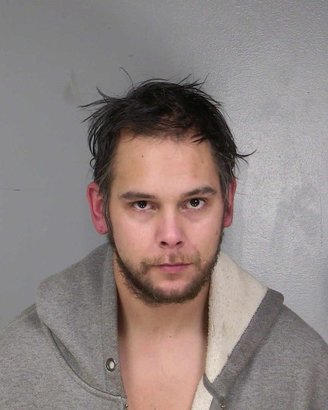
obtained evidence identifying James
Charles Williamson II (30
years old from Hoopa) as the suspect who sold fentanyl to the
decedent prior to the overdose. Williamson already had four active
arrest warrants in Humboldt County.
On
December 20th,
2021, HCDTF with the assistance of the HCSO served a search warrant
at Williamson’s residence in the 100 block of Boozer Ln. in Hoopa.
Agents located Williamson hiding inside a closet in the back of the
house. Williamson was arrested without incident. Agents located
additional evidence connecting Williamson to the fentanyl overdose
investigation.
Williamson
was transported to the Humboldt County Jail where he was booked for
his four warrants as well as the following charges:
192
PC Manslaughter
11351
H&S Possession of fentanyl for sale
11352
H&S Transportation of fentanyl for sale
Anyone
with information related to this investigation or other narcotics
related crimes are encouraged to call the Humboldt County Drug Task
Force at 707-267-9976.
“Shop With a Cop,” 2016. It’s gonna sound a lot like this soon.
If you’re anywhere in the vicinity of downtown Eureka, in a few minutes you’re gonna hear like a million emergency vehicles blaring their sirens like mad, and primed by yesterday’s earthquake you’ll naturally think that there’s some sort of fresh hell underway.
But no. This is only the annual SHOP WITH A COP event, back again after the pandemic put a dent in the festivities last year. This is when various first-responding agencies take some local kids in need out shopping for Christmas presents.
Lots of local businesses and nonprofits and others kick in for this event, which usually includes a hot breakfast, and, of course, a ride in a police car or fire engine or ambulance, which has to be done in style, of course — every switch in the rig flipped on, and to maximum volume.
The loud part of the event is scheduled to get going at around 8:45 a.m., and the procession will thread through Old Town and Downtown before arriving at Target. The world is not ending.
California voters have the brand new districts they’ll use to elect their members of Congress and state legislators, after the state’s independent redistricting commission voted unanimously Monday night to approve its final maps.
These districts take effect with the June 2022 primaries and continue for the next decade. Redistricting happens once every 10 years, after every census, to ensure that each district has the same amount of people.It’s the second time that California’s redrawing is being done by a 14-member independent commission.
But it hasn’t been easy, or without contention.
In addition to balancing population numbers, the commission must comply with the federal Voting Rights Act, ensuring that no minority group’s vote is drowned out. And to create fair maps, the commission didn’t consider current district lines and isn’t supposed to weigh partisan politics. In some cases, it puts incumbents into the same district, or forces others to appeal to new voters to be re-elected.
Particularly on the congressional level, that could help shift the balance of power between Democrats and Republicans. In the U.S. House, three California Democrats are among the 23 Democrats nationally who have already opted not to run for re-election in 2022. Combined with redistricting done by Republican-led legislatures in other states, that could tip the House in favor of the GOP.
Some California Democrats have blasted the “unilateral disarmament” of their power, though an initial analysis by the Cook Political Report says the new congressional map helps Democrats.
The commission’s deliberations have been different from the last redistricting, in 2011, in large measure due to advances in technology, plus social media, particularly Twitter.
The commission was under the pressure of a court-ordered deadline to submit the maps to the secretary of state by Dec. 27 despite a nearly six-month delay in the release of census data. In the last few weeks, the panel held a number of marathon sessions late into the night to hear public comment and try to incorporate competing testimony into the maps.
Commission chairperson Alicia Fernández acknowledged that there were constraints and disagreements along the way, but said she was proud of the commission’s work given the rules they were under.
“There was robust discussion in terms of how these maps should be drawn. We know that not everyone will be happy, but I feel that they are fair maps for Californians,” she told CalMatters.
Now, the maps must sit for three days for public input,though no further changes are permitted, said Fredy Ceja, communications director for the commission. In the meantime, the commission will complete its final report to deliver to the secretary of state.
Even after that happens, the new districts are likely to be challenged in court. And their real impact depends on what voters decide.
James Woodson, policy director for the California Black Census and Redistricting Hub, said the fight for Black political power in California is far from over.
“Census and redistricting is sort of a two-part fight,” he said. “First, it’s making sure that resources came to our community and making sure they had an opportunity to win political power. Now, it’s about getting out the vote in 2022 and the long-term policy pieces that are moving.”
Here’s a first look at the new districts:
Congressional lines
Slower population growth in California means the state lost one of its 53 U.S. House seats this year — though COVID-19 may have caused an undercount of Black and Hispanic residents.
That added another challenge to deciding congressional districts. The population numbers must be exact: There can’t be more than a one-person difference between districts to make sure everyone is represented equally.
Trying to meet all the criteria — equal population, Voting Rights Act compliance, communities of interest and compact districts — in a state with California’s diverse population and geography made the task difficult.
To keep California’s less populous mountain communities together, for example, an earlier version of the maps showed a district stretching from the Oregon border to San Bernardino County. While compactness is one of the lower-ranking criteria, the district still raised eyebrows and was later revised.
Also drawing attention: How redistricting can topple the political dominoes. On Dec. 16, Democratic Rep. Alan Lowenthal announced he would not seek re-election. The next day, Long Beach Mayor Robert Garcia declared for the seat and quickly rounded up support. And on Monday Rep. Lucille Roybal-Allard of Downey, who in 1992 became the first Mexican-American woman elected to Congress, announced that she is retiring after her current term after she was redrawn into the same district with Garcia.
The growing power of Latino voters — and recognizing that in the new maps — has been a constant theme of the redistricting process. A projected 16 of the 52 House districts have a Latino voting-age population of at least 50%.
Pablo Rodriguez, founding executive director of the Communities for New California Action Fund, noted that in the Central Valley there are three new strong Voting Rights Act congressional districts with more than 50% Latino voters.
“For the Central Valley the outstanding question will be: Will the new Latino majority districts create the environment for the first Latino/a congressional representative to be elected to Congress within the next ten years?,” Rodriguez said in a statement. “Confidently, I say yes to not just one, but likely 3.”
But not everyone is a fan of the congressional map. Former redistricting consultant Tony Quinn said some of the new maps could disadvantage Latino candidates, such as the district that pairs eastern San Jose with Salinas.
Quinn said he doesn’t believe the Voting Rights Act required the kinds of districts the commission has drawn.
“It didn’t seem to me that the map needed to be torn up the way it is,” he said. “They way overdid it, especially in L.A. County.”
State Senate districts
While congressional districts each have about 760,000 people, state Senate districts are larger, with nearly 1 million Californians. For example, one encompasses California’s entire border with Mexico. There’s also more leeway — a 5% deviation from the ideal population.
That means that, while the commission tried not to put communities with competing interests together in other maps, it paired some in the Senate map, such as Fresno and Kern counties.
Three Senate districts are going from a Democratic advantage in voter registration to a Republican majority, while one favors Democrats more. Republicans need to flip at least five seats in the Senate, or seven in the Assembly, to end the supermajority that allows Democrats to approve tax increases or put constitutional amendments on the ballot without a single GOP vote.
The Senate map also pits some incumbents against each other, according to an analysis from political data firm California Target Book. For example, Democrat Connie Leyva’s Chino residence gets drawn into Democrat Susan Rubio’s district.
The commission’s sixth and last criteria for redistricting is nesting — placing two Assembly districts into one Senate district where possible. In theory, that makes Senate mapping easier. But because the commission placed a higher priority on other criteria, this time, only two Assembly districts were nested into a Senate district, in Northern California.
In a Dec. 13 letter to the commission, redistricting expert Paul Mitchell wrote that nesting conflicts with trying to comply with Voting Rights Act requirements.
The commission wrapped up its Senate maps on Saturdayto allow time for numbering the districts, a complicated process to limit the number of voters who would have to wait six years to vote for senators since they serve staggered four-year terms.
They now hold 60 of the 80 seats. The new Assembly map creates 63 solid Democratic seats, according to an analysis by California Target Book.
According to the analysis, two Democratic-majority districts in Southern California become stronger Republican districts; they’re now represented by Republican Phillip Chen of Brea and Democrat Cottie Petrie-Norris of Orange County. Another two flipped from Republican to Democratic-majority districts; they’re represented by Republicans Janet Nguyen of Huntington Beach and Marie Waldron of Escondido.
Advocates for the LGBTQ+ community said the maps include big victories across California. In the Assembly map, bringing Hollywood and West Hollywood together gives the community a chance to elect a representative from the community, said Samuel Garrett-Pate, managing director of external affairs with Equality California, adding that the group’s former director, Rick Chavez Zbur, was well-positioned to run.
Board of Equalization
With just four state Board of Equalization districts, they are far less complex to draw.
The board is tasked with ensuring that taxes across different counties are uniform – alcohol and beverage taxes, for example. Because of the county-specific policies, the commission tried to keep as many counties as possible intact. For example, densely populated Los Angeles County is one district by itself.
For these lines, there was little drama at the redistricting commission — and certainly nothing like the fights over congressional and legislative districts.
Monday night, closing out their review of the maps, it was an emotional moment for some commissioners.
“I’m so proud of the work that together we have completed to serve all Californians. Despite a difference of opinion at times, there was always commitment to our common goal — to the goal of creating representative and fair maps for all Californians,” commissioner Pedro Toledo said as he made the motion for a vote.
”We accomplished all of this while in the midst of a global pandemic and unprecedented adversity that impacted us all personally, impacted our communities and our state,” added Toledo, a no party preference voter and chief administrative officer of Petaluma Health Center.
After Dec. 27, the commission expects it will reconvene not only to defend its maps against any legal challenges, but to work on a report that could make the process smoother for the next redistricting.
“We did receive community of interest testimony that did conflict so obviously there are some people that are not going to be happy,” said Fernández, a Republican from Yolo County. “We have more VRA districts than there currently are, we listened to more people than the prior commission. We took all the info to heart and worked together to build these maps.”
###
CALmatters.org is a nonprofit, nonpartisan media venture explaining California policies and politics.
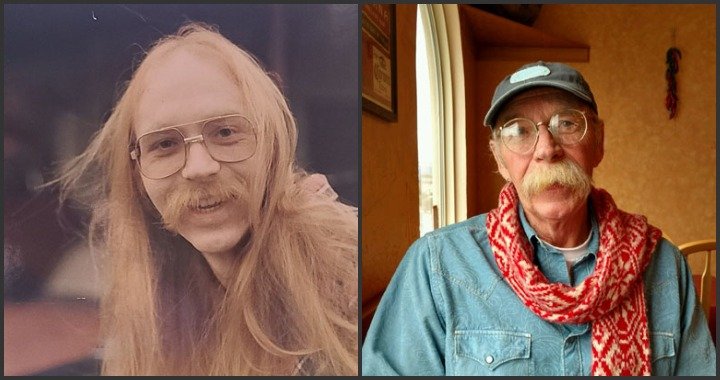
On
December 6, 2021, John Myers passed away peacefully leaving this life
on the wings of his ancestors and with the love of his family and
friends. He was a beloved brother, uncle, and friend.
John
was born in Willits to John Myers, Sr. and Dorothy
Erickson Myers. The family later moved to Humboldt County and made a
home in McKinleyville. John attended school in McKinleyville,
graduated from McKinleyville High School and attended classes at
Humboldt State University.
John
lived a full life in his 71 years, traversing a creative and diverse
career path that included millworker, retail sales, and organic
farming in Temecula, California. John loved art, music, art glass and
growing flowers, especially his Dahlias. He was a voracious reader
and enjoyed the company of friends, family and his precious cat,
Luna. A consummate baker, his prized biscuits and Finnish bread were
always a welcome treat. John was born into a tight knit Finnish
family and was proud of his Finnish heritage and culture.
John
was an absolute rockhound and his hobby took him to Montana, Nevada,
and all over California with his trusty rock hammer. John was a
talented jeweler and made beautiful pieces cherished by friends and
family. He was also an avid camper and loved to gaze out at the sky
on a warm summer’s night while camping at Tish Tang. Let us not
forget to mention his enthusiastic love of treasure hunting at yard
sales and flea markets. You always knew where John was on an early
weekend morning.
John
loved to chat on the phone for hours with his sister Doreen and
friends. He was everyone’s favorite weatherman as he reported the
details of the upcoming weather during the nightly chats.
John’s
sense of humor, gentle manner, compassion, and love for all people
made him a special person. He was committed to helping the less
fortunate, advocating for LBGTQ youth served by the RAVEN Project and
racial equity. John was an active and valued member of the Board of
Directors of Redwood Community Action Agency.
John
is survived by his sister Doreen Fridley (Kenny), brother Dennis
(Sherry), niece Adrienne (John), nephews Dennis Jr. (Denise) and Troy
(Maci) and great-nephews Derek, Andrew, Hunter, and Coby. He is also
survived by special friends Val Martinez, Mary Lou Prentice, Ruth
Collier, Stella Williams, and his dear neighbors Pearl Davis, Paul
Smith, Darlene Boggs, Towanda Wallen, and Amy.
We
wish to extend a heartfelt thank you to the dedicated and
compassionate nurses and doctors who cared for John these past few
years and especially over the last two weeks of his life. Your
sensitivity made a difficult time easier for John and all who loved
him.
To
know John was to love him. We will all miss him and look up into the
night sky to see the star that was lit for John upon his departure
for new adventures.
The
family will be holding a private ceremony for John and a celebration
of his life will be held in January 2022 via zoom to keep everyone
safe. Please contact JohnsFriends@yahoo.com
if you would like to join us for the celebration.
###
The obituary above was submitted on behalf of John Myers’ loved ones. The Lost Coast Outpost runs obituaries of Humboldt County residents at no charge. See guidelines here.
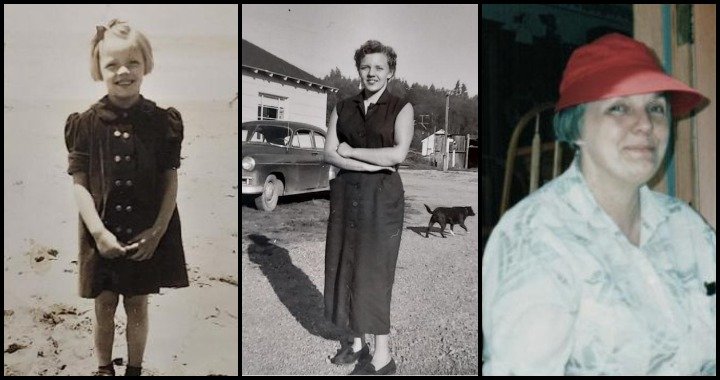
Charlotte Marie Peterson was born in Saint Paul, Minnesota, on August
10, 1937, to Mary C. and Henry A. Jorgensen. She passed away on
November 5, 2021, at the age of 84. Charlotte was named after her
Aunt Charlotte and her grandmother, Marie, on her mother’s side.
Charlotte’s father, who most old-time Trinidadians knew as Hank,
could not stand the Minnesota cold, so he left his job, and with his
wife and two daughters, ages about five and six, headed west to
California for warmer weather. One of Charlotte’s most vivid
memories of the trip west was crossing over the Great Salt Lake by
train.
The family lived
in San Francisco a short time, and in 1944 they headed north where
they found the small town of Trinidad. Charlotte and her older
sister, Bev, spent their childhood swimming in the ocean and playing
in the streets which were pretty empty in those days. Charlotte
recalled one of her father’s earliest jobs in Trinidad was to
replace the wooden cross on the old Catholic Church.
When Charlotte
was a little older she helped Bev, who was working at Paul’s Canned
Salmon receiving station, where fishermen would bring their fish to
be canned. Chester Paul would take the salmon to Klamath, can them,
and bring them back to Trinidad. She recalls telling the customers
that the canned fish they received were the same fish they caught,
when in actuality, the fish were all just thrown in together. The
little building where they worked was later known for a brief time as
Todd Collins’s Pottery Shop and Tom Richardson’s “Gear Shed”
tackle shop, now called Salty’s Supply tackle shop.
Charlotte enjoyed
her high school days at Arcata High, where she lettered in sports.
Volleyball and badminton were her favorites. She also excelled in art
and her favorite teacher, Pearl Degenhardt, always gave her much
encouragement.
Charlotte married a local fisherman Andrew L. Peterson, who often
worked as part of the crew for George Collins on his commercial
fishing boat and was good buddies with George’s son, TJ (Todd).
George owned the house Charlotte’s parents rented and that is how
Charlotte and Andrew met. They lived for a short time at Sylvan
Harbor in a cabin and at the old Trinidad Hotel. They then moved into
the red crooked house near the corner of Ocean Avenue and East
Street, where daughter Karen and son David were born. In 1960
Charlotte and Andrew moved to the property her parents owned, a mile
up the county road from Trinidad, where they had another son, Arne,
in 1961.
We had wonderful
times growing up in the Trinidad area and our mom was always looking
after us in all respects. Our grandparents lived next door and Aunt
Bev and her family also lived in Trinidad. We were all very close and
our days were filled with getting together for barbecues, picking
berries, fishing, sleepovers and going to the beach. Big Lagoon was a
favorite family spot — sunny or foggy, we would go for the day to
swim in the lagoon and look for agates. We also had many fun camping
trips to Richardson Grove and Hidden Springs.
When we were
grown mom went back to school to get her high school diploma. She
then went on to get her AA degree and then a Bachelor of Arts degree
from HSU. We were all very proud of her and what she had
accomplished. Mom was a wonderful artist in watercolor as well as
pastel and acrylic painting, and she won many awards in local shows.
We are grateful that she instilled in us her love of art.
Mom worked as a
cook at Seascape Restaurant for several years and made many friends
there, she also enjoyed working for HCAR doing respite work.
In her later
years she mostly kept to herself, enjoying genealogy research, riding
to town to do her shopping, and attending family gatherings. She
spent her last four years at Eureka Rehabilitation & Wellness
Center and our family is very thankful to their compassionate staff
for the excellent care she received.
Charlotte was
preceded in death by her parents, Henry A. and Mary C. Jorgensen, her
ex-husband, Andrew L. Peterson, her sister, Beverly A. Campbell
Thompson, and brother in law, Bruce Campbell, Sr. She is survived by
her three children, Karen Templeton (Greg), David Peterson (Cindy),
and Arne Peterson (Kila), her niece and nephews, Robin Peterson
(Ken), Carl Campbell (Diane), and Bruce Campbell (Phylis), her
grandchildren, Drew, Keala (Ivan), Kayla, Amy, Lindsey and Andrea.
Mom is also survived by her first great grandchild, Magnus, who was
born in August to Keala and Ivan.
A celebration of
life will be held at a later date.
###
The obituary above was submitted on behalf of Charlotte Peterson’s loved ones. The Lost Coast Outpost runs obituaries of Humboldt County residents at no charge. See guidelines here.
Have you ever wondered what happens inside crab pots when they’re underwater?
Fortuna resident Robert Wall decided to find out.
“We saw a nice break in the weather on Saturday and decided to go out,” the local sport crabber told the Outpost. “My friend John said we should put a GoPro in one of the pots. Honestly, I was just curious and wanted to see what goes on down there.”
So they zip-tied the little camera to the inside of the cage, loaded some herring and chicken in there for bait and pressed record. The footage they later pulled up with their hard-shelled catch shows the cage quickly sinking to the bottom of Humboldt Bay, kicking up a plume of sediment as it lands.
Before the silt has settled, the shadows of hungry Dungeness descend, their claws and legs clattering against the bars of the metal grate.
“I didn’t expect the crab to be at the pot in under 30 seconds,” Wall said. “It gets pretty crazy down there.”
The video — which switches from regular speed to slow-mo, then time-lapse, then back to regular speed — shows an all-out feeding frenzy as the ten-legged crustaceans scuttle up to the bait and start tearing off hunks, using their claws to shove meaty morsels into their little crab mouths. (Make sure you have the sound on when you watch.)
After several years of shortened seasons due to high levels of domoic acid detected in the meat, the commercial and sport crab fishing seasons are now in full swing.
“It has been really good for us sport crabbers,” Wall said, adding, “They are delicious this year.”
At Monday night’s meeting the Fortuna City Council conducted a second reading of the proposed ordinance and again voted unanimously to implement it. The new anti-camping regulations will take effect on Feb. 18 Jan. 19.
Fortuna Police Chief Casey Day said his department’s approach will begin with a “soft launch” of the ordinance, offering education and literature to the city’s unhoused offenders while working with partner organizations.
Even with habitual offenders — those who refuse to adhere to the city’s ordinance and refuse help — the department plans to issue some kind of “warning citation” before charging them with a crime, Day said.
City Councilmember Mike Losey asked Day whether his officers will “make some effort to determine whether there are beds available in Eureka, say, at the homeless shelter.”
This was an acknowledgement of the standard established in Martin v. Boise, in which the Ninth Circuit Court of Appeals found that it’s unconstitutional to impose criminal penalties “for sitting, sleeping, or lying outside on public property for homeless individuals who cannot obtain shelter.” [Emphasis added.]
Day didn’t answer the question directly. He said his officers “have the ability” to check with shelters in Eureka and Arcata but stopped short of committing them to doing so.
“And your officers would make the effort or offer to even transport somebody to one or any of those shelters, correct?” Losey asked.
Day said it would be their “overarching goal to provide that type of assistance.” In the event that they find someone “open minded” and seeking help, he said “we really do try to facilitate that by making those phone calls and/or even, in past practice, arranging transportation to those facilities.”
###
Original post:
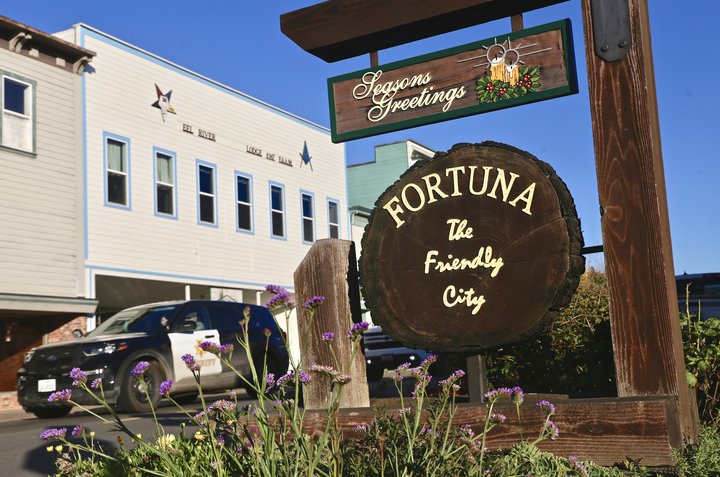
Law enforcement rolls down Main Street in Fortuna. | Photos by Andrew Goff.
###
The Fortuna City Council is set to pass an ordinance Monday evening that would criminalize camping throughout most of the city. City officials say it’s a much-needed remedy to problems caused by unhoused residents, but the American Civil Liberties Union of Northern California says the proposed regulations are both illegal and cruel.
At a December 6 council meeting councilmembers Mike Johnson and Jeremy Stanfield said they hope the ordinance has “teeth” to deal with people who’ve been sleeping in front of businesses and in other public places. Fellow councilmember Mike Losey agreed, saying, “I think our citizens are just going to relish being able to call in and report some of these violations and then see action taken to stop some of this.”
The ordinance, which you can read here, would make it a misdemeanor for any person to camp, occupy camp facilities or use “camp paraphernalia” in residential and commercial zones that cover the vast majority of the city’s jurisdiction. It would criminalize camping in any public place between the hours of 6 a.m. and 10 p.m. — plus the hours between 10 p.m. and 6 a.m. “unless there are no sleeping spaces practically available in any shelter or if there does not exist any viable alternative to sleeping in a public place.”
The City of Fortuna does not have any homeless shelters, though in interviews with the Outpost City Manager Merritt Perry and City Attorney Ryan Plotz said police officers have offered to drive people to shelters in Eureka and Arcata.
The City Council unanimously approved the ordinance on Dec. 6, though City Manager Merritt Perry explained that in order to take effect it must be read and approved a second time. That’s scheduled to happen at tonight’s City Council meeting, and if it is indeed adopted, the ordinance will go into effect in 30 days.
As first reported by the Times-Standard, Plotz crafted the ordinance, with input from Fortuna Police Chief Casey Day, to address complaints about the local homeless population while attempting to navigate the terms of the landmark 2018 Martin v. Boise ruling in the U.S. Court of Appeals for the Ninth District.
In that case, the Ninth Circuit panel found that it’s unconstitutional to impose criminal penalties “for sitting, sleeping, or lying outside on public property for homeless individuals who cannot obtain shelter.” The Eighth Amendment bars punishing a person only “for lacking the means to live out the ‘universal and unavoidable consequences of being human,’” the court found.
The decision has caused many cities across the western United States, including Eureka, to redraft their own anti-camping ordinances. It has also left a good deal of confusion in its wake as municipalities grapple with the lack of specifics in the ruling.
For example, how do you determine whether there are enough shelter beds available when your city doesn’t have any of its own? The court does not explain how to determine how many are enough and over what geographic area.
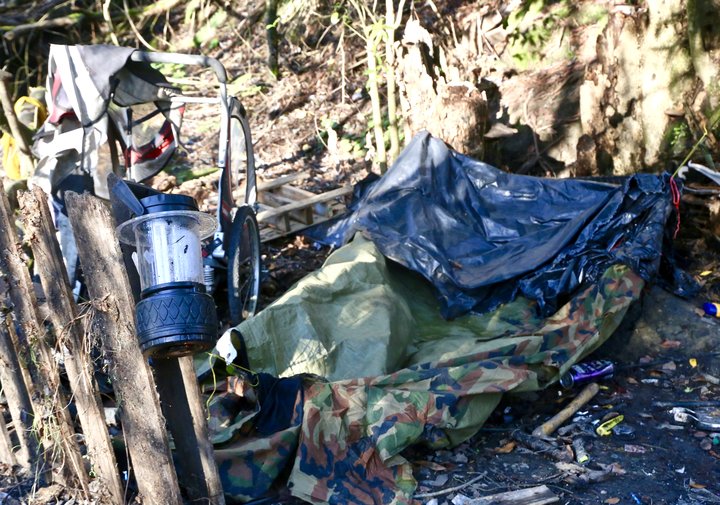
Tarps, a lantern and other signs of a makeshift camp on the outskirts of Fortuna.
###
The Boise decision “doesn’t specify a distance in terms of what’s considered available or not,” Plotz said in a phone interview last week. “It’s one of the areas that Boise has received some criticism from the League of California Cities for not providing that type of detailed guidance.”
Perry told the Outpost that Fortuna approaches the issue of homelessness regionally. When Fortuna recently received $400,000 in CARES Act funding to address homelessness, it wound up giving the money away.
“And so what we did is we made an agreement with the City of Eureka to put half of that towards their UPLIFT Program, and then we put the other half towards Arcata House [Partnership],” he said. The city has also provided funding to Sean Swanson, founder of the nonprofit River Life Foundation, “and he’s been really good at connecting people experiencing homelessness with services,” Perry said. “So we’ll find a way to get people to where there is shelter” — assuming they’re willing to go, he added.
At the Dec. 6 meeting, Plotz told the council that the Fortuna Police Department has largely stopped criminal enforcement of its anti-camping regulations as a result of the Boise case, and residents have noticed an uptick in the number of people building temporary shelters and lying in front of businesses on Main Street.
“This ordinance draws an important distinction between camping on the one hand and sleeping on the other, because the aim of the Martin v. Boise case was to prevent cities from criminalizing sitting, sleeping or lying on public property,” he said. “It does not speak to the larger issue of camping and the things that that comes with, including the erection of temporary shelters.”
The ACLU of Northern California disagrees with Plotz’s assessment. In a statement sent to the Outpost last week the organization says:
The Fortuna City Attorney’s claim that focusing on ‘camping’ rather than “sleeping” makes their ordinance legal is false and misrepresents Martin v. Boise. Martin does not apply to sleeping only. It covers “the unavoidable consequences of being human,” which includes the need for shelter, cooking, and having some personal possessions available.
Homelessness is not a “choice” that can be deterred by enacting laws that criminalize it. The City of Fortuna’s plan to criminally charge unhoused people for existing in public is cruel, unlawful, and does nothing proactive to solve the crisis of homelessness. Additionally, the suggestion from one councilman that residents of Fortuna will “relish” calling in to report unhoused people attempting to survive outdoors suggests a concerning lack of empathy for the plight of unhoused people—people who remain human beings with legal rights regardless of their housing status.”
Plotz said courts have struggled to interpret the language in the Boise decision for not being specific enough to provide real guidance. A lot is left up to interpretation. Fortuna’s ordinance bans camp paraphernalia, which it says “includes, but is not limited to, tents or tent-like structures, cots, hammocks, personal cooking facilities and similar equipment.” The definition explicitly excludes blankets, sleeping bags or bedrolls.
But what about the lantern in the photo above? Is that camp paraphernalia? What about those tarps? Are they being used as blankets? The ordinance says camp facilities, including lean-tos, are prohibited. What about a big piece of cardboard? Would that violate the rules?
Plotz said it could depend on how it’s being used and where. A lot will be left up to individual officers’ discretion, he said. At tonight’s meeting he expects either Perry or the police chief to talk about what programs are available and possible alternatives to criminal citations for violations of the new ordinance.
Day, the police chief, said this ordinance represents a needed update to regulations in “The Friendly City.” At the public meeting two weeks ago he said, “I really feel strongly that for the public morale and health and safety of the community, that this revision to the municipal code is exactly what our community needs.”
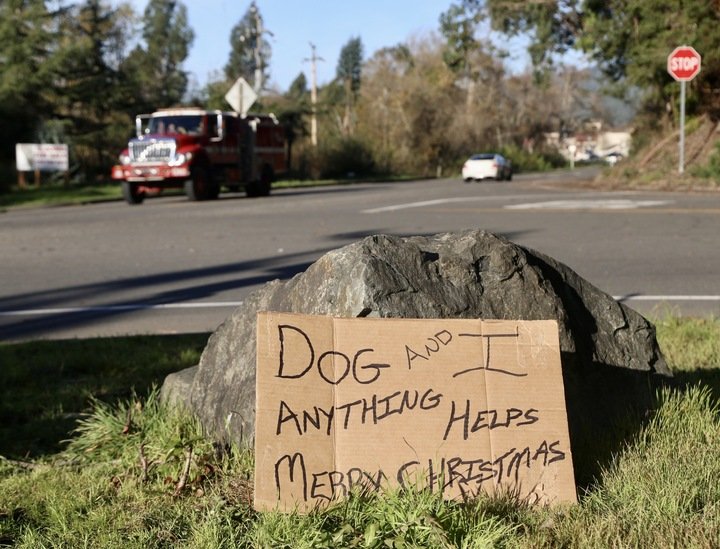
A cardboard sign rests against a rock just outside city limits.