Fund the Police: Newsom Responds to California Crime Concerns
Ben Christopher / Friday, Dec. 17, 2021 @ 2:51 p.m. / Sacramento
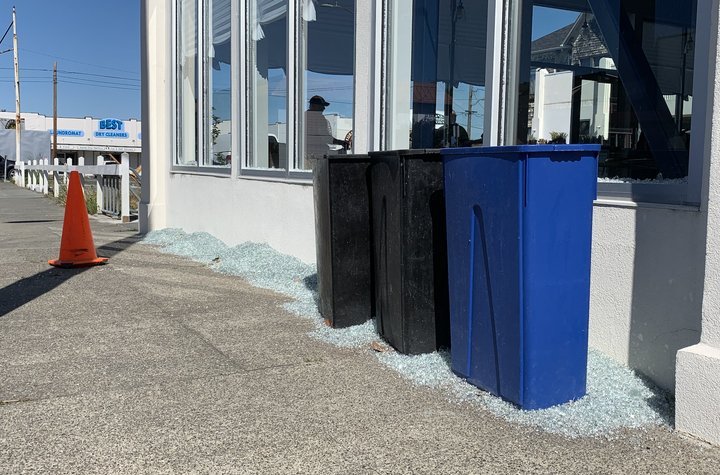
Smashed windows at Fat Cat Bakery on July 17, 2019. Photo: Andrew Goff.
When it comes to law and order, Gov. Gavin Newsom wants California voters to know that he feels your pain — no matter what the statistics say.
Newsom announced today he will be asking the Legislature to spend more than $350 million to ramp up crime-fighting efforts, with the bulk of that cash set aside to help local law enforcement agencies crack down on “organized retail theft.”
The governor is responding to a raft of flash-mob-style shoplifting incidents that struck retailers in the San Francisco and Los Angeles areas — and that inspired a cascade of headlines about out-of-control crime.
Today’s announcement is the latest indication that California’s Democratic leaders want to talk tough on crime, even as they defend a decade’s worth of reforms aimed at making the criminal justice system less punitive and discriminatory.
“We’re not walking back on our commitment in this state to advance comprehensive reforms,” the governor said at a press conference at a California Highway Patrol post in Dublin. “But we also have to recognize this moment we’re in. We have to recognize people’s fears and anxieties.”
Indeed, Newsom stressed that his announcement was motivated more by growing public concern about crime than the crime itself.
“I could regale you with facts,” the governor said, noting that despite an apparent increase this year, crime remains at a relative historical low across the state. Earlier this week the nonpartisan Public Policy Institute of California reported that both violent and property crime are up after a dip last year in Los Angeles, San Diego, San Francisco and Oakland. The rates are now roughly “similar to pre-pandemic levels.”
“Stats mean nothing in terms of your feelings,” the governor said.
Newsom went to special lengths to defend Proposition 47 in particular. The 2014 voter-backed initiative reduced penalties for certain low-level offenses, including theft and shoplifting of less than $950, from felonies to misdemeanors. For nearly a decade, conservatives have predicted that the loosened rules would result in a crime wave. Last year, tough-on-crime activists, along with California’s retailers, put a measure on the ballot to ratchet some of those penalties back up. The measure failed by 24 percentage points.
“Stats mean nothing in terms of your feelings.”
— Gov. Gavin Newsom, announcing a $350 million-plus anti-crime package
But the latest series of high-profile shoplifting raids has revived that debate. Today’s announcement was applauded by the California Retailers Association. “We need to send a message to these theft rings that California will not tolerate organized crime,” association president Rachel Michelin said in a press release.
Senate Republican leader Scott Wilk of Santa Clarita said in a statement: “It shouldn’t have taken increasing homicide rates, widespread news reports of smash-and-grabs, and pleas from Californians for Democrats to come to this realization.”
Palmdale Republican Tom Lackey, vice chairperson of the Assembly Public Safety Committee, called the announcement “too little, too late.” He also lambasted the Democrats as “the party of defunding the police.”
Heading into an election year, Newsom’s budget proposal, most of which would provide additional funding to police and prosecutors, appears intended to leave voters with the opposite impression. Similarly, earlier this week, elected Democratic leaders in both San Francisco and Los Angeles proposed spending more on police overtime.
If the Democratic Legislature approves the governor’s proposal:
- $255 million in grants would go to local law enforcement agencies over the next three years to combat organized retail crime;
- $30 million would go to local district attorneys over three years , and $18 million would create a new statewide anti-theft team at the attorney general’s office;
- $25 million would fund local gun buy-back programs;
- $20 million would assist the National Guard to intercept fentanyl and other drugs at the Mexico border;
- Some money would be reserved to cover uninsured losses of small businesses that have been ransacked by thieves. The written plan doesn’t specify an amount, but Newsom pegged it at $20 million.
The package will be included in the budget proposal that Newsom will unveil early next month.
Assembly Budget Chairperson Phil Ting, a San Francisco Democrat, welcomed the package, saying in a press release that looked forward to “teaming up with the Administration and our law enforcement partners on crafting an effective strategy to stop these sophisticated shoplifting rings.”
Standing beside Newsom at the press conference was Attorney General Rob Bonta. Newsom appointed Bonta as the state’s top law enforcement officer in March, plucking him from the Assembly where he was one of the body’s most liberal members on criminal justice issues.
Opposition to crime is a bipartisan instinct, Bonta said today. “I’ve not met anyone who wants to be a victim of crime — Republican, Democrat, it doesn’t matter.”
Newsom also restated his commitment to crafting a bill that would allow California citizens to sue manufacturers and distributors of prohibited semi-automatic rifles and build-it-yourself “ghost gun” kits.
That proposal is designed to be a blue-state rejoinder to a Texas law that gives citizens the right to sue anyone who “aids and abets” someone in getting an abortion. The U.S. Supreme Court recently allowed that law to stand, effectively permitting a legislative end-run around what was believed to be a constitutionally protected right under its 1973 Roe v Wade decision.
“It is a Pandora’s box,” Newsom said of the Supreme Court’s decision not to immediately strike down the Texas law. But, he added, “to the extent this decision is used to put womens’ lives at risk, we’re going to use this decision to save people’s lives by addressing the issue of gun violence here in the state of California.”
###
CALmatters.org is a nonprofit, nonpartisan media venture explaining California policies and politics.
BOOKED
Today: 12 felonies, 16 misdemeanors, 0 infractions
JUDGED
Humboldt County Superior Court Calendar: Friday, Sept. 4
CHP REPORTS
4646 MM96 E SIS 46.50 (YK office): Trfc Collision-No Inj
E Washington Blvd / Summer Ln (HM office): Defective Traffic Signals
ELSEWHERE
RHBB: CDPH Issues Immunization Recommendations for 2026-27 Respiratory Virus Season
RHBB: Redway Transfer Station to Close an Extra Day for Construction
RHBB: Dows Prairie Road to Close for Two Months for Culvert Repair
No Hazardous Waste Disposal at the Hawthorne Street Transfer Station for the Next Couple of Weeks
LoCO Staff / Friday, Dec. 17, 2021 @ 10:15 a.m. / Infrastructure
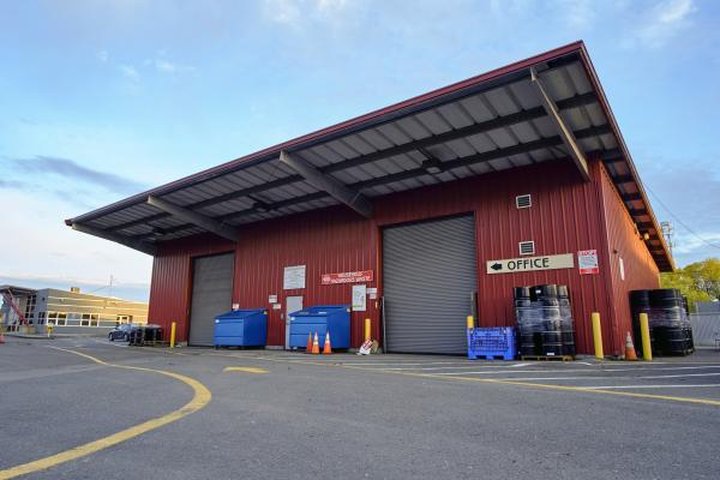
The hazardous waste shack. Photo: HWMA.
From the Humboldt Waste Management Authority:
Due to an unforeseen interruption of service with HWMA’S hazardous waste transportation and disposal contractor, HWMA’s Household Hazardous Waste facility located at 1059 W. Hawthorne Street in Eureka will be temporarily closed during the holiday season for a two-week period from December 20th, 2021 to January 3rd 2022.
HWMA and its staff apologizes for this temporary interruption and asks that residents and small business store hazardous waste material responsibly during this time. Staff will continue to work as quickly as possible to ensure these services are restored.
OBITUARY: Zona Trella Ferris, 1924-2021
LoCO Staff / Friday, Dec. 17, 2021 @ 6:56 a.m. / Obits
Zona
Trella Ferris
August
31, 1924 – December 7, 2021
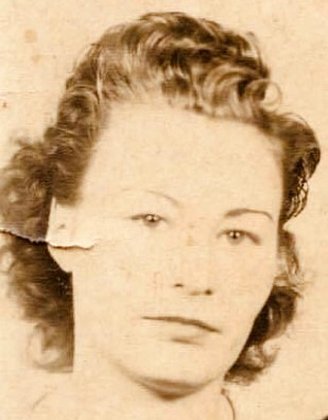
Zona Trella Ferris was born into the arms of her loving parents Dave Drake, Sr., and Lonnie Snapp-Drake on August 31, 1924. She was a Karuk tribal member born to the Village of Panamnik. Her mother Lonnie delivered her and her twin sister, who passed the day after birth. Zona was the oldest of eight. She was raised with her six sisters and one brother at the Drake homestead on the Salmon River. She attended elementary school at Somes Bar and waited two years before circumstances allowed her family to send her to high school in Etna.
The opportunity to attend high school at the time was no easy feat. WWII was in full force and caused increasing responsibilities on women as the men were drafted to fight in the war. Despite these obstacles, her parents chose to earn money that would allow her to move to Etna, where she enrolled and graduated with the class of 1943. Two sisters, Ethel and Betty, soon followed in Zona’s footsteps and moved with her to the valley to attend high school. All three sisters worked while attending school and were only able to make the trip home to the Salmon River during vacations. Their uncle Charlie Snapp, who was the mail carrier for over 75 years, would allow the girls to ride over Salmon Mountain on his Caterpillar through snow and rain to visit their parents at home.
Zona’s sister Betty is 94 and resides in Bishop, California and is married into the Paiute and Shashone People. She recently shared a story about their adventures from Etna to the Salmon River. She recalled,
One time us girls wanted to go visit our parents and Uncle Charlie told us he didn’t think we would be able to make the trip because a blizzard was coming. He said it would be too cold for us to travel over Salmon Mountain and it wouldn’t be safe. We were determined to make the trip and begged Uncle Charlie to go. Uncle let us go and we left from Etna at 8 a.m. and didn’t reach the Salmon River until 2 a.m. It snowed the entire time. We were wet and cold.
Uncle Charlie had a sled to hold freight and mail that was hooked to the back of his Caterpillar so he could get the mail delivered to the Salmon River. Zona saw some eggs Uncle had in the sled and asked Uncle if she could have them and Uncle said, “of course!” Zona traveled up the mountain with those eggs sitting on her lap until Uncle hit a bump and all the eggs went flying. When we arrived to the Salmon River, our parents said they were worried to death and could not believe we survived the trip.
Zona’s father owned and operated a pack train of mules. The family all helped with the pack train and was responsible for packing prestigious guests like President Hoover high into the Marble Mountains. The government delivered all of the supplies the President would need to stay at Haypress Meadows for one month at a time. The Drake family used their pack train to transport the supplies more than 12 miles into the back country. The family helped build President Hoover a cabin which the family called a “Mansion.” The cabin had a walk-around porch and overlooked the beautiful Marble Mountain water and meadows. The family cooked and took care of the President while he stayed and hunted in Karuk ancestral lands. One time the President’s chauffeur sent for Zona’s mother, Lonnie, to come meet them because he was too scared to drive the one-lane dirt road to the Salmon River, so she drove his Cadillac and parked it in the garage while they went to the mountain. The Drake family knew the Marble Mountains well and traveled them regularly.
During Zona’s upbringing, the 1964 flood washed away the bridge and town of the Salmon River. The store, fuel station and Post Office were once located along the South river bar a few miles up the Salmon River. This had an impact on the family and put pressure on them to ration supplies. Several years later, the current store, gas station and post office were built and still remain.
The Drake homestead was a happy home where all of the siblings were woven as one. They did everything together. There was plenty of books to read amongst the family, as their mother Lonnie housed the Siskiyou library in their home. The family did not have electricity but used kerosene lamps when they needed lights. The siblings did not have a playhouse but rather used the entire river system to create memories. Zona grew up during a time when people knew their neighbors and families along the river. The people looked out for one another by sharing their food. Deer, eels, mushrooms and more were shared regularly.
Betty shared,
We had a good life! People were always kind to one another along the Salmon River and we took care of one another. We had fun times and entertained ourselves. We used grapevines to swing like Tarzan to create memories and we wouldn’t trade what we had growing up for anything else.
In 1945, Zona met and married Wilfred Ferris, Sr. and together they raised six children. She was a determined woman who worked hard to help provide for her family. She had a long career, which began in High School at the Etna Hotel pressing laundry. When she moved back home she worked at the Ti-Bar Ranger Station, the Orleans Hotel, the Ishi Pishi Restaurant, Ukonom Ranger Station and later for the United States Forest Service as a Firewatch at the Buckhorn Lookout in Siskiyou County. She retired in 1997. She was known as somewhat of a sharpshooter. She could take out a rattlesnake from her fire lookout tower.
Zona truly enjoyed being with her family while camping, hunting, and fishing. She was well-known for her cooking and learned from her parents at a young age how to can food. She always prepared delicious food and gifted her children and grandchildren with canned fruit, jams and jellies of all sorts. The river community knew her best for providing food for ceremonial dances, community gatherings, basketweaving events, birthdays, and much more. She taught all of her children to be good cooks and they continued the tradition by cooking for events like Following the Smoke and Salmon Camp.
Zona was a basketweaver and avid gatherer. She helped the California Basket Weavers Association (CIBA) develop an herbal book called The First Full Moon in April.
Zona’s knowledge of history was unparalleled. Her family and friends loved sitting and listening to her stories because she knew everyone and had memories associated with all the places from the rivers to the mountain tops. She was very fond of Salmon Summit and the Ferris hunting camp, where she and Wilfred raised their children and grandchildren. Many Birthdays, special events, and memorials happened at Ferris Camp. The amount of quality time Wilfred and Zona spent with their children and grandchildren tells a story about how important we all were to them. She raised her great-grandchildren Ashley and Richard Myers, and Tuekwe Hunsucker and raised her granddaughter Cassandra Wescott, Sandra’s daughter.
Zona would call her siblings every week to talk and laugh about old stories. Zona had a great sense of humor and was not against playing a good joke on people. “Gram” had a large family and so many friends. Words cannot explain her connection to her community and family. She was a true Mountain Woman and her stories and contagious laughter will be missed by all who knew her.
Zona is survived by her daughters Elaine Stevens (Lester) and Sandra Ferris, her brother Dave Drake, Jr., Sisters, Betty Baycock, Sherley Bates and Beverly Drake (Dr. Doyle Bradshaw), and Daughter-in Law Patricia Ferris, Grandchildren, Josh (Carly) and Ben Saxon, Kim Chiokai (Hailey), Michael and Ulysses McLaughlin, Dana Lane (Kevin), Poppy Ferris, Trisha Ferris (Adam), Rick Bradberry, Raymond Ferris (Trissy), Stanley Ferris, Ilene and Francis Ferris, Cassandra Wescott. Zona was blessed with many great-grandchildren, nieces and nephews, family and friends; far too many to list.
Zona is preceded in death by her parents Dave Drake, Sr. and Lonnie Snapp, her late husband Wilfred Ferris, Sr., her children Dwayne Clyde Ferris, Sonny Buck Ferris, Dale Blue Moon Ferris and Noreen Ray McLaughlin, sisters Ethel Star, Ella Benedict and Helen Beck, her grandparents Nellie Morris-Snapp and Ezekiel Snapp, Grandson Wilfred Ferris III, Granddaughters Stephanie and Julie Ferris, and Sister-in-Law Adriane Drake.
Paul Bearers: Rick Bradberry, Josh and Ben Saxon, Michael and Ulysses McLaughlin, Stanley and Raymond Ferris, Tuekwe Hunsucker and Dave Drake, Jr.
Zona will be laid to rest in Etna, California at the Etna Cemetery with her parents, aunts and uncles and many other family members. The Ferris family will hold a graveside service at the Etna Cemetery on January 15, 2022 at 1 p.m. A Flower Drop over the Orleans bridge will be held on December 23, 2021 at 3 p.m. Join the river community by bringing your flowers and dropping them off the Orleans bridge in memory of Zona Trella Ferris.
The Ferris family would like to thank all of those who have reached out by offering food and comfort. Yootva!
###
The obituary above was submitted on behalf of Zona Ferris’ loved ones. The Lost Coast Outpost runs obituaries of Humboldt County residents at no charge. See guidelines here.
OBITUARY: Charlene ‘Char’ Horne Muro Marshall, 1949-2021
LoCO Staff / Friday, Dec. 17, 2021 @ 6:56 a.m. / Obits
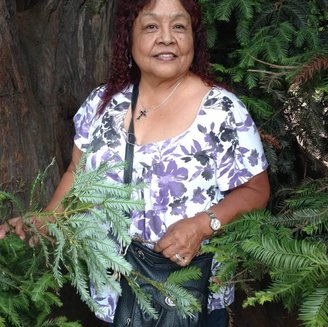
Charlene “Char”
Horne Muro Marshall, 72 of Hoopa, passed away to be with our Lord and
Savior on December 12, 2021 at 12:45 a.m. She was surrounded by her
loved ones singing and reading scripture to her.
Char was born on August 28, 1949 to Rev. Frank Horne Sr. and Pauline White Horne in Hoopa at the old hospital on Loop Road. Char was the oldest of six children — along with Char there are Caroline Horne, Frank “Badge” Horne Jr, Jonathan Horne (deceased), Raelene Cobb and Gerard Horne (deceased). She was a tomboy. When she was a teenager she would wrestle her boyfriends down when they asked her out. She also taught herself how to do hair cutting, perming, dyeing, etc.
In November of 1964 she lost her mother, brother, grandmother and cousin in a tragic car accident and took on the role of helping her father raise her siblings when her dad was out preaching the word of God. She helped with caring for her siblings, she became the mother figure to them and they looked up to her.
Char married a preacher named Leland Muro in the year of 1969 in Reno. She had six beautiful children with him – Charlena (deceased), Linnie, Leland “Brody”, Tani, Tamera and Raina Muro. After Char and Leland got divorced she moved to Hoopa and remarried Russell Marshall and had her last child in 1987, her baby, Russell “RJ” Marshall Jr. In November of 1997 she took on another role as mother for her grandchildren Danielle and Angel after they and their mother got in a bad car accident and her daughter-in-law didn’t survive, she raised Danielle and Angel as though they were her own. She loved them and taught them about the Lord.
She loved to travel to see her children in Santa Rosa, then to Point Arena to see her Aunt Bim and Cousin Oshie along with other family members who reside there. She also loved to traveled for her religion. She would go to all kind of church meetings, whether it be in Covelo or over to Nevada. She was a true woman of God – she put all her faith in him and trusted him with all her heart. All she wanted in life was for her children to know God. Char had a smile that we will never forget or the voice of angel when she would speak or sing.
She is preceded in death by her Father Reverend Frank Horne Sr, Mother Pauline White, Grandmother Ella, Brothers Jonathan and Gerard Horne, Sister Juana Gault, cousin Nadine, Daughter Charlena Muro, Uncle Darnell “Dart” White, Uncle Willington “Duke” White, Aunt Eileen White, Aunt Dolores Starky, Aunt Margaret Horne, Uncle Jake Horne, Uncle Robert Horne, Aunt Christine Horne, Aunt Caroline Horne, Uncle Reginald White.
Char is survived by her Sisters Caroline Horne,, Raelene and Pat Cobb, Brother Frank “Badge” and Chopsie Horne, Children Linnine Muro, Leland “Brody” Muro, Tani Muro, Tamera Penaloza, Raina and Nicoma Sanderson, Russell and Laurie Marshall Jr, Grandchildren Fernando Muro, Danielle Muro, Angel Muro, Tonewhan “Bubba” Muro, Joaquin Muro, Jose Muro, Marco Calixto Jr, Emanuel Muro, Leanna Cisneros, Jaime Muro, Javier Penaloza, Lorenzo Penzola, Carmen Penaloza, Juan Hernandez, Nicoma and Skye Sanderson Jr, Shania Sanderson, Sativa Sanderson, Indica Sanderson, Gerard Marshall, Donald Hostler Jr, Jocelyn Baldy Marshall, Taiya Baldy, Tyler Harrington, Eva Marshall, Ella, Marshall, Great Grandchildren Xiomara Cisneros, Amella Muro, Ariella Muro, Killian Dickey, Castiel Dickey, Yuri Dickey, Nieces Elizabeth Nix, Raelene Carpenter, Melody Horne, Michelle Horne, Andrea Cobb, Krishell Cobb, Nephews Tillman Anderson, Shane Anderson, Darren Blaze Carpenter, Duane “Roogers” Carpenter, Bubba Horne, Jonathan Horne Jr. Ther also numerous great-nieces and -nephews and cousins she loved them all.
Pallbearers:
Blaze Carpenter, Duane Carpenter, Shane Anderson, Tilman Anderson, Gabe Anderson, Nathan Nix, Gerard Marshall, Donald Hostler Jr, Michael Gabriel, Roy Ridenour, Nicoma Sanderson Jr, Leland Moon, Gabe Moon, Jason Marshall, Whits Marshall, Marco Calixto Jr, Emanuel Muro, Jaime Muro, Juan Muro, Caleb White, Lester “Mesket” White, Josh White, Verle Moon,
Honorary pallbearers:
Badge Horne, Russell Marshall Jr, Leland “Brody” Muro, Nicoma Sanderson Sr, Russell Marshall Sr, Willy Hoglen, Leland Muro Sr,
Viewing at Paul’s Chapel in Arcata Friday Dec. 17 from 12 to 4 p.m. Graveside Service in Hoopa on Saturday Dec. 18 at 11 a.m.
Pot luck style reception at the Fire Hall in Hoopa to follow after the services.
###
The obituary above was submitted on behalf of Char Marshall’s loved ones. The Lost Coast Outpost runs obituaries of Humboldt County residents at no charge. See guidelines here.
Two Homicide Suspects Wanted in Oregon Arrested After ‘High-Risk Traffic Stop’ on 299
LoCO Staff / Thursday, Dec. 16, 2021 @ 5:17 p.m. / News
Press release from the California Highway Patrol:
On 12-15-2021 the Humboldt County Sheriff’s Office (HCSO) released a Be-On-The-Lookout (BOLO) broadcast for two homicide suspects out of Oregon, who were believed to be in the Willow Creek area.
On 12-16-2021, at approximately 1015 hours, a California Highway Patrol officer observed one of two vehicles from the BOLO, traveling west on SR-299 near MPM 25.
The officer began following the vehicle, a white Ford F250, until additional units from CHP and the HCSO arrived to assist with a high-risk traffic stop.
Once additional units arrived, a traffic stop was initiated near MPM 10 and a male suspect, 42-year-old Jeremy Lacy, was taken into custody without incident.
While on scene, the second suspect from the BOLO drove on scene and contacted the officers. 51-year-old Eileen Lacy was also taken into custody without incident.
Both suspects were confirmed to have active arrest warrants out of Oregon for homicide and were subsequently booked into the Humboldt County Jail.
Yurok Tribe Declares Emergency Following a Series of Human Trafficking Attempts
LoCO Staff / Thursday, Dec. 16, 2021 @ 4:58 p.m. / News , Tribes

File photo
###
Press release from the Yurok Tribe:
Today, the Yurok Tribal Council issued an emergency declaration in response to a spate of missing persons and attempted human trafficking incidents on the reservation and in Arcata, where there is a disproportionate number of cases involving missing and murdered indigenous women (MMIW).
“Today, we are asking our local, state and federal partners to take a stronger stand against the trafficking of Native women and girls,” said Joseph L. James, the Chairman of the Yurok Tribe. “While human trafficking and abductions have been all too common in the Humboldt County area, I ask all of our members to be extra cautious at this time. If you have to go into town, please take someone with you and let a family member know when you expect to return.”
In the last month, the Yurok Tribal Court received reports from seven Yurok women, including mothers with young children, who were approached by would-be traffickers. Thankfully, all were able to make it to safety. In mid-October, Emmilee Risling was declared missing. The Yurok and Hoopa Valley Tribe, in conjunction with the Humboldt County Sheriff’s Office, implemented a coordinated, month-long effort to locate her, but she has not been found. The Hupa woman was last seen near Weitchpec on the Yurok Reservation. The Yurok and Hoopa Valley Tribes are offering a $20,000 reward for information leading to Emmilee’s safe return.
The Tribal Council issued the emergency declaration through a resolution, which speaks to the underlying cause of the MMIW crisis. According to the resolution: “The intergenerational impacts of 170 years of violence, trafficking and murder through missions, massacres, forced relocation, state sanctioned indentured servitude, boarding schools, widespread removal of children from their families through the child welfare system, disproportionate incarceration, police violence, and high rates of gender violence are still playing out to this day, and directly contribute to the crisis of Missing and Murdered Indigenous Women and Girls.”
Per capita, native women and girls are victims of human trafficking at a much higher rate. Tribes across the US are advocating for additional resources to confront this indelible issue. In 2020, 5,295 indigenous people were reported missing to the National Crime Information Center. At the end of the same year, 1,496 were still missing. Last year, there were 18 cases involving missing and murdered indigenous women and girls in California, according to a report produced by the Yurok Tribal Court and the Sovereign Bodies Institute (SBI). The actual number is likely much higher because MMIWG cases are poorly documented at the state and federal levels. A third of all cases in California occurred in Mendocino, Humboldt and Del Norte Counties, despite the sparse populations in these areas. Even worse, murders of Native women in the state are seven times less likely to be solved.
“Every one of our families has been impacted by this issue. It cannot be allowed to continue,” said Chairman James.
During the past two years, the Yurok Tribe has substantially increased its capacity to respond to MMIW cases both on and off of the reservation. In 2019, the Yurok Tribal Court, in partnership with SBI, started the To’ Kee Skuy’ Soo Ney-wo-chek’ (I Will See You Again in a Good Way) Program to combat the crisis. The Program aims to improve the efficacy of MMIW investigations and establish an enhanced level of protection for Native women, girls and two-spirit individuals in California, one of the top five states for MMIW cases. The program is also developing the first MMIW database in the state. Additionally, the Court formed the Office of the Tribal Prosecutor, which aids in the investigation and prosecution of MMIW and domestic violence cases in all jurisdictions.
Similar to the Yurok Tribe, most tribes are located in rural areas, where law enforcement is minimal due to enduring inequities in federal funding. Predators intentionally target rural and tribal lands because there is less chance of getting caught. MMIW cases, including local incidents, often involve multiple law enforcement jurisdictions, making investigation infinitely more challenging. Prior to the formation of the Tribal Court’s MMIWG2 Program, the Tribe had no formal way to influence off-reservation cases. In many states, including California, Tribes are further hindered by Public Law 280. Public Law 280 grants the state jurisdiction over most violent crimes. When federal legislators determine where to distribute tribal law enforcement dollars, tribes in PL 280 states are often left out. There is no doubt that PL 280 has contributed to the inordinately high number of missing and murdered indigenous women and girls in Humboldt County.
“The quantity of MMIW cases in the local area and across the country is staggering. This needs to change and it needs to change now,” concluded Chairman James.
Here are helpful tips to avoid being a victim of human traffickers
- When in public, be cognizant of your surroundings.
- Travel in groups
- Trust your instincts
- Be suspicious of strangers who reach out via social media
- Take swift action – if someone makes you feel unsafe, leave immediately and report it to law enforcement
- Learn self defense
Former HSU Student With TV Series About Rescuing Animals From Natural Disasters Travels to Kentucky to Save Stranded Pets From Tornado Wreckage
John Ross Ferrara / Thursday, Dec. 16, 2021 @ 4:49 p.m. / Animals
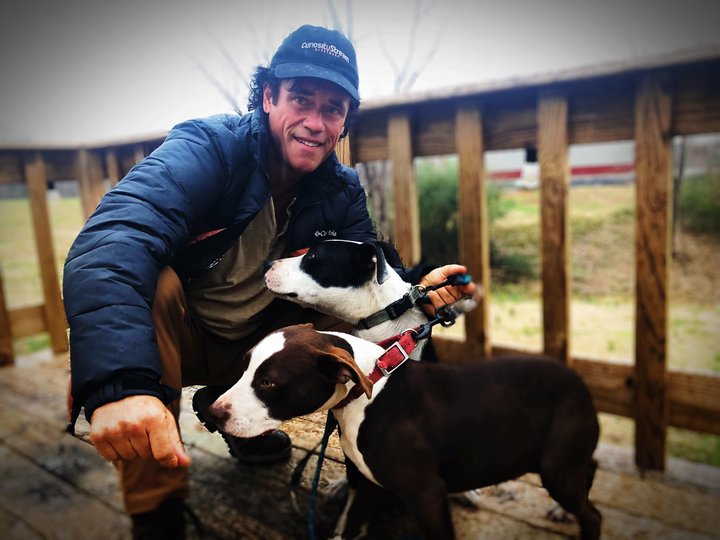
Douglas Thron with two dogs he rescued from the aftermath of the tornado in Mayfield, Ky. | Photos provided by Thron
###
Former HSU student turned animal-rescuing TV personality Douglas Thron is actively working in Kentucky to save stranded pets from the debris left in the wake of the deadly tornadoes that devastated areas of the southern and central United States last week.
At least 90 people were killed during the storms, 80 of whom died in Kentucky.

Starting in Mayfield, Ky., Thron plans to travel across the region using an infrared scope attached to his drone camera to find pets stranded by the disaster. The rescues will be documented for his CuriosityStream network series “Doug to the Rescue.” So far, Thron said he’s rescued two dogs and several cats.
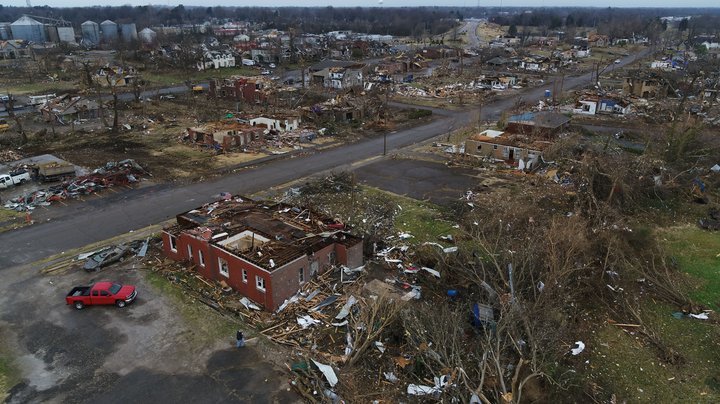
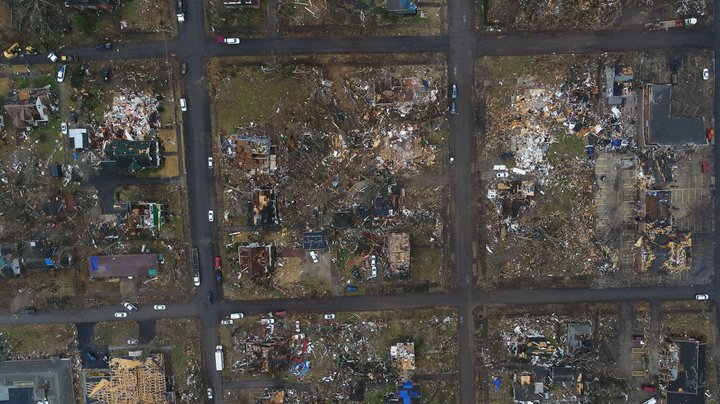
“It looks like a nuclear bomb went off,” he told the Outpost. “Tons of old historical brick buildings just blown down, cars turned over.”
Thron was offered the show after a documentarian learned about his work rescuing stranded house cats with National Park Service Ranger Shannon Jay in Paradise, Calif. following the deadly Camp Fire in 2018.
The active series debuted in June, and documents his drone rescues around the world.
“I was just in Africa doing research and protection of hyenas for almost a month,” he said. “Prior to that, I was saving dozens of dogs from a trash dump in the Dominican Republic.”
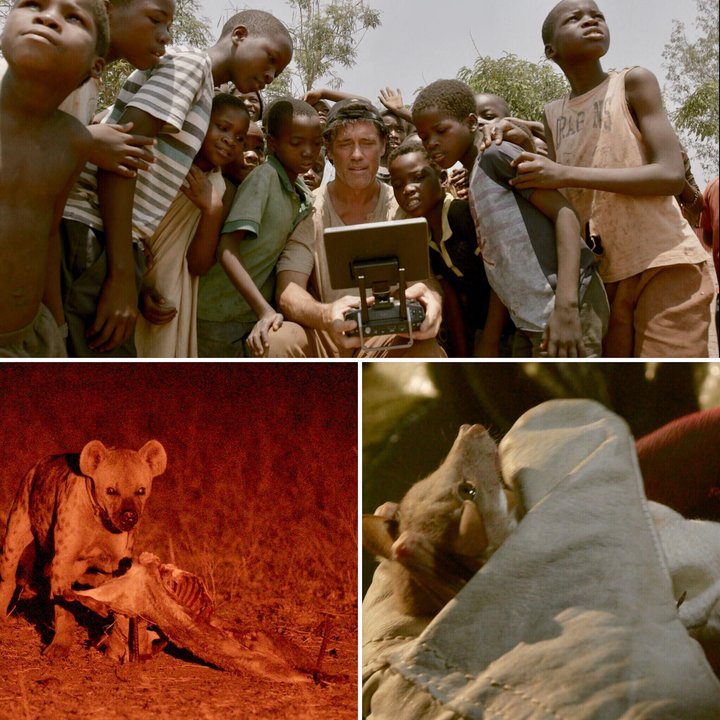
Thron’s travels in Africa.
While he considers himself to be homeless by technicality, Thron’s global rescue efforts are funded by CuriosityStream, the World Wildlife Fund, Pet Care Foundation and individual donations to his GoFundMe page.
No longer a resident of Humboldt County, Thron said he still visits the area regularly, and sometimes returns to save lost Humboldt pets.
“I just got a call recently to look for a lost dog near Fortuna,” he said. “I will try to do that soon as well.”