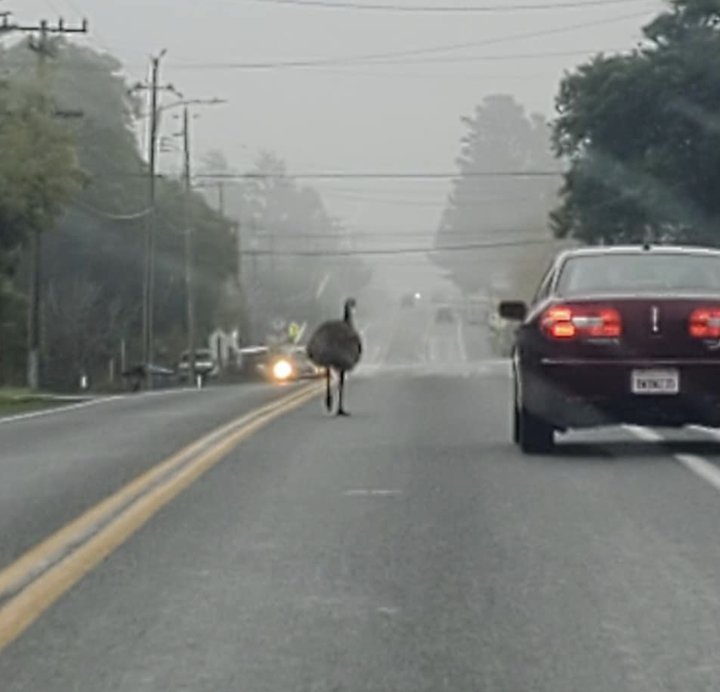
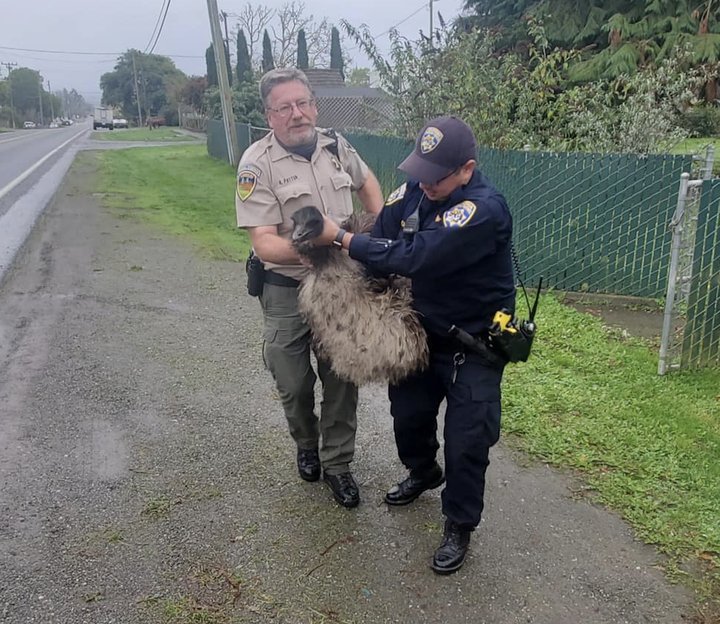
Local law enforcement spent their morning Finding Emu | Photos: CHP
Today is officially not boring. Earlier this morning, officers with the California Highway Patrol and the Humboldt County Sheriff’s Office responded to a call of a loose emu on Rohnerville Road in Hydesville, which is maybe newsworthy in itself? Do many people keep emus in Humboldt? LoCO does not have reliable knowledge on this topic.
Anyway, law enforcement was able to successfully subdue the bird and usher it home without incident. Proud of their efforts, our local CHP decided to post a few photos of the event to their social media and, in so doing, deployed all the emu puns.
From the CHP - Humboldt (emphasis added):
Did you hear about this little guy that got loose today? I guess he was feeling a little ostrichsized at home. At first he was a bit emu-vable. But eventually this Humboldt County Deputy and California Highway Patrol officer were able to get him wrangled.
Sorry, we don’t have an emuji to close out this story. Hope you enjoyed this post.
We tried to make it…emusing.
Wow. That made LoCO emutional. (Sorry.)
Anyway, a word to the bird. Thank you for inspiring our local public servants to discover their inner wordsmiths, li’l emu. You stay home now.
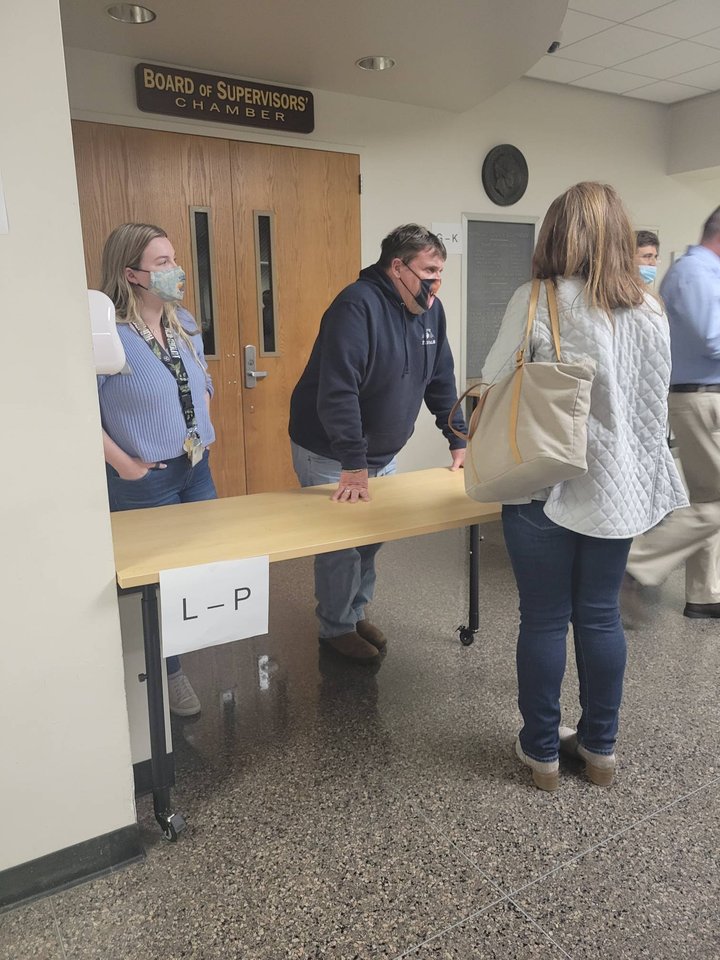
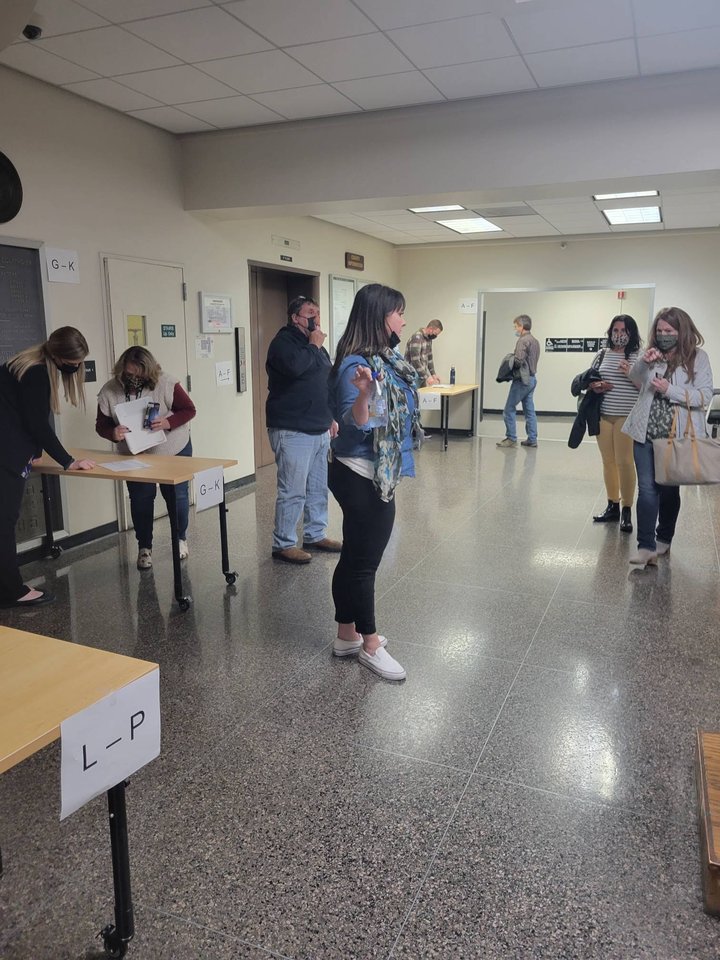
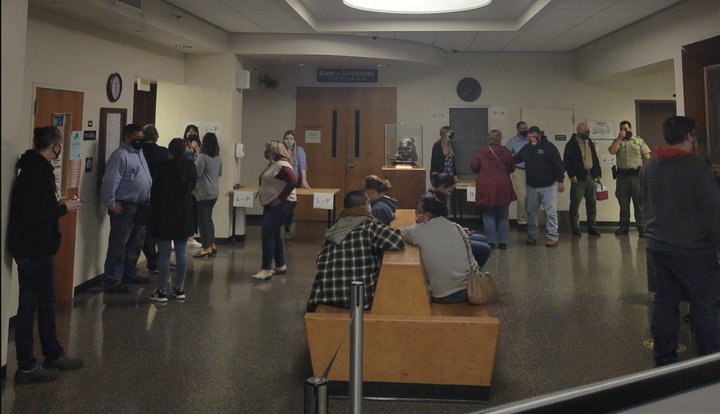
An anonymous county employee sends along the following photos showing County Administrative Officer Elishia Hayes, Deputy CAO Karen Clower and Supervisor Rex Bohn helping to hand out paper paychecks to county employees affected by today’s payroll screw-up.
Also, in case you missed it, the Board of Supervisors will consider a vote of “no confidence” in Auditor-Controller Karen Paz Dominguez during a special meeting on Monday.
###
UPDATE, 3:15 p.m.:
Well, we’re hearing from county employees that paychecks have been issued, but many are in the wrong amount.
“A popular one is paying people $20.60 instead of $2,060,” one worker told the Outpost.
Reached by phone, Deputy County Administrative Officer Sean Quincey confirmed that the county is getting reports of paychecks in the wrong amount — with many apparently seeing decimal point errors like the example above.
“We’re trying to run paper checks for those people,” Quincey said.
Another county employee, Chris Petersen, told the Outpost via email that he was overpaid on his check by about eight four percent.
“[N]o word on when i will see the backup paperwork to find out why,” he said. “I would add that our department has been directing us to keep an eye on our paychecks since the auditor took it back over … as there has been multiple errors reported.”
###
UPDATE, 2:30 p.m.:
A resolution, sounds like! The county just issued the following message to its employees:
Dear County Employees,
Our Payroll team received confirmation from US Bank moments ago that the file we sent was successful and employees using direct deposit should see funds posted to their accounts by close of business today. We are in the process of printing out paper checks for employees who do not normally receive direct deposits. In addition, a small subset of employees who receive direct deposits had errors in their banking information and those employees will receive paper checks. We will notify employees once paper checks are ready to be picked up from the Courthouse. The Courthouse will remain open until 6 p.m. to pick up checks. Any checks not picked up will be mailed Saturday morning.
We will provide another update later today with more information.
###
Bohn and Paz Dominguez
UPDATE, 1:30 p.m.:
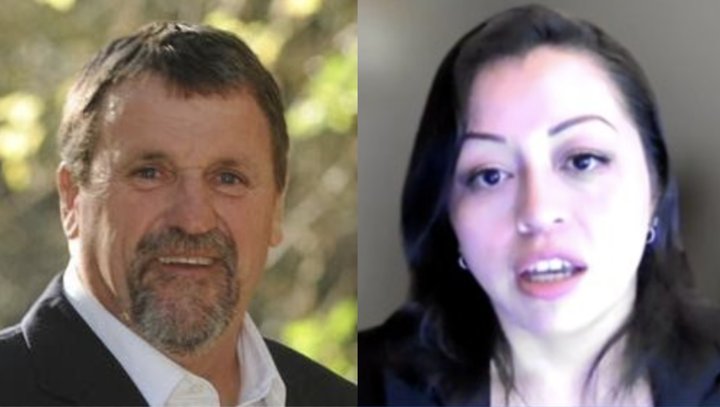
Things are getting a bit heated on Facebook. Auditor-Controller Karen Paz Dominguez headed on over to Supervisor Rex Bohn’s page to comment on his post, which we referenced (and embedded) below.
Here’s what she had to say:
I have let you go on enough, Rex. I really wish you’d stop instigating unnecessary conflict with misinformation to further your political agenda and political hits. It is a disservice to all of the County staff that have been working on this since yesterday because it undermines and devalues their sacrifice and efforts. It is a disservice to County employees because it suggests that the County’s central offices don’t value them or work hard to serve them. It is a disservice to taxpayers by suggesting their County government does not have their best interests in mind. You know damn well that this was a system issue that nobody at the County anticipated. You know this happened previously in 2009. Step up and be a leader. If you want to talk to me, then come find me. Come to my office and sit with me while I troubleshoot the issue with the hardworking staff that have been on this for hours. Otherwise, let us work and go find something to do.
Another update: While the original memo to county staff said “around half” the county workforce has been affected by the delay, Humboldt County spokesperson Manny Machado tells the Times-Standard that, in fact, “more than 75% of county employees receive direct deposit” and are thus still waiting to get paid.
###
UPDATE, 11:45 a.m.:
The County issued this update to employees. It sort of explains what the problem was, though it sounds like they’re still scrambling to ensure everyone gets paid before the end of the day.
“The automated clearing house (ACH) file that was sent to US Bank last night with payment
instructions had an error in it which prevented successful upload to their system and
disbursement of payments this morning … ,” the update says. “We have contacted several of our local banks and are attempting to contact larger institutions
to see if they can prioritize processing these direct deposits.”
The memo goes on to say that there’s a contingency plan: running paper checks for everyone who has yet to get paid.
###
UPDATE, 10:42 a.m.:
Auditor-Controller Karen Paz Dominguez tells the Outpost that she and others worked past midnight last night trying to get to the root of the problem but they have yet to figure it out. Still, she said she’s absolutely determined to get the remaining paychecks out to employees by the end of the day, even if it means signing them all individually herself.
###
Original post:
Many if not most Humboldt County employees did not get paid on time this morning due to some as-yet-unidentified problem with the payroll system.
Employees received a memo late Thursday night or early this morning saying county workers who get paid via direct
deposit may receive their paychecks “later than usual,” though probably by the end of the day.
The memo is a joint statement signed by County Administrative Officer Elishia Hayes, Auditor-Controller Karen Paz Dominguez and Information Technology Director Jim Storm.
A paragraph under the headline “What we know” says this:
While verifying information in the payroll system, staff realized some calculations involved in
calculating pay, benefits, taxes and withholdings were not processing through our financial
system normally for around half the county workforce. The calculation errors did not appear to
have any consistent theme that allowed us to pinpoint a root cause. However, we had all of the
information needed to issue paychecks and knew we could manually enter information if
needed.
First District Supervisor Rex Bohn posted a copy of the memo on Facebook along with an apology to county employees. He points out that the county’s payroll function was moved from the Human Resources Department to the Auditor-Controller’s Office in August. Bohn was the lone supervisor to vote against that move.
“In my 9.5 years here at the County this has never happened,” Bohn says in his post. “My hope is we fix this for good soon. I can not emphasize enough your importance to the County and our commitment to getting you paid.”
One county employee took to Facebook to complain about the string of recent issues concerning the Auditor-Controller’s Office, culminating in this payroll problem. “Woke up to this in my email box this AM,” he wrote, in reference to the memo. “It is unacceptable to not process vendor’s payments for months, for fiscal books not to be closed in a timely fashion, and now not to pay employees on their stated payday!”
You can read the county’s full inter-office memo by clicking here.
Press release from the Humboldt County Sheriff’s Office:
On Nov. 18, 2021, at about 4:59 p.m., Humboldt County Sheriff’s deputies were dispatched to the 500 block of Aldergrove Road, in the county’s jurisdiction of Arcata, for the report of a suspicious vehicle parked along the roadway.
Deputies arrived and observed a male, later identified as 47-year-old Jason Quinton Miller, exiting an area that had been marked as private property. Deputies contacted Miller and learned that he had an extraditable warrant for his arrest out of Oklahoma. Miller was taken into custody for his warrant without incident.
Miller was booked into the Humboldt County Correctional Facility on a fugitive from justice warrant (PC 1551(a)) and is awaiting extradition.
Anyone with information about this case or related criminal activity is encouraged to call the Humboldt County Sheriff’s Office at (707) 445-7251 or the Sheriff’s Office Crime Tip line at (707) 268-2539.
Rebecca Parison in her office at Hueneme Elementary School District in Oxnard on Nov. 12, 2021. Photo by Julie Leopo for CalMatters
###
When Rebecca Pariso agreed to join a team of educators tasked in late 2019 with California’s new mathematics framework, she said she expected some controversy.
“We were transforming math education, and change is hard and scary,” said Pariso, a math teacher at Hueneme Elementary School District. “Especially if you don’t understand why that change needs to occur. But I didn’t expect it to go this far.”
Every eight years, a group of educators comes together to update the state’s math curriculum framework. This particular update has attracted extra attention, and controversy, because of perceived changes it makes to how “gifted” students progress, and because it pushes Algebra 1 back to 9th grade, de-emphasizes calculus, and applies social justice principles to math lessons.
Their intent, the framework’s designers say, is to maintain rigor while also helping remedy California’s achievement gaps for Black, Latino and low-income students, which remain some of the largest in the nation.
At the heart of the wrangling lies a broad agreement about at least one thing:The way California public schools teach math isn’t working. On national standardized tests, California ranks in the bottom quartile among all states and U.S. territories for 8th grade math scores.
Yet for all the sound and fury, the proposed framework, about 800-pages long, is little more than a set of suggestions. Its designers are revising it now and will subject it to 60 more days of public review. Once it’s approved in July, districts may adopt as much or as little of the framework as they choose — and can disregard it completely without any penalty.
“It’s not mandated that you use the framework,” said framework team member Dianne Wilson, a program specialist at Elk Grove Unified. “There’s a concern that it will be implemented unequally.”
“There’s a huge problem with math instruction right now. The way things are set up, it’s not giving everybody a chance to learn math at the highest levels.” — Rebecca Pariso, math teacher, Hueneme Elementary School District
District officials at Cupertino Union School District, for instance, sent families a letter in May saying despite the state framework, it doesn’t plan to “make shifts to our math courses in the foreseeable future.”
Pariso wanted to be a voice for her students among the 20-member team. In her 7,500-student school district in Ventura County, 42% of students are English Learners and 84% qualify for free or reduced-price lunch. She said students like hers have long been dismissed as lacking math skills due to language barriers or factors outside the classroom like housing or food insecurity. The result, she said: In a state that’s home to giant tech companies, her students are alienated from careers in science, math, engineering and technology.
“There’s a huge problem with math instruction right now,” Pariso said. “The way things are set up, it’s not giving everybody a chance to learn math at the highest levels.”
A persisting achievement gap
Mariah Rose, a third-year applied math major at UC Berkeley, said she didn’t have another Black classmate in any of her math classes until this semester.
“There’s one other Black student in my class right now, and that’s just crazy to me,” said Rose. “The number of Black and Brown people in math is so low.”
Rose, who is half Black and half Latino, said this is nothing new. She said she was the only Black female student in her advanced math classes during high school. And her successes in math make her an outlier in California’s public school system where Black and Latino students score lower on standardized tests.
But the question of how to close this gap has opened up another divide between math education experts and academic mathematicians.
In July, hundreds of mathematics and science professors signed an open letter calling on the state to replace the proposed framework. Academic mathematicians say their input is valuable because not only have they gone through the entire math pipeline, but they also know what elementary math builds up to.
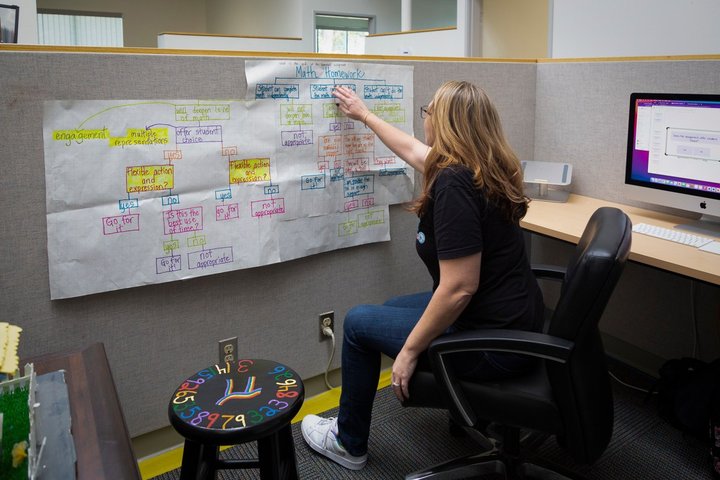
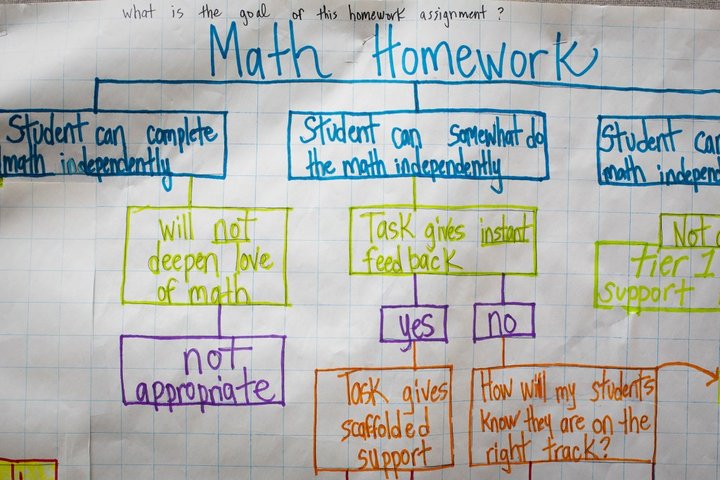
A flowchart created by Rebecca Parison, which she considers a universal design, aids teachers through the process of assigning math homework. “I have noticed homework is sometimes given to students with little thought on its effectiveness,” said Parison. Parison believes if teachers use this chart the learning will be equitable and purposeful. Nov. 12, 2021. Photo by Julie Leopo for CalMatters
Svetlana Jitomirskaya, a mathematics professor at UC Irvine, said the authors of the committee should have consulted more experts in the STEM fields who are more familiar with the advanced education and training students need after high school.
“The process should have definitely involved STEM faculty from top CA universities with direct knowledge of what is needed for success as STEM majors,” she emailed. “It is absurd this was not done.”
And some education specialists say the framework would hurt historically marginalized students the most by injecting too many social justice related topics that distract from the math.
“The way you get social justice in mathematics is to teach the kids math,” said Tom Loveless, a retired math education expert who worked for the Brookings Institution, a national think tank. “It’s not by dressing up mathematics in social justice.”
Jo Boaler is the framework’s primary author and a math education professor at Stanford University. She and other advocates of the framework say university professors — who work with older and more motivated students who elect to take higher level math courses — might not have the insight needed to build a K-12 curriculum, especially for historically marginalized student groups.
“We understand education, and they have no experience studying education,” Boaler said. “Mathematicians sit on high and say this is what is happening in schools.”
Ben Ford, a mathematics professor at Sonoma State University and one of the framework’s authors, said he’s also optimistic that, especially at the Cal State Universities that prioritize instruction over research, the divide between mathematicians and math educators is narrowing.
“The mathematics community cares a lot these days about broadening participation,” he said. “I think we’re getting a lot more sophisticated about how our methods contribute to exclusion.”
“Gifted” math students controversy
A key sticking point in the approval process has been the framework’s recommendation that teachers refrain from labeling students as “naturally talented” in math. This has led to accusations from parents and educators that it holds back “gifted” students.
“Holding back high achievers makes them achieve more?” said Avery Wang, a parent of a Palo Alto Unified student. “That’s exactly the same philosophy that’s being promoted in the math framework.”
Boaler said the revised draft will contain more suggestions for advancing students more quickly in math based on merit.
The framework also calls for more relatable and practical instruction, whether that be through using more inclusive pronouns or word problems related to real-world issues like housing and climate change.
To critics, that sounds perilously like dumbing down math.
“They’re changing math to make it math appreciation,” said Michael Malione, a parent in the Piedmont City Unified School District who works as a private math tutor. “A part of math is learning things that are not authentic to life.”
Malione and other parents say the framework does a disservice to historically marginalized student groups by offering them a simplified version of math that fails to prepare them for the challenges of a career in science, tech, engineering or math.
“Math is gonna be hard for students who don’t enjoy it as much,” Malione said. “But that’s the price you pay for giving them an opportunity to study STEM.”
“They’re changing math to make it math appreciation. A part of math is learning things that are not authentic to life.” — Michael Malione, parent and private math tutor, Piedmont City Unified School District
Advocates of the proposed framework argue that critics are too fixated on protecting students who are already doing well in math. In California, these students tend to be white, East Asian or come from more affluent households.
“The people who advocate for traditional methods see the goal of math instruction as finding the brilliant ones and helping the other ones just get through life,” Ford said. “We’re thinking about the people we miss. That’s the motivation for a lot of us working on the framework.”
Rose, the UC Berkeley math major, said she has mixed feelings. She agrees with the framework’s recommendation to delay more advanced math classes and avoid labeling students based on their math abilities at younger ages. But she isn’t sure if she would be where she is if she hadn’t been accelerated into a higher-level math class in 6th grade.
“It was a game changer,” she said. “I don’t know if I would’ve pursued math if I hadn’t advanced so early.”
Blending math and open-ended inquiry
The framework would not forbid districts from accelerating students in middle school. It does, however, recommend that middle-school students all take the same sequence of “integrated” math classes that blend concepts from arithmetic, algebra and other subjects with the goal of cultivating a foundation and comfort level with numbers.
On top of that, the framework recommends that schools postpone offering students Algebra 1 until 9th grade or later, when it says more students are likely to be able to master the material.
“When kids struggle, they immediately say ‘I don’t have a math brain,’” Boaler said. “That changes how the brain operates.”
Delaying Algebra 1 until 9th grade, however, would require other high school math classes like Geometry, Algebra 2 and Pre-Calculus to be compressed so that students can reach AP Calculus by 12th grade. At San Francisco Unified, which implemented this pathway in 2014, students took a one-year class that combined Algebra 2 and Pre-calculus.
Jitomirskaya said that waiting until high school for Algebra 1 would result in accelerated pre-calculus courses that would be too difficult for most students.
“When kids struggle, they immediately say ‘I don’t have a math brain.’ That changes how the brain operates.” — Jo Boaler, professor, Stanford University
Norm Matloff, a computer science professor at UC Davis and a critic of the framework, said compressed mathematics classes are “dangerous” because they inevitably leave out parts of the curriculum. He said taking classes like Geometry and Algebra in the same year as two separate, year-long classes is a better idea.
For Boaler and her co-authors, integrating traditionally separate math classes goes hand-in-hand with open-ended inquiry. For example, instead of assigning repetitive problem sets, teachers would use collaborative projects such as calculating the living wage in the students’ communities. Open-ended assignments like this don’t necessarily have a single right answer in the back of the book.
“Math can be very boring for kids,” Boaler said. “It’s just about doing these short questions that don’t have any meaning.”
Some education experts and math professors say the framework’s emphasis on open-ended assignments just leads to confusion, especially for struggling and historically marginalized students.
Loveless said teaching through open-ended problems can make students feel lost. He suggests teachers use lecture-style lessons to introduce students to concepts.
“It’s a long standing philosophical dispute,” he said. “Math education departments tend to be very progressive in their points of view.”
The calculus calculus
The framework also creates a new high school data science course as an alternative to calculus. The authors say this course will result in a more diverse student body pursuing careers in science, technology, engineering or mathematics. But some experts say calculus is vital to prepare students for a STEM career.
“If you want a job in data science that isn’t replaceable by a computer in the next couple of years, you need to take calculus,” said Jitomirskaya, the UC Irvine math professor. “They want a data science course that is completely dumbed down.”
State data indicate that not only do relatively few students take calculus in high school, but the number of students enrolling in the most advanced calculus classes — already just 3.7% in the school year beginning in 2014 — dropped in four years to a mere 3.4%.
The framework’s authors counter that taking calculus in high school shouldn’t be necessary to enter a STEM field in college and beyond, especially because calculus can be a barrier to entry for Black and Latino students.
“Derivatives and integrals aren’t important to get into college. The college credit and the AP exam are more important,” Ford said. “Many of us at the college level would prefer students to come to us more ready to take Calculus 1.”
In fact, the University of California and Cal State systems have taken steps to de-emphasize calculus as an admissions requirement.
Rose, the UC Berkeley student, said she didn’t come to appreciate the beauty of calculus until she reached college. In fact, she said her classmates who came to college without having taken AP Calculus sometimes scored higher than she did in their university-level calculus courses.
“Calculus has this whole reputation of getting you into college, but calculus is so much more than that,” Rose said.
Is it ‘woke’ math?
Other critics lambaste the new framework as “woke math” that “de-mathematizes math” with social justice lessons and left-wing ideology.
An open letter signed by over a thousand STEM experts condemned the framework for suggesting that teachers highlight the “contributions that historically marginalized people have made to mathematics,” “take a justice-oriented perspective at any grade level,” and use inclusive gender pronouns.
A Wall Street Journal editorial that helped spark national interest in California’s math curriculum and conservative publications like the National Review have objected to the framework’s occasional citation of “A Pathway to Equitable Math Instruction,” a manual that aims to show math teachers how they can use their class to combat white supremacy. The manual asserts that current math pedagogy in the U.S. reinforces white supremacy in a variety of ways; its critics say numbers are numbers, so how can there be racism in math?
The authors removed references to the manual shortly thereafter.
Rebecca Parison holds a set of dice she uses to teach math to her students at the Hueneme Elementary School District in Oxnard on Nov. 12, 2021. Photo by Julie Leopo for CalMatters
Matloff, the UC Davis professor, said he has no problem with inclusive language, but that “wokism” shouldn’t come at the cost of the math. “I have a problem when people make an obsession out of race,” he said. “They lose sight of the issue, which is to teach kids math.”
Critics have also attacked recommended assignments that try to apply math concepts to social science topics.
But Brian Lindamann, one of the authors of the framework, said divisions between the two fields are often “artificial.”
“For example, something like understanding how cost-of-living works — that’s both mathematics and social justice,” he said. “The intersectionalities of many of these disciplines are the very things that propel society as a whole. Why not have an economics teacher and a math teacher teach a class together?”
And while some critics roll their eyes at the idea of, for instance, using “they” and “them” as a non-gendered singular pronoun, educators like Pariso say insensitive language can be a significant obstacle to learning.
She noted that an earlier draft of the framework included sample lessons on calculating a school cafeteria’s food waste — but that many of her students would have found the entire exercise alienating because they lack food security at home.
Bigger, structural math problems
The framework committee met several times over eight months, in-person at first and then virtually once the COVID-19 pandemic gripped California. Pariso describes the meetings as an “intense” collaboration between math teachers, school district administrators and math education experts.
She and the committee gave their final recommendations for the state’s math framework to a writing team during a series of meetings that ended in December 2020. These authors, five professors from across the state, wrote an 800-page draft that generated both praise and criticism.
After absorbing blowback in hours of public testimony, the California State Board of Education delayed the approval process by two months.
Whatever impact a new framework has, California public schools still face systemic challenges.
Aris Biegler, a Los Angeles math teacher who helped design the framework, said smaller classes are key: “If a kid isn’t comfortable multiplying six times four, I can sort of reinforce them without shaming them.”
But amid an ongoing teacher shortage, teaching is less appealing for those graduating college with STEM degrees.
“I have students who are very passionate about teaching and would very much consider teaching high school,” Jitomirskaya said. “But they would prefer the higher paying STEM jobs.”
Even so — and acknowledging that not all districts will fully implement all the new framework’s recommendations — Pariso said it’s a step in the right direction.
“I used to value and make a big deal about students who got 100%,” she said. “But after reflecting and learning about Jo Boaler’s tools, I realized I needed to take time to celebrate the students who are progressing. I don’t really talk about the one-hundred-percenters any more. I say ‘Wow, look how far you’ve come.’”
###
CALmatters.org is a nonprofit, nonpartisan media venture explaining California policies and politics.
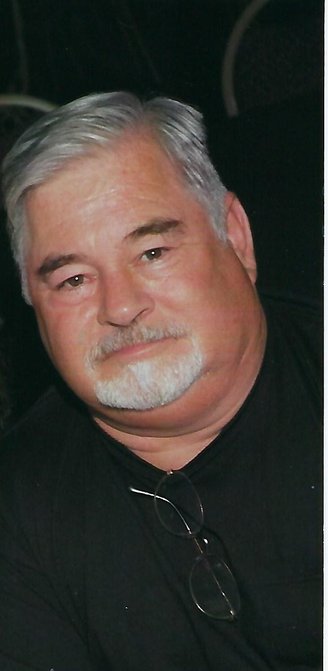
Clinton Dean Rebik was born on March 30, 1966, in Brawley, and passed away on November 4, 2021, in Eureka due to esophageal cancer. He grew up in Brawley and graduated in 1984 from Brawley Union High School. He moved to Arcata to attend Humboldt State University in the fall of 1984 and remained in the area for the remainder of his life.
After graduating from HSU in 1987 with a Bachelor’s Degree in Theatre Arts, he became the Artistic Director for the Ferndale Repertory Theatre for several years, where he directed and acted in many productions. At the same time, he became a part-time black-jack dealer at Cher-Ae Heights Casino, eventually moving over to Blue Lake Casino. In 1999 he and an enthusiastic and intrepid group of theatre artists formed the Redwood Curtain Theatre, for which he was named Artistic Director. Redwood Curtain Theatre staged over 90 productions in twenty years, many of its most memorable directed by Clint.
In 2006 he began working at Humboldt State University in the Office of the Registrar and was promoted to Registrar in 2012. Along the way, he completed his Masters’ Degree in Theatre Arts from HSU, also in 2012.
Along with all aspects of theater, he loved traveling, snowboarding, hiking, lazily rafting rivers, and laying in the warm sunshine. But the thing he loved most in the world was spending time with his sons.
He was preceded in death by his dad, Stephen Emil Rebik, his paternal grandparents Emil and Jean Elizabeth (Cox) Rebik, and maternal grandparents Marvin J. and Agnes Winifred (Hanlon) Young. He leaves his mom, Mary Ellen (Young) Rebik, sister Winifred Jean (Rebik) (Jude) Temple and their two daughters Katelyn Jean and Emma Danielle, his partner of 25 years Thomas Patrick Roscoe, and his two sons Matthew Dean Jioras and Alexander Harry Jioras, and their moms Christina Jioras and Peggy Metzger, plus numerous aunts, uncles, cousins and a multitude of friends. Clint made everyone in his life feel special.
A Celebration of Life will be held on December 4, 2021, at Blue Lake Casino’s Sapphire Palace, from 3-5 p.m.
###
The obituary above was submitted on behalf of Clint Rebik’s loved ones. The Lost Coast Outpost runs obituaries of Humboldt County residents at no charge. See guidelines here.
Clint
Hunter, 73, of McKinleyville, passed away on Nov. 13, 2021. Clint
was born in 1947 to Jean and Clint Hunter Sr., in De Queen, Arkansas.
Five
months after Clint graduated from Arcata High School in 1966, he was
drafted into the U.S. Army to serve in the Vietnam War, where he
served a tour as a member of the Seventh Squadron, First
Air
Calvary, as a helicopter crew
chief
and door
gunner.
In
1968, three weeks after returning home from Vietnam, Clint was
married to his high school sweetheart, Susan, in Arcata. Clint and
Susan soon began to start a family and built their new home in
Freshwater, where they raised their three children – Clint Jr.,
Dennis and Michelle. In 1983, the Hunter family purchased a trucking
company in Willits and would end up spending the next 20 years in the
Willits area, where they purchased a ranch on the north end of town.
Clint and Susan’s business pursuits later transitioned away from
trucking and into the self-storage business. This brought them back
north to Humboldt County, where they would settle in McKinleyville.
Clint
would describe his greatest accomplishment as becoming a father. His
whole life he was able to turn working hard into opportunities to do
the things he loved and to enjoy time with his family. Some of his
most enjoyable times were spent hunting, fishing, flying his plane,
horseback riding, camping, packing into the Marble Mountains, snow
skiing and watching his kids and grandkids wrestle and play soccer.
After
being diagnosed with ALS, Clint spent his final two years battling
with increased physical limitations, yet up until his final day, he
did everything he could to ensure his family would be OK
and prepared once he was gone.
Clint
is survived by his wife of 53 years, Susan; children Clint Jr.,
Dennis and Michelle; Sister, Wanda Wahlund; in-laws, Frank and
Dorothy Dutra; grandchildren Jeremy, Cede, Cayman, Kaylee, Branson
and Logan; and close friend Emiko Miranda. He was preceded by his
father, Clint Sr. and his mother, Jean Mills. Clint will be most
remembered for his wit, hard work and generosity.
In
lieu of flowers, please consider making a donation to:
ALS
Association Golden West Chapter P.O.
Box 565, Agoura Hills, CA 91376
A
Celebration of Life Service will be held at 1 PM on Sunday Nov. 28
at
The
Elks Lodge in Eureka – 445 Herrick Ave.
###
The obituary above was submitted on behalf of Clint Hunter’s loved ones. The Lost Coast Outpost runs obituaries of Humboldt County residents at no charge. See guidelines here.
The governing board of the Fortuna Union High School District last week held a unanimous vote of “no confidence” in the leadership of the office of Humboldt CountyAuditor-Controller Karen Paz Dominguez.
A Nov. 10 letter to county supervisors notified them about the vote, saying “While we recognize Auditor Controller Karen Paz Dominguez’s service, her tenure has been marked by her dereliction of duty in maintaining the quality and professionalism of her elected office.” The letter is signed by district Superintendent Glen Senestraro and all five board trustees.
The message continues:
The Auditor Controller has not closed her books for any months during the entire 2020-21 fiscal year, has not posted any 2020-21 interest (est. $80,000), cash has only been reconciled since March 2021, has missed the statutory deadline for reporting property taxes for the last two years, delayed in posting deposits, and delayed in posting state and federal revenues. These mishandlings have resulted in significant financial implications for our small district.
Meanwhile, the Humboldt County Civil Grand Jury has launched an investigation into the Auditor-Controller’s Office in response to a complaint submitted by Senestraro and the district board. The complaint, first reported by the North Coast Journal, addresses some of the same issues mentioned in the letter along with other matters of alleged fiscal mismanagement.
The Fortuna Union High School District is comprised of Fortuna High School, Academy of the Redwoods and East High School.
The district’s allegations add to a growing chorus of grievances regarding the fiscal management of Paz Dominguez and her office. Like the FUHSD board, county department heads and fiscal management staff say they’ve lost revenues and faced additional workloads due to the delayed closing of this past fiscal year and other overdue postings.
CliftonLarsonAllen, a professional accounting firm hired by the county to conduct last year’s single audit, disengaged from the process in September saying it didn’t have the information necessary to complete the task and had been unable to reach Paz Dominguez via phone, email or a dedicated portal for the Auditor-Controller’s Office.
On Friday, the county’s Workforce Development Board will pursue a vote of “no confidence” against Paz Dominguez.
We reached out to Paz Dominguez for a response to the allegations from Senestraro and the FUHSD board. In emailed responses sent Monday she said, “This is the first I’m hearing about this as I have not received any communications from the district or any of the signers of this letter nor have I been invited to any of their board meetings to provide any information.”
She said her office works directly with the Humboldt County Office of Education and notified that office on Nov. 1 that all submitted transactions from the 2020/21 fiscal year had been completed a month prior.
“This means that all months of the year were posted per their direction for all schools district funds, of which there are over 560,” Paz Dominguez said in her email.
The Outpost has been unable to reach Senestraro for comment. He told the Journal‘s Thadeus Greenson his board that he couldn’t say much due to the ongoing civil grand jury investigation. [Clarification: Greenson quoted Senestraro from the board meeting, not an interview.]
[UPDATE: Senestraro returned the Outpost’s phone messages but said he can’t comment.]
Paz Dominguez did acknowledge that interest has not yet been apportioned for the 2020/21 fiscal year, though she said progress has been made.
“We understand the frustration experienced by districts who have completed their year and are waiting for interest,” Paz Dominguez wrote. “We share in that frustration. However, the County Treasury encompasses hundreds of interest-bearing funds that must be apportioned together and we will continue posting and reconciling what we can as fast as we can.”
She also noted that her department remains very short-staffed.
Regarding the allegation that her office has missed the deadline for reporting property taxes the last two years, Paz Dominguez said her office filed those reports on time, and she blamed the school district for any subsequent delays.
“FUHSD disagreed with the amounts reported but took two years to provide the required certification to our office to justify any changes to the report,” she said via email. “Once they submitted the required certification, we were able to submit amended reports which were accepted by the State.”
She added that if anyone from FUHSD would like to discuss these “misunderstandings,” she’d be happy to do so.
The FUHSD board’s letter to supervisors says, “We have tried to work with her department. We have been met with more hurdles and roadblocks than assistance and answers.”
Paz Dominguez, meanwhile, said, “It is unclear to me which office they are referencing having tried to work with.”