

OBITUARY: Janice (Jan) Kay Syvertson, 1934-2021
LoCO Staff / Monday, Nov. 22, 2021 @ 6:56 a.m. / Obits

Janice (Jan) Kay Syvertson was born on September 8, 1934, in Albert Lee, Minnesota. She passed peacefully on November 1, 2021, surrounded by her loved ones in Fortuna, California. Jan married the love of her life Robert (Bob) Lee Syvertson in 1953. They raised four “practically perfect” children: Robert (Rob) Lee Jr., Peggy, Roger, and Patti Syvertson.
Jan cherished her time working at Redwood Memorial Hospital, and treasured the connections she made with the people there. She was grateful for these relationships and maintained them throughout her lifetime. Following her retirement, she worked for the Fortuna Senior Center; serving the senior community brought her joy and a sense of purpose. Jan was passionate about creating a space where seniors could thrive, and spent countless hours volunteering and supporting the construction of the “new” Fortuna Senior Center.
She was a faithful loving wife, Mom, and grandmother who thoroughly enjoyed spending time with her children and grandchildren. She was known for her kind spirit and sometimes wicked sense of humor. She looked forward to her weekly outings to Redwood Empire Golf and Country Club where she enjoyed having a cocktail (or two) with her friends and “Bobby”. She had an amazing capacity to live life in the moment, forgive with grace, laugh, and never hold on to the past.
Jan was proceeded in death by her parents, Don and Helia Burshem, her husband, Bobby Syvertson, her sister, Lavonne Lloyd, and her two sons, Rob and Roger Syvertson. She is survived by two siblings, Ron and Beverly Burshem, her daughters, Peggy and Patti Syvertson, and her grandchildren Sammy Meranda, Nick, Kelley (husband, Daiel), Josh, Kayla (wife, Devon), and Garrett Syvertson.
The family would like to thank the loving and compassionate staff at Redwood Memorial Hospital with special appreciation for Dr. Dittmer, Dr. Brinkhaus (Sr and Jr), and Israel (Izzy, ICU nurse), who provided excellent care. We are particularly grateful to Dr. Don Baird for his long-term commitment to Mom’s health. If you wish to make a memorial donation in her honor, please donate to the Fortuna Senior Center. A celebration of life will be held at a later date.
God speed, Mom.
###
The obituary above was submitted on behalf of Jan Syvertson’s loved ones. The Lost Coast Outpost runs obituaries of Humboldt County residents at no charge. See guidelines here.
BOOKED
Yesterday: 12 felonies, 16 misdemeanors, 0 infractions
JUDGED
Humboldt County Superior Court Calendar: Today
CHP REPORTS
4408-4799 Sr96 (HM office): Trfc Collision-1141 Enrt
Sr299 / Industrial Pkwy (RD office): Traffic Hazard
0 Sr299 (RD office): Trfc Collision-No Inj
ELSEWHERE
100% Humboldt, with Scott Hammond: #129. You Don’t Have to Be Wealthy to Give Back | Sara Dronkers
RHBB: Trinity County Marks 25th Anniversary of September 11 with First Responder Commemoration Ceremony
RHBB: CDPH Issues Immunization Recommendations for 2026-27 Respiratory Virus Season
RHBB: Redway Transfer Station to Close an Extra Day for Construction
(AUDIO) HUMBOLDT HOLDING UP: Who Was Rick Bartow? A New Film Project Attempts to Chronicle the Work and Life of the Late Wiyot Artist
LoCO Staff / Sunday, Nov. 21, 2021 @ 8:21 a.m. / Humboldt Holding Up

“Coyote Song” by Rick Bartow | Painting images courtesy of Willamette University Archives and Special Collections
(AUDIO) Michelle and Zuzka are Holding Up

Hernandez (left) and Sabata
Since 2019 members of the Wiyot Tribe and Dell’Arte have been collaborating on the Bartow Project — a project documenting and celebrating the life and work of late Wiyot artist Rick Bartow. After the pandemic stalled the project a bit and forced the creators to reimagine the process, the project is finally being realized and will primarily consist of four short films about Bartow to be release in Spring of 2022.

Another painting of Bartow’s
On this week’s episode of Humboldt Holding Up — the Outpost’s mildly creative podcast — Artistic Directors of the Bartow Project Michelle Hernandez (Wiyot) and Zuzka Sabata discuss the relationship between Dell’Arte and the tribe, the project’s and the story of Bartow and his incredible paintings, drawing’s and sculptures, and other topics, including:
- The Sunrise Gathering taking place on the Baduwa’t (Mad) River on Thanksgiving morning
- The “awakening” of Wiyot traditions and how Wiyot culture is become more widely accepted by the community
- Other collaborations between the tribe and Dell’Arte, including the Baduwa’t Festival
- Herndez’s personal relationship with Bartow “uncle Rick” and some stories of his visits in Humboldt
- More!
Click on the audio player above to hear Hernadez and Suska chat with the Outpost‘s Andrew Goff and Stephanie McGeary and learn more about the project and Bartow’s incredible life and work. And maybe you’d like to scroll through past episodes below.

Bartow sculpture “Snarf”, held in the private collection of Ronda Kossow, Julie Swan’s daughter
PREVIOUS HUMBOLDT HOLDING UP GUESTS:
- #75 Foggy Bottoms Boys Thomas and Cody Nicholson Stratton
- #74 North Coast News’ Nazy Javid
- #73 Pumpkin Carver Mike Craghead
- #72 Eureka Police Department Sergeant Leonard LaFrance
- #71 Eureka Artist Duane Flatmo
- #70 Arcata City Councilmember Sarah Schaefer
- #69 Humboldt Hot Air Director Neroli Devaney
- #68 St. Joes’ James Ladika and Austin Allison
- #67 Eureka Artist Richard Evans
- #66 NCRT’s Calder Johnson
- #65 TV Newsman Dave Silverbrand
- #63 Housing Policy Specialist Brian Heaton
- #62 Muralists Blake Reagan and Lucas Thornton
- #61 Arcata City Councilmember Emily Goldstein
- #60 Kayak Guide Eric Stockwell
- #59 Eureka City Councilmember Natalie Arroyo
- #58 Wiyot Cultural Center Manager Marnie Atkins
- #57 Humboldt County Growers’ Alliance’s Natalynne DeLapp
- #56 RREDC Executive Director Gregg Foster
- #55 Dell’Arte’s Michael Fields
- #54 Llama Wrangler Keagan Trischum
- #53 Crabs President David Sharp
- #52 Ferndale Organic Dairy Farmers Kristina Radelfinger and Dorice Miranda
- #51 Former Arcata Mayor Alex Stillman
- #50 Cooperation Humboldt’s David Cobb
- #49 Ink People Center for the Arts’ Libby Maynard
- #48 Humboldt Bay Social Co-Owner Amy Cirincione O’Connor
- #47 Musician Lyndsey Battle
- #46 Mad River Brewing CEO Linda Cooley
- #45 LoCO Editor Hank Sims
- #44 Humboldt Republic’s Jason Brandi
- #43 Table Bluff Farmer Hannah Eisloeffel
- #42 Logger Bar Owner Kate Martin
- #41 Teacher/Rapper Zach “Zigzilla” Lehner
- #40 Madaket Captain “Zippo” Libby Tonning
- #39 Event Planner Alegria Sita
- #38 Food For People’s Anne Holcomb
- #37 AHHA President Nezzie Wade
- #36 Performance Artist Noël August/Tucker Noir
- #35 Eureka Mayor Susan Seaman
- #34 Eagle House Owner Jennifer Metz
- #33 Absynth Quartet Drummer Mike “Tofu” Schwartz
- #32 HACHR Executive Director Lasara Firefox Allen
- #31 Alchemy Distiller Owner Amy Bohner
- #30 Eureka City Councilmember Kati Moulton
- #29 Eureka City Councilmember Scott Bauer
- #28 Ungraceful Ager Barry Evans
- #27 Arcata City Councilmember Sofia Pereira
- #26 HumBrews Music Booker Laurel Weston
- #25 Eureka City Councilmember Kim Bergel
- #24 Film Commission’s Cassandra Hesseltine and Nate Adams
- #23 Marble Maker Topher Reynolds
- #22 Arcata Playhouse Director Jacqueline Dandeneau
- #21 Humboldt Political Junkie Eric Kirk
- #20 Rio Dell Mayor Debra Garnes
- #19 Second District Supervisor Estelle Fennell
- #18 Arcata Food Aficionado Jada Calypso Brotman
- #17 Body Piercer Jackie Silva
- #16 Dick Taylor Chocolate’s Adam Dick
- #15 FUHS Teachers Mark Thom and Inma Thompson
- #14 Eureka City Manager Miles Slattery
- #13 Savage Henry Co-Founder Chris Durant
- #12 Eureka Street Art Festival Organizer Jenna Catsos
- #11 SCRAP Humboldt Founder Tibora Bea
- #10 Gym Owner Tyler Parr
- #9 Six Rivers Brewery Co-Owner Meredith Maier
- #8 Multicultural Skincare Therapist Levia Love
- #7 Annie’s Cambodian Server and Social Worker Joshua Coppock
- #6 Eureka City Councilmember Austin Allison
- #5 HSU Professor Deidre Pike
- #4 Pastor Bethany Cseh
- #3 Singer/Songwriter Chris Parreira
- #2 Eureka City Councilmember Leslie Castellano
- #1 Arcata City Councilmember Paul Pitino
GROWING OLD UNGRACEFULLY: Toilets I Have Known
Barry Evans / Sunday, Nov. 21, 2021 @ 7 a.m. / Growing Old Ungracefully
They say you can judge a person by how they treat their pets (amen). Or how about this, “You can judge a place by the ratio of residents to public bathrooms”? According to the venerable Harper’s Index (which seems to be pretty scrupulous with its sources): In Singapore, that ratio is 197 to 1. In New York City, it’s 7,258 to 1. Yeah, we could sure use a few more here in Humboldt, given the size of our homeless population.
Which got me thinking about loos I’ve known around the world.
The coldest privy I ever sat in was way north of the Arctic Circle in Norway. It was open at the back, meaning that a wind direct from the North Pole, near as I could tell, blew straight up my ass.
Brits have a more casual way of telling you what not to put in the toilet. Here’s a sign I recently saw in a British Rail train:

Photo: Barry Evans.
And this, in a National Trust cafe loo:

Photo: Barry Evans.
We’re talking about sit-down toilets, of course, the standard way of taking care of one’s business in the West. Things are different in many other parts of the world, where they recognize that not only was squatting once the universal pose, but that it’s a much healthier way to eliminate waste. With the increasing prevalence of hemorrhoids, constipation, irritable bowel syndrome and similar intestinal problems, you’d think doctors would be recommending a reversion to the hole-in-the-floor style toilets found from Turkey and points east. And in France.

Squat toilet at a service station in France. “Mintguy,” via Wikimedia. GNU license.
If you aren’t into re-plumbing your bathroom, check out the Squatty Potty®.
Then there’s the acceptance in much of Europe, especially in Paris, of simplifying things by providing the bare minimum for guys to pee on the run, as it were. Here’s a urinal in Lisbon.

Photo: Barry Evans.
By the way, bidets are pretty much de rigueur in much of Europe, where the idea of dragging rough paper across sensitive skin is seen as barbaric. Saves trees, too!
Do you have a toilet story? Don’t be shy…
LETTER FROM ISTANBUL: Monet By The Sea, and Impressions of Galataport
LoCO Staff / Sunday, Nov. 21, 2021 @ 7 a.m. / Letter From Istanbul

“Why don’t we go over to the Galataport?” my wife Özge suggested recently. “It’s open now, I think. We can take Leo and maybe we can see the Monet exhibition.”
I was sold, especially on Monet, but also curious to see how the Galataport was shaping up.
This immense 1.7 billion-dollar project along the shores of Karaköy on the city’s European side has been in the works for several years. When it’s finished, it will be a shopping mall-cultural-commercial-port by the sea. One of those complexes with a lot of hyphens. The vision? Huge cruise ships and luxury liners, filled with tourists, will pull up at the dock, and all these tourists will disembark, eager to spend their money in all the shops and cafes sitting right there just steps away from the pier.
###

Walking from the pier in Karaköy, we navigated a good half mile along the waterfront, taking in the newly built structures but also in search of the Monets. We passed areas still under construction, as well as the old Istanbul Modern, which has been closed during the construction but is expected to reopen soon.
Upon first impression, it was a lot to take in. Having lived in Istanbul the past decade, I have grown used to these massive projects. There was the Marmaray, the metro which runs beneath the Bosphorus, the third span bridge up near the Black Sea, the new international airport, and the canal project, which is expected to break ground soon. And those are just some of the biggest projects.
Throughout the vast city, you stumble across new shopping centers, metro lines and apartment blocks. At times, the city feels like the epicenter of some never-ending construction site. Even on our street in Üsküdar, the two apartments on either side of ours have been knocked down and completely rebuilt over the past two years.
Back to the Galataport. The expensive, ambitious vision is, as I said, not fully realized yet. When it is done, it will boast the world’s first underground terminal (a hatch system), along with office space, a 2,400 car parking lot and will bring in an estimated 25 million visitors a year. As the official website boasts, “(T)his historical city harbor (will be) a world-class cruise liner port and touristic destination, while opening the promenade to public use for the first time in approximately two centuries.”
At this point, the complex is complete enough that you can really get pretty clear idea. The architecture is all low rise, with sharp post-modern edges. Aesthetically, it stands in direct contrast to the Galata Tower, which for centuries has been the most visible symbol of the neighborhood, as well as to the classical architecture of Dolmabahçe Palace, which is located further down the waterline. The neighborhood of Karaköy itself was modeled after Venice, that great shipping port that served as a rival for the Ottomans in the battle for supremacy in the Mediterranean.
These days, the scale of the Galataport makes it clear that the Turkish government wants to again make Istanbul’s port and the Bosphorus an important global sea port (which is puzzling, isn’t it already that? One sees container ships bound to and from China and other points, every day, along with every other kind of vessel). Well, with the Turkish lira down 10 to 1 against the dollar, and inflation on the rise, let’s hope that these ambitions bear fruit.
###

Walking through the complex, my wife and I (with Leo in his stroller) went in search of the Monet exhibit. Along the way, we passed a lot of finished sections, with signposts directing visitors to the various blocs. We passed a D and R bookshop, as well as jewelry and clothing shops. At one point, outside a sweet shop, a man wearing a red Ottoman fez called us and offered a bite of lokum, or Turkish delight, which he cut from a long strip. We waved him off and continued on.
“It would be nice if they offered a place for people to have drinks,” my wife Özge said.
And so they have. We walked out to the impressive promenade, where you could see the ships passing in the blue Bosphorus. Most places are still rather empty, but people were sitting at outdoor tables, drinking pints of beer and glasses of wine and squinting at the sea under the harsh noon sunlight.
“Wonder how much a pint costs,” I said aloud. It is a pricey area, the Galataport notwithstanding. Doubtless, the prices in these fine cafes will be set in tune with the wallets of the tourists, with their dollars and euros and sterling, not we poor Istanbullus and our weak liras. To put it in perspective, a 40-lira pint of beer is for us very expensive, but for a visiting American it’s only 4 bucks, very reasonable.
At any rate, we weren’t there to sit and have drinks. We walked on in search of the Monet exhibit. We found it at last in the O Block. The museum is impressive, a bold, modern design painted bright green. Although we sucked in our breaths a bit when we found out the tickets were 50 lira each, we saw that the queue wasn’t too long so we decided, why not?
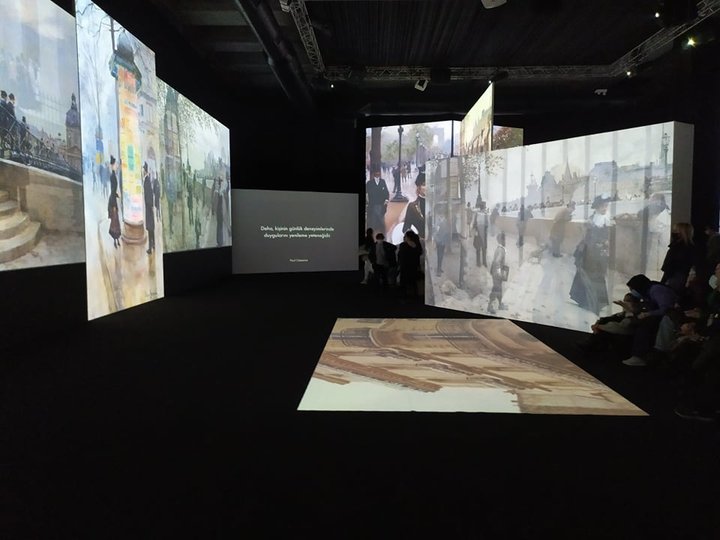
With the tickets in hand, we entered the darkened spaces of the interior. A lift took us up to the second floor, where more alluring darkness waited. At last, we entered a space where we could discern the shapes of people sitting or standing beneath rows of big screens. Music drifted in from speakers, and presently images began to appear on the screens, familiar Impressionist images but also photography from that era, the late-19th Century Industrial images of railroads and factories that stood as a background against which the color and light of the Impressionists can be better understood.
We saw the famous lilies, the sunset and sunrise portraits of gritty urban life, the movement of water, the floating imagery for which Monet is justly famous. Of course, it was a digital exhibit – to my initial disappointment, you’d think if they had all this money for an ambitious port they could at least fork over the cash to get a few real Monets on loan from the Monet Museum in Paris – but I quickly let these snobby thoughts go and let my senses fall into the light and shadow world of the Impressionists.
For the record, the exhibit was called, “Monet and Friends,” so there were other works on display from contemporaries such as as Cezanne, Pissarro, Renoir, et al. Also, the music playing as the images unfolded like colorful apparitions included the works of Debussy and Tchaikovsky. Indeed, one of my favorite moments from that afternoon was of our son Leo standing in front of this image of ballerinas dancing and fluttering on tip toes in a circle to the famous melody from “Swan Lake.”
Alas we were running out of time. Leo enjoyed the novelty of this dark theater-like atmosphere, and the dancing images, but he was difficult to keep in check. We wanted to get him home in time for his afternoon nap. So after a rather brief, flurried visit, we had to bid adieu to Monet and friends, and make our way out of the darkness back out to the bright streets. We walked out to the main road and stopped at a park, where we bought some seeds from a covered lady and let Leo feed the pigeons. They came in a large greedy flock, gobbling up the seeds as Leo dropped them from a pudgy hand, before they all flew upwards in a big burst, and disappeared through the autumn leaves overhead.
###
We kept walking until we reached Kabataş, where we got the ferry back to our neighborhood Üsküdar on the Asian side. The ferry was not crowded, and we were tired, tired from all the walking around and from absorbing all the sensations and new things we had seen.
Still, it felt rewarding to have seen the Monets, albeit digital, to have passed a Friday afternoon in the company of the Impressionists. By the way, the exhibit will be around until the middle of December, if you happen to be in the city and curious enough to check it out.
And it felt good to have gotten some first-hand impressions of Galataport as well. Hopefully, as the port comes fully online, there will be more and even better exhibits. Who knows? Maybe one day they’ll even have real Monets. Wonder how much we’ll have to pay for that? Oh well, money isn’t everything. I recalled a quote I’d seen on a wall at the exhibit. Not sure if it was from Monet or one of his friends. “There are two paths in painting: the broad and easy one, and the narrow and difficult one.” For some reason, that quote just stuck in my head. Maybe I took it in terms of art, or maybe in terms of living in Istanbul, or maybe as a parent or teacher. In art and life, nothing worthwhile ever comes easy, or cheap.
###
James Tressler, a former Lost Coast resident, is a writer and teacher living in Istanbul.
THE ECONEWS REPORT: Celebrating the Hoopa Valley Tribe’s Victory Over the Westlands Water District
The EcoNews Report / Saturday, Nov. 20, 2021 @ 10 a.m. / Environment

Trinity Lake — the Trinity River, backed up behind Trinity Dam. Photo: U.S. Bureau of Reclamation.
###
On this week’s EcoNews Report, Chairman Joe Davis and Mike Orcutt, Fisheries Department Director of the Hoopa Valley Tribe, join Gang Green to talk about the Hoopa Tribe’s work to restore the Trinity River.
Critical to this is wrestling water diversions that go to the Westlands Water District back to the Trinity River. Tune in to learn more about the Hoopa Tribe’s work and what is needed to have a sustainable fishery again in the Trinity River.
AUDIO:
“The EcoNews Report,” Nov. 20, 2021.
REQUIRED READING:
“Fresno County Judge Nixes Westlands Water District’s Federal Contract for Trinity River Water; Hoopa Valley Tribe Celebrates,” Hoopa Valley Tribe press release, Oct. 28.
‘A Safety Net Beginning to Fail’: Child Care in Humboldt County Can’t Recover From the Pandemic
Jacquelyn Opalach / Saturday, Nov. 20, 2021 @ 7:15 a.m. / COVID-19 and Humboldt
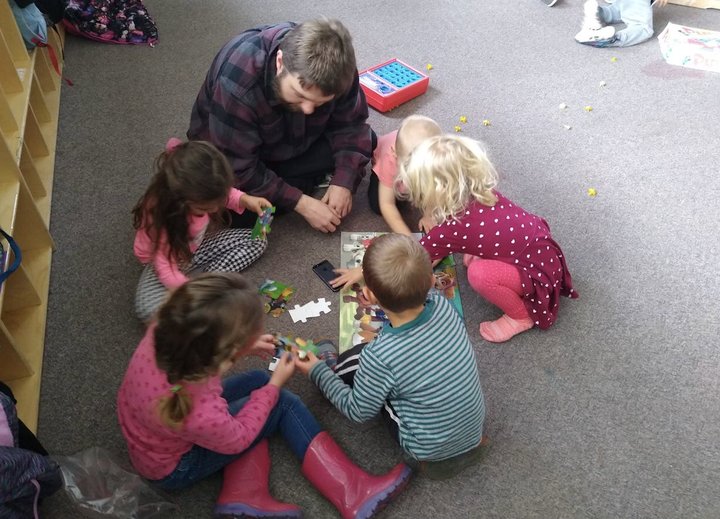
Children and a teacher work on a puzzle together at Educare in Arcata before the pandemic. | Photo: Ranae Liles
###
I don’t remember much about preschool, beyond that it was good. My parents took my sisters and I to Educare, a private non-profit preschool in Arcata. My favorite teacher was lively and caring, had vibrant hair and lots of patience. We gathered each day in a circle on the rug, criss-cross applesauce knee-to-knee, and afterward, during snack time, all the kids sat together at a long table as if we were sharing a great feast. At graduation, I marched across a tiny wooden bridge and received a thornless rose and scrolled certificate, my little Educare diploma.
In 2004, the year I went to Educare, Humboldt had 277 child care centers — both in-home daycare businesses and larger public and private centers — in operation. Just prior to the pandemic, Humboldt’s total child care establishments had dropped to 215. By October 2021, the county had 175 child care centers open and operating, Kerry Venegas, executive director at Changing Tides Family Services, told the Outpost.
Like most industries, child care was immediately and significantly impacted by the pandemic. Support systems jumped into action right away. Changing Tides Family Services, which provides income-eligible families with child care vouchers, distributed personal protective equipment, cleaning supplies and diapers to child care facilities, and delivered food directly to families. First Five Humboldt partnered with Arcata Play Center to bring activity kits, outdoor walking groups and weekly park playdates to families, and worked with the Humboldt Area Foundation to distribute stipends to child care centers that stayed open. A council and task force were assembled to talk about solutions, and their efforts are ongoing.
Even so, 20 months in, as many sectors chug along to a normal-enough tune, child care is stuck in a weird zone, unable to bounce back the way so many other industries have. Darius Kalvaitis, early childhood education chair at College of the Redwoods, described child care as an overlooked safety net that’s beginning to fail.
Problems have been brewing in the child care industry for years in Humboldt, but also statewide and nationally. Child care workers aren’t paid well — about eight to ten dollars an hour, when you factor in overhead costs, Venegas said — and so the industry sees high rates of burnout and turnover. Nevertheless, the money families shell out of their pockets for child care is significant — even when eligible for a state-subsidized voucher — often leaving one parent in dual-income families working just to afford child care.
Of course, COVID intensified existing problems in child care and drew up some new ones – like how on earth to honor masking, sanitation and distancing recommendations while working with infants and toddlers. With those challenges and more, COVID forced many of Humboldt’s child care centers to close, and some have yet to reopen.
At child care’s lowest pandemic low, only 120 centers were open. Over the months, 55 have opened back up, but many are still operating at limited capacity, meaning the number of slots open today are drastically reduced compared to pre-COVID times.
Private in-home child care businesses each account for five to 14 kids — depending on permitting — and larger child care centers, public or private, can take 30 to sometimes 80 kids. Those are the types of child care businesses included in the statistics above, but child care also includes after-school programs, which often are often located on school sites, and classic old-time nannying, which doesn’t require any credentialing.
The still-closed centers make for a significant difference considering how many kids that represents, especially when child care was hard to find in Humboldt County to begin with, Venegas said. About two to four percent of Humboldt’s pre-pandemic child care centers are gone for good.
“When you multiply that out, that’s a big chunk, because every one of those providers is between five kids — and that means at least five families they serve — to upwards of 20, 30 kids. So it takes a big chunk out of available child care.”
My beloved Educare is one of the casualties. When COVID arrived, Educare was renting space from another child care center, where the two shared a building, outdoor play area and children’s bathroom. In need of more space due to COVID, the other facility stopped renting to Educare.
“We shut down. At the time, we thought that that would be temporary,” said Ranae Liles, former Educare director. “We were faced with moving, and in the middle of a pandemic, that wasn’t that feasible.” Several potential rental spaces popped up but none were appropriate for licenseable child care. Liles, who felt bad about accepting even a partial salary, resigned as director after several months but stayed on as a board member to continue searching for a new site.
Deep in the pandemic weeds, the board never found a viable option, so it recently voted to dissolve the nonprofit and say goodbye to Educare permanently, not long after its 40-year anniversary. Prior to the pandemic, Educare had a license capacity of 48 and had a daily attendance of 20 to 28 kids.
There are a lot of reasons child care centers had to close. Many can’t staff their programs. Some in-home daycare programs located in rental properties are at risk of losing their business when a landlord wants to sell. Others never felt safe returning to child care, or chose to retire early.
###
A fair few child care businesses are gone for good. On top of those losses, the centers that did stay open during the pandemic had to decrease their enrollment, or ratios, for safety purposes, and many have held on to those decreased numbers.
“In child care, you have what’s called ratios — how many kids per square feet, how many adults with how many kids — those ratios got shredded. So now the people running the programs can take less kids, but they still have to pay their staff the same amount — they still got to pay their bills, and there’s probably additional costs related to safety, cleaning, maintenance,” said Darius Kalvaitis, early childhood education department chair at College of the Redwoods. “So that was a big problem.”
Little Learners Center, one of Humboldt’s largest private child care businesses, kept only one of their four sites open — for the children of healthcare workers — at the beginning of the pandemic. Today, all four sites are open, but the organization is serving just 130 families compared to 300 children pre-pandemic, said Shannon Hall, founder and director of Little Learners.
“We are still only running at a 60 percent capacity and I don’t plan to return to full classrooms, for many reasons, COVID safety first. Less children means less exposure,” Hall said. “We have a long waitlist but we are enjoying having smaller classroom sizes for more one on one with the children and I can’t keep up with the workload of adding more families with the extra workload COVID has brought.”
Little Learners increased their rates and staff wages because of COVID, and today have 35 staff as opposed to 45 pre-pandemic, when the business had a higher teacher-child ratio.
“Financially, it has been like rebuilding a business.” At the beginning of the pandemic, online curriculum helped keep Little Learners afloat, as well as the support of local partners, Hall said, adding that inflation has been an additional challenge recently.
Positive cases and classroom shutdowns have been a challenge too, but after nearly two years, Little Learners has a good contact tracing and testing system in place, Hall said, with help from Humboldt Open Door Clinic. “It has been hard to shut down when a case happens because we know the extra stress it puts on families, but most of our families are very understanding.”
Complications like whether and how to mask and distance infants, toddlers and young children — who are now the only segment of the population that isn’t vaccine-eligible — and how to protect child care workers from infection continue to hinder child care centers.
“There is no way to care for a child without being in close contact with them at some point, and the families and whoever their families are in contact with, too. So I think child care providers, right on the frontlines, are stepping up all the time to do the job,” Venegas said.
“It’s kind of like a mixing place for germs to begin with. Teachers have always had that problem. I used to get sick a lot when I was a classroom teacher, I mean, all the time,” Kalvaitis said. “There’s no distancing. There’s no masking, because a lot of these are infants, they can’t do it, the kids can’t wear their masks anyway. And so there are safety concerns for sure.”
Anxieties eased with adult vaccination, but because that protection is still not available to kids younger than 5, masking, distancing and observing safety protocols to the greatest extent possible continues to be extremely important, Venegas said. “And that’s a lot. It’s a burden. I also think there’s a realistic part of it — it’s more about the spacing and the sanitizing,” Venegas said, noting that masking a toddler is a really big challenge, though kids are adaptable.
“Going through masks and keeping things sanitized is just a double burden — it’s a very important one — and child care providers themselves want to be safe, and they want to keep the families that they care for safe, and the parents really appreciate that.”
###
Far fewer children have access to child care today than before March 2020. What’s happening to all the other little ones? “[Parents] can’t find care,” Venegas said. “There just aren’t enough open spaces with providers.”
And so parents aren’t working. (It’s happening everywhere.)
“For a lot of parents, what we’re hearing is that — especially parents who maybe had a multi-generational family unit in the same home or next door to each other — were opting out of working, because they couldn’t find care,” Venegas said, adding that in some cases, even when parents could find care, it wasn’t always reliable because of exposure-related closures.
“So there are a lot of sacrifices that parents had to make, and one of them is if they could, [parents] made a choice about one of them not going back to work,” Venegas said, adding that even when parents could work remotely, many struggled to give both their kids and job adequate attention.
And some parents stopped working because service industry jobs don’t offer enough sick leave.
“You usually don’t have a lot of pay built up, so you can’t afford to have an unstable child care situation,” Venegas said, “because if you can’t show up to work, you won’t keep your job for very long.”
###
There may be a lack of overall community awareness when it comes to child care and the trickle-down impacts it has, but there is no shortage of people interested in making it right.
A group of folks involved with local child care systems (including actual child care centers, Changing Tides Family Services, Northcoast Children’s Services, the Humboldt County Office of Education and others) gather twice monthly on Zoom for a Humboldt Emergency Child Care Task Force meeting. The group focuses specifically on looking at ways to aid and protect child care workers; this week, they finalized a survey for local child care providers that will identify what pandemic-related challenges are persisting the most and why. The results will shape recommendations for American Rescue Plan Act funding, which the task force will forward to the Humboldt County Board of Supervisors (which has expressed support for struggling local child care systems).
The task force is one of a few Humboldt groups working to develop solutions (perhaps “adaptations” is more accurate) for the very, very strained local child care scene. They’ll keep meeting indefinitely, as long as the problems keep up.
Kalvaitis is a member of Humboldt’s local Child Care Planning Council.
“The solutions are few and hard between,” Kalvaitis said. “There’s a couple of reasons that they’re hard solutions.”
Like the very small workforce: For one, there are few incentives for still-shuttered child care centers to reopen and increase capacity, and on top of that, the local pool of interested and qualified child care workers is small. Kalvaitis is working to address that from his position at College of the Redwoods by keeping the child care teacher pipeline alive and well. At CR, folks can earn a certificate of achievement for early childhood education in one semester, which is all it takes to qualify for child care work and even start a child care business.
“What’s the solution? I think all of us know what the solution is on the local Child Care Planning Council. We need to put more resources here,” Kalvaitis said. “If we just increase the wages and salaries of these workers, that would make it more attractive, more people would want to do it. They’d do it better, they’d do it longer, they wouldn’t quit.”
Eureka Mayor Susan Seaman (who calls child care her favorite topic) serves on the Humboldt Emergency Child Care Task Force and has been dedicated to improving conditions for local children and families since before the pandemic. She launched the Eureka Children and Family Initiative in 2019, with a goal to assess and address child care roadblocks. A central factor of the initiative is local economic health, which Seaman asserts is fundamentally linked to child care access and quality.
Seaman told the Outpost she’s optimistic.
“The state and feds are talking about childcare as a critical piece of our workforce infrastructure and they’re finally trying provide resources to support that. It’s a very tough time right now to be a provider or to need a provider, but at least this is finally being talked about so we can begin to address it and realize childcare is not just a parent problem,” Seaman said.
“The crisis has been here for a while. It definitely got exacerbated through COVID,” Kalvaitis said. “Here’s an opportunity for the community to recognize that and recognize the ultimate economic and social importance of good care for young children.”
###
Those who are willing and able to work in child care right now are spread thin and stressed out.
“If I could emphasize one thing it would be that it takes a lot of courage and a lot of dedication and a lot of compassion to take the kinds of risks that child care providers have taken the entire pandemic,” Venegas said.
Even so — by no fault of anyone — some are worried about the quality and endurance of COVID-era child care.
“All the little children now that are in this child care loop, they’ve seen nothing but the pandemic, they’ve grown up in the pandemic, with this kind of crisis around them. So that’s all they know,” Kalvaitis said.
Liles,
who has worked in child care for more than 30 years, said the problem
is new and significant.
A whole batch of preschool kids who have never had a typical preschool experience are now entering programs that are struggling to remain developmentally appropriate, Liles said.
“It is almost as if the programs were child-centered before, but now they’re COVID-centered, and the child comes second.”
All the things anyone older than 5 might remember about preschool still exist, but they’re different. During meal times, rather than sitting together and sharing food family-style, kids are sitting apart and are served by adults. During circle time, teachers are struggling to keep kids far apart from one another.
“I think a lot of families bring children into group care because they want them to play with their peers, they want them to establish those relationships. And I’m not saying that isn’t happening, but it’s a little bit more challenging for our young kids,” Liles said.
Kalvaitis anticipates there will be long-term impacts.
“It’s alarming for young children because they’ll have a different developmental trajectory,” he said. The concentration of strictly online child care programs has certainly decreased, and many young kids are back with — or at least near — their peers. But some kids aren’t spending their days with other kids, be it because there are no slots for them or because their parents have chosen to keep them safely at home.
“Young children, they’re supposed to be socializing with people. That’s how they learn, that’s how their brains develop. That’s been reduced. They’re not hanging out with their grandparents like they maybe want to, they’re not hanging out with their cousins like they want to, all the playgroups that there were, were canceled,” Kalvaitis said.
“I don’t think it’s going to have positive outcomes. The data is going to be forthcoming many years from now, but there’s going to be a little blip in the data that shows that something weird happened here.”
###
CORRECTION: Educare is not Humboldt’s only privately operated non-profit preschool, as originally stated in this article. Mad River Montessori in Arcata has run a private nonprofit preschool for more than 40 years. In fact, Mad River Montessori preschool has actually increased capacity to serve more families during the pandemic. The Outpost regrets the error.
County Board of Supervisors to Consider Vote of ‘No Confidence’ in Auditor-Controller Karen Paz Dominguez
Ryan Burns / Friday, Nov. 19, 2021 @ 5:13 p.m. / Local Government

Humboldt County Auditor-Controller Karen Paz Dominguez. | File photo.
###
At a special meeting on Monday, the Humboldt County Board of Supervisors will consider taking a vote of “no confidence” in Auditor-Controller Karen Paz Dominguez, who has often been at the center of controversy since her election in 2018, with the pressure increasing markedly over the past couple of weeks. (See links to previous coverage at the bottom of this post.)
Should the board choose to pass the vote of “no confidence,” it will not have any immediate organizational impact on Paz Dominguez. As an independently elected official, she can only be removed from office via a recall election or a regular election that she fails to win.
An agenda published around 4:30 p.m. Friday includes a staff report with a looong list of Paz Dominguez’s alleged failures:
Karen Paz Dominguez’s tenure as Auditor-Controller has been marred with deficiencies in the following ways:
- Interest apportionment has not taken place for the entirety of Fiscal Year (FY) 2020-21 or 2021- 22;
- Cash has not been reconciled since FY 2018-19 (currently Macias, Gini & O’Connell [MGO] is bringing this work up to date);
- As reported by Fortuna Union High School, statutory deadlines for reporting property taxes are not being met;
- On Nov. 10, 2021, the Board of Supervisors was notified that the Fortuna Union High School District passed a vote of non-confidence in the county Auditor-Controller, Karen Paz Dominguez
- FY 2019-20 single audit is two months past due, following a six-month extension. This has significant impacts on Workforce Innovation and Opportunity Act (WIOA) funding, the Department of Child Support Services, California Development Block Grant (CDBG) funds, Roads funding, First 5 and has made the county ineligible for United States Department of Agriculture (USDA) grants and potentially other competitive state and federal programs;
- The Workforce Development Board passed a Vote of No Confidence in the county Auditor-Controller, Karen Paz Dominguez at their Nov. 19, 2021 Board meeting.
- First 5’s legal counsel has contacted the county regarding the county’s failure to comply with the Memorandum of Understanding between the county and First 5, specific to fiscal services through the county Auditor-Controller
- The FY 2020-21 cost plan was due Dec. 2019; it was not approved by the State Controller until June 2021 and still remains unposted;
- The FY 2021-22 cost plan was due Dec. 2020 and is still not completed;
- Due to delays, the FY 2021-22 budget was developed using FY 2019-20 costs as an estimate, it is likely there will be large deviations and thereby creating significant budgetary impacts
- The Auditor-Controller failed to respond to correspondence from the IRS regarding payroll tax discrepancies, causing $173,022 in penalties, assessments, and liens;
- The Financial Transactions Report is due to the State Controller’s Office by the end of January, following the close of the fiscal year. The Financial Transactions report has not been submitted for FY 2019-20 and the county can be penalized up to $5,000 for the failure to meet this statutory deadline;
- Lobbyist reports have not been submitted timely, $14,000 in penalties have been assessed;
- The Chart of Accounts has not been finalized yet and object codes continue to be closed;
- Departments are struggling to obtain from the Auditor-Controller tools such as the setup of funds, budget units, ten-digit org keys and job ledger codes to effectively manage their budgets
- Delays in posting journals, supplemental budgets and appropriation transfers, often times more than eight months after submittal, are limiting the ability of departments to effectively manage budgets and expenditures;
- Failure to post these transactions timely forces staff to conduct extensive manual tracking
- Failure to post transactions resulted in delinquent CARES Act reporting and other mandated financial reporting
- Failure to pay vendors timely, resulting in late fees, inflated cost proposals, lost discounts and the elimination of credits accounts; · Failure to pay employee expense claims timely;
- Failure to pay child support payments timely;
- Failure to promptly settle employees;
- Failure to timely post daily deposits to the general ledger;
- Failure to effectively transition and manage payroll;
- CalCard penalties for failure to process payments timely;
- Delayed payment of Election/Poll Worker’s stipends;
- Refusal to post interest apportionment from non-general funds to the general fund as allowed by Government Code. This has eliminated more than $1 million in interest that is rightfully due to the general fund as discretionary revenue;
- The Auditor-Contoller has publicly misrepresented status of the single audit;
- Budget blocks have been removed, making it difficult to manage appropriations;
- Government Code §29122 The board shall not approve a claim and the auditor shall not issue payment for any obligation in excess of that authorized in the budget unit appropriation, except upon an order of a court, for an emergency, or as otherwise provided by law
- FY 2020-21 Adopted Budget has not been finalized or submitted to the State Controller Office as actuals for FY 2019-20 are not yet available;
- The deadline was Dec. 1, 2020
- Failure to adhere to the Board of Supervisors request for written Board reports detailing operational impacts associated to the payroll transfer and other county operations;
- Failure to participate in meetings, collaborate or communicate with departments or external agencies regarding financial transaction activities;
- Refusal to update budget reports and participation in the budget process; and
- Failure to take responsibility for her actions.
The county has allocated substantial resources to assist the Auditor-Controller, to no avail. These resources included consultants to assist with year-end and payroll process, additional staffing, and leadership training and coaching.
The action before you today is a Vote of No Confidence and adoption of a No Confidence Resolution. The Vote of No Confidence is a vote that your Board no longer has confidence in the job performance of Karen Paz Dominguez, Humboldt County Auditor-Controller. Adoption of the resolution along with the Vote of No Confidence will direct that the Auditor-Controller to act with all speed and diligence to remedy all items detailed in today’s agenda item, and to faithfully fulfill the duties of her office.
Partway down that list you may have noticed this item: “First 5’s legal counsel has contacted the county regarding the county’s failure to comply with the Memorandum of Understanding between the county and First 5 … .”
The Outpost has obtained a copy of a letter from First 5 Humboldt’s attorney, sent earlier today. You can read it here.
The other item on the above list that we’ll call your attention to is this:
“The Workforce Development Board passed a Vote of No Confidence in the county Auditor-Controller, Karen Paz Dominguez, at their Nov. 19, 2021 Board meeting.”
Scott Adair, the county’s economic development director, told the Outpost earlier today that the 26-member committee, which includes representatives from education, labor, county government and the private sector, passed the “no confidence” vote with two “nays” and one abstention.
Monday’s meeting has one other agenda item for consideration during open session, and (surprise!) it’s also related to Paz Dominguez. The board will consider a resolution that would direct her to comply with Government Code 53647 by making quarterly interest payments to the county’s General Fund.
A staff report says that since the second quarter of fiscal year 2018-19, Paz Dominguez has failed to redirect these payments to the General Fund, thereby shorting the county more than $1 million in interest.
The meeting is set to begin at 9 a.m. Monday, though it will start in closed session, so it’s hard to say when the public drama will begin. A livestream of the meeting should be available at the county’s agenda center webpage once the meeting gets underway.
PREVIOUSLY
- Grand Jury Finds County Has ‘High Risk of Fraud,’ Poor Communication and Insufficient Accounting Training
- Auditor-Controller Karen Paz Dominguez Challenges County’s Planned Responses to Civil Grand Jury Report
- Elected Officials Still Can’t Agree on Whether the Risk of Fraud in County Government is High or, Like, Normal
- As the County Looks to Outsource Payroll, Sheriff’s Deputies Say Their Paychecks Are Riddled With Mistakes
- The Auditor-Controller’s Ongoing Beef With Other County Departments is Getting Ugly
- Defiant Auditor-Controller Gives Board of Supes List of Conditions for Her Help With County Payroll Project
- Supes Call Special Meeting, Say County at ‘Serious Risk of Losing Millions’; Auditor-Controller Says She’s Being Asked to Cut Corners
- County Department Heads and Local Agency Leaders Voice Frustration, Concern With Auditor-Controller
- In Ongoing Conflict With Its Own Auditor-Controller, County Opens Investigation, Looks to Outsource Some Fiscal Oversight Duties; A-C Asks to Retain Outside Counsel
- ‘Nobody is Outsourcing the Auditor’: County Administrative Office Responds to Claims By and About Paz Dominguez
- TODAY in SUPES: Board Agrees to Appoint Outside Attorney for Auditor-Controller, But Not the One She Picked
- State Suspends County’s Purchasing Account for Overdue Payment; Auditor-Controller Takes Responsibility
- County Abandons Investigation Into Fiscal Management Delays, Having Never Interviewed the Auditor-Controller
- TODAY in SUPES: Board Approves ‘Audit Committee’ in Hopes of Solving the Ongoing ‘Dysfunction’ Surrounding Financial Transactions
- The Agency Running Humboldt County’s Workforce Services is Ready to Bail Over Chronically Late Payments
- Board Approves Creation of Chief Financial Officer Position as Staff Emphasizes Distinctions From Auditor-Controller
- Humboldt County Audit Committee Held Its First Meeting … and the Auditor-Controller was Absent
- Board Agrees to Spend Another Half-Million Dollars Trying to Fix Its Ongoing Fiscal Shitshow
- An Embarrassing About-Face on an Expensive Non-Solution to Our Payroll Problems
- As County’s Fiscal Fiascoes Mount, Feds Impose Tax Liens, Contractors Plead for Their Money and Department Heads Sound the Alarm
- In Latest Audit Committee Meeting, Paz Dominguez Asks for Help and Gets It
- County Moves Payroll Back Under Auditor-Controller’s Office Despite Serious Concerns Voiced by Employees
- County Employees Threaten Legal Action Over ‘Failures’ of Auditor-Controller; Workforce Board Pursues ‘No Confidence’ Vote
- ‘Something is Broken’: County Staff, Supervisors and Department Heads Confront Auditor-Controller in Collective Airing of Grievances
- Fortuna Union High School District Submits Vote of ‘No Confidence’ in County Auditor-Controller, Files Complaint With Civil Grand Jury
- [UPDATE: Paychecks Are Getting Issued, But Many Are Incorrect] County Employees Didn’t Get Paid On Time This Morning and They’re Pissed


