

Redistricting Surprise? The County’s Advisory Committee is Looking Seriously at a Plan That Would Move a Distant Quarter of Eureka Into Arcata’s Supervisorial District
Hank Sims / Tuesday, Oct. 5, 2021 @ 12:23 p.m. / Politics
Where to split Eureka? That’s perhaps the biggest of the questions
facing the Humboldt County Board of Supervisors’ Redistricting
Advisory Committee, which has been plugging away for the last couple
of months and is set to publish a set of draft maps as soon as tomorrow.
Humboldt County must be split into five supervisorial districts. It has four major population centers – one of which, Eureka, is roughly double the size of the other three. So the most expeditious solution, as well as the one that probably hews most closely to the letter of the law, is to split the Eureka area more or less in two, each half serving as the major population center for its respective district. In recent memory, this has always been done on a north-south basis, with the line between the First District and the Fourth running more or less down the Harris/Henderson corridor.
But now, after receiving a surprisingly small amount of testimony in favor of a very strange idea, the Redistricting Advisory Committee seems to be looking seriously at dividing the city between east and west … and then giving a western corner of the city, incongruously, to Arcata’s Third District. (“Incongrously,” because they are literally not congruent, except perhaps by sea.)
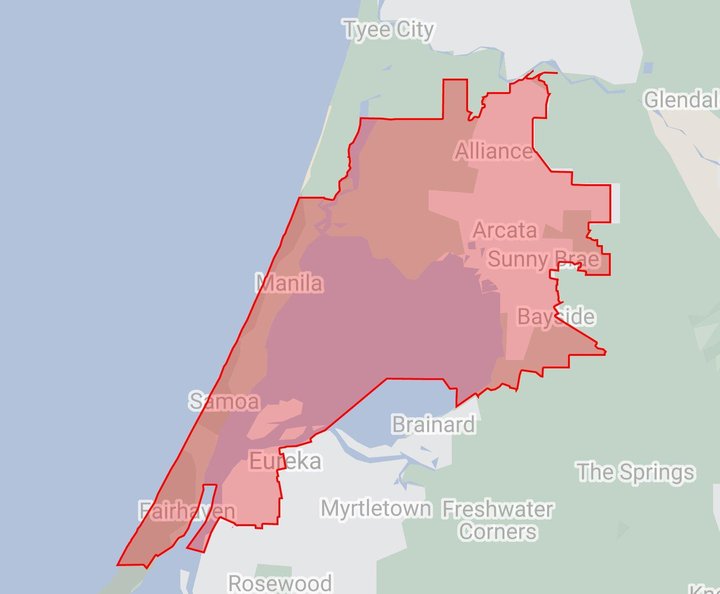
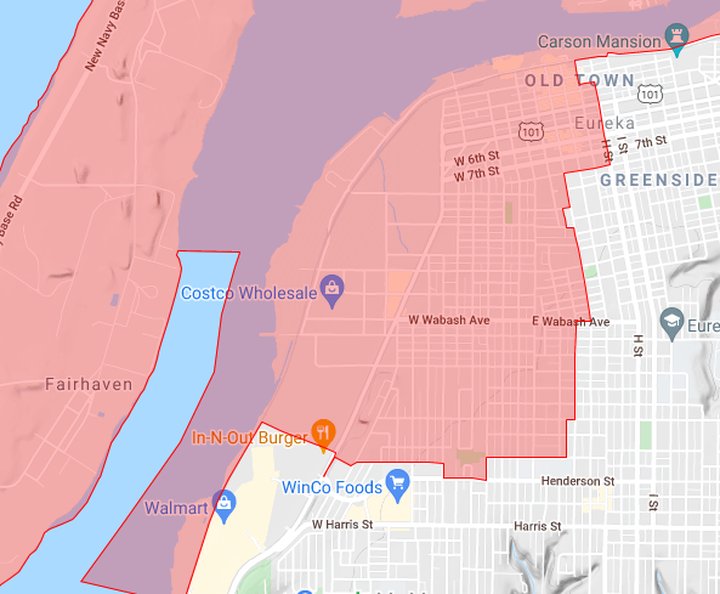
One map submitted to the Redistricting Advisory Committee that incorporates this idea.
Why do this? Well, the bits of public testimony received so far argue that Eureka’s West Side is dominated by renters, as is Arcata, and as such they form a “community of interest” – one of the criteria for how districts should be drawn.
But it’s impossible to ignore another effect that a map like this would have. Depending on how it ends up being drawn, it would also likely move Eureka City Councilmember Natalie Arroyo — a declared candidate for Fourth District supervisor in next year’s election — out of that district entirely. Rather than running against incumbent Virginia Bass next year, she may have to run against the Arcata-based Mike Wilson in 2024.
Jenna Catsos, chair of the Natalie Arroyo for County Supervisor campaign, told the Outpost yesterday that the Arroyo campaign has not followed the redistricting effort so far, but she said that they would likely wish that the city stay together as much as possible — and to follow the north-south split that has divided the city in recent decades.
“This has been an interesting campaign so far, because there are a lot of things up the air,” Catsos said. “Overall, it’s a bit of wait and see. We’ll keep moving ahead and hope that things will be resolved sooner rather than later so we can make concrete plans.”
The idea of moving Eureka’s northwestern corner into Arcata’s district is so geographically odd that it’s something of a wonder that at least a couple people offering feedback to the committee seem to have landed it on it, with similar arguably valid though unusual rationales.
As one person put it in a letter to the committee:
With the majority of the west side of Eureka being made up of residents that rent their homes, it makes sense to align this area of Eureka with Arcata. Our needs for public transportation and other services are a much better fit for this district, and our community interests are far more similar with Arcata than the rest of Eureka. There is a lot of value in these two areas being combined and I would like to see this considered as the redistricting committee moves forward.
Two people — one of whom may or may not have written the above letter — spoke at a Nov. 26 community outreach workshop making the same points:
Audio from Nov. 26 community outreach workshop
Finally, one person submitted a “community of interest” map showing the idea on DistrictR, the Internet platform the county is using to solicit feedback.
Probably because of the relative paucity of public feedback around Humboldt County’s “communities of interest,” these four pieces of testimony — some of which may or may not have come from the same person — seem to have had strong sway within the Redistricting Advisory Committee.
During yesterday’s meeting, the committee asked Redistricting Partners — the contractors actually drawing the draft maps to come back with a refined version of a different map drawn on the DistrictR platform, possibly drawn by committee member Lisa Dugan. (She couldn’t say for sure whether the one they were looking at was hers.)
That map — which you can see here — conducts some eye-popping gymnastics to incorporate the West Eureka-Arcata alliance and other community suggestions, including moving Blue Lake and environs into Rex Bohn’s First District, as well splitting the city of Fortuna down the middle. As pictured above, it would also move Arroyo’s home out of the Fourth District.
So that will be the basis for one of the draft maps presented later this week. Another, at the committee’s request, will seek to maximize rural representation on the board — to join more rural areas up together, so that fewer of them are in the same district as a major population center.
The next meeting of the Redistricting Advisory Committee is scheduled for October 13, at which point the committee will take testimony on the draft maps it will consider forwarding to the Humboldt County Board of Supervisors for feedback or a final decision. Those maps should be published well in advance, and the committee will accept feedback from the public at that meeting. The Board of Supervisors — which has the final decision on the new map — is scheduled to consider the committee’s recommendations on November 2 and again on November 16.
The county is required by law to adopt a new map before Dec. 15. Alannah Smith of the California Center for Rural Policy, which is working with the County in the redistricting process, tells the Outpost that there is a “hold” date for a final vote on the Board’s Dec. 14 agenda, just in case supervisors reject all the draft maps during the November meetings.
BOOKED
Today: 3 felonies, 8 misdemeanors, 0 infractions
JUDGED
Humboldt County Superior Court Calendar: Today
CHP REPORTS
Sr255 / Jackson Ranch Rd (HM office): Live or Dead Animal
3600 Mm299 E Hum 36.00 (HM office): Traffic Hazard
Dyerville Loop Rd / Barnum Rd (HM office): Trfc Collision-1141 Enrt
Elk River Rd / Herrick Ave (HM office): Animal Hazard
ELSEWHERE
RHBB: Woman Suffers Possible Leg Fracture in Dyerville Loop Road Motorcycle Crash
KINS’s Talk Shop: Talkshop September 7th, 2026 – Eureka Police
Governor’s Office: Happy Labor Day! California is the #1 for state for workers, #1 economy in the nation
Governor’s Office: Governor Newsom proclaims Labor Day
(VIDEO) Humboldt County Naturalist ‘Griff’ Takes His Dance Moves to TikTok to Spread the Word About Biodiversity Loss
John Ross Ferrara / Tuesday, Oct. 5, 2021 @ 10:30 a.m. / Internet , Nature
Humboldt’s favorite naturalist John “Griff” Griffith, known for his informative ecology videos and killer dance moves, has joined TikTok to help save the world.
“Young folks are on TikTok, and I want to reach them with an urgent message about biodiversity loss,” Griff told the Outpost. “I also want to be relevant, fun and accessible to the Gen Zers who follow me. So most of my videos on TikTok are gonna be dance videos.”
Griff’s online fame began in Humboldt County in 2012, when a video of him dancing in his California Conservation Corps uniform went viral on YouTube. Griff went on to host an Animal Planet series in 2018, before returning to Humboldt to work as a naturalist at Humboldt Redwoods State park, where he often makes fun and informative videos about ecology and environmentalism for the park’s Facebook page.
Griff talks about the Pacific Lamprey.
“Now I’m talking to thousands, sometimes millions, of people about natural history, rewilding, native plants and biodiversity,” he said. “I will dance my way onto your screen via my TikTok, YouTube, Instagram and Facebook pages and then I’ll show you how being a wildlife conservationist and saving the world can be fun too.”
Griff posted his first TikTok video on Sept. 22 and currently has just a few followers. Give Griff a follow and help Humboldt’s celebrity naturalist reach a new generation of dancing environmentalists.
LAND USE and YOU: The Baumgartners Qualify for Low-Income Housing. Does Your Family?
Brian Heaton / Tuesday, Oct. 5, 2021 @ 7:15 a.m. / Land Use and You
Welcome back for the third episode of Land Use and You, a new series that explores the latest in cutting edge and good old fashioned land use policy. So far we’ve explored how Small Lot Subdivisions and Conservation Subdivisions can be used to add more single-family homes to Humboldt’s beleaguered housing stock.
This month’s episode is a little different. Instead of priming your brain with ideas for how to create housing. we’re taking a moderate-depth dive into an often discussed but poorly understood topic: affordable housing.
What is affordable housing? In Humboldt, affordable housing is typically an apartment whose rent is artificially lowered to a predetermined level in order for it to be affordable to a family at a certain income level. The opposite of affordable housing is market-rate housing, where the landlord is able to charge whatever rent they think someone will pay. There are pros and cons to both affordable and market-rate housing — and it’s important that both types are built.
Area Median Income (AMI). As you might imagine, “affordability” is a relative concept. If you make $186,432 per year, a brand new $64,280 Ford F-150 King Ranch® V6 Turbo Diesel 4x4 pickup truck might well be an affordable vehicle. If you make $29,120 per year ($14/hr CA minimum wage), then that pickup truck is clearly not affordable to you. When it comes to housing, it’s necessary to have a single benchmark against which the rents of affordable housing can be set. This benchmark is called the Area Median Income (AMI), and it’s set on a county-by-county basis. In Humboldt in 2021, the AMI for a four-person household (e.g. two adults and two kids) is $72,000. That’s to say that half of the four-person households in Humboldt earn more than that in a year and half earn less.
The “Big 4” Income Levels. Once you have the AMI benchmark in hand, you can establish affordability levels. In the great state of California, there are four levels that are considered affordable housing:
- Moderate Income: 80% to 120% of AMI
- Low Income: 50% to 80% of AMI
- Very Low Income: 30% to 50% of AMI
- Extremely Low Income: 0-30% of AMI
The rent levels also vary depending on how many people live in the household. Naturally, the more people being supported on an income the greater the income needs to be. For this reason, the numbers scale proportionally to the size of the household. Some households have a single earner (e.g. single parents) while others have multiple incomes (e.g. both parents work). For housing purposes, all of the incomes are added together to get the total household income. But enough of the planning wonk gibberish — let’s look at the actual Humboldt County annual household income levels:
If you live in a four-person household…
- “Moderate Income” means a total household income up to $86k per year
- “Low Income” means a total household income up to $56k per year
- “Very Low Income” means a total household income up to $35k per year
- “Extremely Low Income” means a total household income up to $27k per year
If you live in a three-person household…
- “Moderate Income” means a total household income up to $78k per year
- “Low Income” means a total household income up to $50k per year
- “Very Low Income” means a total household income up to $32k per year
- “Extremely Low Income” means a total household income up to $22k per year
If you live in a two-person household…
- “Moderate Income” means a total household income up to $69k per year
- “Low Income” means a total household income up to $45k per year
- “Very Low Income” means a total household income up to $28k per year
- “Extremely Low Income” means a total household income up to $17k per year
If you live in a one-person household…
- “Moderate Income” means a total household income up to $61k per year
- “Low Income” means a total household income up to $39k per year
- “Very Low Income” means a total household income up to $25k per year
- “Extremely Low Income” means a total household income up to $15k per year
Affordable Rents. An affordable rent (or mortgage) is defined by the State of California and the United States Department of Housing and Community Development (HUD) as costing no more than 30% of a household’s pre-tax income (including utilities). So now that we have the annual income categories sorted out, let’s take a look at an imaginary family to see how much they might be able to pay in rent and whether they would qualify to live in an affordable housing development: Humboldt, say hello to the Baumgartner family.

Those darned Baumgartner girls, pictured here in roughly February 2023 thanks to new LoCO technological advances. Photo by Tim Bish on Unsplash.
The Baumgartner Family. The Baumgartner family consists of Frank, Sandra, and their three-year-old twin daughters Pebble and Stream. Third-generation Eurekans, Frank earns $18.50/hr as a forklift driver and Sandra earns $14.50/hr working in retail. They both work full time, but Sandra doesn’t always get scheduled for forty hours per week at her job. Last year they earned $52,340 total, which works out to $4,361 per month before taxes. Thirty percent of $4,361 is $1,308. However, we need to back out the monthly cost of utilities from that number. If we assume that power/gas/water/garbage cost about $300 per month for a family of four, then the final affordable rent is about $1,000.
Given their annual income of $52,340, the Baumgartner family would qualify for as a “Four Person - Low Income Household” and could (with luck) snag an apartment in an affordable housing development. They would pay around $1,000 per month to rent a 2 or 3 bedroom apartment.
Affordable Housing is Not Free. A common misconception is that it is free to live in affordable housing. This is simply not true. As the income limits show, nearly all people that live in affordable housing work and pay rent every month just like everyone else. Exceptions include housing for low income seniors (social security is the income) and residents of certain developments that provide permanent supportive housing (e.g. disabled veterans). Without affordable housing, lower income households end up paying 30-70% of their income on housing. A household that overpays for housing is less able to save money and otherwise meet their needs.
Conclusion. At this point I hope you’ve picked up a few pointers on the how and why of affordable housing. So the next time someone runs up to you raving about the horrors of a proposed affordable housing development, you can calmly reassure them that they have nothing to fear from service workers. Put another way, if you can stand bravely in front of the cashier at the grocery store — you can stand bravely in the face of an affordable housing development.
If you’re curious, you can read here about how the AMI is calculated and compare Humboldt with other California counties.
###
Brian Heaton is a local pro-housing advocate with a professional background in city planning. Views expressed are his own and do not represent those of any government.
What Should Housing Look Like in Humboldt? If You Have Ideas, the County Wants to Hear Them
LoCO Staff / Tuesday, Oct. 5, 2021 @ 7 a.m. / Infrastructure
Press release from the County of Humboldt:
Make your voice heard for the future of housing on the North Coast. The County of Humboldt Planning and Building Department invites residents to share housing insights and participate in three community listening sessions occurring in October. These sessions will be an open dialogue in which community members may share housing needs, issues, and vision for the future of housing in Humboldt County, as well as perspectives about housing opportunities, challenges, solutions, and more.
The virtual community listening sessions will be held via Zoom. Community members may attend more than one session.
- COASTAL/HUMBOLDT BAY REGION: Tuesday, Oct. 5 6-7:30 p.m.
- INLAND/RURAL REGION: Tuesday, Oct. 12 6-7:30 p.m.
- SERVICE PROVIDERS/LOW-INCOME HOUSEHOLDS: Tuesday, Oct. 26 6-7:30 p.m.
Use the following information to join any of the sessions:
Join via the web (recommended) at this link. Or call in via phone: +1 669 900 9128 Zoom meeting ID: 823 2364 9248 Closed captioning available
For more information or to request accessibility accommodations, please contact Andrew Whitney, Housing and Grants Program Coordinator at: 707-445-7541 or awhitney2@co.humboldt.ca.us.
Board of Supervisors Set to Appoint Elishia Hayes, a 10-Year Employee, to County Administrative Officer Position
Ryan Burns / Monday, Oct. 4, 2021 @ 4:53 p.m. / Local Government

Elishia Hayes, the county’s new CAO
Three months after the County of Humboldt bid farewell to its previous county administrative officer, Amy Nilsen, the Board of Supervisors is set to name her replacement, and they didn’t have to look very far.
At Tuesday’s supes meeting, the board is set to appoint Elishia Hayes to the position that has been likened to being CEO of a company. Hayes has been serving as the acting CAO since Nilsen’s departure, and the board must be pleased with her performance. They’re set to appoint her to the full-time gig without conducting a search for other candidates.
“I am honored and humbled the Board of Supervisors has the confidence in me to lead the county,” Hayes said in a statement provided to the Outpost. “I can’t thank the board enough for the opportunity as I am thrilled to continue working with each one of them. While I am no stranger to hard work or long days, our employees truly set the example.”
Hayes earned a bachelor’s degree in business administration and finance from Humboldt State University in 2002 and spent nearly six years as an account manager for Security National, according to her LinkedIn profile.
Since 2011 she has climbed up the career ladder within the CAO’s office, starting as a revenue recovery officer and advancing through the ranks to become a senior administrative analyst, deputy CAO and, in 2020, the chief operating officer/assistant CAO.
According to the county staff report, Hayes has completed the LEAD Program at the University of Virginia Weldon Cooper Center for Public Service as well as the senior executive credential program from the California State Association of Counties and the Cascadia Center for Leadership in Humboldt County.
Hayes’s starting salary will be an eyebrow-raising $197,038 per year, plus benefits. A new compensation schedule for all county employees went into effect last month. The base salary for her new position starts at that level and goes as high as $222,914 per year.
Nilsen, the previous CAO. was the third-highest-paid county employee in 2019, the most year for which data is available through Transparent California. She made $279,063 in salary and benefits, including $196,029 in regular pay.
Of the 18 other county administrative officers whose salaries we found listed on Transparent California, Nilsen’s ranked 12th from the top, below the likes of CAOs in Fresno, San Benito and Monterey counties but above those in Take, Inyo, Trinity and Glenn. The closest county to Humboldt population-wise on the list is Kings County, whose CAO made a bit more than Nilsen with a base pay of $203,506.
Hayes passed along one more paragraph regarding her promotion:
“Our community now more so than ever needs strong leadership from the county, and I intend to continue working with the Board, departments, local organizations, state and federal partners and the people of Humboldt County to help our area thrive in the short- and long-term. I was raised in Humboldt County and I plan to do everything I can to make this an even better place to live and work.”
ARE YOU OK? Humboldt Awakes to a Facebook- and Instagram-less Utopia
Andrew Goff / Monday, Oct. 4, 2021 @ noon / Hardly News
UPDATE: 2:52 p.m.: Well, it was fun while it lasted. You may return to your battle stations if you must, y’all.
###

Original Post: Well then! We have to assume that this has been Humboldt’s most glorious and productive Monday morning in quite sometime since — and we know we’re not breaking any news, here — Facebook and Instagram are waaay out of commission at the moment.
Checkin’ in: You doin’ good, Humboldt? Breathe, baby.
The great social media outage began at about 8:45 a.m. and, for the life of us, LoCO cannot recall a longer period of time being free of these ubiquitous, time-sucking websites. Like us, you’ve probably already seriously contemplated ways in which today feels different. Maybe you, like us, are actually enjoying this. Maybe not!
Anyway, all this to say, LoCO is still here for ya as we all stumble through this wonderful darkness. For those of you that have grown accustomed to messaging us on Facebook or Instagram, news@lostcoastoutpost.com was probably always a better option anyway. Reach out if you’re lonely!
One last thing. If you’re fiending for some of that benign content candy we’ve all grown accustomed to devouring every waking moment, LoCO will break you off a chunk to tide you over.

This is Senator Tanooki, LoCO’s #1 resident cat legislator, seen here bathed in aww-inspiring golden sunset color as he contemplates his votes on important upcoming bills. “Nooks,” as he’s known to friends and colleagues, works very hard to improve the lives of the people of this great nation and we hope you will take comfort in knowing he’s looking out for us all as we stare into the abyss of a potential Zuckerberg-free future. With Tanooki’s fuzzy guidance, we will get through this, friends.
If you have questions on Tanooki’s policy positions, feel free to leave a comment for him below. And have a less stressful day.
Shlomo Rechnitz Nursing Home Suit Over COVID Deaths Reflects ‘Broken State Licensing’
Jocelyn Wiener / Monday, Oct. 4, 2021 @ 7:33 a.m. / Sacramento
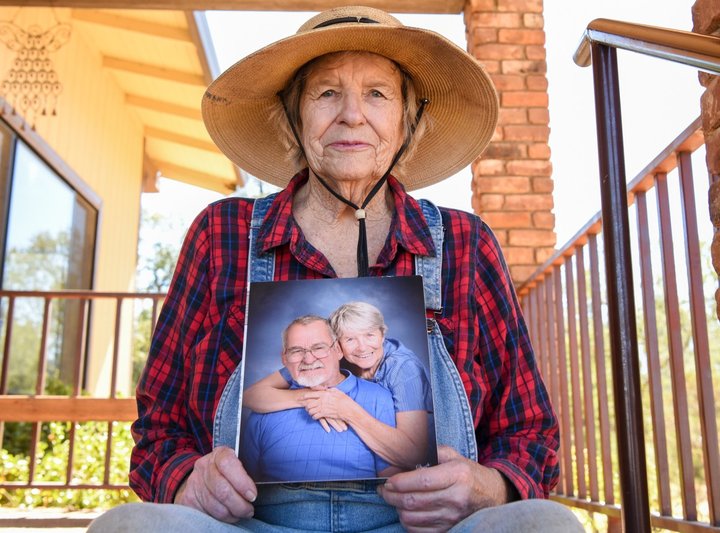
Johanna Trenerry of Happy Valley holds a photograph of herself with her husband, Art Trenerry, who died last year of COVID-19 while staying at Windsor Redding Care Center. His family members, including Johanna, are named as plaintiffs in a lawsuit against the facility. Photo by Matt Bates for CalMatters
###
The state’s largest nursing home owner, Shlomo Rechnitz, is facing a lawsuit alleging that one of his homes is responsible for the COVID-related deaths of some 24 elderly and dependent residents.
The catch? Five years ago, the state denied Rechnitz and his companies a license to operate the place, the state’s own records show.
The case brought against Rechnitz, his companies and the home itself, Windsor Redding Care Center, is yet another footnote in an ongoing nursing home licensing saga documented in a CalMatters investigation last spring.
That investigation revealed an opaque and confusing state licensing process frequently marred by indecision and delays. CalMatters found that the California Department of Public Health has allowed Rechnitz to operate many skilled nursing facilities for years through a web of companies as their license applications languish in “pending” status — or are outright denied.
The lawsuit — which includes a total of 46 plaintiffs, including 14 deceased residents and 32 family members — specifically calls out Rechnitz and his management companies as being an “unlicensed owner-operator” of the skilled nursing facility. The plaintiffs also are suing the previous owners, whose names and companies remain on the license.
Family members of residents who died as a result of a COVID-19 outbreak last fall are suing the facility for elder neglect and abuse, alleging that Windsor Redding forced employees to come into work while symptomatic with the virus, triggering the outbreak.
The complaint further alleges that dozens of residents who fell ill were left isolated and neglected due to “extreme understaffing.” One nurse told state inspectors that she alone had to pass out medications to 27 COVID-positive patients, meaning the medications were often late, according to an Oct. 21, 2020, inspection report, also cited in the lawsuit. Another nurse told them that nurses on the COVID unit, or “Red Zone,” were “stressed, overloaded and tapped out” and unable to take breaks, the report said.
The complaint lists 142 violations substantiated by investigators including neglect, abuse, staffing and infection control issues between January 2018 and June 2021. In November 2020, the federal government fined the facility $152,000 as a result of the inspections.
A ‘broken’ licensing system
Democratic Assemblymember Al Muratsuchi of Los Angeles said the lawsuit against the Redding facility, located 160 miles north of Sacramento, “clearly provides Exhibit A of the broken state licensing system for nursing homes.”
“The fact that this facility had its license application denied and yet they continued to operate during this pandemic, which unfortunately led to an alleged 24 deaths from COVID, highlights the urgent need for the state to fix its broken licensing system,” he said.
On Tuesday, the Assembly Health Committee will hold an informational hearing to discuss problems with nursing home oversight and licensing in the state.
“They know this operator is running the facility, and they’re not doing anything about it. In a sense, the state could be co-defendants in this case.”
— Tony Chicotel, staff attorney for California Advocates for Nursing Home Reform
Rechnitz, a Los Angeles entrepreneur, was in his mid-30s when he began buying nursing homes 15 years ago. He and his companies, including Brius Healthcare, have acquired at least 81 facilities around California, making him the state’s biggest for-profit nursing home owner.
Rechnitz and his companies operate more than a quarter of those facilities despite the fact that the California Department of Public Health has not approved — or has outright rejected — their licensing applications, according to state records. In the case of five “Windsor” facilities, including Windsor Redding, Rechnitz and his companies continue to run them after the state’s license denial. The previous owners’ companies, affiliated with the Windsor brand, are still listed in state records as the official license-holders.
Mark Johnson, an attorney who represents Rechnitz and Brius, said in an emailed statement that he could not comment on pending litigation except to say that: “The facility vehemently disagrees with the allegations and it intends to defend the action vigorously.”
Johnson has previously declined to answer detailed questions about the licensing issues. But he has expressed frustration in emailed statements to CalMatters about the state’s inconsistent approach to Brius homes — approving some, denying others, and leaving still others stuck in pending status.
The death of Art Trenerry
Art Trenerry arrived at Windsor Redding on Aug. 6, 2020, after suffering a stroke, his family and attorney say. Several of Trenerry’s family members are named as plaintiffs in the lawsuit.
Visitors weren’t allowed inside at the time, they told CalMatters. Instead, Johanna, his wife of 60 years, and their children would visit outside the window, said one of their daughters, Nancy Hearden, in an interview. Sometimes the facility would wheel the wrong person out, she said.
Johanna said she would ask nurses to hold the phone to her 82-year-old husband’s ear so she could tell him “Hi Dad, I love you.”
His daughters called twice a day to check on him, growing concerned by their perception that “things aren’t right,” Hearden said. They began looking to move him to a new facility, or to bring him home, she said.
“Just as we were going to get him out of there,” said Hearden, “he got COVID.”

Art Trenerry and his granddaughter, Elizabeth Trenerry, now 4 years old. Photo courtesy of the family
Hearden said she called in a complaint about the care her father received to Shasta County’s public health department on April 20, 2021. “Their response to me was, ‘they’re complying now,’” she said.
Hearden said she had not known who owned the facility when her father arrived there. The state denied Rechnitz licenses to operate Windsor Redding and four other facilities in July 2016, citing the poor track records of many facilities “owned, managed, or operated, either directly or indirectly, by the applicant,” according to 22-page denial letters addressed to Rechnitz.
Two departments within state government record Rechnitz’ relationship to the Redding facility differently. Rechnitz is listed as the owner of Windsor Redding in cost reports filed with the Office of Statewide Health Planning and Development in 2020. But his name is not on the California Department of Public Health’s consumer website, Cal Health Find, which identifies the facility’s owner/operator as Lee Samson, Lawrence Feigen and two limited liability companies with the Windsor brand. Windsor still operates nursing homes in California and Arizona, according to its website.
The lawsuit, filed last month in Shasta County Superior Court, also alleges that Rechnitz and his “management operating companies” circumvented the state’s denial by creating a “joint venture” with Samson and a limited liability company affiliated with S&F Management.
S&F is a West Hollywood-based company that provides “professional consulting services to Windsor facilities,” Todd Andrews, senior vice president of S&F Management Co., told CalMatters in March. When asked about the lawsuit last week, Andrews said that his company and its president and CEO, Lee Samson — also named as defendants in the complaint — have had no day-to-day involvement with the facility. He said the state “has not transferred the license in over seven years,” despite repeated appeals, so Windsor remains the licensee.
A spokesperson for the California Department of Public Health declined to comment on the case because it is pending litigation.
Nursing home oversight in legislative crosshairs
Assemblymember Muratsuchi authored a bill earlier this year that would forbid the use of management agreements to “circumvent state licensure requirements” and would require owners and operators to get approval from the California Department of Public Health before acquiring, operating or managing a nursing home.
The bill stalled in the Assembly Health Committee in the spring. But the committee’s chair, Assemblymember Jim Wood, a Santa Rosa Democrat, said he was so committed to fixing these issues that he planned to take the unusual step of putting his name on it as a joint author next year. Wood will chair Tuesday’s legislative hearing on nursing home licensing, inspections and quality of care – with representatives of the Department of Public Health expected to appear.
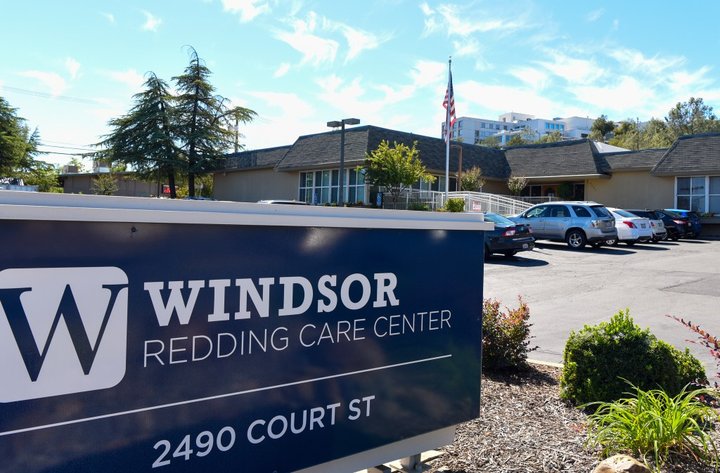
Windsor Redding Care Center is facing a lawsuit after about 24 nursing home residents died of COVID-19 last fall and winter. Photo by Matt Bates for CalMatters
Long before COVID-19, Windsor Redding had a history of care problems. Given that, the complaint says, “it was foreseeable that Defendants would continue to neglect and harm more residents during the pandemic.”
In August 2020, state inspectors cited the facility for admitting patients who were negative for COVID-19 into rooms with residents who were positive for the virus, or had been exposed.
COVID outbreak sweeps through home
By the next month, the facility had an outbreak — 60 of the 83 residents contracted the virus, and “approximately 24” passed away from complications related to COVID-19, the complaint states. (The state identified 23 COVID-related deaths at the home last fall and winter.)
In September 2020, the California Department of Public Health conducted an inspection of the facility and declared an “immediate jeopardy,” the level of deficiency reserved for the most egregious incidents in nursing homes that could cause serious injury or death.
Among the inspection’s findings: the facility had punitive sick leave policies. Two staff members reported being told to come into work despite having symptoms of COVID-19, including “body aches, chills, sweats and respiratory symptoms” for one and “loss of taste, lethargy, and cough” for the other, according to a Sept. 25, 2020, inspection report. Both eventually tested positive.
In that same report, the investigators also reported that staff were reusing personal protective equipment. One nurse was found wearing her N-95 mask around her chin. When asked if staff were to wear their masks over their noses and mouths while at the nurse’s desk, the inspection report said, she responded: “I don’t know.”
The complaint alleges, further, that the defendants have a “general business practice” of understaffing the facility.
“It makes dying alone even lonelier,” said Wendy York, a Sacramento attorney specializing in nursing home abuse whose firm is among three representing the families. “My heart gets heavy when I think of them in this unit, in this environment.”
Tony Chicotel, staff attorney for California Advocates for Nursing Home Reform, said he holds the state partly to account for the outbreak.
“They know this operator is running the facility, and they’re not doing anything about it,” he said. “In a sense, the state could be co-defendants in this case.”
Trenerry family say its goodbyes
The last time Johanna Trenerry was able to see her husband, Art, was the night of Sept. 25, 2020, after he tested positive for COVID. She and some of her children were allotted 15 minutes each to see him. During those minutes, Trenerry sat next to her husband, holding his hand. Right before she left, she raised her face shield and kissed him. He died a week and a half later.
Johanna Trenerry is Catholic, and believes that Art is with God now, and that they’re both keeping an eye on her. Ever since the couple met as 16-year-olds on a blind date, Art had taken care of her, always supporting her “crazy ideas.” She told him she wanted a big family, a farm and a two-story house. “Ok, hon, whatever you want, you can have,” he said.
He worked as a stationary engineer, doing maintenance at the local hospital in Redding, and served as a volunteer firefighter and on the local water board. They raised eight children together on a 14-acre farm in Happy Valley, a small community outside town. His family describes him as quiet, but funny, always ready to help a neighbor and so devoted to his grandchildren that he built them a miniature railroad track on the property.
When a friend down the street said that her own husband was unwell, Johanna didn’t mince words.
“Don’t send him to a rest home,” she told her friend. “He’ll die there.”
###
CALmatters.org is a nonprofit, nonpartisan media venture explaining California policies and politics.


