At an emotional legislative hearing Tuesday, lawmakers and critics subjected the Newsom administration to blistering questions about the state’s oversight of nursing homes.
Assemblymember Jim Wood, a Santa Rosa Democrat who chairs the Assembly Health Committee, questioned the state’s lack of urgency in addressing licensing concerns.
“Where is the proactive, patient centered, public safety approach here?” he asked Cassie Dunham, an acting deputy director of the California Department of Public Health. “Where is that?
“Because I don’t feel it right now. And yet here we are. Here we sit,” he said. “We have to wait for news articles. We have to wait for people to die.”
Democratic Assemblymember Al Muratsuchi of Los Angeles, who introduced legislation earlier this year to address some of these issues, also grilled Dunham about the department’s performance in caring for California’s most vulnerable residents..
“What I’m hearing is a lengthy history, that goes back decades, of the Department of Public Health failing to crack down on bad actors who are gaming the system,” he said.
The tense hearing touched on the department’s staffing levels and on nursing homes’ financial practices, issues which elder care advocates and legislators have raised for years and have triggered similar hearings.
“I struggle to accept the premise that nursing homes are underfunded when their owners are living in homes that are sometimes worth $11 million dollars,” said Kim Valentine, an Orange County attorney who has spent more than 20 years working on cases of elder abuse in nursing homes, in her testimony.
“I am petrified to get old,” she added. “This disgraceful, broken system of senior living care is something that we all need to care about. Because this is our future.”
Two officials of the embattled department acknowledged that some changes are needed but attempted to deflect criticism by pointing to the stresses of the COVID-19 crisis, which hit nursing homes especially hard.
“Throughout the (pandemic) response, the department’s absolute focus has been on saving lives,” said Dunham.
Much of the attention Tuesday was focused on longstanding licensing issues that CalMatters has documented extensively in recent months. The legislators repeatedly referenced reporting by CalMatters, which examined the state’s largest, for-profit nursing home owner, Shlomo Rechnitz of Los Angeles, and the unusual licensing decisions surrounding some of his homes. Lawmakers also cited work by KPCC and LAist, which looked at Crystal Solorzano, another controversial nursing home operator.
“This disgraceful, broken system of senior living care is something that we all need to care about.” — Kim Valentine, Orange County elder abuse attorney
A CalMatters investigation published April 6 revealed an opaque state licensing process plagued by indecision, confusion and yearslong delays. The report detailed how the state has permitted Rechnitz to operate facilities for years through a web of companies, despite license applications left in “pending” status — and some that were formally denied.
A subsequent CalMatters story on Aug. 19 revealed that the department had incorrectly listed Rechnitz as holding permanent licenses for two homes whose applications actually had been undecided. After advocates pointed out that mistake to department officials, they doubled down, admitting the error but refusing to take the licenses away.
This week, CalMatters reported that family members of residents who died as a result of a COVID-19 outbreak at Windsor Redding last fall are suing that facility for elder neglect and abuse, alleging that employees were forced to come into work while symptomatic with the virus, and that dozens of residents who fell ill were left isolated and neglected due to “extreme understaffing.” The complaint specifically refers to Rechnitz and his management companies as being an “unlicensed owner-operator” of the skilled nursing facility, since the state denied them a license in 2016.
Mark Johnson, an attorney for Rechnitz and one of his companies, Brius, has in the past expressed frustration in emailed statements to CalMatters about the state’s inconsistent approach to Brius homes. Johnson also has previously said that the facilities in “pending” status had licenses in good standing and were operated under an “interim management agreement,” which he described as “state approved.”
Tony Chicotel, a staff attorney at the California Advocates for Nursing Home Reform, referred to a “zombie nursing home licensing system,” which he described as “straight bananas.”
“Corrosive (Department of Public Health) inaction has created a system where operators with terrible track records take over nursing homes without approval,” he said. “What’s worse, when the state actually denies a license, it doesn’t really matter. The unfit operator can just keep operating.”
California State Auditor Elaine Howle also called out the department for being inconsistent in its licensing practices at Tuesday’s hearing,
“What I’m hearing is a lengthy history… of the Department of Public Health failing to crack down on bad actors.” — Democratic Assemblymember Al Muratsuchi of Los Angeles
Muratsuchi referred to the Windsor Redding lawsuit repeatedly during the hearing, at one point asking Howle: “Does it make sense to you that a nursing home can continue to operate when the owner’s application for a license has been denied five years ago?”
Howle in 2018 published an audit criticizing state nursing home oversight, saying that licensing lapses by the California Department of Public Health increased the risk that residents may not receive adequate care.
In response to Muratsuchi’s question, Howle said: “I don’t have that authority and that expertise. But if I had a loved one, I would be very concerned about having one of my family members in a facility like that. I would not do it.”
Muratsuchi posed the same question to Dunham of the Department of Public Health, quizzing her on how it was possible that someone with a “documented history of violations” isn’t automatically barred from continuing to own and operate nursing homes in California.
“Throughout the (pandemic) response, the department’s absolute focus has been on saving lives.” — Cassie Dunham, Department of Public Health Official
The complaint against Windsor Redding lists 142 violations substantiated by investigators including neglect, abuse, staffing and infection control issues between January 2018 and June 2021. In November 2020, the federal government fined the facility $152,000 as a result of the inspections.
In response to Muratsuchi’s question, Dunham echoed a response given to CalMatters earlier this year: Ownership applications are decided in a case by case, ‘point-in-time process,” she explained, noting that applicants’ track records may change.
“Operators may improve in their performance, operators may decline in their performance,” she said.
Muratsuchi said it was clear that laws “desperately need to be revised and changed.”
His bill, AB 1502, would forbid using management agreements to “circumvent state licensure requirements” and would require owners and operators to get approval from the state Department of Public Health before acquiring, operating or managing a nursing home.
The bill stalled in the Assembly Health Committee, where Tuesday’s hearing took place, and is not expected to be heard until next year. Wood, the committee chair, said in the spring that he believed the issue would require a lot of staff time to gather data and communicate with various state agencies, and that he wanted to make sure the California Department of Public Health and the Newsom administration were on board.
Craig Cornett, CEO and president of the California Association of Health Facilities, an industry group, said Tuesday that “substantial improvements” could be made in how the department handles licensing decisions. He expressed pride in the work of nursing home staff, especially in light of the pandemic, and said the state’s nursing homes are very highly ranked in many measures of quality. But he also noted that the industry faces “a severe workforce shortage.”
Cornett expressed frustration about long licensing delays and high licensing fees. But he said his organization opposed Muratsuchi’s bill as being punitive, “rather than addressing the fundamental problems with the process.”
“COVID cannot be an excuse to not do better.” — Democratic Assemblymember Jim Wood of Santa Rosa
The Department of Public Health has a wide range of responsibilities surrounding nursing homes; its execution of several of those was criticized Tuesday. In addition to licensing, the department is responsible for routinely inspecting the state’s 1,215 nursing homes to ensure they are meeting federal standards. It also conducts complaint investigations and can cite facilities for violating federal or state rules, and levy fines.
The hearing comes at a pivotal time. The industry is reckoning with the devastating impacts of the past 18 months, during which 9,243 California nursing home residents died of COVID-19, along with 249 healthcare workers. That data comes from the state’s Department of Public Health; some advocates and lawyers for nursing home residents say they suspect it is an undercount.
The department has been reticent to speak to CalMatters about licensing issues, refusing to put any officials on the phone. But at the hearing, legislators repeatedly called department officials to account.
“COVID cannot be an excuse to not do better,” Wood said. “We don’t need excuses. We have to do more.”
###
CALmatters.org is a nonprofit, nonpartisan media venture explaining California policies and politics.
Nevada Joint Union High School District Superintendent Brett McFadden expects the vast majority of his students and staff to abide by the COVID-19 vaccine mandate issued by Gov. Gavin Newsom on Oct. 1.
But he also expects around 10 of his employees to quit out of personal or political opposition to it.
“It’s a really small number, but the individuals who are upset about it are vocal,” said McFadden, whose district in Nevada County is about 65 miles northwest of Sacramento. “The silent, vast majority of educators are saying, OK, we’ll get vaccinated.”
As a small minority of teachers and parents across the state protest vaccine mandates, one legislator is considering ways to strengthen the new immunization requirement by eliminating a controversial public-health loophole state lawmakers had previously removed for the 10 other required vaccines for California’s students.
“The purpose of these laws is not to make anyone vaccinate their children, it’s to keep schools safe,” said state Sen. Richard Pan of Sacramento, a Democrat and pediatrician who chairs the Senate Health Committee. “You don’t want schools having to close, and people having to be sent home and quarantined.”
The vaccine mandate announced last week will take effect as soon as the U.S. Food and Drug Administration fully approves the vaccine for the different age groups. The Newsom administration expects the first vaccine deadline for grades 7-12 to be July 1, 2022.
The mandate, however, allows for personal belief exemptions. This means students and staff could opt-out of the COVID-19 vaccine for religious or ideological reasons.
The process for a personal belief exemptions for vaccinations vary across the country for students and employees, according to Dorit Reiss, a law professor at UC Hastings.
“Some just ask to check a box on a form,” she said. “Others have a different process like submitting a letter.
Pan has a long history with strengthening vaccine rules for students. In 2012, he authored a law that required parents seeking a personal belief exemption to consult with a medical expert about the benefits and risks of vaccinations.
Pan then successfully tightened regulations on medical exemptions in 2019 with a bill that required the California Department of Public Health to audit all medical exemptions at schools with immunization rates of less than 95%, and doctors who submit more than five medical exemptions every calendar year. Anti-vaccine protesters zealously opposed the bill.
Friday’s COVID-19 vaccine mandate revived the issue of the personal belief exemption because the 2015 law requires any immunization requirements issued by the state health department without a vote from the Legislature to include the provision.
“At the time, we were more concerned about routine vaccinations. We were thinking, why have a fight that doesn’t really matter?” Pan said. “The laws that we wrote for school mandates were not written with pandemics in mind. That’s why that provision is in there.”
Pan says he’ll consider authoring legislation that would eliminate the exemption if COVID-19 cases spike across the state or if districts report a high number of students and staff who abuse this provision to avoid the vaccine.
A possible bill, Pan said, would add the COVID-19 vaccine to the list of already required immunizations for both public and private school students. Then it would be treated like the other 10 vaccine requirements that don’t allow for a personal belief exemption under SB 277.
“The problem with the personal belief exemption is that if there are too many people who use it, we’ll have schools that are unsafe,” he said. “We need to be sure kids can stay in school and learn and not have to be sent home for two weeks.”
The California chapter of the American Academy of Pediatrics released a statement in support of the mandate.
“The eradication of smallpox and polio, as well as prevention of meningitis, measles and whooping cough show that vaccines work,” said chapter Chair Yasuko Fukuda. “New vaccines are developed and evaluated by a long-standing rigorous process to ensure effectiveness and safety.”
Catherine Martin, executive director of the California Immunization Coalition, a public-health advocacy group, said she understands the concerns of the parents who are hesitant about the COVID-19 vaccine, but she agrees that the personal belief exemption should be eliminated.
“The number one reason to eliminate the personal belief exemption is to be consistent,” Martin said. “This vaccine is no riskier than any other vaccine.”
COVID-19 vaccines do not currently have FDA approval for kids, but are expected to by the time the mandate goes into effect.
Martin said her organization will spend the next months supporting pediatricians and school administrators as they explain the benefits and risks of the COVID-19 vaccine to students and their families.
“Parents are suffering because they really are scared,” she said. “Doctors are really going to need to up their game in terms of taking time and answering their questions.”
However, Martin has less sympathy for teachers and school staff who refuse to get vaccinated for political reasons.
“If they’re not believing in the science or if it’s a political belief, perhaps they need to find other work,” she said. “Perhaps this is going to weed out folks who don’t believe in the science.”
The California Teachers Association President E. Toby Boyd released a statement last week supporting the vaccine mandate for students and said the vast majority of teachers have already been fully vaccinated.
“While recognizing the need for medical and religious exemptions, we believe vaccinations are key for both student and educator safety, keeping our schools open for in-person instruction and for combating this pandemic,” Boyd said.
CTA Spokesperson Lisa Gardiner declined to comment on whether the union would support the elimination of the personal belief exemption if legislators were to propose a bill.
McFadden expects most of his employees, even those opposing the mandate, will eventually get their vaccines so they can keep their jobs. He said when the governor issued a previous mandate requiring teachers to be vaccinated or undergo regular testing, many teachers complained, but most came around.
“They said, ‘I don’t want to do this,’ but then they realized they have to pay the rent,” he said. “I might have 5 or 10 that don’t get vaccinated, and they’ll leave.”
###
CALmatters.org is a nonprofit, nonpartisan media venture explaining California policies and politics.
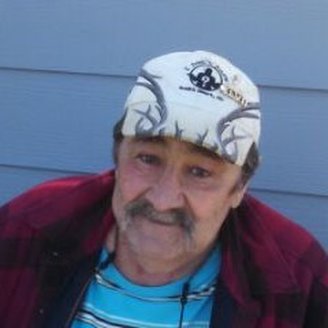
Charles (Chuck) K. Voight passed away unexpectedly on June 21, 2021, at his home in
Fortuna. He was 76 years old. Chuck was born April 9, 1944 in Eureka to Mildred and
Ray Voight. Chuck loved Humboldt County and lived within the county for most of his life. He
spent many years surrounded by the redwood forests as a timber faller. Later in life he moved
to Pennsylvania and changed careers. He began his career as a forklift operator in a distribution
center. But the pull of the ocean and redwoods became too much for him. He returned to his
beloved Humboldt County and family.
Chuck spent his free time enjoying the natural beauty, wonder and bounty of Humboldt County.
Hunting, fishing and crabbing with friends and family were some of his favorite pastimes. He
had many adventures and fun participating in these activities with his late friend Joe Quinn and
many family members. Another of his favorite pastimes was playing dice and cards with family
and friends all in the name of fun. But also a dollar a game.
Chuck is survived by his son Brandon Voight, Brandon’s wife Devin Gallagher, grandsons
Charles Voight and Zachery Ruiz (whom he loved and doted on endlessly) of San Diego, Ca.
His brother Raymond G. Voight, Raymond’s wife Joanne Voight of Porterville, Ca. His sisters
Sharon Voight and Tami Voight both of Fortuna, Ca. His sister-in-law Alice Voight of Bullhead
City, Az. His nephews and nieces with whom he was especially close to Kim, Tony, Kyle and
Edie Behrens, Amanda Deno, Carrie Voight, Tommy Lee, Tawny, and Mike Voight, Kathy
Phillipson, Daniel Foster, Susie and Jeff Morris, Rick and Charles Voight, Jessica (Spotted Leg)
and Niekoma Cantrell, and Mariah Voight-Buckley.
He was preceded in death by his parents Raymond and Mildred (Millie) Voight, brothers David,
Rick, and Tom Voight. Also his nephew Roy Boy Voight.
Chuck will be dearly and deeply missed by his family and friends. Many of those who knew him
will recall the fond and fun memories they had with Chuck out on the boat and sitting around a
card table. Chuck was always always ready for a fun time and an adventure, rockin’ and rollin’.
He will hold a special place in all of our hearts forevermore.
There will be a celebration of life held for Chuck at the Mountain View Village in the Lunchroom
(2123 Smith Ln. Fortuna) at 1 p.m. on the 23rd of October. Parking for the event is in the
church next door. The event will be potluck style. Anyone who is wanting to attend is
encouraged to bring their favorite dish.
###
The obituary above was submitted on behalf of Chuck Voight’s loved ones. The Lost Coast Outpost runs obituaries of Humboldt County residents at no charge. See guidelines here.
In the early morning hours of October 5th, 2021, Detectives with the Eureka Police
Department’s Problem Oriented Policing Team (POP), with the assistance from Agents
with the Humboldt County Drug Task Force (HCDTF) and the California Highway
Patrol Garberville office made a traffic stop on a vehicle on Highway 101 just south of
Richardson’s Grove in southern Humboldt County.
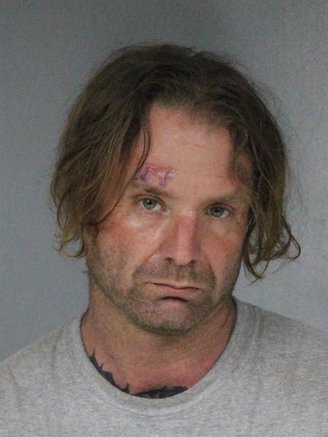
Boggs.
POP Detectives had been investigating the driver, 50-year-old Eureka resident Toni
Deann Boggs for trafficking Fentanyl into Humboldt County from the Bay Area. The
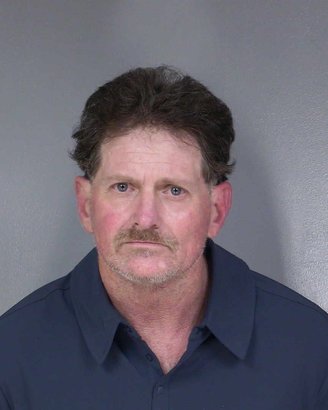
passenger in the vehicle was identified as 52-year-old Eureka resident Thomas
McLafferty.
Throughout the course of the investigation it was determined that Boggs had made four
previous trips to the Bay Area over the past week to pick up narcotics. Detectives had
previously obtained a search warrant for Boggs, her vehicle and her residence on the
1300 block of Long Street in Eureka.
During the service of the search warrant agents located 3.1 ounces of Fentanyl, 2.8
grams of Methamphetamine and .66 grams of heroin in the vehicle. During the service
of the search warrant on Long Street in Eureka, detectives also located a digital scale
and packaging materials.
Boggs was arrested and booked and is being held without bail at the Humboldt County
Jail for the following charges:
Transportation of controlled substances for sale
Transportation of controlled substances across non-contiguous counties
Possession of controlled substance for sale
Conspiracy to commit a crime
McLafferty.
McLafferty was arrested and booked and is being held without bail at the Humboldt
County Jail for the following charges:
Transportation of controlled substances for sale
Transportation of controlled substances across non-contiguous counties
Conspiracy to commit a crime
Humboldt County has seen a substantial increase in illicit Fentanyl distribution,
possession and overdose cases, including an alarming number of overdose deaths.
Fentanyl is a synthetic opioid and a Schedule II narcotic. Fentanyl is often added to
heroin and other drugs to increase their potency and can cause accidental overdose.
In just the month of September 2021, Police Officers with the Eureka Police
Department administered Narcan (Naloxone) to eleven different subjects who had
overdosed on opiates which is double any other month since the inception of the
Narcan program. The Eureka Police Department believes the substantially high number
of Narcan administrations is directly related to the Fentanyl that is flooding our
community.
Today, Governor Gavin Newsom signed AB 1311 by Assemblymember Jim Wood (D-Santa Rosa), a bill that will address the shortage of recycling facilities, especially in rural areas.
For decades, California’s recycling program, in place since 1987, was one of the most successful in the country. Unfortunately drops in commodity prices and the system filling with mostly plastic that has no value, has led to the closing of more than 1,000 recycling centers in California since 2013, many in rural communities.
“Currently there are no certified redemption centers in Humboldt, Trinity, Sierra, or Alpine county,” said Wood. “Given the rural nature of these regions, it has become impossible and impractical for consumers to recover their California Refund Value (CRV) deposits. Something had to be done.”
The California Beverage Container Recycling and Litter Reduction Act contains specific guidelines and CalRecycle has not made any changes to accommodate challenges faced by rural communities. Working closely with the Humboldt Waste Management Authority (HWMA), Wood drafted AB 1311 to address some of the most significant problems for rural redemption centers, including the lack of flexibility.
“I listened to the HWMA’s challenges and comments from the community, and looked for ways to change the system,” said Wood. I felt like David fighting Goliath, even when I was only asking for modest changes, like modifying the hours of operation, but eventually we made some progress.”
AB 1311 authorizes CalRecycle to allow certified recycling centers to operate on an alternative schedule, less than the currently required 30 hours per week, if it best serves the needs of the community and the goals of the program. It requires CalRecycle to develop a process that would allow recycling centers to apply for authorization to operate by appointment. It exempts dealers delivering empty beverage containers to a recycling center or processor from the daily load limits and authorizes the use of reverse vending machines and bag drop recycling centers, setting a 3-day standard for customers to receive payment of CRV without requiring full-time staffing.
“This is one piece of a very large puzzle, but for rural California, I believe the changes we were able to accomplish in AB 1311 will address their unique challenges and allow people to redeem their CRV deposits,” said Wood.
A McKinleyville man who stabbed and killed an intruder in August 2019 was sentenced this morning to five years of supervised probation and a year in the county jail.
Judge John Feeney suspended a seven-year prison sentence for Brian John Leiteritz, who pleaded guilty earlier this year to voluntary manslaughter and use of a deadly weapon.
Leiteritz.
Leiteritz stabbed 30-year-old Chico resident Dylon Thomas Liakos after Liakos reportedly pounded on Leiteritz’s front door and attacked him when he opened it.
As Liakos was leaving, Leiteritz chased after him and stabbed him in the back with an 8-inch kitchen knife. He was initially charged with murder, but the charge was reduced to voluntary manslaughter after the preliminary hearing.
Today Deputy District Attorney Steven Steward asked Feeney to impose the prison sentence. Steward said someone should be held accountable for Liakos’s death.
“He stabbed him in the back,” Steward said. “The People are asking for prison.”
The night of the killing, Leiteritz had endured another day of harassment from his ex-girlfriend Alicia Rose. He had a restraining order against her, but she called him 114 times that day. They had been in a long dispute over property she left at his house.
Rose was friends with Liakos and enlisted his aid. About midnight that night, the power was cut to Leiteritz’s home and he called the Sheriff’s Department asking for help. As he was on the phone with the dispatcher Liakos burst in. Leiteritz was knocked down and his head was injured.
Afterward Leiteritz told the dispatcher he was going after the intruder. She advised against it, but he got a knife and ran after Liakos, stabbing him from behind. The blade punctured his lung and severed his aorta.
Liakos’s mother and sister spoke this morning, telling the judge Leiteritz deserves prison.
Thera Liakos, the sister, described her older brother as her best friend and her hero. She said Dylon was known as “a mathematical and engineering genius” who fell two points shy of a perfect score on his SAT.
He prized loyalty most, Thera said, and was unfailingly loyal to his friends.
“Dylon died the way he lived,” she said. “Helping a friend.”
Mary Liakos, his mother, said she lives two lives. One is a normal life, but in the other “my heart constantly screams in pain.”
When he was killed, Mary said, “my son was walking away.”
The mother said she still can’t believe Leiteritz was held accountable only for manslaughter.
“This was no deed of passion,” she said. “This man is a cold-blooded murderer.”
Leiteritz, 42, listened as he sat at the counsel table next to defense attorney Michael Robinson.
Mary said Dylon was a believer in Karma, and she predicted Karma will come for Leiteritz “110 percent.”
Describing her son’s death as a deadly, vicious murder, she said nothing can be done to bring him back.
“But Your Honor can keep the community safe from this vicious predator for as long as the law allows.”
Robinson, arguing for probation, said it’s obvious Liakos was a helper and a good person.
“Unfortunately it was that goodness and helpfulness that precipitated the ultimate outcome in this case,” Robinson said. “Dylon was manipulated. He was a pawn on behalf of Alicia Rose. That’s why we’re here today. Alicia Rose.”
Rose and Terrance Ford, who was with Liakos that night, were granted immunity for testifying during Leiteritz’s preliminary hearing. Who knows where Ford is, Robinson said, but Rose “is in the wind, with felony warrants pending.”
Robinson described the night of the killing as terrifying for Leiteritz. He was home alone; it was dark and rainy. He saw two men outside and then the house went dark.
It’s not like Ford and Liakos were there to deliver pizza or flowers, Robinson said. No, they went to the side of the house and cut the power line.
“If that doesn’t show a readiness to do evil I don’t know what does.”
Leiteritz was “bowled over” when he opened the front door to Liakos, he said. His blood was splattered all over the entry way.
As to the dispatcher telling Leiteritz he didn’t need to go after the intruder, “I don’t know of any law that says you have to obey a dispatcher.”
In pleading guilty to voluntary manslaughter, Robinson said, Leiteritz has taken responsibility for his role.
Leiteritz, asked if he had something to say, addressed Mary and Thera Liakos in the courtroom audience.
“I truly appreciate your loss and I fully understand,” he said. “There’s nothing I can say that will make this better, but I am truly sorry.”
Steward, responding to Robinson’s remarks about Alicia Rose, stressed that the villain is Leiteritz and the victim Liakos.
“It was (Leiteritz) who took it upon himself to go out there with that knife,” the prosecutor said. “When someone breaks into your home you can’t pursue them and stab them in the back.”
Steward asked that Leiteritz be taken into custody today to begin serving his jail sentence. Robinson requested a delay until Dec. 27, so Leiteritz can spend the holidays with his new wife and the child who is expected to be born in November.
Feeney chose Dec. 12 for Leiteritz to turn himself in at Humboldt County Correctional Facility.
Leiteritz posted bail, after serving 55 days, when the murder charge was reduced to manslaughter.
During the sentencing, a huge photograph of a smiling Liakos stood at the front of the courtroom. Next to it was an equally large photo of Liakos and his sister as young children.
In other court news, Victoria Rae Rulo, a Eureka woman who left two tiny boys alone for two days, pleaded guilty today to felony child abuse with great bodily injury.
In June 2020 the children, one 13 months old and the other barely 2 years old, were left alone in their home for 48 hours. During that time, Deputy District Attorney Steven Steward told Judge Kaleb Cockrum this morning, one of the boys got his leg caught between a bed frame and a wall.
“He ultimately lost function of the leg,” Steward said.
Cockrum said he plans to suspend imposition of a nine-year prison prison sentence provided Rulo attends and succeeds in drug court.
“I’m going to give you a shot,” the judge told Rulo, who was in court in her jail-issued blue jumpsuit. “But if you squander that shot you’re looking at 9 years.”
Cockrum said he decided on probation and drug court after speaking with Deputy Public Defender Casey Russo about Rulo’s significant drug problems.
Also, he said, there may have been “some miscommunication” about who was in charge of the children.
Rulo is set for sentencing on Nov. 11.
###
Sentencing was postponed today for Patrick McTigue, a former county building inspector who has admitted to grand theft and soliciting bribes.
Deputy Public Defender Casey Russo requested the delay because he and McTigue haven’t had time to go over the Probation Department’s recommendation for sentencing.
McTigue will be placed on probation but may face some jail time for his shenanigans while working as a building inspector. Not only did he offer to expedite the marijuana permitting process for those willing to pay, he bilked people into investing thousands of dollars into an imaginary marijuana-delivery service in Sacramento.
Sentencing is now set for Oct. 18.
Deputy District Attorney Steven Steward is prosecuting the case.
If you’re passionate about the use of psychedelics, you’ll want to tune into the upcoming Arcata City Council meeting during which the council will vote on a resolution that would decriminalize the use of psilocybin mushrooms, ayahuasca, mescaline and other entheogenic plants and fungi in Arcata.
The resolution, brought before the council by local advocacy group Decriminalize Nature Humboldt, would declare that “the investigation and arrest of individuals twenty-one (21) years of age and older involved with the adult personal use, cultivation and possession of entheogenic plants and fungi listed on the Federal Schedule 1 list, not be a priority for the City of Arcata.”
The resolution already came before the council in July and seemed to have a lot of community support. More than a dozen community members lined up during public comment to share their own experiences with psychedelics helping them overcome anxiety, depression or drug addiction. Cyrus Meyers, a veteran who served in Iraq, said that psychedelics helped him through his PTSD from the war.
“One experience with psychedelics 14 hours later changed my life,” Meyers said during the July 21 meeting. “ I stopped my use of methamphetamines, coke and any other kind of speed and it’s been 11 years since I [got] clean, coming up on 12. I’m a firm believer that psychedelics gave me the opportunity to view my life as an observer rather than a participant.”
Other commenters focused more on the spiritual growth they experienced with the use of entheogens.
“Just in my own case, there I was at UC San Diego, tripping balls, and I realized I was a Buddhist,” Arcata resident Stewart Richlin said to the council. “And then years later I was making love with this girl who became 10,000 women and I realized I was with my future wife… These substances literally give you access to an infinite font of religious clarity, wisdom, nature and — what I think our founding fathers would have said — the creator or God.”
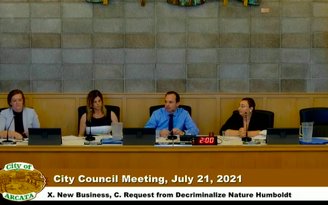
Arcata City Council discusses the resolution in July (back when the mask mandate had been briefly lifted) | Screenshot from video of the July 21 meeting
The reactions of the council were mixed.
Councilmember Sarah Schaefer — who placed the item on the agenda — and Councilmember Emily Goldstein both voiced complete support for the resolution, while Mayor Brett Watson and Councilmember Stacy Atkins-Salazar had some reservations. Councilmember Atkins-Salazar said that although she appreciated the stories from the community, she still had some concerns about the safety surrounding the use of psychedelics.
“I think a really important part about what you guys were talking about is that you had positive experiences because you must have had the right guidance and teachings and surroundings in which to do that,” Atkins-Salazar said to the crowd. “On personal accounts I have experienced — not myself but through other people — some very negative things when these types of medicines go wrong … and there can be very serious consequences.”
Councilmembers Schaefer said that, although she understood concerns around safety, she felt that there are other more dangerous drugs in the community that are legal. “I think psilocybin is a lot safer than Xanax or Valium or alcohol, for that matter. So I don’t think that’s really the scary concern here,” she said.
Mayor Watson said that he was not opposed to the decriminalization, but that he felt he needed more information before passing a resolution.
Ultimately, the council requested that the resolution be sent to the Public Safety Committee for review. After public review, the committee voted to support the resolution, recommending that the council add a stipulation that it is for “personal and private use” and include an educational component.
Working with a small group from Decriminalize Nature Humboldt, city staff reviewed and made edits to the resolution, which the council will consider during its Wednesday meeting. This will be the first time the resolution comes before Councilmember Meredith Matthews, who was appointed shortly after the July 21 meeting.
The Arcata City Council meets on Wednesday, Oct. 6 at 6 p.m. You can view the full agenda and directions on how to participate here.