County Moves Payroll Back Under Auditor-Controller’s Office Despite Serious Concerns Voiced by Employees
Ryan Burns / Wednesday, Aug. 25, 2021 @ 3:37 p.m. / Local Government

Auditor-Controller Karen Paz Dominguez. | Screenshot from Tuesday’s meeting.
###
Less than three years after the county moved its payroll function and staff from the Auditor-Controller’s Office to the Human Resources Department, the Board of Supervisors on Tuesday voted 4-1 to move it back despite serious concerns expressed by a number of fiscal staffers, middle managers and department heads.
In a thoroughly prepared, almost 40-minute-long PowerPoint presentation, Human Resources Director Linda Le, Auditor-Controller Karen Paz Dominguez and independent consultant Scott Johnson, a partner in the accounting firm of Macias Gini and O’Connell LLP (MGO), outlined the background and reasoning behind the recommendation to move payroll back to the Auditor-Controller’s Office.
Le argued that both a comprehensive staffing study and a comparison with operations in 12 other counties suggest that the move would improve accuracy and efficiency while enhancing internal controls.
Johnson agreed, saying the county should locate accounting systems analysts within the Auditor-Controller’s Office to help solve finance and payroll system issues.
Paz Dominguez said she’d been approached by Le five weeks earlier, and in a subsequent review of the county’s complex payroll processes, staff from both departments identified shortcomings in the system while improving collaboration and communication.
“Because of the success of this partnership, we now have a good model to follow for future recruitments and future all-hands-on-deck situations … ,” Paz Dominguez said. “I am excited to see where we can go now, and I believe we are modeling the behavior we want to see across the county.”
Johnson described this joint effort as a “pilot integration partnership” and said it has helped payroll run smoothly and reduce errors.
When their presentation was over, First District Supervisor Rex Bohn splashed some cold water on the Kumbaya mood, saying he’d received correspondence from a number of employees. “Their concerns are extreme,” he said.
Specifically, he brought up this letter, signed by 11 county employees, including payroll specialists, business managers and administrators from a variety of departments.
The letter says that while the recommendation to move payroll back to the Auditor-Controller’s Office “may make the most sense on paper, the current short-staffing of the AC office makes this recommendation at this time deeply concerning.”
Essential financial tasks affecting numerous departments are more than six months overdue, and emails to the Auditor-Controller’s Office don’t get any response beyond an auto-reply for months at a time, the letter says.
The employees suggest that a working group be formed and an interim solution be identified to manage payroll duties until the Auditor-Controller’s Office can staff up enough to manage its essential financial tasks.
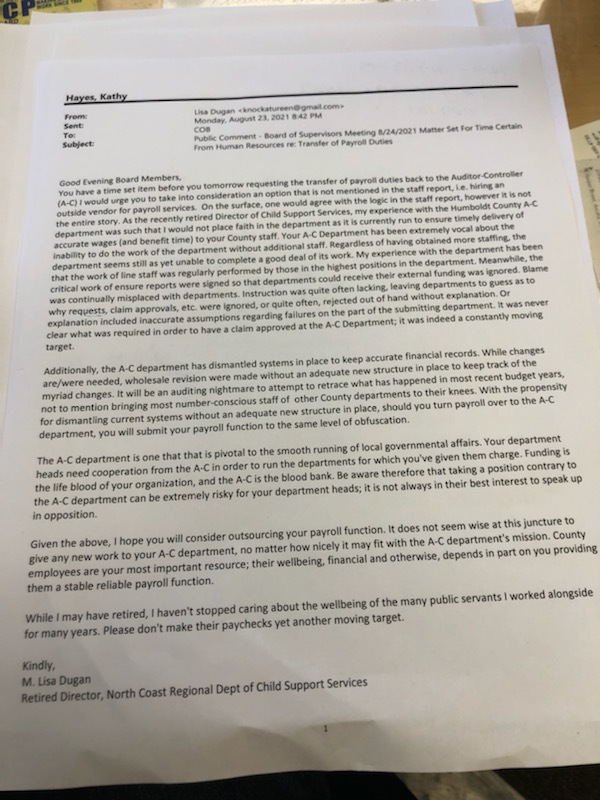
Another letter was sent by Lisa Dugan, the retired director of the North Coast Regional Department of Child Support Services. She urged the board to consider hiring an outside vendor manage payroll services, saying the Auditor-Controller’s Office often ignores or rejects claims without explanation and has a “propensity for dismantling current systems without an adequate new structure in place.”
Connie Beck, the director of the Department of Health and Human Services, also voiced concern about the proposed move, noting that the county’s single audit for the 2019-20 fiscal year has yet to be completed, which is putting the county at risk of losing millions in state and federal funding.
Beck said the Auditor-Controller’s Office hasn’t posted financial journal entries for her department since December — 300 entries totaling more than $74 million. “I could go on and on,” she said. “I can’t see us adding additional duties to an already overworked staff. … I’m super frustrated. It’s not fair that we have a couple departments causing so much work for our staff.”
Public Works Director Tom Mattson said that payroll actually does belong in the Auditor-Controller’s Office, “but she needs to have the resources to deal with it.”
The recommendation from Le’s office called for some of those resources — namely, the transfer of three full-time employees to the Auditor-Controller’s Office and the addition of two more.
Regina Fuller, the deputy director of administration at the Sheriff’s Office and one of the signatories to the employee letter, praised the presentation given by Le, Paz Dominguez and Johnson, though she noted that even management employees had been kept “completely in the dark” about the five-week collaboration between departments.
Paz Dominguez later defended the insularity of that collaboration, saying, “We have to clean our house before we have guests over. … We have to understand our own operations before we invite others.”
Le noted that a number of key payroll specialists have resigned or gone on leave, and Paz Dominguez said recruitment will be easier if the transition is made because new employees will then be trained by the qualified experts in her office.
Second District Supervisor Michelle Bushnell asked Paz Dominguez to address the concerns about adding more responsibilities to her undersized and overworked staff. In response, Paz Dominguez said she can understand how “fear of the unknown” can cause people to “scare themselves,” but she reiterated the value of the recent inter-department collaboration that’s been happening and argued, “There has to be a level of trust within our organization that you have hired the right people.”
Johnson, the independent consultant, assured Fourth District Supervisor Virginia Bass and her fellow board members that with help from eight employees in his firm, “things are getting caught up in [the Auditor-Controller’s] office.” And he praised the collaborative efforts from Le and Paz Dominguez.
Bohn remained skeptical, asking why it has taken two and a half years and the addition of multiple new staffers, plus outside help, to start making progress on solving the county’s various fiscal fiascoes. (Johnson clarified that his eight employees aren’t working there full time.)
Third District Supervisor Mike Wilson said that all the available paths forward are probably going to be “a bumpy road.”
“Not one of them is rainbows and unicorns at the end,” he said. But he said the county’s long-term goals for payroll management align with the recommendation to move payroll back to the Auditor-Controller’s Office. He said the concerns expressed by employees are legitimate but there would also be impacts to not moving forward as recommended. He likened county payroll to a body’s nervous system. “We have to make sure it’s functioning,” he said.
Scott Adair, the county’s economic development director, urged the board to listen to the concerns expressed by fiscal management staff in their joint letter, and he recalled his own department’s difficulties in getting $3.1 million in COVID relief funds distributed to recipients in the community due to delays involving the Auditor-Controller’s Office. Challenges in employee retention and recruitment have exacerbated the serious challenges the county’s had in fiscal management, Adair said.
Kara Fales, a previous member of the county’s payroll staff, called in to encourage the board to leave payroll out of the Auditor-Controller’s Office for the time being given the ongoing problems and staffing shortages there.
The board wound up deliberating for a couple of hours, debating which way to move forward. Bass and Bushnell suggested regular reporting from the Human Resources Department and Auditor-Controller’s Office regarding the payroll transition. The suggestion for a working group was tossed around before being dismissed as too complicated and time-consuming.
Bushnell made a motion to move the payroll function and staff as recommended and to require biweekly reports. Bass seconded the motion. At the suggestion of county counsel, the board agreed to make the reporting a joint effort between the two departments.
Interim County Administrative Officer Elishia Hayes then said that Cheryl Dillingham, a longtime county employee with experience in both the County Administrative Office and the Auditor-Controller’s Office, could be available to help in the payroll transition.
The board wound up voting 4-1, with Bohn dissenting, to approve the “payroll realignment integration,” moving the responsibility back to the Auditor-Controller’s Office less than three years after it was taken away.
BOOKED
Today: 3 felonies, 8 misdemeanors, 0 infractions
JUDGED
Humboldt County Superior Court Calendar: Today
CHP REPORTS
2420 Railroad Ave (HM office): Trfc Collision-No Inj
ELSEWHERE
RHBB: Magnitude 3.7 Earthquake Centered East of Hydesville
RHBB: Motorcyclist Injured in Solo Crash at 14th and California in Eureka
RHBB: Southbound Highway 101 Traffic Backs Up From Richardson Grove to Benbow
RHBB: Woman Suffers Possible Leg Fracture in Dyerville Loop Road Motorcycle Crash
Monument Fire Has ‘Lots of Potential’ to Spread as Weather Conditions Worsen, Firefighters Say; McFarland Fire 73 Percent Contained
John Ross Ferrara / Wednesday, Aug. 25, 2021 @ 11:15 a.m. / Fire

The latest Monument Fire map. | InciWeb
Monument Fire
The Monument Fire burning along Highway 299 in Trinity County between Burnt Ranch and Weaverville is now 154,344 acres in size and remains 20 percent contained.
A team of 1,915 firefighters is currently working on the fire, including 26 hand crews, 148 engines, 14 helicopters, 52 dozers, 47 water tenders, 3 skidgines, 3 masticators and 21 excavators.
After several days of minimal spread due to a thick layers of smoke blocking out the sun, firefighters say clearer skies are now allowing solar radiation to influence the fire’s behavior.
“This fire still has lots of potential,” Alaska Incident Management Team Operations Section Chief Karen Scholl said. “Smoke has kept a lid on the fire for the past few days.”
Slightly cooler temperatures and stronger winds are forecast for today.

Heavy Equipment operators take a break in Division E. | Photo by Heavy Equipment Boss Andrew Snyder
The Trinity County Office of Emergency Services is urging people to sign up with the CodeRed emergency alert system for the latest evacuation information.
Evacuation Orders: In effect for Hayfork north of Highway 3, Sky Ranch Road and Dutch Creek.
Evacuation Warnings: In effect for Big Bar, Big Flat, Burnt Ranch, Douglas City, Junction City, Weaverville, areas south from Barker Mountain to Haystack, the north side of Hyampom Road from Hayfork to 9-mile bridge, Denny, Hawkins Bar and Trinity Village. For detailed evacuation information, visit the Trinity County Sheriff’s Office Facebook.
Evacuation Centers: American Red Cross Shelters have been set up at Shasta College, 11555 Old Oregon Trail, Building 1900, Redding CA; Willow Creek Bible Church, 39 Brannan Mountain Road, Willow Creek, CA; and Fireman’s Hall Pavilion, 9 Park Street in Fortuna.
Animal Evacuation: (Domestic animals) Trinity County Animal Shelter, 563 Mountain View St, Weaverville, CA (530- 623-1370). (Domestic + Large Animals) Hoopa Rodeo Grounds on Pine Creek Rd, Hoopa, CA. (Large Animals with the exception of Swine): Redding Rodeo Grounds, located at 715 Auditorium Dr., Redding, CA (Sandy Ekman (530) 739-8469)
Clean Air Center:
Trinity County has established a Clean Air Center at the Trinity County Library, 351 Main Street, Weaverville. Hours are Monday, Wednesday and Friday from 1-6 p.m. and Tuesday and Thursday from 10 a.m. to 6 p.m. The Clean Air Center at the Murray Building at 6641 Highway 3 in Hayfork has been closed due to fire activity.
Highway 299 remains closed Between Berg Road and East Fork Road.
A damage assessment team confirmed that 50 structures have been destroyed by the fire. For information regarding property damages, contract the Trinity County Office of Emergency Services at (530) 623-1116.

Photos of the McFarland Fire by Heavy Equipment Boss Will Bojorques. | @ironwill707 on Instagram
McFarland Fire
The McFarland Fire burning along Highway 36 in Trinity County is now 119,560 acres in size and is 73% contained.
A team of 875 firefighters are currently working to contain the blaze, including 17 hand crews, 69 engines, 7 helicopters, 45 dozers, 20 water tenders and 3 masticators.

“Overnight, crews were able to finish burning operations, completing solid containment lines in Beegum Gorge and patrolled the rest of the fire,” the fire’s incident management team stated this morning. “Today, crews will continue to strengthen lines in Beegum Gorge and along Highway 36. If conditions permit, they may burn out some green islands inside the perimeter. Firefighters will watch for and extinguish any hots spots near containment lines and mop up.”
A damage assessment team has confirmed that 24 homes and 22 other structures have been destroyed by the fire. One additional home was confirmed to be damaged by the fire. Damage assessments are ongoing. A map of the destroyed structures and images of the properties can be found by clicking this link: visit:https://arcg.is/1Pu8GW
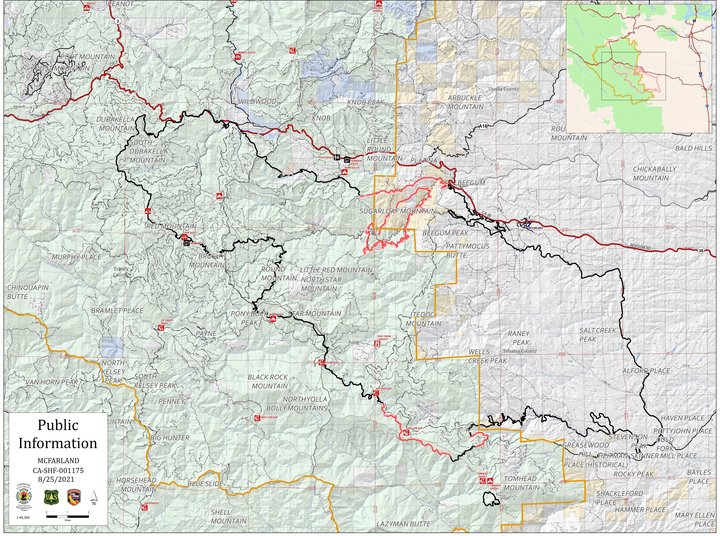
The latest McFarland Fire map. | Inciweb
Evacuation Orders and Warnings:
Shasta County
ORDERS: The Shasta County Sheriff’s Office has issued a mandatory evacuation order for all residents within the township of Platina. The evacuation order includes all residences and roadways from the Trinity/Shasta County line east to the Shasta/Tehama County line. Residents are encouraged to use Platina Road as an evacuation route. There will be a temporary evacuation site at the Igo/Ono Elementary School. https://www.facebook.com/ShastaSheriff
Tehama County
ORDERS: The area west of Vestal and Weemasoul Roads to the Shasta/Tehama County line and south of Highway 36 in the fire area.
WARNINGS: Highway 36 from Bowman Road west to the county line and north to the Shasta County line (Zone 157). The area south of Highway 36, east and north of Vestal Road, and west of Cottonwood Creek (Zone 158). Click here to view the map for Tehama County: https://tinyurl.com/Evacuation-and-Road-Closure
Highway 36 remains closed between Harrison Gulch to Vestal Road.


Quarantined: A New Law Is Disrupting California School Reopenings
Joe Hong / Wednesday, Aug. 25, 2021 @ 10:52 a.m. / Sacramento

Kayden Christiansen and his mother, Heather Christiansen, at their home in Simi Valley. Kayden, a fifth-grader, was in quarantine for 10 days shortly after his California school reopening. Photo by Shae Hammond for CalMatters
###
Heather Christensen got an email on Aug. 14 from her son’s school, saying her 10-year-old had been in contact with a classmate who tested positive for COVID-19.
As required by California health guidelines, Christenson’s son Kayden would have to quarantine at home for 10 days.
“It was only the fourth day of school,” she said. “He’s missing out on not only his friends, but he’s stressing out about falling behind.”
Kayden’s teacher at Madera Elementary in the Simi Valley Unified School District near Los Angeles provided a packet for him to complete during the 10 days of quarantine. Christensen said Kayden finished it in three days and has since then spent his time watching TV and playing video games.
As California schools reopened amid the spread of the more transmissible and deadlier delta variant, student quarantines became commonplace within days. San Francisco Unified reported 64 positive cases among students within the first week of opening. On Tuesday, Los Angeles Unified reported about 6,500 students were in isolation a week after school started.
But a new state law is undermining the ability of schools to keep these quarantined kids engaged. Its provisions attempt to stretch independent study — a program intended for long-term remote learning — to meet the spontaneous, short-term needs of students temporarily quarantined.
Schools say they are unable to hire the teachers required to provide independent study for these quarantined students. As a result, they can languish in an educational limbo, while schools risk losing state funding for the days they are technically “absent.”
At Simi Valley Unified, Superintendent Jason Peplinski says the district lacks the staffing needed to offer any substantial instruction to students like Kayden.To make matters worse, he says the district might lose state funding, which is based on attendance, due to its failure to deliver instruction during quarantines. With about 250 students already in quarantine as of last week, Peplinski estimates the district will lose $13,000 a day.
Nor can many schools meet the needs of a growing number of parents — concerned about the risks of the delta variant — who are seeking to move their kids into more permanent independent study.
“What they did was they wrecked both programs. I know legislators are well-intended people, but they didn’t have enough educators’ perspectives.”
— Jason Peplinski, Simi Valley Unified District Superintendent
At San Francisco Unified, 800 students recently applied for independent study to avoid the spread of the delta variant, more than doubling the number of students who registered before the school year started last week. A spokesperson for the district says there might not be enough teachers to accommodate these students.
District superintendents say the new state law has forced a marriage between independent study and distance learning, further disrupting school reopenings already threatened by the delta variant.
“What they did was they wrecked both programs,” said Peplinski. “I know legislators are well-intended people, but they didn’t have enough educators’ perspectives.”
Independent study — not a catch-all solution
Independent study existed long before the pandemic. This mode of instruction worked best for traveling athletes, child actors and students who wanted to advance more quickly.
Students would collect packets from their schools and complete them on their own. Teachers typically weren’t required to contact students frequently, but that varied depending on their individual needs.
“Independent study is not appropriate for all kids,” said Peplinski. “The only kids that can really choose independent study are the ones who can stay at home with child care.”
State legislators drastically changed these rules just weeks before California schools reopened for the first fully in-person school year since the start of the pandemic.
After the devastation of school closures, distance learning became a radioactive term for legislators. Since the start of the pandemic there’s been little accountability for both students and teachers. Attendance and grades plummeted. Younger learners especially became disengaged. English learners and students with disabilities fell disproportionately behind.
Independent study provided a template to fix distance learning for the small percentage of students whose parents weren’t yet comfortable with sending them back to campuses.
The new law’s provisions “enhanced the existing program to ensure students receive comparable curriculum and increased time with teachers,” said Democratic Assemblymember Patrick O’Donnell of Long Beach, chair of the Assembly Education Committee. “As we start the new school year, we will monitor and contemplate adjustments if needed.”
A spokesperson for the committee’s vice chair, Republican Kevin Kiley of Rocklin, said the distance learning of last year was never meant to be a permanent solution. “Legislators were trying to draw a hard line,” said spokesperson Josh Hoover. “and say schools need to be open in person, and distance learning is no longer on the table.”
But superintendents say the legislation signed by Gov. Gavin Newsom on July 9 overcorrected for the shortcomings of distance learning by forcing districts to completely redesign independent study programs as the only alternative to in-person instruction.
“At the elementary level, it can easily mean a student may not have a spot when they choose to return.”
— Don Austin, Palo Alto Unified District superintendent
Districts are now required to provide students with live instruction as a part of independent study. Teachers have to work with parents and students to design a plan of study. Student-teacher ratios for independent study cannot be higher than district-wide averages.
And under the new state law, if a student decides to move back to in-person instruction, the district has five days to comply. This could be a logistical nightmare considering that many class sizes have already hit their maximum.
“In middle and high schools that’s not just one student, it’s one student times the number of classes they take,” said Don Austin, superintendent of Palo Alto Unified. “At the elementary level, it can easily mean a student may not have a spot when they choose to return.”
Austin and his team ultimately decided to hire a third party to manage its independent study program. The district is paying an additional $3,000 for each of its approximately 230 students enrolled.
“We had to figure out the rules from the Legislature in one month,” he said. “It was pretty out-of-touch.”
As classes resume, independent study meets the delta variant
According to district officials and their lobbyists in Sacramento, the new independent study rules were approved during a more optimistic time when vaccination rates were rising and the pandemic seemed to be receding.
“In defense of the governor and Legislature, it was a whole different set of circumstances,” Snider said. “COVID was trending down. The delta variant spike changed everything.”
At San Francisco Unified, 700 students had signed up for independent study by the district’s initial July 30th deadline. But after more parents expressed interest out of fear for the delta variant, the district extended the deadline to Aug. 27. So far, 800 additional students have signed up. Staffing is the most urgent concern.
“We’re already experiencing a teacher shortage,” said Gentle Blythe, a spokeswoman for the district. “Trying to add teachers to independent study just exacerbates that challenge.”
At Nevada Joint Union High, a district of about 2,500 students, the independent study program is already full. After seeing 30 COVID cases within the first three days of school, Superintendent Brett McFadden said he expects more parents to request a switch to independent study.
“Right now with the explosion of the delta variant, the only other option is independent study,” he said “But all of us only have so many teachers who can teach it.”
The irony of this moment is not lost on lobbyists like Snider. With this year’s state budget, California’s schools are getting more money than ever. But money won’t create more teachers, he said.
“The disconnect is that Sacramento has given districts buckets of money to hire, but there’s no one to hire,” he said. “We’re bleeding more teachers than we can recruit.”
###
CALmatters.org is a nonprofit, nonpartisan media venture explaining California policies and politics.
Escaping Outreach: Former Members of Eureka Church Say It’s a Cult With a History of Hiding Sexual Abuse
Ryan Burns / Wednesday, Aug. 25, 2021 @ 7:15 a.m. / Our Culture

Gospel Outreach of Eureka. | Photo by Ryan Burns.
Back in May, two former members of Gospel Outreach of Eureka, a church that grew out of the Christian hippie commune at Lighthouse Ranch, contacted the Outpost to report a COVID-19 outbreak among the congregation. However, they wound up talking more about the church itself — with the enthusiasm of people who’ve been waiting to tell their stories.
They described the tight-knit congregation of roughly 150 people as zealous and insular and the church as a place where children are forced to spend long hours singing, arranged marriages are the norm and negative emotions are considered selfish and sinful.
In the days that followed, other former members reached out wanting to tell their own stories.
“I grew up in the church and it’s a dark place,” Christen Chauvin said in an email.
Another emailed later that day. “I left/escaped from there when I was 19,” she wrote. “I would be willing to talk to you about the abuse I witnessed and received.” She asked to remain anonymous to protect younger siblings still in the church. We’ll call her Sarah.
Eventually, we spoke at length with seven former members of the church, all of whom felt it was important for the larger community to know what goes on there.
The Outpost was unable to confirm the COVID outbreak — emails and voicemails left with Gospel Outreach went unreturned, and when we knocked on the church’s doors, no one answered. We also sent emails and left voice messages asking to speak with church leadership for this story but got no response.
The 8,000-square-foot church resembles a convention center, with the peaked roofline of its cream-colored exterior set off against a backdrop of spindly redwoods. The building sits at the back of a large parking lot down a dead-end street originally called “Holy Spirit Lane.” Jutting off Harris near Redwood Acres, the short road is now named St. James Place, though people familiar with the church — even some of its members — refer to it as the “cult-de-sac.” The suburban-style tract homes lining St. James Place are filled almost exclusively with members of the church.
“It’s definitely a cult,” said Esther Mandville, a 24-year-old former member who was raised in Gospel Outreach. “It did take me a year to realize that, but I would definitely describe it as a cult.”
As evidence, she and others described a pattern in which children attend a church-run school, girls’ primary career path is teaching in the school, boys can aspire to work in a handful of businesses owned by church members, male elders confer to arrange marriages and family ties make the prospect of leaving feel nearly impossible.
Former members also allege that elders and other adults regularly discouraged and dismissed reports of physical and sexual abuse of minors, allowing the abuse to continue and spread to others. Most of these allegations concern incidents from many years ago that were not reported to law enforcement or child welfare services, making them impossible to corroborate via official records.
Unlikely origins
Gospel Outreach emerged from the hippie utopia that was Lighthouse Ranch, a commune of ragtag spiritual seekers, recovering addicts and countercultural Jesus People who, during the 1970s and ‘80s, lived and worshiped at the abandoned Coast Guard station that once sat atop Table Bluff.
Born at Lighthouse Ranch, the Gospel Outreach movement aims to proselytize every last soul on Earth in hopes of prompting the Rapture. In the early years it morphed and expanded under the charismatic leadership of Pastor Jim Durkin.
Ray DeSoto, who grew up in the church with his brothers, described Durkin as “a positive character” who would welcome homeless refugees from the beach into his religious commune.
In the ‘70s and ‘80s the Gospel Outreach movement spread around the globe, establishing churches in U.S. cities from Alaska to Hawaii to New York and sending missionaries to Europe and Central and South America.
Notably, Guatemalan dictator Gen. Efrain Rios Montt became a convert and, following a 1982 military coup in that country, he employed Gospel Outreach in the notorious rural pacification program known as “beans and bullets.” Church members supplied food, medicine and clothing to local residents before Montt’s forces came in and razed their villages, killing hundreds of indigenous Mayans and rendering survivors wards of the government.
Power struggle
Celeste Villareal was nine when, in 1997, she, her mom and stepfather joined Gospel Outreach after moving to Eureka from Mexico, where they’d been doing missionary work.
At that time, the church still had “the last vestiges of the hippie Jesus movement from Lighthouse Ranch,” she said. “Members would be barefoot, running around with ribbons on sticks.”
Durkin’s death in 1996 had created a leadership vacuum – and a power struggle – within the organization. Many church members assumed that Durkin’s son, Jim Durkin, Jr., would take over, but instead it was a man named David Sczepanski, who’d been among the early residents at Lighthouse Ranch. (He can be seen in video clips from the period.)
Around 1999, Villareal said, leaders from Gospel Outreach Eureka began meeting more frequently with leaders from sister churches in Grants Pass and Olympia.
“After [these meetings], church families would go up to Lighthouse Ranch, and there’d be just hours of us kids doing whatever we wanted,” she said. “It was very loose, not a lot of parental oversight. We’d climb trees for hours, run down to the beach, jump off the bluffs. Boys and girls were very much equals.”
Villareal remembers an elder or pastor from the church in Grants Pass questioning this practice. “He said, ‘Oh, you let girls play paintball and tug of war with the boys?’” she said. After that, “girls were not allowed to play paintball. When there was a potluck, girls would bring a dish. There were these ingrained gender roles. We were expected to stay in the kitchen. That’s when the big shift happened, when we became more cultish.”
‘Brainwashing’
Villareal, Chauvin and others said things grew even more regimented around the turn of the century when Gospel Outreach opened a full-time school. The teachers were women from the church, none of them accredited.
“We never had a consistent science class. No biology. Our history [classes] relied a lot on the Bible,” Villareal said.
Abigail Mandville, Esther’s younger sister, said instruction — both in school and out — was more about indoctrination than education.
‘Brainwashing is kind of an overused phrase, but it really is brainwashing.’
“As a child there’s — how I describe it is brainwashing,” she said. “From the moment you’re born you start memorizing catechism.” She means Martin Luther’s Small Catechism, a book published in 1529 to teach kids about the Ten Commandments, the Sacrament of the Eucharist and other elements of Lutheran faith.
There was also a huge emphasis on music. “By the time you got to a certain age, 11 or 12, you would be expected to join the worship team and the choir that sings every Sunday,” Abigail said.
Questions and independent thought were discouraged. “When I’d try to say something from my own opinion, they would kind of attack you,” Abigail said. “They wanted you to adhere: Don’t stray off the script.”
Chauvin got the same message. “It’s all very interesting, looking at it afterwards,” she said. “Brainwashing is kind of an overused phrase, but it really is brainwashing.”

Many Gospel Outreach members live in the suburban-style homes along St. James Place. | Photo by Andrew Goff.
‘The sky is green’
Much of the education at Gospel Outreach reinforced the church’s strict gender roles, which call on women to be subservient, according to the former members we spoke with.
Chauvin recalls watching the movie version of Taming of the Shrew because “it fits into their theology very well,” she said. In Shakespeare’s play, a man named Petruchio marries then “tames” a headstrong “shrew” of a woman, Katherina, by employing psychological torments — telling her the sun is the moon, for example, until she agrees, at which point he says the opposite. Petruchio also tortures her by withholding food and water until she becomes compliant and obedient.
Abigail said Gospel Outreach’s instruction used similar tactics. “They’d say [to students], ‘The sky is green?’ and we’d say, ‘Yes.’ ‘The grass is blue?” ‘Yes.’ You’re supposed to repeat back illogical things to teach you not to disagree with what the leadership tells you.”
She and others said the phrase often employed to reinforce this lesson is “come under.” Anyone showing signs of independent thought would be told to “come under” their leader, be it a babysitter, a soprano coach or an elder.
Villareal agreed self-expression was discouraged.
“The mentality is that everybody is totally depraved,” she said. “If you do something well, that’s God working through you. If you do something evil? That’s you. … And if you point out that something’s wrong or doesn’t seem right? That’s you having independent thinking. That’s frowned on.”
Giving your all
Chauvin, who is now 34, was entering sixth grade when the Gospel Outreach school opened, and she remembers it as a turning point. “It became something where your whole life is that church,” she said. “The thing that’s really hard for people who grew up in this religion is knowing how to explain how it’s a cult. So much of it is being told the same thing over and over again until you develop a language and phrases not used in the outside world.”
Sarah remembers the schedule as exhausting. “The school is extremely emotionally abusive and taxing,” she said. “All the music, the meetings — you’re hardly sleeping. I would often get three or four hours [of sleep] a night because there was always a new recital or a project or a play.”
“I definitely suffered from sleep deprivation and insomnia,” Esther Mandville said. “I also wasn’t eating properly.” Eating disorders were common among girls in Gospel Outreach, Mandville said.
Skipping meetings and playing hookie weren’t really options, according to DeSoto. “You did go to any and all choir practices or else your zeal was questioned,” he said. “If you weren’t daily giving your all for the glory of Christ, why were you even here? There was this sort of false positivity you have to maintain all the time, which can be taxing.”
Gospel Outreach School is registered with the California Department of Education as a nondenominational religious private school offering first through 10th grades. It does not award high school diplomas or offer special education. Sczepanski is the executive director and sole administrator.
Chauvin said that when she turned 16 she was told that it was time for her to be done with school, so she took the high school proficiency exam.
“Then I became a teacher in the school for free,” she said. “I taught for the next three years. I taught pre-algebra. They don’t go very high — just Algebra 1. … In the morning you’re doing math and language, basic subjects. We never really got much science or literature. Then after lunch all we would do is sing until 3 or 3:30. Sometimes we’d come back in the evening for more singing.”
Villareal and Esther Mandville were also enlisted to teach at age 15 or 16. “For a woman, that was pretty much the only career option until you’re a mom,” Mandville said. “You could be a teacher or you could work in one of the businesses” owned by church members, including North Coast Floor and Tile, SameDay Auto Scratch and Dent Repair and, until it was recently sold, New Life Services Company.
Be zealous and repent
The former Gospel Outreach members said punishment was typically meted out — both at home and at school — in one of three ways: monetary fines, psychological torment or physical violence.
“We’d be encouraged to brag about the spankings we got,” Villareal said. “It was how we knew our parents loved us — because they cared enough not to spare the rod.”
Then there were the fines. “We were charged $20 fines if we left something at home,” Esther Mandville said. “Like, I’m 9 and I forget my notebook — that’s $20.” She paid her debts by doing odd jobs like babysitting and car washing.
Worse was getting singled out for judgment.
“My teacher from age grades five through 12 would laugh at us and berate us,” Villareal said. “She took her pen to mark up my arm and then told me I wasn’t allowed to wash it off. … She’d make fun of how I dressed.” (Though the school is only accredited through 10th grade, Villareal said, “The boys generally continue taking classes until grade 12, [and] the girls will only take select classes if any at all past age 16, as they’re generally placed in teaching positions.)
DeSoto said kids are expected to maintain a cheerful demeanor. “I remember as children being told that being grumpy because you’re tired — because you’ve been practicing choir for four hours, plus school and then choir for two hours after — is not an excuse. The tiredness is just showing your true soul, so you need to repent for being grumpy.”
The most stressful scenario for many of the kids came during the morning circle meetings, where students would gather with Pastor Sczepanski to talk about his latest sermon and other spiritual matters. Regularly, our sources said, one student would be singled out for some infraction, such as having a bad attitude or failing to recite the Ten Commandments, and be made to confess and repent.
“The circle meetings usually end up with everyone fiercely berating one person, trying to get them to break and give themselves over, like breaking a horse,” Chauvin said.
“I think a lot of times the students were just looking for who was going to be the one that day,” DeSoto said. “There was this self-policing to find the one who was the most out of line so everyone could gang up on that person to explain why they were utterly failing and in sin and need to repent. Quite often that reason is just made up.”
Esther Mandville said the only way to get off the hot seat was to admit guilt and show remorse, even if it was a performance.
“They would push you for honesty but if you weren’t giving them what they wanted you had to make it up,” Mandville said. “There were scripts you could follow. Sometimes I would have to make up a sin, like, ‘I’ve been really hating my brother’ or ‘I’ve been thinking about sex and that’s bad.’”
DeSoto said the cruelty of these scenarios didn’t really become clear to him until after he left the church and had some time to reflect.
‘Eventually someone cries and then we can go to choir practice.’
“Myself and other former cult members jokingly say, ‘Remember when they’d lock us in a room until we made another kid cry?’” he said. “Eventually someone cries and then we can go to choir practice — it was really so predictable like that. Two to three days a week that would happen.”
The strictly enforced insularity of Gospel Outreach acts as a containment mechanism, a way to keep members dependent and submissive, DeSoto said. Anyone who finds themselves on the outs will be shunned completely.
“If you had a disagreement, you could be ostracized from the community in a moment,” he said. “Certainly, as a kid, if you got in trouble at school you were in trouble in literally every aspect of your life. If your homework assignment was late you weren’t allowed to go to choir practice or play on the weekend. In this strange way it pushed you to be part of the community 24/7. You’re in constant fear of being ostracized because the community is honestly all you know.”
Arranged marriages
The former members of Gospel Outreach said talking to people from outside the church was discouraged, and so virtually all social interactions, including work, school and family, occurred within the group.
“Most of the marriages are arranged,” said Anne Robinson, another former Gospel Outreach member. She explained that the men will often talk among themselves and decide, “My son will marry your daughter.”
Villareal said sometimes a young man will initiate matters by going to his father and saying he’s ready. Maybe he has a specific bride in mind. “His dad would then talk to the elders, and if the elders approved they’d quiz [the young man] to make sure he could support a family, buy a house and a car, that he had money in the bank, etc. If the elders decided he qualified, they’d recommend someone to him for marriage,” she said.
Young women tend to accept their fate. “They’re not telling you you can’t say no, but I guess I would say it’s frowned upon,” Sarah said.
Chauvin actually wanted to get married, “but I was looking around at my selections. It was not a large pool,” she said. “These were guys I grew up with. I thought of them like brothers. I couldn’t imagine being romantic with any of them. Now I think, ‘Thank God I’m out.’”
Sarah said she’s not surprised that most Humboldt County residents have no idea such a community exists right here in Eureka. “You don’t think of a cult as something you see every day — you think of it as, like, sister wives and all that,” she said. “That’s not what this is. It’s a lot more subtle.”
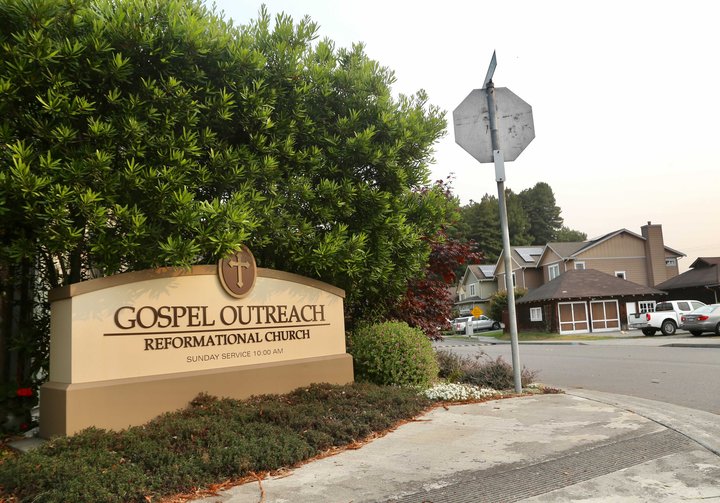
A sign for Gospel Outreach faces Harris Street near the entrance to the McKay Community Forest. | Photo by Andrew Goff.
Shameful and hidden
Villareal said her stepfather regularly abused her and her mother for years, starting shortly after he married her mom, continuing during their missionary work in Mexico and following their move to Humboldt County.
“He would abuse us both, but instead of banding together, we would turn against each other,” Villareal said.
She described her stepfather as excessively controlling and emotionally volatile, often having “all-out screaming arguments” with her mom and regularly spanking Villareal for such transgressions as getting an answer wrong in her multiplication tables.
Her mom suffered from gaps in her memory due to the emotional and physical trauma, Villareal said, but when she tried to talk to other women in the church about the abuse she was told to “come under” and stop gossiping.
She said her stepfather would play emotional games that kept her up well past midnight. “It was part of his controlling thing,” she said. “He’d accuse you of doing something … . You’d have to spend hours searching your soul … . He’d make me stand in the middle of the room. There were countless times I’d wake up when my body was hitting the floor.”
He would also take her clothes from her as punishment, she said, ordering her to get naked and do chores, a form of discipline she remembers being particularly disturbing when she was 12, 13, 14 years old and “very much struggling through puberty.”
Her mother declined, through her daughter, to be interviewed for this story. Reached by phone, her stepfather declined to comment on any specific things Celeste alleged, but in general, he said, “I really don’t want to tear down the church and I think that she’s not accurately representing the way that I raised her.”
Now pursuing a career as a police officer, Villareal has gotten training in how to recognize signs of abuse. Looking back, she realized that in her teens she ticked all the boxes.
“Others too,” she said. “Kids wetting the bed way too old, kids with speech impediments past when they should. All of that, as a child, that’s [treated as] your problem: ‘Why can’t you talk right? Why can’t you stop peeing the bed?’ Or it was shameful and hidden, just not brought up.”
One day, feeling numb and depressed, Villareal went to church without doing her hair or makeup. Another girl’s mom approached her and commented on her appearance. “She said something like, ‘Remember, we don’t put care into our appearance for ourselves; we do it because there are people here who have to look at us.’”
To Villareal, this hammered home a message she’d been getting all along at Gospel Outreach — that women are accessories who should look nice, regardless of what they may be feeling.
“About a week later I attempted suicide,” she said.
After the attempt, she remained despondent and numb. Eventually, she said, one of the dads recognized that she was suffering — a rare thing to acknowledge at Gospel Outreach, Villareal said — and asked what was wrong. She told him it was stuff at home that she wasn’t comfortable talking to him about and he asked if there was a woman she’d like to speak with. She chose the woman who’d been her regular teacher during much of her education, a stern and sometimes cruel woman — the same one who’d written on Villareal’s arm and mocked how she dressed — but one who seemed capable of getting her way. Villareal confided in her, telling her about the abuse she’d been suffering at the hands of her stepfather, including his habit of taking her clothes.
“She asked if anything was sexual,” Villareal said. “I felt like the thing I told her was. … My stepdad makes me do my chores naked and you’re asking me if this is sexual? … I was like, ‘What do you mean?’ She said, ‘If you have to think about it, it probably wasn’t.’”
‘She told me … if I became virtuous then the Lord would give me a husband and take me away from all the abuse.’
Villareal was at a loss. With her mom stuck in the same cycle of abuse, she had gone to the only person she could think of who might be able to help and instead felt dismissed.
“She told me if I just put my head down and ‘come under,’ if I became virtuous, then the Lord would give me a husband to take me away from all the abuse.”
Your father’s nakedness
At Gospel Outreach, an all-male group of elders sits atop the hierarchy. Every weekday at 7 a.m. they hold a “men’s meeting” where they pray, drink coffee and discuss various matters, sometimes rendering binding decisions on issues ranging from child discipline to marriage approvals.
DeSoto remembers being intimidated when, as a teenager, he became one of the boys tasked with preparing and serving coffee to the elders at these meetings. “As a child you see this weird inner sanctum vibe going on,” he said. “There’s this divide: That’s the men’s meeting.”
Chauvin and Sarah recounted how their own stories of abuse were met with dismissive attitudes and religious slogans.
“The phrase they’d use is, ‘Don’t uncover your father’s nakedness,’” Chauvin said.
That’s a reference to a passage in Genesis in which one of Noah’s sons, Ham, finds his dad drunk, passed out and naked inside a tent, and instead of covering him up tells his brothers about it. As punishment for shaming him, Noah curses Ham’s offspring to a life of slavery. (This same passage was employed by Christian slavers as justification for human bondage.)
“Basically the culture [of Gospel Outreach], with the ultimate leadership being the men, it really lends itself to abuse,” Chauvin said. “The father is the ultimate authority. It starts with spanking but leads to much more … and reporting it is considered uncovering your father’s nakedness.”
Sarah said she was beaten and molested by a younger church member. “He was very physically abusive and my parents would tell me it was my fault because I was antagonizing him,” she said. “He would punch me, push me into the wall, this or that. My arms would just be bruised, black and blue, and my parents would be like, ‘Don’t antagonize him.’”
The abuse didn’t stop there. “When I was nine— .” Her voice broke. “Sorry, I’m gonna cry. He had sexually abused me. I told my mom and [my parents] had him buy me a new pair of rollerblades. That was it. And we never talked about it again.”
Sarah blames the church culture more than her own parents. “My parents didn’t intend on being morally wrong [or] bad parents, but they take all their issues to the church. The women were always covering for the men, and if the men did find out about abuse that was happening, the women were told that the men would take care of it.”
One case that all seven of the former Gospel Outreach members talked about involved a boy who, as a teenager, allegedly molested a number of young girls. Because he was a minor when the alleged abuse took place and has not been convicted of the crimes, we’ll call him Todd (not his real name).
Chauvin was working as a part-time teacher when she first heard that Todd had molested two girls. The mother of one of the victims caught him when he was pushing her daughter on a swing, she said. “The mom came out [of her house] and saw that he’d pulled her underwear down and was touching her in her private areas,” Chauvin said. “She freaked out. She stopped it immediately and told the leaders. I was at school with [the mom] that next day, and she privately spoke [to another teacher] in the kitchen. She was horrified and so angry.”
David Sczepanski, the pastor and sole school administrator, was brought in. “Anything like this is dealt with in the men’s meeting because women are not in charge of anything,” Chauvin said. She was told that Sczepanski had a talk with Todd and warned him not to do anything like that again or else Sczepanski would be legally obligated to report him.
Regardless, according to Robinson, Todd did go on to abuse other girls – and she was one of his victims.
“I was four or five; he was 15 or 16,” she said. She initially didn’t tell her parents or anyone else about it. “At the time,” she explained, “I believed I was respecting my elders.” She eventually told her mom what happened but said her mom chose to keep it private.
‘That was one of those things that was swept very much under the rug. I mean, it’s molestation.’
DeSoto had heard about Todd’s crimes and said the cycle of abuse expanded. “That situation developed into [some of] those young kids, the victims, reenacting those experiences with other very young children,” he said. “Anytime you experience that — a young child playing sexual games — you can assume they were also victims of abuse. That was one of those things that was swept very much under the rug. I mean, it’s molestation.”
Robinson and others said that eventually Todd wound up admitting to at least some of the crimes he’d been accused of, but his only punishment was that he wouldn’t be allowed to marry anybody in the church.
Robinson, meanwhile, was treated differently after word spread about her allegations. “People looked at me like I was the problem, like I asked for it,” she said. “In the church, when they find out you’ve been touched, you’re [considered] dirty. … You’re no longer pure in the eyes of God.”
As for Todd, he’s still a regular member of the church.
“The last time I was there,” Robinson said, “he was teaching the kids Sunday school.”

An stage adorned with American flags was recently erected on the basketball court across from the church.
Suffer little children
Abigail Mandville began cutting herself around the time she turned 17. She realized after leaving the church that she’d been suffering from depression for years by that point.
“I would cut my legs, just places nobody would see — higher up on my thighs. I did it to my shoulders as well,” she said. “At one point it was all I could do to feel. I don’t know; that was my coping mechanism.”
As she grew older she tried harder to fit in and make people happy. She even told her parents about the cutting, and they were sympathetic.
“At first my dad didn’t think it was that big of a deal — he thought it was just my hands,” Abigail said. “At some point — I think it was when we went swimming in the summer — he saw the scars on my legs.”
She was told to go talk to Pastor Szcepanski and his wife. “He prayed over me and said I had unconfessed sins and that [my cutting] must have something to do with that.”
At age 11 she’d been diagnosed as diabetic, a condition that required her to get regular insulin injections. “That also had a big part to play in me staying in the church for so long,” she said, “because they don’t teach you how to live on your own — how to refill prescriptions or get insurance or apply for a credit card.”
At the height of her depression, she started having dark fantasies.
“There was one or two times when I thought — really seriously thought — about giving myself just a ton of insulin, just go out that way,” she said.
The church teaches that depression and other mental health issues are the result of selfishness, Villareal said. “If you’re selfless, if you’re here to serve and be a vessel, then you don’t have any time or energy to be sad or anxious or depressed.” Sczepanski would invoke Incurvatus in se, a Latin phrase used to describe a life turned inward. Martin Luther employed the phrase to describe human nature as so thoroughly corrupted by original sin that it “curvedly, and viciously seeks all things, even God, for its own sake.”
Several of the people we interviewed for this story remember Josh, a young man who left Gospel Outreach when he was 17 years old. He’d long been depressed, they said, and about a year after he left the church he killed himself.
Villareal holds the church at least partly responsible. “It was a mixture of clinical depression and the church’s lack of response, or inappropriate response to it,” she said. “And the fact that Humboldt County’s mental health services are just not enough to address the need. He was failed on so many levels, but a big part was the church.”
Esther Mandville believes their peers were suffering just as much. “We’d all be in the classroom early before school, listening to Bastille or some other emo music. I remember looking around the room going, ‘We’re all depressed and just not talking about it.’”
‘All of us were just constantly sick. It messed with your immune systems, the stress and the amount of sleep we were getting — it just wasn’t good for your body.’
As a teenager, Sarah was prone to illness and infections, which she later attributed to stress. “I was losing hair, including eyelashes,” she said. “As soon as I left, everything got better. I know a lot of other girls had health issues when they were there that subsided when they left. All of us were just constantly sick. It messed with our immune systems, the stress and the amount of sleep we were getting — it just wasn’t good for your body.”
Abigail said Josh’s suicide continued to weigh on her, though she stayed in the church for more than a year afterwards. Eventually she decided she needed to get out.
“He was definitely a major reason,” she said. “I realized I was in a place that makes me unhappy. I was just getting worse and worse and I realized the church was the culprit of those feelings — the culture, the upbringing, the people there and the teachings. I decided this is a cult and I left.”
Deliverance
An irregular but steady stream of young adults have defected from Gospel Outreach in recent years — or “escaped,” as several of our interviewees characterized it.
DeSoto said his older brothers’ disaffection began with typical teenage angst and questioning. “But one of the aspects of cults is that they push teens to make bigger ultimatums — you’re either all in or all out, “ he said.
And “all out” means just that.
“That was, like, a big rule: You don’t talk to anybody that left the church,” Abigail said. “They’re fallen from grace. They’re listening to the devil.”
Sarah escaped when she was 19 and drove to the house of a friend whose entire family had left the church six months earlier. Her dad followed her and tried to order her to come back home with him but she resisted, with support from her friend’s family.
“Then I went back the next day to get some of my clothes and they’d already changed all the locks,” she said. Eventually, her dad asked her to get coffee with him and they had a conversation. “He said I could have just told him I wanted to leave, but I had been telling him,” Sarah said. “He told me there were four godly young men waiting in line to marry me.” That failed to convince her to return. “I always wondered who they were,” she said.
Chauvin’s situation was different: She didn’t leave by choice. When she was 19, her father, who was an elder, went to his fellow leaders with theological questions — what he saw as contradictions between the lifestyle at Gospel Outreach and the teachings of the Bible — and when their answers didn’t satisfy him he left the congregation, taking his whole family with him.
“Embarrassingly to admit, I was horrified,” Chauvin said. “I literally thought my life was over because they tell you there’s nothing outside, that if you leave, you will go crazy, do drugs, become a lesbian. Most people who leave do go a bit wild because they don’t know how to function in the real world, so they [church leaders] use them as examples: ‘Look at him; he went into sin.’”
Esther Mandville struggled after leaving, as many do. “You’re ripped away from everything you’ve ever known — that’s really hard,” Mandville said. “At that point I was particularly vulnerable and I fell into a relationship with someone toxic from a sister church [in Olympia].”
She was staying with him in Tumwater, a suburb of Olympia, when he raped her and another woman, Mandville said.
“I told my parents and they were concerned about me but also kind of pushing me not to talk about it because his parents still go to the church and he has a lot of brothers and sisters.”
She reported it to the Humboldt County Sheriff’s Office, she said, and officers here contacted officials in Thurston County, Wash., but the case was dropped due to a lack of evidence.
Mandville recently went to visit their dad on Father’s Day, in part “to prove to my sisters that I’m not a demon spawn under the control of Satan,” she said. Her dad apparently felt otherwise.
“He called me outside and told me that because I was living with my fiancé I was in an evil spirit and I was a puppet of the devil.”
Mandville believes there are plenty of good people at Gospel Outreach, including their parents, “but my dad has really bad depression and a really horrible guilt complex. … They’re being subjected to the same thing I was, but they’re also perpetuating it. It’s just a cycle of abuse.”
Chauvin started college at age 30 and is now in the nursing program. She said it took her a while to be ready for that.
“When you’re told that college is evil and you don’t have any transcripts, so much prevents you from doing things,” she said. “I’ve worked a lot on that, and now I’m able to pursue things I like. I have a career. But I see a lot of the baggage in my marriage. My poor husband has had to deal with it. He’s very loving but I’m always waiting for him to hit me or berate me. I have to say, ‘It wasn’t you; it was me.’ It’s hard to work through those things.”
Robinson said it took her a while to realize the full extent of how Gospel Outreach affected her. “Learning that I was brainwashed my whole life was interesting,” she said with a bit of a laugh. “I’ll still do certain things — like constantly worrying if everyone else around you is okay. My boyfriend, I’ll ask him every five minutes if he needs a drink or food. I’m always checking on people around me.”
Abigail Mandville no longer cuts herself, and she’s feeling better about the world and her place in it. “It’s neat to see how far I’ve come, not just physically … but also mentally,” she said. Looking back she thinks that this containment, this narrowing of the world into a hermetic and rigidly controlled society, is as damaging as anything else at Gospel Outreach. Asked what she hopes for in telling her story, she just wants the kids still inside to have more information.
“I’m hoping if someone is having doubts and they know about this article, I’m hoping they can get some clarity,” she said. “I’m thinking about my siblings and the other kids going through what I went through. I don’t want anybody to have to go through that.”
###
Below you’ll find some suicide-prevention resources:
- Suicide Prevention Lifeline: 1-800-273-8255, press 1 for Veterans.
- Ayuda en Español: 1-888-628-9454.
- Crisis Text Line: Text HOME to 741741
- 24-hr Behavioral Health Crisis Line 707-445-7715 or toll-free 888-849-5728
- Behavioral Health Warm Line 707-268-2999 Monday through Friday, 8 a.m. to 5 p.m.
OBITUARY: Dwight Galen Griffith, 1990-2021
LoCO Staff / Wednesday, Aug. 25, 2021 @ 6:56 a.m. / Obits

Dwight Galen Griffith was born in
Eureka to Richard Allen Griffith on February 10, 1990. Dwight was a
resident of Rio Dell. He passed away on July 20, 2021 at UCSF
Hospital in San Francisco. He was 31 years young.
Dwight was born with a great sense of humor. He was easy and cheesy with it and had the ability to make everyone around him laugh. When he was in junior high school he came home with a certificate for being the class clown. He was so proud of that. His grandparents Frank and Jewel did a lot for him in his younger years, they loved him so much and were very devoted to him.
Dwight was the guy you could count on. He stayed close to his childhood friends. He was there whenever anyone needed help. And then, one day, his world changed when his beautiful daughter Annayah was born. He loved her with all his being. It was wonderful watching him spend time with her. They played, he read her books, cooked breakfast for her and in turn she cooked for him in her little kitchen. She has her dad’s sense of humor. She is a loving, beautiful little girl. We will all miss him dearly. He had the biggest heart and was loved by all.
Dwight was a proud graduate of Toddy Thomas Middle School and Fortuna High School, class of 2008.
Dwight was preceded in death by his grandparents Frank and Jewel Griffith and his aunt, Judy Griffith and his uncle, Donald Griffith. He is survived by his father, Richard Griffith; his step-mother, Clara Griffith (David B.); his daughter, Annaya Griffith and his sisters Alyssa Hornsby (Oroville) and Keeley Griffith (Arkansas.) His niece and nephew Adalyn and Peyton Hornsby. His aunts Joan Griffith (Carol) McKinleyville; Karen Griffith (Marty) Eureka; his uncles Doug Griffith (Nancy) Bloomington, IL; David Griffith (Susie) Godfrey, IL and cousins: Bobby, Lori, Chad, Miranda, Jacob, Elizabeth and Henry.
Dwight enjoyed many friends whom he loved dearly and who he had not just a genuine love and connection to, but a bond like brothers… and he valued them dearly. Thank you for being his friends.
Dwight will be interred in a private graveside service in the Griffith family plot at Sunset Memorial Park, Eureka.
There will be a memorial service this Saturday, August 28, 2021 at the River Lodge in Fortuna, beginning at noon. Please wear a mask.
###
The obituary above was submitted on behalf of Dwight Griffith’s loved ones. The Lost Coast Outpost runs obituaries of Humboldt County residents at no charge. See guidelines here.
OBITUARY: Lura Ann Winzler, 1932-2021
LoCO Staff / Wednesday, Aug. 25, 2021 @ 6:56 a.m. / Obits

Lura Ann Winzler
1932-2021
Lura Ann Winzler passed away on August 11, 2021, at the age of 89. Lura was born in Eureka to George and Ruby Winzler. She had a happy childhood, and spent a lot of time at the family dairy ranch in Fernbridge with her brothers, George (“Bub”) and John, and her sister, Beverly, playing in haylofts and riding in horse-drawn hay wagons.
Lura graduated from Eureka High School in 1949, and attended college at UC Berkeley, receiving a Bachelor’s Degree in Education in 1953. She then attended Stanford for a year, studying Spanish. She taught in the Bay Area for two years before returning to Eureka to help care for her father, George, who had suffered a stroke.
Lura taught in the Eureka area for the rest of her career. She taught mostly at Zane Middle School and Jacobs Junior High. She was an excellent, caring and much sought-after teacher, who could keep challenging kids in check with a quick but gentle wit.
Lura traveled extensively. One of her first trips was to Europe, with her cousin, Marilyn. They started in Denmark, and went down to Paris where they were supposed to pick up a car and drive a friend to Italy. The friend never showed up, and when they went to pick up the car, the person spoke no English. Lura saved the day by communicating with him in Spanish, and she and Marilyn had a great time driving down to Italy by themselves. Lura continued to travel, including trips to the Soviet Union, South America and Costa Rica.
After the passing of her father in 1964, Lura took care of her mother, Ruby. The two of them traveled to many places, including Africa. On one trip, they visited Lura’s niece, who was studying in Germany, then did a tour which ended in Rome. They also visited Austria, and the Winzler family’s ancestral village in Switzerland. Lura continued to take care of her mother until Ruby’s death in 1988.
In her later years, Lura developed an interest in genealogy and family history. Her research took her to places like Nova Scotia and Salt Lake City. She was often accompanied on these trips by her sister, Beverly.
She was also a great lover of dogs, starting with Rusty, the red cocker spaniel she grew up with. After returning home to Eureka, she took in a stray who lived up to his name: Rowdy. Rowdy kept everyone entertained with his antics, but her favorite dog may have been Buffy, the friendly miniature poodle who kept her company for years. After Buffy passed away, she enjoyed occasionally babysitting her nephew’s Labrador retrievers, Molly and Ruby.
Lura was a devoted sister, daughter and aunt. She is finally reunited with her mother and father, her brother Bub and her sister Beverly. She is survived by her brother John, as well as nine nephews and nieces and their children and grandchildren. We loved her very much and will miss her.
The family would like to especially thank her caregivers, Alisa Osburn, Mary Lou Bravo, Sharon Parks and others, as well as the Visiting Angels and hospice nurses and staff who gave her comfort in her final days and hours. We would also like to thank the next-door neighbors on both sides of her house, who always looked out for her.
A graveside memorial service will be held on Saturday, August 28 at Sunset Memorial Park, followed by a get-together at Lura’s house. In lieu of flowers, the family requests that you make a donation to the Winzler Children’s Center in Eureka or the UC Berkeley Alumni Association.
###
The obituary above was submitted on behalf of Lura Winzler’s loved ones. The Lost Coast Outpost runs obituaries of Humboldt County residents at no charge. See guidelines here.
Critically Ill Patients Are Being Transferred Out of County Due to COVID Cases, Staffing Shortages at Local Hospitals
Ryan Burns / Tuesday, Aug. 24, 2021 @ 3:49 p.m. / COVID-19 and Humboldt

Humboldt County Health Officer Dr. Ian Hoffman. | Screenshot from Tuesday’s Board of Supervisors meeting.
###
Local hospitals have been inundated with new COVID-19 patients and health care workers are now under “severe distress and duress,” Humboldt County Health Officer Dr. Ian Hoffman told the Board of Supervisors on Tuesday.
“Many critically ill residents have been transferred out of the county due to lack of bed space in our local ICUs,” he said during his latest update on the pandemic. He went on to explain that the real problem isn’t a lack of beds so much as a lack of sufficient hospital staffing.
Plans to increase staffing levels at local hospitals were implemented weeks ago, but they haven’t really succeeded — largely, Hoffman suggested, because threadbare hospital staffing is a problem across the state and the nation.
“We actually just heard last night of our ability to secure some staff to increase the number of ICU beds, so that should really help,” he said.
Intensive care units have been at or near capacity for the past two weeks, with more than half the beds taken up by COVID patients. That has led hospitals to cancel surgical procedures deemed non-emergencies, though they may be seriously needed by community members — “things like heart surgeries, cancer surgeries [and] joint and back surgeries,” which could be delayed by weeks or months, Hoffman said.
Meanwhile, many of the COVID patients now taking up hospital beds are younger than we’ve seen to this point in the pandemic, “likely since this group has the lowest vaccination rate in our county,” Hoffman said.
Overall, there are signs that the county may be hitting a plateau — albeit a high one — in new cases.
“For the first time in over a month, the case count per 100,000 [residents] is not continuing to rise at dramatic rates week by week,” Hoffman said.

The county health officer called up the above graph, first published on Friday, which shows that the weekly case count among unvaccinated people in Humboldt County crested at 73 per 100,000 residents while the rate among the vaccinated fell to just 18 per 100,000. Roughly 90 percent of the people currently hospitalized with COVID-19 were unvaccinated, according to Hoffman.
That’s the first decline we’ve seen since the Delta-fueled surge began, and Hoffman noted that this dip coincides with the date of the renewed mask mandate, suggesting that people who’ve been following public health advice are seeing lower case rates.
County public health officials are echoing the message being consistently broadcast by their colleagues across the country, that vaccination for anyone 12 and older remains the best tool to prevent new infections and thereby keep schools and businesses open while reducing impacts to hospitals.
With the Food and Drug Administration’s full approval of the Pfizer-BioNTech COVID-19 vaccine on Monday, the county’s slow rate of new vaccinations may start to increase, Hoffman theorized. California recently implemented a vaccine mandate for health care workers and vaccine-or-regular-testing mandates for school staff and employees of state agencies.
Vaccine doses remain widely available but the county’s testing capacity has been strained during the latest surge.
“It’s expected that testing with rapid tests will need to expand in the coming weeks, both in businesses, schools and in healthcare [settings]” through a state-based testing partnership, Hoffman said.
Following the presentation, Second District Supervisor Michelle Bushnell asked whether kids in school really need to wear masks if they’re outside at recess. Hoffman said that if they’re able to maintain the recommended six feet of social distancing it’s not necessary, though he noted that most kids like to play together at recess. Bushnell countered that one school in SoHum has only 30 students total and eight per classroom, making distancing easy.
Fifth District Supervisor Steve Madrone said that while he believes vaccinations are “the way to go,” he thinks the county should broaden its approach in an effort to reach the vaccine-hesitant, possibly by embracing the use of monoclonal antibody treatment.
Hoffman noted that such treatment requires an infusion that takes several hours, plus monitoring, which requires both hospital space and staffing — both of which are in short supply. Providence-St. Joseph Hospital does have a plan to start implementing the treatment, which has proved to be effective in treating early stages of the virus, but the labor-intensive treatments work best for people who have mild symptoms or no symptoms and have yet to be admitted to the hospital, Hoffman said.
Fourth District Supervisor and Board Chair Virginia Bass said irresponsible people — meaning the unvaxxed and/or unmasked — are “unwittingly harming small businesses” by exposing employees to infection. And as for the Humboldt County Fair, which was held despite the recent surge in cases, Bass said, “Personally I was not going anywhere near the fair. I think that was the worst idea.”
First District Supervisor Rex Bohn said the current hospitalization and case numbers are “appalling,” and he pushed back against the frequent claim that the only people who COVID kills are those who were already sick and old. “These were people who were alive and now aren’t, and the main factor was COVID,” he said.
Third District Supervisor Mike Wilson said he was disturbed to learn that locals have fallen for claims that COVID can be treated with ivermectin, a drug often used to deworm livestock.
As if to prove his point, a local man called in during the public comment period to complain that people are having to resort to buying ivermectin at farm supply stores because government officials are getting paid off to promote the vaccine. Another falsely claimed that 1,200 people have died from the vaccine and testing is not effective.
A third caller expressed frustration with such unfounded statements. “The disinformation people are hurting us, hurting our community,” she said. “We need to treat it like the serious problem it is.”
You are not a horse. You are not a cow. Seriously, y’all. Stop it. https://t.co/TWb75xYEY4
— U.S. FDA (@US_FDA) August 21, 2021