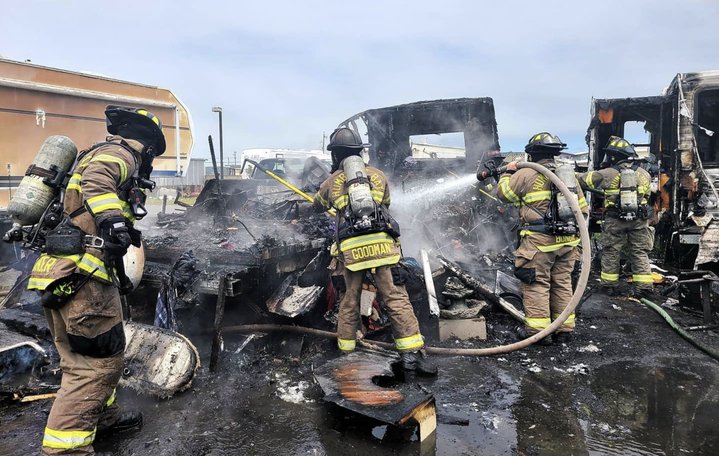
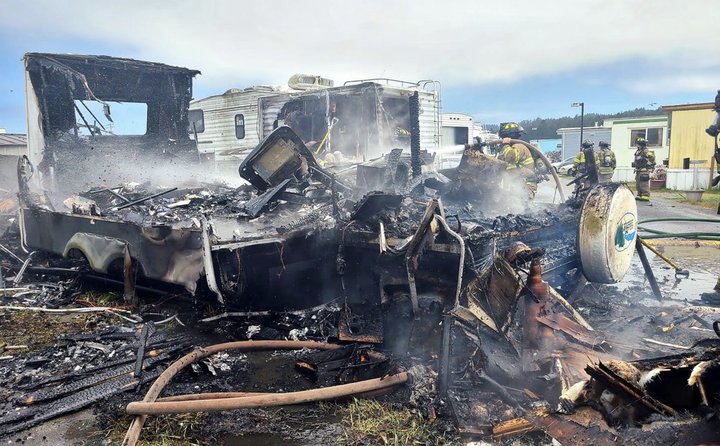
On June 4, 2021 just after 1:00 p.m. tones rang out alerting Humboldt Bay Fire crews to a structure fire on the 1800 block of Buhne Dr. in King Salmon.
As crews made their way from their stations, dispatch provided an update stating that three RVs/trailers were involved and that a resident may be trapped inside. Hearing this, the Incident Commander called for a second alarm, sending the last remaining HBF crew to the fire and pulling in backup from Loleta Volunteer Fire Department and Samoa Peninsula Fire District.
The first engine arrived on scene to find one RV completely engulfed in flames and beginning to burn the units in the spaces on either side. Quickly, the crew accounted for all residents and announced a primary “all clear” for their search while knocking down the fire, protecting the exposures from further damage. Crews gained control of the fire within 15 minutes, and remained on scene for a total of about two hours securing the area, controlling hot spots, and performing an investigation which revealed the cause of the fire is undetermined. There were no injuries — occupants of the RV in which the fire began as well as the neighbors and their dogs were able to evacuate before fire impinged into the homes. Damage to the RV in question, the neighboring RVs, and heat damage to a nearby vehicle is estimated to be around $50,000.
HBF requested response from the American Red Cross, who was able to provide alternate housing accommodations and assistance to affected neighbors. Humboldt Bay Fire crews were grateful for the lack of strong wind this afternoon; the lightweight construction of recreational vehicles combined with the tight configuration of the park could have been a recipe for disaster had it not been for the favorable wind conditions, rapid notification of 9-1-1, and competence of the first-arriving engine and following crews.
Humboldt Bay Fire would like to thank Eureka Police and Fire Dispatch, Loleta Volunteer Fire Department, Samoa Peninsula Fire District, Humboldt County Sheriff’s Office, California Department of Fish and Wildlife, and the American Red Cross for their assistance on this incident.
From the Humboldt County Joint Information Center:
COVID-19
rapid antigen tests are now available at no cost to organizations,
including businesses, faith-based organizations and congregate living
facilities, through the State of California Testing Task Force
(TTF).
Antigen
testing is a rapid point-of-care test with results available in 15 to
30 minutes. Antigen tests are most useful for routine testing of a
population (twice a week or more) such as in a workplace, at entry
into a gathering or congregate setting, or in response to the
identification of a positive case to prevent an outbreak, according
to the TTF.
“Antigen
testing can help organizations accelerate their return to normalcy,
stay open and keep their community safe,” the TTF said.
Symptomatic
people with negative antigen test results and those who test positive
through the antigen process are required to take a more sensitive,
confirmatory polymerase chain reaction (PCR) test. There is a
multi-step process to becoming test ready, which includes submitting
an application, preparing for testing, receiving test kits and
starting testing. The TTF says organizations that follow the steps in
a timely manner can expect to receive their test kits in two to three
weeks.
The
state helps organizations by offering the zero-cost antigen tests, a
patient registration and reporting platform, use of the state’s
Clinical Laboratory Improvement Amendment waiver if needed and
hands-on training. To get started, organizations can learn more about
testing options at testing.covid19.ca.gov/get-started/ and
submit an application to become a testing partner
at testing.covid19.ca.gov/antigen-apply/.
Those
who require a confirmatory PCR test can use the state-based lab PCR
test at a cost of $55 per test (insurance does cover this cost), or
receive a free test through OptumServe, which offers testing at
various locations throughout the county. Walk-ins are welcome at all
sites. Turnaround time for results averages 48 to 72 hours. See the
full schedule below:
Eureka
– Seven days a week, 7 a.m. to 7 p.m. (Redwood Acres, 3750 Harris
St.)
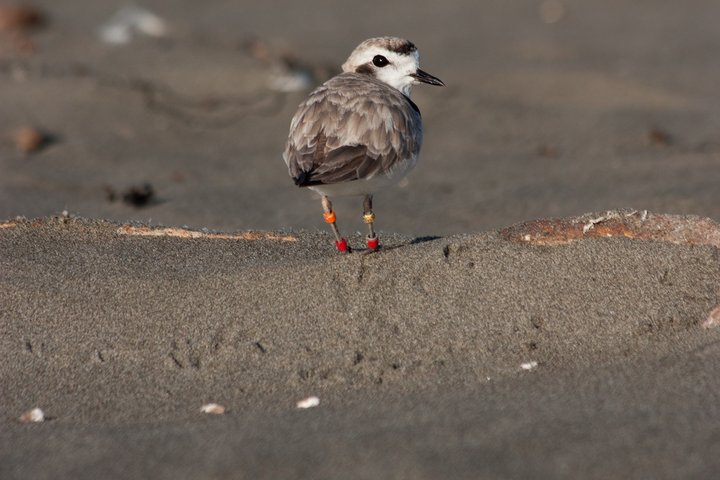
Orange-Red, Yellow Red aka “Old Man” — the oldest western snowy plover in recorded history | Photo by Luke Eberhart Phillips
###
The oldest western snowy plover in recorded history, known by many as “Old Man,” will soon be turning 20 — not an easy feat for this small shorebird — and Friends of the Dunes invites you to celebrate with them by submitting your artistic representations of this famous local plover.
Suzie Fortner, programs and operations director for Friends of the Dunes, told the Outpost that Old Man — whose actual name is Orange-Red, Yellow-Red, for the color of his bracelets used by scientists to identify each plover — was born right here in Humboldt County, near Table Bluff. Orange-Red, Yellow-Red was tagged and recorded on the day he was born: June 26, 2001.
“It’s really exciting when [plovers] make it through their first year,” Fortner told the Outpost, adding that the western snowy plover is considered a threatened species by the Environmental Species Act (ESA).
For a decade, Fortner has been coordinating the Share the Beach program, an effort to educate the public on the western snowy plover’s breeding and nesting grounds on our local beaches. You’ve likely seen areas of Big Lagoon or Clam Beach — two popular plover nesting sites — roped off and signs posted, telling you not to disturb the plovers. Because these shorebirds nest on open beaches, they are extremely vulnerable to both predators and the elements. Many plover eggs never even have a chance to hatch because they are eaten by predators, particularly ravens or crows, Fortner said.
Humans also play a big role in impacting the plover’s habitat. For one thing, crows and ravens are “opportunistic birds” Fortner said, and are drawn to places where there is a lot of human activity. When you have your picnic on the beach, food and trash will likely attract these predators. People driving on the beach also impacts the plovers, Fortner said, adding that off-roading in non-permitted areas has been a big problem in recent years.
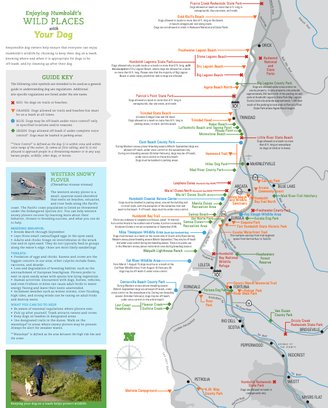
Another way people can affect the plover nesting grounds is by letting their dogs run off-leash, Fortner added. While there are some areas where dogs are permitted to be off-leash, there are many areas where it is not allowed, or dogs are not allowed at all, because they can potentially disturb the wildlife. Fortner said that even if your dog does not chase birds, it can run near plovers’ nests and scare the adults away. This then leaves the nest exposed and the eggs may either be covered by sand or eaten by predators.
All of these factors contribute to the high rate of “nest failure” in western snowy plovers, Fortner said, making them a threatened species. Currently there are only about 74 nesting adults across Humboldt, Del Norte and Mendocino counties.
This is why “Old Man” is so special! Not only is he part of small group of local plovers, he has also defied the odds to live to the (nearly) ripe old age of 20. Most plovers, if they make it past that first year, live up to about 10 years, Fortner said.
So help celebrate Orange-Red, Yellow-Red aka Old Man’s birthday by submitting your artistic depiction of him to the Snowy Plover Art Contest. And if commemorating this adorable bird is not enough of an incentive for you, there will also be prizes for the winners, we are told. Submissions are due by June 21. You can find full details on the Friends of the Dunes website.
It also seems important to note that plover nesting season is currently underway (March 15 through September 15), so right now is the time to be especially mindful when you’re at the beach! “Clean up after yourself, stay in designated areas with off road vehicles and pay attention to where you can and can’t have your dog off-leash,” Fortner said.
To help inspire you, here is an artistic rendering of Orange-Red, Yellow-Red by Hank Sims
Local educators, parents and students are celebrating that every school district in Humboldt County managed to partially reopen campuses before the academic year’s nearing end. From preparing safety protocols to accommodating in-person and remote students simultaneously, bringing kids back on campus was no small accomplishment.
Post-opening campuses, the work hasn’t stopped. Going to school in-person requires constant vigilance over masking, social distancing and sufficient ventilation. However, there is one resource that schools could access — thanks to state aid — but aren’t. COVID testing kits and training (for both PCR (polymerase chain reaction) and rapid tests) are free to all school districts in California, but most Humbodlt schools are opting out.
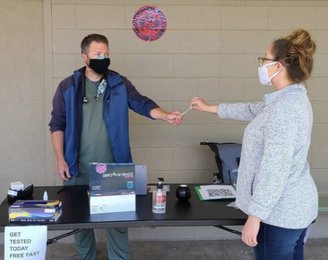
NHUHSD nurse Johnny Kell distributes a rapid COVID test | Instagram
So instead of celebrating, nurse Johnny Kell — who works full-time at the Northern Humboldt Union High School District, and who is tuned in to health in education county-wide — is still stressing. He thinks regular testing access in elementary schools should be a priority, but most elementary district administrators don’t feel the same way.
“The training is minimal and literally anybody can do it,” Kell told the Outpost. Because vaccines aren’t expected to be available to kids under twelve until fall or later, he believes it’s worth it to take advantage of those testing opportunities. Because schools aren’t testing, he predicts that countless outbreaks are happening as a result, probably off campus.
Asymptomatic testing is not a requirement in schools, but it has been encouraged by some leaders in education. In addition to social distancing, masking and proper ventilation, testing can serve as an effective extra layer of protection. The California Department of Education hosted a webinar that promoted and discussed on-campus testing options in March. “Testing can really supercharge the effort to get kids back to school safely,” Dr. Charity Dean, assistant director of the California Department of Public Health, said at that webinar.
“Frequency of testing really matters,” Dean added, referencing models that show a dramatic decrease of infections when folks are tested every three days rather than weekly, bimonthly or never. “As long as there are cases in a community, there are going to be cases walking into schools. It’s unavoidable.”
The Humboldt County Office of Education is offering to streamline the state-funded testing opportunity by ordering and disseminating the tests to schools that request them. HCOE currently provides tests to one private school, one charter school, and seven of Humboldt’s 32 public school districts, according to Ken Conlin, HCOE Communications Center manager. There may be other school districts that are ordering the tests from the distributors — Primary.Health or Color — directly, but other than the Scotia Union School District, the Outpost wasn’t able to identify any of those.
The other 24-or-so districts opted-out perhaps because of a few logistical barriers. Schools might not feel they have the bandwidth to set aside the time and personnel to administer tests (additional costs that aren’t covered by state funding), and schools that do test their students need parental permission. However, none of the superintendents asked to comment for this story cited either of those challenges (most didn’t respond to requests for comment).
Superintendent Jeff Northern of Fortuna Elementary School District told the Outpost in an email that regular testing doesn’t feel necessary in his district. “Quite honestly, we have not had a need to provide ongoing testing of our students,” he said. “Onsite testing may have been necessary if we had maintained our sports programs, but all FESD sports programs have been paused throughout this school year. Our main focus for 2020-2021 has been on maintaining the most safe learning environment possible for our students and in educating our student population as best we could under the circumstances.”
Northern’s practices are aligned with official guidelines from the CDC, which recommend (but don’t require) regular testing of students in counties with ten or more cases per 100,000 (Humboldt’s current numbers are 6 per 100,000), and regular testing of athletes no matter local case numbers. (Testing is required in the event of an outbreak.)
Many school districts in Humboldt health screen their students, which involves asking students about COVID symptoms or contact to a known case and taking their temperature. (Not all schools in the area undergo these protocols; some ask parents to do it at home.) If students and families want tests, some administrators (particularly those at smaller school districts) say that the most they can offer is assistance in securing one elsewhere.
Kell said that positive cases in schools are sometimes associated with student athletes withholding information during those screenings so that they can keep playing sports. Most local on-campus testing efforts are linked to school sports, because that’s where the most — and, hopefully, only — physical contact is happening at school.
At Scotia Union School District, staff are celebrating a COVID-free year. Their 189-student campus has been open since Sept. 1. Although their administration chose not to regularly screen test their students, Superintendent Amy Gossien said the district has been offering on-campus tests to students whose parents request it, as well as daily rapid tests for their student athletes. The school hasn’t had a single positive case and never needed to quarantine a class.
The Klamath-Trinity Joint Unified School District also rapid tests their student athletes daily, the district’s nurse, Angie Brown, told the Outpost. Additionally, PCR and rapid testing is available to all staff and K-12 students who need it at the district’s wellness center. Brown said that the district administers about 50 to 60 tests per day.
Accounting for a massive chunk of northeastern Humboldt, testing at Klamath-Trinity is important but challenging. “We’re about an hour and a half away from any testing sites on the coast, and it’s just not accessible for our students and some of our staff and families,” Brown said. “It’s really important for us to have local testing so that we can provide that surveillance testing for our community. And if there is an outbreak of COVID, we can act quickly if we know the results of those tests.”
In addition to testing, Brown’s role at Klamath-Trinity has expanded significantly with the pandemic. She helps develop reopening safety protocols, communicates with public health, and does contact tracing within the district. “It kind of creates a whole new job on top of my other responsibilities that I currently have, and that has been challenging this year — trying to do everything that needs to be done for the students and their safety, as well as carrying out my regular tasks.”
Though nurses aren’t needed to administer the tests — any school employee can qualify for training — schools’ lack of testing indirectly highlights Humboldt’s gaping shortage of nurses in local schools.
There is a correlation between schools that utilize the testing service and schools that employ a nurse; of the eight school districts that offer testing, five employ a nurse.
Based on the Humboldt County Office of Education directory, seven of Humboldt’s 32 districts employ nurses, plus one charter school, totaling eleven nurse personnel, five of whom work at Eureka City Schools, and one person who works for two districts.
The remaining school districts share the HCOE Health Team, which includes three nurses and two medical clerks. This team usually provides hearing and vision screening, health assessments and student-specific medical training, but their role has changed over the last year.
“During the COVID-19 pandemic our skilled team has been able to pivot quickly to provide support to districts for contact tracing and case investigation, communicate with families, assist public health during vaccination clinics, provide guidance to districts offering COVID-19 testing for staff or students, established a collaborative network of school nurses, and acting as a liaison between public health and districts,” Katie Cavanagh, director of special education at HCOE, told the Outpost in an email.
According to the Population Reference Bureau, Humboldt’s school nurses average a 4,704:1 student-to-nurse ratio in Humboldt County. The recommended student-to-nurse ratio is 750:1, by the National Association of School Nurses standard, and smaller if regular one-on-one care is needed for any student. (No county in California meets that metric).
The nurses we spoke to for this story — Johnny Kell at NoHum and Angie Brown at Klamath-Trinity — said they’re stretched too thin, serving 1,700 and 1,000 students, respectively.
Kell believes that school itself is safe. Noting that he is confident that school safety protocols — like distancing, masking and purifying air — are sound, Kell also stressed that there is too much risk in what goes unsupervised. Between un-frequented areas on campus (like bathrooms), potentially untested athletes, and after school hangouts, he thinks it’s important to take every measure there is to protect unvaccinated kids.
Pockets of unvaccinated people cause spikes, Kell said, and “elementary schools are reservoirs of unvaccinated individuals.”
The Humboldt County Office of Education said they weren’t allowed to share how many cases have been traced back to schools. According to Humboldt’s COVID database, people aged 9 and under account for 7.59 percent of local cases (326 total), while people 10-19 make up 13.18 percent of cases (566 total, plus two hospitalizations).
Even though the school year is nearly over, school, for many students, is not; some will need to enroll in summer programs to account for learning loss.
As the adult world becomes more and more open, children will resume their lives, alongside their parents, without the same protections. Kell referred to a resource called Long COVID Kids, a UK-based database that documents the long-term impacts some children have had with COVID.
Kell is surprised and disappointed that more schools aren’t taking advantage of the testing opportunity. Via a Facebook group, he regularly interacts with thousands of school nurses across the nation, most of whom would jump at the opportunity to provide testing in schools, Kell said. Locally, he feels alone with his concerns about pediatric COVID.
On Tuesday, May
25th, 2021, Dylan Brett Barber, loving son and brother
passed away at age 21.
Dylan was born on
March 4th, 2000 in Eureka to Michael and
Athena Barber. The first born of twins, Dylan made quite the entrance
in this world, as he and his twin were born six weeks premature. This
became a trend for little Dilly, always full of life and adventure.
Dylan was such a
happy baby, no matter what he was going through. At one day old, he
was flown to UCSF for bleeding complications and was diagnosed with
Alpha 1 Anti-trypsin Deficiency, a deficiency that effects the liver.
At 5 years old, Dylan’s health miraculously improved and his liver
was no longer an issue. At 7, he became swollen and ill and it was
then that he was diagnosed with Nephrotic Syndrome. It is this
syndrome that led to his loss of life at such a young age. As a
child, Dylan earned the nickname “Dilly did it” as he always
seemed to be in the middle of some adventure. A chorus of “Dilly
did it” sung out by his siblings could be heard frequently
throughout the house. As Dylan grew up, he was very set on living
life his way — a strong-willed, free spirit, just like his Grandpa
Cliff. Although, Dylan’s zest for life had its share of trials and
tribulations, he always remained true to himself and had a great
heart. His entire face lit up when he smiled and his smiles were
genuine.
Dylan is survived
by his mother, Athena Barber; brothers, Hunter Barber, Drake Barber,
Rowan Barber; sisters, Laura (Donnelle) Barber (and children, Messiah
and Malakai), Lena Cross and Charlee Bowen and step-father Charles
Bowen; his aunt Tanya Parker, great aunt Nancy Hall, great uncle Tom
Burghart and grandfather Herb Barber. There are also more aunts,
uncles, cousins and friends too numerous to mention that Dylan leaves
behind.
Dylan is preceded
in death by his father, Michael Brandon Barber; baby brother, Ferin
Barber; grandfather, Clifford Andersen; grandmother, Laura Burghart;
and great-grandmother Violet Barber.
We are planning a celebration of life on Saturday, June 5 at 3 p.m. at 20/30
Park. Close family and friends who have been immunized are welcome to
start gathering an hour prior at my home to share memories with the
kids as the little ones will not be able to make it to the park.
A special thank
you Celine Pele of Eureka Community Health Center and to Hospice of
Humboldt. You guys are amazing!
A thank you also
to Seth from Humboldt Cremation. I am so grateful for all your help!
He had a smile on
his face and a constant positive attitude that never changed.
Dylan, I love you
so much. Your momma, Athena.
###
The obituary above was submitted on behalf of Dylan Barber’s loved ones. The Lost Coast Outpost runs obituaries of Humboldt County residents at no charge. See guidelines here.
Sandra Lynn Sanderson February
10th, 1946 - April 24th, 2021
Sandra Lynn
Sanderson, long-time resident of Eureka, died on April 24, 2021. Her
family members and friends rallied around her to provide her care
during her 18-month fight against several illnesses as she
transitioned from hospital to nursing care to home and back and forth
several times.
Sandy was born to
Mary Milevoi and Gustie Drimones in Hudson County, New Jersey, and
received by her great grandparents who came from Greece and Austria.
Originally named Cassandra by her father, she went on to be known as
Sandra by many, and by Sandy with her closest friends and family.
She grew up on the beaches of the New Jersey shoreline eating baloney
sandwiches and enjoying time with cousins and other extended family.
Beginning in childhood, she had a lifelong love of horses, dogs,
other animals, and dancing, including performing in the color guard
as a teen. She graduated from Weehawken high school and went on to
junior college in New Paltz, upstate in New York. She also enjoyed
time working at Rocking Horse Ranch in Highland, New York where she
met her first husband, John Holland. Though their marriage did not
work out, she gained a lifelong love of the outdoors, as well as a
zest for taking on career challenges to do exciting things.
Following her
time in New York State, she joined the US Marines during the Vietnam
era, which is when people referred to gals like her as “women
Marines” rather than just Marines. After her service, she took the
advice of some veteran colleagues and entered the US forest service.
She worked full-time for 10 years for the USFS and put in one year
part time for the park service. She enjoyed a lot of time working in
fire suppression and management, as well as in recreation.
Initially, she was stationed to Minnesota in the northern lake
region, but found the giant mosquitoes daunting, so she transferred
to Southern California to fight fires in the Tujunga area, in canyons
surrounding Los Angeles. She was one of the first women to be in
fire-fighting in the USFS. While there she also attended Glendale
junior college and got an associate degree in liberal arts. She
loved writing – and even started to try out to become a California
Highway Patrol officer – but discovered that her biggest love was
really being in the woods and connected to the forest. Some of her
most beloved memories come from her time working in Tujunga, as well
as in Hayfork (Engine Crewman Gs 2, 3, 4) and Big Barr (Engine
Operator). A treasure for her, aside from hiking up extraordinarily
steep grades with 75-pound pack on her back, was being able to have
beautiful moments seeing wild bear and other critters in the woods,
as well as having spirited conversations about nature with her
coworkers.
After relocating
to the Redding area and working near Big Bend and Shasta Lake, she
met the love of her life, Vaughn Sanderson, who also worked in fire
for the forest service. They married in 1989 and had a son, Ethan.
Ethan quickly became the center of Sandy and Vaughn’s universe, and
the love of their lives. The family enjoyed living in several
locations in the beautiful area defined between Eureka and Redding
and up to the Oregon border before finally settling in Eureka.
Having run up and down steep mountainsides for so many years, Sandy’s
knees eventually did not allow her to continue that work and so she
transitioned into work in accounting and other support roles outside
the USFS. She enjoyed making many great friends with staff and
clients at Humboldt Community Access and Resource Center (HCAR),
Sequoia Park Zoo, and the North Coast Dance Company. She also loved
connecting with her church community at the Eureka Faith Center,
particularly as they helped her heal after the unexpected death of
her husband Vaughn.
Throughout her
time in Eureka, Sandy danced as a hobby and for exercise, in addition
to her regular swims. But she absolutely fell in love all over again
with the folks at North Coast Dance Company. Each year for more than
a decade, she relished time being in the annual Nutcracker, working
with young dancers, and watching dancers develop. She performed in
many shows doing different kinds of dancing, including belly dancing
with a sword on her head, and getting to wear gorgeous costumes. But
her favorite role ever was as the dancing bear in the Nutcracker,
bringing together her love of dance and wildlife in one activity.
In reflecting on
her life, she talked a lot about loving family, friends, her animals,
and dance. She also hoped that some of the work she did crashing
through carrier barriers helped other women take chances in
nontraditional careers. Even in her last year of life, she remarked
on how her work in fire for the USFS was some of the most exciting
work she had ever done. She loved every inch of California too, and
enjoyed meeting other spirited, determined, and adventurous people
everywhere she went.
Sandy was
preceded in death by her grandparents, parents, and husband Vaughn.
She is survived by her son Ethan Sanderson, sister Karima Barbara
Gari, her nieces Nancy Piotrowski (who she lured to live in
California decades ago to share in adventures), Danielle Lucarello,
and Dena Balderacchi, great-nephew Tristan Balderacchi, and great-grandniece Arya Balderacchi, as well as cousins and other extended
family on the East Coast, and dear friends all over the country.
Afterlife care
was entrusted to Humboldt Cremation. In lieu of flowers, anyone
wishing to honor Sandy with a donation in her name should donate to
one of her favorite charities, the Sequoia Humane Society in Eureka.
The family notes that in heaven, Sandy will of course be greeted by
her relatives, but they also expect there will be more than 50 of her
pets waiting for her love and affection at the pearly gates.
A celebration of
life will be held at the Eureka Faith Center at 1032 Bay Street in
Eureka on Saturday June 12; door opens at 10:30 a.m., service runs
11-11:30, and a reception will follow at 11:30 a.m.
###
The obituary above was submitted on behalf of Sandy Sanderson’s loved ones. The Lost Coast Outpost runs obituaries of Humboldt County residents at no charge. See guidelines here.
Following a somewhat convoluted discussion on Wednesday night, the Arcata City Council unanimously voted to introduce an ordinance that changes some of the city’s regulations on chain restaurants.
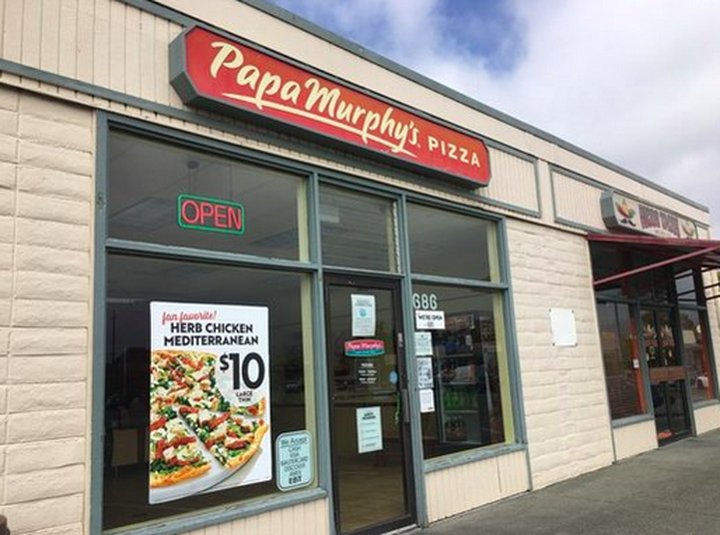
During a recent review of Arcata’s existing Formula Restaurant Ordinance — which was adopted nearly 20 years ago, and caps the number of chain restaurants allowed in Arcata at nine and restricts them from opening in certain neighborhoods — city staff determined that there were some inconsistencies between the definition of “formula restaurant” and the businesses that the ordinance aimed to regulate. Specifically, two restaurants included in the city’s cap — Chester’s Chicken and Papa Murphy’s — did not technically fit under the definition.
When the issue came before the council in April, the council members agreed that Chester’s and Papa’s should be regulated as formula restaurants and requested that the staff amend the definition. The ordinance now regulates restaurants, cafés and coffee shops that serve “menu-ordered” food and provide counter, table or drive-through service. To be considered “formula,” the restaurant, café or coffee shop must offer “standardized menus, ingredients, food preparation, decor, uniforms, architecture, signs or similar standardized features, which causes it to be substantially identical to more than 11 other restaurants,” nationwide.
The ordinance now also includes a subsection about “accessory use” formula restaurants. Community Development Director David Loya explained to the council that “if the primary use isn’t a restaurant and the accessory is not a franchise, it is not considered a formula restaurant.” This definition excludes places like Safeway’s deli, but still includes Chester’s Chicken — which is inside of the Chevron gas station on Giuntoli.
There was some debate during the meeting on whether or not the number of locations included in the “formula” definition should be raised. Loya told the council that several local businesses — including Ramone’s Bakery and Jitter Bean Coffee Co. — are “doing very well” and may expand to include 12 or more locations in the future.
Councilmember Sarah Schaefer questioned if there was some way the ordinance could exclude local businesses from that definition, but Loya said that that type of “blatant favoritism” would present legal issues and City Attorney Nancy Diamond agreed. Ultimately the council decided that it would be best to keep the number of locations included in the “formula” definition at 12 and will potentially revisit that number in the future.
In addition to amending the definitions, the new ordinance raises the number of formula restaurants allowed in Valley West from five to six and allows three more in Arcata’s other commercial districts — including Northtown, the Uniontown Shopping Center and on Janes Road. Loya said during the meeting that a formula restaurant could also potentially open in the Creamery District, but that would require the business to obtain a use permit.
The total cap of nine will, at least for the time being, remain in effect. But there was some debate among the council members about how strict enforcement should be when it comes to regulating businesses that are in the process of opening in Arcata. City staff’s review of the ordinance was sparked by some new chain restaurants trying to open. A Domino’s Pizza has filed building permits for a location in Northtown, and Subway Sandwiches is trying to open a second location in the Uniontown Shopping Center and third, mystery business — which staff has refused to reveal because the permits have not yet been filed — is looking to open in Valley West.
Once the ordinance comes into effect, both Papa Murphy’s and Chester’s Chicken will, again, be considered formula restaurants, which will mean there would be seven total formula restaurants in Arcata. If all three of these other businesses were then to open, that would bring the total number to 10 — which is above the cap.
Councilmember Stacy Atkins-Salazar and Vice Mayor Brett Watson were in favor of allowing all 10 restaurants to be open — essentially making an exception for businesses that have already put a lot of time and money into opening before the ordinance comes into effect. Mayor Sofia Pereira, however, felt that the City should be strict about adhering to the cap and honoring the intentions of Arcata’s ordinance.
Ultimately, the council voted unanimously to move forward with introducing the amendment and will discuss the gray areas at the next meeting — June 16 — when it comes back for adoption.
“I really appreciate us taking the time to talk this through,” Pereira said after the vote. “We didn’t have any members of the public to speak on this item, but I do know that we’ve received communications from folks that expressed that this policy that we’ve had in Arcata is really a landmark policy and sets Arcata apart. So I think the deliberations we’re having here are incredibly important.”