

California Weighs Electric Car Mandate for Uber and Lyft
Rachel Becker / Wednesday, May 19, 2021 @ 7:53 a.m. / Sacramento

Photo by Thought Catalog on Unsplash.
###
Ninety percent of miles logged by Uber and Lyft drivers in California will have to be in electric vehicles by 2030 under a state mandate to be considered Thursday.
The California Air Resources Board’s proposed regulation aims to curb the climate impacts of emissions from ride-hailing trips. It’s an ambitious target: In 2018, electric vehicles accounted for less than 1% of miles traveled by Uber and Lyft drivers in California.
The big question for the gig-economy fleets is: Who will pay for the cleaner cars?
Representatives of Uber and Lyft told the air board that they support the 90% mandate, but are pushing for state funding and flexibility if they encounter delays meeting the targets.
“We are disappointed that the efforts of the past years have culminated in metaphorical sticks with no carrots.”
— Statement by Lyft
“We support this regulation and we support the ambitions that it sets out,” said Adam Gromis, global lead on sustainability policy at Uber. “We do think that there’s work to be done in terms of pairing and marrying the regulation side with supportive policies that can ensure a fair transition for drivers.”
Lyft wrote in a letter to the board: “While we are pleased to see aggressive environmental targets, we are disappointed that the efforts of the past years have culminated in metaphorical sticks with no carrots.”
Environmental groups, labor advocates and drivers are calling for California regulators to ensure that the companies, not the drivers, cover the costs of electrifying their fleets.
“Yearly costs for ride-hailing companies and drivers, including electricity and home chargers, could reach roughly $400 million in 2030, according to an air board staff report. But staff predicts that savings, including on gasoline and maintenance, will far outstrip them — leading to net benefits of $215 million in 2030.”
Still, an air board analysis of driver ZIP codes estimates that about 56% of ride-hailing drivers could be from low-income or disadvantaged communities who may not be able to afford the switch to an electric vehicle.
“The companies should pay all expenses for all the vehicles, all the time. But that’s not happening,” said Nicole Moore, who drives a plug-in hybrid part-time for Lyft in the Los Angeles Area and is on the organizing committee for Rideshare Drivers United. “The cost of the fleet is on the drivers, the cost of the fuel is on the drivers, everything is on the drivers.”
Moore called for any state incentives to go directly to drivers. “This is going to basically be a green badge of honor for Lyft and Uber, when it’s the drivers that are paying for this conversion,” Moore said. “And it’s not right.”
If the regulation is approved by the board, in two years 2% of miles traveled by Uber and Lyft drivers fleetwide must be in electric vehicles, ramping up to 30% in 2026 and 90% in 2030. The 90% mandate would require electrifying less than half of the high-mileage drivers’ vehicles.
It would cut greenhouse gas emissions by 1.81 million metric tons from 2023 to 2030, plus nearly 400 tons of smog-forming gases and particles. That’s equivalent to removing nearly 400,000 cars from California’s roads.
The fleet is fast-growing so the environmental impact is increasing. Rideshare drivers logged about 1.2% of the total miles traveled by light-duty vehicles on California’s roads in 2018, up from 0.05% in 2014. Uber and Lyft dominate the ride-hailing sector, which produces about 1% of the greenhouse gases from light duty cars and trucks in California. Overall, transportation is the biggest greenhouse gas polluter in California.
The fleets have outsized climate impacts, pumping out about 50% more carbon dioxide in 2018 than the average personal vehicle for every mile traveled with a passenger, according to an air board analysis.
That’s because ride-hailing fleets travel a lot between trips or while waiting for a fare. These so-called “deadhead miles” without a passenger account for about 40% of total miles traveled by ride-hailing vehicles.
Factoring in public transit, the Union of Concerned Scientists pegs the impact even higher — estimating that ride-hailing trips produce 69% more planet-warming pollution than the forms of transportation they replace.
A 2018 law authored by state Sen. Nancy Skinner, a Democrat from Berkeley, tasked the air board with setting standards to curb greenhouse gas emissions from ride-hailing companies. The California Public Utilities Commission will be in charge of enforcing them.
The rule also calls for cutting the companies’ carbon dioxide emissions from miles traveled with passengers to zero by 2030, partially by using credits earned by integrating public transit into their apps and improving walkability and access to biking.
“The idea that it’s important to set weak standards in the early years in order to protect drivers is actually exactly backwards.”
— David Weiskopf, NextGen California
Dave Weiskopf, senior policy advisor for NextGen California, a progressive advocacy group founded by Tom Steyer, said the standards aren’t aggressive enough in the early years.
Starting too slowly, he said, will allow the companies to lean on state and federal subsidies as well as on higher-income drivers who were already going to purchase electric vehicles, rather than provide incentives to help lower-income drivers afford them.
“Then the companies can free-ride off of investments that its employees are making — sorry, contractors are making,” Weiskopf said. “The idea that it’s important to set weak standards in the early years in order to protect drivers is actually exactly backwards.”
An earlier proposal, released last summer, would have electrified 60% of vehicle miles traveled.
But Lyft already pledged to electrify its entire fleet by 2030, and Uber has the same goal for vehicles in US, Canadian and European cities, with full electrification by 2040. Uber also said it would commit $800 million to help drivers transition.
Joshua Cunningham, the air board’s branch chief of advanced clean cars, said it’s up to the companies to determine how to meet the targets.
“We do not dictate how the companies spend their money to comply. We don’t dictate whether they give money to drivers. That’s up to them,” Cunningham said. Still, he said, “We hope that the companies will provide financial incentives to drivers.”
Because of Uber and Lyft’s exemptions from labor rules, “there is no assurance that (ride-hailing companies) will pay drivers for the extra costs of electrification,” the staff report said.
A 2021 Chevrolet Bolt EV can start around $36,500, and the costs of installing and maintaining a home charger can run more than $1,400 starting in 2023, the air board says. Renters or people without garages might have to rely on public charging, which can be pricier, Cunningham said.
Government funding shouldn’t take the place of investments from the companies themselves, the Union of Concerned Scientists said. “It would cost less than 4 cents per ride-hailing mile driven to cover the upfront costs of drivers.”
Uber and Lyft together spent more than $108 million on a massive campaign to win voter support for Proposition 22, which exempted companies that employ drivers through apps from a law requiring them to classify their workers as employees and offer employee benefits.
As for a climate mandate, “I’m certain that what the companies are going to do is just displace the costs of this onto their workers,” predicted Veena Dubal, a professor at the University of California, Hastings College of the Law who specializes in work law.
“I think it’s important that there be heavy fines, and enforcement of these fines, if the companies don’t support the drivers in transitioning. And by support, I think that they need to pay for what it will cost drivers to purchase (electric vehicles) in exchange for the the existing cars that they have.”
###
CALmatters.org is a nonprofit, nonpartisan media venture explaining California policies and politics.
BOOKED
Today: 7 felonies, 9 misdemeanors, 0 infractions
JUDGED
Humboldt County Superior Court Calendar: Today
CHP REPORTS
Greenwood Heights Dr / Dean Ln (HM office): Trfc Collision-1141 Enrt
ELSEWHERE
RHBB: Magnitude 3.6 Earthquake Strikes West of Petrolia
Governor’s Office: Governor Newsom signs first-in-the-nation AI safeguards to protect Californians, calls on the federal government to do its part
RHBB: Body Recovered from Humboldt Bay Near Foot of Commercial Street
KINS’s Talk Shop: Talkshop September 9th, 2026 – Michelle Bushnell
OBITUARY: William ‘Richard’ Sloan, 1948-2021
LoCO Staff / Wednesday, May 19, 2021 @ 6:56 a.m. / Obits
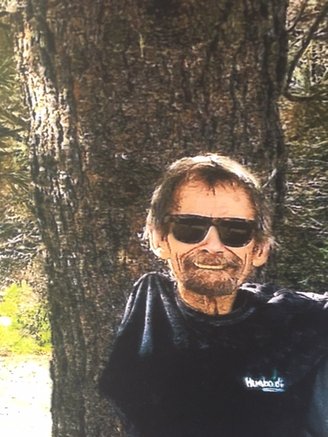
William “Richard” Sloan
November 2, 1948 – April 30, 2021
Richard, as he was known among friends, lived in McKinleyville. He passed away after a short but hard fight with cancer. When he passed he had people who loved him by his side. He was not alone.
Richard was born in Missouri and moved with his mother and sister and brother from Missouri to Colorado, Nevada and finally arrived in California. It was there the family expanded when his mother remarried and now the family of four grew to a family of seven. Richard struggled as so many did in the ‘60s. He entered the U.S. Army and was sent to Viet Nam. He returned forever changed and in more turmoil. He tried to reintegrate into mainstream life. He married a lovely woman from Germany and they had a son Eric. For whatever the reasons Richard could not be still and became a drifter.
He found Humboldt County while hitchhiking the coast. It is then he met his second wife. Through many ups and downs they married — however, it was short-lived. The union gave birth to son Andy in 1977 and they continued to stay close and care for each other deeply.
Richard leaves behind family in other areas of California, Colorado and Texas. His immediate family are here in Humboldt and include: son Andy (Dora); grandsons Dru (Carman), Kristopher, Mason; granddaughters Laly, Aylen and Julie; and great-grandson Bentley and his ex-wife best friend Paula.
The family would like to thank the team at our local V.A. Medical Program and also San Francisco V.A. He was given kind and personal care which will not be forgotten. We also want to acknowledge Dr. Cobb for his kindness and concern for Richard and also Donna, Richard’s care provider (she helped make things easy not only for him but for the family). Hospice was wonderful when they stepped in to help us to include the team at the Ida Emerson House. Ayres also provided gentle support as the family was trying to let go and make necessary arrangements. We thank all of you so much.
Lastly we want to acknowledge Richard was a friend of “Bill.” His sobriety was a struggle for most of his life, however he left this life with full sobriety and recovery and the pride and dignity that comes with that.
The family will have a small celebration of life this summer at the beach, where Richard spent many pleasurable hours.
###
The obituary above was submitted on behalf of Richard Sloan’s loved ones. The Lost Coast Outpost runs obituaries of Humboldt County residents at no charge. See guidelines here.
OBITUARY: Rebecca Marie Enberg, 1932-2021
LoCO Staff / Wednesday, May 19, 2021 @ 6:56 a.m. / Obits
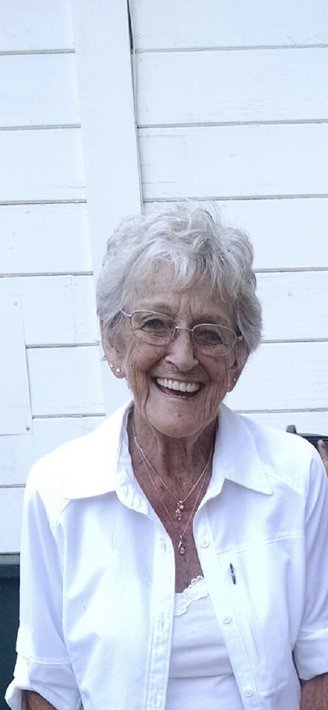
Rebecca
“Becky” Enberg, 88, of Eureka, passed away April 24, 2021
with her family by her side. She lived a full and wonderful life.
Becky was born November 18, 1932 to Marvin East and Elizabeth (Dukes) East in Eureka. In 1938, her mother married Lloyd Roberts, a sheep rancher in Petrolia. Becky was eternally grateful for the life he provided her and her siblings. She loved the Mattole Valley, where she grew up, and joined the Mattole Valley Historical Society to help preserve the history.
Becky attended elementary school in Petrolia and Ferndale High, and eventually graduated from Oakland Technical High School in 1949. In those 11 years, having skipped 5th grade, she never missed a day of school and received many awards.
Becky married Kenneth Smith and the couple had three daughters. When they divorced, she began working for the Humboldt County District Attorney Family Support Division. She loved her job, and took pride in her work. She retired after 28 years of service.
Becky married the love of her life, Roy Enberg, in 1977. Their adventures were many; traveling via motorcycle and car with dear friends all over the United States. They both loved to dance and were simply amazing to watch.
Through the years she was an avid hunter, traveling as far as Canada for deer, elk, caribou and wild boar. She consistently volunteered at the American Cancer Society’s Discovery Shop, often bringing her grandchildren with her when they visited. She also volunteered at the Jazz festivals, elections, Stand Down, and accompanied many Veterans on the Honor Flight Tour of the Wall in Washington, D.C.. She was a member of the Elk’s Lodge, Moose Lodge, Swiss Club, Mattole Valley Historical Society, Humboldt Pioneers, H.E.R.O.’s, Friendship Club, and Retread Motorcycle Club. She loved to garden, sew, knit, crochet, embroider, paint china, weave pine needle baskets and work jigsaw puzzles. She donated many handmade items for charity fundraisers and entered her work in the Humboldt County Fair, always a ribbon winner.
Becky was predeceased by her loving husband of 31 years in 2008, her mother, father, step-father and siblings: Albert Lockwood, Katherine Chenoweth, Douglas East, Lloydene Wines, and her step-daughter Kim (Enberg) McLaughlin. She is survived by her three daughters: Karen Willenberg (Tuolumne, CA), Tracy Maher (Bella Vista, CA), Ronda Hatcher (Eureka, CA), six grandchildren: Shane Jordan, Brad Hooper, Melanie Hooper, Jenner Maher, Courtney Rodes, Emily Willenberg; two step-grandchildren: Jodi Franchi and Ross Burns; eleven great-grandchildren, and three step-great-grandchildren.
A celebration of life will be held at a later date. In lieu of flowers, donations can be made to the American Cancer Society.
###
The obituary above was submitted on behalf of Becky Enberg’s loved ones. The Lost Coast Outpost runs obituaries of Humboldt County residents at no charge. See guidelines here.
OBITUARY: Valerie Eileen Bognuda, 1933-2021
LoCO Staff / Wednesday, May 19, 2021 @ 6:56 a.m. / Obits
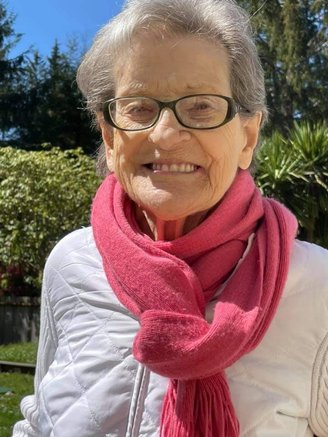
Valerie
passed away suddenly of natural causes on Tuesday, May 11, 2021,
shortly after moving to Crescent City to live with her son, Kevin and
daughter-in-law, Elisa. She had been with them several weeks, and it
was such a content and happy time for her. It was a welcome change
that she embraced, letting us all know she loved being there.
Valerie was born August 9, 1933 to Gilbert and Harriet Shirley in Eureka, California. She was a graduate of Eureka High School. On August 23, 1952, she married her high school sweetheart, Edward Mario Bognuda. Valerie never learned to drive and was content staying busy as a wife and homemaker with her and Ed’s four children: Gary, Kevin, Karen and Brian. Valerie was a devoted, loving and generous Mom! Valerie stayed active in her children‘s endeavors, supporting her sons in various racing activities and her daughter with her horse in gymkhanas. Even when their interests moved on to more challenging sports and other ventures, Valerie’s love and support never wavered!
There are many highlights of Valerie’s life. One is she personally lighted up at any casino, especially Bear River where she often came home a lucky winner! Another highlight was her telephone. Since she lived alone before moving to Crescent City, she took full advantage of her telephone. She rarely let a day pass when she wasn’t checking in on her family and extended family, making sure all were well and happy. Valerie loved baseball and also watched the same soap opera “over the phone” with her sister-law, Liv for years! Valerie would also talk about the cruise her and Ed took to the Caribbean for two weeks in 1976. It was a special occasion for her and Ed.
Although Valerie and Ed’s lives took separate paths, they remained close friends later in life. They were always present at family gatherings and talked regularly on the phone. They were a wonderful example for their children. During the last fourteen years, Valerie lived in Salmon Creek, Miranda, where she was in close proximity to her son, Brian and daughter, Karen and their families. She loved being close to her children and grandchildren while watching the changes in their lives.
Valerie is survived by her children, Gary (Marci), Kevin (Elisa), Karen (Scott) Argo, and Brian (Sandee); grandchildren, Jamison, Ryan, Jennifer (Edgar), Drew (Holly) and Max; two great grandchildren, Malia and Klayden; sister, Barbara Slade; nieces, Judy (John) Bertain, Vicki (Vaughn) Butler, and Shari Doer; nephews, Troy and Darren Ghisetti; and sister-in-law, Livia Manfredda. Valerie was preceded in death by her former husband, Edward; parents, Gilbert and Harriet; step-mom, Lee Shirley; step-sister, Connie Ghisetti; and in-laws on both sides that Valerie loved dearly.
On Tuesday, May 25, 2021, a public viewing will be held at Sanders Funeral Home at 11 a.m., followed by an outdoor memorial service at 1 p.m at the Veteran’s Ocean View Cemetery in Eureka. Pastor David Groe will be officiating.
###
The obituary above was submitted on behalf of Valerie Bognuda’s loved ones. The Lost Coast Outpost runs obituaries of Humboldt County residents at no charge. See guidelines here.
OBITUARY: John H. Benge, 1929-2021
LoCO Staff / Wednesday, May 19, 2021 @ 6:56 a.m. / Obits
###
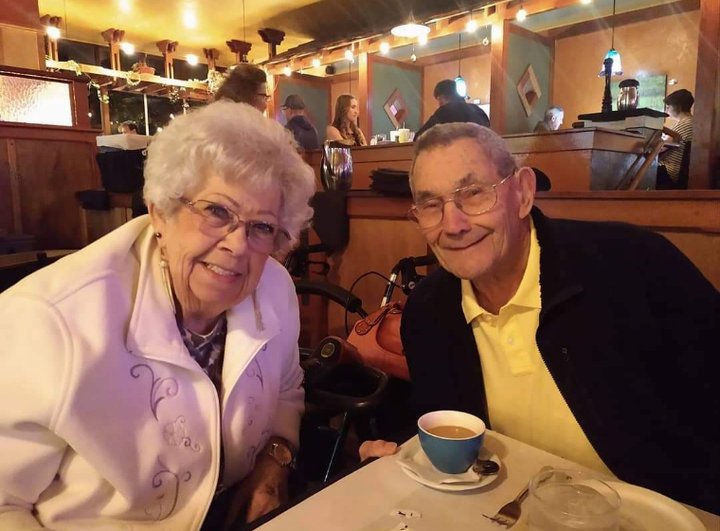
John H. Benge passed away on May 1, 2021, a week shy of his 92nd birthday. John was born on May 9, 1929 in Princeton, Idaho, growing up on Hatter Creek. In his early twenties John got into his lifelong passion of working in the logging industry. His first job was working the log pond at the Potlatch Lumber Mill in Potlatch, Idaho.
In 1952, John married the love of his life, Doris West. In 1954, big timber called, and the young couple moved to Klamath. John worked for few different “logging outfits” in the Klamath area. In 1960, logging took the couple to Arcata, where John and Doris raised their family in Sunny Brae. The couple lived in Arcata for 61 years. John worked for Simpson Timber Company for 34 years, retiring in 1992. During his time with Simpson, John received hundreds of Better Method Awards and made many lifelong friends. In the early 70s, John started the traditional July 4th picnic at Camp Bauer, which Green Diamond still continues to this day.
After retirement John and Doris hit the road in their motor home, touring the country, making memorable trips to Alaska, Branson, Missouri and all places in between. After putting many thousands of miles on the motor home John and Doris decided to buy a second home in Yuma, spending the winter months with friends and family in the Arizona sun and summer months in the Humboldt County Fog. The couple also sailed the seas taking cruises to Alaska, Mexico, Panama and the Caribbean.
Family was important to John, who was known as “Papa” by his grandkids. Together, he and Doris raised three children and were blessed with six grandkids and five great-grandkids.
John was an active community member, serving 50 plus years in the Shriners and was a 32nd Degree Master Mason serving in the Six Rivers Masonic Lodge #106. John is also a Life Member of the Eureka Elks Lodge #652 and a charter member of the Bigfoot Good Sam Club. John was proud of his time with the Arcata Police Volunteer Patrol, receiving Volunteer of the Year in 2006. John never could say no when someone needed help and could fix just about anything. He enjoyed restoring classic automobiles and later in life took up woodworking.
John is survived by his wife of 68 years Doris and their three children: Jerry (Lori), Jonda and Jason (Yesenia). He also leaves behind his grandchildren Johnny, Sarah, Dillon, Krystal, Hailey, Reylan and his great-grandchildren Kiara, Raina, Lucas, Ellie and Kairi. Preceding John in death are his son Johnny K, parents Ella May and John “Dick” Benge, sisters Claire, Geitha, Peggy and Judy, son-in-law Arlis Fike, father and mothers-in-law Kenny and Alma West, and his brother-in-law Richard West.
Family and friends are invited to a Celebration of Life which will take place on June 13, 2021 beginning at 1 p.m., a Mason Memorial will take place at 2 p.m. with a reception to follow. The Celebration Life/Memorial will be at Six Rivers Masonic Lodge — 251 Bayside Rd, Arcata.
###
The obituary above was submitted on behalf of John Benge’s loved ones. The Lost Coast Outpost runs obituaries of Humboldt County residents at no charge. See guidelines here.
TODAY in SUPES: An Apology, Some Vaccine Hesitancy, a Climate Action Plan and a Code of Ethics, Oh My!
Ryan Burns / Tuesday, May 18, 2021 @ 5:42 p.m. / COVID-19 and Humboldt , Local Government
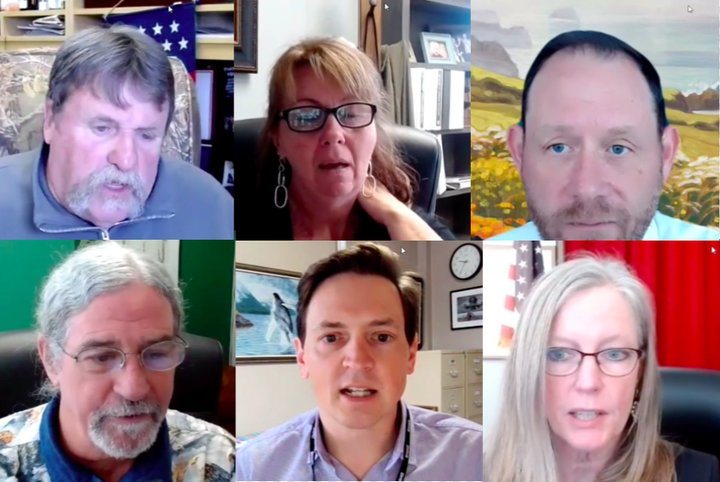
Screenshot from Tuesday’s Board of Supervisors meeting (clockwise from top left): First District Supervisor Rex Bohn, Second District Supervisor Michelle Bushnell, Third District Supervisor Mike Wilson, Fourth District Supervisor Virginia Bass, Health Officer Dr. Ian Hoffman and Fifth District Supervisor Steve Madrone.
###
At the outset of Tuesday’s Board of Supervisors meeting — following the obligatory Salute to the Flag, that is — Fifth District Supervisor Steve Madrone asked for some time to address the community. He proceeded to offer an unqualified apology for employing the term “Oriental” at last week’s meeting when referring to social rituals in some Asian cultures.
Reading from a prepared statement, Madrone said he now understands that using the word “Oriental” as a blanket term for people from Asia “contributes to an ignorant homogenization that is both offensive and dehumanizing.” He promised to continue learning.
As it turned out, this wasn’t Madrone’s only apology on the day.
COVID Update
“We’re entering a new era” in the COVID-19 pandemic, Humboldt County Health Officer Dr. Ian Hoffman said during his latest biweekly address to the board — “not quite the end of the pandemic, but the closest we’ve been yet.”
The CDC’s recently updated mask guidance for fully vaccinated people is cause for optimism, as is the growing body of evidence for vaccine efficacy, in the doctor’s view.
“The science supports that if [you’re] fully vaccinated and exposed to COVID-19, you will likely have no symptoms or, at worst, very mild cold-like symptoms [while] avoiding hospitalization, ICU and death,” Hoffman said.
That message has been echoed in recent weeks by four of the five supervisors, all of whom have spoken openly about getting their own COVID jabs while encouraging the public to follow suit. Madrone and First District Supervisor Rex Bohn even recorded public service announcements at the Ferndale headquarters of the Outpost‘s parent company, Lost Coast Communications. [Correction: Bohn recorded his in Ferndale while Madrone’s was recorded outside, on McKinleyville’s Hammond Trail.] You can listen to them below:
Second District Supervisor Michelle Bushnell, meanwhile, has been the exception. While she has frequently asked clarifying questions of Hoffman during his regular COVID updates, she has remained circumspect about her own views on vaccination, even as the board deliberates about how and when to return to in-person meetings.
Given her position as a public representative, not to mention the public health implications of vaccine hesitancy in rural American counties in particular, the Outpost tried several times over the past week to get Bushnell on the record about her own vaccination status.
She didn’t respond to three emails sent last week, but after a follow-up text sent Tuesday morning, Bushnell called the Outpost during the lunch break of Tuesday’s meeting. She was polite yet firm in her stance.
“I decline to discuss it because I prefer to keep my medical doings private,” Bushnell said. “But I encourage people to seek the vaccine if they choose — but research it. Consider the data.”
So there’s that.
During Hoffman’s presentation earlier in the day, Bushnell had asked him exactly how many of the 63 new cases reported on Monday were people who’d been fully vaccinated.
Hoffman said he didn’t know the number from that specific group but that, broadly speaking, Humboldt’s so-called “breakthrough” cases are in line with national statistics. “The data supports that among the fully vaccinated, even mildly symptomatic COVID-19 is extremely rare, occurring in less than 0.026 percent of fully vaccinated [people],” he said. “This means that out of the 60,000-plus Humboldt residents who have been fully vaccinated, only a little over a dozen would have had a positive COVID test, with most of them having no symptoms or very mild symptoms. And that’s exactly what we’re seeing so far in reality.”
Public health officials plan to spend the coming weeks vaccinating as many people as possible and considering new masking guidelines to implement come June 15, when the state will fully reopen and drop its mask mandate. In the meantime, face masks will continue to protect the vulnerable and unvaccinated while buying time for the lates eligible age group — 12- to 15-year-olds — to get their shots, Hoffman said.
While Humboldt may be close to the end of the pandemic, we’re clearly not there yet.
“What we are currently seeing in our community are pockets of unvaccinated people who are getting exposed and infected by a more contagious UK variant that is continuing to drive our case rate and positivity rate higher than the rest of the state,” Hoffman said. The county’s case rate and testing positivity rate are likely to remain near their current levels into July, in part due to the arrival of new mutations, such as the P1 variant from Brazil, which has made its way behind the redwood curtain.
People who still need their vaccines can visit vaccines.gov or the state-operated MyTurn site or contact CVS, Rite-Aid, Walgreens, Barnes Arcata Family Drug, Costco, Safeway or Greens Pharmacy in Fortuna, Hoffman said. Anyone having trouble booking an appointment cal call the county at (707) 441-5000 for help.
For people who have yet to be vaccinated, Hoffman said county health officials “strongly urge you to wait no longer. Please get vaccinated now. Let us know what barriers you have, be they physical, financial [or] medical knowledge barriers. We want to remove those barriers before we remove the public health restrictions that are currently protecting the unvaccinated from COVID-19 that is circulating widely in our community.”
Third District Supervisor Mike Wilson reiterated that last point, noting that with the mask mandate set to be lifted in less than a month, the risks for the unvaccinated will only increase, especially with more virulent variants now causing serious illness and hospitalizations among younger patients.
“It’s just part of our personal responsibility,” he said, referring to vaccinations.
Bohn held up a stack of papers and said they’re filled with false conspiracy theories about the COVID vaccines, including one that claims a boy who received his shots started displaying “monkey tendencies.” His constituents send such material to him daily. “There’s a wide swath of young people that believe all this stuff,” he said. “Maybe our campaign going forward should be tackling the B.S.”
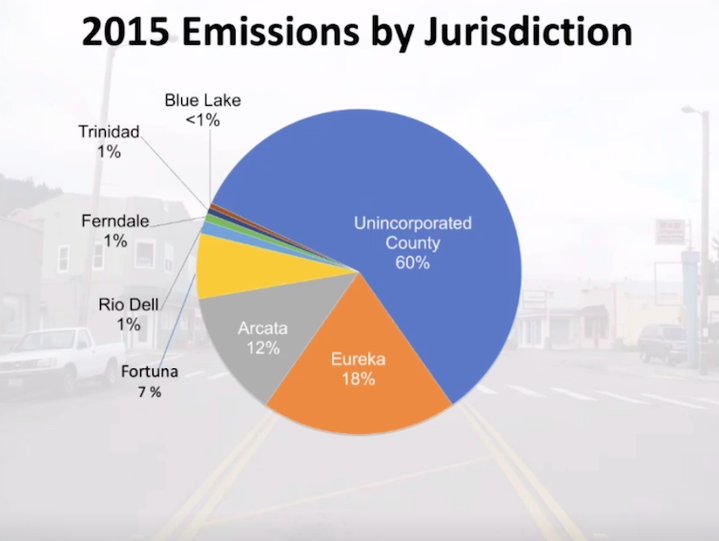
Greenhouse gas emissions by jurisdiction in Humboldt County. | Screenshot.
Climate Action Plan
In preparation for the inevitable future catastrophes wrought by a warming planet, county staff has been working with employees from Humboldt’s seven incorporated cities on a draft Regional Climate Action Plan, and today the Board of Supervisors got an update on the status of that plan.
In a PowerPoint presentation, County Planner Connor McGuigan said the goal of this process is for the county and all seven cities to wind up with their own plans for reducing greenhouse gas emissions. A first draft for an overall plan should be completed in the next couple of months, after which each jurisdiction can start developing their individual plans, McGuigan said.
According to a countywide greenhouse gas inventory conducted by the Redwood Coast Energy Authority, transportation is the No. 1 source of emissions in Humboldt. Other major sources include combustion of fuels such as natural gas and propane, electricity consumption and livestock. (Cow burps, in other words.)
The emissions breakdown by county jurisdiction, as seen in the pie chart above, track pretty closely to population, though the unincorporated region has more livestock and more driving, so its emissions are a bit elevated, comparatively speaking. But the county’s overall emissions have dropped since 1990, as you may or may not be able to see in the bar chart below. (The blue bar on the left represents 1990 emissions; the orange is 2015.)
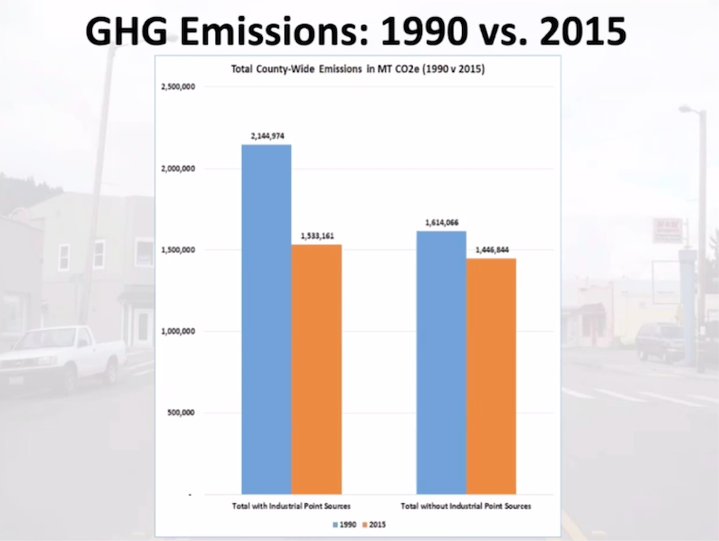
The state has set a target of reducing greenhouse gas emissions to 40 percent below the 1990 level by 2030 and another target of reaching carbon neutrality by 2045. The county’s draft Climate Action Plan mirrors those goals.
How will we get there? McGuigan said smarter land use planning can reduce emissions along with more electric vehicles and a greater focus on public transportation, walking and bicycling. Renewable energy generation, such as solar farms and wind energy, can also make a major difference, so the county is looking at ways to streamline the permitting process for such projects.
Jurisdictions in California will have an easier time streamlining development if they have adopted a Climate Action Plan that meets the requirements of the California Environmental Quality Act (CEQA), “and we’re designing our Climate Action Plan to meet these requirements,” McGuigan said.
Once the public draft is made available, county staff plans to hold a series of public workshops while gathering input from stakeholder groups.
After the presentation, Bohn asked how involved the board-appointed citizens advisory committee for this project has been in these planning efforts. Planning and Building Director John Ford conceded that the committee has yet to be consulted. He apologized and promised to do so forthwith.
Several community members called in to urge the board to adopt a qualified Climate Action Plan. Wilson made a motion to do just that, and Madrone seconded it. Fourth District Supervisor and Board Chair Virginia Bass brought up the issue of NIMBYism, noting the public opposition to the Terra-Gen wind farm project, which the board voted down, and recent solar farm proposals.
When it comes to green energy infrastructure, Bass said, “While people may want to see this, they don’t want it where they can see it. … We can’t keep saying ‘no.’”
The board wound up voting unanimously to accept the report and direct staff to continue moving toward a qualified Climate Action Plan, with amendments to facilitate permitting of solar facilities.
Code of Conduct and Ethics
For the last item of the day’s agenda, taken up after the lunch break, the board embarked on a study session for adopting a code of conduct and ethics. Human Resources Director Linda Le explained that it’s important to outline expected behaviors and identify ways of addressing to violations of that code.
Shelline Bennett, an attorney with the firm Liebert Cassidy Whitmore, led the study session, walking the board through a draft version of the Code of Conduct and Ethics, which you can read by clicking here. The laws around ethics are “vast and complex,” Bennett said, and violations are handled in a number of ways, including through the California Fair Political Practices Commission (FPPC).
Immediately after Bennett’s presentation it looked as if the draft document might get adopted without much discussion, but the board soon embarked on a rather veiled airing of generalized grievances, not unlike a group therapy session.
Madrone said the draft was excellent, but adopting a code of ethics is the easy part. What’s hard is navigating a civil conversation when someone violates that code. He returned to his use of the term “Oriental” last week, saying he initially reacted defensively to being called out in the media before realizing, after a series of conversations, that, “I literally made racist comments and broad generalizations.” How should the board address such transgressions in the moment? he asked.
Bass said she and her colleagues sometimes have a tendency to talk down to each other and use sarcasm.
Bushnell said she’d like all the board members to be kinder to each other.
Madrone said he appreciated those comments and issued another apology. He said that at Bushnell’s first meeting, he brought up the issue of perceived conflicts of interest and “ended up being very preachy” and condescending. For that he apologized to both Bushnell and Bohn.
Bass asked how the board should handle it when a public commenter is making unfounded accusations about county staff. Is it okay to break in with a reminder to be polite?
County Counsel Jefferson Billingsley said there’s no harm in asking people to maintain “a certain level of decorum,” just as long as it doesn’t cross the line into chilling public participation.
These feelings having been expressed, the board proceeded to adopt the draft document unanimously. A final draft will be brought back to the board for adoption at a future date.
Former HSU Student to Star in TV Series About Rescuing Animals From Natural Disasters
John Ross Ferrara / Tuesday, May 18, 2021 @ 5:25 p.m. / Entertainment , Feel Good , HSU
“Doug to the Rescue” official trailer. | CuriosityStream
As a junior at Humboldt State University in the mid-’90s, his aerial photography depicting the deforestation of Humboldt’s old-growth redwoods took him across the country as an environmentalist calling for the preservation of the region’s dwindling old-growth forests.
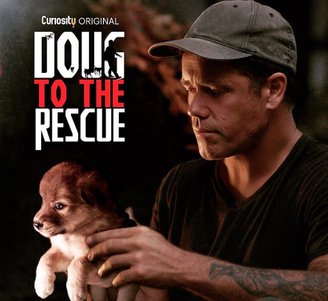
Thron holds a rescued puppy. | Photos provided by Thron from his Instagram page.
“I ended up giving over 400 presentations to 40,000 people,” Douglas Thron remembered. “The Pacific Lumber Company threatened to sue me over the slide shows, so I left Humboldt State and never made it back.”
His slideshow lectures fueled support for the Headwaters Forest Act of 1994, which, among other things, instituted the prohibition of old-growth timber sales, added measures to restore logged redwood groves, and protected threatened species like the marbled murrelet and northern spotted owl that roost in the forests’ upper canopies.
Nearly 30 years later, Thron is still using aerial photography to make a difference, and his efforts have landed him a starring role in a new TV series “Doug to the Rescue.”
The opportunity came in 2018, when he was asked to use his drone camera to help National Park Service Ranger Shannon Jay rescue house cats left behind during the deadly Camp Fire that decimated the rural community of Paradise, Calif.
“I give Shannon credit for getting this going,” Thron told the Outpost. “I filmed that postal truck delivering the mail after the Santa Rosa fires and that went all over the world. Someone wanted to license [the footage], and they were working on a documentary of Shannon. I had never thought about what happens to people’s dogs and cats after a fire. I went out helping as a cinematographer and a licensed drone pilot.”
Attaching an infrared scope to his drone, Thron was able to help Shannon Jay locate and rescue dozens of cats in the wildfire zone. The successful technique caught the interest of documentarian Ezra Wolfinger, who immediately began following Thron around the world, funding his efforts to find and save animals stranded in the wake of natural disasters in hopes of turning the project into TV series.
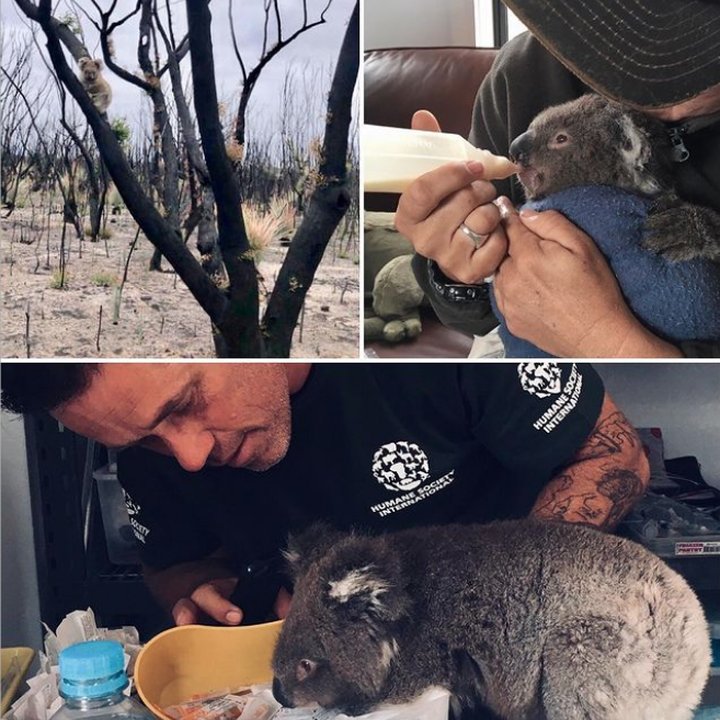
Thron feeds koalas rescued from the recent Australian brush fires.
Two-and-a-half years later, “Doug to the Rescue,” is set to debut on June 10 as a six-part series on the CuriosityStream network.
“It’s a pretty fascinating show documenting all this technology and how it’s used to save wildlife and pets,” he said. “It’s exciting, fast-paced, heartwarming and has happy endings.”


